Big news in the Outdoor Sports retail industry — the Merger of Bass Pro with Sportsman’s Warehouse is NOT going to happen — the buy-out effort is halted. Under a planned merger deal, announced in late 2020, the Great American Outdoors Group, which now owns Bass Pro and Cabela’s, was going to purchase Sportsman’s Warehouse for $785 million. In 2017 Great American acquired Cabela’s for more than $4,000,000,000 (four billion). Great American (based in Missouri) was going to pay $18 a share for Sportsman’s Warehouse, a significant premium over the listed stock price. Sportsman’s Warehouse Holdings Inc. will now continue to operate independently from its HQ in West Jordan, Utah.
According to the Springfield Missouri News-Leader, the deal collapsed because of Federal Trade Commission (FTC) opposition, among other factors: “Nearly a year after Bass Pro entered into a merger agreement with Utah-based Sportsman’s Warehouse Holdings Inc., the deal is off, according to a federal filing dated Dec. 2 by Sportsman’s Warehouse. The filing stated that feedback from the Federal Trade Commission led both companies to believe that the deal would not get FTC approval.”
As listed in a Sportsman’s Warehouse SEC filing, Bass Pro’s parent company Great Outdoors LLC will pay Sportsman’s Warehouse $55 million to terminate the merger.
According to Bloomberg, the cancellation of the merger is related to a 2021 Executive Order by President Biden instructing Federal regulators to boost competition in retail industries. Bloomberg also noted Sportsman’s Warehouse stock dropped signficantly after the planned merger was canceled.
Sportsman’s Warehouse Revenues Boosted Dramatically by Hunting and Shooting Sales
Jon Barker, President/CEO of Sportsman’s Warehouse Holdings, Inc., was disappointed that the Bass Pro merger did not go forward. However his company’s revenues are booming. According to SGB Online: “Sportsman’s Warehouse’s same-store sales surged 48.3% in fiscal year 2020 compared to fiscal year 2019. The gains were led by its hunting and shooting department, which showed a same-store hike of 70.0%. Hunting and shooting grew to account for 57.6% of Sportsman’s Warehouse’s sales in the year, up from 49.1% the prior year.”
Both Bass Pro and Sportsman’s Warehouse Have Billions in Revenue
Had the merger gone through, approximately 110 stores (and $1.45 billion in sales) would have been added to the Great American Outdoors Group retail empire. SGB Online reported: “According to Moody’s, Bass Pro had revenues in the twelve months ended September 26, 2020, of $7.1 billion. Sportsman’s Warehouse’s sales in 2020 were $1.45 billion.”
British Lee-Enfield Model SHT’22/IV Rifle, courtesy www.iCollector.com.
Our friend Dennis Santiago was a technical advisor for History Channel’s Top SHOT TV show. One of the notable Top Shot episodes involved the “Mad Minute”, a marksmanship drill practiced by the British Army in the decades preceding World War I. Dennis observed that the Top Shot competitors didn’t fare too well in their “Mad Minute” attempts, not scoring many hits in the alloted one-minute time period. That prompted Dennis to give it a try himself — seeing how many hits he could score in one minute with an authentic Lee-Enfield rifle. So, a while back, Dennis ran the drill at a range in California.
Dennis, an active high power rifle competitor and instructor, enjoyed his “Mad Minute” exercise, though he assures us that this takes practice to perfect. Dennis tells us: “Here is a ‘Mad Minute’ drill, done using a period correct Lee-Enfield (SMLE) No.1 Mk III rifle and Mk VII ammo. I got to the Queen’s Regulations (15 hits in one minute) on the second run and put a good group on the target at 200 yards. This is ‘jolly good fun’ to do every once in a while. This is ‘living history’ — experiencing a skill from a time when the sun never set on the British Empire.”
“Mad Minute” was a pre-World War I term used by British Army riflemen during training at the Hythe School of Musketry to describe scoring a minimum of 15 hits onto a 12″ round target at 300 yards within one minute using a bolt-action rifle (usually a Lee-Enfield or Lee-Metford rifle). It was not uncommon during the First World War for riflemen to greatly exceed this score. The record, set in 1914 by Sergeant Instructor Alfred Snoxall, was 38 hits. (From WikiPedia.)
Want to See More “Mad Minute” Action with a Modern Tubegun?
In 2012, Gary Eliseo ran a “Mad Minute” exercise using a modern, .308 Win Eliseo RTM Tubegun of his own making. Gary ended up with 24 hits on a bull target set at 300 yards. (Gary actually had 25 hits in 25 rounds fired, but the last round hit just after the 60-second time period expired.) Note how Gary pulls the trigger with the middle finger of his right hand. This allows him to work the bolt faster, using his thumb and index finger. CLICK HERE for Eliseo Tubegun Mad Minute story.
Watch Gary Elesio Shoot the ‘Mad Minute’ (Starts at 4:47 on Video)
NOTE: In an interesting coincidence, Dennis Santiago was actually in the pits pulling targets for Gary during Eliseo’s 2012 “Mad Minute” exercise.
History of the MAD MINUTE Commentary by Laurie Holland, UK Shooter
The original military requirement of the “Mad Minute” saw the soldier ready to fire with a round in the chamber, nine in the magazine, safety on. This course of fire is still followed by the GB Historic Breechloading Arms Association and other bodies in their recreated “Mad Minute” competitions.
The first 10 would go quickly, but reloads were critical, this not done by a magazine change as Gary did with the RTM or in a modern tactical or semi-auto rifle, but through slick use of ‘chargers’. It is this aspect which fouls so many of my colleagues up as it is very easy to cause a jam and a large part of 60 seconds can go in sorting it out!
Charger clips were selected for those that just held the rounds firmly enough to stop then falling out, were sand-papered and polished with a stove / fireplace polish called ‘Zebrite’ so that the rimmed rounds would slip through the clips like corn through a goose.
If you’re unfamiliar with the cock-on-closing Enfield action, it seems clumsy. With intensive practice it is very smooth and can be operated incredibly quickly. The trick is to whip the bolt back onto its stop and initiate a rebound movement that takes it and the cartridge well into the chamber thereby reducing the effort required to close the bolt and chamber the round.
The MAD MINUTE Training Standards and Target
“Mad Minute” was a pre-World War I term used by British Army riflemen during training at the Hythe School of Musketry to describe scoring a minimum of 15 hits on a target at 300 yards within one minute using a bolt-action rifle (usually a Lee-Enfield or Lee-Metford rifle). It was not uncommon during the First World War for riflemen to greatly exceed this score. The record, set in 1914 by Sergeant Instructor Alfred Snoxall, was 38 hits.
Royal Scots Fusiliers soldiers train with SMLE Mk III Lee–Enfield rifle.
Listed as “Practice number 22, Rapid Fire” of The Musketry Regulations, Part I, 1909, this drill required at least 15 shots on the Second Class target at 300 yards. The exercise was just one of several annual tests to classify a soldier as a sharpshooter, first or second class shooter depending on the points achieved.
Research indicates the Second Class target was a 48″ x 48″ square with 24″ inner circle and 36″ outer circle. The sight mark was a central 12″ x 12″ shape representing a soldier. ALL hits scored points (3 for center circle, 2 for outer circle, 1 for outer square). NOTE: Though some sources say the Mad Minute drill used a 12″-diameter round target, this appears to be a mistake from Ian Hogg’s book “The Encyclopedia of Weaponry”. No other source mentions a 12″ circle, which would be a mere 3.82 MOA. In reality the true drill target was a 48″ x 48″ square, roughly 15 times larger. (From No.WikiPedia.)
There is a new guide to rimfire rifles — with a special focus on the tactical-style rigs used in NRL22 and similar competitions. Gun Digest’s Rimfire Revolution: A Complete Guide to Modern .22 Rifles, covers rimfire firearms, hardware, optics and ammo. Every major gun manufacturer has brought at least one new rimfire rifle to the market in the last two years, and these models are covered in detail. This 272-page book can help recreational shooters, competition shooters, and varmint hunters alike.
How to PREVIEW the CONTENT: Go to Amazon.com and click on “Look Inside” to see 100+ screen views from the digital Kindle version of the book.
The .22 Long Rifle caliber is the most popular ammunition and firearm chambering in the world. It’s a backyard plinker, small-game hunter, tactical trainer and Olympic medalist. The humble .22 LR is undergoing a massive resurgence in the United States, and around the world. Topics covered in this full-color book include: complete coverage of semi-autos and how they work, bolt-action accuracy advice, match shooting tips, DIY precision gunsmithing, hunting with rimfires, and the future of the rimfire market. There is also a detailed, illustrated history of rimfire cartridges.
Additional Coverage of .17 Caliber Rimfire Options
This book also contains some sections on the popular .17 caliber rimfire cartridges: .17 HM2, .17 HMR, and .17 WSM. Of these three, the .17 HM2 (aka “17 Mach 2″) is the most affordable, the .17 HMR is the most popular, while the .17 WSM has the best ballistics by far.
Precision Rimfire Competition and Recommended .22 LR Rifles
Here are three videos covering NRL22 competition and .22 LR tactical bolt-guns that work well for these kinds of multi-position, tactical-style matches.
About the Rimfire Revolution Book Author
Michael R. Shea is a an editor-at-large at Field & Stream magazine, a contributing writer for Gun Digest the Magazine, and SHOT Business magazine. His work has also appeared in Men’s Journal, Outdoor Life, and Ducks Unlimited magazines and many more. He also directs a monthly National Rifle League .22 (NRL22) match in New York state.
Under the current administration in Washington, Second Amendment rights are under attack. President Biden wants to restrict handguns and ban modern semi-automatic rifles such as the AR-15. And the ATF continues to digitize millions of sales records, effectively creating a national Firearms Registry, in direct violation of Federal law.
To help fight these trends, Brownells encourages all gun owners to take collective action to help defend the Second Amendment. For this purpose Brownells has declared the first-ever Second Amendment Day (2A Day) on February 2, 2022 — 2-22-2022.
FREE Range Sessions, FREE Ammo, and FREE Food
On 2A Day you can shoot for free — on Brownells’ nickel — at affiliated gun ranges. On 2-22-2022, Brownells has partnered with a few gun ranges to host 2nd Amendment Day range sessions. The range sessions will include free range time, limited free ammo, and free food for those who attend.
Post your Second Amendment Day Range Sessions
Brownells encourages Second Amendment supporters unable to attend a participating range to shoot at a nearby, local range and post photos of their 2A Day activities on social media with hashtag #2ADay.
Join a Second Amendment Organization
Brownells recommends that gun owners join a national and/or state-level gun rights organization. Brownells will promote the Firearms Policy Coalition (FPC), Second Amendment Foundation (SAF), and American Suppressor Association (ASA) on its website. Brownells will also feature a clickable USA map which visitors can use to find a state organization to join.
Brownells states: “The most important thing you can do is join with us to help preserve, protect and expand your 2nd Amendment rights. Join a state level organization promoting gun rights where you live. Join a national organization to help protect freedom for the whole country. In the spirit of joining, Brownells will purchase FPC memberships for its employees, and donate $22,222 each to FPC, SAF, the ASA, and the Iowa Firearms Coalition.”
Advocate for Your Rights — Contact Your Legislators
Brownells encourages all gun owners to advocate for the 2nd Amendment by contacting their state and federal lawmakers and communicating citizen support for gun rights. The National 2nd Amendment Day webpage includes tips on how to how to effectively communicate with politicians.
“The spirit of this event is to designate a day that we, as a nation, recognize, celebrate and do our part to secure one of the most important rights guaranteed by our Constitution – the right to keep and bear arms,” said Pete Brownell, Chairman of the Board. “This event, which we hope continues to grow in size, scale and scope, is aimed at bringing all freedom-loving Americans together on one day – 2/22 – this year and every year going forward to show support for our beloved 2nd Amendment.”
The 2022 Southwest Nationals are history. This was a very successful mid-range and long-range event, with 330+ participants and some great shooting in F-Open, F-TR, and Sling divisions. We congratulate the 2022 SWN Champions: Tod Hendricks (F-Open, 1243-73X); Keith Trapp (F-TR, 1233-62X); and Kimberly Rowe (1231-63X). Shown below are Sling Winner Kimberly Rowe, and F-TR Champ Keith Trapp.
Here are the TOP TEN for each of the three divisions. CLICK HERE for ALL results:
2022 Southwest Nationals Top Ten Competitors by Division
F-Open Class
Tod Hendricks, 1243-73X
Tim Vaught, 1241-71X
Ken Dickerman, 1238-66X
John Masek, 1237-65X
William Kolodziej, 1235-57X
Doug Skogman, 1235-56X
Eric Wuestenhoefer, 1233-60X
Omar Alonzo, 1233-59X
Emil Kovan, 1233-57X
C.J. Sitton, 1232-62X
F-TR Class
Keith Trapp, 1233-62X
Fritz Braun, 1228-58X
James Crofts, 1224-36X
Brad Sauve, 1221-40X
Carl Matthews, 1217-50X
Drew Rutherford, 1217-45X
Matt Schwartzkopf, 1216-45X
Anthony Jordan, 1214-37X
Michael Waters, 1212-43X
Ellis Berry, 1210-48X
Sling Class
Kimberley Rowe, 1231-63X
Bobby Gill, 1231-55X
Oliver Milanovic, 1230-69X
Justin Skaret, 1229-58X
Curtis Gordon, 1228-63X
Ron Zerr, 1227-63X
Robert Gustin, 1226-49X
Trudie Fay, 1225-57X
Eron Ahmer, 1224-47X
Ken Shomber, 1222-51X
Click the links below for full results, including Grand Aggs and day-by-day performances. You can also find further results plus a large collection of photos at SouthwestNationals.net.
The Berger SW Nationals is one of the few American events where sling shooters compete on the same firing line as F-Class competitors (though in separate groups).
Reading the wind can be challenging at Ben Avery. What’s your wind call here?
Top competitors show focus and concentration in mid-range match.
Stunning F-Open rifle with SEB Mini front rest with Blake Machine accessories.
Looking downrange during Team Match.
Here is the 1000-yard firing line on the final day of competition.
Competitor’s Thoughts about the 2022 SW Nationals
Our friend John Masek (“F Class John” in our Forum) shot great to finish 4th overall in the F-Open division. Here is his “take-away” from this year’s SWN:
The 2022 SWN saw what I can only describe as the largest collection of tight-shooting guns I’ve even seen. As we approached the 800-yard line for the first day of the Long Range program, it was absolutely dead calm and everyone knew some high scores were going to get posted. By the end of the 800-yard match, the vast majority of the 134 F-Open shooters shot a clean 150 with a staggering eight of them shooting a perfect 150-15X (even 11-year-old Ethan Blake). By the end of the day, after shooting 15 rounds each at 800, 900, and 1000 yards, the entire first page of F-Open shooters was separated by only 7 points — a crazy tight margin.
On the following day we started with a very difficult 10-15 mph headwind that derailed many shooters. After the dust settled, there were 22 points separating the first page of shooters but still just 9 points spread among the top 20. The final day was fairly mild and it was anyone’s game, but there was just enough wind to keep shooters on their toes, giving many a chance at redemption from the previous day.
At the end of the day, Tod Hendricks, Tim Vaught, and Ken Dickerman kept their heads in the game and held onto their leads to finish 1st, 2nd and 3rd respectively in F-Open. Tod shot an amazing 200-15X in his final round, proving that he was indeed deserving of the F-Open gold medal after three days of fierce competition.
As always, this match, along with the F-Class Nationals and V2 Finale, bring out the finest shooters in the country (and others from around the world). I highly encourage anyone who is able to attend these matches to do so. It’s an experience like no other. No matter your score, you’ll leave with more experience and certainly more friends than you arrived with.
There was construction behind the Ben Avery Range. Note the many tall cranes.
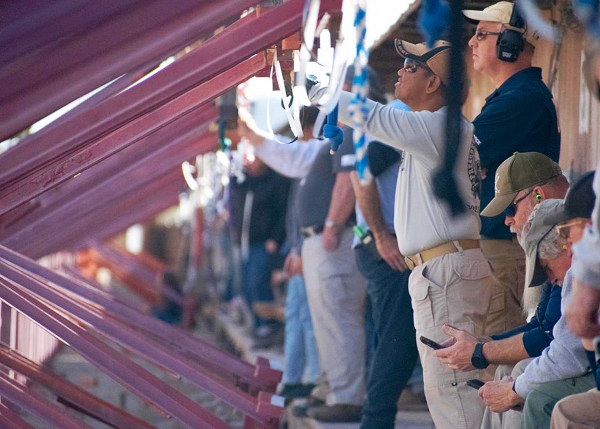
Competitors being transported for their sessions pulling targets in the pits.
Working in the pits is part of the Berger SWN experience.
Over 300 Competitors from Many Countries
On opening day of the 2022 SW Nationals Nancy Tompkins posted: “We started the day off with National anthems for Brazil, Canada, Puerto Rico, Scotland, the United Kingdom, and the USA. We have 282 shooters today and 333 for the Long Range portion of the match. It is fantastic seeing so many targets up and so many competitors after the last two years.”
Photo by Nancy Tompkins near Ben Avery Shooting Facility the evening before the Southwest Nationals. Nancy posted: “Thank you to all of the sponsors, volunteers, and shooters who have traveled from all over… to make this match so special.
Parting Shot: Norm Harrold Target, 200-17X
Paul Phillips posted: “Today I pulled a target for Norm Harrold. This was his 1000-yard target that scored 200-17X. This was the best F-Class score I ever pulled for. It sure is nice when they’re all in the X-Ring. Nice shooting Norm! This is a 5-inch X-Ring.” NOTE: This was from the first 20-shot competition on Day 2 at 1000 yards. We believe Norm had the second highest score for this particular 20-shot match, behind Steven Zock who shot an amazing 200-19X.
We created this custom target in 5 minutes using PrintTargets.net. If you like it, DOWNLOAD HERE.
AccurateShooter.com has a HUGE collection of FREE downloadable PDF targets. We offer a very wide range of target designs: Load Development Grids, NRA Bullseye targets, Official-Size BR targets, Realistic Varmint Targets, Silhouette Shapes, Fun Plinking Targets, and even specialized tactical training targets. If our collection of free targets isn’t enough, or if you want to create a new kind of target — you’re in luck. The Australian-based interactive website, PrintTargets.net, allows you to create your own customized, printable PDF targets. Shown below are just a few of the target designs you can create in minutes:
CLICK Graphic to Create Your Own Targets.
Just follow the step-by-step instructions to set paper size, layout, bullseye color, line thickness, number of rings and diameter. You can even add Score Numbers to your target rings. PrintTargets.net is easy and fun to use. It’s much faster to create targets this way than to try to draw a series of circles with PowerPoint or MS Paint.
Power-User Tip: PrintTargets.net even offers a handy diamond-grid calibration diagram that you can add to your custom target designs. You’ll find the calibration grid as option #15 when you design your target — just scroll all the way down the PrintTargets.com home page.
The U.S. Army Marksmanship Unit (USAMU) has produced an excellent series of videos, which collectively cover the Basic Rifleman’s Course. If you are getting started in High Power shooting, or want to improve your position shooting skills, this series is well worth watching. And these videos are not just for service rifle shooters — even bench shooters can benefit from these videos, particularly Part 5, which explains how to estimate wind speed and direction. The lead instructor for these videos is SFC Brandon Green, a three-time National High Power Champion. When SFC Green talks, you should listen.
SFC Brandon Green is a shooting superstar. Green won his third NRA National High Power Rifle Championship in 2018 at Camp Atterbury, Indiana. He dominated the HP Championship cycle, finishing eight points and ten Xs ahead of his nearest competitor. Brandon also won High Power National Championships in 2015 and 2013. And in 2017 he set new records at the CMP’s National Trophy Matches at Camp Perry. One of the greatest marksmen in the nation’s history, SFC Green has no weaknesses, excelling at all positions, both rapid-fire and slow-fire.
Part 5 — Wind and Weather Estimation (Very Useful for All Shooters)
Note: This video includes a hit location “target analysis” in the first 6 minutes.
Part 4 — Minute of Angle Explained
Part 3 — Ballistics and Zeroing
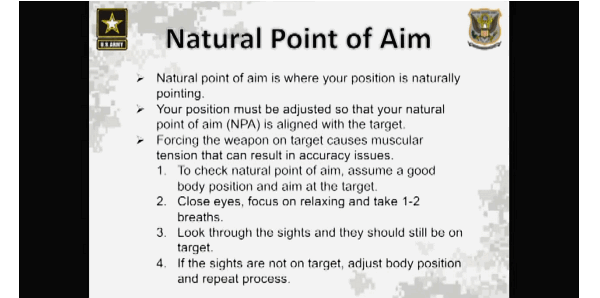
Part 2 — Positions, Sight Alignment, and Natural Point of Aim (Very Useful)
Part 1 — Aiming and Sight Picture
Three-time National High Power Champion SFC Brandon Green (left above) set four new National Records at Camp Perry in 2017.
About SFC Brandon Green — One of America’s Greatest Marksmen
A three-time National High Power Champion, SFC Green has had a distinguished shooting career while at the USAMU. In 2018 Green set 4 Individual National Records and capturing his first President’s 100 match win while setting a new national record for the match. 2018 also saw SFC Green winning his third National Trophy Individual championship while setting a new national record for this championship. In 2017 Green won his fourth Interservice Individual Championship, setting a new record for this match in the process. He was also a member of several first-place winning teams, including the Nation Team Trophy and the National Infantry Trophy team match at the National Championships.
SFC Green has won the Interservice Long Range championships five times and is the current record holder for this match. In 2007 and 2008 Green captured the coveted Wimbledon Cup trophy during the NRA National Long Range Championships. He earned his third overall NRA National High Power Championship title in 2018. Green is also a lead instructor for the USAMU’s marksmanship courses and teaches the Small Arms Firing School every summer at Camp Perry, Ohio.
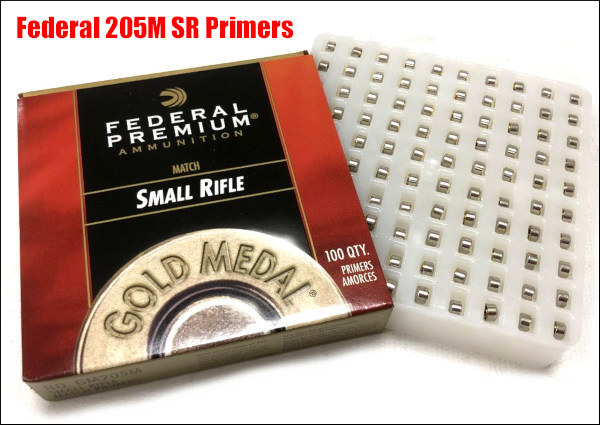
Do you know how gun primers are made — how the explosive elements are applied into those tiny cups? Find out by watching this video filmed at a Federal ammunition factory. It starts out with empty primer cups loaded, 1000 at a time, into trays using vibration (0:05 time-mark). While much of the process is automated, there is still a significant role played by production workers who apply a green, paste-like charging compound to the inside of hundreds of primer cups.
At the 0:17-second time-mark you can see the factory worker “charging” the primers with the priming compound. After the cups are filled, then the plate of cups “mates up with a plate of anvils” (0:40 time-mark). Then the primers are unloaded from trays and inspected.
Primer “Mysteries and Misconceptions” Article
There is an excellent article about primers on the Shooting Times website. This authoritative Shooting Times article explains the fine points of primer design and construction. The author reveals some little-known facts about primers and corrects common misconceptions. Here are some highlights:
Size Matters
Useful Trivia — even though Small Rifle and Small Pistol primer pockets share the same depth specification, Large Rifle and Large Pistol primers do not. The standard pocket for a Large Pistol primer is somewhat shallower than its Large Rifle counterpart, specifically, 0.008 to 0.009 inch less.
Magnum Primers
There are two ways to make a Magnum primer — either use more of the standard chemical mix to provide a longer-burning flame or change the mix to one with more aggressive burn characteristics. Prior to 1989, CCI used the first option in Magnum Rifle primers. After that, we switched to a mix optimized for spherical propellants that produced a 24% increase in flame temperature and a 16% boost in gas volume.
Foiled Again
Most component primers have a little disk of paper between the anvil and the priming mix. It is called “foil paper” not because it’s made of foil but because it replaces the true metal foil used to seal early percussion caps. The reason this little disk exists is strictly a manufacturing convenience. Wet primer pellets are smaller than the inside diameter of the cup when inserted and must be compacted to achieve their proper diameter and height. Without the foil paper, the wet mix would stick to the compaction pins and jam up the assembly process.
The Berger SW Nationals competition is back! After being cancelled in 2021 due to Covid concerns, one of America’s best shooting matches returns in 2022. The match kicks off tomorrow, February 9, 2022, and continues through Sunday February 13, 2022 at the Ben Avery Shooting Facility in Phoenix, Arizona.
This is a unique match that combines F-Class competition with High Power (Palma) prone sling shooting. The nation’s top F-Open and F-TR shooters will be in Phoenix, along with top “hard-holders” with their bolt-action long-range target rifles.
If you’re curious about the equipment favored by Berger SWN competitors, here are the equipment lists from the last SWN match in 2020. This list was compiled by the match directors from info supplied by 2020 F-Class and High Power competitors. This covers hardware (actions, barrels, stocks), optics (riflescopes, spotting scopes), and cartridges (brass, bullets, powders). As you’d expect, .284 Win (and variants) dominated the F-Open ranks. Though some guys did try the .223 Rem for F-TR, the .308 Win was still used by the vast majority of F-TR shooters.
Matt Schwartzkopf, USA F-TR Team member (and Ben Avery Range Supervisor), collected comprehensive gear reports during the 2020 Berger SW Nationals. Matt then created charts showing competitors’ choices for Actions, Barrels, Stocks, Riflescopes and Spotting Scopes. In addition, Matt compiled bullet choice and powder preferences for all classes along with cartridge rankings for F-Open Division.
ACTIONS Listed by Division (Sling, F-TR, F-Open)
ACTIONS by Brand (Combined Listing — All Divisions)
BARRELS by Brand (Combined Listing — All Divisions)
BULLETS by Brand (Combined Listing — All Divisions)
CARTRIDGE BRASS by Brand (Combined Listing — All Divisions)
POWDER by Brand (Combined Listing — All Divisions)
STOCKS by Brand (Combined Listing — All Divisions)
RIFLESCOPES by Brand (Combined Listing — All Divisions)
SPOTTING SCOPES Listed by Class (Sling, F-TR, F-Open)
The best F-Class and Sling shooters in the nation compete each year at the Berger Southwest Nationals at the Ben Avery range in Arizona. Walk down the firing line and you’ll see the absolute “best of the best” in equipment — from $3500 optics to $2000 stocks and $400 triggers. Berger SWN shooters have some of the best equipment you can buy. In this game, where just 1 or 2 points can separate first from third place (considering X-Count), it’s important to have top-flight equipment. That means a custom action, custom barrel, and high-end stock or chassis system.
Cartridge Selection in F-Open Division
In addition, Matt produced an interesting listing of cartridge/caliber types for the F-Open division. This is helpful because cartridge choice is unrestricted in the F-Open class. By contrast, the F-TR division is limited to .223 Remington (5.56×45) or .308 Winchester (7.62×51). You can see that the .284 Winchester (and variants) currently dominate F-Open.
Shooters’ Forum Thread about SWN Gear Selection
There was a discussion of the 2020 SWN Gear Selection in our Shooters’ Forum. CLICK HERE to view that Forum thread. Many top SWN shooters, including past F-Open National Champion Larry Bartholome, contributed to this Forum discussion about gear options.
The Tack Driver Showdown is a 300 meter, one-of-a-kind match designed to determine the most accurate rifles in the world regardless of discipline or class. The 2021 Tack Driver II event had 80 of the world’s top competitors representing several disciplines (Short-Range for Group, Short-Range for Score, UBR, F-Class, 600-yd and 1000-yd Benchrest) with calibers/cartridge types ranging from .22 PPC to .300 WSM.
IMPORTANT: Folks, if you shoot competitive benchrest, please DO watch the First Video below. It is full of invaluable information and shooting tips. As Bart holds multiple world records, you should listen to what he says. This is, without question, one of most informative benchrest videos I have ever seen in 18 years of running this site. — EDITOR
This year the match was VERY challenging, with tough, very windy conditions and low temperatures. The overall winner of the Grand Aggregate was bullet-maker Bart Sauter, shown above. Bart was shooting his wickedly accurate 6 BRA rifle with 103gr bullets of his own making. Bart demonstrated that a 6 BRA cartridge with long bullets can beat a 6 PPC, at least at 300 meters when the wind is fierce.
WATCH THIS! Folks, if you are a benchrest competitor, you absolutely should watch this video. This offers very important insights you won’t find anywhere else. The first five minutes shows very important advice on setting up your rest and bags. Starting at the 10-minute mark, Bart shows how he shoots the rifle, with rapid manual reloads. At the very end, 15:55+ Bart runs five (5) shots in 9 seconds!
Match Results — What Cartridge Types Dominated
Bart reports: “It’s interesting to see the calibers/cartridges in the Top 10 of each category. The Group Match was in fact won by the 6 PPC. However, look at the top 5. Three of the Top 5 are NOT 6 PPCs — that’s notable. The Score Match was won with a .30 WW (I have no clue what that is). There were two .30 calibers in the Top 5 and three in the Top 10. The Grand Aggregate was won with a 6 BRA. I think it’s noteworthy the Top 5 had two 6 PPCs, two 6 BRAs and a .30 WW! That’s a pretty good mix. The Top 10 had a variety of 6MMs and one .30 caliber. That’s another surprise.”
Group Match Results
1st 6 PPC
2nd 22 PPC
3rd 300 WSM
4th 6 Dasher
5th 6 PPC
6th 6 BRA
7th 6 PPC
8th 6 BRA
9th 6 PPC
10th 6 PPC
Leveling the Playing Field — What Works Best at 300 Meters Commentary by Bart Sauter
There has been a long standing debate in the shooting world as to whether mid-range/long-range cartridges such as the Dasher, 6 BRA, and 6mmBR are accurate enough to compete against the 6 PPC or 30 BR at shorter distances. The problem has been finding a format that allows the both short-range and longer-range cartridges to compete on a level playing field. The Tack Driver match addresses the problem by moving the distance to 300 meters (approximately 329 yards). This is a bit farther than short range group and score matches which are typically shot at 100 and 200 yards. While the mid-range/long range cartridges shoot primarily at 600 and 1000 yards.
Cartridges Left to Right: 6 PPC, 30 BR, 6mmBR, 6 BRA, 6 DASHER. Those five cartridges represent 85% of cartridge types used at the Tack Driver II match.
Another piece of the puzzle is the type of match — group vs. score. Short Range matches consist of either a group or score match. In group shooting you’re trying to shoot as small of a group as possible (5- or 10-Shot group). Unlike score it doesn’t matter where the group forms on the target. However, in score competition the goal is to hit five individual bullseyes per target, preferably dead center. Score matches are won by the highest point total while group matches are won by the smallest aggregate (smallest average of total groups shot).
Things are different for longer range competitions. 600-yard and 1000-yard Benchrest competitors shoot for score AND group simultaneously on the same target. In other words competitors are trying to shoot the smallest group in the middle of the bullseye for the highest point total. The Tack Driver addresses this problem by having an equal number of score targets and group size targets. Tack Driver II had 5 score targets and 5 group targets at 300 meters, so neither discipline is favored.
6 BRA Wins Tack Driver II Match
The winning combination this year was a 6 BRA (6mmBR Ackley Improved) shot by Bart Sauter. Below are the particulars on Bart’s winning rifle and load information. Watch the following video to learn more about Bart’s very accurate rifle.
Barrel – Lederer 1:8″-Twist, 28″
Barrel Bore Diameter – 0.237″
Neck – .272″ NO TURN
Bullets – 103gr Bart’s Hammers
Case – Lapua 6mmBR parent
Primers – CCI BR4 sm rifle
Powder – Hodgdon H4895
Seating Pressure – 22 to 25 lbs. on gauge
Bullet Seating Depth – .009″ into the rifling from first touch.
Tack Driver II-Winning 6 BRA Rifle — Components Explained
Questions and Answers with Bart Sauter
Match Prep, Cartridge Choice, Comparative Wind Drift, Reloading Gear, Wind Conditions and more…
Q: How did you prepare for the match?
Bart: My good friend and shooting buddy, Jim Chaney, built a target frame which was placed at 300 meters for practice before the match. Our two biggest concerns about the match were: 1) staying competitive during the score portion; and 2) being able to see bullet holes during heavy mirage. The range is mostly South Carolina sand and faces southeast (you can get sun in your eyes). It has a notorious reputation for heavy mirage. So much so that seeing bullet holes can be an issue. Many shooters were swayed to shoot .30 calibers because the holes are easier to see. In fact, when the sun came out for the last couple of targets, several shooters complained they couldn’t see their shots on paper.
Q: I know you’ve shot a 6 PPC for years? What made you decide to go with a 6 BRA?
Bart: Well several things. During practice I bounced back and forth, playing with the 6 PPC and the 6 BRA. My shooting buddy Jim shot his 6 PPC. One of the things I noticed was my 6 BRA consistently edged my 6 PPC and and Jim’s 6 PPC in group size.
The Drift Test — The real eye-opener came when Jim and I conducted a drift test at 200 yards comparing the 6 PPC with 68gr Boattail Avengers to my 6 BRA with 103gr Bart’s Hammers. For the test both rifles were tuned as well as possible. The idea was for both shooters to hold the same point of aim for each shot (total of 5 per sequence). The shots were fired simultaneously by conducting a count down for example “One, Two, Three, FIRE!” Winds were 7 to 10 mph.
Bart (foreground) and Jim Chaney conducting comparative wind-drift tests with 6 PPC and 6 BRA prior to Tack Driver II Match.
Each shot was intentionally fired in a different wind condition over flags. The first 3 shots from the 6 BRA formed a nice 0.300″ group while the 6PPC spread out to a 0.650″. The final two shots were fired in a hard crosswind pushing to the right then a hard crosswind to the left. The 6 PPC was pushed to over a 1.6 inch group while the 6 BRA kept them to around an 0.850″. The test was so conclusive that during the drive to the match Jim abandoned his 6 PPC, and we doubled up on my 6 BRA.
Comparative Wind Drift Explained — 6 PPC vs. 6 BRA
Q: That explains why you chose the 6 BRA, but how did you meet the challenge of seeing 6mm bullet holes despite bad mirage?
Bart: Jim and I played with several different scopes trying to see what would work best. The mirage at my place can be substantial. Around September I purchased the new Valdada 10-60x56mm Precision scope with 40mm tube. This scope is amazing, not only optically, but rock solid accuracy-wise. So if anything was going to work to see bullet holes, it’s this scope. As it turned out, I had no problem seeing my shots on the Tack Driver II targets while others struggled on the last couple of targets.
Q: Did you preload for the match?
Bart: No. I’ve never been to this range so I wasn’t sure where I needed to be load-wise. Also the forecast was calling for cool temperatures and rain, so I had no clue. The plan was to get there early and start tuning soon as the range opened for practice on Friday. It took about 15 shots to verify that the same velocities and load that I ran at a previous Memphis match would work for the Tack Driver II.
Q: If you weren’t preloaded, did you load at the range?
Bart: Not exactly, I didn’t preload for the match at home but I did preload at the hotel. I brought 300 sized and primed cases and everything needed to reload. So after practice, it was back to the hotel to load. Below is my set-up at the hotel.
Reloading setup at hotel: K&M Arbor Press with seating pressure gauge, Wilson Bullet Seater, AutoTrickler V3 Powder trickler/scale housed in a portable, wind-proof loading box.
I loaded cases with Hodgdon H4895 in one-tenth grain increments (0.3 grains total spread) to shoot over the course of the day. I expected that a three-tenth spread would be enough to keep the rifle in tune over the forecast 20-25 degree temperature range. As a backup plan in case the load went completely sideways we hauled all the loading gear to the range each morning. I kept 100 sized and primed cases ready if needed. Fortunately we did not have to use them. We were able to use the three different, prepared loads throughout the day, changing as the ambient temperature rose (highest charge in morning).
Q: What were conditions like?
Bart: The conditions at Tack Driver II for both days were tough! We had switchy head winds ranging from 15 to 25 mph with occasional gusts to 30 mph. Temperature started with morning lows in the high 30s and warmed to a high around 50. The forecast called for rain both days but fortunately it didn’t materialize during the competition.
Bart Sauter checks out conditions during the match. Winds were switchy with gusts to 30 MPH.
Q: Do you have any observations or take-aways from the match?
Bart: Yes, I do! Jim Cline and crew puts on one hell of a match — very well organized and professionally run. And, most of all, the Tack Driver II was fun. Jim keeps things rolling and he has a gift for winding shooters up and getting the competitive juices going. For example he told three of the Top 6 PPC shooters, “If Bart beats you with that 6 BRA, all of you are getting autographed T-shirts at the award ceremony”.
True to his word, Jim Cline presents (L to R) Roy Hunter, Jeff Pineheart, and Wayne Cambell, with their Bart Sauter-autographed Tack Driver T-shirts. (Cline stands behind the trio.)
About Bart Sauter and Bart’s Custom Bullets
Our philosophy at Bart’s Custom Bullets is to take care of our customers, don’t cut corners, test everything, and never sell a bullet I wouldn’t be proud to take to a match. We started making bullets in 2000, while I was still in the Army. From the beginning Kim (my wife) and I decided to spend whatever It would take to get the best equipment available. We built a range for testing at every location the Army sent us. It’s been a successful combination.
Our bullets have set well over 50 world records and have won every major competition in short range. Now we are making strides to accomplish the same thing in Long Range.
Bullet Design — What Does the Future Hold? We have come a long way in the design and manufacturing of bullets. Everything has improved to include high-quality presses, jackets with close to zero run-out, and bullet dies that are straighter and more concentric than ever before. I believe we are close to the apex of designing bullets that shoot from 100 out to 1000 yards. Any improvement at this point will be incremental. In my opinion, the bullets we make right now are capable of shooting a 0.500″ group at 1000 yards (without wind effects). That probably sounds crazy to a lot of shooters. But I think the capability currently exists. It’s just going to take a special gun, barrel, shooter and condition combination to see it. Now bullets for Extreme Long Range (ELR) could be a new frontier for bullet design.


 Lee-Enfield No. 4 Rifle (1943), courtesy

 Research indicates the Second Class target was a 48″ x 48″ square with 24″ inner circle and 36″ outer circle. The sight mark was a central 12″ x 12″ shape representing a soldier. ALL hits scored points (3 for center circle, 2 for outer circle, 1 for outer square). NOTE: Though some sources say the Mad Minute drill used a 12″-diameter round target, this appears to be a mistake from Ian Hogg’s book “The Encyclopedia of Weaponry”. No other source mentions a 12″ circle, which would be a mere 3.82 MOA. In reality the true drill target was a 48″ x 48″ square, roughly 15 times larger. (From








 Our philosophy at


