Gavin Gear, founder of the UltimateReloader.com website, has created a very popular YouTube Channel. Over the past 14 years, Gavin has produced hundreds of videos covering nearly every aspect of reloading, rifle assembly, and gunsmithing. When important new reloading products are released, you’ll often find that the very first, in-depth reviews come from Gavin. He seems to get the new stuff before ANYone else.
Gavin’s Ultimate Reloader videos are very professional, with high-quality lighting and audio, multiple camera angles, and careful editing. And unlike many of the YouTube video hosts, Gavin is also a talented shooter and skilled gun-builder. His shop is complete with modern lathes, mills and other tools so he can build his own very accurate rifles from start to finish.
BAT Machine Modular Bolt — Design Features and “How To”
With most rifle actions, if you want to run a variety of cartridges with different case head diameters, you will need multiple bolts. However, there IS an alternative to purchasing multiple pricey bolts. BAT Machine has come up with a great solution for the bolt face issue — the Modular Bolt System. In this video Gavin explains how the Modular Bolt System works. He explains the design, then shows, step-by-step, the entire process for swapping bolt head sizes. With a bit of practice, this can be done easily in a couple minutes. Showing a bolt head swap start to finish (00:50 — 2:15 time mark), Gavin shows how to use the BAT Bolt Disassembly Tool and BAT Sleeve Removal Tool to complete the task quickly and easily.
AMP Inline Press — Effect of Brass Prep and Neck Chamfer
In this video Gavin examines various cartridge brass prep processes, and then used the advanced, computer-controlled AMP press to determine how those processes affect bullet seating forces/consistency. Gavin noted: “Each process is examined and a graph is presented of the bullet seating forces. We anticipated some of what we saw, and were surprised by other things.” The computer-controlled AMP press provides a graph of the exact seating forces, allowing to improve your brass prep to achieve the most consistent seating. Gavin notes: “Lately we’ve been seeing the AMP Press used for tight quality control from precision reloaders around the world.”
In this follow-up video, Gavin employs the advanced AMP press to examine how case neck chamfering affects bullet-seating force and consistency. Gavin tells us: “In this video, we single out one variable: Chamfering Case Mouths.”
Creedmoor Sports TRX-925 Scale Review
This is NOT a magnetic force-restoration scale, but it is one of the best strain-gauge scales you can buy. And, priced at $349.95, the Creedmoor Sports TRX-925 Precision Reloading Scale costs less than half what a good force-restoration scale costs. That’s a big deal for folks on a budget. This TRX-925 scale offers very good performance for the price. We include a second, detailed, 25-minute review by F-Class John who says the TRX-925 offers excellent performance for the price. F-Class John, who has his own popular YouTube Channel, produces very comprehensive, thorough product reviews.
This Second TRX-925 Video is from F-Class John:
Finding Cartridge Length to Lands in your Barrel — Three Methods
In this video, which has over 250,000 views on YouTube, Gavin shows three (3) different methods to determine length to lands (L-to-L). This means you are finding the exact length of a case with bullet when the bullet first contacts the rifling in the barrel. It is important to determine this dimension with repeatable precision, so you can tune your load length for best accuracy. In addition, in some disciplines you’ll want to avoid seating into the lands.
Creedmoor Enhanced Press Head for Redding T-7 Press
The new Creedmoor Enhanced Press Head for the Redding T-7 Turret Press is a direct upgrade that offers many advantages for precision, ease of use, and reloading. Made from solid 416 Stainless Steel, this Press Head boasts precision cut threads, integral detent/track system, and seven threaded handle position. Creedmoor states: “A machined stainless steel head, rather than one made from cast steel, allows for tighter tolerances, an improved surface finish, and ultimately makes a better product for our customers.” The Redding T-7, already a good turret press, functions better with this press head, which is precision-machined to ensure flatness of both upper and lower surfaces. The Enhanced Press Head, which can be installed in a matter of minutes, is available now from Creedmoor Sports for $179.95.
.223 Rem vs. 5.56x45mm — 6.3 Million Views
This video explains essential facts and corrects common misconceptions related to both .223/5.56 ammunition, as well as .223/5.56 rifles. Gavin provides insight on chamber specs, pressure levels, barrel twist rates, military 5.56 crimped brass, and other important topics. If you are new to the AR world, this video is definitely worth watching. And that’s why it now has garnered over 6.3 MILLION YouTube views, making it one of the most popular gun-related videos ever made. Gavin adds: “Don’t forget to check out the full write-up on UltimateReloader.com.” CLICK HERE for FULL STORY.
The IWA Outdoor Classics trade show, aka “Euro SHOT Show”, runs March 3-6 at the Nuremberg Exhibition Centre in Germany. IWA Outdoor Classics is Europe’s biggest combined trade show for the hunting, shooting, and civilian/military security industries. This year 918 exhibitors from a total of 54 countries will present their latest products and services in ten exhibit halls. We are pleased to see the IWA Outdoor Classics return in 2022 after the event was cancelled due to COVID in 2020 and 2021.
We featured some notable images from the IWA Outdoor Classics trade show in yesterday’s Daily Bulletin. Here is our second installment of IWA images. CLICK HERE for MORE PHOTOS.
Three long years have passed since the last IWA Outdoor Classics in 2019. In years past this been a hugely popular event, attracting over 45,500 trade visitors from 115 countries.
European Market for Civilian Firearms is Thriving
While IWA show attendance may be lower this year, Europe’s civilian firearms industries are thriving, based on data from the European Institute of Hunting and Sporting Arms (IEACS). “Global production of civilian firearms has increased in recent years, as has European production, which recorded 3.6 million firearms produced in 2020, of which 2.7 million were pistols and 900,000 were shotguns and rifles. Compared to the previous year, this represents a 34% increase in European firearms production,” said Nicola Perrotti, IEACS president.
What’s the next best thing to a stockpile of gleaming, freshly-loaded ammo? How about a movie showing gleaming, freshly-loaded ammo being made — from start to finish? The five-minute video below shows the ammunition production process at the Lake City Army Ammunition Plant in Independence, Missouri. Lake City is the largest producer of small arms ammunition for the U.S. military, producing roughly four MILLION small-caliber rounds every day.
This promotional video does go overboard at times (too many smiling employees gushing about quality control). Still, it is fascinating to watch the process of creating cartridges — from the drawing (or extrusion) of raw brass into casings to the placement of projectiles and primers.
Quick History of Lake City Ammunition Plant Lake City Army Ammunition Plant (LCAAP) is a 3,935-acre government-owned, contractor-operated facility in Independence, Missouri that was established by Remington Arms in 1941 to manufacture and test small caliber ammunition for the U.S. Army. The facility has remained in continuous operation except for one 5-year period following World War II. Remington Arms operated the plant from its inception until 1985. Then Winchester took over the facility from 1985-2000.
Prior to its acquisition by Northrup Grumman in 2018, Orbital-ATK ran the plant since late 2000, initially as Alliant Techsystems (ATK). Recently Olin Corporation announced that its ammunition division, Olin Winchester, LLC, has been selected by the U.S. Army to operate and manage the Lake City Army Ammunition Plant for the next seven years — Winchester will assume full operational control of the Lake City plant on October 1, 2020.
The IWA Outdoor Classics trade show, aka “Euro SHOT Show”, opened yesterday, March 3rd, in Nuremberg, Germany. For four days (March 3-6, 2022), exhibitors from around the world will show their products at the Nuremberg Exhibition Centre. IWA Outdoor Classics is Europe’s biggest combined trade show for the hunting, shooting, and civilian/military security industries. CLICK HERE for MORE PHOTOS.
Three long years have passed since the last IWA Outdoor Classics in 2019. In years past this been a hugely popular event, attracting over 45,500 trade visitors from 115 countries. This year 918 exhibitors from a total of 54 countries will present their latest products and services in ten exhibit halls. We are pleased to see the IWA Outdoor Classics return in 2022 after the event was cancelled due to COVID in 2020 and 2021.
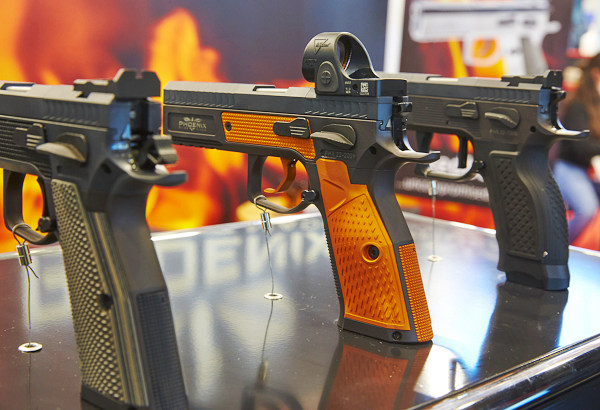
Anschutz straight-pull action Biathlon rifle with interesting skeletonized grips.
European Market for Civilian Firearms is Thriving
While IWA show attendance may be lower this year, Europe’s civilian firearms industries are thriving, based on data from the European Institute of Hunting and Sporting Arms (IEACS). “Global production of civilian firearms has increased in recent years, as has European production, which recorded 3.6 million firearms produced in 2020, of which 2.7 million were pistols and 900,000 were shotguns and rifles. Compared to the previous year, this represents a 34% increase in European firearms production,” said Nicola Perrotti, IEACS president.
About the IWA Outdoor Classics Trade Show
What is now the IWA Outdoor Classics trade show began 49 years ago as Germany’s national product show for gunsmiths and gun retailers. That product show started modestly in 1973 with less than 100 exhibitors. Over the past five decades IWA Outdoor Classics has grown into a massive event, drawing the major players in the hunting, security, and shooting sports industries. In the firearm universe, the IWA event is second only to America’s SHOT Show in importance.
IWA Live Talks – Long Range Shooting and Hunting
In this IWA-hosted video, Nic Kytlica, Shooting Sports Marketing Manager at Leupold, explains how modern optical and electronic technology has enhanced long-range shooting. Nic also explains key equipment used for long-range shooting and hunting. The video also covers the rise of long-range competition shooting in Europe. To view other IWA Live Talks, CLICK HERE.
At the request of our readers, we provide select “Deals of the Week”. Every Sunday afternoon or Monday morning we offer our Best Bargain selections. Here are some of the best deals on firearms, hardware, reloading components, optics, and shooting accessories. Be aware that sale prices are subject to change, and once clearance inventory is sold, it’s gone for good. You snooze you lose.
1. Graf’s — Peterson Catridge Brass In Stock
⏺ Peterson brass is strong and consistent, good selection of cartridge types
Peterson makes great brass for a wide variety of popular cartridges. Peterson has earned a great reputation for its consistent, long-lasting match-grade brass. Right now Graf’s has Peterson brass IN STOCK for a wide range of cartridge types — from small varmint rounds to F-Class cartridges all the way up to big magnums for ELR. Whether you shoot a .22-cal or even a .408 CheyTac round, you should find in-stock Peterson brass that suits your needs.
2. EuroOptic — Vortex Optics Closeout Sale (Save Hundred$)
⏺ Huge discounts on excellent scopes with superb warranty
Need a scope for your next rifle project, but have a limited budget? You can save hundreds of dollars with EuroOptic’s Vortex Optics Close-Out Sale. EuroOptic has FFP and SFP Vortex scopes with a variety of feature sets and magnification ranges — all at crazy low prices. All Vortex scopes on sale are brand new, with full factory warranty.
3. Creedmoor Sports — American Practice Bullets
⏺ Major discounts on big-name factory bullets; great for practice
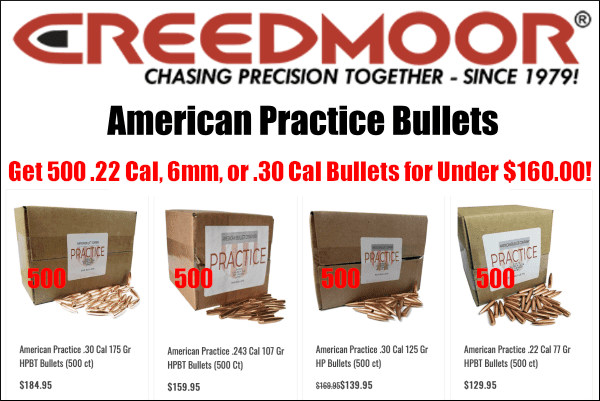
We can all use more live fire practice. To shoot more without breaking your budget, we recommend these American Practice bullets. These are good quality “big name” bullets in a wide range of calibers. You can get 500 bullets for a fraction of their normal costs. CLICK HERE for the full selection. We recommend: 77gr .224 bullets; 107gr 6mm bullets; and 168gr .308 bullets. With these deals you can practice more often.
4. Powder Valley — Accurate Powders IN STOCK, Low Prices
⏺ Good selection of Accurate-brand powders at VERY favorable prices
For a long time, Powder Valley Inc. has been one of the best resources for reloading supplies. Powder Valley is a highly ethical company, run by honorable folks who have worked hard to hold down prices on powder and primers. Powder Valley has also been a staunch supporter of AccurateShooter since the beginning. Right now Powder Valley has a good selection of Accurate-brand powders in stock at very fair prices — from $27.25/lb (Accurate #2) to $34.50/lb (Accurate 4064). If you could use one of the available Accurate-brand powders, head over to Powder Valley today.
5. Midsouth — Hornady V-Max Bullet Sale
⏺ Get high-quality, first-rate tipped hunting bullets at bargain prices
V-Max bullets are favored by game hunters and varmint shooters. Right now Hornady V-Max bullets, in a wide assortment of calibers/weights, are on sale at Midsouth. The Hornady V-MAX polymer tip increases the ballistic coefficient and also initiates dramatic expansion upon impact — even at velocities as low as 1600 fps. For varmint hunting in .20, .224, and 6mm calibers, the V-Max bullets are a great choice, and now you can save big. 22-Caliber shooters can select 40gr, 50gr, 53gr, and 55gr bullets all for just $21.59 for 100 bullets.
6. Palmetto SA — S&W M&P15-22 Sport Rimfire Package, $449.99
⏺ Good, reliable rimfire AR clone for NRL22 and cross-training
This Smith & Wesson AR-style M&P15-22 provides the fun of an AR15 with the low cost of rimfire ammo. This can work well for cross-training or NRL22 matches. The S&W M&P15-22 SPORT features a slim M-LOK handguard that easily accepts a variety of accessories without removing the handguard. The M&P15-22 SPORT comes standard with removable Magpul MBUS front and rear folding sights. This $449.99 package includes 3 magazines and a nice gun case.
7. Midsouth — Bulldog Rifle Case 54″, $69.99
⏺ Good deal on excellent case for long rifles up to 52.5″
Highly rated by purchasers, the Bulldog Long Range Rifle Case fits rifles up to 52.5″ long. This premium 54″ soft case is on Sale Now for $69.99 at Midsouth, 18% off the regular $84.99 price. The Bulldog LR works great for long-barreled match rifles. This versatile case boasts a tough 600-dernier water-resistant outer shell, plus quilted inner lining with Velcro tie downs. There are two zippered center pockets plus an external zippered pocket at front. The main compartment zippers are lockable. Choose either Dark Tan (shown), or Matte Black for the same $69.99 price.
8. Amazon — Lyman Brass Smith Case Trim Xpress, $119.99
⏺ Efficient, well-designed power trimmer that indexes off shoulder
Trimming brass is critical to precision reloading. However, with most case trimmers it’s a pain to adjust trim length, plus the hand-cranking becomes tiresome. A better, more efficient case trimming solution is offered by the Lyman Brass Smith Case Trim Xpress. We like this case trimmer for good reason. The smart design allows for .001″ trim length adjustments with the click of a dial. The tool ships with 10 bushings that cover the most popular neck sizes on the market. To see a video of the Case Trim Xpress in action, check out our Lyman Case Trim Xpress Review.
9. Amazon — Caldwell The Rock Jr. Front Shooting Rest, $35.19
⏺ Low-cost rest works for young shooters and as back-up varminting rest
Simple and light can be good. When teaching youngsters to shoot or when sighting in a hunting rig, this Caldwell Rock Jr. Rest may be all you need. Weighing under 5.5 pounds, this compact rest is easy to set up. It offers 7.75″ vertical adjustment. One verified buyer states: “After lugging [a heavy front rest] to and from the range a few times I realized it was just too big and heavy for what I really needed. This little rest is inexpensive, yet it’s ideal for sighting-in firearms and airguns, and for informal shooting. A hint: Lubricate the elevation screw and the thrust washer that sits under the elevation wheel with a dab of lithium grease, and your adjustments will be smoother and easier.”
10. Brownells — Wipe-Out Foam Cleaner, $10.99
⏺ Wipe-Out Foam is effective, particularly when used right after shooting
Walking the firing line at the Berger SW Nationals, one cleaning product was mentioned over and over again and for good reason. Sharp Shoot R Wipe-Out foaming bore cleaner is a no-nonsense, easy-to-use bore cleaner that does a great job. We get best results with two applications of Wipe-Out after some wet patches. If you’re tired of long brushing sessions, give Wipe-Out a try — it really reduces brushing required. This is a good deal. The same 5 oz. can is $23.87 on Amazon!
Do you know what the inside of a rifle chamber (and throat zone) really looks like? Do you understand the concept of headspace and why it’s important? If not, you should read the Brownells GunTech article Gauging Success — Minimum Headspace and Maximum COL. This article explains the basics of headspace and shows how to measure headspace (and length to lands) in your barrels with precision. The article also explains how to adjust your full-length sizing dies to “bump the shoulder” as needed.
Why is headspace important? The article explains: “Controlling headspace and setting proper C.O.L. also represent improved safety and reduced cost of handloading. Excessive headspace can cause case head separation and gases in excess of 60,000 PSI escaping from a rifle’s chamber. Too little headspace can result in a chamber forced bullet crimp and a bullet that becomes an obstruction more than a properly secured projectile. Excessive C.O.L. can result in a rifling-bound bullet, a condition that could result in spikes of excessive pressure.” [Editor’s NOTE: It is common for competitive benchrest shooters to seat bullets into the rifling. This can be done safely if you reduce your loads accordingly. With some bullets we often see best accuracy .010″ (or more) into the lands. However, this can generate more pressure than the same bullet seated .010″ away from initial lands contact. As with all reloading, start low and work up gradually.]
How is headspace specified? Most cartridges used within the United States are defined within ANSI/SAAMI Z299.3-4. Brownells explains: “In the case of the .243 Winchester, as an example, there are pressure specifications, cartridge drawings and, as pictured above, chamber drawings. Armed with a chamber drawing, each manufacturer producing a firearm for the .243 Winchester knows the proper standard dimension to cut chambers and set headspace. Notice there are two headspace reference dimensions for the chamber. The upper is a place in the chamber where the shoulder is .400″ in diameter; the “datum” or “basic” line. The lower is the 1.630″~1.640″ minimum – maximum dimension from the breech face (bolt face) to that point in the chamber that measures .400″.”
The actual headspace of any firearm is the distance from the breech face to the point in the chamber that is intended to prevent forward motion of a cartridge.
Finding Cartridge Length to Lands with OAL Gauge
Using a comparator on a set of calipers, you can quickly determine cartridge base-to-ogive length. This is the measurement from the base of the case to the forward-most full diameter section of the bullet, which is for convenience called the ogive. (Technically, the “ogive” is the full curve from bullet tip back to full-diameter ring). Shown here, that ogive is 0.243″ diameter.
The next step is using a modified (threaded) case with a Hornady OAL tool to determine Length-to-Lands (LTL) in your rifle’s chamber. During this measurement process, the modified case, with a bullet in its neck, is inserted in the chamber. Go slow, take your time. Here are 5 tips that will help you get repeatable and reliable LTL measurements:
1. Start with a clean chamber and clean barrel throat.
2. Make sure the modified case is fully screwed down and seated on the OAL Gauge. It can sometimes unscrew a bit during repeated measurements.
3. Insert the modified case slowly and gently, but ensure the shoulder of the modified case is fully seated on the end of the chamber.
4. Push the gray plastic rod GENTLY. It is common for the bullet to be tilted a bit. You want to allow the bullet to self-center in the throat BEFORE you apply much pressure. Then tap a couple times and push until you feel resistance. Do NOT push too hard — that will jam the bullet in the lands.
5. Repeat the measurement at least 3 more times. If you follow our instructions, you should, typically, get a repeatable measurement, within 0.0015″ or so, 3 out of 4 times.
The Civilian Marksmanship Program (CMP) has issued an ammunition safety advisory to all users of M1 Garands, M1903s, and M1903A3 rifles. Ammunition that is loaded beyond 50,000 Copper Units of Pressure (CUP) and using bullets weighing more than 172 grains should be limited to modern rifles, and NOT USED in old military rifles aged 70+ years.
After this warning was issued by the CMP, the California Rifle and Pistol Association (CRPA) provided further safety recommendations for owners or older firearms:
CRPA Ammunition and Older Firearms Guidelines
Many of us have either purchased or inherited firearms in excess of 25 years of age. The issue … noted as an example by the Civilian Marksmanship Program in regards to certain ammunition leads as they apply to the M1 Garand is not isolated to that particular firearm. The CRPA… has seen similar issues exposed with other [older] firearms when using modern loads. We strongly advise you to check with the manufacturer for recommended load limitations before purchasing modern ammunition for an older firearm.
CRPA also recommends these safety procedures:
— Have a gunsmith check your older firearm for safety prior to using it.
— Take a reloading class to help develop a safe load for your older firearm.
— Inspect older ammunition for defects such as a green patina or rust build up on the cases or crystallization on the projectiles. If defects are observed, the CRPA suggests disassembling the ammo into components for proper recycling and disposal.
Storage of Ammo for Older Rifles
The CRPA also cautioned that you should be cautious about older ammo that may be decades old, including old milsurp ammunition. The CRPA advises:
1. Store ammunition in a cool, dry, location where little temperature fluctuation occurs.
2. If storing ammunition in an air/watertight ammo can, utilize water absorbent silica packs and place packs in the can with the ammunition.
3. Conduct periodic checks every 12-24 months and replace the silica packs as needed.
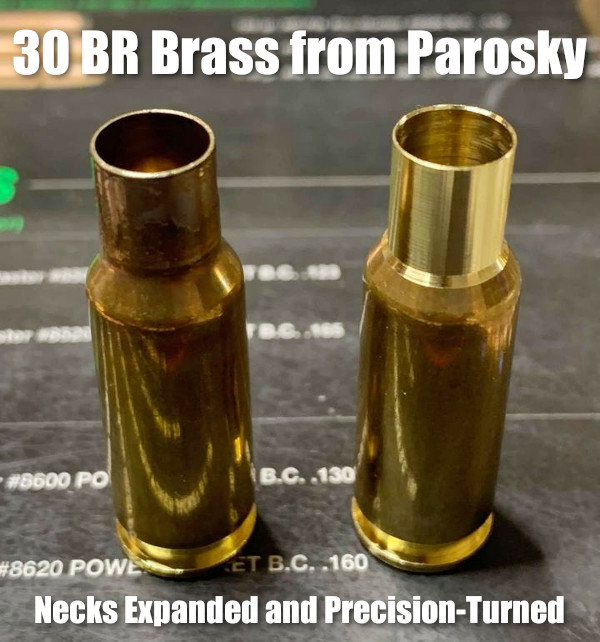
Here’s good news for 30BR shooters. Paul Parosky, maker of the excellent PRP Custom Bullets, is now offering 30BR neck-turned brass. This can save you considerable time and effort forming 30BR cases from Lapua 6mmBR brass. And the neck-turning is superb, again representing time save (and no tools to buy). You will soon be able to order this 30BR brass from Bruno Shooters Supply. If you communicate with Amy at Bruno’s, Paul may be able to neck-turn to your specific thickness. Paul notes: “Here are necks turned for a 0.330 neck. I’ll try my best to accommodate anyone’s neck dimensions as they wish. Just message Amy Bruno Parosky (at Bruno’s) for details.”
About this Neck-Turning set-up — Paul Parosky notes: “For neck-turning I’m using an old drill press that has been re-worked. The cutter and spindle are all indicated before neck turning to ensure no runout. The RPM is around 520. The lube I use is a mixture of royal and mystery oil.”
Why the 30 BR Dominates 100/200 Benchrest for Score Competition
The 30BR, along with some wildcat variants, remains the dominant cartridge in short-range (100/200) benchrest-for-score competition. The 30BR’s .308″-diameter bullets are larger than the 6mm bullets used by the 6PPC (which rules group BR competition). The bigger 30-Cal diameter has an advantage in touching scoring rings. In addition, the 30BR is also relatively easy to tune, and barrel life is considerably better than with smaller-caliber benchrest cartridges. For more information, see our AccurateShooter 30BR Cartridge Guide.
Cases are Expanded, Then Neck-Turned
To produce his 30BR brass, Parosky first uses a series of expander mandrels. Then he neck-turns with power using a converted drill press. Paul tells us: “This is done the old school way, I use three different tapered expander mandrels, then neck-turn it to the proper neck chamber, then run them up through a FL expander mandrel to ensure necks are straight. Then I clean all the cases.”
Paul Parosky Can Also Neck-Turn 6PPC Brass
Paul Parosky also expands and neck-turns 6PPC cases that are made from parent Lapua .220 Russian cartridge brass. Here, illustrating his 6PPC neck-turning operation, is a Paul Parosky post on the USA Benchrest & Extreme Precision Shooters Facebook page.
The 300 Meter .22 PPC — Smaller Caliber for Less Recoil
By GS Arizona
[This article originally appeared in Precision Shooting Magazine many years ago, but we are reprising it because the .22 PPC remains a notable cartridge for many disciplines, from benchrest to silhouette.]
I’ve spent the past few years pursuing the largely solitary pastime of 300 Meter shooting in the US. While it is a hugely popular sport in Europe, with thousands of competitors in each of various countries and overflowing national championships, in the U.S., 300 Meter shooting is simply a forgotten discipline. As an example, consider that the entry at the USA Shooting 300 Meter National Championships held at Fort Benning did not reach 20 competitors in [years past]. For those not familiar with the discipline, the 300 Meter ISSF target has a 100 mm ten ring, 200 mm 9 ring and so forth. That’s a 3.9″ ten ring at 328 yards for those of you who may object to the metric system, electricity and other intrusions upon a well settled universe (which ends at the dragons). [Editor’s Note: GS Arizona was a championship-class prone shooter, in both rimfire and centerfire disciplines, who had a popular online Blog, which has been closed.]
300 Meter Basics
300 Meter matches can be either three-position (prone, standing, kneeling) or all prone. Being of that age at which limbs aren’t limber and the mid-section obscures one’s view of the toes, I shoot prone matches only and leave the 3P to those for whom the term “shooting athlete” doesn’t produce an automatic smirk from the better half.
Like most 300 Meter shooters, I shoot a 6BR as my main rifle. As used in 300 Meter shooting, the 6BR is loaded with a 105-108gr bullet, with a velocity in the 2850 fps range. There is simply no cartridge out there at this time that delivers the accuracy, low recoil and ease of loading that can be had from the 6BR. That doesn’t mean we shouldn’t embark on a quixotic adventure now and then to find something better. This article is about one such search. So, if you don’t mind spending some time learning about an uphill struggle in a forgotten corner of the shooting world, pour a hot cup of coffee, get a plate of chocolate chip cookies and read on.
Getting Started–The Concept Behind the Project
The premise for building a .22 PPC was simple — less is more. Less recoil, that is, while retaining good ballistics and accuracy, should allow for higher scores. The hard part is meeting the ballistic and accuracy standards set by the 6BR. If pressed I might also admit to a desire to do something different. I made a decision early on in the project to stick to 80-grain bullets. I believe the 80 is pushing the envelope for safe and sane pressure in a case the size of the PPC; additionally, there are a number of manufacturers of 80-grain .224″ bullets so selection and testing can be more meaningful. Barrels are another consideration and all of the better barrel makers offer a 1:8″ twist .224 barrel (unlike the limited selection of 1:6.5″ twist required for 90 grain .224″ bullets).
With the basic parameters of a full-length .22 PPC case (reformed Lapua .220 Russian to be exact) and an 80-grain bullet established, a few other details needed attention. The first of these was specifying certain dimensions for the reamer maker. I chose not to change any of the essential dimensions of the .22 PPC such as headspace, shoulder angle or body taper, but there were a couple of areas that I felt needed to be different from the typical Benchrest PPC. These were neck diameter and throat length. With the outstanding quality of the Lapua brass, I elected to go with a 0.255″ neck diameter which would allow the use of unturned brass and still leave 0.002″ clearance around the neck of a loaded cartridge. The throat was specified longer than a standard PPC to allow for the length of the 80-grain bullets and avoid having the bullet go past the neck/shoulder junction.
300 Meter .22 PPC — Equipment List Hardware
Action: RPA Quadlite, RPADefense.com.
Stock: Master Class Highpower Prone MasterClassStocks.com
Barrel: Broughton .224″ bore, 1:8″ twist, 30″ Palma contour
Rear Sight: Warner #1, Anschutz Iris, Warner-Tool.com
Front Sight: Gehmann Iris from Scott Riles
Trigger: Jewell 4 oz. one-stage
Bolt Knob: Keychain from 7-11 ($2.00)
Detours Along the Way
Like Quixote stumbling his way to his dreams, I’ve made a few mistakes. That 0.255″ neck diameter turned out to be the first. Turning brass isn’t a problem, but I was so captivated by the quality of the .220 Russian brass that I planned to skip turning or just take a light (0.001″) clean-up cut. Well, that’s fine, but as it turns out, PPC die makers assume you have turned necks and using unturned brass causes problems. The Redding Competition Seater, for instance, wanted to crimp the entire length of the neck onto the bullet. Turns out it was 0.250″ in the neck diameter of the sliding sleeve. This required reaming the sleeve which wasn’t too hard as the sleeve is made of relatively soft steel. Hand turning the chambering reamer with lots of care and oil took care of that problem. This opened up the neck to 0.255″ which might be 0.001″ more than ideal but I’ll live with it.
Sizing dies were another problem altogether. Forget using a non-bushing die with unturned brass–you’ll just overwork the neck to death. The Redding bushing dies worked well, though. Fired brass ends up at 0.254″ and is sized to 0.250″ in two steps (0.252″ and 0.250″) to maintain better concentricity.
I also got the throat length wrong as the base of the bullet (above the boat tail) is halfway up the neck and I want it just above the shoulder. I don’t know how I missed on that spec, but that’s what happened. As it turns out, the extra throat length hasn’t caused any problems with the Nosler 80, but it might with shorter or pointier bullets. Powder and primer choices became additional areas for demonstrating my inability to make good choices. You might think that adding a heavier bullet to an existing cartridge would be simple but it really turned into a full scale adventure.
Choice of Components and Smiths — Only the Best
Based on my previous favorable experience and that of a few friends, I ordered a Broughton barrel for the PPC, a .224″ bore 1:8″ twist, long enough to finish at 30 inches in what is generally referred to as a medium Palma taper. I haven’t been disappointed by the barrel: like all of those made by Tim North of Broughton Barrels, it is top notch. With the barrel and reamer in hand, they and the RPA Quadlite action were sent to Al Warner for barreling and then on to Alex Sitman for the stock. I can’t say enough good things about Alan’s metal work and Alex’s stock work. They have barreled and stocked many rifles for me over the years, all flawless. Alex’s Highpower Prone stock fits me like a comfortable moccasin. The trigger is a Jewell set at 4 oz., the rear sight is a Warner #1 and the front sight is a Scott Riles with a Centra aperture.
Eventually, the UPS man — purveyor of all things worth having — arrived with a long package and the real work began. Load testing and shooting can be a lot more frustrating than planning and talking to gunsmiths, but hopefully the eventual results make it worthwhile. I had a good supply of Nosler 80-grain bullets and some preconceived notions about powder and primers. Off to the loading bench.
Load Development + Accuracy Testing Fire-forming the .220 Russian cases to the PPC chamber was a breeze: run an expander into the neck to get them to .224″, bump the shoulder 0.002″, load a caseful of IMR 4895 (about 23 grains) and insert a Nosler 77 (leftover from another project) and fire. I shot these at 100 yards while zeroing the rifle and was very impressed with the accuracy. Fouling was minimal, off to a promising start.
Once formed, I loaded the brass with Varget and the 80-grain bullets. Since Varget has given such good results in the 6BR, it was a natural starting point for this project. However, it quickly became evident that it might be too slow. While accuracy was excellent, powder fouling in the barrel was very heavy even at the highest charge tried (28.5 grains) and there was soot all the way down the shoulders of the cases. Cleaning the bore felt like patching a rusty water pipe after just 20 shots. I knew I’d never make it through a 60-shot match (about 70 shots with sighters) without cleaning[.]
Putting the .22 PPC to the Test in Competition
At this point, I took the PPC to a 300 Meter match with the Varget load. While it might not look perfect, I needed to try it. The first string was a 198 and I was able to clean the rifle immediately after firing. The second string was also a 198 but I had to fire the third string without cleaning. The effects of the fouling were evident in the last score, a 194.
While a 590 total isn’t bad for 300M, it was a bit below my average with the 6BR at this range – my home range that I knew well. More importantly, the score dropped as the group opened up in the third string when I wasn’t able to clean. At the Nationals all 60 shots are fired without a break for cleaning or additional sighters; therefore, Varget, while promising, wouldn’t work in the long run.
The next faster powder on my shelf was IMR 4895. I’d used it in the fire forming loads and if I had a lick of sense I would have tried it right away since the fire forming loads shot so well. However, stubbornly clinging to the preconceived notion that Varget was going to be a great powder for this combo cost me a month or so fooling with it. I then worked up loads with 4895 from 26.8 to 28.6 and saw that while 4895 was better suited to the case than Varget, it was still slow. The powder fouling was still occurring, though to a lesser degree. The shoulders still showed some soot, but less. I settled on 27.8 grains as a useful load and loaded 70 cases.
New Load for a New Home
At this point, I moved from Florida to Arizona causing a delay of several months in testing. The move also had an effect on the load as the hotter and drier climate in Arizona turned out to be much more suitable for 4895. Of course, I still had those 70 rounds loaded with 27.8 so I shot them in practice. Everything seemed OK but one primer (Federal 205M) pierced at the edge. I didn’t pay much attention to that as there were no other pressure signs and it was the first primer failure of any sort so far in this project. Extraction was fine, primer edges were nicely radiused and base growth was under two tenths. There was an opportunity to shoot a 500-yard prone match the following day so I reloaded the cases with the same load. At the match I pierced two more primers, this time right at the edge of the firing pin, causing two craters running into the firing pin hole. As you might imagine, all subsequent shots cratered into that area, although no more pierced.
I was contemplating a switch to Hodgdon Benchmark (slightly faster than H4895) until this point. Now, repairing the bolt face and switching to a tougher primer took priority. I loaded 25 rounds with CCI BR4 primers and 25 with Remington 7.5 primers. Both of these are well known for their tougher cups which I hoped would eliminate the piercing. I like the mild flash from the Federal 205 and believe it contributes to good accuracy, but I needed a primer that holds together more than I need to cut another tenth MOA. Bearing in mind that the powder charge itself might need reworking, I took those 50 rounds to the range to test them with the 27.8 gr. IMR 4895 load as it remains best to only change one thing at a time. Temperatures were in the 100 to 110 degree range during testing as they are for a good portion of the year here in Phoenix. If the load won’t work in hot temperatures, it just won’t work at all for me.
The primer testing at 200 yards showed the CCI BR4 primers to be better suited to this load than the Remington 7.5 primers. While no primer failed out of the 50 fired, the CCI BR4 primers gave distinctly better accuracy. I fired two ten-shot groups prone (scoped) with each, the Remington-primed groups averaged just over 1 MOA and the CCI-primed groups averaged 1/2 MOA. The difference between the two was principally in the amount of elevation in the groups. Given that result, as well as previous good experience with the CCI primers in the 6BR, I settled on the CCI BR4 primers for the PPC.
Final Testing at 500 Yards–It all Comes Together
While the purpose of the 80-grain PPC is 300 Meter shooting, those matches are somewhat hard to find so I’ve done most of my testing at 200 yards on the local public range (Ben Avery Shooting Facility in Phoenix) and at 500 yards in some of the local prone matches. With the primer issue potentially resolved, I went back to the 500-yard range to make sure the load held good elevation at that distance.
Final testing at 500 yards was a complete success. I fired one group of 24 shots from the prone position. Elevation for the bulk of the group was right at 3″ (0.6 MOA), the horizontal spread was somewhat larger as the group was fired in gusty, fast-switching conditions. The CCI BR4 primers functioned flawlessly, with no sign of pressure despite ambient temperatures over 100° F. None of this should be taken as a general statement of inadequacy of Federal primers. I have used (and continue to use) the very same lot of Federal 205M primers in my 6BR and have not experienced any problems at all. Simply stated, the 80-grain .22 PPC is an odd duck and has special requirements when fired under the conditions that prevail in my area.
At this point, I’ve determined that the basic premise of a .22 PPC for 300 Meter matches is perfectly viable, even if it is quite a bit more complex an undertaking than the 6BR. Recoil reduction over the 6BR was minimal, bordering on unnoticeable, but accuracy is on a par with the 6BR, perhaps slightly better. As a nice bonus, the PPC has proven to be quite useful for the 500-yard prone matches that are a regular part of the Phoenix shooting scene and it never fails to spark a good conversation with a new friend when I’m practicing or testing at the range. Future plans include testing Berger and Hornady 75 and 80-grain bullets and Hodgdon Benchmark powder. And, after conferring with your moderator, who ran some simulations in QuickLOAD, I’ll be trying Reloder 15 soon (QuickLOAD predicts RL15 allows 100% load density with good velocity). At some point I’ll also have the reamer reground for a shorter throat and tighter neck, but probably not until time comes to rebarrel.
6mmBR Norma versus .22 PPC
For the shooter who wants a superbly accurate, easy to load cartridge for 300 Meters to 600 yards, you simply can’t beat the 6BR. Everything you need, including brass, dies, reamers and knowledge are just a phone call away. The .22 PPC, by contrast, is an uphill struggle. The chambering reamer was custom ground to my specifications to allow unturned brass, as well as a longer freebore for the 75- and 80-grain bullets that are the heart of the project. The no-turn necks also meant that the Redding Competition Seater (an excellent unit) had to be reworked to allow for the thicker neck diameter. Once those hurdles were overcome I struggled to find the best powder for this combination–and I’m still searching. Unlike the 6BR where any of a half dozen or more powders will do the job (Varget, Reloder 15, N140, N540, IMR 4895, Norma 203B, etc.) the .22 PPC with heavy bullets has proven finicky with even the most accurate powders leaving fairly heavy carbon fouling.
Despite the problems, the .22 PPC offers a bit more pure accuracy than the 6BR and also a tiny bit less recoil. Both of these things can contribute to slightly higher scores in prone matches. However, to get the most out of the PPC, one must find the time to clean between 20 shot strings–a not inconsiderable effort sometimes in the mad rush of pit changes, scoring, shooting and just plain being tired.
This rifle was initially a .223 and when that cartridge proved unsatisfactory for my purposes, I had it rebuilt as the .22 PPC you see here. I like it and I enjoy the challenge, but I would not recommend this combination as someone’s primary rifle; it can get a bit frustrating. To put it into another context, the 6BR is like a 350 Chevy, it’ll just keep on doing the job forever, no matter what. The .22 PPC is like a Ferrari, it’ll scream when you do everything right, but it takes more attention to detail and a lot more maintenance. You wouldn’t want a Ferrari as your only car and likewise, you would be better off making the .22 PPC a second rifle.
Parting Shots — The .22 PPC vs. 6mm BR
If you’re looking for a simple, accurate and reliable cartridge for 200 to 600 yards, you probably can’t improve on the 6BR. However, if you’re someone who finds the journey as rewarding as reaching the destination, then you may very well enjoy a .22 PPC for prone shooting. While I received a great deal of help in this project from friends, gunsmiths, suppliers and parts makers far and wide, I really must acknowledge the huge debt we all owe to Ferris Pindell and Dr. Lou Palmisano. Without them there would be no PPC. We truly stand on the shoulders of giants.
There is a new guide to rimfire rifles — with a special focus on the tactical-style rigs used in NRL22 and similar competitions. Gun Digest’s Rimfire Revolution: A Complete Guide to Modern .22 Rifles, covers rimfire firearms, hardware, optics and ammo. Every major gun manufacturer has brought at least one new rimfire rifle to the market in the last two years, and these models are covered in detail. This 272-page book can help recreational shooters, competition shooters, and varmint hunters alike.
How to PREVIEW the CONTENT: Go to Amazon.com and click on “Look Inside” to see 100+ screen views from the digital Kindle version of the book.
The .22 Long Rifle caliber is the most popular ammunition and firearm chambering in the world. It’s a backyard plinker, small-game hunter, tactical trainer and Olympic medalist. The humble .22 LR is undergoing a massive resurgence in the United States, and around the world. Topics covered in this full-color book include: complete coverage of semi-autos and how they work, bolt-action accuracy advice, match shooting tips, DIY precision gunsmithing, hunting with rimfires, and the future of the rimfire market. There is also a detailed, illustrated history of rimfire cartridges.
Additional Coverage of .17 Caliber Rimfire Options
This book also contains some sections on the popular .17 caliber rimfire cartridges: .17 HM2, .17 HMR, and .17 WSM. Of these three, the .17 HM2 (aka “17 Mach 2″) is the most affordable, the .17 HMR is the most popular, while the .17 WSM has the best ballistics by far.
Precision Rimfire Competition and Recommended .22 LR Rifles
Here are three videos covering NRL22 competition and .22 LR tactical bolt-guns that work well for these kinds of multi-position, tactical-style matches.
About the Rimfire Revolution Book Author
Michael R. Shea is a an editor-at-large at Field & Stream magazine, a contributing writer for Gun Digest the Magazine, and SHOT Business magazine. His work has also appeared in Men’s Journal, Outdoor Life, and Ducks Unlimited magazines and many more. He also directs a monthly National Rifle League .22 (NRL22) match in New York state.


 What’s the next best thing to a stockpile of gleaming, freshly-loaded ammo? How about a movie showing gleaming, freshly-loaded ammo being made — from start to finish? The five-minute video below shows the ammunition production process at the Lake City Army Ammunition Plant in Independence, Missouri. Lake City is the largest producer of small arms ammunition for the U.S. military, producing roughly four MILLION small-caliber rounds every day.






 Finding Cartridge Length to Lands with OAL Gauge




 300 Meter .22 PPC — Equipment List
 Sizing dies were another problem altogether. Forget using a non-bushing die with unturned brass–you’ll just overwork the neck to death. The Redding bushing dies worked well, though. Fired brass ends up at 0.254″ and is sized to 0.250″ in two steps (0.252″ and 0.250″) to maintain better concentricity.
 Fire-forming the .220 Russian cases to the PPC chamber was a breeze: run an expander into the neck to get them to .224″, bump the shoulder 0.002″, load a caseful of IMR 4895 (about 23 grains) and insert a Nosler 77 (leftover from another project) and fire. I shot these at 100 yards while zeroing the rifle and was very impressed with the accuracy. Fouling was minimal, off to a promising start.
 While a 590 total isn’t bad for 300M, it was a bit below my average with the 6BR at this range – my home range that I knew well. More importantly, the score dropped as the group opened up in the third string when I wasn’t able to clean. At the Nationals all 60 shots are fired without a break for cleaning or additional sighters; therefore, Varget, while promising, wouldn’t work in the long run.
 New Load for a New Home
 Final testing at 500 yards was a complete success. I fired one group of 24 shots from the prone position. Elevation for the bulk of the group was right at 3″ (0.6 MOA), the horizontal spread was somewhat larger as the group was fired in gusty, fast-switching conditions. The CCI BR4 primers functioned flawlessly, with no sign of pressure despite ambient temperatures over 100° F. None of this should be taken as a general statement of inadequacy of Federal primers. I have used (and continue to use) the very same lot of Federal 205M primers in my 6BR and have not experienced any problems at all. Simply stated, the 80-grain .22 PPC is an odd duck and has special requirements when fired under the conditions that prevail in my area.


