With all the buzz about the 6.5 Creedmoor and its 6mm Creedmoor little brother, some folks forget that we’ve had an outstanding mid-sized, Across-the-Course cartridge for a long time — the 6XC. Pioneered by 11-time National High Power champion David Tubb, the 6XC has won national High Power championships, excelled in mid-range prone matches, and performed great in the varmint fields. It has also been used successfully by many Precision Rifle Series competitors. It’s no wonder — the 6XC has less recoil than a 6.5mm Creedmoor, there is a great selection of superb 6mm bullets, and Peterson 6XC brass is high-quality and reasonably priced ($69/100) from DavidTubb.com. Fine Norma 6XC brass is available from Grafs.com.
PRS Rifle with Modern 6XC II Chamber
Forum member Grimstod posted this new 6XC II rifle in our long-running Pride and Joy Rifle Thread. Grimstod notes: “These 6XC Gen IIs seam to be a hot commodity lately. This one is for PRS. It features a Premier Accuracy Atlas action made by Kelbly. The bolt and heavy-taper, fluted barrel are Cerakoted to match. I really like the ejectors on these Atlas actions. The stock is a KRG X-Ray painted in Premier Accuracy exclusive colors. The Kelbly Atlas action does not have any modifications. So far every Kelbly action we have tried has had perfect timing and trigger fall. We have been supper pleased with them. I look forward to using a lot more of these excellent actions.”
What is the 6XC II you may ask? That designates a 6XC with a chamber dimension optimized for Norma brass. It turns out that Norma brass is a bit bigger at the bottom than the 22-250 brass from which the 6XC originated. Robert Whitley of 6mmAR.com has created two new JGS reamer specs that fit the Norma brass perfectly, improving feeding and extraction. Here is Robert’s Report:
The 6XC II Chamber — Upgraded for Today’s Norma 6XC Brass
by Robert Whitley of 6mmAR.com
The 6XC II Chamber works perfectly with the Norma 6XC brass and resolves the “sticky bolt lift” issue. The original 6XC chambering was designed based off the usage of 22-250 brass which typically has a web diameter in the range of .461″-.463″. The area of the chamber just forward of the web on the original 6XC chambering was .4695″ which left plenty of clearance.
When Norma 6XC brass became available Norma appears to have developed the base of the case from the .308 Winchester line of cases which have a larger web diameter. The web diameter of the Norma brass typically measures right around .4685″ which leaves almost no diameter clearance.
As shooters would use Norma 6XC brass in an original 6XC chamber they typically would experience “sticky bolt lift” due to the lack of clearance and the fact that the large web diameter of the brass prohibited the re-size dies (no matter how small the base diameter was) from squeezing the brass down enough to create sufficient clearance. The 6XC II chamber resolves this issue. You can order 6XC II sizing dies from 6mmAR.com that work perfectly with this re-designed chambering. 6XC II die sets are in stock now — call (215) 348-8789 to order.
6XC II Long Range Reamer (Throated long for 105-115gr Bullets):
The 6XC II-LT reamer below is throated long to keep the full bearing surface of 110-115gr bullets forward of the neck/shoulder junction of the case. Note, 6mmAR.com has also developed a shorter-freebore version for 6mm bullets with shorter bearing surface. SEE shorter 6XC II Reamer Print.
6XC II Chamber and Sizing Die Combo:
- Resolves the “sticky bolt lift” problem shooters experienced using the Norma 6XC Brass in the original 6XC chambers.
– Chamber accepts all 6XC brass or ammo with no modification. Take your existing 6XC brass or ammo and use it without issues.
– Works well with existing Norma 6XC brass, or 6XC brass made from re-formed Winchester and Remington 22-250 brass.
– 6XC II Sizing dies and die sets are available from 6mmAR.com and in stock.
If you are looking for someone to chamber your rifle or re-barrel an existing rifle in the 6XC II chamber, Fred at Sabreco, Inc. in Skippack, PA, (610) 584-8228 can help you. He has the reamers for the cartridge as well as the head space gauges for the cartridge, and has had extensive experience chambering many barrels and rifles.
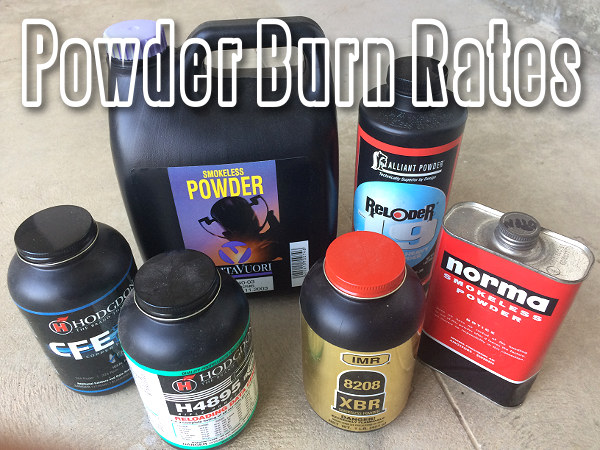
Day after day, one of AccurateShooter’s most-visited web pages is a reference guide featuring a comparative burn rate chart, ranking powders from fastest to slowest. Compiled by Hodgdon Powder Co., this Burn Rate Chart displays the relative burn rates of 163 different powders. Here is the latest table, released by Hodgdon in November of 2019.
You’ll want to download this Powder Burn Rate Table. This table shows the latest IMR powders including the Enduron series (IMR 4166, 4451, 4955, 7977), highlighted in green. This 163-entry comparison table provides vital information for hand-loaders. Note — this invaluable chart is not limited to Hodgdon and IMR propellants. This burn rate chart ranks powders from eight major powder-makers: Accurate, Alliant, Hodgdon, IMR, Norma, Ramshot (Western), Vihtavuori, and Winchester.
This chart provides useful information for all hand-loaders. When doing load development, and testing one powder versus another, it’s generally wise to choose propellants that share the same relative burn rate, as least for starters.
NOTE: Hodgdon powders are blue, IMR Enduron powders are green, IMR standard powders are yellow, and Winchester powders are red. DOWNLOAD Chart HERE.
Peterson Cartridge Company (“Peterson”) has released a lengthy, authoritative guide to the 22 Creedmoor cartridge, a popular wildcat based on the 6.5 Creedmoor or 6mm Creedmoor necked down to .224 caliber. We think the 22 Creedmoor would be a great long-range varmint cartridge, similar to the .22-250 Rem, but with a more moder, efficient cartridge design. In addition, some PRS/NRL competitors may turn to the 22 Creedmoor because it has less recoil and is flatter-shooting than the 6mm Creedmoor. In addition, .224-caliber match bullets are typically less expensive than heavier 6mm and 6.5mm projectiles. Less recoil, and less cost — what’s not to like?*
Along with load data, this article has specific sections dedicated to: Primers, Rifling Twist Rates, and Reloading Supplies. If you are considering building a .22 Creedmoor, we recommend you download the full Peterson .22 Creedmoor article, which is available in PDF format.
Peterson states, “Since its inception in 2007… the 6.5 Creedmoor has seen some pretty meteoric growth in popularity. That growth continues as of this writing, as the cartridge has now gone mainstream with hunters and shooters alike. As the popularity of the 6.5 Creedmoor has increased, so has the number of wildcat cartridges based off of it. Some of those popular wildcat cartridges are the 6mm Creedmoor, the .25 Creedmoor, and now the .22 Creedmoor. This data sheet will cover the .22 Creedmoor.
To help our customers, and anyone else who shoots .22 Creedmoor, we decided to create this Data Sheet and distribute it. [In this LOAD DATA Document] you will find four (4) common bullets, and four (4) common rifle powders used when handloading the .22 Creedmoor cartridge. We then took the different bullet and powder combinations and loaded them up to the SAAMI Maximum Average Pressure (MAP) for the 6.5 Creedmoor and 6mm Creedmoor cartridges, which is 62,000 PSI. [O]ur goal was to provide a wide spectrum of bullet weights and the powders used with them.
All of the following data was gathered by our ballistician in our indoor ballistics lab located in our factory in Pennsylvania. Although we were able to gather pressure and velocity data in our lab, we have NOT tested these loads for accuracy. Again, these loads are just designed to give shooters information regarding what velocity, a given bullet and powder charge combination, will produce the SAAMI Maximum Average Pressure (MAP) of 62,000 psi.”
Sample .22 Creedmoor LOAD DATA
IMPORTANT — Pressures can vary significantly with different Cartridge Overall Lengths (COAL). In addition, ANY change to ANY load components — primers, bullets, brass, powder — can affect pressure. Always load conservatively. In addition, because of variances in bore dimensions, some barrels may show higher pressures than others. Again, always start with conservative loads, well below MAX pressures.
*Actually there IS a potential downside — reduced barrel life. We expect that a .22 Creedmoor running hot varmint loads would experience shorter useful barrel life compared to a 6.5 Creedmoor. This is based on what we’ve observed with .22-250 and .22-250 Ackley barrels compared to our 6.5 CM barrels.
Report from Peterson Cartridge Company
For a while now Peterson Cartridge has made 6mm BR Norma (6BR) casings (sold exclusively through Graf & Sons). These have been popular with benchrest, varmint, and PRS/NRL shooters. But recently we had a customer ask us to make 7mm BR Remington casings. That customer is David Fricke of Lehigh Defense and SSK Firearms. Lehigh is known for making specialized, high-performance bullets.
Recently, Lehigh began making bullets for the J.D. Jones-designed Whisper line of cartridges, which are necked up from 7 BR casings. Some years back, J. D. Jones of SSK industries developed several efficient dual-role cartridges, the .302 Whisper, the .338 Whisper, .375 Whisper and the .416 Whisper. These are all made from necked-up 7mm BR Rem casings. The “dual role” refers to the fact that they can be loaded either for subsonic applications, or for high velocity shooting. According to Fricke, “Remington made the XP-100 bolt-action handgun, and one of the calibers they chambered it in was 7mm BR, which became very popular with Silhouette shooters. Remington also made the 7 BR casings which people like to neck up to the different Whisper calibers.”
Fricke concluded, “The 7mm BR caliber is a highly efficient, inherently accurate round, which doesn’t require much powder. The balance between the powder charge, bullet weight, barrel length and related harmonics results in a caliber with outstanding accuracy.”
Expect this 7mm BR Brass to be Necked-Up and Necked Down for Other Calibers
Commentary: With this new 7mm BR brass, we expect wildcatters will go to work right away, necking the case up to 30 BR, the favored cartridge for 100/200 score benchrest competition. We’ve also heard plans that some PRS shooters may neck down and fire-form the cartridge for a 6.5 BRA version with a 40° shoulder.
Peterson Brass — Strong, Uniform, Durable
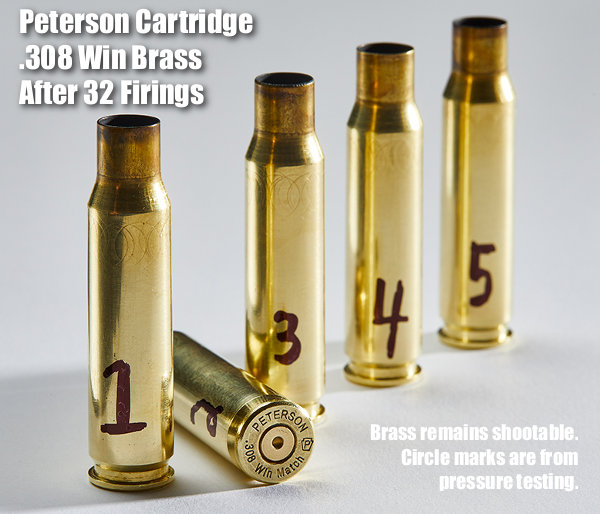
Peterson brass is among the most precise, durable (over many load cycles), and uniform on the market. Extended load cycle tests have shown great longevity for Peterson brass, which has performed well in many disciplines from PRS to ELR. For more information on Peterson Cartridge Company or to learn more about its match-grade brass and loaded ammunition, visit PetersonCartridge.com.
Extended Load Cycle Test of Peterson Brass
About Peterson Cartridge Company
Peterson Cartridge Company is a family-owned, American manufacturer of match-grade brass rifle casings and loaded ammunition. This 20-minute video provides an inside look at the Peterson Cartridge company. Host Larry Berg visits Peterson’s modern production facility in Pennsylvania. There are also interviews with Peterson Executives and engineers.
Tired of messing around with neck bushings? Is there a simpler (and potentially better) solution for controlling case neck tension? Yes there is — the precision honed non-bushing die.
You can purchase a Forster non-bushing Full-length sizing die for many popular cartridge types for under $50.00. Then you can send that die to Forster, and Forster will custom-hone the neck for a $24 fee (includes return shipping). When done right, the honed FL die can load ultra-straight ammo with the precise next tension you prefer for your brass and bullet choice.
Alternative to Bushings — Honed Full-Length dies
Conventional, non-bushing full-length sizing dies can create ultra-accurate ammo with very low run-out. For some applications, we prefer a non-bushing FL die over a bushing die — so long as the neck tension is correct. But many FL dies have an undersized neck diameter so you end up with excess neck tension, and you work the brass excessively. Forster offers a simple, inexpensive solution — honing the neck diameter to whatever size you want*.
If you purchase a Forster non-bushing, full-length sizing die, Forster will hone the neck dimension to your specs for $24.00 including return shipping. This way you can have a FL die that provides the right amount of tension for your particular load. (The max amount of diameter change Forster can do is about .008″) Forster dies are relatively inexpensive so you can afford to have a couple of FL dies with necks honed to different diameters — such as 0.266″ and 0.267″ for a no-turn 6mmBR. The die itself is fairly inexpensive — currently Precision Reloading charges $44.54 for a Forster 6mmBR FL sizing die (Forster Part #018121).
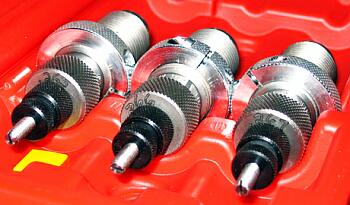
Forster FL dies, necks honed to .265″, .266″, and .267″.
Steve Rasmussen of IowaHighPower.com gave this a try. In fact, he had three dies made — each with a different neck dimension. Here’s his report: “My original Forster 6BR FL die sized the necks down a lot [to about 0.260″]. I sent my die in and asked if they could supply two more FL dies (for three total) to have the necks honed to 0.265″, 0.266″, and 0.267″.” In addition to the purchase cost of two more FL-sizing dies, Steve paid $36 ($12 per die) for the three dies to be honed.
Steve’s honed dies produced very straight loaded ammo:
“Brass springback after sizing is running 1 to 1.3 thousandths. My loaded rounds are running 0.2697-0.2699 using [older Gold Box Lapua brass]. So far the dies are working well. I sized 80 cases with the 0.266″ necked die. The shoulder is running 0.4582″ and 0.300″ up from the base is 0.4684". I spun 20 of ‘em and 16 had a runout of one thousandth (0.001) and the other 4 at 1.5 thousandths (0.0015).”
We custom hone the inside neck diameter by using a diamond stoning process. We enlarge the inside diameter to your specification to prevent over-sizing of the case neck due to thick neck walls. You may require this service for multiple reasons: 1) If you use some brands of brass cases which have thicker neck walls. 2) If you do not intend to outside neck turn case necks that have thickened after repeated firings. Please specify desired inside neck diameter. Note: 1) No more than .008″ stock removal from your existing die neck diameter is possible. 2) Honing is done in increments of one half thousandth of an inch (.0005″), meaning that your specified inside diameter must be either.XXX0″ or .XXX5″. FEES: $24.00, includes shipping within continental U.S. (lower 48 states). Please allow 1-3 weeks
Here’s a simple task you can do that will give your seater die a more perfect fit to your match bullets. You can lap the inside of the seater stem so that it matches the exact profile of the bullet. This spreads out the seating force over a larger area of the bullet jacket. That allows smoother, more consistent seating, without putting dents, creases, or sharp rings in your bullets.
This process is demonstrated here by our friend Erik Cortina of Team Lapua-Brux-Borden. Erik, one of the nation’s top F-Class shooters and a skilled machinist, explains: “Here I’m lapping my new seater die stem with lapping compound. I chuck up a bullet in the lathe and lap the inside of the seating stem. I put lapping compound on the bullet and also in the stem. You can do the same with a hand drill and bore paste. You can see in the piture below how much contact area the stem has on the bullet after being lapped. This bullet is a Berger 7mm 180-grain Hybrid. ”
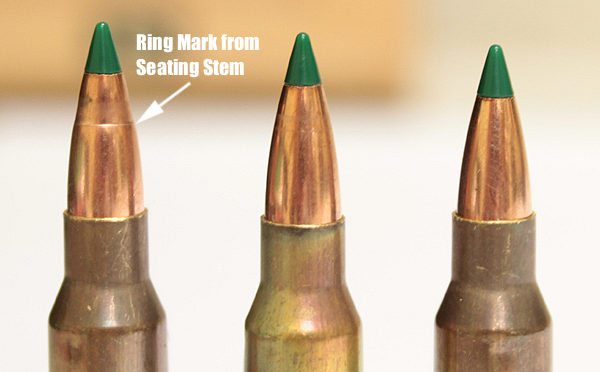
It can be helpful but it’s not necessary to make your seating stem an exact match to a bullet, particularly if you’re loading hunting or varmint rounds. But it is helpful to do some mild internal stem polishing. This should eliminate any ring (or dent) that forms on the bullet jacket during seating.
Sharp edges on a seating stem can cause a ring to be pressed into the bullet jacket — especially with compressed loads that resist downward bullet movement.
Q2: Is there any down-side to the process?
Not really. However, if you shoot many different bullet types for a particular cartridge, you may not want to conform the stem aggressively to one particular bullet design. Lightly lap the inside of the stem to remove burrs/sharp edges but leave it at that. A light lap will prevent a ring forming when seating bullets.
At the request of our readers, we provide select “Deals of the Week”. Every Sunday afternoon or Monday morning we offer our Best Bargain selections. Here are some of the best deals on firearms, hardware, reloading components, optics, and shooting accessories. Be aware that sale prices are subject to change, and once clearance inventory is sold, it’s gone for good. You snooze you lose.
1. Mc3 Stocks — 20% Off All Stocks and Accessories
Here’s a great oppotunity — get 20% Off all Mc3 products during the April Stay Healthy 2020 Sale. Do you have a rifle you’ve been wanting to upgrade? You can get 20% off EVERYTHING in the McMillan Mc3 store. Save on Hunting Stocks, Tactical Stocks, Bottom Metal, Magazines and other accessories IMPORTANT: To save 20% use Code STAYHEALTHY during checkout. Thanks to ELR Researcher for this tip.
2. Precision Reloading — HUGE Clearance Up to 50% Off
Precision Reloading is running a Big Clearance on a wide range of products including bullets, loaded ammo, reloading tools, dies, holsters, storage boxes, and more. You find some truly great deals, with many items up to 50% off. There are over 400 items on sale, including Berger, Barnes, and Nosler Bullet Sample Packs, cleaning kits, and more.
3. FREE FL Die Set with RCBS MatchMaster Dispenser
Have you been wanting to try the impressive new RCBS MatchMaster powder dispenser but you’ve been waiting for a special deal? RCBS is now offering a FREE Die Set Promo. Purchasers of a MatchMaster Scale/Dispenser qualify for a free set of MatchMaster Dies, with a $185.00 MSRP. This Promotion applies to MatchMaster machines purchased from any retailer including Amazon, Graf & Sons, and Midsouth Shooters. After completing your purchase, submit the RCBS Redemption Form to get your FREE set of MatchMaster FL dies. Die sets for 23 different cartridge types are available. MORE INFO HERE.
4. Midsouth — Aguila .22 LR Ammunition in-stock
Has the recent run on supplies got you thinking that you could use some more rimfire ammo? Well Midsouth Shooters has a full selection of reliable Aguila .22 LR ammunition at very affordable prices. A wide variety of Aguila .22 LR rimfire ammo is currently in-stock and ready to ship.
5. Bruno Shooters — McMillan Stock Sale
McMillan makes some of the best stocks available, with proven designs for just about any discipline or action type. If you’ve been in the market for a new stock, head over to Bruno Shooters Supply. Bruno’s has discounted a wide selection of McMillan stocks including popular tactical, hunting, and benchrest stock designs. Save money and avoid the manufacturer’s waiting period.
6. Sportsman’s Warehouse — Savage AXIS II w/scope, $399.99
If you’re in the market for a good basic rifle packaged with a 3-9x40mm scope, here’s a great deal. Sportsman’s Warehouse has the Savage Axis II with optic for just $399.99!. Currently this package deal is offered with 12 different chamberings including the popular .223 Rem, .243 Win, 6.5 Creedmoor, .308 Win, and .30-06 SPR. This is a great value for a basic hunting rig.
7. Natchez — Bushnell Gold Binoculars, $49.99
We love high-end binoculars, but it makes sense to have a lower-cost set of binoculars that you might keep as a spare, lend to a friend on request, or use on camping trips. Right now Natchez is selling Bushnell 8x42mm Custom Gold Binoculars for the crazy low price of only $49.99. Hard to beat that price (under fifty bucks) for a brand name optic.
8. Amazon — Tactical Survival Knife, $18.95
Good knives are vital tools, particularly during times of crisis. When we saw this cool tactical survival knife for only $18.95 we couldn’t resist sharing. With a G10 handle and full tang design this tactical chopper is equally at home around the shop as it is out in the field. The knife features a serious square-front 3.5″ blade, and ships with a rugged nylon carry sheath. Choose either Black or Silver, both with 3mm-thick stainless steel blades. A this price you could grab a pair — one in each color.
Are you sitting around in Coronavirus lockdown trying to figure out what to do? How about organizing your reloading area with these handy wall-mounted storage bins. At just $24.97 for 30 units — nearly 50% Off the regular price — this storage set is a great bargain. Use these for bullets, brass, ammo boxes, small tools — you name it. At this price you can get all those odds and ends put in their place and be ready for when the world gets back to normal.
NOTE: Barnes has just opened a new e-Commerce site where you can buy Barnes bullets direct from the manufacturer. To mark that development, we’re republishing an interesting article on how Barnes develops BC values and ballistic data for its match bullets and ammunition. Barnes employs advanced Doppler Radar to record bullet speeds at multiple distances out to 1500 yards.
Determining Bullet Ballistics with Doppler Radar Data
How do you build better (more precise) ammo drop tables? With radar, that’s how. Barnes Bullets is using Doppler Radar to develop the drop tables for its Precision Match line of factory ammunition. The Doppler radar allows Barnes to determine actual velocities at hundreds of points along a bullet’s flight path. This provides a more complete view of the ballistics “behavior” of the bullet, particularly at long range. Using Doppler radar, Barnes has learned that neither the G1 nor G7 BC models are perfect. Barnes essentially builds a custom drag curve for each bullet using Doppler radar findings.
Use of Doppler Radar to Generate Trajectory Solutions
by Barnes Bullets, LLC
Typical trajectory tables are generated by measuring only two values: muzzle velocity, and either time-of-flight to a downrange target, or a second downrange velocity. Depending on the test facility where this data is gathered, that downrange target or chronograph may only be 100 to 300 yards from the muzzle. These values are used to calculate the Ballistic Coefficient (BC value) of the bullet, and the BC value is then referenced to a standardized drag curve such as G1 or G7 to generate the trajectory table.
This approach works reasonably well for the distances encountered in most hunting and target shooting conditions, but breaks down rapidly for long range work. It’s really an archaic approach based on artillery firings conducted in the late 1800s and computational techniques developed before the advent of modern computers.
There is a better approach which has been utilized by modern militaries around the world for many years to generate very precise firing solutions. Due to the sizeable investment required, it has been slow to make its way into the commercial market. This modern approach is to use a Doppler radar system to gather thousands of data points as a bullet flies downrange. This radar data is used to generate a bullet specific drag curve, and then fed into a modern 6 Degree of Freedom (DOF) [ballistics software program] to generate precise firing solutions and greatly increase first-round hit probability. (The 6 DOF software accounts for x, y, and z position along with the bullet’s pitch, yaw, and roll rates.)
Bullet-Specific Drag Curves Derived from Radar Data
Barnes’ advanced Doppler radar system can track bullets out to 1500 meters, recording the velocity and time of flight of that bullet every few feet along the flight path. The noteworthy graph below shows a Doppler Radar-derived, bullet-specific drag curve alongside the more common G1 and G7 curves:
Neither of the standard curves is a particularly good match to our test bullet. In the legacy approach to generating a downrange trajectory table, the BC value is in effect a multiplier or a fudge factor that’s used to shift the drag curve of the test bullet to try and approximate one of the standard curves. This leads to heated arguments as to which of the standardized drag curves is a better fit, or if multiple BC values should be used to better approximate the standard curve (e.g., use one BC value when the velocity is between Mach 1 and Mach 2, and a different BC value when the velocity is between Mach 2 and Mach 3.) Barnes’ approach to creating trajectory tables is to generate bullet-specific drag curves, and use that data directly in a modern, state-of-the-art, 6 DOF ballistics program called Prodas to generate the firing solution.
Story tip from EdLongrange. We welcome reader submissions.
Cutting out the middleman — that’s what Barne is doing by launching its own e-Commerce website. Yes, now you can purchase the full line of Barnes bullets directly from the manufacturer. However, Barnes ammunition will only be sold through commercial retailers — no online ammo sales.
The new e-commerce web store, Shop.barnesbullets.com, allows individual consumers the convenience of purchasing Barnes Bullets directly. This can help you find the most popular bullets that are sometimes in short supply on dealers’ shelves.
Direct Shipping for Most States
All items on the site can be shipped direct to a consumer’s residential address except certain jurisdictions (such as California), which are noted on the site. All purchasers must be of 21 years of age or older, and adult signature with photo ID will be required to verify this upon delivery. And right now Barnes is offering FREE Shipping on all orders over $99.00.
Set Up Your Own Account or Shop as Guest
Personal accounts can be created to store shipping addresses for speed of checkout, see order status, and order history. A guest checkout option is also available. After an order is submitted auto-generated emails will be sent for: order confirmation, invoice of purchase, processing status, and shipped status.
CLICK HERE to view a catalog of All Barnes products.
If you have questions about the new Barnes online store, contact Barnes Customer Service: customerservice@barnesbullets.com. Or Telephone: (435) 856-1000.
“Garbage In, Garbage Out.” You have to input key variables with precision if you want your Ballistics Apps to deliver reliable long-range trajectories. So says Tom Beckstrand, Field Editor for Guns & Ammo magazine. A former U.S. Army Special Forces Officer, and avid long-range competitor, Beckstrand knows the importance of using your ballistic calculator correctly. Here are his tips on how to achieve the best results using Ballistics Calculators.
“The most important inputs to make any ballistic calculator work correctly are muzzle velocity, ballistic coefficient, and sight height,” says Beckstrand.
Ascertain Accurate Muzzle Velocity with a Good Chronograph
“Cheap chronographs will not give an accurate muzzle velocity, so the serious shooter needs to spend the money on a quality chrono.” When you chronograph, make sure to measure the distance from the muzzle to the chrono unit. That input is also important to your Ballistic calculations.
Use Reliable G1 and G7 Ballistic Coefficients
Beckstrand added, “Ballistic Coefficients are available from ammunition and bullet manufacturers, and most of these coefficients the manufacturers provide are really quite accurate.” Ballistic Coefficient or BC, is a number that reflects how well a bullet cuts through the air. The higher the BC, the less the bullet is affected by air drag.
Measure Sight Height Correctly Using Calipers
Beckstrand has found that many shooters aren’t inputting sight height or they are guessing at the correct height. As target distance increases, just a half-inch of sight height inaccuracy can mean several inches up or down.
“Sight height is the input most often overlooked and is usually the source of greatest error. I think a lot of shooters, especially those new to long-range shooting, simply don’t understand the importance of this input.”
Sight height is the distance from the centerline of the scope to the centerline of the bore. Some shooters, Beckstrand believes, just “eye it up” and estimate the distance. “Really, you should use a set of calipers to measure the sight height distance … within 0.1 inch”.
This Video Explains How to Set Up and Use Ballistic AE:
Need a top-notch Ballistics App for your iPhone, iPad, or iPod? Start with Ballistic AE, the number 1 (i.e. most installed) App for iOS systems. Ballistics AE (Advanced Edition) is the most popular iOS ballistics program for many good reasons. Full-featured and easy to use, Ballistics AE has been refined over many years, and it supplies rock-solid solutions derived from JBM Ballistics solver (created by James B. Millard). Unlike some other Apps, Ballistics AE is STABLE on iPhones (with various OS levels). What’s cool is that Ballistics AE is now on sale for just $9.99.
We’ve used the Ballistic AE program on an iPhone 5S, iPhone 6, and iPad, and it performed well. Here are some of the features we liked:
1. Mirrors output from online version of JBM Ballistics we often use for initial calculations.
2. Controls are simple to use and (mostly) intuitive.
3. Handy comparison feature lets you compare ballistics for different projectiles side by side.
4. Advanced Wind Kit allows you to account for complex wind situations.
5. Projectile and BC Databases are very comprehensive.
6. Software is regularly updated to match Apple OS changes.









 This approach works reasonably well for the distances encountered in most hunting and target shooting conditions, but breaks down rapidly for long range work. It’s really an archaic approach based on artillery firings conducted in the late 1800s and computational techniques developed before the advent of modern computers.


