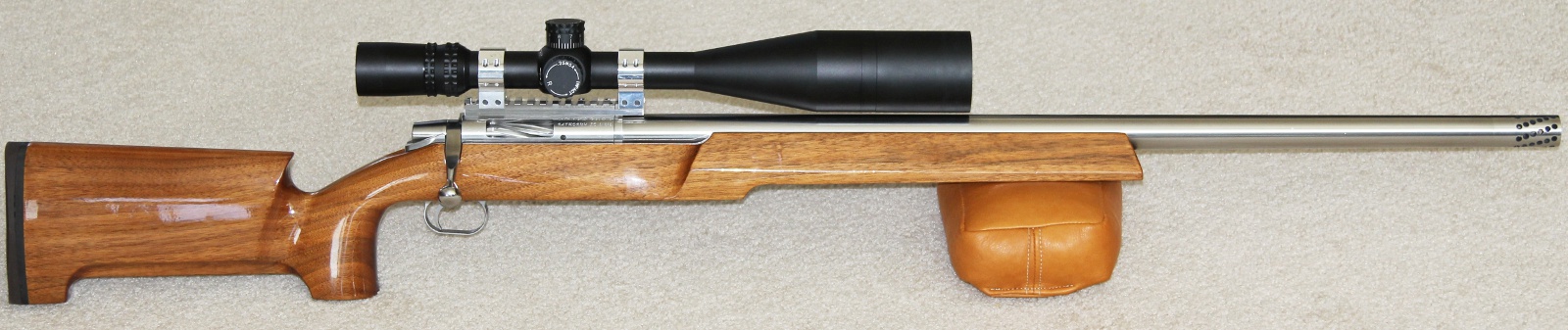
For centerfire ammo, you can choose from dozens of flip-top boxes, storage bins, or milsurp-style ammo cans. For rimfire ammo, there are not so many good choices. Our preferred rimfire ammo carrier is the MTM SB-200 Small-Bore Fitted Ammo Box. This flip-top plastic box holds 100 rimfire rounds in 10×5 black grids on the left and right. In the center is a storage area that will hold another 100 rounds in factory boxes. MTM’s SB-200 box was recently re-designed so it will now hold 17 HMR rounds, as well as 17 Mach 2, 22 short, 22 Win Mag Rimfire, and of course 22 Long Rifle (.22LR)
MTM Case-Gard 200 Round Smallbore Box
This is really the only product of its kind on the market. It allows you to conveniently and securely hold 200 rimfire rounds, and also segregate your ammo by brand or bullet type. These boxes fit all types of popular rimfire ammunition. The vertical clearance of the lid is sufficient to hold the longer .22 WMR Rounds, and 17 HMR (as well as .22 LR naturally). The lid fits securely so you don’t have to worry about your rimfire ammo spilling out on the way to the range.
If you don’t have one of these boxes yet, we recommend you order one or two. They cost less than $15.00 and are available in Blue or “Rust” (a brick color).
Welcome to the wacky world of Municipal Anti-Gun Ordinances. San Francisco and Los Angeles have city-specific magazine bans and gun storage requirements, and now it appears that Seattle may target gun owners with new “sin taxes” on firearms and ammunition.
$25 Per Gun and Five Cents Per Round
The Seattle City Council will soon vote on a new local law that will add a $25.00 surcharge to every new gun purchase. In addition, the proposed Seattle City Ordinance will add a $0.05 (five cent) fee to each and every centerfire round sold in Seattle. Rimfire .22LR rounds will be taxed $0.02 per round.
The stated purpose for the new Gun and Ammo Tax is to raise money to combat crime, according to Seattle City Council President Tim Burgess, author of the Gun Tax ordinance. Burgess told local KING-5 TV reporters that this is essentially a “Sin Tax” on guns and ammo: “We’ve been working on this for several years. Sure, I wish we would have done this 20 years ago, but we know what the problem is. We tax cigarettes and alcohol and even wood-burning stoves for public health purposes. Why not guns and ammunition?”
While supporters of the Gun and Ammo Tax, including Seattle Mayor Ed Murray, claim the new city tax would raise over $300,000 to fight crime, in reality this measure is more about getting rid of guns that it is about making Seattle safe. The National Shooting Sports Foundation (NSSF) has opposed the Seattle Gun and Ammo Tax, stating: “[This ordinance] will have no effect on decreasing gun violence. It is designed to place a huge burden on legitimate firearms retailers and law-abiding gun owners. Additionally, the proposed ordinance is a gross violation of Washington’s firearms preemption statute.”
Daniel Xu, writing in OutdoorHub.com notes that gun buyers already pay Excise Taxes with each purchase: “However, unlike the [Federal] Pittman-Robertson Excise Tax, which retains funds for conservation and habitat-protection efforts, the funds collected by the ordinance will go entirely back into the city for ‘gun violence research and prevention programs’. City leaders have yet to specify… how the funds will be spent.”
In some areas of the country (California in particular), hunters are now forbidden to use bullets that contain lead. If you need a lead-free projectile for your deer rifle, consider Nosler’s E-Tip projectile. This has plenty of penetrating power and retained energy while complying with laws requiring “unleaded” ammunition. An “expansion chamber” behind the green polymer tip helps ensure reliable expansion with 95% weight retention. The video below shows a .30 Caliber 180gr lead-free E-Tip power through TWO 12-inch blocks of Ballistics Gel at 100 yards. This was fired from a .308 Winchester.
Watch 180gr eTip Penetration and Expansion in Ballistic Gelatin:
Nosler claims the E-Tip bullet has advantages over other solid copper hunting bullets: “Unlike the competitor’s one-piece designs, Nosler E-Tip bullets will not blow the petals off at extreme velocities nor will the low end expansion ever be questioned, as the minimum impact velocity is set at 1800 fps for standard calibers.” One hunter, posting on Facebook, gave the E-Tip high marks: “I have had the opportunity to take a pig with a 130 gr E-Tip from my .270 and they work flawlessly. My son took two pigs with his .300 Win Mag and 165gr E-Tips and they worked flawlessly as well.”
This video illustrates the design and construction of the Nosler eTip Bullet:
At SHOT Show 2015 Bullets.com President Shiraz Balolia signed a contract with Norma to produce a large quantity of ultra-high-quality .284 Winchester and 6mm Dasher brass. The .284 Win brass is now in the USA and it is very good indeed. Now .284 Win and .284 Shehane shooters have a true premium product, without having to neck-up 6.5-284 brass. In addition, special enhanced quality-control measures were employed by Norma (as a condition of the Bullets.com contract) to ensure this brass is very uniform and very long-lasting. Expect the primer pockets to stay tight for a long time, even with stout loads.
This custom-made .284 Winchester Brass from Norma is double-drawn for body consistency and the heads are double-stamped for longer primer pocket life. This “special run” brass, created exclusively for Bullets.com, is produced to extremely high tolerances from high-grade raw materials.
Bullets.com President Shiraz Balolia (left) and Norma Managing Director Paul-Erik Toivo sign contract for ultra-high-grade Norma brass.
Check it out on our website: http://bit.ly/1KpiVh2
Forum member XmarksSpot has been shooting a wicked fast varmint cartridge that has broken the 5000-fps barrier using Berger 30gr varmint bullets. That’s some serious velocity! The parent case is a 6mmBR, which is then improved and necked down to .224 caliber. XmarksSpot reports:
Some people think 5000+ fps is mythical. Well just thought I’d let you guys know that I got 5239 fps a couple weeks ago shooting 30-grainers with my 224 McDonald, a wildcat cartridge based on an improved 6BR case necked down to 224. (This case is very similar to a 22 Dasher.) The bullet used is the 30gr Berger. (The 40s run fast too — about 4800 fps.) The rig is a Rem 700 with a 30″ Hart barrel. Below is the case before and after forming. As you can see it has a 40° shoulder and far more case capacity than a 22 BR (a 22 Dasher case holds about 41.0 grains H20). My most accurate loads are with 50-52gr bullets, with bugholes the norm at 4200 fps. The 40gr bullets will do 4800+ fps.
This 224 McDonald wildcat was originally developed by Charles McDonald. He has been developing and chambering custom cartridges for years. Editor’s Note: Many folks may not be aware of the little .224-caliber 30gr Berger varmint bullet, Berger item # 22301. This bullet is not on Berger’s current production list but some vendors may still have “old stock” inventory. The little 30-grainer has an 0.119 G1 BC and will work in 1:15″ or faster twist barrels. For more info, visit BergerBullets.com.
Warner Tool Company (WTC) has introduced a new series of “Flat Line” ultra-high-BC bullets. These sleek, lathe-turned solids are some of the most perfectly-streamlined projectiles ever sold. The Ballistic Coefficients (BCs) of Flat Line projectiles are as much as 20% higher than other match bullets of similar caliber and weight. For example, the .30-caliber 200gr Flat Line bullet has a claimed G1 BC of 0.780. Compare that to 0.555 for the Sierra 200gr MatchKing and 0.622 for the Berger 200gr Hybrid.
The new Flat Line bullets all show extremely high Ballistic Coefficients for their weights:
Caliber
Description
Twist Rate
3000-1500 fps
3500-1500 fps
G1 BC
G7 BC
G1 BC
G7 BC
30
155.5gr Palma
10
0.553
0.285
0.576
0.290
30
175gr FTR
10
0.678
0.340
0.694
0.348
30
200gr
9
0.780
0.391
0.796
0.399
33
255.5gr LRBT
10
0.814
0.400
0.834
0.411
WTC also claims that Flat Line bullets can be launched at faster velocities than other bullets of similar caliber and weight. In its marketing materials, WTC says that Flat Line bullets deliver “Higher velocities when compared with projectiles in its weight class [and] much higher velocity when compared with projectiles of similar BC.” For example, WTC claims that “the 155.5gr .30-caliber bullet has the velocity of a 125-135gr bullet [with] the BC of a 185-200gr bullet.” It will be interesting to see if these claims can be verified in field tests.
Here are comparative G1 BCs for a variety of large .30-caliber bullets:
Cal Zant of the Precision Rifle Blog has obtained some early-production Flat Line bullets from their designer, Josh Kunz. Zant has written a lengthy article explaining the design and features of the new Flat Line bullets. If you are considering ordering some of these new lathe-turned solids, you should definitely read Zant’s report.
These bullets were designed by Aerospace engineer Josh Kunz using advanced computational fluid dynamics (CFD) to simulate supersonic air flow around the bullets. Through the use of advanced modeling and precision CNC machining, Kunz has developed extremely uniform, ballistically “slippery” bullets that fly faster and flatter than other projectiles of similar weight/caliber.
Premium Pricing: Flat Line Bullets Cost $125 to $165 per Hundred
These new Flat Line solid bullets are pricey. The 155s cost $1.25 per bullet and the price goes up from there. If you need large quantities of projectiles for a week-long match, the cost can be daunting. One hundred fifty of the 200-grainers will set you back $435.00! Here is a price list for the new Flat Line bullets. All quantities are in boxes of 50. Pricing is introductory and subject to change.
.30 Cal 155 grain
$62.50 per 50-ct box ($1.25 per bullet)
.30 Cal 180 grain
$67.50 per 50-ct box ($1.35 per bullet)
.30 Cal 200 grain
$72.50 per 50-ct box ($1.45 per bullet)
.338 Cal 255 grain
$82.50 per 50-ct box ($1.65 per bullet)
Is the cost worth it? When you look at the overall expense of attending a major match, and the fact that the top places in big matches are sometimes are decided by a single point (or X-Count), some competitors will spend the extra money for these ultra-high BC solids.
How do you build better (more precise) ammo drop tables? With radar, that’s how. Barnes Bullets is using Doppler Radar to develop the drop tables for its new Precision Match line of factory ammunition. The Doppler radar allows Barnes to determine actual velocities at hundreds of points along a bullet’s flight path. This provides a more complete view of the ballistics “behavior” of the bullet, particularly at long range. Using Doppler radar, Barnes has learned that neither the G1 nor G7 BC models are perfect. Barnes essentially builds a custom drag curve for each bullet using Doppler radar findings.
Use of Doppler Radar to Generate Trajectory Solutions
by Barnes Bullets, LLC
Typical trajectory tables are generated by measuring only two values: muzzle velocity, and either time-of-flight to a downrange target, or a second downrange velocity. Depending on the test facility where this data is gathered, that downrange target or chronograph may only be 100 to 300 yards from the muzzle. These values are used to calculate the Ballistic Coefficient (BC value) of the bullet, and the BC value is then referenced to a standardized drag curve such as G1 or G7 to generate the trajectory table.
This approach works reasonably well for the distances encountered in most hunting and target shooting conditions, but breaks down rapidly for long range work. It’s really an archaic approach based on artillery firings conducted in the late 1800s and computational techniques developed before the advent of modern computers.
There is a better approach which has been utilized by modern militaries around the world for many years to generate very precise firing solutions. Due to the sizeable investment required, it has been slow to make its way into the commercial market. This modern approach is to use a Doppler radar system to gather thousands of data points as a bullet flies downrange. This radar data is used to generate a bullet specific drag curve, and then fed into a modern 6 Degree of Freedom (DOF) [ballistics software program] to generate precise firing solutions and greatly increase first-round hit probability. (The 6 DOF software accounts for x, y, and z position along with the bullet’s pitch, yaw, and roll rates.)
Barnes has invested heavily in this modern approach. Our Doppler radar system can track bullets out to 1500 meters, recording the velocity and time of flight of that bullet every few feet along the flight path. Consider the graph below showing a bullet specific drag curve referenced to the more common G1 and G7 curves:
Neither of the standard curves is a particularly good match to our test bullet. In the legacy approach to generating a downrange trajectory table, the BC value is in effect a multiplier or a fudge factor that’s used to shift the drag curve of the test bullet to try and approximate one of the standard curves. This leads to heated arguments as to which of the standardized drag curves is a better fit, or if multiple BC values should be used to better approximate the standard curve (e.g., use one BC value when the velocity is between Mach 1 and Mach 2, and a different BC value when the velocity is between Mach 2 and Mach 3.) Barnes’ approach to creating trajectory tables is to generate bullet-specific drag curves, and use that data directly in a modern, state-of-the-art, 6 DOF ballistics program called Prodas to generate the firing solution.
Story tip from EdLongrange. We welcome reader submissions.
Many tactical shooters have adopted the .260 Remington as an alternative to the heavier-recoiling .308 Winchester. The .260 Rem has also performed well in the hands of long-range High Power shooters such as SSG Sherri Jo Gallagher, past National High Power Champion. The .260 Remington is basically the .308 Win necked down to .264 (6.5 mm) caliber. It can launch very high-BC 130-142 grain projectiles at impressive velocities. The ballistics of the .260 Rem allow it to shoot flatter, with less wind drift, than typical .308 Win loads.
For fans of the .260 Remington, very high-quality factory ammo is now available. ABM Ammo, a division of Berger Bullets just announced that it will produce two varieties of .260 Remington ammo.
ABM’s 260 Remington 140gr Berger Match Hybrid Target ammo is designed for class-leading ballistic and superior accuracy. Using the highest-BC 6.5 mm caliber bullet offered by Berger, the 140gr Hybrid, this load features less wind deflection and more energy on target than the competition. ABM claims that this Match Hybrid ammo is “unrivaled as a long-range 260 Remington factory ammo option.” Since it pushes a higher-BC bullet than other .260 Rem factory ammo, we’d have to agree with that statement.
Performance based on a 26″ barrel and sea level conditions.
Mission Ready .260 Rem OTM Tactical Load for Mag-Fed Rifles
ABM Ammo also offers .260 Rem factory ammo loaded with the NEW 130gr AR Hybrid bullet. The .260 Rem 130gr Berger Match AR Hybrid OTM Tactical load is optimized for the AR-10 platform or any magazine-fed rifle. Berger’s 130gr AR Hybrid bullet offers a 0.290 G7 BC. That’s very close to the 0.317 BC of the longer 140gr Hybrid. This, combined with a 2847 FPS muzzle velocity, provides excellent performance in a shorter COAL that feeds perfectly from box magazines.
In fact, if you run the ballistics (using JBM) using ABM’s published MVs, you’ll find that you give up nothing with the shorter bullet. At 600 yards, the 130gr “Mission Ready” load has 78.8″ (12.5 MOA) of drop. By comparison, the “Match Ready” load with 140-grainers has 80.3″ (12.8) MOA of drop at 600 Yards (That’s not a mistake — the smaller bullet has LESS drop because it has a higher MV to start.) At 1000 yards, the “Mission Ready” load is virtually identical to the “Match Ready” load: The 130gr ammo has 304.6″ (29.1 MOA) of drop at 1000 vs 303.4″ (29.0 MOA) for the 140gr ammo at the same distance. (These calculations are based on standard conditions at sea level, with ABM supplied MVs.)
Because the ballistics are so close, you may want to try both loads in your .260 Rem rifle, even if you single-load and are not restricted by mag length. Some barrels may have a preference for one bullet over the other.
Product Tip from EdLongRange. We welcome reader submissions.
We know our readers are curious about the new Tipped MatchKings (TMKs) introduced by Sierra Bullets this year. Our friend Bill at Rifleshooter.com got hold of some of the .30-Cal 175-grain TMKs and tested them in his .308 Win rifle. He found the bullets were very consistent in weight. As for bearing surface, the SD was fairly low (.002″), but measurements varied from 0.400″ to 0.407″. Seven-thousandths extreme spread is more than we like to see, as it may affect accuracy. Therefore we recommend you sort by bearing surface length before loading these in match rounds.
In our Forum recently, there was a discussion about “improved” cartridges based on the .243 Winchester parent case. One popular such cartridge is the Super LR, a 30° long-necked wildcat. The 6mm Super LR was developed by Robert Whitley, who wanted something similar to the 6XC, but with “more boiler room” to push the 115-grain bullets comfortably at 2950-3050 fps.
To illustrate the Super LR for interested readers, we dug into our archives and found a report on a 6mm Super LR varmint rifle belonging to Barry O. (aka “TheBlueEyedBear”), a long-time AccurateShooter Forum member. A few years back, Barry put together an impressive 6mm Super LR long-range varminter on a BAT SV action. Barry actually sourced many of the components for this rifle through our AccurateShooter Forum Free Classifieds. CLICK HERE to read all about Barry’s Super LR BAT-Actioned varmint rifle, featured in our popular Gun of the Week Series.
CLICK Photo to Read Full Story
The Richard Franklin walnut LowRider stock (above) for Barry’s rifle came from fellow Forum member “Preacher”, who also did most of the metal work. The gun is chambered as a 6mm Super LR.
6mm Super LR Cartridge Design and Loading Advice by Robert Whitley, AR-X Enterprises
Conceptually, the 6mm Super LR is like a long-bodied 6XC (case body about .120″ longer). The Super LR has a long neck (.321″ vs. the .263″ long neck of the parent .243 Winchester case). The Super LR also has a 30° shoulder angle vs. the 20° shoulder angle of the .243 Winchester parent case. The Super LR has about 54 grains of H20 capacity, compared to 55 grains for the .243 Win and 49 grains H20 for the 6XC.
The Super LR has sufficient case capacity to shoot the 115gr 6mm bullets in the 2950 – 3000 fps range without being “on the edge” of maximum pressure. If you do not need to run sustained fire in long strings, you can “hot rod” things more. Testing has shown that the Super LR can run the 115s up around 3100 fps without issues. With the 105-108 grain 6mm bullets, the 6mm Super LR can push them up in the 3150-3200 fps range with the right powders. In addition, if you like to shoot the 105-108 grain bullets close to the lands, or engaging the lands, the Super LR cartridge case neck is long enough to give most of them a good bearing surface purchase, even if the chamber is throated for the 115gr bullets. That gives the 6mm Super LR cartridge great versatility.
The 30° shoulder angle of the 6mm Super LR is another good feature of the Super LR. Not only does it help to avoid the throat-torching effect that people associate with the .243 Winchester (because of the .243’s short neck and 20° shoulder angle), but the 30° shoulder angle has also been a hallmark of some very accurate cartridges such as the 6 PPC, 6mm BR, 6XC, and 6.5 x 47, to name a few.
The 6mm Super LR wildcat is easy to make. Robert Whitley figured out how to reform domestic .243 Win brass with one simple pass through a Redding 6mm Super LR full-length sizing die. Robert has commissioned these dies from Redding. Call Robert at (215) 348-8789 to order.Learn more about the 6mm Super LR on Whitley’s www.6mmAR.com website.




 This approach works reasonably well for the distances encountered in most hunting and target shooting conditions, but breaks down rapidly for long range work. It’s really an archaic approach based on artillery firings conducted in the late 1800s and computational techniques developed before the advent of modern computers.