|
|
May 19th, 2013
 Effects Of Cartridge Over All Length (COAL) And Cartridge Base To Ogive (CBTO) – Part 1 Effects Of Cartridge Over All Length (COAL) And Cartridge Base To Ogive (CBTO) – Part 1
by Bryan Litz for Berger Bullets.
Many shooters are not aware of the dramatic effects that bullet seating depth can have on the pressure and velocity generated by a rifle cartridge. Cartridge Overall Length (COAL) is also a variable that can be used to fine-tune accuracy. It’s also an important consideration for rifles that need to feed rounds through a magazine. In this article, we’ll explore the various effects of COAL, and what choices a shooter can make to maximize the effectiveness of their hand loads.
Sporting Arms and Ammunition Manufacturers’ Institute (SAAMI)
Most loading manuals (including the Berger Manual), present loading data according to SAAMI (Sporting Arms and Ammunition Manufacturers’ Institute) standards. SAAMI provides max pressure, COAL and many other specifications for commercial cartridges so that rifle makers, ammo makers, and hand loaders can standardize their products so they all work together. As we’ll see later in this article, these SAAMI standards are in many cases outdated and can dramatically restrict the performance potential of a cartridge.
Bullet seating depth is an important variable in the accuracy equation. In many cases, the SAAMI specified COAL is shorter than what a hand loader wants to load their rounds to for accuracy purposes. In the case where a hand loader seats the bullets longer than SAAMI specified COAL, there are some internal ballistic effects that take place which are important to understand.
Effects of Seating Depth / COAL on Pressure and Velocity
The primary effect of loading a cartridge long is that it leaves more internal volume inside the cartridge. This extra internal volume has a well known effect; for a given powder charge, there will be less pressure and less velocity produced because of the extra empty space. Another way to look at this is you have to use more powder to achieve the same pressure and velocity when the bullet is seated out long. In fact, the extra powder you can add to a cartridge with the bullet seated long will allow you to achieve greater velocity at the same pressure than a cartridge with a bullet seated short.

Figure 1. When the bullet is seated farther out of the case, there is more volume available for powder. This enables the cartridge to generate higher muzzle velocity with the same pressure.
When you think about it, it makes good sense. After all, when you seat the bullet out longer and leave more internal case volume for powder, you’re effectively making the cartridge into a bigger cartridge by increasing the size of the combustion chamber. Figure 1 illustrates the extra volume that’s available for powder when the bullet is seated out long.
Before concluding that it’s a good idea to start seating your bullets longer than SAAMI spec length, there are a few things to consider.
Geometry of a Chamber Throat
The chamber in a rifle will have a certain throat length which will dictate how long a bullet can be loaded. The throat is the forward portion of the chamber that has no rifling. The portion of the bullet’s bearing surface that projects out of the case occupies the throat (see Figure 2).

The length of the throat determines how much of the bullet can stick out of the case. When a cartridge is chambered and the bullet encounters the beginning of the rifling, known as the lands, it’s met with hard resistance. This COAL marks the maximum length that a bullet can be seated. When a bullet is seated out to contact the lands, its initial forward motion during ignition is immediately resisted by an engraving force.
Seating a bullet against the lands causes pressures to be elevated noticeably higher than if the bullet were seated just a few thousandths of an inch off the lands.
A very common practice in precision reloading is to establish the COAL for a bullet that’s seated to touch the lands. This is a reference length that the hand loader works from when searching for the optimal seating depth for precision. Many times, the best seating depth is with the bullet touching or very near the lands. However, in some rifles, the best seating depth might be 0.100″ or more off the lands. This is simply a variable the hand loader uses to tune the precision of a rifle.
CLICK HERE to Read Full Article with More Info
Article sourced by EdLongrange. We welcome tips from readers.
May 11th, 2013
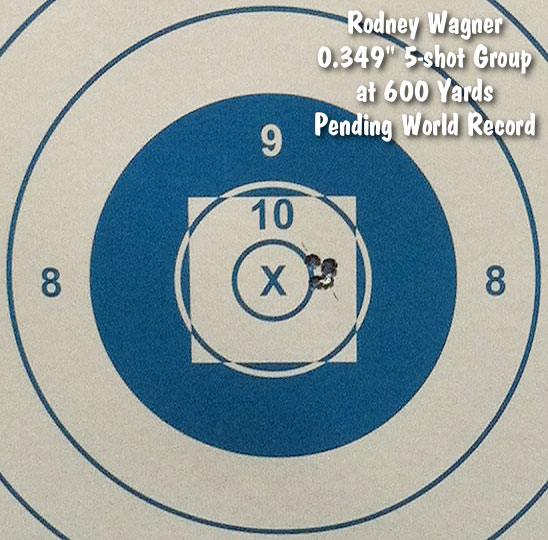
 This is one of the most amazing feats of precision shooting ever recorded. In an IBS 600-yard Benchrest match today at the Piedmont range (Rutherfordton, NC), Forum member Rodney Wagner shot a 0.349″ five-shot group at 600 yards. That smashes the existing 0.699″ IBS Light Gun Record (and it’s way smaller than the NBRSA record as well). To top that, the group was centered up for a 50-2X score, which establishes another record (50 score with small-group tie-breaker). Rodney (aka “Eggman” on the Forum) was shooting a 17-lb IBS Light Gun with a Brux barrel chambered for the 6mm Dasher, a popular improved version of the 6mm BR Norma cartridge. Rodney was shooting 32.5 grains of Varget, with CCI 450 primers, and Berger 108gr BTs, seated .020″ away from the lands. This is one of the most amazing feats of precision shooting ever recorded. In an IBS 600-yard Benchrest match today at the Piedmont range (Rutherfordton, NC), Forum member Rodney Wagner shot a 0.349″ five-shot group at 600 yards. That smashes the existing 0.699″ IBS Light Gun Record (and it’s way smaller than the NBRSA record as well). To top that, the group was centered up for a 50-2X score, which establishes another record (50 score with small-group tie-breaker). Rodney (aka “Eggman” on the Forum) was shooting a 17-lb IBS Light Gun with a Brux barrel chambered for the 6mm Dasher, a popular improved version of the 6mm BR Norma cartridge. Rodney was shooting 32.5 grains of Varget, with CCI 450 primers, and Berger 108gr BTs, seated .020″ away from the lands.
Stay tuned — we will have more information soon. Our friend Sam Hall was on hand to interview Rodney at the Piedmont range. Click “PLAY” button below to hear Rodney talk about his rifle and his load:
Rodney Wagner Talks about his 0.349″ 600-yard Group (Click PLAY to Hear Audio)
[haiku url=”http://accurateshooter.net/Video/wagnertalks.mp3″ title=”Wagner Talks about 600-Yard Record Group”]

Record-Breaking Family — Like Son, Like Father
Here’s an interesting factoid: In 2008, Rodney’s teen-age son set the IBS 600-yard Light Gun record with a .711″ five-shot group, combined with an Aggregate of 1.628″. That Agg was itself an IBS record (until Chad Jenkins recorded an 1.5009″ Agg in 2012). Rodney’s son was shooting a 6BRX. The 600-yard group record was then lowered by Rodney’s friend Sam Hall, who shot a 0.699″ group in 2010. Sam also set the current 600-yard LG score record with a perfect 50, but that should be eclipsed by Rodney’s 50 score based on tie-breaker by group size.
Look at that target and try not to be astonished! When this editor saw the group, I was honestly stunned and speechless. Consider this, one MOA at 600 yards is 6.282 inches. So Rodney’s 0.349″ group works out to 0.055 MOA. That’s what a mid-zero group at 600 yards looks like boys and girls….

- Equipment: BAT Model B action (RBLP Rt Eject), Brux HV-contour barrel (29″), Jewell trigger, March 10-60x52mm (Tactical knobs, Burris Rings), Shehane ST1000 fiberglass Tracker stock.
- Chambering: 6mm Dasher (.268″ Neck, .114″ Freebore, Necks turned to 0.265″)
- Load: Lapua 6mmBR brass formed to 6mm Dasher, 32.5 grains Hodgdon Varget, CCI 450 Primers, Berger 108gr Boat-Tails seated .020″ away from lands (jumping).
May 11th, 2013
Current demand for loaded ammunition and reloading components is very high. To meet this demand, ammo imports into the USA have nearly doubled. But supplies are still short. One reason is that domestic ammo manufacturers are already operating at full capacity — and they have been doing so for the past decade or so. The machines just can’t run any faster…
Now an important domestic ammo-maker has committed to a significant increase in production capacity. Remington Arms Company, LLC (“Remington”) recently announced a major expansion of its Lonoke (Arkansas) Ammunition Plant. Remington will spend $32,000,000 to add new structures and machinery.

Work on the expansion, which will include the construction of a new building, is expected to begin second quarter of 2013. The $32 million expansion plan is projected to be in operation by the second quarter of 2014. The Remington’s Lonoke Ammunition Plant, opened in 1969, produces a wide variety of commercial ammunition.
“We continue to invest in all of our manufacturing operations because we are committed to ensuring quality, increasing product availability, and improving on-time delivery. This significant investment in Lonoke is a testament to that commitment. Our customers can count on Remington to invest in its manufacturing operations in order to ensure that its facilities are state-of-the art”, said Kevin Miniard, Chief Operating Officer of Remington. Read about Remington ammunition.
May 10th, 2013
Conventional .308 Winchester brass has a large primer pocket with a large, 0.080″-diameter flash hole. In 2010, Lapua began producing special edition .308 Win “Palma” brass that has a small primer pocket and a small flash hole, sized 1.5mm (.059″) in diameter. Tests by U.S. Palma Team members showed that the small-flash-hole .308 brass possibly delivers lower Extreme Spread (ES) and Standard Deviation (SD) with some bullet/powder/primer combinations. All things being equal, a lower ES should reduce vertical dispersion at long range.
Why Might a Small Flash Hole Work Better?
The performance of the small-flash-hole .308 brass caused some folks to speculate why ES/SD might be improved with a smaller flash hole. One theory (and it’s just a theory) is that the small flash hole creates more of a “jet” effect when the primer fires. German Salazar (Rifleman’s Journal Editor) sought to find out, experimentally, whether this theory is correct. German explained: “During one of the many internet forum discussions of these cases, Al Matson (AlinWA) opined that the small flash hole might cause the primer flash to be propagated forward more vigorously. In his words, it should be like shooting a volume of water through a smaller nozzle, resulting in a flash that reaches further up the case. Now that kind of comment really sparked my curiosity, so I decided to see what I could see.”
More Primer Testing by Salazar
You can read more about this test and other primer experiments on RiflemansJournal.com.
Salazar Primer Tests: Small Rifle Primer Study | Large Rifle Primer Study
Large and Small Flash Hole .308 Cases — But Both with Small Primer Pockets
To isolate the effect of flash hole diameter alone, German set up a test with the two types of .308 case that have a small primer pocket: Remington BR brass with a 0.080″ flash hole and Lapua Palma brass with a 0.062″ flash hole. NOTE: German reamed the Lapua brass to 0.062″ with a Sinclair uniforming tool, so it was slightly larger than the 0.059″ factory spec. The Remington brass has a .22 BR headstamp as this brass was actually meant to be re-formed into .22 BR or 6 BR before there was factory brass available for those cartridges.

German set up his primer testing fixture, and took photos in low light so you can see the propagation of the primer “blast” easily. He first tested the Remington 7 1/2 primer, a primer known for giving a large flame front. German notes: “I thought that if there was a ‘nozzle effect’ from the small flash hole, this primer would show it best. As you can see from the photos, there might be a little bit of a flash reduction effect with this primer and the small flash hole, the opposite of what we expected, but it doesn’t appear to be of a significant order of magnitude.”
Remington BR case, 0.080″ Flash Hole, Remington 7.5 Primer.

Lapua Palma case, 0.062″ Flash Hole, Remington 7.5 Primer.

Next German tested the Wolf .223 primer, an unplated version of the Small Rifle Magnum that so many shooters use. German notes: “This is a reduced flame-front (low flash) primer which has proven itself to be very accurate and will likely see a lot of use in the Lapua cases. With this primer, I couldn’t detect any difference in the flash produced by the small flash hole versus the large flash hole”.
Remington BR case, 0.080″ Flash Hole, Wolf .223 Primer.

Palma case, 0.062″ Flash Hole, Wolf 223 Primer.

German tells us: “I fired five or six of each primer to get these images, and while there is always a bit of variance, these are an accurate representation of each primer type and case type. You can draw your own conclusions from all this, I’m just presenting the data for you. I don’t necessarily draw any conclusions as to how any combination will shoot based on the pictures.”
Results of Testing
Overall, looking at German’s results, one might say that the smaller diameter of the small flash hole does not seem to have significantly changed the length or size of the primer flame front. There is no discernible increased “jet effect”.
April 25th, 2013
Forum Member John L. has been intrigued by the question of “overbore” cartridges. People generally agree that overbore designs can be “barrel burners”, but is there a way to predict barrel life based on how radically a case is “overbore”? John notes that there is no generally accepted definition of “overbore”. Based on analyses of a wide variety of cartridges, John hoped to create a comparative index to determine whether a cartridge is more or less “overbore”. This, in turn, might help us predict barrel life and maybe even predict the cartridge’s accuracy potential.
John tells us: “I have read countless discussions about overbore cartridges for years. There seemed to be some widely accepted, general rules of thumb as to what makes a case ‘overbore’. In the simplest terms, a very big case pushing a relatively small diameter bullet is acknowledged as the classic overbore design. But it’s not just large powder capacity that creates an overbore situation — it is the relationship between powder capacity and barrel bore diameter. Looking at those two factors, we can express the ‘Overbore Index’ as a mathematical formula — the case capacity in grains of water divided by the area (in square inches) of the bore cross-section. This gives us an Index which lets us compare various cartridge designs.”


OVERBORE INDEX Chart
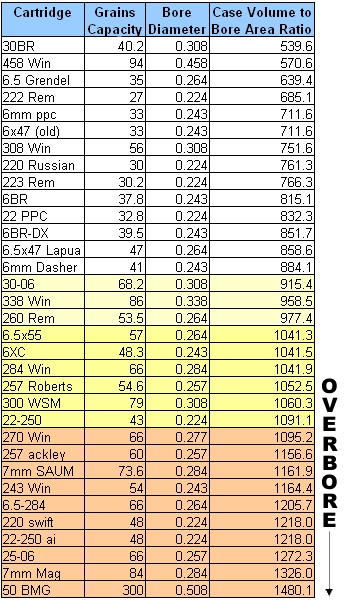
So what do these numbers mean? John says: “My own conclusion from much reading and analysis is that cartridges with case volume to bore area ratio less than 900 are most likely easy on barrels and those greater than 1000 are hard on barrels.” John acknowledges, however, that these numbers are just for comparison purposes. One can’t simply use the Index number, by itself, to predict barrel life. For example, one cannot conclude that a 600 Index number cartridge will necessarily give twice the barrel life of a 1200 Index cartridge. However, John says, a lower index number “seems to be a good predictor of barrel life”.
John’s system, while not perfect, does give us a benchmark to compare various cartridge designs. If, for example, you’re trying to decide between a 6.5-284 and a 260 Remington, it makes sense to compare the “Overbore Index” number for both cartridges. Then, of course, you have to consider other factors such as powder type, pressure, velocity, bullet weight, and barrel hardness.
Overbore Cases and Accuracy
Barrel life may not be the only thing predicted by the ratio of powder capacity to bore cross-section area. John thinks that if we look at our most accurate cartridges, such as the 6 PPC, and 30 BR, there’s some indication that lower Index numbers are associated with greater inherent accuracy. This is only a theory. John notes: “While I do not have the facilities to validate the hypothesis that the case capacity to bore area ratio is a good predictor of accuracy — along with other well-known factors — it seems to be one important factor.”
April 23rd, 2013
 Cabelas.com has just made available some of the hard-to-find Hodgdon propellants, in 1-lb containers. H4831sc, Benchmark, H380, Hybrid 100V, Retumbo, H414 are all showing as “in stock” with prices ranging from $22.99 to $27.99 per pound, with a $20.00 HazMat fee. There is a catch — purchasers are limited to two (2) pounds of any Hodgdon powder product per order, per day. The 1-lb containers of H4831sc are currently on sale at $25.99, marked down from $27.99. NOTE: Varget was available earlier today at Cabelas.com, but Varget actually sold out minutes before this story was published. Good luck grabbing some of the other powders! Cabelas.com has just made available some of the hard-to-find Hodgdon propellants, in 1-lb containers. H4831sc, Benchmark, H380, Hybrid 100V, Retumbo, H414 are all showing as “in stock” with prices ranging from $22.99 to $27.99 per pound, with a $20.00 HazMat fee. There is a catch — purchasers are limited to two (2) pounds of any Hodgdon powder product per order, per day. The 1-lb containers of H4831sc are currently on sale at $25.99, marked down from $27.99. NOTE: Varget was available earlier today at Cabelas.com, but Varget actually sold out minutes before this story was published. Good luck grabbing some of the other powders!
CLICK HERE: Cabelas.com Hodgdon Powder
April 20th, 2013
 Here’s good news for reloaders. Some large shipments of propellants were delivered in the last week, and we are starting to see supplies of some popular powders start to catch up to demand. Third Generation Shooting Supply received a very large order of Alliant Powders in one-pound containers, including the popular Reloder series. If you need RL15, RL19 or RL22 you may be able to grab some before it’s gone. TGSS has already sold nearly a ton of RL15 this week. Here’s good news for reloaders. Some large shipments of propellants were delivered in the last week, and we are starting to see supplies of some popular powders start to catch up to demand. Third Generation Shooting Supply received a very large order of Alliant Powders in one-pound containers, including the popular Reloder series. If you need RL15, RL19 or RL22 you may be able to grab some before it’s gone. TGSS has already sold nearly a ton of RL15 this week.
Natchez Shooters Supplies is featuring Vihtavuori powders, and the Natchez inventory system is showing supplies “in stock” for many of the most popular Vihtavuori powders including N320, N133, N135, N540, N150, N160, and N165. All these powders (including 8-lb jugs of N133) are shown “in stock” as of this morning, but we caution that things change quickly!
NOTE FOR LATE READERS: Inventory shown for 10:00 AM April 20, 2013.
Powder Valley Inc.
Partial List of In-Stock Powders
Hodgon H380 (1 lb.) — In stock at $18.35/lb
Hodgdon H1000 (8 lbs.) — In stock at $152.00 for 8 lbs.
Hodgdon Retumbo (1 lb.) — In stock at $21.35/lb
Hodgdon Superformance (8 lbs.) — In stock at $152.00 for 8 lbs.
Alliant Reloder 50 (1 lb.) — In stock at $19.15/lb
Alliant Reloder 50 (8 lbs.) — In stock at $137.50 for 8 lbs.
IMR 7828 (8 lbs.) — In stock at $147.80 for 8 lbs.
Norma 203B (1 lb) — In stock at $24.80/lb (this is nearly identical to Reloder 15)
Vihtavuori 3N37 (1 lb) — In stock at $29.95/lb
Vihtavuori N150 (1 lb) — In stock at $29.15/lb
Vihtavuori N160 (1 lb) — In stock at $29.15/lb
Third Generation Shooting Supply
Alliant Powders (Partial list)
Power Pro 4000 MR (1 lb.) — 961 lbs. in stock at $19.99/lb
Power Pro Varmint – (1 lb.) — 133 lbs. in stock at $19.99/lb
Reloder 10X – (1 lb.) — out of stock
Reloder 15 (1 lb.) — 733 lbs. in stock at $20.99/lb
Reloder 17 (1 lb.) — out of stock
Reloder 19 (1 lb.) — 2579 lbs. in stock at $20.99/lb
Reloder 22 (1 lb.) — 1797 lbs. in stock at $20.99/lb
Reloder 25 (1 lb.) — 109 lbs. in stock at $20.99/lb
Reloder 50 (1 lb.) — 36 lbs. in stock at $20.99/lb
Natchez Shooters Supplies
Vihtavuori Powders (Quantities Limited)
Vihtavuori Oy N3N37 (1 lb.) — In Stock at $31.49/lb
Vihtavuori Oy N320 (1 lb.) — In Stock at $31.49/lb
Vihtavuori Oy N133 (8 lbs.) — In Stock at $197.49 for 8 lbs
Vihtavuori Oy N133 (1 lb.) — In Stock at $30.49/lb
Vihtavuori Oy N135 (1 lb.) — In Stock at $30.49/lb
Vihtavuori Oy N150 (1 lb.) — In Stock at $30.49/lb
Vihtavuori Oy N160 (1 lb.) — In Stock at $30.49/lb
Vihtavuori Oy N165 (1 lb.) — In Stock at $30.49/lb
Vihtavuori Oy N540 (1 lb.) — In Stock at $34.99/lb
Editor’s Note: As with all inventory systems, there can be a variance between actual inventories and listed inventories. We are reporting what is shown “in-stock” this morning. But if the inventories are not updated in “real time” as shipments are made, true supplies may be less than what is shown.
April 18th, 2013
In most of the country “March Madness” is all about hoops. But in the Sacramento (CA) area, “March Madness” is a popular multi-match shootfest that brings out some of the top F-Class and sling shooters in the region. During this year’s Folsom Shooting Club March Madness series, Forum member Bob A. (aka “Killshot”) brought out his “Forum Classifieds Special” and beat all comers in the F-Class Division in both the American-Canadian Match and the Long Range Regional Match (See Results). Bob’s 6mm Dasher sports a blue-printed Rem 700 action. Who says you need a high-dollar custom action to run with the big dogs? In fact, this same gun, built with components sourced from Forum Classifieds, set a Sacramento F-Class range record of 200-17X. In this story, Bob talks about the build, and he explains his methods for loading ultra-accurate Dasher ammo.


Bob’s Budget-Build Dasher F-Classer
I’m a newcomer to F-Class competition and shot my first match in 2010. After getting accustomed to the match format and seeing what others were using, I wanted to build a proper rifle for F-Open but needed to keep it simple and, well, cheap. I found a solid “base” to build on in the form of a Dave Bruno-built, “pre-owned” 6-6.5×47 Lapua that I located in the AccurateShooter Forum classifieds in late 2011. The base action was a trued and blue-printed Remington 700 receiver circa 1971 with a spiral-fluted bolt. It was in a Shehane ST1000 stock painted sky blue and had a Jewell 1.5-oz BR trigger. I sent the bolt to Greg Tannel (Gretanrifles.com) to have the firing pin hole bushed and sleeved, the ejector removed and the hole filled and the face trued. I ugraded to Tannel’s Light Steel firing pin assembly while it was out.
Having the working bits completed, I needed a barrel. So I went to the AccurateShooter classifieds again and found a 1:8″-twist, 30″ x 1.25″ (diam.) Bartlein with a 0.236″-land bore. I called Dave Kiff and explained my pursuit and he recommended his PT&G “world record” 6 Dasher reamer (.2704″ no-turn neck and .104″ freebore). A month or so later the reamer and gauges arrived.

I had the barrel chambered by Marc Soulie of Spartan Precision Rifles (510-755-5293, Concord, CA). Marc is a great builder and I’m pleased to call him a friend. He is an outstanding shooter himself and developed his lathe skills from several “name smiths” I won’t mention here, all while he continued in his previous profession. Marc went into building custom rifles full-time a couple of years ago and is at the point in his career that word of his work has spread. He was recently selected by Frank Galli to create 25 rifles, each customized to the buyer’s specs, for the Sniper’s Hide 2013 Group Build. Marc has also built a number of tactical-style rifles for the Northern California Practical Precision Rifle Club’s shooters, several of whom have won or placed high in major matches.

After his great shooting in March, Bob reports: “I could not be happier with my little budget build. With a few more good scores I might even stop looking at BAT Machine’s website — my little old Remington action seems able to hold its own with the BATs and Kelblys just fine.
The rifle got its good looks from a Pennsylvania artist named Kenny Prahl. His Prahl Designs shop (724-478-2538) added the white ghost-flames over the existing sky blue metallic paint. Kenny’s work with an airbrush floored me, he does everything from stocks to mailboxes to gas tanks equally well.

“I use a Nightforce Benchrest 12-42x56mm with a NP-2DD reticle. To help my aging eyes I use a 3.5X BulzEyePro lens booster, I found it helped with mirage and target clarity enough that I rarely dial down the magnification even when mirage is bad.”
Looks Great, Shoots Better
Fire-forming showed great promise — ten-shot groups of half an inch at 200 yards were typical. I lost only one case to a split neck and the “blow lengths” are good and consistent.This was followed up with load development which saw 100-yard, five-shot groups in the .1s and .2s as the rifle showed its preference for Reloder 15 over Varget powder, and for CCI 450s over all other primers. The bullet of choice is the ever-popular Berger 105gr Hybrid Target.

In February 2012 I began shooting the Dasher in monthly club matches at the Sacramento Valley Shooting Center, the home range of a number of excellent F-Class, Benchrest and High Power shooters. Using a Farley Coaxial rest up front (also picked up from a WTB ad on AccurateShooter’s Forum) and an Edgewood bag in the back, I gradually improved my gun-handling to the point where I could shoot a respectable score. This was very different from the bipod shooting I’d done in the past in F/TR.

Like many others, I settled on the high-node dose of Reloder 15. Shooting F-Class puts a good number of rounds down the tube in a short time-frame. That can be hard on throats. At roughly the 1,200-round mark the groups started to grow as the throat wore. So, a barrel set-back was needed. The barrel was rechambered by another great California gunsmith, Ken Breda (831-334-2386, Aptos, CA). Ken, a sling shooter and all-around good guy, was able to get me back shooting with little down-time. When I went back to the range, I found the now 1.25″-shorter barrel shot equally well, even with the same load I had previously used.
An October Surprise — New Range Record, 200-17X
The chamber setback and muzzle cleanup brought the Dasher back to life and it was was really shooting well with several “cleans” shot at a few distances at club matches this summer. I shot the Folsom Shooting Club’s October match, this one a 3×600. I drew relay number two and settled in to spot and score for the shooter who drew relay one. The wind was very light and good scores were being posted. I set up for my first string and fired four sighters: three 10s and one X.
 “Here we go”, I thought as I went for record. Happily, the first six shots found the X-Ring before a 10 came up out of the pits. The next six shots also found the X-Ring, then another 10 came up. Shots 15 thru 19 were all Xs and I finished the string of twenty shots with a final 10. I’d cleaned the 600-yard F-Class target with 17 Xs! This was by far my best “clean” at any distance. “Here we go”, I thought as I went for record. Happily, the first six shots found the X-Ring before a 10 came up out of the pits. The next six shots also found the X-Ring, then another 10 came up. Shots 15 thru 19 were all Xs and I finished the string of twenty shots with a final 10. I’d cleaned the 600-yard F-Class target with 17 Xs! This was by far my best “clean” at any distance.
I followed the first string up with a 199-6X and a 195-7X as the wind was beginning to harrass everyone on their third strings. My final score of 594-30X gave me my first win in F-Open by one point. I was very happy and received many congratulations from fellow shooters after the match. It wasn’t until I arrived at the range for November’s match that I learned that my 200-17X was a new range F-Class record.
I couldn’t believe it. Considering the quality of shooters and the number of big matches held at Sacramento Valley, setting a range record of ANY type there is an accomplishment. I have been fortunate to meet and shoot with some absolutely fantastic people at the Sacramento Valley Shooting Center. It took a little while to find out just how talented some of them were — several are national champions and record-holders but you’d never know it talking to them. These guys have always been helpful to others. Likewise, I try to help out when new shooters need a hand.
 Dasher Loading Tips Dasher Loading Tips
My chamber is set up for Lapua’s current iteration of 6mmBR brass, in the blue plastic boxes. My case preparation is straight-forward. I fire-form with virgin cases right out of the box. I don’t size them but I will give the primer holes a good look and clean up the flash hole with a .058″ bit in a pin vise. To fire-form, I seat a Berger 108gr BT .030″ into the lands over a standard 6mmBR load of Varget.
For my match load, I use Alliant Reloder 15. We shoot year-’round in Northern California. It was a brisk 28º at the start of our January match this year. Your load needs to be able to carry you from that cold to the 100º+ heat we get in the summer months. While Varget is less sensitive to temperature changes, RL15 gives me lower spreads and better long range control.
I clean my fired cases with stainless steel media in a Thumler’s rotary tumbler after every firing. I anneal after every other firing using a Bench-Source machine which is very well made and easy to operate. I use a Whidden full length bushing die with Redding bushings for sizing.
After sizing, I chamfer the inside of the neck with the K&M tool which has a pilot rod centered in the flash hole. Then I’ll give the neck and mouth a “once over” with some 0000 steel wool. I finish loading off with a Redding Competition Seating Die with the micrometer top.
 I use a carbide ball on the expander rod of the full length sizing die. I use a .266″ TiN-coated bushing and the ball just kisses the inside walls of the sized neck. I get very consistent neck tension this way and have had no issue with split necks. I use a carbide ball on the expander rod of the full length sizing die. I use a .266″ TiN-coated bushing and the ball just kisses the inside walls of the sized neck. I get very consistent neck tension this way and have had no issue with split necks.
Seating Depth Considerations
With fire-formed brass, the junction of the bullet’s bearing surface and boat-tail is above the neck/shoulder junction of the case, so I have no issues with donuts. You can see how a loaded round looks in the photo at left. For occasional trimming, I use a very nice little Possum Hollow trimmer that indexes on the case shoulder.
April 12th, 2013
We all know that reloading components are in very short supply these days — bullets, brass, powder — you name it. Every day we get calls and emails from guys trying to find these items. Here’s a tip for those of you who need high-quality brass: Midsouth Shooters Supply carries Norma Brass, and Midsouth has this brass for many popular cartridge types IN STOCK now. Here’s a partial list of unprimed Norma brass available for purchase at Midsouth as of April 12, 2013:
NORMA Brass IN-STOCK at Midsouth Shooters Supply (Partial List)
| 6MM PPC RIFLE BRASS 25ct |
Item: 013-10260105 |
Price: $22.72 |
| 6MM BR Norma RIFLE BRASS 25ct |
Item: 013-10260155 |
Price: $22.72 |
| 6MM XC RIFLE BRASS 25ct |
Item: 013-10260185 |
Price: $24.66 |
| 222 REM RIFLE BRASS 25ct |
Item: 013-20257115 |
Price: $15.13 |
| 22-250 REM RIFLE BRASS 25ct |
Item: 013-20257315 |
Price: $22.72 |
| .260 REM RIFLE BRASS 25ct |
Item: 013-20266025 |
Price: $28.42 |
| 6.5×55 REM RIFLE BRASS 25ct |
Item: 013-20265515 |
Price: $20.84 |
| 6.5-284 RIFLE BRASS 25ct |
Item: 013-20265285 |
Price: $31.79 |
| 270 Win RIFLE BRASS 25ct |
Item: 013-20269015 |
Price: $24.69 |
| 280 REM RIFLE BRASS 25ct |
Item: 013-20270505 |
Price: $27.82 |
| .30-06 Springfield BRASS 25ct |
Item: 013-20276405 |
Price: $25.46 |
| 300 WSM BRASS 25ct |
Item: 013-20276765 |
Price: $48.11 |

April 11th, 2013
Sinclair Int’l now carries Bullet Sample Packs from Bullet Proof Samples LLC. These 12-bullet packs are available for Berger, Barnes, and Nosler bullets in popular weights, types, and calibers. With the sample packs, during load development, you can try out a variety of projectiles without investing in an entire box of each type. That’s smart. Sample packs range in price from $5.99 to $15.99 (for twelve bullets per pack). Most of the Berger bullet packs are priced under $10.00, with many in the $6-$7 range.

CLICK HERE for the Sinclair Int’l bullet sample pack webpage. (Once there, select Barnes, Berger, or Nosler). You’ll also find the sample packs on page six of the Sinclair Int’l print catalog. To place an order, or for additional information, call 800-717-8211 or visit www.sinclairintl.com.
|


