We first featured this story in 2010, but the results of this rimfire ammo test have been of such widespread interest that we try to bring the test to readers’ attention every year.
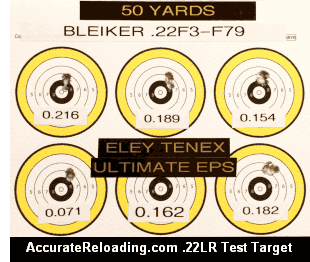
In 2010, the staff of AccurateReloading.com Forum completed a massive .22LR Rimfire Ammunition Testing Project. Some 55 different types of ammo were tested, using a highly-accurate Swiss-made Bleiker rifle, with a 2-stage trigger. All ammo varieties were tested at 50 yards, 75 yards, and 100 yards, shooting five, 5-shot groups at each distance. Though these tests were completed some time ago, many readers have requested a “reprint” of the ammo rankings, so we’ve republished this data below.
The results are fascinating to say the least (and perhaps eye-opening). The tester observed: “I got some amazing groups, and some which are, frankly, absurdly bad! This has re-enforced what I had experienced with 22 ammo in the past — that is being consistently inconsistent.”
While we strongly caution that .22LR rimfire ammo may work well in one gun and not another, and ammo performance can be improved through the use of barrel tuners, the AccurateReloading.com research provides invaluable guidance for smallbore shooters. Overall, the testers burned through over 4,000 rounds of ammo, and you can see the actual test targets online. To read all the test reports, and view target photos visit AccurateReloading.com.
0.162 Eley Tenex Ultimate EPS
0.164 Lapua Midas Plus
0.177 Lapua Polar Biathlon
0.187 Eley Match EPS
0.193 Eley Match
0.203 Lapua Midas M
0.215 Lapua Center X
0.216 Western Value Pack
0.229 Lapua Signum
0.241 Lapua Master L
0.243 Eley Pistol Match
0.256 Olin Ball
0.256 Akah X-Zone
0.261 Lapua Midas L
0.261 Lapua Master M
0.263 Eley Tenex Semi Auto
0.270 Lapua Super Club
0.272 Eley Tenex
0.303 Lapua Standard Plus
0.312 CCI Standard Velocity
0.319 RWS R 50
0.319 Eley Standard
0.328 SK High Velocity
0.339 Eley Club Xtra
0.340 Winchester T22
0.356 Federal Champion
0.362 Eley Subsonic HP
0.371 CCI Mini Mag
0.376 Federal American Eagle
0.377 Norinco Target
0.380 Sellier & Bellot Club
0.384 Eley Club
0.387 Eley Sport
0.388 Totem
0.392 Swartklip Match Trainer
0.398 Federal Gold Medal
0.403 Swartklip HV
0.409 Eley Match Xtra Plus
0.424 Sellier & Bellot Std
0.443 Remington Target
0.461 Lapua Crow HP
0.475 Eley Silhouex
0.479 Magtech
0.498 Eley High Velocity
0.513 Winchester Super X
0.516 Kassnar Concorde
0.539 CCI Blazer
0.560 Winchester Supreme Pistol
0.576 Norinco Pistol Revolver
0.593 SK Standard
0.611 Sellier And Bellot HP
0.626 SK Standard HP
0.686 Logo HV
0.956 Pobjeda Target
0.274 Lapua Center X
0.283 Lapua Standard Plus
0.295 Eley Tenex Ultimate EPS
0.307 Lapua Midas M
0.329 Lapua Master M
0.346 Eley Match
0.373 Lapua Polar Biathlon
0.399 RWS R 50
0.432 Lapua Midas L
0.448 Eley Tenex Semi Auto
0.467 Eley Match EPS
0.474 Lapua master L
0.491 Eley Match Xtra Plus
0.494 CCI Standard
0.496 Eley Subsonic HP
0.507 Eley Sport
0.512 Federal American Eagle
0.513 SK High Velocity
0.514 Eley Standard
0.516 Eley Tenex
0.516 Lapua Crow HP
0.532 Western Value Pack
0.533 Fed. Champion Target
0.535 Lapua Midas Plus
0.564 Akah X Zone
0.566 Olin Ball
0.573 Eley Club Xtra
0.616 Lapua Signum
0.631 Winchester T22
0.639 Swartklip HV HP
0.641 Eley Club
0.642 Eley Silhouex
0.647 CCI Mini Mag
0.679 Eley Pistol Match
0.682 Swartklip Match Trainer
0.690 Federal Gold Medal
0.692 Remington HV
0.703 Lapua Super Club
0.720 Winchester Super X
0.738 Eley High Velocity
0.759 Kassnar Concorde
0.765 Sellier And Bellot Club
0.770 Winch. Supreme Pistol
0.770 Norinco target
0.775 CCI Blazer
0.802 Norinco Pistol Revolver
0.841 LVE Logo HV
0.855 Sellier & Bellot Std
0.871 Magtech
0.923 Sellier & Bellot HP
0.934 SK Standard HP
1.017 Remington Target
1.257 Totem Standard
1.442 SK Standard
1.578 Pobjeda target
0.455 Eley Match
0.510 Lapua Midas Plus
0.549 Lapua Midas M
0.611 Lapua Polar Biathlon
0.611 Eley Tenex Ultimate EPS
0.619 Eley Match EPS
0.622 Eley Club
0.630 Lapua Center X
0.631 RWS R50
0.679 Eley Tenex Semi Auto
0.694 Lapua Midas L
0.729 Eley Tenex
0.739 Lapua Master L
0.753 Lapua Super Club
0.785 Lapua Master M
0.831 Eley Sport
0.851 Eley Match Xtra
0.859 Lapua Standard Plus
0.867 Akah X-Zone
0.877 Eley Pistol Match
0.907 Norinco Target
0.924 Eley Silhouex
0.939 CCI Standard
0.952 Eley Subsonic HP
0.963 Magtech
0.970 Olin Ball
0.978 Kassnar Concorde
0.995 Eley Club Xtra
1.009 Western Value Pack
1.032 Federal Champion
1.087 Norinco Pistol Revolver
1.100 CCI Mini Mag
1.112 Lapua Crow HP
1.143 Winchester T22
1.142 Federal Gold Medal
1.144 federal American Eagle
1.156 Swartklip Hollo Point
1.165 Lapua Signum
1.170 Swartklip Match Trainer
1.175 Fed. Champion Value Pk
1.182 SK high Velocity
1.201 Totem
1.224 Winchester Super X
1.358 Eley Standard
1.367 Remington High Velocity
1.375 CCI Blazer
1.414 Eley High Velocity
1.450 Remington Target
1.504 LVE Logo
1.813 SK Standard
1.879 S&B Club
1.947 S&B Hollow Point
2.073 SK Standard HP
2.221 S&B Standard
2.266 Pobjeda Target
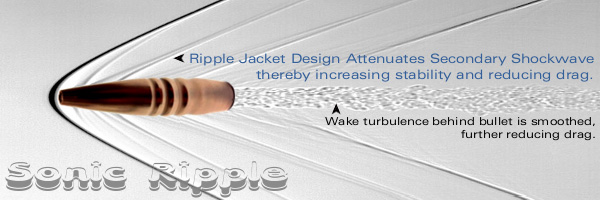
At the end of this year, Berger Bullets plans to introduce a new projectile that may truly be the most revolutionary bullet design since the advent of jacketed spitzers in the late 19th Century. Berger’s new bullet is unlike anything we have ever seen before. It features concentric curved ridges, or “ripples”, on the bearing surface. Tests show that this new projectile, dubbed the “Sonic Ripple Bullet”, has signficantly less drag than conventional bullets (no matter what their ogive configuration). In addition, the Sonic Ripple design provides increased stability at all velocities (allowing barrels with slower twist rates for a given bullet weight).
So, what does all this mean in practical terms? Well, compared to conventional bullets (of similar weight/size), the Sonic Ripple Bullet will shoot a flatter trajectory, buck the wind better, retain energy longer, and remain stable for a much longer distance. That’s big news for competitive shooters, tactical shooters, and long-range hunters.
The Science of the Sonic Ripple Bullet Design
Bryan Litz, Ballistician for Berger Bullets, explains: “This radical leap forward in bullet design was made possible by advanced, new bullet-making technologies. The unusual bullet appearance is only part of the revolutionary ‘Sonic Ripple’ system. The curvilinear waves or ripples in the bullet jacket are designed to create a specific resonance when fired from a specially ‘tuned’ barrel system. The result is an optimization of the sonic wavefront created by the bullet as it travels through its trajectory. This wavefront optimization simultaneously reduces bullet drag while increasing bullet stability.”
In essence, the supersonic shock-wave is smoothed out, dramatically reducing secondary wave fronts. This is all good, as Bryan explains: “If all the internal ballistic requirements are met, the Sonic Ripple bullet exits the muzzle with a harmonically-stabilized launch dynamic. As a further benefit of the ripple design, tests show that the concentric ripples also enhance boundary layer airflow attachment on the bullet. This, in turn, dramatically reduces wake turbulence and attendant drag.”
The reduction of wake turbulence (combined with wavefront optimization) represents a “major breakthrough” which should increase projectile BC by at least 0.14 (on G7 scale), according to Bryan. But, we wondered, might the increased surface area associated with the ripples slow the bullet down in flight? Actually, no. Bryan explained: “Eddies in the boundary layer around the ripples actually lower skin friction drag which more than compensates for increased surface area, resulting in a net friction drag loss at all velocities — both supersonic and transonic.”
Sonic Ripple Bullets Available by the End of 2013
When will we see Sonic Ripple Bullets on dealers’ shelves? Maybe this year. Berger’s marketing department told us: “The Sonic Ripple technology is currently under development and is expected to mature enough for commercial application by late fall, 2013.”
Berger Bullets has released its “new and improved” Ballistics Calculator on the Berger Bullets website. Much work, and several weeks of testing, went into Berger’s new web-based ballistics calculator. But Berger is pleased to announce that the handy Balllistics Calculator is now up and running! CLICK HERE for Calculator.
How to Use Berger’s Ballistic Calculator
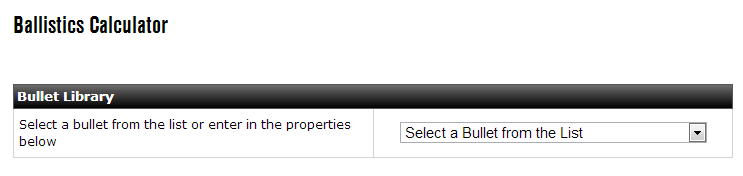
On the top of Berger’s home-page you’ll find a link that says “Ballistics”, with a drop-down menu for Berger’s Twist Rate Calculator and Ballistics Calculator. When using the Ballistics Calculator, the first element you’ll see is the bullet library. This convenient tool automatically fills in the bullet properties fields with the correct information when you select a bullet from the list.
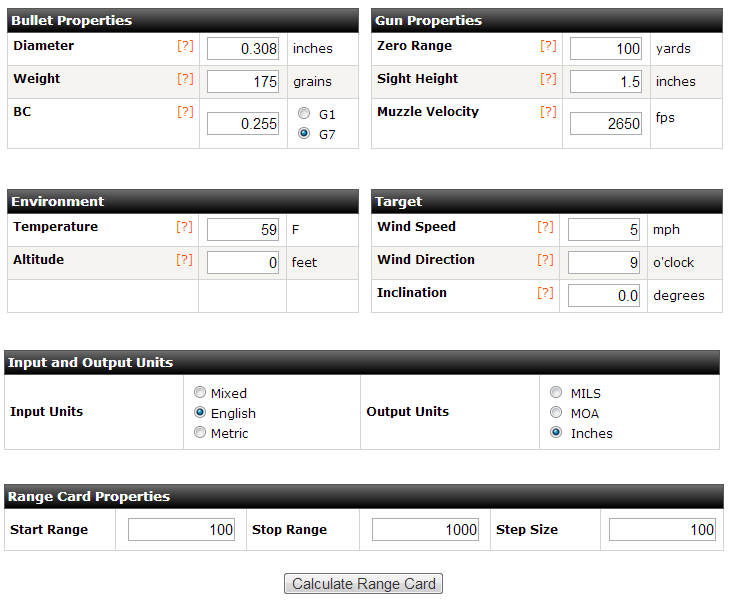
Below, you will see the bullet properties fields are filled in with the 30 Cal 175gr VLD Berger Target Bullet information. You would then manually change the Gun Properties, Environment, Target, and the rest of the fields to correspond with the conditions you will be shooting under. After you have filled in all the variables properly, click “Calculate Range Card” to generate a ballistic solution showing your load’s trajectory, with come-up values at various distances.
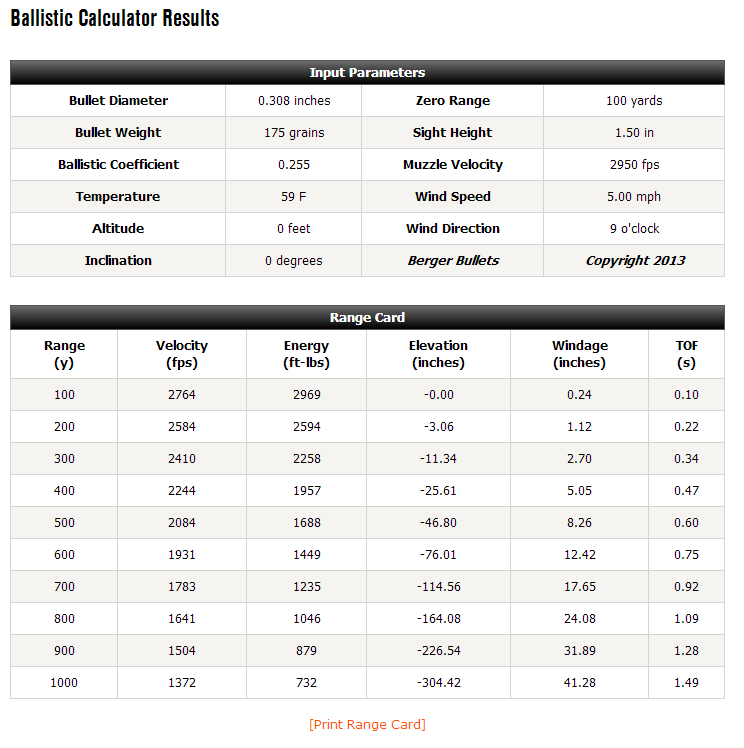
Once the Calculator Results are given, you can print them out and take them with you to the range or on your hunt. Here is an example of the calculated results:
If you have questions about the Ballistics Calculator CLICK this link or use the contact info below. Berger also plans to release a mobile version of the Ballistics Calculator in the near future. This should work well on smart-phones and tablets, so watch for it!
Berger Bullets
Marketing and Shooter Services
Phone: 714-447-5422 (option 2)
M-F 8am to 4:30pm pst
Story tip from EdLongrange. We welcome reader submissions.
Traditions™ Performance Firearms is bringing out a complete line of dummy training cartridges. These will meet SAAMI specs for dimensions, and the dummies are weighted so they handle just like the real thing. Training cartridges will be offered for all firearms types: Rifle, Pistol, and Shotgun. Forty different rifle cartridge types — everything from .17 Rem to 50 BMG — will be for sale later this year. Yes there is .22LR, but unfortunately, the 6PPC, 6mmBR, 6XC, 6.5-284, and .284 Win are not yet in the line-up.
Traditions™ Training Cartridges are the only training cartridges available that meet all SAAMI (Sporting Arms and Ammunition Manufactures Institute) specifications for dummy ammunition. The Training Cartridges are weighted like real ammunition so they have the same feel when practicing. These training cartridges are intended for function testing, dry-firing, malfunction drills, and teaching demonstrations.
Traditions™ precision Training Cartridges have durable brass cases and rims so they won’t degrade like plastic dummies. Precision-assembled, these are available in over 60 chamberings and shotgun gauges. For most of the common rifle calibers, these training cartridges cost about $10 for a pack of two (2) dummy rounds. For more information or to view Traditions™ complete line of products, go to TraditionsFirearms.com, or call 1-860-388-4656.
Traditions Training Cartridge Types for Rifles
.17 Rem
.204 Ruger
.22LR
.22 Hornet
.222 Rem
.223 Rem
22-250 Rem
.223 WSSM
6mm Rem
.243 Winchester
.243 WSSM
.257 Roberts
.25 WSSM
.25-06 Rem
.260 Rem
6.5×55 Swedish
6.8 Rem SPC
.270 Winchester
270 WSM
7mm-08
7mm WSM
7mm Rem Mag
7×57 Mauser
.303 British
.30 Carbine
.30-30 Winchester
7.62×39
.308 Winchester
300 WSM
.30-06 Spr
.300 Rem UM
300 Win Mag
8×57 Mauser
.338 Rem UM
.338 Winchester Mag
35 Whelen
.375 H&H
.458 Win Magnum
.45-70
50 BMG
To celebrate its 90th Anniversary, Lapua has developed a special new web site with many cool features including contests, product videos, and an interactive shooting game. You’ll find an interesting historical timeline recounting the history of Lapua starting in 1923. The timeline covers development of the factory, important product releases, competition successes, and other important milestones.
Submit your “Best Shot” and Win Prizes
On the site, Lapua invites readers to submit a short description of their “best shot” made with Lapua ammo or components: “Sometimes things just click. When did you have your moment of absolute precision? Share it with us…” Prizes will be awarded each month for the most impressive “best shot” stories submitted by readers. CLICK HERE for more info.
Play Interactive Biathlon Game
Site visitors can play an interactive shooting game featuring Biathon rifles and Lapua Polar Biathlon .22LR Ammo (other rifles and shooting disciplines will be added in the future). You’ll want to visit the Biathlon Game Page to see all the features, but we’ve embedded a sample here so you can see how it works. NOTE: you may have to use the scroll bars at the bottom and right sides. (This is because the game format is larger that our Bulletin “real estate”).
Here’s a Ballistics Trivia challenge, put together by Bryan Litz of Applied Ballistics LLC. Bryan is Berger Bullets’ Ballistician and the author of Applied Ballistics for Long Range Shooting. Bryan posed the following Ballistics Question about Kinetic Energy and Aerodynamic Drag:
Consider a .30 caliber 175 grain bullet with a G7 BC of .259 (Berger 175 OTM) fired level at a muzzle velocity of 2650 fps in standard (ICAO) sea level conditions.
As this bullet flies downrange, it loses velocity due to aerodynamic drag. As the velocity of the bullet decays, so does its Kinetic Energy (in ft-lbs). The Kinetic Energy lost by the bullet in a given amount of time can be defined in terms of power.
Another way to think about this is that the aerodynamic drag on the bullet can be expressed in terms of power, calculated from the projectile’s change in Kinetic Energy over flight time.
Question: How much power (expressed in Watts) is applied to the bullet by aerodynamic drag on average over:
A) 500 yards?
B) 1000 yards?
C) 1500 yards?
Guesses are welcome, but this one can be calculated exactly.
If you have a rifle chambered in .260 Remington, you may be wondering if the Lapua .260 Brass is worth the money compared to domestic-made brass. Well, the answer is “yes” if you demand consistent weight and dimensional uniformity (including neckwall thickness).
Mike Harpster of Dead Center Sports took the time to weigh and measure Lapua .260 Rem brass. His test show this brass to be extremely uniform. Weight variance was less than one (1) grain in a 20-case sample. And case neckwall thickness was very consistent.
Report by Mike Harpster: Lapua .260 Rem Brass Test Results (with Comparisons)
I pulled twenty (20) pieces randomly from one Lapua box to do some measurements. I weighed them on my Mettler-Toledo digital lab scale and here are the individual weights of each case. Remarkably, the Lapua brass had less than one grain total weight variance among all 20 cases!
While checking the Lapua brass I remembered I had just received some Winchester brand .308 brass, so I thought it would be interesting to do a comparison between the two brands. I again pulled 20 cases at random from a bag of 50 and repeated the same measurements. The results are shown in the right half of the table below.
Weight Variance Lapua .260 Rem Brass vs. Winchester .308 Brass
LAPUA .260 Rem Brass
Winchester .308 Win Brass
Average: 172.20 grains
ES: 0.94 grains
SD: 0.259
Average: 158.49 grains
ES: 2.64 grains
SD: 0.678
Lapua Brass Further Inspection
With sample Lapua .260 Rem cases, I also measured the neck wall thickness in four places with calipers, not the most accurate method but I feel confident that the thickness did not vary more than .001″ over the 20 cases (.0145-.0155). The inside diameter of the neck measured .260 which would give .004 of neck tension out of the box. I visually checked the flash holes and I did not find any flakes of brass or burrs inside, the holes were round and centered.
Winchester Brass Further Inspection
The flash holes on the majority of the Winchester brass were not round or centered and they had large burrs inside. The neck wall thickness was pretty consistent, varying only .0015″ (.0125″ – .014″). As you can see in the photo (right) many of the Winchester cases were badly dented while the Lapua brass showed very few minor dents. The annealing on the necks of the Lapua brass was clearly evident while the Winchester showed no signs of being annealed. [Editor’s note: Winchester tumble-polishes its brass before shipping — so you would not notice annealing coloration if annealing had been done.]
I have never done these measurements on any other brass so I don’t know how they compare, but I am very impressed with the overall quality of the Lapua .260 brass. If they prove to hold up to the repeated firings I get from my Lapua 6BR brass I believe .260 shooters wil be very happy.
Mike Harpster — Dead Center Sports
105 Sunrise Drive
Spring Mills, PA 16875
phone: 814-571-4655 www.deadcentersports.com
Reloading components are in short supply right now — bullets, brass, powder, primers — you name it. But here’s some good news. Powder Valley Inc. (PVI) has received a huge shipment of Berry’s Mfg. plated bullets. PVI’s president Bryan Richardson said his company now has seven (7) tons of Berry’s bullets in stock, mostly copper-plated pistol bullets. PVI now has Berry’s bullets in all the popular pistol calibers, including: .32 (0.312), .380 (0.356), 9mm, .38/357, .40/10mm, .44 (0.429), and .45 (0.452). PVI also has some Berry’s rifle bullets in stock for: .30 carbine, 7.62×39, and 45-70.
These days, quality .338 Lapua Magnum brass is hard to locate — and expensive when you can find it. Here’s a money-saving solution for you .338 LM shooters. Grafs.com has acquired a large quantity of once-fired .338 Lapua Mag cartridge brass. This brass bears the “NT” headstamp, but Graf’s says this brass is “manufactured by Lapua, to Lapua specs”. Cost is $159.99 for one hundred (100) cases. That price includes shipping charges, but there is one $6.95 handling fee per order. This .338 LM brass is IN-STOCK as of March 5, 2013.
How does that price compare to brand-new Lapua-made .338 LM brass? MidwayUSA sells a box of 100 Lapua-made .338 LM cases for $257.99, but MidwayUSA is “out of stock” with no back-orders being taken. Elsewhere we’ve seen Lapua-made .338 LM brass sell for up to $289.00 per hundred.
Product tip from EdLongrange. We welcome reader submissions.
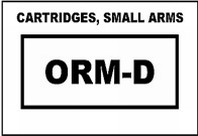
The days of the “ORM-D: Small Arms Cartridges” labels for ammo shipments are numbered. The Dept. of Transportation (DOT) is phasing out the current ORM-D ammo labels, replacing them with a larger striped diamond label that does not mention “Small Arms Cartridges”. This change is designed to harmonize U.S. shipping rules with United Nations standards. You can start using the new “Limited Quantity” diamond labels for ammo shipments right now, but the new labels are not yet mandatory. You can continue to use the old ORM-D “Cartridges, Small Arms” labels until December 31, 2013. As of January 1, 2014 you MUST use the Striped Diamonds.
OFFICIAL UPS RULES — Elimination of ORM-D Classification In an attempt to harmonize and align with international standards, the DOT has amended the 49CFR regulations regarding the ORM-D classification. Effective January 19, 2011, with the publication of the HM-215K final rule, the hazard class of ORM-D is being eliminated. Those materials may still be shipped classified as a limited quantity (“Ltd Qty”). In conjunction with ORM-D hazard class elimination in HM-215K, limited quantity ground shipments will no longer require shipping papers when prepared under the new rule. This includes those materials previously classed as Ltd Qty that required shipping papers via ground transport.
Ground Ltd Qty Marking
Air Ltd Qty Marking
NOTE: These illustrations are not true to scale. The actual default Ltd Qty Diamond label to be used for ammo shipments is much larger, about 5″ per side. A smaller 2″ per side version of the Ltd Qty striped diamond can be used on smaller packages.
There is a transition period for shippers to comply with the new classification, marking and labeling requirements. Until December 31, 2013 a limited quantity package containing a consumer commodity as defined in 171.8 may be reclassed as ORM-D, or until December 31, 2012 for ORM-D-Air material. UPS began accepting materials with the new markings effective April 1, 2011. Note: To be in compliance with TDG, Standard (ground) Ltd Qty shipments to Canada prepared under HM-215K require the verbiage ‘Limited quantity’ or ‘Ltd qty’ to also be marked on the carton.
Download OLD and NEW Label Formats
On the Parallax Curio and Relic Forum, a thread includes PDF samples of both the new Diamond Ltd Qty Labels and the current ORM-D Labels. The thread explains: “The good news is the new label doesn’t have any indicator that the package contains ammunition. The bad news is the new label is gigantic compared to the old ORM-D label. You are required to use one of the larger labels on one side of any package containing ammunition. If the package is too small for one of the larger labels then you are permitted to use one of the smaller labels instead. Because of the size requirement in the regulations, you only get two of each label on standard piece of printer paper.”
If you want to still use the ORM-D Small Arm Cartridges Labels until the new Diamond Labels are mandatory, here are links to PDF sheets of ORM-D labels. These PDFs have many rows of labels per page so you can save printer paper. The black version and blue version will use up more printer ink, so you might want to use the white version to be more economical.


 In 2010, the staff of AccurateReloading.com Forum completed a massive .22LR Rimfire Ammunition Testing Project. Some 55 different types of ammo were tested, using a highly-accurate Swiss-made Bleiker rifle, with a 2-stage trigger. All ammo varieties were tested at 50 yards, 75 yards, and 100 yards, shooting five, 5-shot groups at each distance. Though these tests were completed some time ago, many readers have requested a “reprint” of the ammo rankings, so we’ve republished this data below.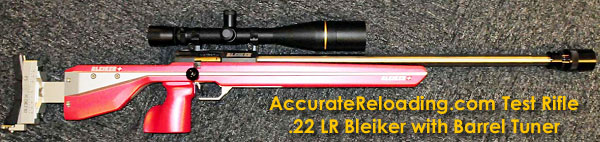


 The Science of the Sonic Ripple Bullet Design

 If you have questions about the Ballistics Calculator
 Traditions™ Training Cartridges are the only training cartridges available that meet all SAAMI (Sporting Arms and Ammunition Manufactures Institute) specifications for dummy ammunition. The Training Cartridges are weighted like real ammunition so they have the same feel when practicing. These training cartridges are intended for function testing, dry-firing, malfunction drills, and teaching demonstrations.

 Consider a .30 caliber 175 grain bullet with a G7 BC of .259 (Berger 175 OTM) fired level at a muzzle velocity of 2650 fps in standard (ICAO) sea level conditions.
 If you have a rifle chambered in .260 Remington, you may be wondering if the Lapua .260 Brass is worth the money compared to domestic-made brass. Well, the answer is “yes” if you demand consistent weight and dimensional uniformity (including neckwall thickness).
 Average: 172.20 grains
 Average: 158.49 grains
 Lapua Brass Further Inspection

 In an attempt to harmonize and align with international standards, the DOT has amended the 49CFR regulations regarding the ORM-D classification. Effective January 19, 2011, with the publication of the HM-215K final rule, the hazard class of ORM-D is being eliminated. Those materials may still be shipped classified as a limited quantity (“Ltd Qty”). In conjunction with ORM-D hazard class elimination in HM-215K, limited quantity ground shipments will no longer require shipping papers when prepared under the new rule. This includes those materials previously classed as Ltd Qty that required shipping papers via ground transport.