Fiocchi of America is recalling various lots of 22-250 Remington and .243 Winchester centerfire rifle ammunition. There is a serious safety issue affecting certain lots of Fiocchi ammo types: 22250B, 22250HVD, 243SPB, 243HSB, and 243SPD. The problem involves the loading of multiple bullets in a single cartridge. If you have any Fiocchi ammo from the affected product lots listed below you should return it immediately. The following ammunition products are affected by this recall:
Text of Fiocchi’s Recall Notice:
Through extensive evaluation Fiocchi has determined that the above lots of 22-250 and 243 may have been loaded with multiple bullets that can cause excessive pressure. This ammunition with multiple bullets may cause firearm damage rendering the firearm inoperable, and subject the shooter or bystanders to a risk of personal injury when fired. DO NOT USE THE ABOVE LISTED FIOCCHI 22-250 REM. OR 243 WIN. AMMUNITION OF SPECIFIED LOT NUMBERS. The ammunition lot number is black ink stamped inside one of the box end tuck flaps that you would open to remove the 20-round carrier.
To determine if your ammunition is subject to this notice, review the ITEM and LOT NUMBER. If the item number AND last three digits of the lot number match the above listed products, please return the ammunition to FIOCCHI of America via United Parcel Service (UPS) or FedEx Ground. Securely pack the ammo in a strong fiberboard box with packing materials to make it “snug” in the box. You will need an “LQ” label to ship the ammunition. To get the “LQ” label, [CLICK this LINK] or you can call the factory customer service directly at 417-449-1039 or email service@fiocchiusa.com prior to shipping. Affix the “LQ” label to the package with packing tape ensuring that all sides are adhered to the carton and ship to:
FIOCCHI OF AMERICA, INC., ATTN. Recall, 6930 N. FREMONT RD., OZARK, MO 65721
Fiocchi will provide replacement product upon receipt of your return. Please include your name, street address, phone number (required for return shipping), and email address with your return. Ammunition cannot be shipped to post office boxes.
This notice only applies to above listed Fiocchi 22-250 Rem. and 243 Win ammunition with the above lot numbers. If you have questions concerning this ammunition recall, please call customer service directly at 417-449-1039, write to the above address, email service@fiocchiusa.com, or visit our website, www.fiocchiusa.com.
Wolf Match Target and Wolf Match Extra ammunition is justifiably popular with competitive 22 LR shooters. Wolf Match Target, at $4.90-$6.20 per box, shoots as well as many types of 22 LR ammo costing much more. (Price varies with quantity purchased.) We recently chronographed Wolf Match Extra ammo (using multiple chronographs), and it showed lower ES and SD than some lots of much more expensive Eley ammo. But Wolf rimfire ammo is often in short supply.
SK Ammo — Made by the Folks Who Make Wolf
What to do? Here’s a tip — if you like Wolf Match, try the SK match ammo. SK Jagd Munitions actually manufactures Wolf Match ammo. The gold-box, SK-brand ammo is made in the same German plant as Wolf , and testing shows SK can deliver the same accuracy and reliability as Wolf. The SK Standard Plus is the equivalent of Wolf Match Target, while the SK Rifle Match is the equivalent of Wolf Match Extra. SK offers a wide range of rimfire match ammo at affordable prices. Here are current offerings at Champion Shooters Supply:
SK Rifle Match: $7.90 (50-rd box)
SK Pistol Match: $6.00 (50-rd box)
SK Standard Plus: $5.00 (50-rd box)
SK HiVelocity: $6.50 (50-rd box)
SK HiVelocity SPC: $6.50 (50-rd box)
SK Subsonic: $6.50 (50-rd box)
SK Rifle Match:
“I’ve tried over 20 different brands of match .22LR in my Anschutz 1907 including the various Wolf, RWS, Aquila, Lapua, and Eley loadings and the SK Match was one of the best. It was VERY consistent. 10 shot groups of 0.25″ to 0.3″ are the norm at 50 yards. Unlike most of the other less expensive ‘match’ ammo, the SK has yet to throw a bad flyer in 500 rounds. The Eley Tenex Ultimate EPS and Match EPS gave similar results. I consider the SK Match to be the best value for my rifle.” — D. Fletcher, TN
SK Standard Plus::
“I bought this because the Wolf MT is getting hard to find. This is the same ammo as the Wolf. I tried it in all my rifles and get about the same groups as the Wolf. Had no problems with this ammo and recommend it highly.” — H. Disharoon, VA
“Oh No — The secret’s out! For an exceptional price, this is absolutely the best .22 target ammo. I use it mainly in my Custom Ruger 10/22. CZ 452s just love this stuff. A majority of the silhouette shooters at my club use ‘SK Std Plus’ during matches and practice. I have shot cases of this stuff and can only count very few fliers.” — J. Batterton, AR
Berger Bullets has announced a new series of “Classic Hunter” Hybrid bullets designed to fit and feed in magazines and perform well in barrels with SAAMI standard chambers. Berger’s Eric Stecker explains: “For the first time in Berger’s history we’ve purposefully designed Hybrid-shaped hunting bullets that comply with the restrictive dimensional standards set by SAAMI. We did this so that hunters can shoot ammo loaded with Berger Hunting bullets in their factory rifles while feeding through a magazine.”
Berger came up with a new hunting bullet design because SAAMI standard dimensions significantly limit the length of the nose (negatively affecting external ballistics performance) in two ways. First, the length from the end of the neck to the tip of the bullet of SAAMI standard ammo is typically so short that to make an ogive that will allow bearing surface to be forward of the neck it must be blunt and therefore have a low BC. The other way SAAMI limits nose length is by specifying longer throat lengths than are optimal. Stecker notes: “When you have a long throat, the nose can’t be too long or the jump to the rifling is considerable. This is typically bad for precision and accuracy. So what you end up with is stubby nose bullets with low BC and poor external ballistics performance.”
To overcome SAAMI-imposed design contraints, Berger’s Bryan Litz designed Hybrid hunting bullets with noses short enough to conform to SAAMI dimensional standards. These bullets should be popular among those who hunt with factory rifles and feed their ammo through a magazine. The bullets use a dual-curve ogive design. As you move forward along the bearing surface, the ogive curve starts as a tangent tangent curve (which is forgiving of seating depth). As you continue forward on the nose the tangent curve transitions into a secant curve. Secant ogives are known to be more efficient in the wind (VLD bullets are pure secant ogives).
When you combine these two shapes you get the best of both worlds (less sensitivity to seating depth differences and improved external ballistics performance). Since these new Berger Classic Hunter bullets must have a nose length that is short enough to comply with SAAMI standards we get the most external ballistics performance possible by making the nose with Bryan’s Hybrid design.
Eric Stecker is enthusiastic about the new Hybrid Hunting Bullets: “We know that this bullet design works [well] because we tested it not only in media but also on game. I took these bullets with me to New Zealand to test them on several animals of various sizes and at various ranges. I know from firsthand experience that hunters who try this bullet in the field will be happy that they did.”
Product Tip by EdLongrange. Product Photos by Robert Whitley, 6mmAR.com.
Black Powder Cartridge Rifles (BPCR) typically fire cartridges with large capacity — 70 grains or more of the ‘holy black’. For a variety of reasons, BPCR shooters may want to use a black powder substitute when training, hunting, or when competing in matches that allow substitutes. The problem with most smokeless propellants is that they are designed to operate at much higher pressure levels and they don’t fill the case well when loaded to black powder pressure levels. (There are some exceptions).
Allian Black MZ Wins Field & Stream Award
Alliant Powder has developed a new black powder substitute that works well in black powder cartridge rifles and in muzzle-loaders. Alliant’s new Black MZ is an innovative, non-corrosive black powder substitute that resists moisture and reduces cleaning time.
Alliant claims that Black MZ “burns cleaner for less residue and easier cleaning” and that Black MZ can deliver “better velocities at lower pressures.” In fact, Black MZ performs so well that it was recently awarded Field & Stream’s “Best of the Best” award in its product category.
Field & Stream reports: “[Black MZ] performed so well… that the test team was able to fire muzzleloaders repeatedly without any cleaning. And when a patch was run through the barrel, there was far less fouling than is normally seen. The loose grains also can be packed tightly, producing great energy results while maintaining low barrel pressure.” Alliant states that: “Moisture resistant and virtually non-corrosive, Black MZ replicates black powder performance without the ignition headaches and cleaning hassles common to traditional black powder use.”
Alliant Brand Director Rick Stoeckel declares: “We are excited to win the Best of the Best from Field & Stream. We strive to provide the best products for our consumers, and this recognition reaffirms the effectiveness of Black MZ” [for both muzzle-loaders and Black Powder Cartridge Rifles].
Are you bored with your “whimpy” .50 BMG? Looking for something with a little more punch? Well J.D. Jones and his team at SSK Industries have created a truly big boomer — the .950 JDJ. As its name implies, rifles chambered for the cartridge have a bore diameter of 0.950″ (24.13 mm). This would normally make such rifles “destructive devices” under the 1934 National Firearms Act (NFA). However, SSK obtained a “Sporting Use” exemption allowing the rifles to be sold without special restrictions as destructive devices. CLICK HERE to watch .950 JDJ being fired.
.950 JDJ Specifications
Rifle Cost: $8000.00
Ammunition Cost: $40.00 per round
Projectile Weight: 3,600 grains (more than half a pound)
Rifle Weight: Between 80 and 120 pounds
Muzzle Energy: 38,685 ft/lbs (52,450 Joules)
Momentum: 154.1 Newton-seconds
As crafted by SSK Industries, .950 JDJ rifles use McMillan stocks and very large-diameter Krieger barrels fitted with a massive 18.2-lb muzzle brakes. The ammo produced by SSK features solid 3,600 grain bullets and CNC-machined cartridge brass. It is also possible (through a lot of work), to use a 20mm cannon casing shortened and necked-down.The primer pocket is swaged out to accept a .50 cal machine gun primer. That 3,600 grain bullet is just massive — it weighs more than half a pound. The cartridge propels its 3,600 grain bullet at approximately 2,200 fps. This yields a muzzle energy of 38,685 ft-lbs and a momentum of 154.1 Newton-seconds. The energy on target (knock-down power) is comparable to WWI-era tank rounds.
Founded by Marc Jamison, Jamison International built its reputation as a producer of unique, obsolete, and hard-to-find brass cartridge cases, including military, hunting, and African game calibers. Unfortunately, Jamison Int’l halted production 9 months ago. However, here is good news for shooters — Jamison’s machines are running again….
Jamison International has been “reconstituted” as a Division of Captech International. Jamison Int’l, now part of Captech, has moved its operations from Sturgis, SD to a new, 31,000 square-foot facility in Rapid City, SD. The new facility also offers ample room for expansion and machine refurbishment to reduce the cycle-time between production runs of Jamison’s cartridge cases. Marc Jamison will continue to oversee cartridge brass production operations to ensure quality standards.
Captech is now accepting orders on all of the previously Jamison-produced calibers as well as Jamison’s basic brass line for forming. “Many unique cases are currently available in stock and more are in production each week”, said a company spokesperson. CLICK HERE for list of Captech/Jamison cartridge brass products.
For more information, or to place orders, contact:
History of Jamison International In the late 1990s Marc Jamison decided the gun industry needed a producer of custom and obsolete cartridge brass. So in 1996 Marc founded Rocky Mountain Tool and Armory (RMTA) in Huntington Beach, California. In 2001 Jamison moved the business and machinery from California to Sturgis, South Dakota. The name of the company was then changed from RMTA to Jamison International. In 2003 Marc Jamison teamed up with Corey Kupersmith, who had recently acquired Cheyenne Tactical (CheyTac USA). This new partnership was called Jamison International VLLC. Together they purchased the assets of Bell Brass (aka Bell Extrusion Laboratories Ltd.) and then acquired equipment from PMC (aka Eldorado Cartridge Corporation). In its heydey, Jamison Int’l produced a wide variety of cartridge brass, as well as CheyTac ammunition, and lathe-turned .375 and .408 bullets.
Powder Valley Inc. (PVI) will be offering a September Special that can save you $25.00 or more on powder and primers orders. Starting September 1, 2012, if you order at least 32 pounds of powder (that’s four 8-lb jugs), Powder Valley will pay your Hazmat fee. You can also add primers to your order to a maximum shipping weight of 50 pounds. Remember, a minimum of 32 pounds of powder must be ordered to qualify for the FREE Hazmat, and all items must be in stock at time of order. The maximum freight you will be charged on 50 pounds of product will be $19.95 plus insurance. NOTE to Shoppers: The Hazmat Fee will still show in your online shopping cart. However, Powder Valley will deduct the Hazmat fee when your order is processed.
Powder Valley Expects New Alliant Powders by Mid-September
In related news, Bryan at Powder Valley let us know that two new Alliant powders should arrive very soon: “We expect to receive Alliant Reloder 33 and Alliant 1200R within the next 10 days. Alliant RL33 was specifically manufactured for the 338 Lapua Magnum. Alliant 1200R is a new ball powder very similar to Reloder 10X.” This would make Allliant 1200R a good choice for progressive reloading for small rifle cartridges. Powders in the RL10X burn-rate range work well for light bullet applications in .222 Rem, .223 Rem, .22-250 Rem and benchrest calibers.
New Reloder 33 Delivers More Speed in Big Magnums
Alliant Reloder 33 is a new powder created by Rheinmetall Nitrochemie in Switzerland (Nitrochemie also makes Reloder 17). Like Reloder 17, Alliant’s new Reloder 33 powder employs a proprietary process by which the powder kernels are impregnated with burn-rate controlling elements. This delays the peak pressure spike and smooths out the pressure curve. Effectively, this allows the powder to deliver energy at a more constant rate, producing more overall velocity for the bullet — as much as 150 fps more than with any other powder. Reloder 33 was designed for the .338 Lapua Magnum but it is suitable for other large magnums and ultra-magnums. Reloder 33 should “raise the bar” of velocity for the .338 Lapua Magnum and other ultra-magnums.
Bullet Proof Samples now offers 12-count packs of big-name bullets. This lets you try out many different bullet types without forking out big bucks for larger 50-ct or 100-ct boxes. Currently, Bullet Proof Samples offers projectiles from Barnes, Berger Bullets, and Nosler. The sample packs range in price from $5.49 (for 22-cal varmint bullets) to $15.99 (for a .30-Cal Barnes LRX). The Berger Bullets sample packs run $6.49 to $10.49, with the larger 7mm and 30-cal bullets at the upper end of the range. On a per-bullet cost basis, it’s still much cheaper to purchase a “normal” 100-ct box, but the sample packs let you “test before you invest.”
Berger’s Michelle Gallagher tells us: “We receive frequent feedback from shooters who are looking for bullets in small pack quantities so that they can test different bullets without the expense of buying full boxes. We’re pleased to be associated with the launch of Bullet Proof Samples. This is a new company who has done an exceptional job of addressing that concern. Bullets are packaged in blister packs, so they can be clearly seen. Each pack contains 12 bullets. They will be offering Nosler, Barnes and Berger in a variety of weights and calibers.
This effort will be featured in an upcoming issue of American Rifleman and will launch officially this week. Bullet Proof Samples is not a Berger Bullets LLC company, but we are supportive of their efforts and believe that they will be addressing a need in the shooting community that is presently unavailable.”
Creedmoor Sports is running a one-day sale, today only (August 8, 2012). Get 10% off the price of Lapua Brass, with order of two boxes or more. NOTE: This offer is limited to in-stock Lapua cartridge brass inventory only (supplies are limited). No coupon or discount code is needed — the discount will be applied at checkout!
Here’s your chance to get your hands on quality, major-brandname brass for half price or better. Powder Valley Inc. (PVI) now has once-fired brass from factory ammo shot on police ranges. Bryan at Powder Valley reports: “We have obtained a good amount of rifle brass for a fantastic price. This brass came straight off a police rifle range. We believe the brass to be 95% one-time fired as most all of the ammunition used was new production. It is one steal of a deal about half the price of new. We have sorted it according to headstamp. At these prices it won’t last long.” Cartridge types available are .243 Winchester, .270 Winchester, 30-30 Win, and .30-06. Choose from Federal, Remington, or Winchester head-stamps. Or, save a couple bucks with a “mixed headstamp” order. To Order, go to the PVI website and click on the “Specials” Tab at the top left. Prices range from $18.00/100 for the 30-30 brass to $26.50/100 for .30-06 brass:


 Fiocchi of America is recalling various lots of 22-250 Remington and .243 Winchester centerfire rifle ammunition. There is a serious safety issue affecting certain lots of Fiocchi ammo types: 22250B, 22250HVD, 243SPB, 243HSB, and 243SPD. The problem involves the loading of multiple bullets in a single cartridge. If you have any Fiocchi ammo from the affected product lots listed below you should return it immediately. The following ammunition products are affected by this recall:
 SK Ammo — Made by the Folks Who Make Wolf


 When you combine these two shapes you get the best of both worlds (less sensitivity to seating depth differences and improved external ballistics performance). Since these new Berger Classic Hunter bullets must have a nose length that is short enough to comply with SAAMI standards we get the most external ballistics performance possible by making the nose with Bryan’s Hybrid design.

 Black Powder Cartridge Rifles (BPCR) typically fire cartridges with large capacity — 70 grains or more of the ‘holy black’. For a variety of reasons, BPCR shooters may want to use a black powder substitute when training, hunting, or when competing in matches that allow substitutes. The problem with most smokeless propellants is that they are designed to operate at much higher pressure levels and they don’t fill the case well when loaded to black powder pressure levels. (There are some exceptions).
 Field & Stream reports: “[Black MZ] performed so well… that the test team was able to fire muzzleloaders repeatedly without any cleaning. And when a patch was run through the barrel, there was far less fouling than is normally seen. The loose grains also can be packed tightly, producing great energy results while maintaining low barrel pressure.” Alliant states that: “Moisture resistant and virtually non-corrosive, Black MZ replicates black powder performance without the ignition headaches and cleaning hassles common to traditional black powder use.”
 Are you bored with your “whimpy” .50 BMG? Looking for something with a little more punch? Well J.D. Jones and his team at
 In the late 1990s Marc Jamison decided the gun industry needed a producer of custom and obsolete cartridge brass. So in 1996 Marc founded Rocky Mountain Tool and Armory (RMTA) in Huntington Beach, California. In 2001 Jamison moved the business and machinery from California to Sturgis, South Dakota. The name of the company was then changed from RMTA to Jamison International. In 2003 Marc Jamison teamed up with Corey Kupersmith, who had recently acquired Cheyenne Tactical (CheyTac USA). This new partnership was called Jamison International VLLC. Together they purchased the assets of Bell Brass (aka Bell Extrusion Laboratories Ltd.) and then acquired equipment from PMC (aka Eldorado Cartridge Corporation). In its heydey, Jamison Int’l produced a wide variety of cartridge brass, as well as CheyTac ammunition, and lathe-turned .375 and .408 bullets.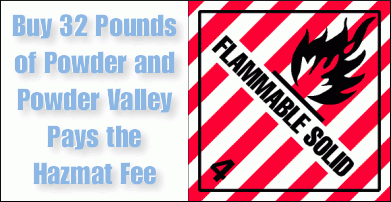
 New Reloder 33 Delivers More Speed in Big Magnums
 Berger’s Michelle Gallagher tells us: “We receive frequent feedback from shooters who are looking for bullets in small pack quantities so that they can test different bullets without the expense of buying full boxes. We’re pleased to be associated with the launch of Bullet Proof Samples. This is a new company who has done an exceptional job of addressing that concern. Bullets are packaged in blister packs, so they can be clearly seen. Each pack contains 12 bullets. They will be offering Nosler, Barnes and Berger in a variety of weights and calibers.


