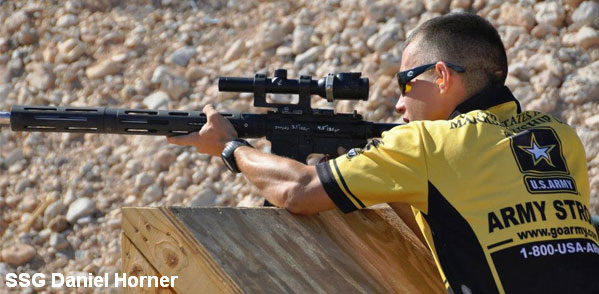
SSG Daniel Horner of the USAMU used the new 300 AAC Blackout (300 BLK) cartridge to win first place overall in the Tactical Optics division of the 2011 USPSA Multigun National Championship, held outside of Las Vegas, Nevada. Horner’s choice of cartridge allowed him to satisfy “Major Power Factor” requirements while using his regular AR15 rifle and magazines. The only important change was replacing the 5.56mm barrel with a .30-caliber barrel.
The 300 AAC Blackout was created by Advanced Armament Corp. and Remington primarily for the military as a way to shoot .30-caliber bullets from the M4/AR15 platform while using standard magazines. As explained by Robert Silvers, AAC’s R&D Director: “Now there is a way to shoot 30 caliber from your AR while still using normal magazines with full capacity. Even the bolt stays the same, and all that changes is the barrel.” For more information visit www.300aacblackout.com and download the 300 BLK Cartridge Information Guide (PDF).
The concept of putting a .30-caliber bullet in a shortened 223 case has been done before, but not as an industry-wide standard that anyone can make products for, royalty-free. SAAMI, the industry standards organization, adopted and standardized the AAC 300 Blackout earlier this year. The SAAMI diagram for the 300 BLK is shown below.
Affordable Factory 300 BLK Ammo is Available
Remington now sells a variety of 300 BLK ammo: 1) 125 grain open-tip match with a custom Sierra bullet; 2) 220gr subsonic, and 3) 125gr AccuTip (photo below). While the 300 BLK is easy (and inexpensive) to reload, Remington and AAC recognized that most people are not reloaders. So Remington will be budget-priced UMC-brand 300 BLK ammo through at just $12.99 per box — that’s less than most other rifle cartridges than are more powerful than the .223.
The 300 AAC Blackout has been touted as an important new hunting round, but we see it more as a specialized “rule-beater” 30-cal option that lets 3-Gun competitors “make major” with a low-recoil cartridge that also offers long barrel life. For those who need to run a .30-caliber cartridge from a standard AR15 platform (as opposed to the AR10), the 300 AAC Blackout makes some sense. But for hunters using a bolt gun, there are any number of tried and true options, such as the 7.62×39, .30-30, and, of course, the .308 Winchester (7.62×51 NATO).
Setpoint Ammunition, a subsidiary of Setpoint Systems Inc., has finalized an OEM distribution agreement with Berger Bullets. The agreement allows Setpoint Ammunition to offer a selection of Berger’s precision bullets for use in custom cartridges sold on their SetpointAmmo.com website. Setpoint Ammunition will initially offer three Berger projectiles for use in their 7.62×51 / .308 WIN cartridges: 155gr Match Hybrid; 185gr Long Range BT;and 168gr Match Hunting VLD.
“The agreement with Berger Bullets allows us to offer some of the best projectiles available for use in our precision ammunition,” said Brad Angus, President of Setpoint Ammunition. Angus went on to say that this agreement has been anticipated for some time. “Teaming with Berger has always been one of our goals. When you combine the well-known reputation of Berger Bullets with the unprecedented precision that we’ve built into our ammunition loading process, you get the best custom rifle ammunition available on the commercial market today.”
Setpoint’s Unique Manufacturing Process
The revolutionary Setpoint Ammunition ordering and manufacturing process allows customers to dictate the case, projectile, powder load and overall length of the cartridge via the online ordering system. This unique process gives consumers the ability to fine-tune their ammo to fit their specific firearm and application.
The order is relayed from the website to the manufacturing facility, where fully-automated machines (designed and built for Setpoint Ammunition by Setpoint Systems,) load and assemble the cartridges to high levels of precision. By mechanizing the entire loading process, precision and consistency are maximized. The final outcome is affordable, reliable, high-performance ammunition. (Sales packages are available for military, law enforcement and tactical security groups.)
105gr Hybrid Tests Demonstrate Excellent Accuracy and Consistency By Robert Whitley
After the initial Daily Bulletin Report on the new Berger 6mm 105gr Hybrids, I did some accuracy and consistency field testing with these new bullets. They shot so well, I thought an update was in order. My 100-yard testing has revealed much about these new bullets — all of it good so far. The test rifle was a MAK Tube Gun with a trued Rem 700 action (glued in), with a 6mm Brux 30″, 1:8″-twist barrel chambered with a no-neck-turn 6mm BRX chamber (1.563″ max case and .120″ free bore). The 6mm 105gr Hybrids fit and work well in this 6 BRX chamber configuration. (CLICK HERE to view a print of the reamer I used for the 6 BRX chamber.)
Hybrids Show Excellent Accuracy in Prone Tests (with Sling)
As some may know, I am predominantly a prone shooter and do most of my load testing prone with a sling. I chose to do the same with these Hybrids, to see how they would perform when fired as they would be in a prone match. In this case, shooting prone with sling, I shot four 10-shot groups (two 10-shot groups in each of two range session). All four groups were right around .5 MOA (i.e. each group about .750″ edge-to-edge, minus a bullet diameter of .243″ = .507″). The new Berger 6mm 105gr Hybrid bullets had no problems doing this. The groups shot were also consistent with the best groups I have been able to shoot in the past with the Berger 108gr BT bullets and the Berger 105gr VLD bullets, and I consider both of those bullets to be excellent and accurate. There is no question in my mind that these new Hybrid bullets are accurate, and the consistency is there! Check out my test targets below.
The two 10-shot targets above were shot at 100 yards on September 30th, prone with sling. The 6 BRX load was: Berger 6mm 105gr Hybrids, Lapua brass, 32.0 grains N140, Federal 205M-AR primers, .020″ jump. Note: If you put the targets over each other the groups line up perfectly.
These two 10-shot targets (above) were shot at 100 yards on September 23, prone with sling. The 6 BRX load was: Berger 6mm 105gr Hybrids, Lapua brass, 31.0 grains H4895, Federal 205M-AR primers, .020″ jump. When I can shoot 20 Xs in a row (as I did with these two targets) the rifle is really shooting well.
Accuracy needs to be coupled with consistency, especially when running longer strings of fire or in matches demanding a larger number of hits on the target. I am pleased to report that I have found the Berger 105gr Hybrid bullets to be consistently accurate bullets (i.e. there were no anomalies or fliers, they just keep going where you pointed the rifle). At each of the last two range sessions I shot back to back 10-shot groups with no break between the two (i.e. 20 shots in a row and only switching to the next target after 10 shots). Not only did the individual 10-shot groups stay tight, but if you hold each first target over the second target, the groups are right on top of one another. This is what I look for in terms of consistency — that I can keep shooting, and the bullets keep going right into the group, with no odd fliers.
105gr Hybrid Bearing Surface and Optimum Free Bore
Shooters may wonder how the new 6mm 105gr Hybrids function with the existing freebores on chambers set up for current Berger 105gr VLDs and Berger 108gr BT bullets. Based on the investigation and measuring of various chambers, here are some general guidelines:
1. For a chamber with a 1.5° throat angle, and the bullets touching the lands, the Berger 105gr Hybrid bullets sit up in the neck a little further than both the current production Berger 105 VLD Target bullets and the Berger 108gr BT bullets.
2. Based on basic measuring and testing, for the junction of the boat tail and bearing surface of a 6mm 105gr Hybrid bullet to be in the same spot as other bullets, the 105 Hybrid (Lot #3079) would need about .020″ – .025″ less freebore than recent production Berger 105gr Target VLD bullets (Lot #3220) and about .030″ – .035″ less freebore than recent Berger 108gr Target BT bullets (lot #2791).
3. Since the Hybrids are designed to work both in the lands and jumped away from the lands, some extra freebore may not be a bad thing. In truth, the 105 Hybrid bullets should work well and fit well in various 6mm chamberings (such as 6 BRX, 6 Dasher, 6mmAR etc.) which have been optimized for the previous generation, non-Hybrid 6mm Berger 105s and 108s.
Cabela’s is running a nice promotion now on its Cabelas.com website. Reloading components, including bullets, brass, powder, and primers, are now discounted 20%. Plus there are even great savings on some products listed in Cabela’s Bargain Cave. To see the discounted items, visit Cabela’s Reloading Components SALE Page.
Here are some of the hundreds of products currently On Sale at 20% Off:
Story Tip by EdLongrange. We welcome reader submissions.
The Weapons System Technology Analysis Center (WSTIAC), part of the U.S. Department of Defense (DoD), recently conducted a comparison test between standard primers and lead-free primers. The test procedure, along with the surprising test results, are discussed in the WSTIAC Journal (Vol. 11, No. 2).
Key Findings of the WSTIAC Primer Study Were:
1. Lead-Free primers suffered from significant delays in ignition.
2. Lead-Free large rifle primers had a “a much larger variation in peak blast pressure” than did lead-based large rifle primers.
3. Field tests showed 7.62×51 rounds loaded with lead-free primers to be less accurate than rounds loaded with lead-based primers.
4. So-called “match-grade” primers were NOT always more consistent in pressure than standard primers.
Russian Lead-Free Primers Tested
WSTIAC scientists did some pretty sophisticated testing, measuring the blast waves of lead free primers vs. standard primers. The lead-free primers, denoted as DDNP for their “Diazodinitrophenol” active ingredients, were matched up against commercially-available primers containing lead. Eight models of widely-used, lead-based primers were tested along with two DDNP-based Russian-made primers, a large rifle primer (model KVB-7E) and a small pistol primer (model KVB-9E). Brief field tests were also conducted with large rifle primers in loaded ammunition. Testers measured primer ignition times, bullet muzzle velocities, and accuracy on 200m targets.
Lead-Free Primers Were Less Reliable, with Less Uniform Pressure
While you’ll need to read the study to understand the full results, in a nutshell, the DDNP (lead-free) primers proved somewhat less reliable than standard primers. The study observed: “The most obvious difference between the lead-based and DDNP-based primers was a perceptible delay between firing pin strike and ignition in 15 of 19 shots with the DDNP-based primers (and one misfire); in contrast, there were no misfires or perceptible delays in ignition with the lead-based primer.” The scientists theorized that: “The delay in ignition in 6 of the 10 shots with the DDNP-based primer suggests that this primer is at the low end of strength needed to reliably ignite 46 grains of an extruded powder.” The study also noted that: “DDNP-based KVB-7E has a much larger variation in peak blast pressure than other primers.”
Lead-Free Primers Were Less Accurate in 7.62×51 Ammo
One very interesting finding related to accuracy. In field tests, 7.62×51 ammo loaded with lead-free primers was tested against ammo with lead-based primers (other components were identical). At 200m, the average 10-shot group size of 7.62×51 ammo with lead-free primers was 2.5 MOA vs. 1.8 MOA for ammo with lead-based primers. That 0.7 MOA difference may well be meaningful (though we’d like to see the test repeated with multiple 10-shot groups, fired from a more accurate rifle). For precision shooters, this is a provocative finding because it suggests that a change in primer type, by itself, may have a dramatic impact on accuracy. The scientists surmised that: “ignition delay is the most likely cause of the larger average group size.”
“Match” Primers Are NOT Always More Consistent
One surprising collateral finding in the study challenges the widely-held notion that “Match Primers” are better, at least when judged by pressure uniformity. “Table 1 shows average peak pressures along with standard deviations from the mean for the primers in this study…. There are significant differences in the standard deviations observed for different primer types, and it is notable that so-called ‘Match’ primers are not always more consistent than non-match primers.” Readers should look at the bottom right of Table 1 below. Note that, as a percentage (%) of total pressure, the non-match CCI 450s have a significantly lower SD than the “Match” Fed 205m primers. On the other hand, the Federal 210M and 215M “Match” primers ARE more uniform in pressure than the non-match CCI Large Rifle primers.
ABSTRACT: Comparing Blast Pressure Variations of Lead-Based and DDNP (Lead-Free) Primers
This article describes the blast pressure waves produced by detonation of both lead styphnate and diazodinitrophenol (DDNP) based firearms primers measured with a high-speed pressure transducer located at the muzzle of a rifle (without powder or bullet). These primer blast waves emerging from the muzzle have a pressure-time profile resembling free-field blast pressure waves. The lead-based primers in this study had peak blast pressure variations (standard deviations from the mean) of 5.0-11.3%.
In contrast, lead-free DDNP-based primers had standard deviations of the peak blast pressure of 8.2-25.0%. Combined with smaller blast waves, these large variations in peak blast pressure led to delayed ignition and failure to fire in brief field tests.
by Robert Whitley
I recently received some of the new Berger 6mm 105gr Hybrid Match Bullets for testing. There is much interest in these new 6mm Hybrids, so I thought I’d share my initial observations. A couple of things are very striking about these new bullets:
1. They appear to be very long, sleek and aerodynamic, while they still maintain a good bearing surface length (full-diameter shank). I like bullets with a sufficient bearing surface length because I find that it makes for bullets that are easier to shoot and tune. I also feel a good bearing surface length makes for a bullet that has a better potential for consistent performance over bullets with a short bearing surface.
2. The published ballistic coefficient (BC) numbers on these bullets are quite high. They have a stated G1 BC of .547 and a G7 BC of .278. Looking at the bullets themselves it’s easy to see why these BC numbers are so high. The front end of the projectile is quite long and similar to what you see on long-range VLDs, but the transition to the bearing surface has a blended appearance (the Hybrid part) vs. the sharp transition you typically see with most VLDs and secant ogive bullets. The 105gr Hybrid bullets also have a long boat-tail.
3. The new Berger 105gr Hybrid bullets measure right around 1.261″ OAL. By comparison, the many other 105gr to 108gr bullets I’ve measured all seem to run in the range of 1.210″ to 1.225″ OAL. The Berger 105gr Hybrid bullets are thus a fair bit longer than the others, which is why a true 1:8″ or faster twist is recommended for them. The bearing surface diameter of the new Hybrids was dead on at 0.243″. So these bullets are neither “fat” nor “skinny”.
4. The tips on these bullets are quite uniform, with the meplats closed up nicely. The Hybrids have nice small tips similar those on the Berger 108s (reasonably tight in diameter). While I sometimes like to point my match bullets, I like to shoot bullets that are ready to go “out of the box”, and these are just that. I’m hoping they will perform very well without meplat trimming or pointing.
Berger’s 6mm 105gr Hybrids Slated to Go on Sale in Late October
Berger has done its own in-house testing on these bullets and found them to be accurate and appropriate for release for additional testing by shooters out in the field. Unless this additional field testing reveals something that no one anticipated (which I doubt), I suspect these new projectiles will be one of Berger’s most popular bullet offerings. The planned official release date for the new 6mm, 105gr Hybrids has been tentatively set for mid- to late-October of 2011. So, barring some last minute changes, these 105s should be on dealers’ shelves before Thanksgiving.
Sinclair Int’l is offering some good deals right now. First, Sinclair has the new Rock River Arms 2-Stage AR15 match trigger marked down to $99.00 from $120.00. If you’re building a black rifle, here’s a chance to save twenty bucks. Click the image below to get the discount.
Sinclair is also running a sale now on Hornady BTHP Match Bullets. We’ve heard positive reports on the new match bullets with the Advance Manufacturing Process (AMP) jackets. Our friend John Adams has tested some of Hornady’s new 6mm 105-grainers with AMP Jackets. John says they shoot very accurately and are extremely uniform. John tells us: “I’m impressed by the new Hornady 105s. They are some of the most uniform bullets I’ve ever sampled. I absolutely stopped sorting them because the base to ogive measurements were so consistent.”
The popular BulletFlight Ballistics Program, is now available for Android OS smart phones and mobile devices. BulletFlight (from Knights Armament) has emerged over the past couple of years as one of the very best balllistics programs for iPhones and iPods. And now Android device users can enjoy the same functionality and features.
BulletFlight Android OS software comes in three different versions, all available through the Android Market. BulletFlight L1 (Level 1, $3.99) is a fast-running ballistics App with a host of features, including: user-selectable BC models (G1, G7, G8 etc.); output in inches, cm, MOA, Mils, and scope clicks; 360° wind drift calculation. BulletFlight includes a large database of bullet types (with weights, BCs etc.)
BulletFlight L2 (Level-2, $11.99) adds a full calculation screen where you may enter exact range and atmospheric details. The Level-2 version can also generate range-cards, perform cosine-angle calculations, handle mil-dot range estimations, and calculate impact energy, velocity, and flight time. What’s more, Level-2 offers GPS functionality so you can geo-locate your position, and/or download local weather information. The $11.99 L2 software package is what we recommend for most users.
BulletFlight L2 Screen Shots
Level M is Ideal for Ultra-Long-Range Shooting
Priced at $29.99, BulletFlight Level-M (Military) version further adds the ability to calculate an actual BC based on bullet drop, two velocities, or flight time. This can be useful if you make your own bullets, do extensive experimental work, or shoot at extreme long range. If you do regularly shoot beyond 1000 yards, BulletFlight Level-M is probably the best choice. The Level-M software factors bullet spin drift and Coriolis effect into the ballistics solution — making this a super-sophisticated tool. In addition, the Level-M software can calculate bullet stability based on MV, barrel twist rate, and bullet specs.
With all versions of BulletFlight, you can also create your own custom ammo profiles (with velocity, BC, bullet type), allowing you to easily output ballistic plots for multiple firearms, without having to enter the rifle/bullet profile each session.
Are there significant metallurgical differences in the alloys used in various brands of cartridge brass? The answer is yes, and we have proof. Using a state-of-the-art X-Ray Fluorescence Spectrometer, some tech-savy Wisconsin shooters recently analyzed the alloys in seven different types of cartridge brass.
The test results revealed significant differences in the percentages of copper and zinc in the different brands. Copper content ranged from a low of 72% by mass (Winchester, S&B) to a high of 80% by mass (Remington). Zinc, which adds hardness to the alloy, ranged from a low of 20% by mass (Federal) to a high of 36% (‘brown box’ Lapua). Interestingly, the tests, as reported by Forum Member Fred Bohl, revealed that the alloy in the new ‘blue box’ 6mmBR Lapua brass is different than the alloy in Lapua’s older ‘brown box’ 6mmBR brass. Specifically, the ‘blue box’ 6mmBR brass has more copper and less tin (by mass). Here’s a summary of the X-Ray Fluorescence spectrometry tests:
This testing was done at major science laboratory, using high-grade X-Ray Spectrometry Analyzing equipment. Fred reports that: “The data was run by one of the club members with the permission of the test lab supervisor who is also a club member and shooter. The data in original output reports was far more detailed about trace elements at lower orders of magnitude primarily from surface contaminants (some were rerun after establishing a repeatable cleaning procedure)”. The testing process is discussed in this Shooters’ Forum thread.
We do NOT have the metallurgical expertise to infer that any particular alloy shown above is “better” than another. The alloy “blend” is merely one of many variables that can have an impact on the performance and quality of the finished product. Annealing times/methods differ and some cartridge brass is extruded while other cartridge brass is made with the traditional drawing process. Readers should not presume, on reading the above chart, that they can identify the “best shooting” brass simply based on the constituent metals in the various alloys.
General Observations about Cartridge Brass Alloys
With the cartridge brass X-Ray Spectrometry results in hand, Fred Bohl hoped to find out what “real world” conclusions (if any) we could draw from the raw data. Fred sent the test results to some knowledgeable metallurgists, soliciting their comments. Fred explains: “When I first posted this information [in the Shooters’ Forum], I had hoped to elicit replies from expert metallurgists and to initiate a useful discussion. From [their replies] I distilled the following ‘consensus’ comments”:
1. The range of Copper/Zinc ratios suitable for use in cartridge making by typical processes is 85/15 to 65/35 (% by weight or mass).
2. The range of Copper/Zinc ratios suitable for use in cartridges intended for reloading is 80/20 to 70/30. Above 80% copper, the resulting case would tend to be too soft and difficult to attain the distribution of hardness desired (harder at the base and softer at the neck). Below 70% copper the resulting case would tend to be too hard, would work harden too quickly and require frequent annealing. [Editor: That said, the ‘brown box’ 6mmBR Lapua brass, with 62% copper/36% zinc content, enjoys an unrivaled reputation for both accuracy and its ability to perform well after a dozen or more reloading cycles. We know 30BR shooters who have shot the same old-style Lapua brass (6mmBR parent case) more than 50 times. So maybe the “expert” view needs re-thinking.]
3. As the percentage of zinc increases, the tensile strength, yield strength and hardness tend to increase. However, above 35% zinc, while tensile strength will continue to tend to increase, both yield strength and hardness will tend to begin to decrease.
4. The trace additives of iron and/or silicon are used to control the processing characteristics of the alloy. Trace additions of chromium will improve corrosion resistance and give a shinier surface (both largely cosmetic).
5. Selection of the alloy and additives is a trade off among: end use desired properties; processing time and yield; and cost of materials. For example, the classic 70/30 cartridge brass was considered an optimum combination of corrosion resistance and hardness for single use by the military with good process yield at acceptable material cost.
6. All of my responding experts were surprised by the brown box Lapua alloy except for the oldest. He remembered using an almost identical alloy late in WWII when copper was in very short supply for military small arms ammunition.
Federal Ammunition has released a new type of small rifle match primer optimized for AR15s and similar semi-automatic rifles. The new Gold Medal® AR Match Primers, designated GM205MAR, have harder primer cups than the popular Federal 205M match primers. The harder cup is designed to perform better in semi-automatic actions that use free-floating firing pins. A Federal spokesman said that Federal’s “normal” 205M primers were not ideal for use in firearms, such as ARs, with free floating firing pins. Hence Federal designed the new GM205MAR primers. These are available now from major vendors such as Midsouth Shooters Supply, which offers the new GM205MAR primers for $35.22 per thousand.
Other AR-Friendly Primers
For quite some time, CCI has offered its #41 milspec small rifle primer for use in ARs. A CCI #41 primer is a ‘magnum’ strength primer, equivalent to the CCI 450 Small Magnum rifle primer. However, the #41 primer is made with a bigger gap between the tip of the anvil and the bottom of the cup, creating a slightly less sensitive primer. The #41 primer also has a thicker bottom on the cup than the CCI 400 primer.




 “The agreement with Berger Bullets allows us to offer some of the best projectiles available for use in our precision ammunition,” said Brad Angus, President of Setpoint Ammunition. Angus went on to say that this agreement has been anticipated for some time. “Teaming with Berger has always been one of our goals. When you combine the well-known reputation of Berger Bullets with the unprecedented precision that we’ve built into our ammunition loading process, you get the best custom rifle ammunition available on the commercial market today.”


 Russian Lead-Free Primers Tested


 Are there significant metallurgical differences in the alloys used in various brands of cartridge brass? The answer is yes, and we have proof. Using a state-of-the-art X-Ray Fluorescence Spectrometer, some tech-savy Wisconsin shooters recently analyzed the alloys in seven different types of cartridge brass.


