An Italian company, CompBullet, has produced a radical new line of CNC-machined projectiles with a cavity in the bullet base connected to ports (holes) placed radially around the bullet’s circumference. Currently CompBullet offers six bullet types: 9mm (100 gr), .40 cal (155 gr), .44 Cal (200 gr), .45 Cal (200 gr), and .30 Caliber Rifle (125 gr). CompBullet’s pistol projectiles have one row of radial ports, while the longer rifle bullets have two rows, resembling the porting on a muzzle brake.
Italy’s CompBullet makes many claims about its new, patented ported bullets. Supposedly the ported, cavity-base bullets go faster than conventional bullets, yet generate less recoil. CompBullet also claims that its radical projectiles produce less smoke and reduced flash on exiting the muzzle. We are skeptical of many of CompBullet’s claims. We also have some concerns about bullet integrity and potential safety issues — at least when used in high-velocity applications.
Velocity
Compbullet claims that gases exiting the radial ports “lubricate” the bullet as it travels down the bore, yielding enhanced velocity. However, if any gas is actually able to exit the holes while the bullet is in the rifling (it’s not clear that in-barrel venting really occurs), then this will simply serve to REDUCE the gas pressure pushing on the base of the bullet. If anything, the bullet should go slower than a conventional projectile, not faster.
Jet Effect
CompBullet projectiles have a cylindrical cavity in the base. CompBullet claims that hot gases will shoot out the bottom of the bullet (like a rocket) and this increases velocity. But this runs contrary to the bullet-maker’s claim that the hot combustion gas moves forward and out the vents. But what, you might ask, if there are powder kernels that have migrated into the cavity and ignite inside the bullet? That might indeed cause gas to move both forward and rearward. However, the force of any rearward gas jet would be minimal compared to the main pressure flow pushing from behind, at least while the bullet is in the barrel.
Reader’s Comment: Hope the holes are small enough so the powder doesn’t fall out if the round is tipped over or something. It’s a good idea for custom salt and pepper shakers though!” –Josh
Recoil Reduction
Muzzle brakes reduce felt recoil and muzzle lift, on both pistols and rifles. However, they are attached to the gun. We’re not sure how gas blowing out the sides of a bullet is going to have any effect on recoil, because that action occurs after the bullet has left the muzzle. It IS possible that some in-barrel venting from the bullet’s ports may occur (if the ports aren’t blocked by the rifling), but that, as explained above, will only serve to reduce pressure pushing on the base of the bullet and hence reduce velocity. To the extent CompBullet projectiles deliver less felt recoil (if they do), it’s probably because they have lower velocity. If CompBullet projectiles actually fly faster (than do conventional bullets), that would be easy to demonstrate with chronograph tests. However, CompBullet provides NO CHRONOGRAPH DATA on its website. Without such data, we remain unconvinced.
Safety Issues
With a CompBullet projectile, there is the potential for powder to shift from the cartridge case into the bullet’s central cavity, prior to ignition. If this occurs, and the kernels inside the bullet do not fire off prior to the bullet leaving the barrel, there is the possibility of an explosive fragmentation of the bullet once it leaves the muzzle. We don’t know if this could actually happen, but there’s a word for a small, metal container filled with gunpowder — a grenade.
Bullet Integrity
A conventional jacketed bullet can fly apart when the combination of heat, friction, and spinning force stresses the bullet’s construction. With the CompBullet projectile, you have a bullet that is heated from the inside out, with numerous weakening holes drilled in the structure.
Accuracy
We discussed the effect of radial ports on a bullet with Bryan Litz, chief Ballistician for Berger Bullets. He said: “this ported bullet design is interesting, but I can’t see how it would have any usefulness for precision shooting. If flaming gas really jets out the ports, and the outflow of every port is not perfectly uniform, then this will quickly cause a reduction of bullet stability, which won’t help accuracy at all.” Bryan also wondered if drag from the gas out-flowing from the ports might slow down bullet spin-rate. With less rpm, spin-stabilization would be reduced. “Unstable bullets are not accurate”, Bryan added.
Flash Signature
There does appear to be some evidence of a smaller smoke “cloud” on bullet exit and a reduced flash signature, if the photos on the CompBullet website can be believed. We would like to see an actual comparison between conventional ammo and CompBullet ammo, using identical powder charges. CompBullet’s photos do not provide a comparison with ammo loaded with non-ported bullets. We cannot confirm that flash is reduced unless we can see photos of both ported and non-ported bullets, shot with the same powder loads, in the same lighting conditions. See sequence below with 9x21mm pistols:
The inventor of the CompBullet ported projectile is Alain Della Savia, a IPSC Grand Master and 6-time Italian National Revolver Champion. He was inspired by the recoil reduction offered by ported handguns. He hoped to develop a new kind of ammo that had reduced recoil, while still satisfying the IPSC “power factor” requirements. His solution was to build ports in the bullets themselves, using CNC-machining methods: “After a year of experiences, [Alain] found the right balance between materials and internal compensation system inside the bullet.”
Eric Stecker of Berger Bullets was kind enough to supply some of Berger’s 80gr 6mm Varmint bullets for testing. These were formerly called the Berger MEF, but now the box says “Varmint — Match Grade” (part #24321). Our initial testing, in a standard 6BR with 1:8″-twist, 3-groove PacNor barrel demonstrated that “Match-grade” was no boast. These things shoot! At 100 yards, the first two shots went into the same hole. A nice 5-shot group formed up under 0.2″. And to keep things interesting, this was with a varmint-style stock and only one wind-flag about 30 yards out. By comparison, the best we could do with Hornady 75gr V-Maxs in this gun were groups in the mid-fives (half-MOA+).
Reader ShCal of San Luis Obispo has also tested the 6mm Berger 80s and also got great results, shooting under 0.5″ at 200 yards.
K&M Precision Shooting Products has two very handy products you may not know about yet. The first, a brilliantly simple device that lets you see your case necks as you expand them, can be used by anyone who necks-up brass (with a compatible expander die body). The second new product is a specialized “fat grip” holder that will make neck-turning easier for those of you out there who use K&M neck-turners.
K&M Expand Mandrel Window Riser
This is a simple threaded extension placed between your expander die body (K&M Expand Iron) and the top of your press. It carries the expander mandrel higher, above the press, and has a cut-out view port so you can see the mandrel as it passes through the neck. Smart, eh? This provides visual feedback during the process of expanding your brass. The patent-pending view riser costs $20.00. Will it expand necks faster, or reduce run-out? We doubt it, but we still would like to have one, if only to eyeball the mandrel to control the neck-entry rate more consistently from case to case.
Installation: Thread the Expand Mandrel Window Riser into the top of your loading press, then thread the K&M Expand-Iron (Expander Die Body) fully into the top of the window riser and adjust each so you can stroke out the press completely without driving the case mouth into the press adapter. This allows you to view the expanding operation which is typically blind under the press. The riser also eliminates the need for the stop screw in the expander mandrel. LINK: Expand Window Riser Instructions (PDF).
Ergo Holder for K&M Neck-Turning Tool
K&M’s rounded, oversized Ergo Holder lets you hold the K&M neck-turning body more securely (and with less hand cramping). Priced at $35.00, it is an expensive accessory, but we suspect many guys with K&M neck-turners will spring for an Ergo holder just because it gives you a more secure and comfortable grip on the small, square-edged K&M neck-turner.
Customer Feedback Inspired K&M’s Ergo Holder
The folks at K&M told us that their new Ergo Holder was produced in response to customer requests: “[Customers reported that] the neck turner can be hard to hold due to its compact size, especially in high-volume use. The Ergo Holder is machined from aluminum, providing a fatigue-proof grasp of the neck turner. Its mass works like a heat sink to help dissipate heat from the pilot during the turning process. The neck-turner body easily assembles into the Ergo Holder and is held in place with one set screw. The Ergo holder is also designed with the dial indicator in mind and actually makes its use more convenient”.
LINK: Ergo Holder Installation/Use Instructions (PDF).
Credit Forum Member EdLongRange for spotting these new K&M products.
SAAMI, the Sporting Arms and Ammunition Manufacturers’ Institute, is an association of the nation’s leading manufacturers of firearms, ammunition and components. Founded in 1926, SAAMI promulgates industry standards for firearms ammunition safety, interchangeability, reliability and quality.
New SAAMI Website Offers Free, Printable Cartridge Diagrams
SAAMI recently rolled out a new website loaded with invaluable info for shooters. From the new SAAMI site you can access hundreds of FREE official cartridge diagrams and chamber drawings for all ammo types: Rimfire, Pistol Cartridges, Rifle Cartridges, and Shotshells. Are you looking for the official 17 HMR diagram, or 6.5 Creedmoor, or 7mm Winchester Short Magnum? You’ll find them all, along with hundreds more, on the SAAMI site. Said Rick Patterson, SAAMI’s managing director. “This redesigned website will help provide greater visibility and understanding of SAAMI’s important work.”
Please Read These Instructions Carefully
To access the cartridge diagrams, go to SAAMI’s Technical Information webpage, and CLICK ON Cartridge and Chamber Drawings to reveal categories. You will find links to 20 new and/or updated cartridges there.
To find the full set of cartridge diagrams, you need to click on the link to Current Cartridge & Chamber Drawing documents — American National Standards Published by SAAMI. There you will find links to four categories of diagrams: Rimfire, Shotshell, Centerfire Pistol/Revolver, and Centerfire Rifle. These links will launch large PDF files that have diagrams of the cartridge types. NOTE: These are very large PDF documents. For example, the Centerfire Pistol/Revolver PDF is 189 pages long. You must scroll down to see the cartridge type you want.
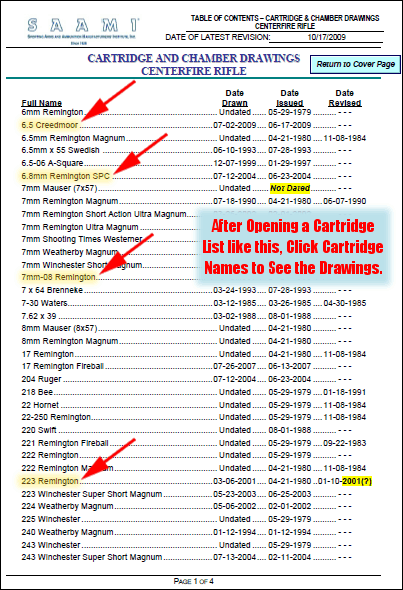
Unfortunately, the organization of the SAAMI site is much less convenient than before. Previously you could access a page and then simply click on a link for the cartridge you wanted to view. Below is a sample of the first page of the previous Rifle Cartridge Diagram List.
Red arrows show you where to click, after you launched the page under the old website.
SAAMI Standards Documents With Additional Info
You can also click the subcategory links under SAAMI/ANSI Standards to see multiple diagrams in a larger PDF file. You may have to click the SAAMI/ANSI standards line first to display the four sub-categories: Pistol/Revolver, Centerfire Rifle, Rimfire, and Shotshell.
Credit Boyd Allen for finding SAAMI’s Cartridge Diagram PDF Archive.
Prices of bullets and brass have gone up dramatically in recent months. We are hearing from active shooters that cost considerations are influencing their decisions about what calibers and chamberings to shoot. There is a definite trend to smaller cartridges and lighter bullets.
One match shooter told us: “I’ve been debating between a 6.5×47 Lapua and a 6-6.5×47. After comparing the cost of 6.5mm vs. 6mm bullets, I decided on the 6mm. If I save $7 bucks a box, and shoot 4000 rounds a year (40 boxes of bullets), that’s $280.00 in savings–enough to buy a new barrel.”
Here are some comparative bullet prices for 6mm, 6.5mm, 7mm, and 30-caliber bullets at Midsouth Shooters Supply. Prices are for a 100-count box. Note that the 6.5mm match bullets cost 25% more than the 6mms. For active shooters, the price difference adds up quickly. (Prices from current catalog listings; particular items may be out of stock.)
Brand
6mm
6.5mm
7mm
.308
Berger
105gr VLD $30.15
140gr VLD $37.87
180gr VLD $44.12
190gr VLD $45.37
Sierra
107gr MK $26.25
142gr MK $32.45
175gr MK $31.08
200gr MK $33.73
Here are brass costs for Lapua brass from Grafs.com. Prices are for 100-count boxes (or four 25-count boxes for the .338 Lapua Magnum). Generally speaking, the bigger the case, the higher the price (except for the .308 Win).
.223 Rem
.243 Win
6.5×47 Lapua
6.5-284
.308 Win
.338 Lapua Mag
$58.99
$93.99
$104.99
$118.99
$69.99
$264.99
Consider Barrel Life Also
Certainly, moving to a smaller caliber can often reduce what you have to pay for brass and bullets. On the other hand, you need to consider barrel life. Hot-loaded 6mms, such as a .243 Ackley, can burn up a barrel much more quickly than a .308 Winchester. In comparing the “operating costs” of various cartridges, you need to factor in barrel replacement costs as well as component prices. If you have to spend $550 (including smithing) to replace a custom 6mm barrel every 1500 rounds, you’re spending $1100 more than a guy who has a .308 Win which lasts 4500 rounds.
Applied Ballistics LLC, Bryan Litz’s company, has started producing new .300 Winchester Magnum loaded ammunition, supplementing the ultra-accurate .308 Winchester ammo that Applied Ballistics rolled out in 2010. The new .300 Win Mag ammo is featured on Bryan’s new dedicated webpage for ammo sales.
The new .300 Win Mag ammo is loaded with Berger’s LRBT 185gr “Juggernaut” bullet. This high-BC bullet, combined with an impressive 3155 fps muzzle velocity (from 28″ barrel), gives the new Applied Ballistics ammo superior performance compared to other commercial .300 WM ammo offerings. Take a look at the chart below:
Exclusive AccurateShooter.com Offer — Get $5.00 Off Each Box of .300 WM Ammo
To promote the new .300 Win Mag ammo, Bryan is offering a special discount to AccurateShooter.com members. When shopping on Bryan’s Ammo website, if you order .300 Win Mag ammo, use Coupon Code ASDC on check-out. That Code will save purchasers $5.00 per box on any quantity of .300 Win Mag ammo. The Coupon Code, valid through November 30, 2011, is good for one purchase per customer.
Sierra has introduced a new .30-caliber flat-based bullet, the 125 grain OTM (open-tip match HP) MatchKing, item #2121. This unique flat-based bullet was designed in conjunction with AAC (Advanced Armament Corporation) and Remington for the new .300 AAC Blackout (BLK) cartridge. The bullet length is tailored to correctly fit and feed from AR-15 platform magazines. The projectile’s Open Tip is pinched for greater uniformity in the same manner as Sierra’s Palma Competition bullets. The G1 BC is surprisingly high for a relatively short, flat-based bullet: 0.310 (below 1600 fps), 0.330 (1,600-2,000 fps), 0.338 (2000 – 2650 fps), and 0.349 (above 2650 fps). Though it will perform well at low velocities in the .300 BLK, this bullet can handle the higher velocities produced by common .30 cal mid-sized cartridges, such as the .30-30.
The new 125gr Matchking is now being loaded in factory ammo, including Remington’s Premier Match, which retails for $34.00 for a 20rd box. These 125gr bullets are available now from MidwayUSA for $34.99 per hundred. Sierra offers five other bullets in the same general weight range that may work well in the .300 Whisper or .300 AAC Blackout:
Recently, Berger released two new .30 caliber Hybrid Target bullets, a 215-grainer and a 230-grainer. With this new pair of projectiles, Berger now offers .30 Cal Hybrids in weights of 155 gr, 168 gr, 185 gr, 200 gr, 215 gr, and 230 grains. These bullets use a Hybrid nose designed by Bryan Litz to optimize long-range performance and enhance “tunability”. The Hybrid nose starts with a tangent shape and transitions into a secant shape. This allows these bullets to be much less seating-depth sensitive (than the VLD) while at the same time the secant portion reduces drag (for a higher BC). Berger’s Eric Stecker: “It is my understanding that each of these [new Hybrid] bullets has the highest BC of any bullets in their weight class. Combine this with being easier to tune and what you get is six new projectiles that raise the performance bar for .30 cal rifles.”
Berger Rolled Out 11 New Bullet Designs in 2011
This has been a busy year for Berger Bullets. It has introduced eleven (11) all-new projectile designs. In addition, Berger re-labeled two of its popular bullets. Here’s a summary of the new offerings:
6mm 105 gr Hybrid Target
.30 cal 155 gr Hybrid Target
.30 cal 168 gr Hybrid Target
.30 cal 185 gr Juggernaut Target (Name change — this was formerly called the 185 gr Long Range BT.)
.30 cal 185 gr Hybrid Target
.30 cal 200 gr Hybrid Target
.30 cal 215 gr Hybrid Target
.30 Cal 230 gr Hybrid Target
.22 Cal 77 gr OTM Tactical (Name change — this is the same bullet as the .22 cal 77 gr BT Target, but it’s new to the Tactical line).
.30 Cal 175 gr OTM Tactical (designed for .308 Win to be a transonic-stable option.)
.30 Cal 185 gr Juggernaut OTM Tactical (designed as a transonic-stable option for the 300 Win Mag.)
.30 Cal 230 gr Hybrid OTM Tactical (designed as a supersonic option for the 300 Win Mag.)
.338 Cal 300 gr Hybrid OTM Tactical (this is the redesigned Gen 2 version.)
At the gun industry writers round-table meeting earlier this month in Kansas City, KS, Alexander Arms made important announcements regarding the 6.5 Grendel Cartridge.
1. The “6.5 Grendel” has been officially approved as a SAAMI Cartridge. (This means that cartridge dimensions will be standardized for the purpose of manufacturing brass, loaded ammunition, pre-fit barrels, and 6.5 Grendel-chambered firearms.)
2. Alexander Arms has officially “relinquished” its trademark claim on the term/label “6.5 Grendel”. This opens the door to other companies offering products (such as ammo, barrels, magazines) which are identified by the 6.5 Grendel moniker.
Here is the text of Alexander Arms’ Official Press Release:
The 6.5 Grendel is an Official SAAMI Cartridge and Trademark is Relinquished.
The Sporting Arms and Ammunition Manufacturers’ Institute (SAAMI) has adopted the 6.5 Grendel as an official SAAMI cartridge. As a result of the cartridge’s official recognition, Alexander Arms will relinquish the trademark “6.5 Grendel”. Bill Alexander states: “One of the primary purposes of trademarking the name was to protect the integrity of the design. With the adoption of the 6.5 Grendel cartridge standard by SAAMI, the design is now protected, and any confusion in the marketplace as to the specification of the cartridge has been eliminated.”
SAAMI’s formal adoption of the design specifications for the cartridge has led Alexander Arms to announce that it will relinquish its federally-registered trademark and that “6.5 Grendel” to be the common commercial name for a cartridge that adheres to the specifications adopted by SAAMI.
Alexander Arms is proud that a cartridge of its design has received this important designation, and is pleased to take this important step in the continued market development of this breakthrough cartridge, which is perfectly matched to the AR-15 platform.
For additional information contact:
Alexander Arms
wayne@alexanderarms.com
540-639-8356
According to The Firearm Blog, “Hornady submitted the cartridge to SAAMI last year but the application was rejected because Alexander Arms refused to relinquish the trademark.” With the waiver of trademark objections by Alexander Arms, look for greater production of standardized 6.5 Grendel ammo and brass. We can also expect more factory and custom rifles to be chambered in the efficient 6.5 Grendel cartridge. Some gunsmiths had avoided working with this cartridge because of Alexander Arms’ trademark claims. In fact, the were even concerns about sales of “6.5 Grendel” chambering reamers, so some gun-builders developed slightly-different wildcats in order to get around Alexander Arms’ objections. But that is all “old history” now….
If you’ve been lusting for a serious, ultra-long-range big-bore tactical rifle, check out this special offer from Barrett Firearms. Purchase any Model 82A1 chambered for the .416 Barrett and get 200 rounds of ammunition from Barrett as a free extra. That’s right, get 200 rounds of .416 Barrett ammunition FREE with your purchase of any configuration Model 82A1 .416 rifle. The retail cost of 200 rounds of Barrett-Brand .416 ammo exceeds $1000.00.* That’s a nice incentive, but remember that a Barrett Model 82A1 rifle costs a jaw-dropping $8,900.00 without optics. CLICK HERE for Barrett Price List (PDF).
If you can afford it, the Model 82A1 in .416 Barrett is a great ultra-long range performer. The chambering is also legal in jurisdictions that ban the .50 BMG or other .50-caliber cartridges. To qualify for this free ammo deal, head to your local dealer and ask them to use Promo Code FILL20MAGS when purchasing directly from Barrett. That will entitle you to 200 rounds of .416 Barrett ammunition, with your new rifle. That ammo’s worth over a thousand bucks. Take a look at the size of the cartridge, and you’ll understand why .416 Barrett ammo is so pricey.







 The new 125gr Matchking is now being loaded in factory ammo, including Remington’s Premier Match, which retails for
  Recently,


