This Easter Weekend Save 10% off Creedmoor Brand Products with Promo Code EASTER.
Here’s good news for shooters getting their gear for the 2021 season. Creedmoor Sports is now offering 10% OFF all Creedmoor brand products. If you need a quality shooting coat, shooting mat, scope stand, sling, glove, data book, or other shooting accessory, here’s your chance to save. Hundreds of Creedmoor-branded products are 10% OFF through Monday, April 5, 2021 at 12:00 PM CST.
CLICK HERE to see all the discounted products. Remember, to get the 10% Discount you need to use Discount Code “EASTER” during checkout. Below are some of the best-selling Creedmoor brand shooting sports products on sale.
Here are some of the quality Creedmoor brand items on SALE:
Three Shots Standing at 400 Yards in 4.37 Seconds Could you hit a silhouette target at 400 yards, shooting offhand? Probably, with a little practice. Now try doing that three times in just 4.37 seconds, including picking up/mounting the rifle! Not possible? Watch the legendary Jerry Miculek do that in this impressive demonstration of rapid-fire rifle shooting.
Jerry Miculek — that name is synonymous with revolvers. But Jerry is also one heck of a rifleman, as he demonstrates in this video. Grabbing his AR rifle from the top of an oil drum, Miculek proceeds to put shots on three different steel targets at 400 yards — all in under 4.4 seconds. Most of us would be lucky to make one successful shot in that time limit. Watch the successful 3-shot sequence starting at 2:19 time-mark in the video.
In this video, Jerry hits not one but THREE c-zone targets at 400 yards. And he does this in under 4.4 seconds starting with his rifle laying on a support. It took Jerry two tries (on his first run he hit 2 out of 3 in 4.65 seconds). On the second attempt (see video starting at 2:19), it takes Jerry just 4.37 seconds to shoulder his rifle, aim, and fire three shots, each hitting a separate steel target. Wow. That’s truly remarkable. Most of us would need ten seconds (or more) just to get the scope on the first target.
Trust us folks, this ain’t easy. It takes remarkable marksmanship skills to shoot with this kind of precision at this kind of pace. As Jerry would say himself, “Not bad for an old guy who needs glasses”.
CMP 2021 National Matches at Camp Perry — Registration
The Civilian Marksmanship Program (CMP) has commenced registration for the 2021 National Trophy Rifle and Pistol Matches at Camp Perry in Port Clinton, Ohio. Guests may sign up for the historic annual event beginning April 1, 2021 on the CMP website.
The 2021 National Matches kicks off with the Pistol phase on July 12, featuring 1911 As-Issued Match, Military & Police, GLOCK, Service Pistol EIC matches and Pistol Small Arms Firing School. New Pistol events have been added to the 2021 NM calender.
Following the Pistol series is the CMP’s Smallbore program. This will include 3-position, prone, and team matches for competitors of all ages. For the first time, a Smallbore Small Arms Firing School will be conducted for new and experienced marksmen, led by members of the U.S. Army Marksmanship Unit.
The remainder of the National Matches schedule includes modern and vintage Rifle competitions: Garand, Springfield and M1 Carbine matches, Rimfire Sporter, President’s Rifle, National Trophy Individual — plus several other favorites enjoyed by scores of competitors each year.
A 4-Man Team event and 800 Aggregate will also be fired on the CMP’s High Power electronic targets. The National Matches Rifle events will conclude in August with the Long Range series, fired on Camp Perry’s Viale Range.
During the summer, the National Match Air Gun events will be held at the CMP’s indoor airgun range, the Gary Anderson CMP Competition Center. The air-conditioned range, which features state-of-the-art electronic targets, will be open throughout the National Match weeks. Rental equipment and pellets are available for a small fee.
New Product Demonstrations at 2021 National Matches
Also new in 2021, the CMP has created Industry Days. Conducted during the Pistol and Rifle phases Industry Days will feature vendor stations located around Camp Perry. Displays will highlight new technology with live-fire demonstrations and other interactive product demos.
With the current drastic shortage of reloading components — powder and primers in particular — many folks are finding it difficult to load sufficient live ammo for matches. And when you CAN find primers, they may cost as much as $300 per thousand! Even if you’re able to pay that crazy price for primers, if you can’t find suitable powder, then you can’t shoot.
Thankfully the Precision Rifle Series (PRS) team has developed a new form of competition ideal for this challenging era of component shortages. In the new Sonic Tactical Series (STS), the PRS organization offers an affordable, fun form of competition that is not powder/primer dependent at all. And STS competitors never have to worry about burning out those costly custom barrels. That’s because STS matches are all about the fun of tactical togetherness, without the hassle of hand-loading, or the frustration of misses. STS is all about fun with guns with zero cost-per-shot. Now that’s something we can all appreciate.
The new PRS Sonic Tactical Series (STS) will feature full multi-stage matches, complete with varied shooting positions, barricades, moving targets, and ranging exercises. You will do everything just like a normal PRS match, but without burning precious ammunition (or using up barrel life). All stages will be run via dry-fire but with AUDIBLE confirmation of “virtual” hits on target. The exciting shout of “Impact!” will confirm your hits after dry-firing at the target. Experiencing the adrenaline rush of hearing the word “Impact!” is what this game is all about, hence the Name Sonic Tactical Series (STS).
It’s fun to shoot STS Matches with your significant other. Ramia Whitecotton Facebook photo.
You can shoot an STS match without having to worry about loud noises or muzzle blast. All you’ll hear is that reassuring “Impact!” from your partner. BTW, this is a great way to get your wife or girlfriend involved in the shooting sports. She’ll enjoy instant gratification from your loud “Impact!” shout, with no painful recoil or blustery muzzle blast.
Any types of rifles can be used at STS matches including inexpensive Airsoft rigs. Put the money you save into your tactical wardrobe. Remember, a real man can never have too much camo!
All STS matches are conducted with two-person teams. The first team member will aim at the target, range it with his FFP MilRad reticle, center his crosshairs, and then yell “Bang”. His partner must wait the appropriate time and then yell “IMPACT” loudly, so everyone within two counties can hear. The two-person team that has the best correlation between true shot-over-distance time and the issuance of the word “Impact” will win the stage. So Be Loud and Be Proud!
In STS Matches, competitors work as a team. The triggerman ranges the target, then steadies his aim, and shouts “Bang!”. His partner calculates the exact flight time then yells “IMPACT!”… the louder the better!
This Sunday we feature an impressive .300 WSM Heavy Gun shot by a superb long-range shooter. With this rig, at age 83, Arizona benchrest ace Charles Greer drilled a remarkable 2.862″ 100-10X group, beating all known 1000-Yard HG 10-shot records on the books. If this record is approved (which is likely), Greer’s .300 WSM can rightfully be hailed as the most accurate 1000-yard gun in history.
Story compiled with help from Jason Peterson
This would be an excellent 10-shot NBRSA Heavy Gun group at 600 yards, but this target was shot at 1000 yards by Charles Greer (aka “chuckgreen” on AccurateShooter forum) on February 13, 2021 at an NBRSA Match in Arizona. Chuck was shooting his .300 WSM Heavy Gun with Borden action, Krieger barrel, and Berger 220gr Hybrids. The event was hosted by the Sahuaro 1000 Yard Benchrest Club, at Three Points Range, outside Tucson, Arizona. Though it is pending final approval, it appears this is the smallest 10-shot Heavy Gun group ever shot, anywhere, at 1000 yards, and it was centered for a 10X. That’s doubly impressive when you consider that Charles Greer achieved this at age 83! Yes “Old guys rule”!
Amazing 100-10X 2.642″ (unofficial) 10-Shot Group at 1000 Yards.
This group is perfectly centered for an amazing 100-10X score. The group was range measured at 2.642 inches. For reference, the 1000-yard X-Ring is 3.00″ in diameter. The “X” itself is about 1.2″ tall. Pending final verification, this amazing target should shatter two NBRSA records. This handily beats the current single target HG score record of 100-6X held by Bill Schrader since 2005, and the single target HG group record of 3.650″ held by Tim Height (2019). For comparison, the current IBS 10-Shot 1000-yard HG group record is 2.871″ by Michael Gaizauskas from 2016. So it appears that this may be the smallest 10-shot group ever shot in competition in history. And from what we can determine, this is the first potential HG size record that also has a 100 score with TEN Xs.
Because shots are not marked in this discipline, this stunning group was a surprise to Greer: “I had no idea that I was shooting a world record target until I went back to the pits after my relay. Just as well. If I’d seen nine rounds in the X on the target, staying steady [for the last shot] would have been challenging….”
Forum member “Tom” (2016 IBS 1000-yard Nat’l Champion and holder of several IBS 1000-yard records) unofficially measured Greer’s 1K group at 2.680 inches (0.256 MOA), using Ballistic-X software. Awaiting final group measurement by the NBRSA Long Range Committee, as currently measured, this target is just under existing IBS and Williamsport 10-shot HG 1000-yard records: The current IBS HG 1000-yard group record is 2.871″ held by Michael Gaizauskas. The current Williamsport HG 1000-yard group record is 2.815″ held by Matthew Kline.
Benchrest Shooting — Sport for All Ages Charles Greer reminded us that even senior citizens can succeed in benchrest competition: “One of the benefits of benchrest shooting is that it is a sport accessible to us even as we age. I cannot run and gun anymore like I used to do in IPSC and IDPA but as long as I can get my body and my equipment up to a bench, I can still be very competitive. That is not possible for us old guys in most sports and shooting disciplines. As I am ‘only 83′ I am hoping to squeeze a few more years of competition out of the old body before I have to pack it in for good.”
Charles is thankful for what he has achieved in this sport over many decades: “The Shooting Gods have certainly smiled on me from time to time during my brief shooting career and for that I am incredibly grateful.”
This target may also be the smallest 1K 10-shot group ever shot in competition, in ANY Class. In 2014, Jim Richards fired a 10-shot, 2.6872″ Light Gun group under Williamsport Rules at Deep Creek Range in Montana. However, Jim’s record small group was NOT centered in the 10-ring and it appear that Greer’s group could measure smaller. [Editor: Charles is no stranger when it comes to 1000-yard records. Charles is the current listed holder of two NBRSA 1000-yard score records: 3-Target HG Score: 294-8X (2010); 6-Target 2-Gun Score: 441-13X (2010).]
100-10X at 1000 — This May Be a First
After looking at all the 1000-yard records from different organizations, it appears that Greer’s 100-10X score could well be a first! And it may be many years before another 100-10X score is ever shot in competition.
Arizona’s Three Points Range is known for its windy conditions. So much so that small groups are not common in match reports. 6mm cartridges that are commonly shot at other 1000-yard benchrest competitions are rarely shot at Sahuaro 1K BR Club matches. The bigger calibers dominate here.
Charles Greer NBRSA 1000-Yard Heavy Gun Specifications:
Action: Borden BRMXD drop port
Barrel: Krieger 30″ 4-groove, 1:10″ twist, custom contour 1.35″ tapered to 1.00″
Chambering: .300 Winchester Short Magnum (WSM)
Chamber Specs: .337 neck with .280 freebore
Stock/Weight: McMillan/Wheeler LRB (solid fill) stock at 27 pounds
Gunsmith: Gerald Reisdorff
Optics: Vortex Golden Eagle 15-60x52mm
Front Rest: Sinclair Competition with 4″ Edgewood bag
Rear Rest/Bag: Wahlstrom mechanical rear rest with custom Edgewood bag
Load Details: Norma .300 WSM brass, Alliant Reloder 23 powder, Federal 210M primers, Berger 220gr LR Hybrid bullets at 2800 FPS
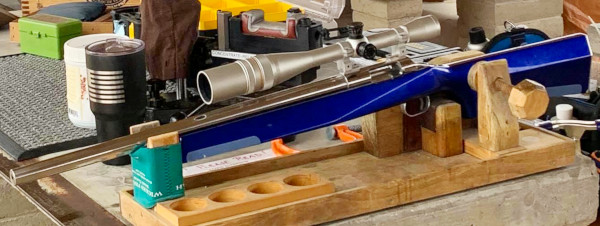
Greer has done something clever with his McMillan/Wheeler benchrest stocks. He has flipped over (inverted) the adjustable metal rudder (or keel) that runs on the underside of the buttstock. This provides a wider, flat tracking surface. The inverted rudder runs in a special sandbag on a Walhstrom mechanical rest. NOTE: Mechanical rear rests ARE legal for BOTH Heavy Guns and Light Guns under current NBRSA rules (see page 24). Shown at right is Greer’s Light Gun, but his Heavy Gun has the same system.
Charles explains: “Both my LG and my HG are of the same configuration except for additional weight in the stock of the HG. I decided to do this so that I would not need a separate rest system for each gun which saves on expense and makes it much easier to switch the LG out for the HG during competition. No need to change rest systems and re-align everything. Both of my stocks are McMillan/Wheeler LRB models with the adjustable rudder that can be repositioned horizontally to improve tracking. The rudder has a 3/4 inch-wide base that is usually fit into an Edgewood gator bag with a flat top. I did not like the way the rifle tracked with this set up and wanted something more solid and stable.
So I found that if I turned the rudder upside down and re-installed it that way on the stock, using the same screws and holes, the top of the rudder when turned down provided me with a base 1.5″ wide with a 1/4″ rail on each side. I got a Wahlstrom mechanical rear rest and had a custom Edgewood front bag made for it with a 1.5″ separation between the ears. The rail tracks perfectly in the bag and I can tighten the ears to make it quite solid and steady. I have noticed a huge improvement in tracking with this set up. I am still refining this arrangement but plan to continue using it on both rifles. I have never seen this done and was thinking maybe your readers would be interested.”
Questions & Answers with Charles Greer
Hall of Fame short-range shooter Gary Ocock interviewed Charles Greer. This interesting Q&A dialog covers shooting styles, equipment selection, recoil management and other notable topics.
Q: Tell us about your rifle, accuracy standards, and choice of calibers and bullets for the 1K game.
Greer: I set up two rifles, Light Gun and Heavy Gun. Both will shoot 100-yard 5-shot groups in the high ones and low twos. In Arizona I want a heavy, high-BC bullet in both guns to buck the wind and want to keep the ES under 10 FPS. I’m finding .300 WSM with Berger 220 LRHT bullets and a 4 groove Krieger barrel will provide the performance I need, and I shoot this round in both rifles.
Q: Explain your rest set-up, tracking, and recoil management. And how fast do you typically shoot your strings of fire?
Greer: I am using a Sinclair Competition Front Rest along with a mechanical rear rest, both with Edgewood front bags, to give me the stability necessary to provide consistent tracking even with these relatively high recoil rounds. Almost perfect tracking and consistent return to battery in the same spot is necessary to get a record string off quickly and smoothly. I try to get my strings off in a time of between 6 and 10 seconds per round depending on conditions. Any faster and I get sloppy.
Q: What were conditions like when you shot that amazing 10-shot group?
Greer: On the day I shot the record-pending target I had the first relay. There was wind but it was light, maybe 4-5 mph and seemed steady. The flags were about halfway up to horizontal and seemed to be holding that way. My procedure is to shoot 5 sighter rounds, two to adjust my initial round on paper to the X-Ring and then three more during the last minute to check for changes in the wind. If these last three rounds stay in the Ten Ring it is usually a sign that the wind may be steady enough for me to shoot a good group. On the “record” day the last three sighters were right in or near the X-Ring and when the record target came up I quickly but carefully dumped my 10 rounds holding the scope dot right on the X. The wind apparently held absolutely steady, and I got the result you see on the target.
That is my normal shooting technique. I pretty well know during the last minute of the sighter period whether a good group will be possible. If each of my last three sighters ends up inches away from the X in different directions, I know the wind is shifty and a good group on that target is unlikely. I adjust the last sighter to the X and then dump the string the same way just hoping the wind may hold for a minute or so. Sometimes it does, but often not so much.
During the record strings there is no way to know where the rounds are going. They are not marked, and the holes cannot be seen through the scope at that distance. The 1K flags are big and heavy and not very indicative of minor wind changes so I do not try to hold off or change my point of aim unless a flag completely reverses direction during a string. I’ve found that over the years adjusting my point of aim to the X after the last sighter and then dumping my strings gets the best results overall.
Q: What is your highest shooting accomplishment so far?
Greer: Well, the highest accomplishment (if one can call it that) would have to be this 100-10X target. This may end up being the best 10-shot target ever shot in a sanctioned match. 0f course, there is a tremendous amount of luck involved in this coming together but I certainly am pleased.
I had set four NBRSA world records when I was shooting previously: Light Gun Agg in 2008, and all three possible Highest Three Target Score records in 2010, two of which still stand. The first was probably the most satisfying as was my performance in the 2010 Nationals where I placed high in several categories and was Heavy Gun Champion for Score.
Q: Who do you attend matches with?
Greer: During the last year my son, Brian, has become my match shooting companion. We go out together every month. Brian was able recently to purchase the great 300 Ackley HG that I competed with and set world records with in 2010. I sold the rifle to a friend who never shot it and it found its way back into our family. Brian is now becoming a serious competitor.
Photo Right: Charles Greer with son Brian.
Q: What are your future shooting goals?
Greer: To keep on shooting our local match each month and to try to get to the Nationals once or twice more before I get too damn feeble. And to be able to see my son take my place as a regular winner when I can no longer compete.
Q: Is there any advice you would like to share with new shooters?
Greer: Make a commitment to excel at whichever discipline you choose. Get the best equipment and components that you can afford and consider each match a learning experience. At some point anything that can go wrong will go wrong and one must learn from these mistakes. Most importantly, be patient and keep coming back. In Arizona good shooting conditions are rare. You gotta be “in it to win it”. If you show up at every match you can attend eventually a great condition will appear on your relay and you will have a chance to shoot a spectacular score.
Q: What is your shooting background?
Greer: I started shooting rabbits as a kid in the Mojave Desert, trained on various firearms in the military in the fifties and sixties and over the years hunted birds and large game and played with various handguns. In 2005 I moved to Tucson from Mexico the first time and, looking for an activity, started shooting IDPA and IPSC pistol matches at Pima Pistol Club. Shortly thereafter I bought a .308 Savage tactical rifle and got interested in shooting for accuracy. One thing led to another and before long I bought a better Savage varmint rifle in .300 WSM and started shooting the 1K match at Tucson Rifle Club at Three Points around 2007. I kept upgrading my equipment, started winning matches, set some world records.
After the 2011 NBRSA Long Range Nationals I felt rather burnt out on shooting. I sold all my guns and equipment and headed South looking for perhaps one more adventure. I found some but they did not include shooting as South of the border folks tend to shoot back when they hear anything go bang. I returned to Tucson in May of 2019, built a couple of new rifles, and got involved again in the monthly Sahuaro match where the most recent world record target was shot. I would like to resume shooting the NBRSA Long Range Nationals. Will not be ready this year but probably will in 2022.
Q: Have you tried other disciplines at different ranges?
Greer: I have only competed in Long Range, mostly 1000 yards but 600 yards a few times at the Nationals. I would like to try shooting “Score” and there is a monthly match at our range. May try it if I can get an appropriate rifle.
The Civilian Marksmanship Program (CMP) will offer hands-on rifle and pistol training programs in 2021 at locations around the nation. The CMP’s Marksmanship 101 Program, formerly known as the Small Arms Firing School (SAFS) On The Road, is designed to train beginners on rifle or pistol essentials and competition basics in a closely monitored setting, utilizing the talents of qualified CMP staff, trainers, and members of the U.S. Army Marksmanship Unit (USAMU).
Held at CMP Games matches and at various CMP Affiliated Clubs around the nation, the courses are led by certified CMP Master Instructors and talented members of the U.S. Army Marksmanship Unit. The course curriculum is based off of the Small Arms Firing Schools (SAFS) offered at the annual National Rifle and Pistol Matches at Camp Perry, Ohio, which have been attended by countless individuals since 1918.
Upcoming Rifle Marksmanship 101 Classes:
New England Games, September 19, 2021, Jericho, Vermont
Oklahoma Games, October 17, 2021, Oklahoma City, Oklahoma
Talladega 600, November 16, 2021, CMP Talladega Marksmanship Park, Talladega, Alabama
Upcoming Pistol Marksmanship 101 Classes:
New England Games, September 19, 2021, Jericho, Vermont
Oklahoma Games, October 17, 2021, Oklahoma City, Oklahoma
Firearms and Ammunition Are Provided by CMP
Here is one of the biggest lures of the Marksmanship 101 Program — the CMP supplies guns and ammo! Rifles (AR-15), pistols (M9) and ammunition will be provided by the CMP at each location.
Programs Combine Classroom Learning and Outdoor Shooting
The Marksmanship 101 rifle and pistol courses train both adults and juniors in a safe and comfortable environment. Courses will be held at multiple locations. CMP Training Director Steve Cooper explains: “We know there are many people across the country who simply don’t have the time or means to travel to Ohio for the Small Arms Firing Schools during the National Matches, so, we decided to take the same basic curriculum and training on the road and customized the name.”
The Marksmanship 101 courses are a mix of indoor classroom learning and outdoor experiences on the range. Areas covered during the course include firearm safety, essential firing practices and handling, positioning and other competition skills, along with live firing on the range. Each course ends with applying everything learned to a true Excellence-In-Competition match on the range. “We always start our 101 events in a classroom environment, where we explain and demonstrate everything we’re going to do, very thoroughly,” Cooper said.
Program Requirements for Marksmanship 101
Since CMP Marksmanship 101 programs are designed to fit even those new to the marksmanship world, no previous firearm experience is required to attend. Participants ARE required to bring hearing and eye protection for the live-fire activities. Individuals should also dress according to weather conditions and may also bring any other desired competitive shooting equipment they wish to use.
How to Register for CMP Marksmanship Training Programs
Visit the CMP Marksmanship 101 website for Registration Links and other information. Once on the website, click your desired date and location to be sent to the CMP Competition Tracker page to complete registration. Questions regarding Marksmanship 101 may be directed to Amy Cantu at 419-635-2141 ext. 602 or acantu@thecmp.org.
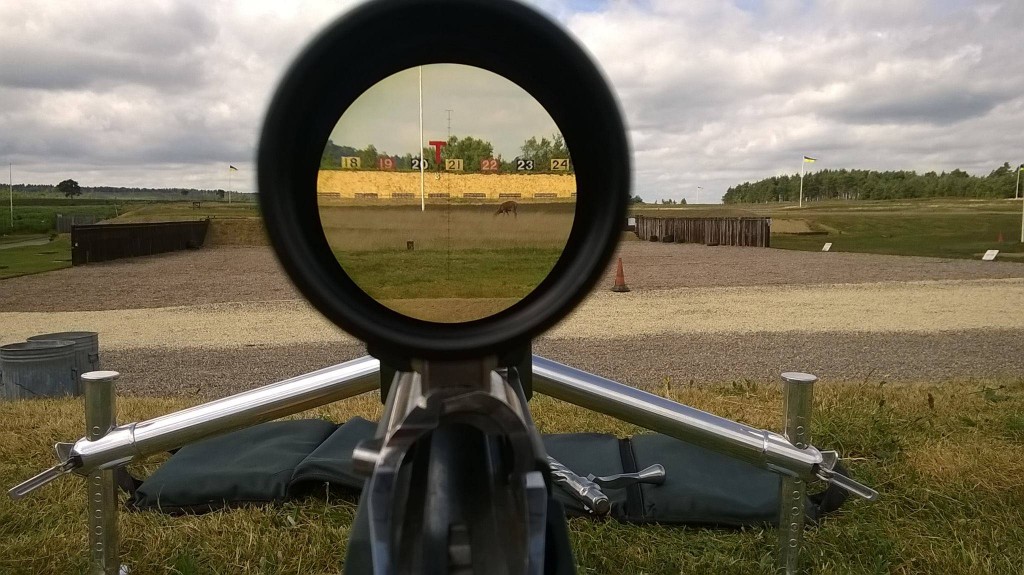
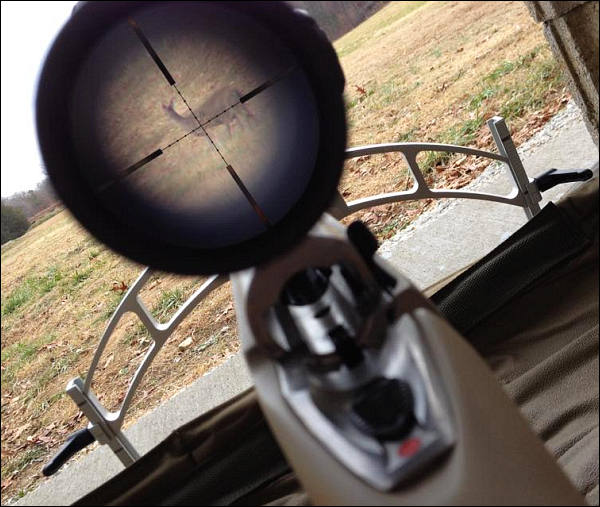
What’s wrong (or right?) with this picture? Does the “F” in F-class refer to “Fauna”? Look carefully at this Bisley Range photo taken by Australian R. Hurley while looking downrange through his March 8-80X scope. The photo was taken in 2015 at the Bisley National Shooting Centre in the UK.
The Story Behind the Photo
British shooter T. Stewart reports: “I was there when this photos was taken. All I can say was that Mr. Hurley was firmly reminded that should said deer accidentally jump in front of his bullet … he would spend five years ‘At Her Majesty’s Pleasure’.”
“That morning we had five deer moving across the targets, literally blocking the V-Bull. Since we were on the 900-yard Firing Point, and elevated for such, obviously the bullet would pass well above them. But they do NOT move or flinch at the noise or passing bullets since they are not hunted on the Bisley Ranges. Earlier this year we saw a herd of 20 or so deer grazing slowly across the Range.”
More Fauna Findings…
Apparently Bisley is not the only place were “the deer and the antelope play”. In Canada, on the Connaught Ranges near Ottawa, Ontario, shooters often encounter a variety of wildlife. William McDonald from Ontario says: “Animals are a common sight on the Range. Along with deer we see geese, turkeys, and coyotes on a daily basis.”
Likewise, E. Goodacre from Queensland, Australia often sees ‘Roos on his home range: “I shoot at Ripley, Australia, and shooting is regularly interrupted by kangaroos. Our last silhouette match was delayed by an hour while 30 ‘Roos dawdled across — silly buggers!”
R. Hurley wasn’t the first fellow to view deer through his F-Class rifle’s scope. After seeing Hurley’s photo from Bisley, B. Weeks posted this image, saying: “Been there, done that!”
Over the past six days the Civilian Marksmanship Program (CMP) conducted a major spring shooting event — the Talladega Spring Classic held at the Talladega Marksmanship Park in Alabama. This year’s event was a success, with participants enjoying a wide range of pistol and rifle competitions, plus training courses.
TALLADEGA SPRING CLASSIC 2021
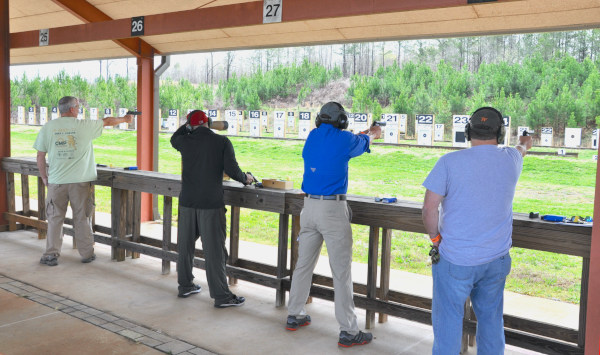
Spring has sprung! From March 16 through 21, the CMP has hosted a major series of rifle and pistol matches at the CMP Talladega Marksmanship Park in Alabama. The March 2021 Spring Classic event at Talladega included a mix of both new and traditional rifle matches, along with pistol competitions, and a variety of training courses.
On the rifle firing lines were Service Rifles, Vintage Military Rifles, and Rimfire Sporter Rifles. And there were even M1 Garands being shot from the bench. In the pistol areas, both rimfire and centerfire matches were held.
Spring Classic Featured New Benchrest Garand Match
The Talladega Spring Classic featured traditional matches plus some notable new events. Debuting this year was a Benchrest Garand Match. In addition there was a new Mid-Range 3×600 Rifle Match, and new Pistol 2700 Match. Along with the new events, the Spring Classic including CMP staple events including: Rimfire Sporter Rifle Match, .22 Rimfire Pistol EIC, Service Pistol EIC, and GSMM (Garand/Springfield/Vintage and Modern Military) Rifle matches.
There were also multiple training sessions including: Long Range Rifle Clinic, Team CMP 600-Yard Clinic, Rifle Marksmanship 101 Course/M16 Match, and Pistol Marksmanship 101 Course/M9 Match. These classes allow participants the opportunity to learn marksmanship from skilled, certified instructors.
This article was originally written by noted rimfire gunsmith Bill Myers. Sadly, Bill passed away in May 2010, but his legacy lives on. He pioneered many advancements in rimfire gunsmithing and Myers-built guns still win matches in benchrest competition.
Crafting competitive rimfire benchrest rifles is considered an art as much as a science. The smith must understand subtle, yet critical aspects of vibration control, barrel tuning, and rifle balance. In the United States, only a handful of gunsmiths consistently turn out rimfire BR rifles that consistently run at the front of the pack at major matches. Bill Myers was one of those master craftsmen. In this article Bill discussed the process of building a winning rimfire BR rig. He reveals some interesting secrets, including his procedures for testing bedding performance and his barrel indexing system. Bill’s methods obviously work, as the Suhl-actioned rifle featured here won a truckload of trophies in its very first match.
Building a Match-Winning Rimfire Benchrest Rig
by Bill Myers
In my opinion, a winning rimfire benchrest rifle is probably twice as difficult to build as a competitive centerfire rifle. The relatively slow .22 LR bullets stay in the barrel much longer than centerfire bullets. This means that vibration control is critical. Likewise bedding is critical. Bore finish and lapping are very important. The amount of bore taper or “choke” can have a huge effect on accuracy. Ignition is also very important and above all, rimfire BR rifles need a very stable stock that tracks perfectly. A rimfire that shoots great is a complete marriage of all components and of the shooter’s need to be aware of everything possible.
Click Photo to Zoom
The rifle featured in this article was built from scratch with attention to all the details that go into accuracy. The goal was to build a gun that could win from the get-go. This would be a “Spec Gun”, meaning a rifle that was personally tested and tuned by me for optimum performance before it went out to the customer.
The Suhl trigger is as good as it gets so no change was needed. It easily adjusts down to about 2 ounces.
Baer Stock in Bubinga Wood
There are many choices when you start to build a complete rifle. It has to shoot well and it has to catch ones eye, or it’s just another rifle on the line. I prefer wood stocks on rimfires for two reasons: they are very stable if the right wood is used and they have a certain traditional appeal to many shooters. I chose Bubinga wood for this particular gun because it is very stable and heavy, it has a very dense grain and a very pronounced figure with a natural red color. The Bubinga is a very forgiving wood to work with.
Gerry and Bruce Baer in Pennsylvania do all my stock blanks. I do all my own inletting and bedding. The blank weighed 4.5 pounds when it came off of Bruce Baer’s duplicator. This Bubinga wood is so hard that it did not need pillars, but I put them in anyway. I bed all my stocks with Loctite Steel Bed liquid and add filler to desired thickness. The final bedding is done with an aircraft tooling epoxy that does not deteriorate over time. The stock has an ebony butt plate and six (6) coats of automotive clear, polished to a “high buff” finish.
Suhl 150-1 Action Accurized and BN-Nickel Plated
I used a new, unfired Suhl 150-1 action. As explained in the sidebar below, the Suhl 150 actions were originally crafted in East Germany for position rifles. They have a very fast lock-time and come with an outstanding trigger. However, they need some work when adapted to a modern BR gun. The action needed to be accurized and threaded. I have a special tool that I use to accurize actions. It uses two sets of spiders for dialing-in the bolt raceway. After the bolt raceway is running true, one can thread and true up all bearing surfaces so that everything is in perfect alignment with the action raceway bore.
BN-Nitride Plating on Action
I decided to plate the action and all bolt parts with Boron Nitride nickel plating. I bough the BN Electroless Nickel Kit from Caswell Plating and did the job myself. I started by bead-blasting the action so that it would end up with a “satin” finish. The plating material is then applied in a tank. The Boron Nitride goes directly into the plating solution, but you need to use a pump to keep the solution agitated so the BN distributes evenly.
Once the action is completely ready (the metal must be perfectly prepped, with no contaminants), the process goes easily and can be completed in about half an hour. The end result is a very slick, low-friction finish, that is .0002″ (two ten-thousandths) thick and hard as glass. The Boron Nitride makes everything very smooth. After the plating job, the action was noticeably slicker than before.
The cone breech (photo below) permits the barrel to be INDEXED (rotated around bore axis) to any position on the clockface. You then test various rotation settings to find the best accuracy. The system does work. Some barrels shoot best in a particular rotational setting. E.g. with index mark at 3 O’clock vs. 12 O’clock.
Fitting and Chambering the Barrel
As for a barrel, I had two good choices: one Shilen 1:16″-twist, 4-groove ratchet and one Benchmark 1:16″-twist, 3-groove. Both barrels were very accurate and at the end, I decided to leave the Shilen on the rifle because I wanted to put the Benchmark on another Suhl I’ve set aside for myself. I chambered the barrel for Eley flat nose EPS. We’ve found the gun also shoots the new Lapua X-ACT ammo very well.
The barrel finished at 25″ long and features a tuner by the Harrell brothers of Salem, Virginia. I use a flat 90° crown–it’s the most accurate and its gives a good seal against the tuner. I also use a 45°, 12-flute cutter that leaves no burr when cutting the crown. This chamfer protects the crown when cleaning the barrel. There is no sharp edge for the brush or jag to hit on the return stroke. The barrel was headspaced at .043″ and I use a tapered reamer ground by Dave Kiff of Pacific Tool & Gauge in Oregon. The chamber leade area is lightly polished to remove reamer burrs. The breech end of the barrel is machined with a 1/2″ ball end mill to produce what I call a “Myers cone breech.” Technically, it has a sloping radius as you can see, rather than a straight-sided cone. Finishing the breech in this fashion facilitates indexing the barrel, as the barrel can be rotated to any position (on the clockface), without requiring new extractor cuts.
Barrel Indexing — Finding the “Sweet Spot”
When indexing a barrel, one rotates it to different clockface positions relative to the action. Imagine marking a barrel at TDC or 12 o’clock, and then rotating it so the mark is at 3 O’clock, 6 )’clock, 9 O’clock and so on. At each position one shoots groups to determine at which index setting best accuracy is achieved.*
I know that barrel indexing is controversial. I don’t want to get into a lengthy debate other than to say that I believe that careful and thorough testing can reveal a “preferred” index position for a good barrel. With the barrel set in that particular position relative to the action I believe the barrel can yield optimal performance.
I perform the indexing tests indoors at 50 yards. I use a rail-gun with floating action. The barrel is held in place with a clamping fixture similar to an Anschutz 2000-series action. Basically, two vertically-stacked metal blocks clamp around the barrel. I can index the barrel this way simply by unclamping the barrel blocks, rotating the barrel and then re-clamping the system. I have a special system so the action can stay in the same position, even as the barrel is rotated.
It takes time and effort to get solid indexing results. Normally I shoot at least 400 rounds of ammo in 3-4 indexing sessions. Shooting a handful of groups is not enough. You may think you’ve identified the best index position, but you need to shoot many more rounds to verify that. Also, in a very good barrel, the effects of indexing may be subtle, so it will take many groups to confirm the optimal position. In my experience, really good “hummer” barrels do not benefit as much from indexing as an “average” barrel.
Accuracy Testing with Both Barrels
I tested the rifle indoors at 50 yards at the Piney Hill Benchrest Club range. There was no finish on the stock, but it shot well in my one-piece rest with the Benchmark 16-twist, 3-groove barrel and no added weight on the tuner. I shot 30 rounds of Eley Match EPS Black Box (1064 fps) and had 25 Xs and five 10s on the IR 50/50 style target. Not too shabby for a new barrel with no special break-in.
When the Shilen barrel arrived, I installed it on the rifle. By this time the stock had been clear-coated and finished, and the action had been polished and plated. I shot the Shilen barrel outside since it was too hot in the building. The first target was a 250-19X with a new lot of Eley Match EPS Black Box (1054 fps). The gun shot well. My friend Tony Blosser asked to shoot the gun, and he drilled a 250-20X in a steady wind using the same Eley ammo. See target at right.
Advanced Procedures — Vibration Control and Tuner Position
Barrel Tuning Using 2-Way Electronic Indicators
Before competing with this rifle, I put it in a firing fixture I use to tune the barrel. I employ a pair of very expensive Swiss 2-way electronic min/max hold indicators. These measure both up movement and down movement of the barrel as the gun is fired. I can measure the actual vertical travel of the barrel at any position from the front of the receiver to the tuner. I can also tell how long the barrel vibrates, time-wise. Using this fixture I found that the Shilen barrel was very consistent in readings and seemed to work well with no additional weight on the tuner. No barrel ever stops vibrating completely — but this was close, showing less than .002″ of total movement.
Bedding and Vibration Control
I have found that measuring the actual movement of the barrel during firing tells me a lot about the quality of the bedding. I have learned that if I see very big movements (e.g. .010″ up and .005″ down), then there may be a problem with the bedding. I saw this kind of big swing on a rifle with bedding that had not cured properly.
Another pattern I watch for is uneven vertical movement. For example, if the barrel vibrates .008″ up but only .002″ down, that tells me the bedding has issues. As noted above, I look for minimal vibration travel (after the tuner is fitted and optimized), and I also want that travel to be relatively equal both up and down. Good rimfire gunsmiths agree that proper bedding has an important influence on vibration control and tuning. By measuring actual barrel movement during firing, we can, to an extent, quantify how well the bedding is working. At a minimum, we can see if there’s a serious bedding problem.
Trial by Fire — Shooting the Gun in Competition
After semi-gluing in the action, the rifle was shooting great. So, I decided to take it to the Maryland State Unlimited Championship to see if it was truly competitive — whether it could “run with the big dogs”. As it turns out, the Bubinga Suhl was more than just competitive. The rifle won three of the six cards and won the meters championship. In the photo below you can see all the trophies the gun won in its very first match. One of the other competitors in Maryland, dazzled (and perhaps a bit daunted) by the Bubinga Suhl’s stellar performance, told me: “Sell that gun Bill. Whatever you do, just get that darn rifle out of here.” Confident that this was a rifle capable of winning major matches, I packed up the rifle and shipped it to Dan Killough in Texas. Killough has shot some impressive scores with the gun.
Suhl Target Rifles — East Germany’s Legacy
Suhl 150 rifles were manufactured in former East Germany (GDR) by the Haenel firearms factory in the town of Suhl. This region has a long history in arms production. In 1751, Sauer & Sohn founded the first German arms factory in Suhl. Following WWII, Suhl 150s were produced for Communist Bloc marksmen, including East German Olympic shooters. Prior to German unification, the East German national shooting arena was located at Suhl and hosted many top-level competitions including the 1986 ISSF World Championships.
Superb Rifles with Amazing Triggers
As a product of East Germany, the “mission” of the Suhl 150 was to rival the accuracy of the Anschütz, Walther and other premium match rifles built in the West. East German shooting teams wanted to finish on top of the podium, so they needed a rifle with superb inherent accuracy. The Suhl 150s have an outstanding trigger that can be adjusted down to about two ounces. The Suhl 150 action, like the Anschütz 54, boasts an extremely fast lock-time — an important factor in a position rifle. And Suhl barrels were legendary for accuracy.
Suhl 150 Benchrest Conversions
Many of the first used Suhl 150s that made it to America were converted to Benchrest rifles because the action/trigger/barrel combination was unbeatable for the price. Some of the barrels on these “surplus” Suhls were phenomenal — as good as any custom barrels available today. It was not unknown for a Suhl 150 barreled action, transplanted into a benchrest-style stock, to win BR matches with the original barrel. Today, however, most of the Suhl benchrest conversions end up with modern, American-made barrels. While some older Suhl barrels can “shoot with the best of ‘em”, new barrel designs optimized for use with tuners have an edge, at least in benchrest circles. That’s why builders such as Bill Myers swapped out the Suhl barrel with something like a Benchmark reverse-taper two-groove.
Today Suhl 150 rifles are very hard to find in North America. In 2006, a used Suhl 150, even without sights, might fetch $1200.00 or more. Then, in 2007 through early 2008, hundreds of Suhl match rifles were imported. This drove prices down, and those “in the know” snapped up complete Suhl 150s at prices ranging from $450 to $850 (see 2007 advert at right), depending on condition.
Many of these rifles were left “as built” and used successfully in prone competition. Others were converted into benchrest and silhouette rifles, “parted out” for the actions and triggers. If you were able to grab one of those imports at a good price–consider yourself lucky.
* Bill Myers actually created his own clamping rimfire action to facilitate barrel indexing. CLICK HERE for Myers Rimfire Action. To index the barrel, Myers simply loosened three clamping-bolts and rotated the barrel in the action. Because there is no thread to pull the barrel in or out, the headspace stays the same no matter how much the barrel is rotated. With a threaded action, you might have to use shims to test different rotational positions, or otherwise re-set the shoulder with each change.
Congrats to Lester Bruno, overall winner of the 2021 Cactus Classic Benchrest Match. This popular NBRSA match is held every year at the Ben Avery Range outside Phoenix, Arizona. Lester shot brilliantly, particularly at 200 yards, to win the Two-Gun convincingly with an 0.2099 Overall Aggregate. Ed Adams was second with a 0.2303 Two-Gun Agg, with Durward Wofford in third place with 0.2655. Along the way Lester nailed a remarkable 0.1742 200-yard Heavy Varmint Agg. That’s mighty impressive.
Click Image Below for full-screen Panorama Image:
Paul Parosky reported: “So the Cactus Classic COVID Edition of 2021 has come to an end. Lester Bruno won with some amazing shooting at the LV and HV 200 yards. Myself? I need some more time behind the rifle and at 200 yards. We came across some nasty mirage that basically it was really hard to see the bullet hole. I still was able to finish in the middle of the pack 29th in the 2-Gun Aggregate, which is OK with me. But most of all had super great time, meeting new people and also putting faces to the FB friends from the group. The referees, Matthew Schwartzkopf and his crew [plus] the Wickenburg School volunteers did a wonderful job keeping the match going flawlessly.”
2021 Cactus Classic Top 25 Two-Gun Overall Results:
In 100/200 yard Group Benchrest, most top competitors load at the range, tuning their loads for the conditions. Here you can see the portable powder measure (left) and a compact ARKCO Hood Press (right). That blue combo press can both size cases with a screw-in die and seat bullets using a Wilson Seater die (placed on left side). The vast majority of short-range benchrest-for-group competitors run the 6PPC cartridge with fast-burning powders such as Vihtavuori N133.
Capstone Precision Group (Berger Bullets, Lapua, SK, Vihtavuori) provided many valuable prizes to competitors at the 2021 Cactus Classic.




 Charles Greer reminded us that even senior citizens can succeed in benchrest competition: “One of the benefits of benchrest shooting is that it is a sport accessible to us even as we age. I cannot run and gun anymore like I used to do in IPSC and IDPA but as long as I can get my body and my equipment up to a bench, I can still be very competitive. That is not possible for us old guys in most sports and shooting disciplines. As I am ‘only 83′ I am hoping to squeeze a few more years of competition out of the old body before I have to pack it in for good.”


 Greer has done something clever with his McMillan/Wheeler benchrest stocks. He has flipped over (inverted) the adjustable metal rudder (or keel) that runs on the underside of the buttstock. This provides a wider, flat tracking surface. The inverted rudder runs in a special sandbag on a Walhstrom mechanical rest. NOTE: Mechanical rear rests ARE legal for BOTH Heavy Guns and Light Guns under current
  Q: Who do you attend matches with?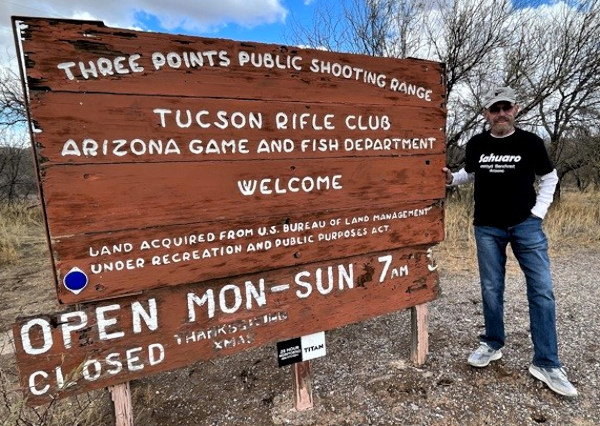




 TALLADEGA SPRING CLASSIC 2021



 Accurized and BN-Nickel Plated
 BN-Nitride Plating on Action
 Fitting and Chambering the Barrel
 Accuracy Testing with Both Barrels


 Today Suhl 150 rifles are very hard to find in North America. In 2006, a used Suhl 150, even without sights, might fetch $1200.00 or more. Then, in 2007 through early 2008, hundreds of Suhl match rifles were imported. This drove prices down, and those “in the know” snapped up complete Suhl 150s at prices ranging from $450 to $850 (see 2007 advert at right), depending on condition.