This summer, our friend Dennis Santiago made his first-ever pilgrimage to Camp Perry, Ohio to compete in the National Matches. He recounts his experience in a fascinating, informative, and often humorous story on his Dennis Talks Guns Blog. When you have a few moments to spare, you should definitely read Santiago’s account of his First Time at Camp Perry. This is much, much more than a match report. Dennis gives insights into the human side of the experience — and the little things that make Camp Perry so special. CLICK HERE to Read Full Camp Perry Story.
Dennis competed in a number of events during his two-week stay. Shooting “classic” service rifle and his new scoped, “modern AR” service rifle Dennis competed solo (in Presidents 100 and NTI matches among others) and also as a member of the California Adult Team in the 4-man NTT match.
Santiago’s First Time at Camp Perry report is a “must-read” for anyone contemplating a Camp Perry visit. Here are some highlights — but honestly folks, do read the entire story — it’s well worth it.
First Time at Camp Perry, by Dennis Santiago
Perry Ain’t Like Home
Iron Sights and “Perry-Vision”
This range is kicking me hard. I tell people about how hard I was pushing my eye into my aperture. They smile that “welcome to Camp Perry” smile again. They ask what sights I’m shooting on my A2 and I tell them I’ve got an 0.050″ front and 0.038″ rear to maximize depth of field. They smile more broadly and tell me my problem is that I’m from the Western provinces where the sun is bright and the ground is devoid of flora. Lots of light. It’s green here and we have clouds I’m told. Not nearly the same ambient lighting. You have the wrong sights my son. Where the green grass grows you want a big fat 0.072″ front the size of an aircraft carrier deck and a huge 0.046″ hole in the morning and maybe close it down to an 0.042″ rear aperture later if the sun comes out. But that desert glare sight system of yours will lose you about 5-8 points in these parts. Well there you go. Learn something every day.
Baptism at Camp Perry
One’s first visit to Camp Perry is a series of baptismal rites. I shall now enumerate them…
Walk the Base. Do not drive around. Get used to walking. Walk from your hut to everything. Walk to the administration buildings. Walk to the ranges. Walk to commercial row. Walk to the CMP North Store. Walk to the CMP or Army trailer to have the triggers of your rifles(s) weighed. Walk. This is your primary mode of transportation while on base for the next couple of weeks.
Go Shopping. It’s called Commercial Row. It is the best shopping mall for competitive shooters ever. The sale prices here are Black Friday quality. You stock up on supplies. You can buy elusive powders in quantity with the same lot number. Same with bullets and primers. Everything you need to keep making your pet loads. Oddly, not cases. This is a service rifle tournament. Pretty much everyone is using LC or WCC cases. I stocked up. Then I began politely watching my expected cubic feet and gross weight capacity for the drive home as other people asked if I could take stuff back for them instead of shipping their loot.
Learn about the Perils of Perry. One, evacuate the range. It rains at Camp Perry. Sometimes that rain comes with lightning. When that happens range controls issues an evacuation order. Depending on where you are and how much time you have, you either grab your stuff and make for a sheltered structure or leave your stuff under whatever rain cover you have and leave it there until the storm cell passes. This happened on squadded practice day. There was no squadded practice. There was learning to make a better rain cover for the next two weeks because it’d probably happened again. I was particularly proud of my final design which involved a very large tarp and many bungee cords. Modern art to be sure. I received many compliments.
Peril Two — Cease fire, boat in the impact area. One has not truly been to Camp Perry until your shooting string is put on hold while range control sends someone out to tell an errant yacht or jet ski that it’s not a good idea to go into that area with all the buoys with the signs on them that say, Danger. Live Fire. Keep Out.
Shooting Gear
I brought two rifles with me to Camp Perry. The first was my iron sights-configured AR-15. Being my very first trip to the Nationals, I wanted to check off a bucket list item to shoot irons at a National Match. The gun has a Geiselle trigger and an upper I assembled from White Oak Armament parts. The barrel is a Krieger that had 3,800 rounds arriving at Perry. The sights are pinned 1/4×1/4s. I run Sierra 77gr SMKs short line and 80gr SMKs seated .015″ off the lands Long Line with it.
The other rifle I brought was for NRA week. It’s a 2016 Rule Service Rifle, Optic. It has a collapsible UBR stock and a Geiselle Mk VII quad rail. The barrel is an older DPMS .223 that was cryo-treated back in the day. Round count on arrival at Nationals was around 1,800. Same ammunition combination [as the iron sights rifle]. The chamber on this barrel has a shorter throat so I brought a Lee Hand Press with an RCBS competition seater die to set the 80gr SMKs back to proper jump for NRA week. The sighting system for this gun was one of the very new Nightforce 4.5X Competition SR’s with the CMP R223 reticle. Parallax is set to 200 yards. It’s mounted using Nightforce’s superbly engineered AR-15 service rifle Unimount.
Members of the State of California Teams at Camp Perry. Dennis is front row left.
Coaching — When It All Comes Together, at Last
I coached one of the California teams in the NTIT Rattle Battle match. This was the day I finally began to be comfortable at Camp Perry. Walking up and down the field, first as a verifier and then as a coach, I felt back in the game. At team matches you get to confer with your teammates comparing wind calls and observing the effects of their calls as the shooting members of their squads send rounds downrange. You watch the traces of bullets arcing in the air going left or right of the bull’s center depending whether or not the call was right. This process was cathartic. I began to remember that I really can read a range once I get the hang of it.
The 2016 NRA World Shooting Championship (WSC) takes place September 15th through 17th, 2016 at the Peacemaker National Training Center in Glengary, West Virginia. The richest multi-gun event in North America, boasting $250,000 in cash and prizes, the WSC attracts the world’s best multi-gun shooters. This unique 3-day multi-gun match tests competitors’ skills across twelve stages sampling nearly every major shooting discipline (rifle, shotgun, and pistol). To be honest, the WSC is mostly a “run and gun” speed game, but competitors still must engage small targets at long range, so genuine marksmanship skills are required.
This year there will be three divisions: Open Professional, Stock Professional, and Amateur. Stock Professionals and Amateurs will use provided guns and ammo. But a 2016 WSC Rule change allows Open Pro competitors to bring their own firearms and ammunition for the match. Allowing the top Pros to shoot their own, optimized match guns should produce faster times and higher scores (plus fewer complaints about off-the-shelf guns that aren’t zeroed or don’t run right).
How to Win the World Shooting Championship
As first published in the NRA Blog, here are competition tips from reigning overall NRA World Shooting Champion Bruce Piatt, and Dianna Muller, the top female competitor at the 2015 WSC:
“The format at the NRA World Shooting Championship is unique in that you don’t know what you have to shoot until you show up, so training for the event is a little difficult. My advice is to pack some good eye and ear protection, bring an open mind, be prepared to listen to the stage descriptions, figure out the best way you can take the guns they provide, and post the best score you can. When the match supplies all the guns and ammo, all you have to do is deal with ‘the performance’. This is the most level playing field in the shooting sports — anyone from around the world can come and play.” — Bruce Piatt
“The NRA World Shooting Championship match is such a different breed — it’s really a difficult match for which to prepare! Over the past two years, I’ve learned to relax. I focus on relaxing in my own sport, because when you focus on the expectations over the procedure, it usually never works out in the shooter’s favor. The same goes for this match. You are tackling disciplines outside your expertise and using guns you aren’t familiar with, and that can really rattle your nerves if you don’t prepare for that mental challenge. But you can use this match design to your advantage. Remove all expectations, because, who is great at ALL the disciplines (besides Jerry Miculek)?! Give yourself some room to be ‘not so great’, focus on the fundamentals and try to enjoy the match. It is kind of liberating throwing everything to the wind and seeing how you stack up against all kinds of shooters! Coming from such a gear intensive sport as 3-Gun, I really enjoy walking up to 12 different stages and shooting guns and ammo that are provided. Although there may be issues with that format, it’s a great way to level the playing field, get down to brass tacks and see who is the most well rounded world champion shooter!” — Dianna Muller
Tech Milestone — Norm Crawford won the 2016 Wimbledon Cup at Camp Perry using a carbon-fiber composite barrel. That’s a first for composite barrel technology.
With a score of 200-16X, Norman Crawford won the Wimbledon Cup Match during the 2016 National Long Range Rifle Championships using a 32″ Proof Research carbon-fiber composite barrel chambered in .284 Shehane. The Wimbledon Cup Match, a prestigious 1,000-yard shooting competition, dates back to 1875. The current course of fire consists of 20 timed shots, fired from prone. Crawford’s win represents the first time in the Cup’s 141-year history that it has been won with anything other than an all-steel barrel. The Proof Research barrel features a steel core with an external multi-axis carbon wrap.
Crawford’s Wimbledon Cup win really is an important technological milestone. Crawford’s performance may encourage other competitors to consider steel/carbon composite barrels for a variety of shooting disciplines. Without question, composite technology barrels offer significant weight-savings over conventional all-steel barrels. And Crawford proved that a composite barrel can deliver winning accuracy, at least in a sling/prone discipline.
“I don’t know of anyone else in this sport using a carbon fiber [composite] barrel,” said Crawford, who has been shooting Proof composite barrels since 2013.
“The benefits over a steel barrel are that you get a larger-diameter, stiffer, faster-cooling barrel that weighs less than a standard, medium Palma-taper barrel. [There is] no real downside I’ve been able to identify in three years of shooting them. All five Proof barrels I own are capable of winning any match — providing I do my part.”
A 30-year Army vet and former Army Special Operations Sniper, Crawford has been shooting competitively since 1990. He has won many major titles, including the NRA National Long Range Championship in 2005. His 2016 Wimbledon Cup victory was his second — Norm also won the Cup in 2003. A three-time member of the U.S. Rifle Team at the World Championships, Crawford also used a Proof Research barrel to tie the national record for a 600-yard Any Gun, Any Sight competition in North Carolina last November, one of five national records he has set or tied during his shooting career.
Proof Research CEO Larry Murphy praised Crawford: “We are honored that Norm chose our barrel to go up against the best shooters in the world with. By putting our barrels to the test in intense competition, he pushes us to do our best as well.”
Yes, F-Classers, it’s time for the Nationals. Is your ammo loaded? Scope zeroed? The 2016 NRA F-Class Nationals will be held in Lodi, Wisconsin at the Winnequah Gun Club from September 23 through October 1, 2016. This will be a combined Mid-Range and Long Range event, with the Mid-Range activities running September 23-27, followed immediately by the Long-Range Nationals which conclude October 1, 2016. F-TR and F-Open shooters will compete for both individual and team honors. Here is the schedule:
Electronic Scoring at F-Class Championships This is big news. For the first time ever in the USA, electronic (sonic-sensor) targets will be used for both the Mid-Range and Long Range F-Class National Championships. NOTE: These are NOT like the self-contained Kongsberg target systems at the CMP’s Talladega Marksmanship Park.
At Lodi, Competitors will still aim at conventional paper target faces but sonic sensors on the target frames will allow instant shot plotting and scoring. This target system was developed by Silver Mountain Targets of Canada. The Silver Mountain system uses sonic sensors (essentially high-tech microphones) to triangulate shots with great precision. Monitors will be positioned at each firing station. The Silver Mountain system has been extensively tested and the match directors have hard-wired the target “brains” back to the scoring center to ensure reliable communications. Before the championship, match officials will be conducting a mandatory class on the operation of the electronic target monitors.
Looking downrange at Winnequah Gun Club in Lodi, WI:
2016 NRA F-Class National Championships FEE Schedule:
Mid-Range – Individual entries all individual matches – $230
Mid-Range – Each Team match (pay at range) – $80
Long Range – Individual entries all individual matches – $230
Long Range – Each Team match (pay at range) – $80
Combined Individual entry Mid-Range and Long Range – $400
STATE of the ART — F-TR and F-OPEN
Here is the sleek .308 Win rig Bryan Litz used to win the 2015 Mid-Range AND Long-Range F-TR Championship at the Ben Avery Range in Phoenix.
And here is the 7mm RSAUM F-Open rifle belonging to Kenny Adams. The reigning F-Open World Champion, Kenny will be one of the favorites in Lodi…
Kenny’s World-Beating 7mm RSAUM Load
For his 7mm RSAUMs Kenny loads Hodgdon H4350 powder and Federal 215m primers into Nosler or Norma RSAUM brass. In the RSAUM he runs Berger 180gr Hybrid bullets seated “just touching” the lands. Kenny is very precise with his charge weights. Using a Sartorius Magnetic Force Restoration scale, Kenny tries to hold his powder charges to within 1-2 kernels charge-weight consistency.
The National Shooting Sports Foundation and Cavern Cove Rimfire welcomes everyone to join us October 14 – 16, 2016 for the 2016 NSSF Rimfire Challenge World Championship! The event will be hosted at the Cavern Cove Rimfire facility in Woodville, Alabama.
Competitors will be challenged with both rimfire pistol and rifle stages. As with all NSSF Rimfire Challenge events, both novice and experienced shooters are encouraged to participate. This event is designed to be fun and enjoyable for all skill levels. For many shooters, a Rimfire Challenge represents their first competitive shooting experience.
Rimfire Challenge events are intended to be entertaining for the entire family. Whether you’re coming as a spectator or a competitor, side shooting activities are in the works so that everyone in attendance will have the opportunity to enjoy some trigger time. Come one come all to what will be a very exciting and fun weekend!
Are you a died-in-the-wool .50 BMG fan? Got a hankerin’ for heavy artillery? Then visit the FCSA Photo Gallery page. There you’ll find hundreds of photos from Fifty Caliber Shooting Association (FCSA) matches and 50 Cal fun shoots in eleven states plus Australia, Switzerland, and the United Kingdom. To access the photos from the Gallery Page, start by selecting a state/country and then click on the colored buttons for the event date (e.g. 2015-04).
Photo sets go all the way back to 2002, so you can see the evolution of the hardware over the years. Sample multiple archives to see the differences in terrain from one range to another — from Raton’s alpine setting to the hot, dry Nevada desert. This Gallery is really a treasure-trove of .50-Cal history. Here are a few sample images.
Story Tip from EdLongrange. We welcome reader submissions.
U.S. Rifle Team (F-TR) Selects New Berger 200.20X Bullet for 2017 World Championships
Berger Bullets has released new .30 caliber bullet that could be a game changer for the F-TR discipline — a bullet with exceptional accuracy and very high BC. Berger’s NEW 200.20X Hybrid Target Bullet is the result of extensive research and development in partnership with the U.S. Rifle Team (F-TR), world champion shooters, and accuracy enthusiasts within the long range shooting community.
The new 200.20X has a 0.640 G1/0.328 G7 BC compared to 0.616 G1/0.316 G7 for the older 200 grain .30 caliber Hybrid. That’s a significant reduction in drag. Recommended twist for the new bullet is 1:10″, same as with the earlier 200-grainer.
Berger Chief Ballistician and U.S. Rifle Team (F-TR) member Bryan Litz said, “This is the ideal bullet for F-TR and similar long-range disciplines. The 200.20X has a longer boat tail and nose, with shorter bearing surface which equates to less drag, a higher ballistic coefficient, and fewer points lost to the wind. The BC of the new 200.20X is 4% higher than the existing 200 grain Target Hybrid (G7 BC of 0.328 vs. 0.316). The shorter bearing surface also makes the 200.20X easy to load and shoot in standard chambers. New shooters won’t need special reamers or costly gunsmithing to make this bullet perform.” Bryan himself is switching to the new 200.20X: “After winning the 2015 National Mid-Range and Long Range F-TR Championships with the Berger 215 grain Target Hybrid, I’m switching to the 200.20X because it’s an even better option.”
Bryan tells us that new 200-20X bullet requires a 1:10″ twist to achieve full stability and performance (BC) in most conditions, but you can shoot it out of a 1:11″ twist with a minor decrease in BC. For a stability analysis, enter this bullet in the Berger Stability Calculator with a weight of 200.2 grains, and a length of 1.508″ to get stability results for your particular rifle and atmospheric conditions.
After extensive field testing, this new 200.20X bullet has been adopted as the official .30 caliber match projectile for the U.S. Rifle Team (F-TR). The team verified that this new bullet offers very impressive performance — the higher BC equates to less wind drift, and this bullet has shown exceptional ability to “hold waterline”. Check out this 1000-yard group by Team member Dan Pohlabel, as shown on an electronic target monitor.
To learn more about the new .30 caliber 200.20X Hybrid Target Bullet and its development, visit the Berger Bullets Blog for details. These 200.20X bullets are available right now through your favorite authorized Berger Bullets vendors.
About the U.S. Rifle Team (F-TR)
The two- time World Champion, U.S. Rifle Team (F-TR) is comprised of 30 shooters and coaches who have dedicated themselves to four years of training and preparation to represent the United States at the 2017 World Championships to be held in Canada. They compete all over the world at various ranges out to 1,000 yards.
Buy Bullets and Support U.S. Rifle Team (F-TR)
Eric Stecker, President of Berger Bullets said, “We are proud to be the Official Bullet of the U.S. Rifle Team (F-TR). To support our team, Berger Bullets will donate $1.00 for every box of 200.20X bullets sold towards U.S. Team expenses for the upcoming 2017 F-TR World Championships, which will be held at the Connaught Ranges in Ottawa, Canada.”
Grizzly Industrial and Bullets.com President Shiraz Balolia pulled off a stunning feat of marksmanship recently, winning his third straight F-Open title at the Canadian F-Class National Championships. It wasn’t easy — conditions were tough, as was the competition — there were top shooters from around the world, including many past U.S. Champions. Shiraz had a slim, one-point lead after Day 2, but Balolia ended up tied on total points (and V-Count) with Emil Kovan at the end of the third and final day. But when the cards were compared, a string of Vs on Day 3 secured Shiraz the win via tie-breaker. Thus Shiraz achieved the memorable “three-peat”, winning Canada’s 2016 F-Open National Championship to complement his 2015 and 2014 victories.
Three-Peat at Connaught — 2016 F-Open Canadian Championship
by Shiraz Balolia This trip to Ottawa for the Canadian National Championship was a specially important one. The U.S. Team tryout process and practice was to take place for two days prior to the National Championship as the next F-Class World Championship is going to be held in Ottawa in August of 2017.
Connaught Range is a fantastic range that is very well run. Pullers are provided as part of your entry fee and matches are run at different times of the day, even into the evening. The flags are heavier than the ones we use in USA and are notorious for lying to the shooter. Matches are shot in pair firing mode which means one shooter takes a shot and the other scores. You cannot simply rattle off a shot as soon as the target comes up.
Crazy Hot Conditions at the Connaught Range
The first day the winds were mild, but tricky and the temperature was 102° F. I had never shot in such weather and ended up in the 6th place for the day. The second day had several matches at 900 meters and the wind picked up, with a 105° F recorded temperature, causing havoc with everyone. In one of my matches at 900 meters I took my two sighters and my first shot for record was a 3 (equivalent to an 8 in USA). To top it off I shot another 3 a few shots later. Liar, Liar, flags on fire! Anyway, I dropped 7 points in that match only to find out some very good shooters had dropped over 10! I moved to top position for the two-day Aggregate.
The third and final day was one string of 20 shots with shooters squadded by their two-day Aggregate ranking. So I was paired with Emil Kovan, while the third position shooter was paired with the fourth-ranking shooter et cetera. We all shot in identical conditions.
Après Moi, le Déluge — Not Your Gentle Drizzle
Then came a vicious rainstorm. We waited out the storm for two hours before we shot. The rain was really, really nasty and coming down really hard. We were all huddled under the U.S. Open Team’s tent.
Shiraz and Emil Battle to the End…
Finally, after the long delay, we got back to the firing line. And it went down to the wire. Emil shot a 100 with 3 Vs and I shot a 99 with 12 Vs. When the dust settled, we ended up with the same score and total V-Count (611-61V). The tie would be resolved by a “count-back” procedure. I had a stack of Vs at the end of my string and that won the match. What a fight!
Shiraz told us that this third championship was the toughest: “A while back, I had rotator cuff surgery on my shooting arm and had not shot a match in 9 months. I barely was able to test loads for three weeks before I shipped my ammo and did not know what to expect.” He says that winning “did not even sink in for a few days and looking back, I think this will be something I will cherish forever.”
Shiraz’s win came against very tough competition. Shiraz notes: “The whole U.S. Team, the whole Canadian Team, many South Africans, Germans, British, Ukrainians and others were present. We had several past US National Champions present as well and it was a great honor to shoot with all of them.”
Note: This is a photo from 2013, there may be slight changes in the rifle.
The rifle features a BAT Machine ‘M’ action, with a 31″, 1:10″-twist Bartlein barrel. The scope is a March 10-60x52mm, which sits on a +20 MOA angled rail. The primary stockwork, including fitting of the adjustable cheek-piece and buttplate, was done by Alex Sitman of Master Class Stocks. Shiraz customized the stock with finger grooves, fore-end channel, and a bottom rear slide. Shiraz did the final stock finishing as well.
Gun Components
BAT Machine Action
Master Class Stock, modified by Shiraz
Bartlein Barrel, 1:10″ Twist, 31 inches long
Fitted Barrel Harmonic Tuner
March 10-60x Scope with fine crosshair and 3/32″ dot
Caliber & Load
.300 Winchester Short Magnum (WSM)
215gr Berger Hybrid bullets, 2870 FPS
Norma .300 WSM Cases
H4831SC Powder
Tula (Russian) Primers
NOTE: Shiraz was not running anywhere near max: “I chose a light load for Ottawa due to the range limits as my other accurate node is 100 FPS faster and almost at the range limit.”
Clear skies and calm winds welcomed 85 of the nation’s best Precision Rifle Series (PRS) shooters to the PRSID Shootout at the Snake River Sportsmen range in Vale, Oregon. Held on August 27-28, this sold-out event was hosted by the Precision Rifle Shooters of Idaho (PRSID). Finishing first was Jake Vibbert of Washington state with a 163.500 score, followed by Oregonian Jon Pynch with 156.500. In third place was Ben Cleland of Georgia with 152.500.
Over the two-day event, competitors shot 20 challenging stages such as ‘MGM Spin Cycle’, ‘Run through the Rocks’, and ‘MGM Spinner Chicken Dinner’. The course of fire featured many reactive targets. The “instant feedback” offered by reactive targets is a major “fun factor” contributing to the rapid growth of PRS shooting. Shooters engaged MGM targets on 19 of the 20 stages at distances from 300 yards to 1160 yards with MGM Flash Targets on all engagements past 300 yards. The Flash Target Systems made impacts easy to see for both shooters and spotters.
Light React LED Hit Sensors were also used to help confirm hits on the two long-range stages with engagements out to 1160 yards. In the past couple of years the PRS has emerged as a very popular competitive shooting discipline. PRS specializes in tactical-style target shooting “on the clock” with challenging scenarios and targets placed at distances out to 1200 yards. More typical, however, are PRS stages with targets placed from 200 to 500 yards.
Event organizers commented afterward: “A big thanks to Travis Gibson and MGM Targets for backing our club and for making targets that show clear impacts, it made it easy on the spotters. [The] Max light react system ran flawlessly on the long range in combination with MGM flashers. There was never any guessing whether you had an impact or not.”
The ability to read the wind is what separates good shooters from great shooters. If you want to learn wind-doping from one of the best, watch this video with 2010 National High Power Champion (and U.S. Army 2010 Soldier of the Year) Sherri Gallagher. Part of the USAMU’s Pro Tips Video Series, this video covers the basics of wind reading including: Determining wind direction and speed, Bracketing Wind, Reading Mirage, and Adjusting to cross-winds using both sight/scope adjustments and hold-off methods. Correctly determining wind angle is vital, Sheri explains, because a wind at a 90-degree angle has much more of an effect on bullet lateral movement than a headwind or tailwind. Wind speed, of course, is just as important as wind angle. To calculate wind speed, Sherri recommends “Wind Bracketing”: [This] is where you take the estimate of the highest possible condition and the lowest possible condition and [then] take the average of the two.”
It is also important to understand mirage. Sheri explains that “Mirage is the reflection of light through layers of air, based off the temperature of the ground. These layers … are blown by the wind, and can be monitored through a spotting scope to detect direction and speed. You can see what appears to be waves running across the range — this is mirage.” To best evaluate mirage, you need to set your spotting scope correctly. First get the target in sharp focus, then (on most scopes), Sheri advises that you turn your adjustment knob “a quarter-turn counter-clockwise. That will make the mirage your primary focus.”




 “The NRA World Shooting Championship match is such a different breed — it’s really a difficult match for which to prepare! Over the past two years, I’ve learned to relax. I focus on relaxing in my own sport, because when you focus on the expectations over the procedure, it usually never works out in the shooter’s favor. The same goes for this match. You are tackling disciplines outside your expertise and using guns you aren’t familiar with, and that can really rattle your nerves if you don’t prepare for that mental challenge. But you can use this match design to your advantage. Remove all expectations, because, who is great at ALL the disciplines (besides Jerry Miculek)?! Give yourself some room to be ‘not so great’, focus on the fundamentals and try to enjoy the match. It is kind of liberating throwing everything to the wind and seeing how you stack up against all kinds of shooters! Coming from such a gear intensive sport as 3-Gun, I really enjoy walking up to 12 different stages and shooting guns and ammo that are provided. Although there may be issues with that format, it’s a great way to level the playing field, get down to brass tacks and see who is the most well rounded world champion shooter!” — Dianna Muller


 This is big news. For the first time ever in the USA, electronic (sonic-sensor) targets will be used for both the Mid-Range and Long Range F-Class National Championships. NOTE: These are NOT like the self-contained Kongsberg target systems at the CMP’s Talladega Marksmanship Park.


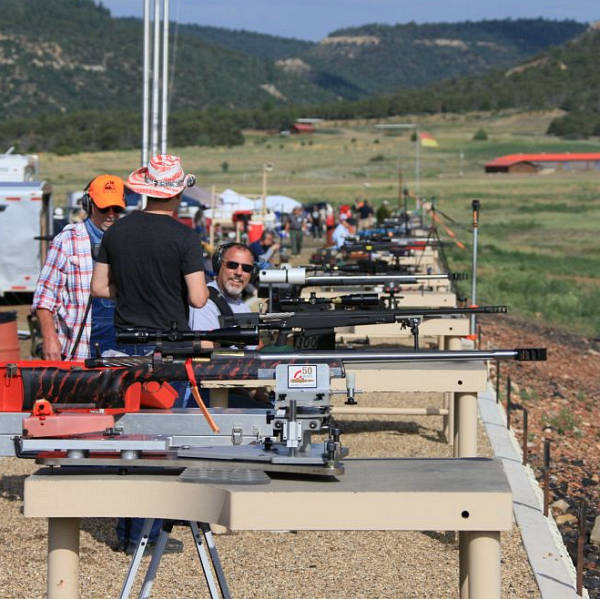


 This trip to Ottawa for the Canadian National Championship was a specially important one. The U.S. Team tryout process and practice was to take place for two days prior to the National Championship as the next F-Class World Championship is going to be held in Ottawa in August of 2017.


 The ability to read the wind is what separates good shooters from great shooters. If you want to learn wind-doping from one of the best, watch this video with 2010 National High Power Champion (and U.S. Army 2010 Soldier of the Year) Sherri Gallagher. Part of the USAMU’s Pro Tips Video Series, this video covers the basics of wind reading including: Determining wind direction and speed, Bracketing Wind, Reading Mirage, and Adjusting to cross-winds using both sight/scope adjustments and hold-off methods. Correctly determining wind angle is vital, Sheri explains, because a wind at a 90-degree angle has much more of an effect on bullet lateral movement than a headwind or tailwind. Wind speed, of course, is just as important as wind angle. To calculate wind speed, Sherri recommends “Wind Bracketing”: [This] is where you take the estimate of the highest possible condition and the lowest possible condition and [then] take the average of the two.”


