|
|
October 3rd, 2013
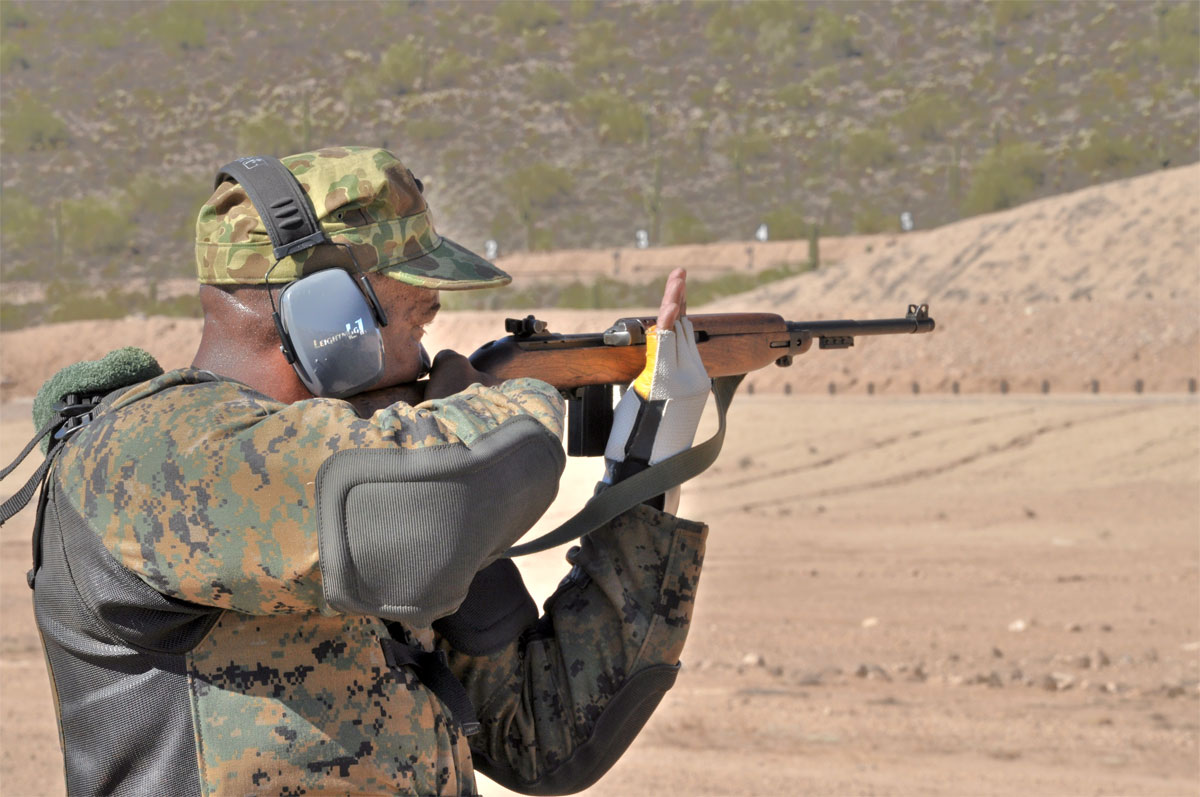
 There’s a new gun game focusing on defensive rifle skills — the NRA National Defense Matches (NDM). Think of this as IDPA with ARs. The inaugural NRA National Defense Matches will be held October 12-13, 2013 at Peacemaker National Training Center, in Gerrardstown, West Virginia. There’s a new gun game focusing on defensive rifle skills — the NRA National Defense Matches (NDM). Think of this as IDPA with ARs. The inaugural NRA National Defense Matches will be held October 12-13, 2013 at Peacemaker National Training Center, in Gerrardstown, West Virginia.
NDM programs are designed for all skill levels, with the goal of developing and exercising defensive rifle skills. There are three types of NDM matches. First, the basic-level match allows novices to shoot from a variety of positions at relatively close ranges out to 100 yards. Competitors will engage targets from standing, kneeling, prone, and ‘roll-over’ prone positions (to simulate actual defensive situations). Next is the advanced-level NDM. This type of match is held on multiple bays with targets placed at seven to 50 yards. Shooters must move quickly from one firing point to the next. The championship-level, open-terrain NDM, calls for shooters to maneuver through undulating forested terrain, engaging targets from difficult firing positions, at distances out to 500 yards. All NDM matches are conducted according to established general parameters, but the actual courses of fire can be adapted to the features of particular ranges, to suit the terrain and range lay-out. Watch the video to see how NDM matches are conducted.
National Defense Match Demonstration Video (Warning: Very Loud — turn speakers down.)
Story tip by EdLongrange. We welcome reader submissions.
September 30th, 2013
 Over the years, many Civilian Marksmanship Program firearms purchasers have asked if the CMP would consider offering reliable, reasonably-priced and prompt maintenance, repair and upgrade of USGI-issue rifles. The CMP has responded and the answer is “YES”. Over the years, many Civilian Marksmanship Program firearms purchasers have asked if the CMP would consider offering reliable, reasonably-priced and prompt maintenance, repair and upgrade of USGI-issue rifles. The CMP has responded and the answer is “YES”.
Starting October 1, 2013, the CMP Custom Shop (Anniston, AL) opens for business, providing a wide variety of repair, upgrade and custom services for a wide range of U.S. Military rifles, specifically those issued in early eras. As well as regular repairs (and troubleshooting), the CMP Custom Shop will be able to perform virtually any normal upgrading, accurizing, customizing, and refinishing for the types of rifles the CMP sells.
CMP will work on the M1 Garand, M1 Carbine, 1903 and 1903A3 Springfield, the 1917 Enfield and the Krag. Other rifles like the Remington 40X, Mossberg 44, and H&R Model 12 can also be serviced. CMP will NOT work on shotguns, pistols, revolvers, M14/M1A, AR15-style rifles or other commercially-produced modern rifles. For a list of services (with prices) visit the CMP Custom Shop webpage.

NOTE: Before you can send a rifle to the CMP Custom Shop you must be a customer on file in the CMP system. Customers must meet the same eligibility requirements as for CMP rifle purchases. Once qualified, you can purchase a rifle from the CMP and have the CMP Custom Shop make modifications to it prior to shipping.
CMP Custom Shop Can Work on USGI Rifles Purchased from Other Sources
The CMP Custom Shop can work on rifles that may have been purchased elsewhere as long as they were made by a USGI contractor. Some examples include: Springfield Armory (not Springfield Inc.), Harrington & Richardson, Winchester, International Harvester, Remington, Rock Island, Eddystone, Inland, Underwood, Rock-Ola, Quality Hardware, National Postal meter, Standard Products, IBM, Irwin-Pederson and Saginaw. NOTE: There are many NON-USGI copies of the M1 Garand, 1903 Springfield and especially the M1 Carbine that CMP will be unable to work on.

 For more information, call (256) 835-8455, x1113, or send email to customshop [at] thecmp.org. Shipping and Correspondence address for the CMP Custom Shop is: For more information, call (256) 835-8455, x1113, or send email to customshop [at] thecmp.org. Shipping and Correspondence address for the CMP Custom Shop is:
CMP Custom Shop
1803 Coleman Rd
Anniston, AL 36207
September 30th, 2013
Here’s a handy, new smart-phone App for competitive shooters. The ISSF Target Tracker App uses the touch-screen on your Android smart-phone so you can record shot positions during practice sessions or matches. Since the user inputs the shot position this will work with both old-fashioned paper targets as well as the newer electronic targets. This software automatically shows the correct target configuration for the discipline you select. Three-position shooters can create separate scoring categories for kneeling, prone, and standing. Sighters can be recorded separately from record shots.
The Target Tracker App for Android OS is now available for $9.99 through the Google Play App Store. NOTE: This Android Target Tracker App has many features not yet available for the iPhone. The App developer plans to release an updated iOS (Apple) version in a month or two.

Description of Application
The Target Tracker is a unique application for your Android devices which provides a powerful training aid for your ISSF-style shooting training, matches, and finals sessions. The application utilizes the touch screen features of the Smartphone, allowing you to record the position of each shot as it is fired during your practice session or match. It also keeps track of the time elapsed between shots, and helps you analyze this time to show what shooting pace produces your best results. You can select from several shooting disciplines, including 10m Air Rifle, 10m Air Pistol, 50m Rifle and Standard pistol 25 and 50m, and 300m Rifle. Each discipline records the shots on the correct target design with proper shot size. The application complies with the latest ISSF regulations for Match and Finals.
September 24th, 2013
The 10th Western CMP Games and Creedmoor Cup Matches will be held at the Ben Avery Shooting Facility in Phoenix, Arizona, on 11-20 October 2013. The Western CMP Games Matches run 11-15 October 2013. The Creedmoor Cup Matches take place on 16-20 October 2013. All interested shooters, (whether new, recreation-oriented shooters or experienced, national championship contenders) are invited to participate in these unique, national-level competitions. NOTE: Registration for the Creedmoor Cup matches must be done online via www.creedmoorsports.com.
 Western CMP Games Entry Form | Western CMP Games Online Registration
Western CMP Games & Creedmoor Cup Program | Directions to Ben Avery Range
| Western CMP Games Matches
Garand & Springfield Match Clinic
John C. Garand Match
Springfield Match
Vintage Military Rifle Match
Small Arms Firing School/M16 Match
Rimfire Sporter Match
Carbine Match
Vintage Sniper Match
|
Western Creedmoor Cup Events
High Power Rifle Clinic
Creedmoor Cup (2400 point aggregate)
4-Man Team Match
Creedmoor EIC Match
|
A Garand-Springfield-Military Rifle Master Instructor Clinic (lead by Gary Anderson, DCM Emeritus) will be head 11-12 October, prior to the Western CMP Games. For more info about the Western CMP Games email croguski[at]thecmp.org or call (888) 267-0796, ext. 1114. For Creedmoor Cup info, contact Dennis DeMille, demille[at]creedmoorsports.com or call (800) 273-3366 (Mon–Fri, 8 am to 4 pm.)

September 22nd, 2013

Report for International Benchrest Shooters (IBS)
 On August 30-31, 2013, Robert and Chrissy Ross hosted this year’s 2013 IBS 1000-Yard National Championships at their Midwest Benchrest range in Yukon, Missouri. On August 30-31, 2013, Robert and Chrissy Ross hosted this year’s 2013 IBS 1000-Yard National Championships at their Midwest Benchrest range in Yukon, Missouri.
This year’s format was run with all the Light Gun (LG) relays shot on Friday, followed by all the Heavy Gun (HG) relays on Saturday. The competition was very tight as the Two Gun Overall Champion, Henry Pasquet from Elsinore, Missouri, didn’t even realize he had won until his name was called out at the award ceremony. Henry, an active AccurateShooter Forum member, secured a well-deserved National Championship with strong performances in both classes. Henry registered a fifth place in LG Group along with tenth place in LG Score. Henry then finished first in HG Score along with eleventh in HG Group to earn the 2013 Two-Gun Overall Title.
IBS 2013 1000-Yard National Championships Results (PDF)
Matthew Kline traveled from Pennsylvania to take second place in the Two Gun competition. He garnered that honor with an eighth Place in LG Group and a fourth place in LG Score. Matthew followed up these with a ninth place in HG Group and eleventh place in HG Score.


Kansas’ Jim Bauer came in a close third in the Two Gun rankings, by finishing first in LG Score and 21st in HG Group, then adding a second place in HG Group and 16th place in HG Score. Jim’s wife Sally, last year’s IBS long-range Shooter of the Year winner, was the Top Female Shooter. Rory Jacobs, from Vapor Trail Valley Shooting Club in Spickard, MO was the Top Junior Shooter.

Hot Temperatures and Fickle Winds Challenge Shooters
The Midwest Benchrest range is literally in the Ross’ back yard and is cut right out of the middle of a Missouri forest, which gave the shooters new to the range a false sense of confidence, thinking the trees would block the winds. The shooters had to deal with temperatures in the upper 90s (and the shade trees offered little relief). With the incredible humidity present, it felt it was even hotter. Although the winds weren’t very high, they weren’t very cooperative either, as they were never consistent throughout both days. One minute it was directly behind the shooters and the next it was quartering to the right. A moment later it was to the left.

The early relay winners seemed to favor the end benches, while later in the day, they seemed to favor the middle benches. There was was nothing but bright sunshine for the two-day event. Cloud cover and cooler temps, which were earlier forecast for the shoot, finally showed up the day after the tournament. Needless to say, the “heat monkeys” were making small groups difficult at this year’s shoot. Most small groups that were shot, were followed up with larger groups, in both the LG and HG events.

All in all, everyone still had a great time competing, seeing friends and fellow shooters from other parts of the country, and enjoying the Ross’ hospitality. It wasn’t long after the shoot was over before everyone started talking about where the 2014 Nationals would be. Perhaps, Robert Ross said it best: “Ultimately, the competition yields to the resulting friendships, which are fostered as part of a common goal: Raising the bar in long range precision shooting.”
The two-day competition was run as smoothly as any monthly shoot is run. The weekend’s shoot really started off on Thursday night though. Jim and Sally Bauer, Hornady, and Midwest Benchrest, sponsored a fantastic fish fry for all the competitors and their spouses. This provided some neutral ground to meet up and catch up with both new and old friends alike before the actual shooting began. If possible we will add equipment lists and individual relay results to this story on Accurate Shooter.com.
Featured Hardware at the 1K Nationals (Click Photos to Zoom)


September 10th, 2013
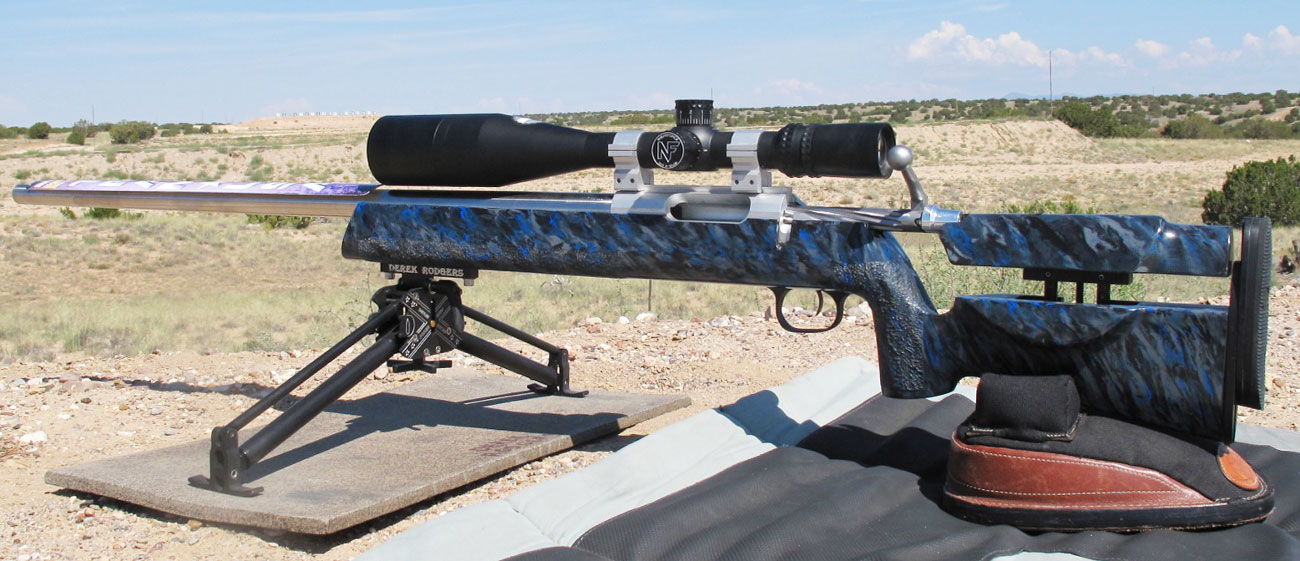
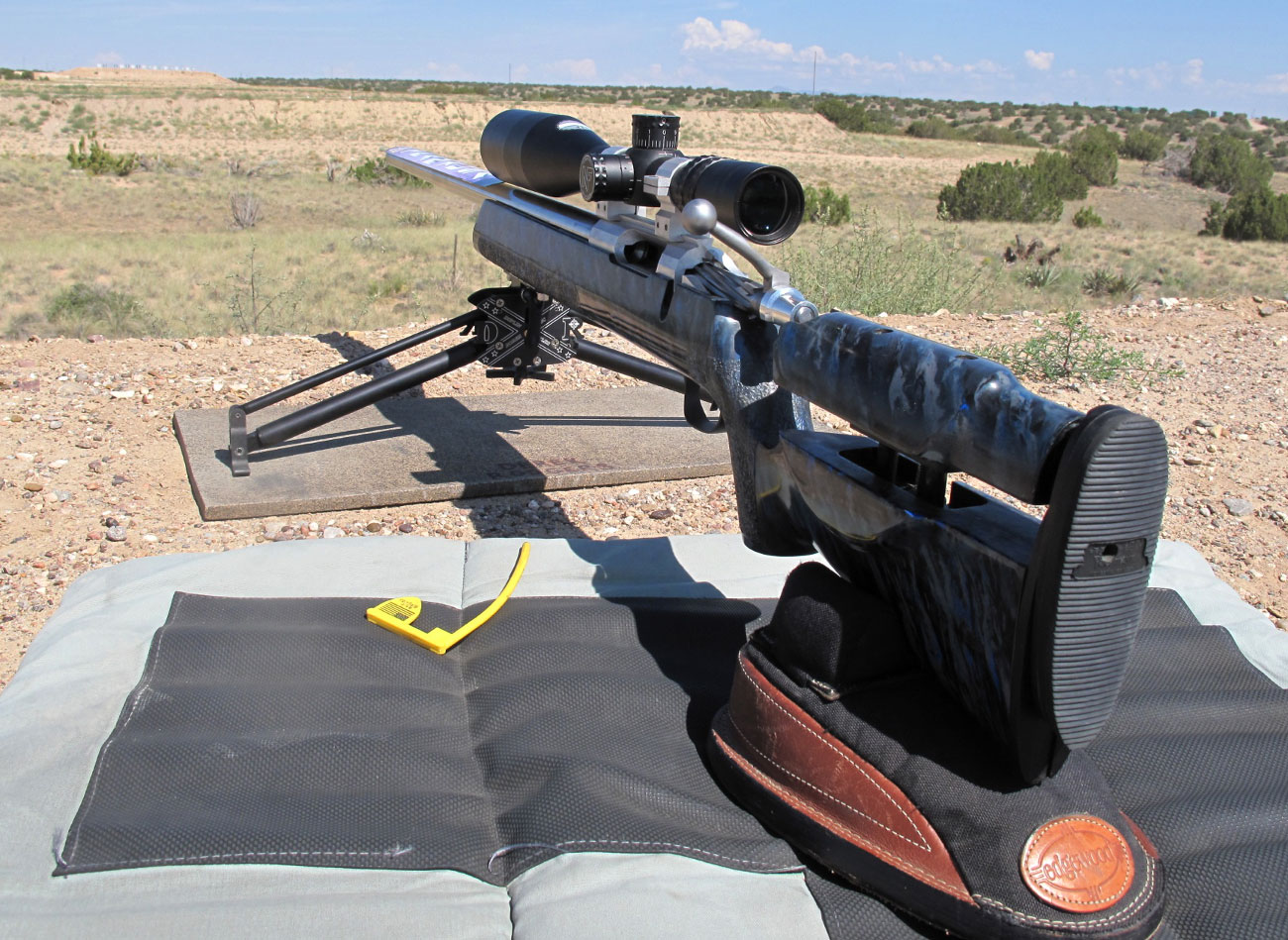
While attending the 2013 F-Class World Championships at Raton, we had a chance to talk with Derek Rodgers, who had just been named the 2013 U.S. F-TR National Champion. Derek’s F-TR Win at Raton makes him the only shooter to have won U.S. F-Class National titles in both F-Open and F-TR divisions. Derek was excited about his performance at Raton: “F-TR was my first love in competitive shooting and [winning the F-TR title] has always been a personal goal to achieve”. In this Q&A session, Derek tells us about his rifles and his Nationals-winning .308 Winchester load. Derek also provides some advice for new shooters in the F-TR game.

Q: Readers want to know about your rifle. How did your select your stock, action, and bipod? And tell us about working with your gunsmith Doan Trevor and the quality of his work.
Derek: For my F-TR project, I carefully chose as many lightweight components as possible, without compromising performance. I wanted to put the weight savings (from light components) into a heaver, stiffer barrel. The rifle features a left port, left bolt Kelbly F-Class Panda action fitted with a Kelbly trigger. The stock was acquired as an uncut blank. It’s a McMillan Prone stock and is very comfortable in design. It also has a nice vertical pistol grip and gentle palm swell. This makes getting behind the gun feel very natural. [Editor’s Note: Though Derek is a right-hander, he shoots with a Left bolt-Left port action. This allows him to stay in the shooting position, right hand on grip, while manipulating the bolt (and feeding rounds) with his non-trigger-pulling hand.]
CLICK on Rifle Photos for Full-Screen Versions

Rifle photos by Dennis Welker.

 Doan Trevor built the entire rifle. Doan even made all of the hardware on the gun. Doan was able to drop pounds vs. ounces as a result. Doan’s 3-way butt-plate hardware alone weighs just half a pound! Doan was highly attentive in helping me build the gun the way I wanted. His bedding and fitment is clean and he has creative ideas for the competitive shooter. While my stock is fiberglass, Doan really shines when it comes to building stocks from wood blanks. In fact, Doan built the stock used by second-place finisher Lige Harris, and also fourth-place Trudie Fay. I feel fortunate to have Doan so close. He’s truly a master craftsman who can quickly turn a project into reality. Doan Trevor built the entire rifle. Doan even made all of the hardware on the gun. Doan was able to drop pounds vs. ounces as a result. Doan’s 3-way butt-plate hardware alone weighs just half a pound! Doan was highly attentive in helping me build the gun the way I wanted. His bedding and fitment is clean and he has creative ideas for the competitive shooter. While my stock is fiberglass, Doan really shines when it comes to building stocks from wood blanks. In fact, Doan built the stock used by second-place finisher Lige Harris, and also fourth-place Trudie Fay. I feel fortunate to have Doan so close. He’s truly a master craftsman who can quickly turn a project into reality.
I chose a Bartlein barrel on this rifle. It is an 1:11″ twist, 32″ long, heavy-contour barrel to stabilize heavy bullets. This barrel was a real hummer from the start. I shot six shells over the chronograph to determine initial chamber behavior and all six loads shot into 1 hole at 100 yards. Each cartridge had 0.5 grains increase in powder. That’s never happened to me before.

Up front, I used a Duplin Bipod. It weighs just 17.2 ounces and is made in North Carolina by Clint Cooper and supplied through Brownells/Sinclair. It is a new product for them and it has already proved to be an extremely lightweight, solid platform. Kelbly rings and an NXS 8-32X scope top the rifle off.
Q: Could you talk about your experience shooting at Raton — dealing with the challenging winds. Did you have any strategy going into the Nationals? Did that change?
Derek: The Raton winds can be intimidating to a person that has never shot there before. In fact, one of the first comments I heard was that it was ugly and nasty out there as the flags ripped straight out to the NW. I glanced downrange and thought it looked like another beautiful New Mexico day (being from NM does have its perks). There is usually no shortage of big wind out here. I’m fortunate to shoot 1K matches locally at a Del Norte Gun Range located outside of Albuquerque. It prepared me to shoot when I can see the mirage and proceed with caution when I can’t. It is the same elevation as the Whittington Center and gives me true testing with actual come-ups that will work dead on at both ranges. My strategy going in to the match was to shoot heavy 200 grain Berger hybrid bullets. I felt like it was the best compromise between BC and velocity. My load held an incredibly flat water-line and that gave me the confidence to either shoot through the entire string in tough wind or stop and wait until the switching winds returned to what I like to see. I was fortunate to pick the correct wind-sets and jump in when I needed to — or wait when the mirage didn’t look right. It paid off as I saw competitors’ targets raised with wide ring spotters. A few times I watched my clock and let a couple relays tick down to the last several minutes before finishing. The winds are quite challenging here and wind pickups and let-offs are huge! The wind calls are definitely magnified in Raton.

Q: You are the only shooter to have won both the F-Open and F-TR U.S. National Championships. How would you compare and contrast F-Open vs. F-TR?
Derek: Now that I’ve won both F-TR and F-Open National titles, I have finally captured the elusive F-TR national victory. F-TR was my first love in competitive shooting and [winning the F-TR title] has always been a personal goal to achieve. I could not be happier to win in my home state with a spectacular level of expertise in attendance. You really need to remain 100% focused in F-TR and try not to miss any condition change. If you do, you will pay dearly as the .308 Win just doesn’t have the extra horsepower to plow through the minor wind changes like Open guns can. Needless to say, F-Open shooters have their hands full in Raton as well; high BCs and fast, booming magnums aren’t the only way to get good scores. Open shooters need to be just as in-tune with the wind. Most of the Open Class shooters use sophisticated rests and cartridges superior to the .308 Win. However, I saw rough conditions disrupt many top shooters as they handed over their score cards to line officers. Although not in a front rest, I have learned to manage my F-TR gun to keep it tracking straight back under recoil. I had two main concerns in Raton this year with my F-TR rifle: 1) Keep all my shots on paper even if the winds blow 25+ mph; and 2) do NOT shoot another target! It’s very easy to do if your bipod slides over during recoil. That was less of a concern for me when I shot Open. Open Class rifles have a more stable foundation that stays in place better. However, just one crossfire at this level will take you out of contention to win anything in Open or F-TR. Both classes are very tough these days on the upper level and you can’t afford to give away points.

Q. What was your load for Raton and did you have to make any adjustments for the altitude or temperature?
Derek: My load for the upcoming Nationals was something I used earlier in the year to win the 2013 East Coast Sinclair Nationals: Berger 200gr Hybrids, Lapua brass, Varget powder, Wolf LR primers. I felt it was very consistent against some of the best F-TR shooters around. However, my biggest concern was my load being over-pressured in late summer. It was a hot year in New Mexico. In June, I made a couple trips to Raton and discovered my loads that I felt were safe were actually on the hot side. I tested locally in the heat of the day vs. calm cool mornings. I also spent quite a bit of time studying past load data / temperatures and came up with a game plan to work with what I had. I kept my fingers crossed that the ambient temperature would stay in the low 80s. I knew my load shot well from 50-80 degrees, but above that and I thought I may have problems with the groups coming apart late in a string. I saw this happen to me in the past with temp-stable powders in a .308 Win. In fact, .308 Win loads become much more critical when pushing the cartridge to its full capacity. Had the temps been in the mid to upper 90s, I’m sure the rifle would have shot differently.

Q: What advice would you offer to someone getting started in F-TR competition?
Derek: I think shooting F-TR has allowed me to really get an idea of what the wind is doing. If a new shooter is interested in trying it, the best tips I can offer is to partner up with a few experienced shooters that know how to hand-load carefully and compare shooting notes. This helps someone get traction with proven methods. Another tip would be to get matches under your belt–at different ranges. It may seem trivial, but each range is different. The shooter may benefit by seeing something that he hasn’t encountered before. The other thing I’d suggest to new shooters is not to worry about your score when starting. Keep shooting. More trigger time is key. I’d recommend working on eliminating your lowest ring value first. For example, if you’re lowest score was a 6, next match try to only shoot better than 7s. Once that is eliminated work on your 8s. When you consistently shoot 9s and 10s then you can be assured that your technique is solid and manageable. Higher scores and Xs will come….
September 7th, 2013
All target shooters strive for perfect shot placement. Well one man has come closer to perfection than any other shooter who ever lived. You are looking at Michael Stinnett’s .0077″ NBRSA world-record group, the smallest 100-yard 5-shot group ever shot in the history of rifle competition. (We’re told the group was certified at .0077″ though labeled .008″ on this photo. A moving backer verified that this was FIVE shots.)
Call it stunning, call it humbling, call it amazing. It is, quite simply the apotheosis (“perfect example”) of accuracy. This is what we all hope to achieve. It’s staggering to see that a rifle can drill FIVE perfectly-overlapped holes — the last virtually indistinguishable from the first — at a target a football field (100 yards) away. Yes the stars aligned for Mike, but it’s great to see a benchmark like this, if only to remind us what is possible in our sport of precision shooting. (Sighters appear below record target.)

Below is a larger-than-life-size view. Using this photo we measured the group with target-calculating software, and it came out .006″ (the software only goes to three digits). We recognize that it would be much better to work from the real target rather than a photo, so we are not challenging the official measurement in the least. But this does confirm that this is a phenomenally small five-shot group.

Many folks have asked about the gun and ammo that produced the .0077″ group. The Light Varmint-class Benchrest rifle was chambered as a .30-caliber wildcat, the 30 Stewart, which is based on the 6.5 Grendel case necked up. Mike was using Hodgdon H4198 powder behind BIB 114gr, 10-ogive bullets. Notably, the record-setting ammo was pre-loaded before the match. Here is Mike’s tuner-equipped rifle. CLICK HERE for more information on the rifle and cartridge.

|
Best Group Ever Record Rifle Equipment Report
Action: Kelby Panda “Speedy Shorty” with solid bolt and PPC-diameter bolt face. Kelby was asked to build several actions which were identical with the intent to eliminate any variance in head space between the two new rifles. This helped me use a single set-up on sizing dies for both rifles and ammo is interchangeable. Both actions were sent to Thomas ‘Speedy’ Gonzalez to be blue-printed and have Jewell triggers installed.
Reamer: 30 STEWART (I just call it a 30 PPC as that is what everyone expects, but it is in fact a custom design and Ralph deserves about 99% of the credit).
Barrels: Krieger was selected for the barrels. After discussions with Randy Robinett of BIB Bullets, a 1:17″ twist was identified as the correct, safe solution. Ralph Stewart has cut all my chambers using a custom-designed reamer. [Our goal] was consistent headspace and Ralph has been able to keep my barrels within .0002 variance. The barrel tuner also comes from Ralph Stewart.
- Stock: Larson (including action bedding)
- Scope: Leupold 45X Competition in Kelby Single Screw Tall Rings
- Brass: Lapua (Base case is 6.5 Grendel)
- Bullets: Randy Robinett (BIB) 30 Cal. 114gr, 10 Ogive (secondary bullet; primary is 112gr BIB)
- Powder: H4198 – Stout Load with 2980 FPS Velocity
- Front Rest: Farley Coaxial
- Bags: Micro Fiber
- Flags: Graham Wind Flags (large)
|
September 5th, 2013
 IBS Report and photographs by Dick Grosbier IBS Report and photographs by Dick Grosbier
Over Labor Day weekend the Union County Sportsmans Club (Weikert, PA) hosted the 43rd annual IBS 100/200 Score Nationals. This club has a reputation for hosting fine events, and this match certainly lived up to that reputation. With 63 guns on the line, this year’s Score Nationals was well-attended. All in all this was as good a Score Nationals as I have attended in quite a while. I tip my hat to the Union County crew for running an excellent match. Weather was warm and a little muggy both days. I do not believe we ever had a drop of rain (despite a 30% chance of rain forecast). Mirage was very minimal as it was overcast both days. Winds started out very calm and slowly increased all day long both days.
2013 IBS Score Nationals Results (PDF) | 2013 IBS Score Nationals Results (XLS)
View IBS Score Nationals Full Photo Gallery (100 pictures)

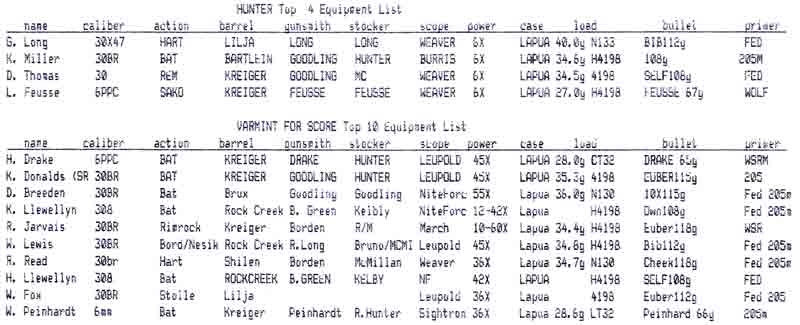
Left to Right: IBS Score 2-Gun Winner Dean Breeden, Varmint For Score Grand Agg Winner Herb Llewellyn, Hunter Class Grand Agg Winner Gary Long.


On Saturday, Herb Llewellyn started out on a tear in Varmint For Score (VFS) class and stayed hot, finishing the 100-yard event with a 250-25X score. We witnessed some really fine shooting in less-than-perfect conditions. Junior Shooter Kevin Donalds Jr. (photo below) laid down a fine 250-24X to finish second. Kevin, who turns a ripe old 13 years of age in a few days, shot a remarkable 250-25X Aggregate a few months back. To the best of my memory those are the only two 250-25X scores in IBS this year. A.R. Edwards was third with 23X.

In Hunter Class Dean Breeden shot 250-17X beating more than 50% of the VFS shooters, and for those of you who do not fully understand Hunter Class, the big thing to remember is they shoot 6-power scopes. Peter Hills from Maine also shot a 250 in HTR with 9X.

Sunday the shooters lined up for the 200-yard event. Shooting his 6 PPC, Hal Drake shot a 250-14X, proving that a PPC can still win in a Score match (at least at the longer ranges). Second place (as at 100 yards) went to a Kevin Donalds, but this time it was Kevin Donalds Senior who was the runner-up, posting a 250-13X. Third place honors went to Dean Breeden also with 250-13X. In Hunter Class, veteran shooter Gary Long shot 248-5X to beat K.L. Miller under Creedmoor tie-breaker rules. Dave Thomas was third with 247-7X.
You may have noticed that nobody in the top three on Saturday was in the top three on Sunday. This led to some interesting results in the VFS Grand Aggregate. Top Man was Herb Llewellyn, with a 500-36X. Herb’s victory at the Nationals pretty much puts the last nail in the coffin of anybody trying to catch Herb in the Score Shooter Of the Year race.
Second in the Grand was Herb’s lovely wife Kim with a 500-34X. Third place went to Randy Jarvais who learned the hard way to not drop the first X! Randy tied with Kim for total score all weekend but Kim shot a 5X on the first target and Randy got a 4X. Fourth in the Grand went to 200-yard winner Hal Drake with 500-33X, and Ricky Read rounded out the Top Five with 500-32X.
Gary Long won the Hunter Grand division with 497-22X, Dean Breeden was second with 496-20X, and third was Dave Thomas with 496-14X. It was great to see Dave back shooting again. Dean Breeden put in a repeat performance as IBS Score 2-Gun winner with a 996-51X score, Larry Feusse was second with 990-46X and Dudley Pierce was third with 987-44X.
IBS 43rd Annual 100 / 200 Yard Score Nationals
Union County Sportsman’s Club — August 31st to September 1st, 2013



CLICK Equipment Lists Below to See LARGE Versions
 |
 |

Praise for the Match Crew and Kitchen Crew
I cannot say enough good things about the target crew and range officer Mark Trutt. They ran a very efficient match. I do not recall a single delay all weekend from loose- or erroneously-hung targets. We started promptly at 9:00 am and finished around 2:00 pm both days. Range officer Mark Trutt did an outstanding job when confronted with a tricky situation regarding IBS Score 2-Gun shooters. The range has 40 benches and we had a very nice turnout of 63 guns on the line but it simply was not justified to run a third relay so Mark judiciously added around 10 minutes between each relay to allow 2-gun shooters some time to reload. I don’t think the time would even have been noticed but the target crew was speedy and efficient, so we ended up with a little extra time on the line. I personally felt it made for a very nice, laid-back pace for competitors shooting only one gun. Scoring was fast and efficient for the most part.
The Kitchen crew deserves praise for the fine breakfasts and lunches. In good Weikert tradition, we were treated to “Mama Trutt’s” fresh-baked cookies each afternoon. — Dick Grosbier
September 3rd, 2013
 American Kenny Adams is the new F-Open World Champion, winning the individual title last week at Raton, New Mexico. ‘King Kenny’ rose to the top through with skill, countless days of practice, and great determination. He put in the trigger time, including many long days at Raton. But when we cornered Kenny after his win at the Worlds he was quick to give credit to his gunsmith, Stick Starks of S&S Precision Rifles in Texas. American Kenny Adams is the new F-Open World Champion, winning the individual title last week at Raton, New Mexico. ‘King Kenny’ rose to the top through with skill, countless days of practice, and great determination. He put in the trigger time, including many long days at Raton. But when we cornered Kenny after his win at the Worlds he was quick to give credit to his gunsmith, Stick Starks of S&S Precision Rifles in Texas.
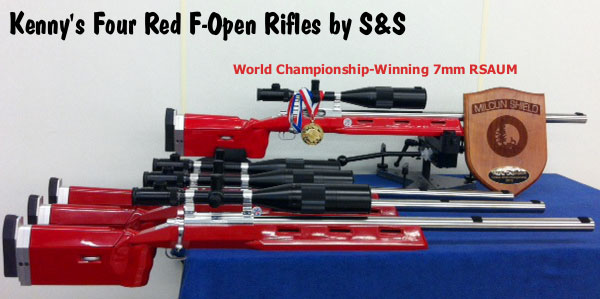
Kenny told us: “I want to thank my gunsmith, Stick Starks from S&S — he got me going in this thing in the right direction four and a half years ago. Working with Stick has probably shaved a couple of YEARS off my learning curve.” Kenny’s world-beating rifle features a Panda F-Class action placed in a Robertson F-Class stock. The Krieger barrel is chambered for the 7mm RSAUM.

Kenny Has Four Red F-Class Rifles All By S&S
What’s interesting is that Stick Starks made Kenny three other F-Class rigs, all with red Robertson stocks and Panda F-Class actions. So, counting the championship 7mm RSAUM, Kenny owns a fleet of four fire-engine-red F-Class rigs, all built by Stick at S&S. These three other red rifles were originally chambered in 6.5-284, 6mmBR, and 6.5×47, but Kenny switches barrels (and chamberings) to suit the venue and course of fire. In Raton, Kenny had two (2) of the red rifles chambered in 7mm RSAUM and two (2) chambered for the .284 Winchester. However, in the Individual World Championship he shot just one rifle, a 7mm RSAUM (shown below). He used the second 7mm RSAUM-chambered rifle in the F-Open Team Championship. This second RSAUM (used for team shooting) is the one pictured above, but his other RSAUM is identical in all respects. He did not shoot either .284 Win during the Worlds.
Kenny’s World-Beating 7mm RSAUM Load
For his 7mm RSAUMs Kenny loads Hodgdon H4350 powder and Federal 215m primers into Nosler or Norma RSAUM brass. In the RSAUM he runs Berger 180gr Hybrid bullets seated “just touching” the lands. For his .284 Winchester-chambered rifles he loads necked-up Lapua 6.5-284 brass with 180gr Hybrids pushed by H4831sc powder and Federal 210m primers. Interestingly, he is very precise with his charge weights. Using a Sartorius Magnetic Force Restoration scale, Kenny tries to hold his powder charges to within 1-2 kernels charge-weight consistency.
While Kenny praised S&S for building great rifles, Stick is quick to say that Kenny deserves the credit: “He’s the man that pulled the trigger. He’s the man that beat the world. You can’t believe how dedicated Kenny is to his sport. He spends so much time shooting and practicing — true dedication. Kenny hung in there, never gave up, did the best a man can hope to do. Yeah you have to have good equipment, but you do have to have dedication in this sport. Buy the best equipment you can and the rest is up to you — learning how to read conditions. That’s all there is to it.”
S&S Can Build You a ‘Kenny Clone’ for $3800.00
By the way, if you want a gun just like Kenny’s, Stick told us: “I’ve got barrels, Panda F-Class actions, and I have one last Robertson F-Class stock left. Just one — these aren’t made any more you know. A complete build, with barrel of your choosing and Jewell trigger, will be about $3800.00.”
S&S Precision Rifles is a leading gunsmithing operation based in Argyle, Texas. Stick Starks and the crew at S&S build very accurate rifles, that also exhibit superb craftsmanship. While S&S built a championship-winning F-Open gun for Kenny, they can also built short-range benchrest rigs, as well as varmint and hunting rifles — all with hallmark S&S quality. S&S can handle every aspect of gunsmithing — chambering, bedding, even stock-painting.
In the video above, the folks at S&S put together some tack-drivers for their customers. There are some nice glimpses of bedding work, and barrel finishing. Watch carefully — at the 40-second mark you’ll see a sub-1/4″, 10-shot group that S&S co-owner “Stick” Starks shot at 200 yards with his 6.5×47 Lapua rifle. That’s serious accuracy. Half-way through the video, Stick offers advice for shooters looking for a super-accurate fun gun for club shoots: “If you want to shoot [at] 100 and 200 yards, I’d get me a 6BR or a 30 BR. It would be the most fun gun you ever had… and the barrel will probably last three or four thousand rounds.” If you want a gun to shoot at primarily 500-600 yards, Stick recommends the 6.5×47 Lapua chambering: “Run it with the Berger 130s and Hodgdon H4350 powder. That H4350 works great with the 130 Bergers.”
September 2nd, 2013
Report and Photographs by Tony Chow
On August 12th to 16th, USAMU’s Fort Benning range hosted the 2013 USA Shooting 300m National Championships. This match, held every four years, nominates athletes to represent the United States at the 300m World Championships, due to be held in 2014, in Granada, Spain.

300m Shooting — A World-Class Challenge
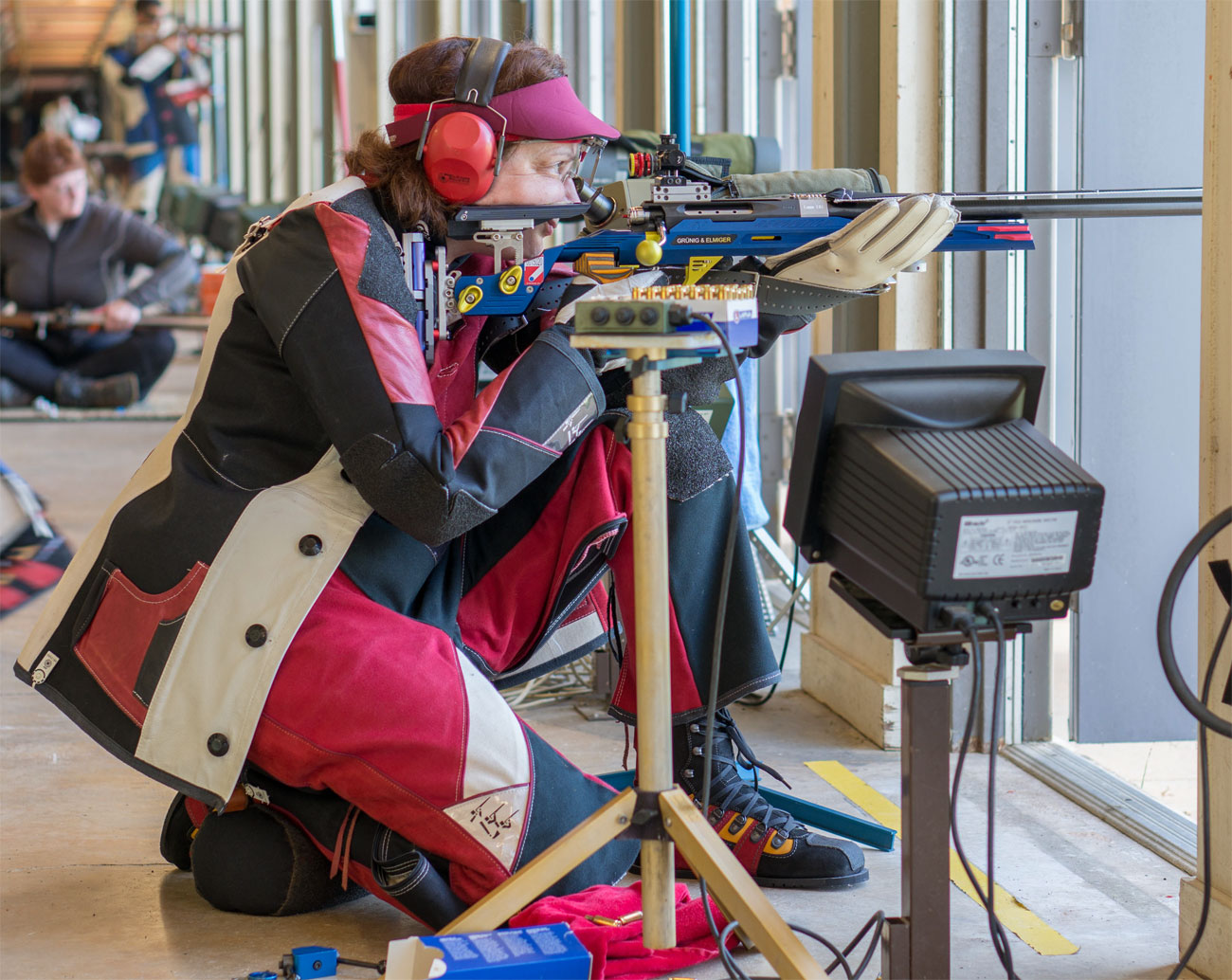
300m shooting is a challenging discipline. With much smaller scoring rings than NRA targets, the 300m target can bedevil even the most experienced High Power shooters, especially in tricky wind conditions. While European 300m shooters typically use expensive rifles from the likes of Gruenig & Elmiger (G&E) and Bleiker, less costly American-made equipment has proven to be every bit as competitive. Case in point are the free rifles used by the USAMU team, all of which are built from American target actions such as Panda and BAT, fitted with Krieger barrels, and glass-bedded into Anschütz stocks.
The competition took place in unseasonably mild weather for this time of the year in Georgia. As the popularity of 300m shooting is limited in the United States, 21 shooters in total took part in four days of competition. Despite the light participation, the athletes included some of the best international rifle shooters in the country. The relaxed and club-like atmosphere belied intense and high-level competition on the firing line.


Electronic targets record all shots as 10, 9, 8, etc., with the X-count being the first tiebreaker. Each whole number score is accompanied by a more precise score that ranges from 0-100. An official 10, for example, could be anything from 91 (on the edge of the ring), all the way to 100 (dead center). The more precise score is NOT used officially for score keeping in ISSF competition, but could be in the future, as already is the case in 50m prone and 10m air rifle.


3P Course of Fire and Results
The 3P events occupied the first two days of competition. Athletes shot in three positions–kneeling, prone, and standing — using free rifles, mostly chambered in 6BR. Under ISSF rules, men fire 40 record shots in each position, while women fire 20 record shots in each position. Each event is repeated on the second day, and the two-day aggregates determined the winner. In Men’s 300m 3P, USAMU’s Joseph Hall, who had never shot a 300m match before, beat his more experienced teammates Joseph Hein and Michael McPhail to take gold. Among women, USAMU’s Erin Lorenzen edged out 2008 World Championship veterans Reya Kempley and Janet Raab for the gold.
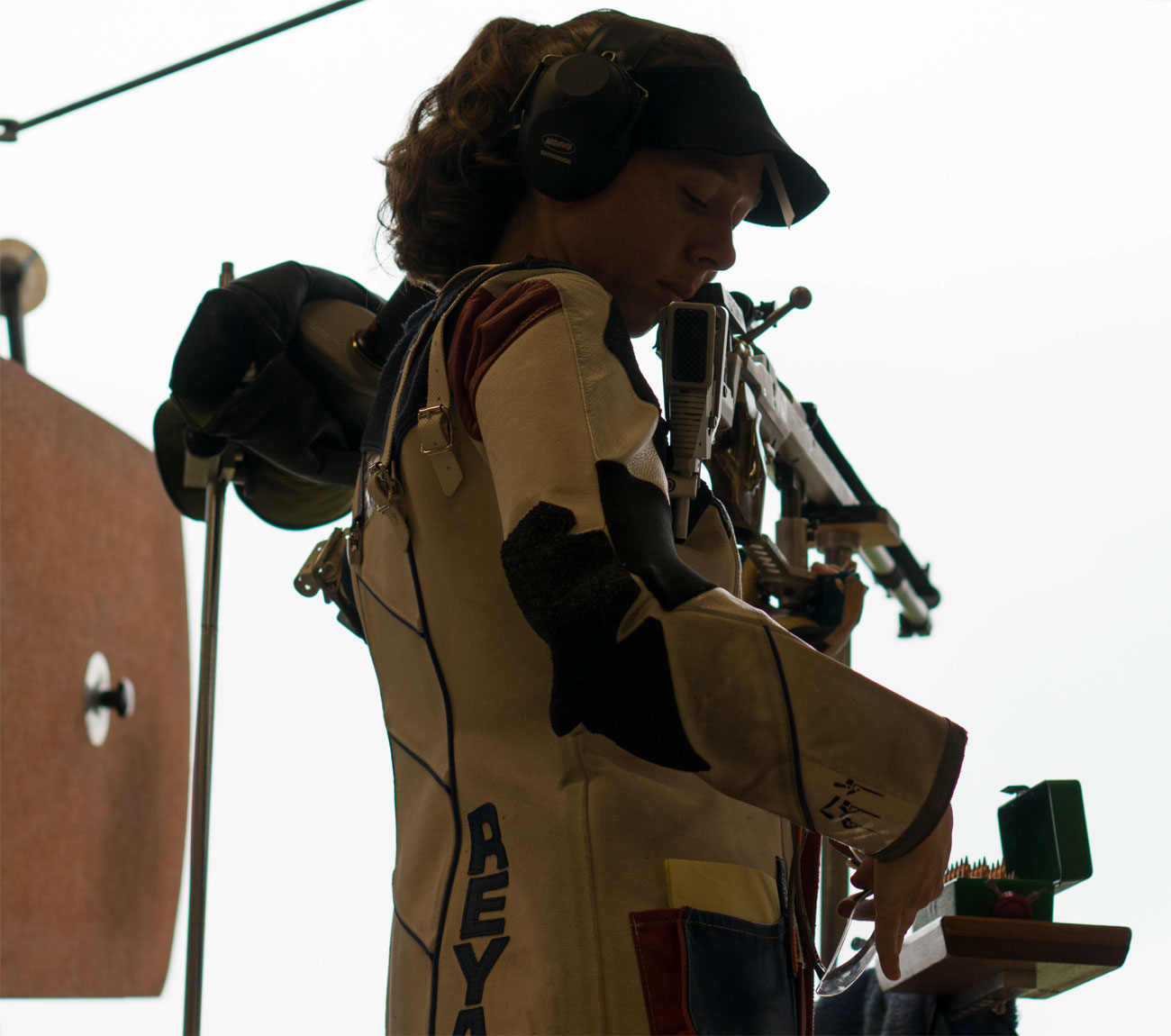
The prone and Standard Rifle events followed in the second half of the competition. The 300m prone match is shot by both men and women, using same free rifles as in the 3P events. The Standard Rifle match is another 3-position event, except contested only among men, using rifles strictly limited in external shape and adjustability. Cooler temperatures and intermittent rain made conditions trickier to read than during the first two days. In men’s prone, USAMU’s Eric Uptagrafft took gold, edging out Unit teammates Hall and McPhail. In women’s prone, Erin Lorenzen once again came out on top over Reya Kempley (photo below) and Michelle Bohren.


In the Standard Rifle event, AMU’s Joseph Hall continued his good form and took another gold over teammate Joseph Hein. Equally noteworthy is the third place finisher Steve Goff. Goff, an AMU Hall of Famer who now competes as a senior in USAS matches, beat back much younger challengers to earn the third and final slot in the 2014 US Men’s Standard Rifle Team.
Cartridge Options for 300m Shooting — by Tony Chow
The cartridge of choice in 300m is 6mmBR Norma (aka 6BR). The AMU shooters all shoot Norma Diamond Line 6BR factory ammo, loaded with moly-coated 105gr Berger HPBT bullets, with the notable exception of prone match winner Eric Uptagrafft, who shoots handloads with HBN-coated bullets in his 6mm Dasher. Civilian shooters mostly shoot the 6mmBR as well, also preferring Berger bullets. I was the odd man out shooting a Gruenig & Elmiger (G&E) chambered in 6.5×47 Lapua. That cartridge was actually the result of a collaboration between G+E and Lapua to create an alternative to 6BR, though in the 300m world, it never managed to catch on. There was one shooter using 6.5-284 and another shooting a wildcat cartridge called “.260 BMR (boomer)”.
 I’m not the authority on the pros and cons of various calibers. I doubt that most world-class 300m shooters concern themselves too much with these matters. The 6BR is simply good enough. It holds well inside the 10-Ring, is relatively economical, and offers extremely long barrel life when using mild factory loads. G+E rates its chrome-moly, cut-rifled 6BR barrels as capable of lasting 7,000 rounds. The AMU gunsmith, Glenn Sulser, told me that the AMU’s policy is to re-barrel at the 4,500-5,000 round mark. I’m not the authority on the pros and cons of various calibers. I doubt that most world-class 300m shooters concern themselves too much with these matters. The 6BR is simply good enough. It holds well inside the 10-Ring, is relatively economical, and offers extremely long barrel life when using mild factory loads. G+E rates its chrome-moly, cut-rifled 6BR barrels as capable of lasting 7,000 rounds. The AMU gunsmith, Glenn Sulser, told me that the AMU’s policy is to re-barrel at the 4,500-5,000 round mark.
Longer cartridges such as 6.5×47 and 6XC are supposed to offer easier feeding, but in my observation, the nose-heavy nature of 6BR is, in practice, not a major problem for 300m shooters. One of the advantages of 6.5×47 is even longer barrel life, and that’s the reason I went for this caliber myself. But looking back now, the greater recoil and extra cost in brass and powder are probably not worth it.
Factory Ammo vs. Handloads — Cost Considerations
One of the advantages the AMU shooters enjoyed over the civilians is that the Unit marksmen had an unlimited supply of ammo, and therefore could shoot as many sighters as they wished. In a 15-minute sighting-in period, it was not uncommon for AMU shooters to fire 20+ sighter shots, just as they do in smallbore. We civilians had to settle with under 10 sighters, in order to leave enough for the match.
Unless you are filthy rich or have someone else paying for the ammo, reloading is definitely the only way to go. A reloaded round costs under 50 cents a piece. The European factory ammo costs nearly $3 a round these days (as sold in the USA).
CLICK Photos to See Full-Screen Images:


|