|
|
March 11th, 2009
Creedmoor Sports has introduced a new Air Rifle that mates an Olympic-quality Anschütz 8000-series barreled action (and trigger) with authentic AR15-style stock, chassis, and sights. The new system, dubbed the “AiR-15™”, is designed to allow Service Rifle and High Power competitors to cross-train with a precision air rifle system between matches and during the off-season. Although the rifle is supplied with a mock magazine (for correct off-hand ergonomics), the gun is a single-shot, using manual-fed 0.177 pellets. The AiR-15 combines an Anschutz 8001 junior barreled action with the patent-pending Creedmoor AiR stock kit. The stock kit includes the receiver sleeve, fore-end (with sling swivel, air cylinder, alignment hanger), butt stock, carry handle with National Match rear sight (1/4 min), and a National Match front sight.


Dennis DeMille, past Camp Perry Champion and Creedmoor Sports General Manager, has worked hard to develop the AiR-15 system. He has shot the prototype and he believes it is an ideal training platform for Service Rifle Shooters. Dennis tells us: “Look, you can shoot this in your basement in the dead of winter. The ergonomics are identical to the AR15. The sights, front and rear, are in exactly the same position. And by using Anschütz 8001 barreled actions and triggers, the system offers superb accuracy. The AR Air Rifle will deliver one-pellet-hole accuracy at 10 meters. I’ve visited the Anschütz factory. Every one of these barreled actions is tested and they all come with test targets verifying their accuracy.”
 Price and Availability Price and Availability
Creedmoor’s new AiR-15 air rifle should be available as a complete rifle by early summer 2009. The retail price for a complete AiR-15 will be US $1850.00. Though delivery will take a few months, Creedmoor is taking orders right now for the first production run.
There will also be a kit for shooters who already own an Anschütz 8000-series air rifle. The kit will include the full AR-style stock and chassis, including handguard, sights, receiver assembly, and buttstock. The price of the kit will depend on production costs and projected sales demand, but Demille hopes to deliver the kits for under $800.00. With the kit, you can simply “drop-in” your 8000-series barreled action.
AiR-15 to Be Used in New CMP Air Rifle National Match Program
For 2009, the Civilian Marksmanship Program (CMP) has developed a new National Match Air Rifle discipline consisting of High Power-style matches shot at reduced distances with air rifles. At CMP National Match Air Rifle tournaments, you can use sporter, precision or AR-type air rifles to shoot in 10-meter standing and three-position (prone, sitting and standing) courses of fire that simulate outdoor High Power rifle shooting (but with reduced-sized targets). A test match for this new Air Rifle National Match Series will be held this Saturday, March 14th, in Anniston, Alabama. There will be a 20-shot standing event as well as a 60-shot prone + sitting + standing event.
CLICK HERE for CMP National Match Air Rifle Information Brochure.
Challenging Even at 10 Meters
While Dennis DeMille believes the AiR-15 will be ideal for introducing new shooters into rifle competition, he wanted to stress that shooting the AiR-15, even at 10 meters, can help even the best High Power shooters improve their scores. Dennis explained: “While this air rifle is capable of one-hole accuracy (at 10m), it is also very unforgiving of flaws in form or hold. Because the pellets are moving so slowly (about 575 ft/sec.), any mistake will move you out in the scoring ring. This air rifle will help you develop perfect trigger control, perfect follow-through, and perfect natural point of aim. Trust me — you can’t BS any part of your hold with an air rifle. I know if you train with an air rifle in the off season, your centerfire scores will improve.”
Creedmoor May Sponsor Winter Indoor ‘Air AR’ matches
If air-powered versions of the AR15 Service Rifle prove popular, Creedmoor Sports is considering sponsoring off-season matches at different locations across the country. These would feature reduced 10m targets that exactly duplicate the sight picture of NRA Across-the-Course targets at 200, 300, and 600 yards.
For more information, visit CreedmoorSports.com or call 1-800-CREEDMOOR.
March 8th, 2009
As shooters seek less expensive ways to shoot, rimfire competition of all types is becoming more popular. Silhouette shooting is fun because you get to knock down small steel targets, just like in a shooting gallery at a County Fair. But don’t let anyone suggest Silhouette is easy. All shots are taken from the standing position. If you haven’t tried that recently, you’ll find that your crosshairs will be dancing all around the target.

At an official match, you’ll shoot at least 40 shots, ten each at four sets of 1/5th size standard High Power Rifle Silhouette targets. The smallest targets, the chickens, are set at 40 yards, Pigs are at 60 yards, Turkeys are at 77 yards, and Rams are at 100 yards. (Alternatively, metric distances are used.) Though the rams are the largest targets, hitting them is far from easy, given the ballistics of 22 rimfire ammo. At 100 yards, a little bit of wind will blow you off the target.

Two classes of rifles are used in Rimfire Silhouette: Standard and Hunter Class. Standard rifles can weigh up to 10 pounds, 2 oz. (with sights) and have no restriction on trigger pull weight. The fore-end shall not exceed 2 1/4″ wide, and 2 1/4″ deep measured from the centerline of the bore. Bull barrels are common, and the gun of choice is the Anschutz 54.18 MS (Metallic Silhouette) or 1808 (thumbhole version of the 54.18). A 54.18, if you can find one, will set you back $1200.00 – $1700 depending on condition. The 54:18 is in limited production and even good used models are hard to find.

Hunter Class rifles must have a more conventional “sporter-style” stock, typically with a narrow fore-end. A high comb is used to provide a good cheek weld. Hunter Class Rifles are limited to 8.5 pounds (with scope), and the trigger pull weight shall not be less than 2 pounds. No bull barrels are allowed — you must use a conventional tapered hunting barrel. Among production rifles, the Anschutz 1712 is the rifle to beat. These guns are very accurate out of the box, and come with an outstanding two-stage trigger that breaks cleanly right at two pounds. Kimber and CZ also make factory silhouette rifles for the Hunter Class. Though not on a par with the Anschutz 1712, the Kimber and CZ are viable options for novices or shooters on a tight budget.
Many top silhouette shooters like Mark Pharr will shoot the lighter Hunter rifle in both classes. Pharr and others have found that accurized Hunter Class guns can be competitive even against the heavier guns. While a stock Anschutz 1712 Hunter is impressive, many competitors will hot-rod their gun, putting a 1710 or 1712 action in a Mark Pharr-designed stock. They will then add a match barrel from Lilja, Shilen or other top barrel maker. Shown below is an Anschutz 1712 action in Pharr stock.


If you want to learn more about rimfire silhouette, visit SteelChickens.com. To order a Mark Pharr stock (built by Robertson Composites), contact Chickens Shooting Supply.
CLICK HERE for Summary of Rimfire Silhouette Rifle Rules.
March 8th, 2009
 The NRA Shooting Coach Education Program offers both basic and advanced technical and tactical skills coach training schools for rifle, pistol, shotgun and High Power rifle along with training camps and clinics. The Coach Education Program is a cooperative effort of the three major competitive shooting organizations in the United States: the NRA, USA Shooting (USAS) and the Civilian Marksmanship Program (CMP). The NRA Shooting Coach Education Program offers both basic and advanced technical and tactical skills coach training schools for rifle, pistol, shotgun and High Power rifle along with training camps and clinics. The Coach Education Program is a cooperative effort of the three major competitive shooting organizations in the United States: the NRA, USA Shooting (USAS) and the Civilian Marksmanship Program (CMP).
The NRA Coach Schools are taught by National Coach Development Staff who are Certified Coaches that have been carefully selected, based on their talents and expertise in the areas of sports, education, coaching, athletics, and shooting.
Don Sipes, NRA’s National Shotgun Coach Trainer, explains that the Coach training program has been very effective: “The growth has been phenomenal … we had 495 [NRA Certified Shotgun Coaches] as of July 1, 2007, and after [the March 2009 session], we’ll have over 1,500 coaches.” Looking to the future, Sipes hopes to have 1,800 NRA Certified Shotgun Coaches by the end of 2009.
Shooting Coach School
The 2-day coach school is the heart of the program. The instructors use up-to-date materials and PowerPoint presentations to present coaching methodology and a variety of learning activities for all participants. Each coach certification school involves two days of sports-specific lessons designed to teach coaching fundamentals. The following subjects are taught:
Safety and Risk Management
Competition Events
Rules
Equipment and Facilities
Fundamentals of Shooting |
Shooting Positions
Sports Psychology
Training Planning
Running Quality Programs
How To Conduct Tournaments |
If you are interested in becoming an NRA Shooting Coach, you can attend one of the 2-day clinics held at a dozen locations nationwide. Currently, most of the coaching schools are for ATA Trap and shotgun disciplines, but there are also sessions for Smallbore and Air Rifle disciplines scheduled from April through July. CLICK HERE for a list of Coach training seminars (with contact info). To learn more about Rifle or Pistol Coach Education, contact Marcus Raab (703) 267-1589 or mraab [at] nrahq.org.
February 27th, 2009
 For years the NRA has published Shooting Sports USA, an informative print magazine for competitive shooters. While sample articles and a match calendar could be found on the web, the complete magazine contents were available only via a conventional print magazine subscription. For years the NRA has published Shooting Sports USA, an informative print magazine for competitive shooters. While sample articles and a match calendar could be found on the web, the complete magazine contents were available only via a conventional print magazine subscription.
Now that’s changed. You can read ALL the contents of Shooting Sports USA now for FREE, in a monthly “Digital Edition”. Using “digital paper” technology from Olive Software, the entire magazine loads as a file in your internet browser. You can size the pages larger or smaller. You can even turn the pages as with a conventional magazine. To get your FREE subscription to Shooting Sports USA in digital form, just go to the Shooting Sports USA website, and enter your email address and zip code. That’s it — no fees, no credit card info required.

CLICK HERE to read a sample Digital Edition of Shooting Sports USA
(Note: This will load a flash player that may not be compatible with all browsers.)
Get New Rules, Match Results, Gear Reviews, and More…
The current issue of Shooting Sports USA includes the 2009 NRA Competitive Rule Changes. You can access those rule changes by viewing the March, 2009 sample digital edition (may take some time to load). Other features in the March edition include Shooters News, a Score Sheet (recent match results), Brief Product Reviews, and a Calendar of Coming Events.

February 23rd, 2009
This story comes to us courtesy of the NRA Blog, which recently featured the innovative program of the North Coast Shooters Association (NCSA). The NCSA has pioneered a “movable match” that utilizes multiple shooting facilities to expand the opportunities for competitive shooters in the Midwest and Ohio region. The NCSA is a mobile shooting club. Instead of owning its own range, the NCSA has a trailer loaded with everything needed to hold a match including homemade spotter discs, spindles, and pasters. The NCSA holds its competitions wherever they find enough interest, rather than trying to draw people to one location. This unique approach attracts first-time shooters and those adverse to traveling long distances, creating a nice turn-out every time.

NCSA Offers Matches at Military Bases
A little over a year and a half ago, NCSA founder Nick Mullet decided there weren’t enough places to shoot east of the Mississippi River. As a result, the North Coast Shooters Association was formed with the mission of opening additional ranges for civilian shooters. Nick contacted military bases normally closed to civilians and got permission to hold matches. The NCSA secured .50 and .223 caliber matches at Fort Knox, Fort McCoy, Fort Drum, Camp Gruber, Camp Perry, and Thunder Valley.
“From our start in mid 2007, we’ve held five .50 caliber matches and two .223 matches in four different locations throughout three states”, Nick stated. The NCSA has grown to 74 paid members and has high hopes for the future. With increased membership comes more frequent competitions over a larger area. Any and all skill levels are welcome to NCSA matches as long as they follow Nick’s two basic rules: 1) No one has the authority to get hurt; and 2) Have a good time.

For more information, visit the North Coast Shooters Association website and NCSA Forum. The NCSA may be planning a match near you.
February 17th, 2009
A new study by Target Sports Marketing, based on surveys of Camp Perry competitors, provides some interesting facts. First, and this is no surprise, more than 80 percent of competitive shooters reload their own ammunition. The majority of these shooters (60 percent) compete year-round while a larger percentage (70 percent) practice year-round.

Shooters in 50s and 60s Outnumber Younger Participants
Interestingly, there is a significant “generation gap” among shooters. According to the survey, shooters in their 50s compose the largest segment of competitive rifle shooters. And, the combined number of rifle shooters in their 50s and 60s exceeds all other age categories combined. Keep in mind, Camp Perry focuses on traditional NRA High Power, Palma, and long-range events. Were you to survey other disciplines (such as 3-Gun Matches), you’d likely find a different age distribution. Nonetheless, the numbers do demonstrate the need to increase the number of younger rifle competitors. Unless there is a major effort to attract new, younger shooters, it appears that competitive rifle shooting could decline in popularity dramatically in a decade or so, as the Age 50s cohort gets older.

The findings are based on the feedback of nearly 400 rifle and pistol competitors at the 2008 U.S. National Matches at Camp Perry, Ohio, hosted by the Civilian Marksmanship Program (CMP). The study focuses on individual competitor demographics, shooting sports engagement and brand preferences for firearms, ammunition, components and accessories. An animated, narrated summary of the report is available at css.targetsportsmarketing.com. Definitely click the link — many interesting facts are revealed. This particular presentation focused on 186 CMP competitors, two-thirds of whom were rifle shooters.
Graphs and data created by Target Sports Marketing for the CMP.
February 17th, 2009
This news item comes to us via the NRA Blog. Attention all Junior Pistol and Smallbore Rifle Shooters: registration for the NRA Junior Pistol and Junior Smallbore Camps is now open! Space is limited to 50 shooters for the Junior Pistol Camp and 72 shooters for the Junior Smallbore Rifle Camp. CLICK HERE to download your paperwork, and send it in. You can also call (703) 267-1481 for more information.
CLICK HERE for Smallbore Rifle Camp Program Materials
These camps are designed for junior, intermediate-level pistol or smallbore rifle shooters. The smallbore rifle camp has been primarily designed for the intermediate shooters. However, beginners will be accepted on a space available basis. Shooters need to be at least 12 years old. Taught by NRA Certified Coaches, both camps provide expert coaching in the fundamentals of shooting while providing a safe, enjoyable learning experience. These camps are the perfect way for juniors to improve their shooting skills while meeting other shooters in their age group.

The NRA Junior Pistol Camp will be held July 14-17, 2009 at Camp Perry, Ohio. The NRA Junior Smallbore Rifle Camp will be held July 25-30, 2009 at Camp Perry, Ohio, and provides instruction in 3-position and 4-position smallbore rifle shooting. Both camps cost $175.00 for advanced registration (must be received before June 15, 2009) or $200.00 for standard registration (paperwork received after June 15, 2009).
February 15th, 2009
From February 12th through the 28th, Camp Perry hosts more than 500 high school Junior Reserve Officers’ Training Corps (JROTC) cadets from across the US and Department of Defense Schools overseas. The cadets will be competing in the All Service Air Rifle Championships to determine Army, Marine, Navy and Air Force JROTC national individual and team champions. In addition, the top competitors in each championship will advance to the National JROTC Air Rifle Championship at Fort Benning, Georgia in March.
Camp Perry’s new Marksmanship Center facilities are comparable to the best airgun ranges in the world (such as those in Beijing and Munich) that host International Sport Shooting Federation (ISSF) competitions. Gary Anderson, CMP’s Director of Civilian Marksmanship, said, “our state-of-the-art air rifle range [is] the finest facility of this type in the entire Western Hemisphere.”

The JROTC competition process started last November when nearly 7,000 cadets and 1,200 JROTC unit teams began firing on CMP-provided postal targets at their home ranges. The CMP then used its Orion Visual Imaging Scoring system to scan and score the 21,800 10-bullseye paper targets electronically.

Competitors in the JROTC Championships will fire with either “precision” or “sporter” class air rifles. In general, precision rifles are high tech and feature adjustable stocks and triggers, internal rechargeable air tanks or CO2 cylinders, etc. Sporter rifles are low-cost, conventional appearing air rifles without specialized adjustments, but they also utilize air or CO2 cylinders to power their projectiles. The competition entails 60-shot three-position events to be fired on two successive days. Each day, competitors will fire 20 shots each in prone, standing and kneeling positions at bullseye targets placed at 10 meters.
For more information, visit the CMP website at www.ODCMP.com. Some of the JROTC Air Rifle matches will be “webcast” on the internet.
February 13th, 2009
 Bryan Litz recently assumed the mantle of “Ballistician” for Berger Bullets. Before joining Berger, Bryan was a missile design engineer working with the U.S. Air Force. An NRA High Master, Bryan also happens to be one of the country’s top long-range shooters. Bryan (aka “bsl135″ in our Forum) has written many ballistics programs and technical papers dealing with long-range flight dynamics of projectiles. Bryan has recorded some very impressive match performances recently. At the 2008 NRA National Championships at Camp Perry, Bryan beat 258 other competitors to win the Palma Individual Trophy Match. Bryan shot a remarkable 450/26x, not dropping a single point. Bryan Litz recently assumed the mantle of “Ballistician” for Berger Bullets. Before joining Berger, Bryan was a missile design engineer working with the U.S. Air Force. An NRA High Master, Bryan also happens to be one of the country’s top long-range shooters. Bryan (aka “bsl135″ in our Forum) has written many ballistics programs and technical papers dealing with long-range flight dynamics of projectiles. Bryan has recorded some very impressive match performances recently. At the 2008 NRA National Championships at Camp Perry, Bryan beat 258 other competitors to win the Palma Individual Trophy Match. Bryan shot a remarkable 450/26x, not dropping a single point.
Palma Match — Caught on Video
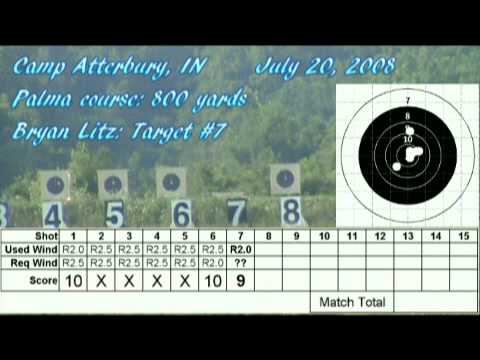
Bryan recently crafted a cool video that puts the viewer “in the driver’s seat” as Bryan shoots an 800-yard match with his .308 Winchester, iron-sights Palma rifle. Watch as each shot is marked and scored. Bryan explains: “The inset target at upper right displays each shot location in sequence. The score card shows the windage used for each shot, as well as the windage that was ‘Required’ for that shot to be centered. Wind wasn’t very challenging in this string, only requiring between 2 and 3 MOA right. This particular match is the 800-yard phase of a Palma course fired in the summer of 2008 at Camp Atterbury, IN. NOTE: I’ve had to cut out some ‘pauses’, and speed up the film in order to meet YouTube’s size requirements, so that’s why we sound like chipmunks.”
CLICK SCREEN to WATCH VIDEO. Click Menu Button for High Quality (HQ) Option
Bryan also has his own website with a number of authoritative articles. Topics include: Bullet Design, Meplat Trimming, Gyroscopic and Coreolis Drift, Palma Bullet Analysis, How Ballistics Programs Work, and Ballistic Coefficient Testing. CLICK HERE to visit BRYAN LITZ Website.
February 11th, 2009
On the ShootingUSA television show, today’s episode will feature the Infantry Team Match at Camp Perry. In connection with that segment, Sgt. First Class Kyle Ward of the U.S. Army Marksmanship provides guideslines on how to properly fit a shooting sling, and how to best use the sling in various shooting positions.
CLICK HERE to read Sgt. Ward’s step by step Sling Instructions.


|
Proper Sling Adjustment
Once the sling is linked together properly, Sgt. Ward explains: “The next step is attaching the sling to your arm. Attaching the sling to your arm is simply done by creating slack in the sling, turning the sling a quarter turn clockwise if you’re a right handed shooter, or a quarter turn counter clockwise if you’re a lefty. You know that your sling is set to the proper length when you can easily and comfortably get into position, when you can take your firing hand off the rifle, and the rifle remains in your shoulder. To get the most of your sling, setting it to its proper length, and where you place it on your arm is critical. There are some general rules to follow when setting up your sling. You want it tight enough that it’s providing maximum support, but not so tight that you have to fight to get it into position.
Proper Sling Placement
Sling placement on your arm is also critical. In the sitting position, you want to place the sling toward the inside of the arm. Place the sling too far to the outside, and it will likely introduce pulse into your position. It’s not uncommon to have to adjust the length of the sling for different firing positions. While using the sling in the prone position, you should place the sling in the outside of the arm. Placing the sling too far towards the inside will reduce the sling’s effectiveness and likely generate pulse.
Try these techniques the next time you’re on the rifle range. Proper use of the leather sling will definitely increase you scores, and decrease the amount of perceived movement when looking through the sights.” |
|


