|
|
August 7th, 2009
The High Power Silhouette Championships at the NRA Whittington Center (Raton, NM) started Thursday morning (August 6th) with many Smallbore Silhouette competitors taking to their big guns for High Power. Match 1 went well but extreme afternoon winds were blowing silhouettes off the rails so Match 2 was halted. That means the remaining two High Power Hunting Rifle matches over the next two days will jump to 60 shots rather than 40 to close the gap. The top shooters in Match 1 were Joy Cox (35), Defending Champion Angustin Sanchez, Jr (34 – 9 turkeys), and Laura Goetsch (34 – 8 turkeys)

The High Power Silhouette Championships are similar in format to the Smallbore Silhouette Championships held earlier this week. The Standard Silhouettte High Power Rifle matches are shot in the morning with the Silhouette Hunting Rifle Class shot in the afternoon. The main differences between the disciplines are obviously the type of rifle (Centerfire vs. Rimfire) and the distances. For High Power, targets are set at 200 meters (chickens), 300 meters (pigs), 385 meters (turkeys), and 500 meters (rams), while in Smallbore, targets are set at 40, 60, 77, and 100 meters.
A variety of chamberings are popular in the centerfire Silhouette game, including the .243 Win, 6.5 BR, 6.5×47 Lapua, 260 Rem, 7 BR, 7mm-08, and the .308 Winchester. In selecting a caliber, shooters must balance between knock-down power and recoil force. A 6.5mm or 7mm bullet in the 130gr range running 2900 fps is just about ideal. You also need a caliber capable of serious inherent accuracy.
This report courtesy the NRABlog.com
August 5th, 2009
It was “Ladies First” at the 2009 NRA National Smallbore Silhouette Championships. Cathy Winstead-Severin shot brilliantly to win both the Rifle AND Hunting Rifle titles, as well as the High Woman title for both classes. We’ve always said women can compete head to head with male shooters and win. Cathy proved that convincingly.

This wasn’t Cathy’s first big victory. She won her first National Smallbore Silhouette title in 1998. Along with husband James Severin, Cathy operates Good Shooting Sales & Service in Joplin, Missouri, a shooting supply business specializing in rimfire and silhouette products.
Smallbore Rifle Championship Top Finishers:
First Place (and High Woman): Cathy Winstead-Severin: 111
Second Place: William Motl: 108
Third Place: Derek Greenaway: 107
High Junior: Tyler Kamp: 104
High Senior: Loren Peter: 96
Team Champions: Texas State Gold: 214
Smallbore Hunting Rifle Championship Top Finishers:
First Place (and High Woman): Cathy Winstead-Severin: 108
Second Place: William Zander: 105
Third Place: Laura Goetsch: 104
High Junior: Tyler Kamp: 98
High Senior: Bob Snyder: 85
Team Champions: Belgrade Air Shooting Sports: 205
August 4th, 2009
Roughly 130 competitors have gathered at the NRA Whittington Center for the NRA Smallbore Silhouette Championships held August 2-4. Today the final matches will be held for the Smallbore Rifle Class and Hunting Rifle Class Silhouette Championships.
This year, 13 shooters have traveled from Mexico to compete against some of the best Smallbore Silhouette shooters in the United States. Seven of these Mexican competitors made the 20-hour journey together. Surprisingly however, the Mexican contingent did NOT include Agustin Sanchez, Jr. this year. Agustin, the “Tiger Woods of Silhouette” has won the event for the past six years, but now someone else will take his title. “It’s up for grabs,” said NRA Silhouette Program Coordinator Jonathan Leighton. “There are a lot of good shooters here, so it’s anyone’s game right now.”

Above, Gabriel Guerra of Mexico shoots while Carlos Mercado spots for him. Guerra loves Silhouette shooting for the comradery and the challenge: “I enjoy the mental game, and it’s a very fun sport. You meet nice people, here and in Mexico. I like the friendship of the teams.”
Invented in Mexico, Adopted in America
It’s thought that silhouette shooting began in Mexico around 1914 as a marksmanship contest between Pancho Villa’s men. The sport spread throughout Mexico following the Mexican Revolution, eventually making its way to America in the 1960s. Silhouette shooting started as a centerfire sport, but over the years rimfire silhouette has become more popular. CLICK HERE to read about the history of silhouette competition.

If you’re interested in getting involved in smallbore silhouette, a fun yet challenging discipline, you’ll find a Summary of Silhouette Basics in our Daily Bulletin Archives. You’ll also find more information, including current rules, on the Steelchickens.com website.
Smallbore Silhouette Course of Fire and Rifle Classes
At an official Smallbore Silhouette match, you’ll shoot at least 40 shots, ten each at four sets of 1/5th size standard High Power Rifle Silhouette targets. The smallest targets, the chickens, are set at 40 yards, Pigs are at 60 yards, Turkeys are at 77 yards, and Rams are at 100 yards. (Alternatively, metric distances are used.) Though the rams are the largest targets, hitting them is far from easy. At 100 yards, a little bit of wind will blow you off the target. Two classes of rifles are used in Rimfire Silhouette: Standard and Hunter Class. Standard rifles can weigh up to 10 pounds, 2 oz. (with sights) and have no restriction on trigger pull weight. The fore-end shall not exceed 2 1/4″ wide, and 2 1/4″ deep measured from the centerline of the bore.
August 3rd, 2009
The August issue of Target Shooter, the excellent UK-based webzine, is now available FREE online. As usual, this edition is chock full of interesting feature articles written “by shooters, for shooters”. You can either read the monthly e-magazine online, OR you can now download the entire August issue to your computer. This lets you peruse multiple articles at your leisure. (For readers with a slow web connection, reading offline may be more convenient, once you’ve downloaded the file.)
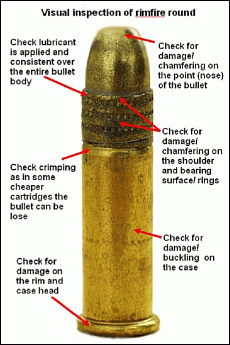 Among the featured articles this month are an authoritative section on rifle maintenance and scope-mounting by Vince Bottomley (p. 13), a user’s guide to the Redding T7 press by Laurie Holland (p. 55), and an excellent guide to Rimfire Ammo selection and sorting by Carl Boswell (p. 40). If you follow Carl’s procedures (including the visual inspections shown at right), you’ll experience fewer unexplained “flyers” — we can guarantee that.
Complete F-Class Worlds Report
Amazingly, Target Shooter’s August issue contains a detailed, 4-page report on the 2009 F-Class World Championships which concluded just a few days ago in England. You’ll enjoy the reports from the field and interviews with top F-Classers from around the world. In addition to the match report, the August Target Shooter profiles Britain’s Gary Costello, the winner of the Individual World F-Class Championship.
Gary’s rifle was built by American gunsmith Alan Warner and is chambered as a 7mm-270 WSM. (The 270 case is used because it has a slightly longer neck and slightly less capacity). The action is an aluminium Stolle Panda with RBLP configuration. The scope is a March 10-60X mounted in Kelbly rings. The stock is an Alex Sitman Master Class laminated long-range thumbhole model. Sadly, the handsome gray/blue stock broke at the thumb-hole during shipping from the USA. However, Pet Walker of Walker Customer Rifles in West Yorkshire restored the stock to better than new condition, providing Gary with a beautiful rig that carried him to victory.

August 2nd, 2009
 Tony Boyer is, without question, the greatest short-range Benchrest for Group shooter who has ever lived. In a rare interview for the August 2009 issue of Precision Shooting magazine, Tony shares many of his “secrets of success” with his friend (and fellow benchrester) James Mock. James also interviews Tony’s wife Faye, a superb shooter in her own right.
This Boyer interview is now, for a limited time, available online. CLICK HERE to READ INTERVIEW. Every short-range and mid-range benchrest shooter should read this article word for word, at least twice. Tony reveals insights that may surprise you, and will certainly enlighten you. You may be surprised that Tony is now shooting a .268″ neck.
And in the article Tony challenges many commonly-held ideas. For example he doesn’t think vertical is mostly load-related: “Most shooters think that vertical groups are caused by too light a powder charge. This may be true, but more often than not, the rifle has more to do with this than the load. If the rifle is muzzle heavy, this can cause vertical. Also, the way the action is set in the stock can cause vertical as can handling problems…such as shouldering the rifle.”
Barrel Quality is All-Important
What is the main secret to Benchrest accuracy? Throughout the interview, Boyer stresses the importance of barrel quality. Tony can quickly identify barrels with winning potential. He has “developed a system that takes no more than 30 rounds to determine if it is going to shoot”. Tony needs that kind of efficiency because he burns through barrels very quickly: “Contrary to what many say, I rarely shoot a barrel more than 600 rounds in competition. I can remember only one barrel that exceeded 1200 rounds.”
When asked if there was one paramount “secret” he could share to help new shooters, Tony replied: “If you have the means, buy as many barrels as possible. A great barrel is the real secret of this game. There are barrels out there that shoot better than they should. They have been given the name ‘hummer’. I can assure you that they exist.”
August 1st, 2009
The Smallbore Prone Championship matches have concluded at Camp Perry, and we have a new National Champion, Spc. Joseph Hine from the U.S. Army.

As the Smallbore prone champ and winner of the Critchfield Trophy, Specialist Joseph Hein was awarded the Critchfield trophy plaque, a gold tone national champion, a medallion, a Chiappa blackpowder muzzleloading rifle, and a $500 Visa gift card. Here are the top finishers and their final scores.
1. SPC Joseph Hein – 4790×354 | National Champion
2. Richard Fowke – 4790×355 | Civilian Champion
3. Reya Kempley – 4789×374 | Woman Champion
Runner-up Richard Fowke was crowned the Civilian Champion. Fowke actually outscored Hein by one “X”. But as a British citizen, Fowke wasn’t eligible for the U.S. National Championship. Third-Place finisher Reya Kempley also received an award as Top Female Shooter. Reya also shoots a 6mmBR centerfire rifle in international 300m competition.

This story was provided by the NRA Blog. You’ll find many more photos of the Camp Perry Smallbore competition and awards ceremonies on the NRA Media Relations Public Gallery. On that page, click on any thumbnail to view a slideshow of related photos.
July 31st, 2009
 This year’s 2009 World F-Class Championship was held at the historic Bisley Range in England, and UK Shooters served their country proud, winning the prestigious F-Open Team Competition and dominating the individual matches in both F-Open and F-TR classes. Great Britain’s F-Open shooters proved their mastery of the challenging Bisley course, posting a 3436-230V score to top the second-place American Team by 59 points (Team USA score was 3377-234V). The South African Team, defending Champions, finished third with a 3337-188V score.
UK Shooters truely dominated the Individual F-Open Championship, capturing ALL of the top ten places, lead by Gary Costello (1st Place) with 458-44V, followed close behind by fellow Brit Des Parr with 456-36V. That’s nine Brits and a Scot in the Top Ten. In the Individual Competition, F-TR division, Britain finished one/two at the top of the podium, with Russell Simmons (437-23V) winning the Gold, and countryman George Barnard (432-23V) winning Silver. American Stan Pate took third with a 420-25V score.

American F-Open Team Vice-Captain Shiraz Balolia, writing in his Bisley Blog, suggested that the windy conditions favored the 7mm caliber used by the home team Brits: “The individual World F-Class Championship is over. We essentially got overpowered by the 7mm guns. Bisley is not a range that you can win using 6.5mm guns, which is what the whole US Team is using. Of the top 10 positions, all but one were Brits with 7mm guns. The odd one was a Scot also with a 7mm gun.”
After the Team Match concluded, Shiraz wrote: “The British team won the World F-Class Open Championship. USA took second and South Africa third. The Brits beat us by 59 points and they were very surprised that we came that close to them. I believe that there were two main factors that worked very well for them. First and foremost was that they had full knowledge of their range and have been practicing on that range fairly regularly as a team for quite some time. Secondly, their 7mm guns were a good wind-bucking caliber that, when combined with good coaches (who have coached at that range for many years), gave them the results they were after. Someone made the comment to me that the Americans were improving by the day. Unfortunately, we ran out of days and it was game over. Our coaches did an outstanding job under very trying conditions. We beat the previous champs, South Africa, by 40 points.”
EDITOR’s NOTE: In the previous F-Open World Championships in South Africa, Team USA was defeated by the home team South Africans who were shooting 7mms. At Bisley in 2009, the same thing happened, with the Brits winning on their home turf, again using 7mms. Do we see the writing on the wall?

CLICK HERE for Complete F-Class Championships Results.
CLICK HERE for 2009 F-Class World Championship Photo Archive.

Americans Win F-TR Class
In the F-TR class the American Team powered to victory, haulting the British juggernaut. Under the leadership of Captain Darrel Buell, and coach Gary Rassmussen, shooters Brad Sauve, Dale Carpenter, Warren Dean, Monte Milanuk, Paul Phillips, Stan Pate, Jeff Rorer, and John Weil won the F-Class Restricted Teams Match with a 1581-76V score. The USA Rutland Cup Open Team of David Bailey, Mike Downey, David Gosnell, and Larry Taite, coached by Nancy Tompkins, also finished first, besting a strong Great Britain Red squad (second place), and Don Nagel’s third-place Connecticut Yankees.


All photos © 2009 by 762_AK, used by permission.
July 30th, 2009
Dennis DeMille is a past Camp Perry National Champion, and one of the nation’s top High Power shooters. Since retiring from the U.S. Marine Corps, Dennis has served as the General Manager of Creedmoor Sports in Oceanside, California. We recently had the chance to interview Dennis at the Creedmoor offices. With his decades of competitive experience, Dennis has a wealth of knowledge. In this 3-minute interview, Dennis shares insights into the High Power shooting game. He discusses the most effective ways to train for competition, the fundamentals of good marksmanship, and how to recognize and perfect your natural point of aim. Dennis also offers solid advice on how to get the best “bang for your buck” when choosing shooting accessories for High Power and Across the Course competition.
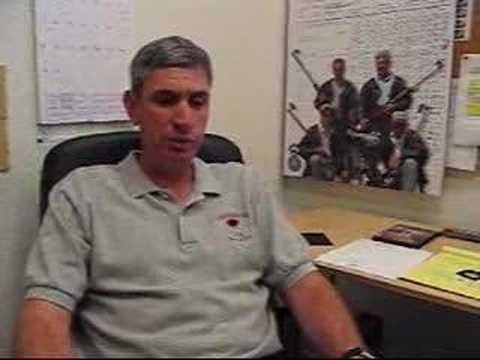
CLICK HERE to WATCH DeMille Interview VIDEO
During our visit to Oceanside, Dennis gave us a tour of the facility. Dennis also explained the manufacturing process for Creedmoor’s popular shooting coats. All these shooting jackets are hand-crafted in Oceanside by experts with years of experience. Special templates are used to ensure each coat perfectly fits its new owner.

6.5 Creedmoor Ammo and Components
Today, 7/30/2009, we asked Creedmoor Sports to check its inventories of 6.5 Creedmoor components. Plenty of 6.5 Creedmoor cartridge brass is in stock. There is a good supply of 120gr A-Max bullets, but no 140s. As for 6.5 Creedmoor loaded ammo, a couple hundred 20-rd boxes of Hornady ammo is on the shelves as of 7/30/2009. A handful of die sets are in stock, with more on order. 6.5 Creedmoor case reamers are in stock.

July 29th, 2009
 Headed to Camp Perry this summer? Take the “Bernosky Challenge” while you’re there and compete for over $1000 in cash prizes. The “Bernosky Challenge” is being conducted by the Civilian Marksmanship Program in cooperation with Creedmoor Sports.
Competitors in the Bernosky Challenge will fire the National Match Air Rifle Standing Course with the new Creedmoor-Anschütz NMAR air rifles and compete against the current Camp Perry High Power champion, Carl Bernosky. One of America’s all-time great target rifle shooters, Carl won his 9th NRA National High Power Rifle Championship in 2008. This year, Bernosky will seek his 10th Championship using a Creedmoor CSR-1 Match Rifle chambered in 6.5 Creedmoor.
ANYONE who can beat Carl Bernosky in this air rifle challenge will receive $100. (See challenge rules for details.) Go to www.creedmoorsports.com or CLICK HERE for more details.
The new National Match Air Rifle discipline was developed by the CMP to simulate High Power rifle across-the-course shooting and provide adults with an air rifle discipline that builds on the popular junior three-position air rifle program. This NMAR discipline gives High Power competitors off-season shooting opportunities. One of three NMAR equipment classes is for air rifles configured like M16/AR-type rifles.The Creedmoor-Anschütz NMAR rifle is one of these rifles. NMAR targets are scaled down High Power SR and MR targets. Courses of fire are closely related to current High Power courses.

Thirty-five (35) Creedmoor NMAR rifles are available for anyone for use during this competition. CLICK HERE for more details!
July 27th, 2009
At Camp Perry, the Hough Theater stage saw many people honored as Smallbore 3-Position champions Saturday night. Specialist John Hein of the United States Army won the title of National Overall Champion. Leonard Remaly was named Senior Champ.

And while the Award Ceremony honored all the Smallbore 3P winners equally, it was Any Sight National Champion Greg Drown that drew the only standing ovation from the crowd. One reason was because of his score. The other is because he shoots from the seat of a wheelchair.
 “I developed multiple sclerosis gradually between 1995 and 2000,” explained Greg. “It was a shock.”
A lifelong competitive shooter, Greg has earned a few titles in his time –- but nothing on the scale of an NRA Championship. “I”ve won state titles, regional titles, even qualified for the 1984 Olympic Trials, but this was a surprise. I think it was Friday, when the weather turned, that’s when I knew I had a chance.”
 Weather plays an important part in every tournament Greg shoots. Because of MS, his ability to shoot is often hampered by fatigue. “It plays havoc on the body,” said Greg. “Hot muggy days, like we had here in 2008, those are really tough. But this year it was raining and cool. The weather was perfect.”
As everything fell into place and the shots found their mark, Greg began to think about scratching another goal off his list. “I have a book,” he said. “List of goals and things I want to accomplish. Coming on stage tonight for this ceremony was one of them.”
This story comes courtesy the NRA BLOG, which is providing extensive, daily-updated coverage of the NRA National Championships.
|


