The CMP National Matches at Camp Perry, Ohio commence July 8, 2024 with 3P Air Rifle events. The Camp Perry matches are historic, having been held since 1907 at this location on the shores of Lake Erie. The 2024 First Shot Ceremony takes place Monday, July 15 on the grounds of Camp Perry. Air Force Academy shooting coach and former Olympian Launi Meili is the 2024 First Shot Speaker. Launi will address the crowd and make the traditional First Shot to officially open the National Matches.
For this week’s Saturday at the Movies, we offer seven videos from Camp Perry. These cover both rimfire and centerfire shooting, team matches (including the famous “Rattle Battle”), along with pistol shooting. If you’re heading to Camp Perry this summer, today’s video showcase provides an informative preview. And watch the video above for a great short preview of the event.
CMP National Matches at Camp Perry — Ranges, Events, Training
This 3-minute video above shows the Camp Perry ranges and shooting facilities and explains the programs scheduled, including training courses. The video also covers nearby accommodations and explains how to register for the National Matches on the CMP website.
NTIT Team Match — “Rattle Battle” at Camp Perry
The CMP’s National Trophy Infantry Team Match (NTIT) has been a staple at the National Matches since 1922. Also known as the “Rattle Battle,” the event is one of the most unique in the competitive rifling world — scoring is based on how many hits six-person teams can score on a bank of targets during a series of 50-second firing periods at four yardages.
Watch CMP ‘Rattle Battle’ Video — 50 Seconds of Rapid Fire…
Teams fire upon eight silhouette targets from 600, 500, 300 and 200 yards during successive 50-second periods. After each rapid-fire string, team members move forward (to the next-closest distance) carrying all equipment from firing line to firing line. The video shows the California Grizzlies, one of the top junior squads. The lead photo shows the U.S. Army Reserve (USAR) Team in action during the NTIT match. See more in USAR “Rattle Battle” Video.
Camp Perry M1 Garand Competition — Vintage Military Rifle
The John C. Garand match is a Camp Perry classic. Note the signature Garand clip in the air.
The CMP hosts the popular M1 Garand Match as well as the Springfield M1A Match. This writer’s father carried a Garand in WWII — reason enough for me to want one. But I also loved the look, feel, and heft of this classic American battle rifle. And the unique “Ping” of the ejected en-bloc clip is music to the ears of Garand fans. Some folks own an M1 Garand for the history, while others enjoy competing with this old war-horse. The CMP’s John C. Garand Match is one of the most popular events at Camp Perry every year. There are other vintage military rifle matches.
Rimfire Sporter Event Draws Hundreds of Competitors
If there is a single CMP event at Camp Perry every summer that draws the most competitors and offers the lowest cost of entry, that would be the annual Rimfire Sporter Match. This year’s match will be held on Saturday, July 13th at the Viale Range. There will also be a CMP Sporter Live-fire Training Clinic on Friday the 12th. One of the most popular annual Camp Perry events, the Rimfire Sporter Rifle match features .22 LR competition in open sights (O-Class), telescopic (T-Class) and tactical/unlimited (TU) classes, fired at 25 and 50 yards. A CMP Rimfire Clinic will be held prior to the match.
Each year, the Rimfire Sporter Match attracts hundreds of shooters to the shore of Lake Erie at Camp Perry. The CMP National Rimfire Sporter Rifle Match offers shooters a recreation-oriented competition where they use affordable, smallbore sporter rifles with either scopes or iron sights. All you need are a .22 LR rifle, sling, and ammo.
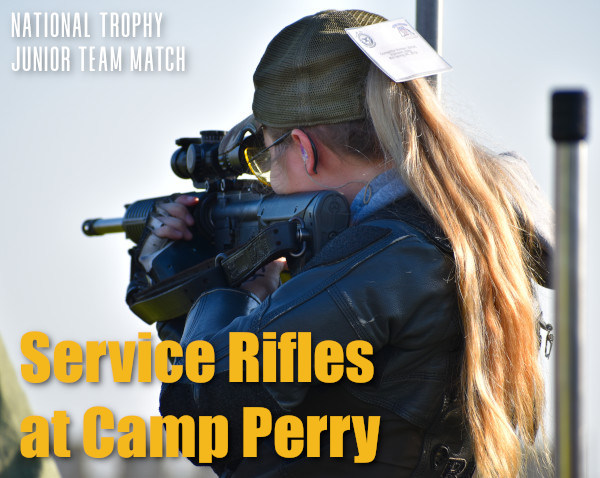
Service Rifle Matches — AR-Platform Rifles, Now with Optics
Service Rifle shooting is fun yet challenging. You need to develop skills with multiple positions and be able to make rapid wind calls. However, the modern AR-based service rifle is affordable and has relatively low recoil. Highly-customizable, modern service rifles can be fitted with adjustable stocks and optional magnified optics. Older military rifles, such as the M1A and M1 Garand, offer different challenges with heavier-recoiling cartridges, greater weights, and classic iron sights. Hi-Lux asked competitors at Camp Perry during CMP’s 2021 summer games what they enjoyed most about competition with service rifles and Military rifles such as the M1 Garand. The shooters’ responses had four key themes: Self-Improvement, Comradery, History (enjoying shooting rifles with heritage), and Challenge.
Camp Perry Bullseye Pistol Competition
Camp Perry hosts the most prestigious annual trophy matches in our nation’s history. And in a venue renowned for service rifle matches, the sport of precision pistol is no less important, no less challenging, and no less respected. The National Trophy Pistol Matches are all about traditional handgunning — the stance, the intense concentration, and of course, the one-handed grip. It’s all unmistakable as the game of Bullseye Pistol. Every year there are 20+ match trophies for the top Bullseye Pistol shooters, both military and civilian. And the very best will claim National Match Trophies and receive the President’s 100 Tab.
CMP Camp Perry National Matches Registration Links
The 2024 CMP National Matches at Camp Perry officially commence Thursday July 11, 2024. The summer schedule concludes Saturday, August 10 with the Palma Match and awards. Here is the full CMP schedule (click to zoom):
NOTE: This CMP Calendar is hosted online in spreadsheet format. This allows you to increase display size, and also to search for specific words. CLICK HERE to view full spreadsheet calendar.
History of Camp Perry
“In the year 1907 the machinery of the National Matches, now grown to immense proportions, was moved to the mammoth new range at Camp Perry.”
—James Drain, Arms and the Man, August 1911
Federal legislation originally launched the National Matches. The 1903 legislation also established the National Matches, commissioned the National Trophy and provided funding to support the Matches. The National Matches have been held at Camp Perry since 1907. The range is located along the shores of Lake Erie in northern Ohio near Port Clinton. The site was first acquired in 1906, in response to the need for a larger facility for military training and the NRA’s shooting programs. The original land for Camp Perry was purchased in 1906, and the reservation was named after Commodore Oliver Hazard Perry, the American naval commander who won the Battle of Put-in-Bay during the War of 1812.
On August 19, 1907, Cpl. L. B. Jarrett fired the first shot at the new Camp Perry Training Site. And that year, 1907, Camp Perry held its first National Pistol and Rifle Championship events. This location has hosted the annual National Matches ever since. Typically over 4,000 competitors attend the National Matches each year, making it the most popular shooting competition in the western hemisphere.
The 2024 NRA National Matches at Camp Atterbury commence Monday, July 22, and conclude Monday, August 19, 2024. You can register now for pistol, smallbore rifle, and centerfire (High Power) rifle matches via the NRA Competitive Shooting website. Click the link below to REGISTER for the 2024 NRA National Matches at Camp Atterbury.
15 Ruger Guns as Prize Awards: Ruger, the Title Sponsor of the NRA National Matches, has donated 15 firearms to the competitors’ prize tables at the 2024 NRA National Matches.
This year’s calendar returns to the traditional National Matches schedule, starting with the Precision Pistol National Championships, followed by the Smallbore Rifle National Championships and ending with the High Power Rifle Nationals, specifically the Long-Range and Palma Championships. The 2024 NRA High Power National Championships will be fired on electronic targets.
Precision Pistol (July 22 – 25)
July 22 –Opening Ceremony, Practice, Preliminary Match (no awards), Harry Reeves Match
July 23 – .22 Championship, .22 EIC
July 24 – Centerfire Championship, Service Pistol EIC
July 25 – .45 Championship, Distinguished Revolver, Awards Ceremony
Smallbore Rifle Prone and F-Class (July 28 – August 1)
July 28 – Squadded practice, Metallic Sights Day One
July 29 – Metallic Sights Day Two
July 30 – Randle, Dewar, Team Matches
July 31 – Any Sights Day One
August 1 – Any Sights Day Two, Awards Ceremony
Smallbore Rifle Three-Position (August 2 – 4)
August 2 – Metallic Sights
August 3 – Drew Cup Team Match, Team Matches
August 4 – Any Sights, Awards Ceremony
High Power Rifle Across the Course (August 5 – 10)
August 5 – Seeding Match
August 6 – Member’s Trophy, Scott Trophy, Coast Artillery Trophy Matches
August 7 – Navy Cup, Army Cup, Coast Guard Trophy Matches
August 8 – Appreciation Cup, Marine Corps Cup, Air Force Cup Matches
August 9 – Crescent Cup, Cavalry Cup, Crowell Trophy Matches, Awards Ceremony
August 10 – EIC Leg Match
High Power Rifle Mid-Range (August 11 – 14)
August 11 – 300-, 500-, 600-yards, 600-yard Teams
August 12 – 3×600 yards, 600-yard Teams
August 13 – 300-, 500-, 600-yards, 600-yard Teams
August 14 – 3×600 yards, Awards Ceremony
High Power Rifle Long-Range (August 16 – 19)
August 16 – Wimbledon Cup, Rem Trophy, Porter Trophy, Andrus Trophy, Herrick Trophy Team Matches
August 17 – Leech Cup, Mustin Trophy, Farr Trophy, Aitken Trophy, Roumanian Team Trophy Matches
August 18 – Palma Individual Match, Awards Ceremony
August 19 – Palma Team Matches, Awards Ceremony
2024 NRA National Matches at Camp Atterbury Calendar
Camp Atterbury is a National Guard training facility located in Edinburgh, Indiana, which is about 37 miles south of Indianapolis.
The NRA National High Power Championships will be fired on advanced Silver Mountain electronic targets. Another other nice feature of Camp Atterbury is the large, modern covered range. This is used for smallbore and pistol competitions.
The 2024 National Pistol Matches take place July 14-21 at the Camp Perry National Guard Training Site in Port Clinton, Ohio. These matches are run by the Civilian Marksmanship Program (CMP) and Ohio National Guard. If you want to shoot in the National Pistol Matches this year, it’s not too late to register (links below). CLICK HERE for more information about the National Pistol Matches.
The National Pistol events, open to adults and juniors of all experience levels, include several traditional matches like the President’s Pistol (President’s 100), National Trophy Individual, and National Trophy Team events alongside a series of 900 Aggregate matches for .22, .45, and centerfire pistol. The CMP Games competitions, such as the Military & Police and 1911 As-Issued Matches, will also be part of the National Matches schedule (see Calendar below). The last pistol matches run on Sunday the 21st, with Pistol Games Awards at the end of the day.
The GSSF GLOCK National Challenge returns to the schedule in 2024, while the Service Revolver EIC Match has been renamed the Philip Hemphill Memorial Service Revolver EIC Match in honor of Philip Hemphill, a celebrated national champion who passed in 2023. There will be plenty of talent on the firing line. In recent years, over 90% of the top 50 Service Pistol shooters were Distinguished.
CMP will also conduct indoor Air Pistol National Matches at the Gary Anderson CMP Competition Center. Rental air pistols are available for a modest fee.
This video shows .45 ACP centerfire pistol competitors at Camp Perry
Interested in competing in the Camp Perry Pistol Matches this summer with either a .22 LR rimfire pistol or centerfire pistol? It’s not too late to register. CLICK HERE for Pistol Match Online Registration.
In connection with the National Matches, a Pistol Small Arms Firing School (SAFS) will be held July 15, 2024. Participants in SAFS are instructed by some of the top military marksmen and women in the country on firearm safety and competition basics, both within the classroom and on the range. All firearms and ammo are provided for the live-fire portion of the clinic.
The 2024 National Matches will include a Pistol Small Arms Firing School.
For those looking for a little extra time on the range before competing, be sure to sign up for Pistol Practice on July 15 and 16 (cost: $5.00 per practice time). Competitors will receive a Pistol Practice card at check-in, with additional practice time open for purchase (if available).
About the National Matches:
The annual National Matches have been held at the Camp Perry National Guard Training Site since 1907. The month-long series is comprised of the CMP National Trophy Pistol and Rifle Matches, National Games Matches, National Smallbore Matches, National Air Gun Championships, and the National Mid-Range and Long Range Matches. The National Matches also include educational clinics for shooters of all experience levels. View National Matches schedule and programs at: Thecmp.org/cmp-national-matches.
With the huge popularity of NRL22 and PRS rimfire matches, along with the growth of rimfire benchrest events, and local rimfire fun matches, we’ve seen heightened demand for all types of .22 LR ammunition. Plus the high cost of centerfire bullets and limited availability of powders and primers has pushed many centerfire shooters into the rimfire fold. Accordingly, prices have been rising for quality .22 LR ammunition. Thankfully, if you use Ammoseek.com, you can find most types of .22 LR ammunition, from bulk-pack plinking fodder to high-end Lapua, ELEY, RWS, SK, and Norma ammo.
Find Rimfire Ammunition Fast with AmmoSeek.com
Here’s a great search service that can help you locate hard-to-find ammunition and reloading components — while saving money in the process. AmmoSeek.com monitors scores of online vendors — checking current pricing and available inventory, for pistol, rifle, and shotgun ammunition. Looking for .22 LR ammo for your rimfire trainer or NRL22 rifle? Just select “.22LR” from AmmoSeek’s “Quick Seek” menu. NOTE: In mobile view type “22LR” in the “Search Ammo by Caliber” field top center.
And here are the 6/20/2024 search results for .22 LR ammunition. These are six of the 1000+ entries, starting with the least expensive, just 4.1 cents ($0.041) per round:
How to Search by Manufacturer and Bullet Weight
You can also search for a particular .22 LR ammunition manufacturer, and/or search by bullet weight. Just click on the “Modify Search Link”. Once you see the “Modify Search” column on the left, scroll down and you can sort by price (cost per round) and/or shipping cost. Here are the results of a search for LAPUA .22 LR rimfire ammunition:
Precision Rifle Series (PRS) Rimfire Finale on Shooting USA
This week Shooting USA showcases the PRS Rimfire Finale. This rimfire discipline is like Precision Rifle Series (PRS) centerfire competition, but shot with .22 LR rimfire rifles. Shooters can compete without the high cost of centerfire ammo and without the need for a 1000-yard range. The 2023 PRS Rimfire Finale, sponsored by Ruger, was held in Pennsylvania in October 2023. The big event drew over 200 competitors. SEE: PRS Rimfire Series Info.
Shooting USA SHOW TIMES: This Shooting USA Episode airs Wednesday, June 17, 2024 at 9:00 PM Eastern and Pacific; 8:00 PM Central. If you miss the regular broadcast, you can stream the show online at any time on Vimeo for $0.99 per episode.
PRS Rimfire Finale — Over 200 Competitors
The 2023 PRS Rimfire Series Finale drew over 200 competitors. The Finale Match was hosted last October by MKM Precision in Kennerdell, Pennsylvania. PRS and NRL tactical matches are among the fastest-growing competitive shooting disciplines. And rimfire tactical disciplines are actually growing even faster (than centerfire PRS/NRL) because .22 LR ammo is much cheaper than centerfire ammo, and there are many more ranges where rimfire matches can be held. PRS Rimfire offers the same kind of fun without the high cost of centerfire ammo and the time-consuming burden of hand-loading. Rimfire PRS also offers generally less expensive rifles, and a whole lot less recoil.
At the PRS Rimfire Finale in Pennsylvania match directors set out many unique courses of fire, and the target placements were certainly challenging. Many of the stages had cross-course target lay-outs. This makes wind-reading much more challenging, especially with the relatively slow, low-BC .22 LR cartridges used in PRS rimfire competition.
Tune in to Shooting USA TV on Wednesday, 6/19/24 to see the PRS Rimfire Finale. You’ll enjoy the coverage of this popular PRS rimfire sport, which we expect to grow significantly in 2024 and beyond. Notably, the National Rifle League (NRL) now conducts many more NRL22 matches than NRL centerfire matches. And competitors of course are drawn by the fun/challenge of a tactical match with much lower ammo costs — $0.10-$0.25/rd vs. $1.20/rd or more (counting brass, primer, bullets, powder, and barrel wear). And there are many more viable venues, because you don’t need a very big range to run a rimfire tactical match.
Getting Starting in PRS/NRL Rimfire Competition — The Rifle
Interested in getting started in PRS Rimfire competition? This MDT video explains the components you’ll need for a top-level .22 LR PRS rig.
Today’s Saturday Showcase features Palma rifles and Palma competition. The Palma discipline is a prone Iron Sight competition that originated in 1876, making it the second oldest continuing rifle match in the world. Except for a hiatus in the late 1900s, there is a nearly 150-year history of Palma matches. The Palma Course of Fire includes stages at 800, 900, and 1000 yards. At each yard-line you get two (2) sighting shots followed by 15 shots for record, for a grand total of 51 shots.
Under U.S.A. Palma rules the gun must be a rifle with metallic sights chambered for .308 Win (7.62×51) or .223 Rem (5.56×45). Most of the rifles featured in these videos are chambered for .308 Winchester, but we do have a video of John Whidden shooting his .223 Rem Palma gun — you’ll notice the significantly reduced recoil. CLICK HERE for more information on Palma Rules.
Components of Modern Palma Rifle and Palma Competition Basics
We definitely recommend you watch this video. Hosted by SSG Robert Germanelo of the U.S. Marine Corps Shooting Team, this video explains the basic rules of Palma competition and covers the key features of a modern, tubegun-style Palma rifle. The featured rifle has a Eliseo Competition Machine stock, Krieger 30″ 1:13″-twist barrel, Defiance Machine single-shot Rem 700-compatible action, Jewell trigger, Warner Tool Aperture Rear Sight, and Stallings Machine “Right Sight” in the front.
John Whidden Shoots His Modern .223 Rem Palma Rifle
With the latest bullets, long barrels, and strong Lapua brass, the .223 Rem CAN compete successfully in modern Palma competition. Here we feature a .223 Rem Palma rig belonging to 5-time NRA Long Range Champion John Whidden. Watch video at 00:25 and you’ll see the recoil of Whidden’s .223 Rem Palma rifle is significantly less than a .308 Win Palma rig. John joked: “With the .223 Rem there is just a pop and a wiggle after the shot.” CLICK HERE for full 1200-word report on this rifle with many more photos.
Modern .308 Win Palma Rifle with Custom Anschutz-style Stock
Here a Palma competitor showcases his modern .308 Win Palma rifle built with an custom-made, Anschutz 1913 model-style stock with the main frame crafted by the host’s father. This rig has a 30″ barrel chambered for 155gr bullets. The video explains how the components were chosen, why the barrel is so long, and how the stock adjusts in numerous ways to fit the shooter’s particular prone style. Below is a diagram of the sight picture. This is covered at 1:56 in the video.
Palma Rifles Shooting 1000 Yards at Bisley in the UK
This UK-produced video features Palma matches at the Stickledown Range at Bisley. This video showcases the Inter-Counties match, where competitors use iron-sighted Palma rifles on targets at 1000 yards. This video provides a good introduction to the Palma discipline as practiced in Great Britain.
Canadian Palma Fun — Nova Scotia Shooters at 900 Yards
In this video, filmed at a beautiful range in Nova Scotia, two Canadian shooters compete at 900 yards with their iron sighted .308 Win Palma rifles. The video combines three different views into one frame, so you can simultaneously see downrange, see the shooters, and see the shot impact on the electronic target display. The shooters fired .308 Win cartridges loaded with Vihtavuori N140 powder and 155gr Sierra #2156 PALMA bullets.
Ballistics Guru Shoots Palma at 800 Yards
The talented Bryan Litz, head honcho of Applied Ballistics LLC, demonstrates his shooting skills in this video. Watch Byran complete the 800-yard phase of the Palma course shot at Camp Atterbury, Indiana in the summer of 2008.
Brass Test in .308 Win Rifle — Lapua vs. Norma Brass
This video by our friend Keith Glasscock is not specifically about Palma rifles. But it does provide key information about the .308 Win cartridge, the most popular chambering for Palma rifles. Keith tests two different brands of .308 Win brass — Lapua and Norma. The results are enlightening. We have observed that Lapua brass can probably take higher loads and has greater longevity. NOTE: For this test a .308 Win F-TR rifle chambered for heavier bullets was used. But it’s still a good comparison test for .308 Win brass.
Palma Chambering and Bullet Weight Limits
There is, understandably, quite a bit of confusion concerning caliber limitations for Palma rifles and Palma competition. Some folks say you can shoot a .308 Winchester (or 7.62×51) with a bullet weight up to 156 grains. Others say you can shoot a .308 Win (or 7.62×51) with any bullet weight. Still others opine that you can shoot EITHER a .223 Rem (5.56×45) or a .308 Win (or 7.62 NATO).
So who is right? Well, all these viewpoints are correct in part. That’s because different rules apply in different venues. In most, but not all United States Palma competitions, you can shoot either a .223 Rem or .308 Win with no restriction on bullet weights. But in some U.S. Matches, most notably the Spirit of America, certain prizes are limited to .308s with 156gr max bullet weights OR .223s with 81gr max bullet weights. What’s the bottom line? In most USA Palma competitions you can shoot either a .308 or a .223 with no limit on bullet weight. In International Palma competitions you can shoot either a .308 or a .223 but the max bullet weight is limited.
Editor’s Note: The CMP National Matches at Camp Perry are less than a month away. This article covers key points for rifle competitors at major matches. To do well, you want to be an “informed competitor” with a positive attitude and full knowledge of the course of fire and match rules.
Don’t Be “That Guy” (The Bad Apple on the Firing Line)
By SFC Norman Anderson, USAMU Service Rifle Team Member
You know the guy, he’s still talking at the coffee jug when his preparation period begins, then his magazines aren’t loaded when the command “STAND” is given, and finally, he doesn’t know the rules when he argues with the block officer as his target comes up marked “9 and No”. Although this guy might be the highlight of the “after match” activities, he is the proverbial bad apple on the firing line. With this example fresh in your mind, let’s go over how not to be “that guy”.
While the sport of High Power shooting is a hobby for most, all are passionate about performance throughout the day. In order to achieve your maximum performance each and every day, it is essential that you conduct yourself as a professional competitor. As a competitor, you have a personal responsibility to know the course of fire as well as the rules and procedures that apply to it and to be prepared to follow them. Knowing this will not only make you a better competitor, but it will enable you to resolve situations with other targets besides your own. So what does all this mean? I’ll explain…
Know the Course of Fire
Know the course of fire. It sounds easy enough, as we all shoot plenty of matches, but it’s more than that. If you think about it, how many people in the pits, for example, do not really know what is happening on the firing line? This leads to targets being pulled early during a rapid fire string or missing a shot during a slow fire string. In cases like this, the result is the same, delays in the match and upset competitors. To avoid being “that guy,” it is imperative that you stay tuned to the events as the day progresses. When you are at the range shooting a match, be at the range shooting the match.
At any firearms competition — be sure you know (and understand) the course of fire.
Know the Rules
Now, let’s discuss rules. As you have probably heard more than once, the rulebook is your best friend. Here is why. I can virtually guarantee that most competitors know some of the rules based only on the old “this is how we do it at home” adage. The funny part of that is, the same green NRA rulebook and orange CMP rulebooks are used to govern High Power matches all over the country.*
It is vital that all shooters be familiar with the rules as they are written, not with “how they are applied at home”. This creates consistency and continuity in how matches are conducted, from local club matches to state tournaments to National Championships. Knowledge is power when it comes to scoring targets under contention, what to do in the case of a malfunction, or even how to file a protest correctly. These rules are in place for a reason and it benefits everyone to both know and operate by these rules.
Maintain Composure and Humility — Exhibit Good Sportsmanship
One aspect of competing that cannot be forgotten is bearing. As I mentioned earlier, you must be prepared for both good and bad to happen. All too often we all see “that guy” (or that “that guy’s” gear) flying off of the firing line in disgust. Remember that we all must maintain our composure and humility in all conditions, not matter what happens. After all, it’s just a game. To put it into perspective, if it were easy, attendance would be a lot higher. Sportsmanship must be displayed in an effort to keep from ruining the day for all those around you. It doesn’t cost anything to smile, and smiling never killed anyone. So turn that frown upside down and keep on marching, better days will come.
Like a Boy Scout — Always Be Prepared
Lastly, I would like to cover preparedness. Being prepared goes beyond simply having your magazines loaded and a zero on your rifle. It means approaching the firing line, knowing what you are about to do, being ready for what is going to happen (good or bad), and being ready for the results. If you approach the firing line to merely shoot 10 shots standing in your next LEG match, you are not going to be pleased with the result. You must be prepared mentally and physically, not only for the next stage, but also the next shot. By being prepared physically (equipment ready), you give yourself peace of mind which is an essential part of being prepared mentally, and by being prepared mentally, you are less likely to become distracted and are more likely to maintain focus for each and every shot.
Conclusion — Informed Competitors Make for Better Matches
The culmination of these efforts results in a shooter that knows how to be ready for success on the range, but also and perhaps more importantly, a shooter who knows what it means to be a competitor. When you have a range full of competitors who know and follow the rules and proper match procedures, the match runs smoothly, everyone shoots well, and a good time is had by all. In the end, isn’t that what it’s all about?
* After this article was originally written, the CMP separated its rules into multiple Rulebooks, which can all be downloaded from the CMP.org/rulebooks page:
The CMP Highpower Competition Rules 2024 (27th Ed.) for CMP-sponsored and sanctioned matches for Highpower Rifle events in National Trophy Matches, Excellence-In-Competition (EIC) Matches, CMP Cup Matches and other CMP-sanctioned competitions.
The CMP Pistol Competition Rules 2024 (27th Ed.) for CMP-sponsored and sanctioned Pistol Matches in the National Matches, National Trophy Matches, Excellence-In-Competition (EIC) Matches, and other CMP-sanctioned competitions.
SSG Greg Markowski of the USAMU at Camp Perry, Ohio.*
The U.S. Army Marksmanship Unit (USAMU) fields pistol teams as well as rifle and shotgun competition squads. Consequently the USAMU’s Reloading Shop loads tens of thousands of pistol rounds every year. In this article, the USAMU’s handgun experts talk about reloading for handguns — with smart tips on how to achieve superior accuracy with 100% reliability. This article, which offers important insights on COAL, primers, crimps and more.
This video shows .45 ACP centerfire pistol competitors at Camp Perry
Precision Pistol Reloading — Recommended Methods
Optimize the Taper Crimp
One often-overlooked aspect of handloading highly-accurate pistol ammunition is the amount of crimp and its effect on accuracy. Different amounts of taper crimp are used with various handloads to obtain best accuracy. The amount is based on bullet weight, powder burn rate and charge, plus other factors. It is not unusual for our Shop to vary a load’s crimp in degrees of 0.001″ and re-test for finest accuracy.
Use Consistent Brass
Brass is also important to pistol accuracy. While accurate ammunition can be loaded using brass of mixed parentage, that is not conducive to finest results, particularly at 50 yards. It is important for the serious competitor/handloader to use brass of the same headstamp and ideally one lot number, to maximize uniformity. Given the volumes of ammunition consumed by active pistol competitors, using inexpensive, mixed surplus brass for practice, particularly at the “short line” (25 yards), is understandable. However [at 50 yards], purchasing and segregating a lot of high-quality brass to be used strictly for slow-fire is a wise idea.
Importance of Uniform COAL
Uniformity of the Case Overall Length (COAL) as it comes from the factory is also important to achieving utmost accuracy. More uniform case lengths (best measured after sizing) contribute to greater consistency of crimp, neck tension, ignition/burn of powder charge, and so on. Cartridge case-length consistency varies from lot to lot, as well as by maker. Some manufacturers are more consistent in this dimension than others. [Editor’s note: It is easy to trim pistol brass to uniform length. Doing this will make your taper crimps much more consistent.]
Primers and Powders — Comparison Test for Accuracy
Pay attention to primer brands, powder types and charges. Evaluating accuracy with a Ransom or other machine rest at 50 yards can quickly reveal the effect of changes made to handload recipes.
Bullet Selection — FMJ vs. JHP
Bullets are another vital issue. First, there is the question of FMJ vs. JHP. A friend of this writer spent decades making and accuracy-testing rifle and pistol bullets during QC for a major bullet manufacturer. In his experience, making highly-accurate FMJ bullets is much more difficult than making highly-accurate JHPs, in large part due to the way the jackets are formed. Small die changes could affect accuracy of FMJ lots dramatically. The CMP now allows “safe, jacketed ammunition” in Excellence-in-Competition (EIC) Service Pistol matches, although wadcutter ammunition is prohibited. Thus, the option to use very accurate JHP designs simplifies the life of CMP Service Pistol shooters in pursuit of the prestigious Distinguished Pistol Shot badge.
Hopefully, these tips will be helpful to any pistol shooters interested in accurate handloads, not just “Bullseye” shooters. Small tweaks to one’s normal routine can pay big dividends in improved accuracy and make practice and competition more rewarding. Stay safe, and good shooting!
TOP IMAGE: SSG Greg Markowski, a shooter/instructor with the USAMU, fires his pistol during the 2018 Civilian Marksmanship Program’s National Pistol Matches at Camp Perry, Ohio. At that event, Markowski claimed the General Mellon Trophy, General Patton Trophy and the General Custer Trophy. U.S. Army photo by Maj. Michelle Lunato/released by Defense Visual Information Distribution Service.
Want to improve your understanding of Ballistics, Bullet Design, Bullet Pointing, and other shooting-related tech topics? Well here’s a treasure trove of gun expertise. Applied Ballistics offers dozens of FREE tech articles on its website. Curious about Coriolis? — You’ll find answers. Want to understand the difference between G1 and G7 BC? — There’s an article about that.
“Doc” Beech, technical support specialist at Applied Ballistics says these articles can help shooters working with ballistics programs: “One of the biggest issues I have seen is the misunderstanding… about a bullet’s ballistic coefficient (BC) and what it really means. Several papers on ballistic coefficient are available for shooters to review on the website.”
Credit Shooting Sports USA Editor John Parker for finding this great resource. John writes: “Our friends at Applied Ballistics have a real gold mine of articles on the science of accurate shooting on their website. This is a fantastic source for precision shooting information[.] Topics presented are wide-ranging — from ballistic coefficients to bullet analysis.”
Here are six (6) of our favorite Applied Ballistics articles, available for FREE to read online. There are dozens more, all available on the Applied Ballistics Education Webpage. After Clicking link, select Plus (+) Symbol for “White Papers”, then find the article(s) you want in the list. For each selection, then click “Download” in the right column. This will send a PDF version to your device.
Editor: This story by Tommy C. (aka “dc.fireman”) comes from our Shooters’ Forum. It’s fascinating to see how a relatively inexpensive Savage M12 BVSS varmint rig was transformed into a sophisticated 300M match rifle with a modern chassis, Shilen barrel, and top-of-line sights. With some ingenuity, and careful parts selection, Tommy created a rifle that can compete with match rifles costing many thousands of dollars more. American ingenuity at work!
Savage Reborn — Old BVSS Transformed into 300M Match Rifle
by Tommy C. (aka “dc.fireman”)
So, I began the project of building a 300M International competition gun, about a year ago, intending to compete at the 300M Nationals this year in Minnesota at the Minneapolis Rifle Club. Realistically, I didn’t want to pay the price-tag demanded of the Bleikers, Grunig & Elmigers, Hammerlis, or Tanners that (infrequently) pop-up for sale from time to time. So I decided to build my own 300M Match rifle with an American action, barrel, chassis, and trigger.
Here is Tommy’s completed 300M Match rifle with Savage action in PDC Custom chassis.
I had decided on the .260 Remington (aka 6.5-08) as the caliber choice. This beat out 6.5×47 Lapua simply due to the cost/availability of brass. The .260 Rem cartridge is based on the .308 Win parent. I made my first batch of brass by necking down some Federal .308, and it worked great. [Editor: We do recommend Lapua .260 Remington brass for match purposes for those who don’t have a supply of good .308 Win brass.]
I had an older Savage M12 stagger-feed action, originally from an old .22-250 BVSS. I contacted James at Northland Shooter Supply, and he walked me through the game plan and equipment I needed: Shilen Select Match 26″ barrel, NSS Stainless recoil lug and nut, a set of Forster headspace gauges, and the NSS action wrench.
Catalog photo of current Savage M12 BVSS in .22-250 Rem.
A few months later, I replaced the original Accu-trigger with a Rifle Basix SAV-II trigger, and immediately wondered why I waited so long to do that. The Rifle Basix is perfect for my application. Mind you the he safety DOES NOT work now, but, I don’t need it for my application.
Another member on the AccurateShooter Forum sold me a BVSS stock that has been re-worked by Alex Sitman of Masterclass Stocks, and it served as a placeholder, until I could find a maker who could nearly replicate my Feinwerkbau 2700 Alu stock in my smallbore match gun.
After scouring the AccurateShooter Forum, and multiple internet searches, I found PDC Custom in Michigan. I spoke with Craig Kierstadt a few times, before finally deciding to pull the proverbial trigger on his chassis. He had a few of the older chassis stocks with spacing for the Savage stagger-feed action. He machined an Anschutz rail into the fore-end for my hand stop and sling. Then he powder-coated the chassis black, and sent it to me sans grip and butt plate.
Photo of action/chassis. Tommy says: “It locks up really tightly, and you can tell Craig spent some time on the CNC work need to make this all fit.”
There are a few minor issues with the PDC chassis, but overall, I would rate this a 9.5 out of a possible 10. The price, and the features built into it, plus the ease of which everything fit together, far outweigh any minor issues. And two of the issues I quickly corrected with Teflon tape. I will need to make a walnut cheek piece — a curved one isn’t conducive to aperture iron sight shooting.
Savage Action .260 Rem 300M Match Rifle Components:
Action, Barrel, Stock, Grip
Savage M12 stagger-feed action, 4.27″ spacing
Shilen Select Match Barrel, 26″
Rifle Basix SAV-II Trigger
PDC Custom Chassis — tool-less adjustments
Bobsled SLED for single loading (required)
MEC Contact III Butt plate (German)
MEC handstop/sling swivel (German)
Walnut Target grip for AR-15 (eBay sourced)
Sight Components and Hardware
MEC Spy Long rear sight (German)
Centra front sight tunnel (German)
Centra adjustable aperture (German)
Medesha sight extension tube + collar
Champion’s Choice front sight base
Champion’s Choice mirage band
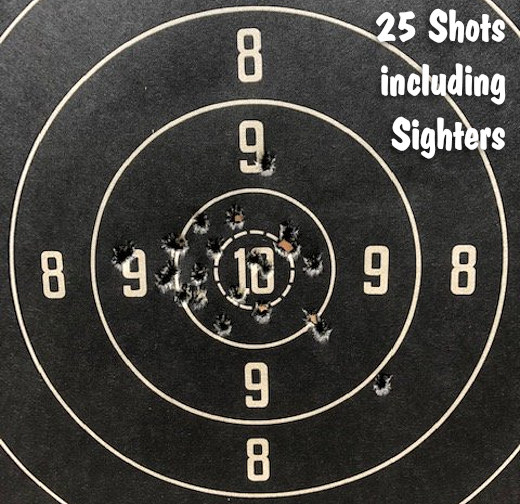
For his practice load, Tommy shot 123gr Hornady ELD-M bullets with H4831 powder and CCI BR2 primers. This load performed well — Tommy posted: “My 25-shot initial prone test today shows promise. There are five sighter shots, and 20 record shots. One of the 9s at 9 o’clock is my first sighter, the other one I own. The 8 out at 4 O’clock was a round that was difficult to chamber. My initial scoring puts me somewhere in the vicinity of 193-7X.”
The target used is the NRA C2, “300M International Rifle Target, reduced for 200 yards”. The 10 Ring is 2.40″ in diameter, while the Inner 10 (X-Ring) is 1.24″.
Match Load — Varget and Nosler Bullets
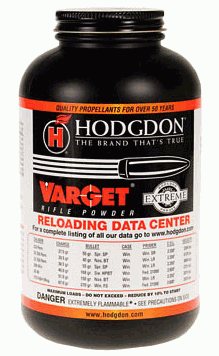
For his match load, Tommy switched to Varget and Nosler bullets: “My match load uses 37.9 grains Hodgdon Varget with a Nosler 123gr bullet. This was a recommendation by a gentleman with a lot of experience in 300M shooting.”
Tommy adds: “The amount of knowledge gained via the AccurateShooter Forum has made this all a reality, instead of just a passing thought.”




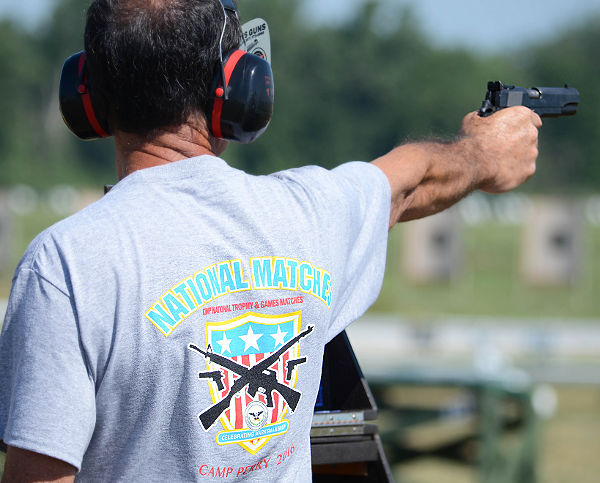
 The National Pistol events, open to adults and juniors of all experience levels, include several traditional matches like the President’s Pistol (President’s 100), National Trophy Individual, and National Trophy Team events alongside a series of 900 Aggregate matches for .22, .45, and centerfire pistol. The CMP Games competitions, such as the Military & Police and 1911 As-Issued Matches, will also be part of the National Matches schedule (see Calendar below). The last pistol matches run on Sunday the 21st, with Pistol Games Awards at the end of the day.


 Know the Rules


 Use Consistent Brass


 Match Load — Varget and Nosler Bullets


