Winter is coming soon. For many Americans that means indoor training if they want to maintain their shooting skills. Even if you can shoot outdoors all year long in your location, it makes sense for position shooters to work on their rifle holds. The Mantis systems help with that. These advanced smart devices record and plot the movement of your firearm as you aim and then break the shot. There are systems for both dry-fire and live-fire training, starting at $99.99. Considering the cost of bullets these days, and the difficulty of finding primers, it makes sense to increase your dry-fire training.
Mantis X2 for Dry-Fire, $99.99
Built for dry-fire use only, the Mantis X2 ($99.99) provides real-time, shot-by-shot feedback for both pistol and rifle users. You can track multiple training sessions with data-driven insights, and monitor your progress. This unit has earned high user reviews such as: “As a new gun owner the Mantis X is a game changer for me. I have not been able to get to the range during the lockdowns and being able to practice at home [is great].” And another: “Easy to install[.] The App is free and easy to use.”
The Mantis X2 is a good value. The manufacturer states: “There is nothing at this price point that will give you this level of feedback for dry fire.” There are actually four Mantis models: X2 ($99.99), X3 ($169.99), X7 Shotgun ($199.99) and X10 Elite ($249.99). The X3 adds live fire functionality. MORE INFO HERE.
Mantis X10 Elite– Advanced Training System
The advanced Mantis X10 Elite ($249.99) is 50% lighter and 40% smaller than the original Mantis, with three times the battery life and four times the data transfer rate. This new quick-detach X10 system offers all X2 and X3 functions PLUS recoil analysis and software support for all shooting sports (pistol, rifle, shotgun, archery). Collecting thousands of data points per second, the X10 works with dry fire, live fire, airsoft/CO2, and simulated firearm systems.
Mantis Blackbeard Trigger Reset System for AR-Platform Rifles
If you compete with an AR-platform rifle, you can definitely benefit from the Mantis Blackbeard system, a drop-in Bolt Carrier + Magazine replacement that works with your existing trigger. Using electromechanical wizardry, the $199.00 Blackbeard quickly resets the hammer between each shot, so you can stay in position through multiple practice shots. Installation takes less than a minute — remove the bolt carrier group, drop in the red upper unit, place the red Mantis magazine and you’re good to go. All Blackbeards now support both direct impingement and piston-driven ARs. Guys we know say that a few sessions with this system delivered marked improvement in their service rifle scores.
Mantis X3 for Live-Fire or Dry-Fire, Rifle and Pistol
The Mantis X3 collects thousands of data points per second and analyzes your shooting in real-time. For both pistols and rifles, the X3 works with dry fire and live fire. It will also work with airsoft/CO2/compressed air, and simulated firearm systems. Priced at $169.99, the Mantis X3 mounts to standard universal accessory rails. (No Picatinny rail? Creedmoor Sports sells adapters). The X3 is part of the second generation of Mantis Shooting Performance Systems.
Enjoy the Shooting Sports USA Archives
With winter coming, many Americans will soon be spending more time indoors at home. For some folks that means long sessions in front of the boob tube. Here’s a better idea — there’s a vast resource of great gun-related content available online for FREE. Check out the Shooting Sports USA Articles Archive. SSUSA maintains a vast digital library with hundreds of articles going back to June 2009.
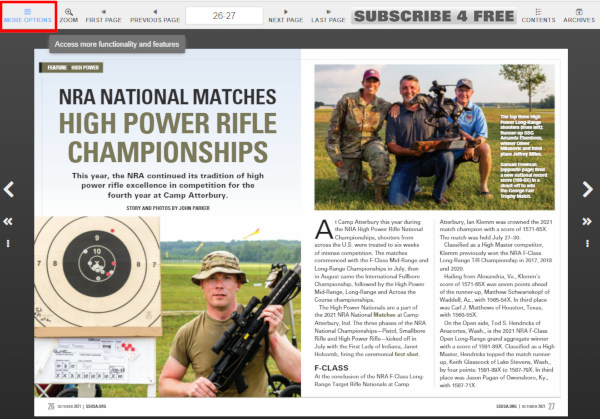
It’s easy to find back issues of Shooting Sports USA magazine. Here’s how: First, navigate to the SSUSA Online Issue. Then click on the “ARCHIVES” icon in the upper right area (indicated with red arrow). When you click on “ARCHIVES”, a window will open with a selection of Shooting Sports USA magazine covers/dates in a vertical column. The most recent issue (November 2021) will appear at the top. You can then scroll down — use the vertical scroll bar to go from November 2021 (the latest issue) all the way back to June 2009. Click any issue cover to read.
How to Find and Save Articles
To search back issues, select “MORE OPTIONS” from the toolbar (top left). Then click the “SEARCH” button. When that opens, select either “Search Archives” for ALL back issues or “Search Only this Issue”. When you’ve made your choice, enter your search term(s). For example, you can search for “Camp Perry” or “Palma” or “F-Class Championship”. You can also save any archived issue as a PDF for viewing offline. Just click “SAVE” to download the article you’re currently viewing/reading.
Read Sample Articles
Here are a couple of our favorite SSUSA feature stories from recent years. There are hundreds of other informative articles worth reading.
Yes, the type of targets you use can make a difference during load development and training — helping you align your crosshairs, estimate group size visually, and also record load data/gun type. Here we provide selection of FREE printable precision and training targets. This selection includes popular load development targets AccurateShooter created as well as other useful grid targets. You can download ALL these targets as PDF files and then print them out on 8.5×11″ heavy paper.
AccurateShooter.com offers a cool page with over 50 FREE downloadable targets. You’ll find all types or FREE targets — sight-in targets, varmint targets, rimfire targets, bullseye targets, tactical targets, load development targets and more. CLICK HERE for all our free targets, including our LOAD DEV target.
We created the above target a decade ago. Since then it has been used by tens of thousands of shooters. It has proven very popular as a load development target, since all your load data fits neatly in the boxes under each target. In fact this target is being employed by both rifle-makers and barrel-makers (including Criterion) to test their products. The target was designed for aiming efficiency. The diamonds have 1/2″ sides and you can align your cross-hairs on the horizontal and vertical lines. It is a clean design that is easy to see even at 200 yards with a 20X scope. When we test, we usually crank in a little elevation, setting the point-of-impact higher, so that our shots fall in the gray circles. That way you leave the squares intact for precise aiming.
Versatile Targets with Multiple Aiming Points
We use the two targets below for load development and precision practice. For the left target, use the corners of the diamonds to align your cross-hairs precisely. The circle dot target (on the right) can also be used for informal rimfire competition at 50 yards. Right-Click Each Target to Download Printable PDFs.
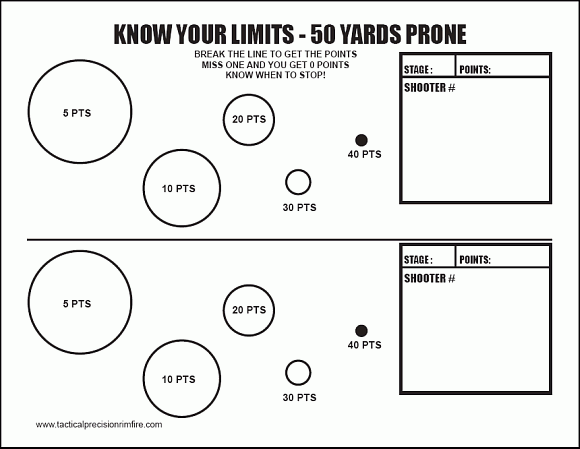
Know-Your-Limits Target for Rimfire Training & Fun Matches
Here’s a rimfire training target with “big to small” target circles. Start with the largest circles, then move to the smaller ones in sequence. This systematic drill provides increasing challenge shot-by-shot. Novices often are quite surprised to see their accuracy improve as they move from bigger to smaller aiming points. That provides positive feedback — always a good thing.
Right Click and “Save as” to download printable PDF versions of target.
RED Center Pistol Target
Here’s a NRA-type target for pistol shooting. The bright red center helps when shooting indoors because well-placed bullet holes are much more visible. This target includes data entry boxes to record gun type, score, and load data. This is one of many good free targets available at Targets4free.com.
The Tack Driver Showdown is a one-of-a-kind “all comers” rifle match. This unique multi-discipline match will reveal what rifle types are truly the MOST accurate, at least out to 300 meters. The Tack Driver Showdown II match will be held Saturday, November 6-7, 2021 at the Mid-Carolina Gun Club in Orangeburg, South Carolina. The organizers have invited virtually any type of rifle (except railguns) to compete at 300 meters for group and score honors. There should be nearly 100 competitors at the event this coming weekend. No organization membership is required. NOTE: Registration closes Wednesday November 3, 2021 at 6:00 PM. Contact Match Director Jim Cline at: 843-957-6546. Forum members can also send a PM to Jim Cline aka jcline.
Unlike any other rifle match in the world, on the firing line you will see 6 PPC LV/HV rifles, 30 BR score rigs, 17-lb 600-yard and 1000-yard benchrest guns, F-TR rifles, F-Open rifles, Palma rifles, PRS rifles, and maybe even an AR15 or two.
The concept behind the event is to settle the unending arguments about which guns are TRULY the most accurate. The 6PPC is king in 100/200 group competition, the 30BR rules 100/200 score, 6mmBRs and 6BR Improveds dominate in 600-yard Benchrest, the .284 Win is the leading F-Open cartridge, and various 6mms and 6.5mms win PRS matches. It will be interesting to see which chamberings and bullet weights will “rule the roost” at 300 meters. Match Director Jim Cline plans to post match results on our AccurateShooter.com Forum. For more information, read this Forum Thread.
Tack Driver II targets will be placed at 300 meters (328 yards). That’s not even “mid-range” by benchrest standards, but it should be far enough that the higher BCs of the bullets shot by F-Class and 600/1000-yard benchrest rigs could come into play.
Basic Information on the Tack Driver Shoot:
There are two divisions — bolt-action rifles and semi-auto gas guns. There are no specific design limits other than a 22-lb maximum weight, and a .338 maximum caliber. Past IBS President Jeff Stover tells us: “We envision the full array of the world’s most accurate rifles on the line: short and long range benchrest rifles, F-Class, AR, other tactical, egg-shoot rifles, whatever…[.]” Key rules are listed below. Semi-autos will need chamber flags, otherwise bolts must be out at all times. You do not have to be a member of the IBS to shoot. The range will be open Friday, November 13th starting at 12:00 noon for practice and flag setting.
Cash Payouts for the Winners in both Group and Score
Match Director Jim Cline noted that First place through Fifth place will be paid in both score, group and Grand Aggregate finishing positions. Match fee is $120, which includes a catered lunch both days. Jim states: “We will have an additional $30 cash option, $50 cash option and a $100 cash option. You have to be in the $30 cash option to get in the $50 cash option and in the $50 to be in the $100.”
2021 Tack Driver II Showdown Rules Overview
1. NO membership of any organization required.
2. NO one piece rest, all shooting will be done off benches. You may use a bi-pod, bags or rest combination.
3. You have to shoot the same gun at all targets. If you have a catastrophic failure, you have to continue with a gun of the SAME caliber and cartridge. (Has to be approved by the match director ONLY.) Scope failure will require a scope change.
4. No electronic equipment of any type will be allowed on the bench or downrange.
5. No spotting scopes allowed on the bench or people spotting for you.
6. No coaching under any circumstances (except youth).
7. Any gun is legal 30 caliber and under with a 22 pound weight maximum.
8. Any protest will be handled by the committee and their decision is FINAL!
2021 Tack Driver II Showdown Match Course of Fire
1. Competition will consist of 5 group targets and 5 IBS 200 yard score targets at 300 METERS.
2. All targets will be 7-minute matches. There will NO warm-up match on either day. ALL
shots count in the scoring area of the target.
3. Range will be made available for practice on Friday before the match starting at 8:00 AM only closing to set flags. Flag setting times are 7-8 am, 9-10 am, 11am-12pm and the
range will be called cold at 3:00 pm to end all practice.
4. We will alternate targets each time:
Day 1: Score/Group/Score/Group/Score
Day 2: Group/Score/Group/Score/Group
5. We will rotate 10 benches for the second day’s course of fire.
6. Winner will be determined by place of finish at each discipline. If there is a tie we will break it by highest place of finish. If that can’t break it we will go to group place of finish.
Covered Firing Line at Mid-Carolina Gun Club. Photo from 2019 100/200m Score Nationals.
Jim Cline tells us: “Preregistration is REQUIRED. A $100 nonrefundable deposit is required with your form to hold a spot. Limited to the first 100 guns! There will be a $60 nonrefundable deposit to hold a camping spot 1st come first serve. I have 13 with full hook-ups and 7 with power and water. There is space for self-contained camping as well.” For more information, including camping/RV details at the Mid-Carolina Gun Club venue, contact Jim Cline at 843-957-6546, or post questions on this Accurateshooter Forum Thread.
Scope Evaluation with Test in Benchrest Competition by James Mock
Since I started shooting in competition in the early ’90s, rifle scopes have really improved. The one which I am now testing may be the high point (zenith) of scope quality. The IOR Valdada Terminator 12-52x56mm with 40mm tube is a great scope by any standard. There are only two negative aspects to using one of these instruments. One is cost (retail $3695) and the other is weight (three pounds).
Many say that this scope is without equal. However, the most common complaints among those willing to pay the cost for this exceptional instrument was that there was no zero stop and the 1/4-MOA adjustments were too coarse. The folks at IOR Valdada listened and corrected both problems. They added a very functional zero stop and changed the adjustments to 1/8th MOA. Valdada listens to its customers.
“The Valdada performed absolutely perfectly and enabled me to win the match. The 1/8th MOA clicks are crisp and accurate and the big 40mm tube allows 100 minutes of vertical adjustment. The tracking of the scope was perfect. The MOA reticle and the precise 1/8th minute clicks helped tremendously. The scope performed flawlessly. Even with my 77 year-old eyes, I could see 6mm bullet holes in the white at 600 yards with this scope. I have been able to do that only one other time.”– James Mock
Some of the great qualities of the new Terminator scope are:
— Lenses are made with the finest glass from the Germany’s famous Schott Glasswerks (lenses have the proprietary Z-7 coating with 7-11 coats for EACH lens surface).
— Parallax adjustment on the tube body allows convenient and very precise adjustments.
— Reticle with precise hashmarks and illuminated center dot.
— One hundred MOA of vertical adjustment range.
This scope is very well thought out in all respects. The parallax adjustment is on the tube just behind the objective bell. It is very easy to get a sharp, parallax-free image with it.
As can be seen in the picture, this scope has every feature that long range shooters desire. With the change from 1/4-MOA to 1/8-MOA adjustments, one can see that this company listens to its customers. This is a second focal plane (SFP) scope and Valdada has a 40mm tube scope with first focal plane (FFP) for those who prefer that option. NOTE: The max magnification for the FFP version is 40X rather than 52X.
The power-changing ring of this scope is also well thought out. It features three different color-coded “clicks” that indicate subtension of the hash marks. (Meaning you have positive confirmation of the hash mark value). At 14.4X the reticle hash marks subtend 1/2 MIL. At 26X they represent one MOA and at 52X the hash marks represent 1/2-MOA (very handy for wind calls).
IOR Valdada 12-52x56mm Scope Proves Itself in Competition This Month
I received the scope on October 15th and used it in a 600-yard match on Saturday, October 16th. I quit competition several months ago and sold my trusty BAT/Leonard rifle. However, I could not stay quit and I picked up a Stiller Cobra action, and Dusty Stevens chambered a Krieger 1:7.5″-twist barrel in 6mm Dasher for this rifle. I received the barrel on October 13th, and that gave me three days to break in the barrel, find a load and get the scope zeroed. I shot 15 rounds of 1 shot/clean, 1 shot clean, 1-shot clean, 3-shots clean until I had 15 rounds. Since I did not have the scope, I could not develop a match load.
After receiving the Terminator on Friday, October 15th. I finished the fire-forming of the 48 pieces of brass and zeroed the scope with the fire-forming load. The scope was not hard to zero and I was very impressed with the optics. I wasn’t surprised at the quality — since 2009, I have shot a Valdada 36X Benchrest model on my target rifle. That is a superb scope with rock-solid adjustments and great Schott glass.
Shooting the “Square” Confirms Great Tracking
I shot the “square” with some fireform loads and the last bullet went through the hole made by the initial round. For those not familiar with this test, it consists of 5 shots while using the same aim point and adjusting 6 MOA between each shot. So the second shot is 6 MOA above the first, the third is 6 MOA right, the fourth is 6 MOA down and the fifth, final shot is 6 MOA left. When the last shot goes through the hole of the first, one can conclude that the scope adjustments are spot on. This Terminator was perfect.
Because of time restraints, I did not have a chance to work up a good load for this barrel, so I resorted to a load that had worked with a previous Dasher. It was with 32.5 grains of Varget and a 105gr Berger Hybrid seated .007″ into the lands. I favor Bart’s Hammers, but did not have enough to shoot the match.
Although I had only one day with the scope before the match, I got it mounted on the rifle. I shot ONE shot at my 100-yard range and adjusted the scope up 11 MOA. I told some of the shooters that I had never been so ill-prepared for a match. However, the Valdada performed absolutely perfectly and enabled me to win the match (first win at 600 in a long time!). The MOA reticle and the precise 1/8th-minute clicks helped tremendously.
The 1/8-MOA clicks are crisp and accurate and the big 40mm tube allows 100 minutes of vertical adjustment. The tracking of the scope was perfect. Valdada uses steel ball bearings in this scope.
During the match, the hash marks are very useful. Since the hash marks subtend 1/2-MOA at 52X, I used the scope at that power until the 4th target and then used it at 26X so I could use the 1-MOA hash marks. Since we shoot a steel gong for sighters, it is easy to determine the amount of winddrift by using these hash marks.
This scope features a lighted reticle. This is not an important feature for the type of shooting that I do, but many make use of this feature. The scope also features a zero stop that is very handy for those shooting events in which several adjustments are used. If one gets “lost” he can simply dial back to the “set zero”. This system was very easy to use.
Bullet-maker and benchrest shooter Bart Sauter has been using an IOR Valdada Terminator scope for several years and has made an impact in the 600-yard game. He is a Valdada dealer. If you need a Terminator or other IOR Valdada optic, give Bart a call.
Jessie Harrison won the Ladies title at this year’s USPSA Open Gun National Championship, marking the 22nd time she has done so in the category.
Jessie Harrison is arguably the best female action pistol shooter in history. No other lady has amassed as many championships or set so many records. And Jessie scored yet another milestone recently, winning her 22nd U.S. Practical Shooting Association (USPSA) Ladies Championship. Jessie won the title at the recent USPSA Race Gun Nationals held October 22–24, 2021 at the Talledega Marksmanship Park in Alabama.
“Fun field course from USPSA Race Gun Nationals! Getting to stretch the legs and do a little run-n-gun is always nice!” — Jessie Harrison
Jessie Harrison at the 2021 USPSA Race Gun Nationals in Talladega Marksmanship Park.
“I’m very excited to share that I’ve won my 22nd USPSA Ladies National Title. I defended my Ladies Open title this year against some of the best women shooters in this country and it was an honor to share the range with them. With USPSA bringing the ladies Super Squad back, it has invigorated the competition and brings the best out of all of us. There’s nothing more intense than stepping to the line amongst your competitors and having to perform. It also creates a camaraderie between everyone that you can’t find anywhere else. Each of these ladies pushed me the entire weekend to do better and I respect all of them as competitors and friends!
Thank you to USPSA for understanding the need for our squad again and making it happen AND for hosting such a great Nationals!
A big round of applause to the match staff for their hard work and long days on the range for us competitors, it’s a selfless job and you’re appreciated!
A big heartfelt thank you to all of my sponsors for your support and encouragement for the past 21. I never could have dreamed I’d be doing what I love for so long and it wouldn’t be possible without all of you!”
Jessie, who is captain of the Taurus Shooting Team, also congratulated fellow winners at the 2021 USPSA Nationals: Christian Sailer (221.44, match winner), Justine Williams (64.89, Ladies Limited) and Mason Lane (79.5, Limited winner). Learn more about the USPSA competitions at USPSA.org.
Keith Glasscock is one of America’s very finest F-Class shooters. This talented trigger-puller took second in F-Open division at the F-Class National Championships three years in a row. A smart engineer with aviation knowledge, Keith is a master wind reader, who has served as the wind coach for top F-Class teams. In fact Keith is in Arizona right now coaching a team at Ben Avery.
Keith shares his wind-reading expertise on his popular YouTube Channel — Winning in the Wind. This channel provides intelligent advice on multiple topics including reloading, load development, shooting strategies, and yes, reading the wind.
Keith has the credentials to back up the advice he offers in his video lessons. A High Master, Keith finished second overall at the 2021 NRA F-Class Long Range Championship in F-Open division. He also finished second at the 2020 Nationals, and he took second place at the 2019 Nationals. His consistency is unrivaled, which means he definitely knows the secrets of long-range wind calling and loading ultra-accurate ammo.
Today we feature two of Keith’s latest YouTube videos, both focused on wind reading.
Wind Direction vs. Wind Speed — Which is More Important
Most shooters find wind reading somewhat intimidating. That is understandable. The wind can change constantly during a match, with variations in both wind velocity and angles. Sometimes you think you have a cycle figured out, but then there can be an unexpected lull. Or you may start a string in what you think is a stable condition, but then a surprise shift changes everything. In addition, wind flows can be influenced by terrain features, such as berms, which have varying effects depending on wind angle (e.g. a tailwind hitting a berm will act differently than a 90-deg crosswind). That is why a good wind reader needs to identify both the wind speed AND the wind angle. In this video, Keith explains when to focus primarily on direction and when to pay most attention to velocity. With headwinds and tailwinds, Keith notes, you should monitor angle changes carefully. With crosswinds, speed is the key variable to watch.
KEY Points to Remember
— Small changes in wind direction changes alter POI drastically at long range
— During head or tailwinds, focus on wind direction
— During crosswinds, focus more on wind speed
— The wind is cyclic — always be aware of the pattern
Determining Wind Direction with Precision
Many shooters try to read the wind merely using whatever wind flags might be aloft on the range. Flags are important of course, but there are other vital factors that a wise wind-watcher will monitor. You want to watch mirage, and the movement of grass and trees. In looking for angle changes, Keith says the spotting scope is a very important tool. His tripod is equipped with angle markings on the rotating tripod head. This allows him to ascertain wind angles with great precision.
In the video below, Keith shows how to use a spotting scope to read the wind. He explains how he uses his spotting scope in his role as a wind coach. But a spotting scope can also be used effectively by competitors shooting prone or from a bench. Many top shooters use their spotting scopes to watch mirage during their relays. Keith notes that smart competitors can also use their spotters BETWEEN relays to scout natural wind indicators (moving grass, trees etc.), check for boils, watch mirage, and estimate wind velocity cycles.
KEY Points to Remember
— Wind flags leave a lot to be desired in precision wind direction reading
— Precision wind direction can be obtained with a spotting scope
— There is a boil both directly upwind and directly downwind
— Angle indicator on your tripod helps with angular precision in wind readings
— Scouting with a spotting scope before your turn to shoot can be fruitful
Questions and Answers with Keith Glasscock
Q. How did you get started as a wind coach, and what were the most important stages in your progress in wind-reading?
Keith: I started coaching this team in 2017. I was looking for a team to shoot on, but they needed a wind coach. I’ve been a backseat driver ever since. I learned the most about reading the wind from shooting when the conditions are absolutely miserable – flags popping, wind switching, people missing the targets entirely, and there I was, having to make the big call. I learn from my own mistakes, and it shows. I still make mistakes, but try to limit them to ones I haven’t already made. In essence, I am in the most important stage now. Humbly looking at the wind knowing its power and mystery, while learning new things every day.
Q. What are the most common wind-reading mistakes you see people make at matches?
Keith: The most common, in a word, is UNDER-confidence. Most shooters can make that wind call with accuracy. But their fear prevents them from doing that, and prevents them from learning or taking advantage of smooth, solid conditions. The second common mistake is failure to anticipate changes. That comes from not gauging the wind pattern. It’s all about patterns in a sport where wind changes so small have such profound impacts on score.
Q. What’s more important — wind flags, or mirage (or maybe the unexpected horizontal that appears on the last shot recorded on target).
Keith: Both flags and mirage lie. The only thing that tells the truth is a bullet. Unfortunately, the wind can switch faster than you can shoot in most cases. I take a fluid approach. I look for what on the range right now tells me what the wind is doing.
Q. When are conditions so bad/unpredictable that it is necessary to just stop shooting and wait for things to get better?
Keith: This is situational, and comes down to what you are observing. I never like to shoot in the top of a gust condition, even when I know what the hold is. The drop off is what gets you that surprise 8.
Q: What type of wind meters do you recommend?
Keith: While Kestrels are inexpensive and quite serviceable, they are directional in nature. If I want absolute wind speed, an omnidirectional style unit is preferred.
Q. Are there ways to practice reading the wind (and judging wind speeds) when one is away from the range?
Keith: I really concentrate on seeing mirage any time I’m outside, without optics. I can, many times, see the boil of the mirage, and wind direction with the naked eye. My time in aviation has my eye tuned to see things like shear zones and venturis in the airflow. I take a moment, anytime the air is moving, to feel the air on my skin, see the trees and grass moving, and areas where the wind does funny things. Trees and grass tend to get too much credit as precision wind indicators. I use them as wind change indicators. It also gives me an opportunity to humble myself and realize how dependent I am on mirage and flags.
Today, October 20, 2021 Shooting USA TV features the Talladega 600 held this past January. Shooting USA notes: “Competition is back, as America gets back to normal again. For the Civilian Marksmanship Program … the Talladega 600 brought competitors from across the country — all glad to be back shooting. Dozens of competitors are on the line at the Talladega Marksmanship Park, the impressive home range of the CMP.”
Shooting USA noted that this event was a welcome return to normalcy: “After a year of cancelled competition, the Talladega 600 offered days of shooting in matches for most everything you might own, from rimfire to High Power. That had shooters from across the country emptying their gun-safes, and driving down to Alabama to shoot.” After being postponed due to storm damage from Hurricane Zeta, the CMP’s 2020 Talladega 600 event was rescheduled to January 2021.
SHOOTING USA TV Air Times
View Shooting USA on the Outdoor Channel: Wednesdays 9:00 PM (Eastern and Pacific); 8:00 PM Central.
NOTE: If you miss the 10/20/2021 broadcast, you can still view the show on Vimeo for a small 99-cent fee, or just $1.99 per month unlimited. LINK HERE: Shooting USA on Vimeo.
About the Talladega 600 — Southern Classic
The Talladega 600, “A Southern Classic”, is held annually. Though typically fired in November, the 2020 Talladega 600 was rescheduled to January 2021, due to storm damage from Hurricane Zeta. This year, matches included Garand, Springfield, M1A, Carbine and Vintage/Modern rifle events, and versions of prestigious National Trophy Rifle Matches. There was also an Excellence-In-Competition (EIC) match, 4-Man Team match, and .22 Rimfire Sporter match.
NEW Garand Benchrest and Rimfire Sporter Benchrest Matches
Two new types of matches were conducted at January’s Talladega 600: a Benchrest Garand Match and a Rimfire Sporter Benchrest Match. Competitors at these events can use sandbags to support their rifles. The Benchrest Garand match was very popular, and is likely to become a regular event.
Pistol Matches Were Popular
The Talladega 600 included .22 Rimfire EIC and Service Pistol EIC matches, along with As-Issued 1911 and Military & Police matches.
State-of-the-art Kongsberg target systems are used at the CMP’s Talladega Marksmanship Park.
About Talladega Marksmanship Park
The 500-acre CMP Talladega Marksmanship Park is one of the most advanced outdoor shooting facilities in the Western Hemisphere. The facility includes a 600-yard rifle range, a 100-yard multi-purpose range, and a 50-yard pistol range, equipped with Kongsberg electronic targets and scoring monitors. Since the 54 targets at each line register hits and calculate the scores instantly, no pit duty is required at Talladega. The park regularly hosts rifle, pistol and shotgun events throughout the year.
Think you need a relatively long case-neck for good accuracy? Think again. Stan Ware broke all the rules with his radical Wolfpup cartridge, proving that a near-no-neck design can deliver match-winning accuracy. Read on to learn how the Wolfpup works…
Retired gunsmith Stan Ware is a talented shooter who’s not afraid to think “outside the box”. Stan competes in both Hunter Benchrest (HBR) and Varmint for Score (VFS) disciplines. In his quest to build the ultimate Hunter Benchrest cartridge, Stan created the radical “Wolfpup” wildcat, based on a 6mmBR parent case. Noting the dominance of 30 BRs in VFS matches, Stan wondered if a stretched 30 BR could work in HBR competition. The challenge was case capacity. Under HBR rules the cartridge must hold at least 45.0 grains of water, equal to the capacity of the classic 30/30 case.
To get the requisite HBR case capacity, Stan figured he needed to boost the volume of a 30 BR case significantly, so he would have to move the shoulder forward — a lot. He did this by running a 30 BR reamer deeper and deeper, test-firing brass along the way. After three reamer passes, he ended up with the capacity he needed (the Wolfpup holds 45.3 grains of water). But then he looked at the finished product — a case with almost no neck, and he wondered “how could this possibly work?”.
From Trashbin to Winner’s Circle
Ware’s prototype Wolfpup ended up so short-necked, so unlike any “normal” cartridge, that Stan figured it was “dead on arrival”. Stan told us: “I said ‘this ain’t going to work’ and I threw the brass in the trash can. Honest. But later I thought I better shoot it and see what it does.” There was one problem — Stan didn’t have a seating die. He noticed the short neck provided a bit of tension after fire-forming, so he literally seated some bullets, BIB 118s and 125s, with his fingers. For powder he used H4198 and started with 35 grains, one grain more than a 30 BR load. Stan then did a pressure work-up: “I actually went up to 41.0 grains and didn’t have a sticky bolt. I ended up at 37.9 grains of Hodgdon 4198 — that gave 3150 fps, where the sweet spot is.” (Later testing revealed a second accuracy node at about 3020 fps, using 36.4 grains of H4198).
Stan’s radical short-necked Wolfpup shot great from the get-go. Once he found the right velocity node, the gun shot in the ones and zeros with both 7-ogive and 10-ogive bullets, both 118s and 125s. The Wolfpup proved easy to tune — it’s not finicky at all. And it’s a winner. Stan began shooting the Wolfpup in 2006 in both VFS and HBR matches and the ‘Pup’ started winning matches right away. In 2007, Stan won the Wisconsin State VFS Championship shooting the Wolfpup. In June 2010 at a Webster City, Iowa VFS match, Stan won the Grand Agg and posted high X-Count for the match, while placing first at 100 yards and second at 200 yards. How’s that for a cartridge that almost ended up in the trash bin?
Does Stan deserve an award for “most innovative benchrest cartridge design”? Stan chuckles at that notion: “I’m not a hero, not a genius. I really didn’t do anything. The fun part is thinking outside the box — for me anyway. Shooting is an age-old process of experimentation. You never learn it all.”
Why Does It Work?
How can such a radical case design perform so well? “That’s a good question,” Stan admitted. He then explained: “The 30 BR is inherently accurate, so I figured something based on the 30 BR should be accurate too. My personal belief is that the short neck doesn’t hurt you. Plus if the throat in the barrel is straight, the bullet can self-align. If the chamber is good, the bullet will self-center in the throat. In a regular case there’s not much room to do that, so a bullet can start off-center, and you don’t get the same results every time. A bullet in a conventional case is stopped from self-centering by the stiffer neck, particularly in a tight-clearance BR gun.”
Reloading the .30 Wolfpup
Stan’s Wolfpup chamber has a neck dimension of 0.330″. He turns his necks for a 0.327″ loaded round. Bullets are jammed .020″ forward of first contact with the lands. When he closes the bolt it pushes the bullet back in the case — almost a soft seat. Stan notes: “To start with I normally bump the shoulder .0005-.001″ so they go in easy. Just by doing that I get a little neck tension. I also use a bushing. Right now I’m running a .322, but it’s not particularly sensitive. I’ve tried one-thousandths increments up to a .325 bushing and couldn’t tell a lot of difference.” For bullet seating, Stan uses a Wilson 30 BR seater die into which he ran the chamber reamer. This gives perfect case fit during seating operations.
About the Illustrated Gunstock
You’ll notice Stan’s stock contains scenes from Vietnam and a quotation. Here’s the story. A Vietnam combat veteran, Stan served “in-country” with the Army’s 509th Non-Divisional Combat Unit (out of Fort Riley) from 1965-1966. Shortly before he left Vietnam, Stan went to a shop to have a souvenir lighter engraved. He asked the vendor for an appropriate inscription. The shop’s metal-worker engraved: “War is a tragedy. It takes mans’ best to do mans’ worst.” That message, along with the combat scenes, were hand-painted on Stan’s rifle by his wife Susan, a talented artist. She spent more than 20 hours painting the rifle stock.
Getting started in the shooting sports can be intimidating, especially for women. Thankfully, there are many training resources available. NSSF has compiled a series of target shooting tips for women, by women. These tips, presented by instructors Deb Ferns, Kay Miculek, and Lena Miculek-Afentul, cover basic shooting methods and safety. Topics include pistol grip, stance, eye dominance, and ear protection. These tips can benefit any novice shooter, not just the ladies.
Rifle Stance and Hold (for Action Shooting)
Champion 3-Gun shooters Kay Miculek and Lena Miculek-Afentul demonstrate rifle stance basics and how to properly hold an AR-platform rifle for action shooting.
Grip and Stance for Pistol Shooting
Mother/daughter team Kay Miculek and Lena Miculek-Afentul demonstrate proper grip and stance for shooting semi-automatic pistols in action disciplines.
Eye Dominance (and Hand/Eye Cross-Dominance)
Learn how to identify your dominant eye. Kay Miculek, a cross-dominant shooter, explains how other cross-dominant individuals can maintain a proper sight picture.
Ear Protection — Double-Up for Safety
Babes with Bullets Director Deb Ferns says the most common complaint among new shooters is, “It’s too loud!” Deb recommends “doubling up” — wearing muffs OVER soft foam earplugs. That’s “sound advice” for any shooter.






 During the match, the hash marks are very useful. Since the hash marks subtend 1/2-MOA at 52X, I used the scope at that power until the 4th target and then used it at 26X so I could use the 1-MOA hash marks. Since we shoot a steel gong for sighters, it is easy to determine the amount of winddrift by using these hash marks.




 Retired gunsmith Stan Ware is a talented shooter who’s not afraid to think “outside the box”. Stan competes in both Hunter Benchrest (HBR) and Varmint for Score (VFS) disciplines. In his quest to build the ultimate Hunter Benchrest cartridge, Stan created the radical “Wolfpup” wildcat, based on a 6mmBR parent case. Noting the dominance of 30 BRs in VFS matches, Stan wondered if a stretched 30 BR could work in HBR competition. The challenge was case capacity. Under HBR rules the cartridge must hold at least 45.0 grains of water, equal to the capacity of the classic 30/30 case.
 From Trashbin to Winner’s Circle
 Why Does It Work?


