|
|
January 27th, 2010
Howa previewed some impressive new varmint models at SHOT Show 2010. We liked the new Howa 1500 Thumbhole. This features a skeletonized, laminate varmint stock with a nice wide, flat fore-arm. The fore-arm is about 2.25″ wide and is completely flat on the bottom. Slab sides run almost all the way back to the action. This provides a very stable platform that should track well in the bags. Varminters put lots of rounds down-range, so barrel heat can be an issue. To help keep your barrel cool, the fore-arm has four “Buick” vents on each side (left and right), plus SIX large vents cut in the bottom.


Behind the action there is a comfortable pistol grip carved at a good angle for shooting from the bench. It has a nice palm swell at the bottom but is narrow enough at the top that you can get your thumb around for secure, properly aligned grip. I tried out this stock and it was very comfortable. The slightly raised comb was shaped nicely and the grip really felt good in the hand. The middle section of the stock is completely carved away (presumably to save weight). However on the last 5″ or so, the stock has a conventional section on the bottom. This provides a solid platform to ride the bags.

The new Howa 1500 Thumbhole Varminter will cost between $695 and $830 depending on chambering. It will be offered in both short action and long action versions. Available chamberings are: 204 Ruger, 223 Rem, 22-250, 243 Win, 6.5×55, 25-06, 270 Win, 308 Win, 30-06, 300 Win Mag, 7mm Rem Mag, and 338 Win Mag. For more information, contact Legacy Sports Int’l, USA Distributor for Howa rifles.

January 27th, 2010
At SHOT Show 2010,  Wyoming’s Freedom Arms showcased its Model 2008 break-open precision pistol. This handsome pistol should prove popular with handgun hunters and handgun silhouette shooters. The gun is offered in 10″, 15″ and 16″ barrel lengths and with long or short wood forearms. Wyoming’s Freedom Arms showcased its Model 2008 break-open precision pistol. This handsome pistol should prove popular with handgun hunters and handgun silhouette shooters. The gun is offered in 10″, 15″ and 16″ barrel lengths and with long or short wood forearms.
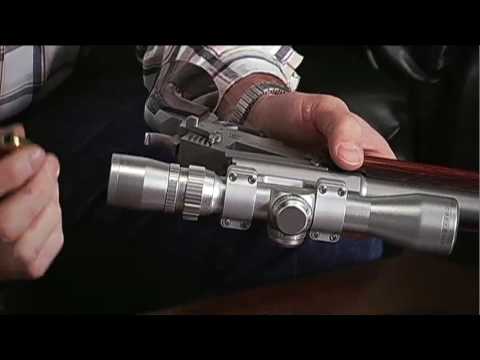
The Freedom Model 2008 is beautifully machined, and contains many carefully engineered features to ensure positive lock-up and safe operation. In the video below, Bob Baker of Freedom Arms explains how the locking mechanism, extractor, and rebounding hammer work. Baker also demonstrates how to switch barrels. As with the Thompson/Center Encore and Contender pistols, the Freedom Model 2008 can shoot many different chamberings from one platform, giving it great versatility. Baker tells us that, when chambered in 7mm BR, Freedom’s Model 2008 can approach half-MOA accuracy with tailored handloads.

The Freedom Model 2008 starts at $1495.00, which includes one barrel and forearm. Nine (9) chamberings are currently offered: .223 Rem, 6.5×55, 7mm BR, 7mm-08, .308 Win, 338 Federal, 357 Magnum, 357 Max, 375 Win. CLICK HERE for a Model 2008 Spec Sheet (PDF file).
You can see more photos on the Quinn Brothers’ GunBlast Website:
Full Report from 2008 (30+ photos)
Breech Closeup Photo
Hammer Closeup Photo
2010 Update Photo
January 26th, 2010
Though the use of high-tech materials, such as carbon fiber and kevlar, modern riflestocks have become stiffer, stronger, and lighter. Wild Dog, a small company in Queensland, Australia, is producing some of the nicest carbon-reinforced hunting and tactical stocks you can buy. Wild Dog stocks sport innovative features, such as a trap door for ammo storage in the side of the buttstock. Wild Dog’s hunting stocks are sized right and comfortable to hold — the comb height and drop angles are “just right” for a classic sporter.

And when Wild Dog says they can build a stock that’s “ultra-light”, they aren’t kidding. Wild Dog’s Bruce Simms showed us a lightweight sporter stock that weighed just 20 ounces! We were sufficiently impressed that we may choose a Wild Dog stock for an ultra-light, walk-around varminter project AccurateShooter.com has in the works.

This Editor was also very impressed by Wild Dog’s tactical stocks. The Wild Dog thumbhole will work for shooters with any hand size. The grip section of some other thumbhole stocks (notably the Accuracy Int’l) is very thick and fat (way too fat for this Editor’s hands). By contrast, you’ll find the Wild Dog thumbhole is comfortable and controllable even for shooters with medium to small hands. Wild Dog’s adjustable cheekpiece system on the tactical stocks is better than most — the hardware is simple but sturdy and the cheekpiece fits flush when retracted.


Overall, the Wild Dog stock designs — both hunting and tactical, are carefully crafted and very well thought out. The tactical stocks feel right in both offhand and prone positions. The hunting stocks are easy to handle and the hand-painted camo finishes really do work in the field, as you can see in the photo below.

January 19th, 2010
Today at the SHOT Show’s “Media Day at the Range”, Burris gave us a glimpse of the future in hunting optics. The new Burris Eliminator scope will range your target, calculate your trajectory, and illuminate a spot on the reticle that becomes your aimpoint at extended range. We could write a treatise on the Eliminator’s breakthrough technology, but all you really need to know is that after you range your target with the scope, a red dot appears on the vertical crosshair that is the correct aiming point for your ranged distance. The ballistics “hold-over” is already calculated. Just put the calculated red dot on the target, and pull the trigger. It’s that simple.

The new “Eliminator” scope is being introduced as a 4-12x42mm optic, for an expected $850.00 street price. The laser is activated with a simple push-button on the left side of the scope, and also comes with a remote switch that you can attach to the rifle in a more convenient position allowing the laser to be activated while maintaining the aim of the rifle. In the above photo you can see the remote switch on the objective end of the scope.


Once the target range is acquired, the range displays for about 10 seconds and the illuminated aiming dot remains illuminated for 70 seconds. The illumination clock allows plenty of time to pull off a good shot, yet saves battery life.
So how does the Burris LaserScope calculate the appropriate trajectory of your load? The software in the scope contains a database of hundreds of factory-loaded cartridges and even calculates handload trajectories using two (2) user-provided data points. The user inputs the zero range (100 or 200 yards) along with the inches of drop at 500 yards. The 500-yard drop is best found by real world shooting, not by using a calculated trajectory approximation from a ballistic program. The scope’s software then uses the zero-distance and the 500-yard drop figure to extrapolate the entire trajectory.
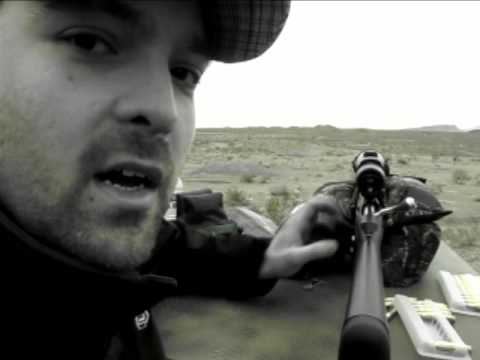
While shooting this scope on a Tikka 7mm-08, we successfully engaged targets from 350-570 yards that were approximately the size of a whitetail deer’s vitals area. Seeing how the conditions were not very conducive to accurate shooting with rain and a 5-15 mph switchy wind, we were impressed with the results.
For those that hunt or shoot out to about 600 yards or so, this scope will definitely speed up the process of pulling off an accurate long range shot. In a matter of seconds, you can locate a target, range it, and engage it. There is no time wasted fumbling with a separate laser rangefinder, no time wasted looking at a drop chart, and no time wasted clicking in the appropriate amount of elevation. As long as you can get a range on your target, the only thing left to worry about is the wind! This scope is obviously not for everyone, but we are confident that many hunters can benefit from this remarkable new technology.
Burris Eliminator Specs:
Click value 1/4″ at 100 yards
Weight 26 ounces; length 13″
Eye Relief 3-3.5″
Elevation Travel 50″
Laser range 550-800 yards based on reflectivity
January 19th, 2010
Savage Arms was well represented today at the SHOT Show’s “Media Day as the Range.” We saw and shot several new offerings from Savage (including a tactical rifle in 338 Lapua Magnum and a hunting weight 6.5-284). We’ll cover these centerfire Savages later this week. One of the new Savages we really liked was the model 93R17 TR, a slick little 17 HMR. It looks and feels like a full-sized centerfire tactical bolt-gun, it comes with an excellent stock and nice trigger, and it is both affordable and very accurate. (NOTE:v Savage is also offering 22LRs rimfires in the same stock, the MK II TR and TRR.)

 This rifle features an all-new, texture-painted wood stock with a very sound “tactical” design. It is well thought out, with good ergonomics, and offers options and design details that most rimfires do not. The stock features a moderate beavertail fore-end, a fairly vertical grip and a shallow butt-hook at the rear for support using the non-shooting hand. The black textured paint is very similar to the black painted finish on McMillan stocks (notice the texture in the photo). This rifle features an all-new, texture-painted wood stock with a very sound “tactical” design. It is well thought out, with good ergonomics, and offers options and design details that most rimfires do not. The stock features a moderate beavertail fore-end, a fairly vertical grip and a shallow butt-hook at the rear for support using the non-shooting hand. The black textured paint is very similar to the black painted finish on McMillan stocks (notice the texture in the photo).
The “look and feel” of the model 93 TR is similar to the popular Rem 700 PSS, and that’s good news for tactical shooters. With the new m93 TR, you feel like you are shooting a full-size tactical rifle. It feels solid and comfortable. And this rifle features with an optional factory-installed picatinny rail — a very nice feature on a rimfire rifle. You can easily move your scope back and forth between the model 93 and a Picatinny equipped centerfire bolt-gun. The model 93 should prove very popular with shooters who want to train with an economical rimfire that has very similar ergonomics to a centerfire bolt gun. For training duties only you may prefer the 22LR version. But the 17 HMR would be our pick for a “working” varmint rifle.

With CCI hollowpoint 17 HMR ammo, the m93 proved very accurate — we hit everything we shot at with ease, even in rainy, gusty conditions. Targets were mostly clay pigeons at 50-100 yards; we could break a clay, then easily hit the smaller pieces. Clearly this gun can be a very effective short-range varminter.
Overall, we really liked the feel and ergonomics of this rifle. It is a good choice for those seeking a rimfire trainer that handles like an “adult-sized” centerfire rifle. We are confident this will make a great varmint rifle as well as a economical tactical trainer. Your Editor expects that this rifle will be a hot seller for Savage.

Savage m93 17 TR Specs: Cal 17HMR; barrel 21″; overall-length 40″; weight about 7.5 lbs.
January 16th, 2010
 Forum member David K. (aka “mongochicago”) displayed a handsome 1919-vintage 1885 Winchester High Wall in our Forum Rimfire Gallery. The 91-year-old rimfire has been transformed from stem to stern with a new barrel, engraving on the receiver, and stunning exhibition-grade walnut fore-arm and buttstock. Forum member David K. (aka “mongochicago”) displayed a handsome 1919-vintage 1885 Winchester High Wall in our Forum Rimfire Gallery. The 91-year-old rimfire has been transformed from stem to stern with a new barrel, engraving on the receiver, and stunning exhibition-grade walnut fore-arm and buttstock.
The beautiful wood comes from Ballard Rifle & Cartridge Co. of Cody, Wyoming. Shilen Rifles provided the new blued octagon barrel (chambered in 22 Magnum). David tells us: “This is an 1885 Winchester made in 1919 that I customized for prairie dog shooting. The gunsmith was Mark Stratton, and the engraving was done by Darrel B. Nelson.” |


January 13th, 2010
Blaser, popular German builder of deluxe straight-pull hunting rifles, has released a new rifle with a unique, to say the least, detachable magazine system. The magazine is integrated with what would be the trigger guard/bottom metal on a conventional rifle. Pull out the R8’s magazine and the trigger guard and trigger shoe come with it — it’s all one unit.

This short video illustrates how the unique magazine/trigger works:

Presumably, combining the external trigger linkage with the magazine offers a safety advantage. This way, if you have a round still in the chamber, even after removing the magazine, you can’t pull the trigger to fire the round. Blaser states: “When removing the magazine, the R8 automatically de-cocks and once the magazine is removed, the cocking slide cannot engage anymore. Today, this is a very important safety feature securing the rifle against misuse by unauthorized persons.” It sounds like a good idea, but we wonder how practical this system is. Murphy’s law dictates that some hunter will travel half way around the world for his “hunt of a lifetime” only to find he forgot his magazine and now he has a rifle without a trigger. Most conventional rifles with detachable magazines can still be used as single shots even without the magazine.

The one real advantage we see to the R8 design is that the whole action/receiver is extremely short, allowing a more compact rifle length. Blaser claims: “The design of the R8 magazine above the trigger allows the overall length of the rifle to be 9 cm (3.5 inches) shorter than conventional bolt action rifles.” Another nice thing about the R8 is that the trigger pull is crisp and light right out of the box. The Blaser R8’s trigger breaks at just 1 5/8 pounds, and lock time is extremely fast. And the R8’s cocking mechanism is something new. According to Blaser, the R8 does not rely on a spring to reset the trigger after firing. Instead it uses a “desmodromic trigger mechanism” for improved reliability in wet or dusty conditions. (For those of you who don’t ride desmo-valved Ducati motorcycles, a “desmodromic” design typically employs a rocker arm and cam lobe to achieve reset.)
All the interesting new features of the Blaser R8 are illustrated on Blaser’s German website via an interactive Product Gallery. CLICK HERE to view the Product Gallery.
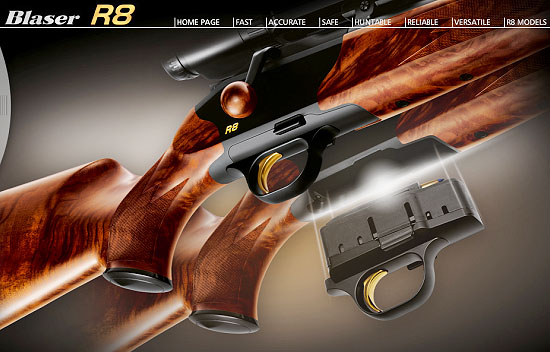
Starting in February 2010, the Blaser R8 will be available from Blaser dealers in a variety of models: Professional, Jaeger, Luxus, Attaché, Baronesse, Safari PH and Safari Luxus. In addition a custom-engraved R8 Custom class model will be offered. For more information, visit Blaser-usa.com.
January 10th, 2010
30-caliber magnums are the chamberings of choice for North American big game hunters. Although the venerable .30-06 and .270 remain popular, Boone and Crockett Club records show that the 30-caliber magnums (of one variety or another) take more North American trophies than any other caliber/chambering. (Note: “30-caliber magnum” includes .300 Win Mag, .300 WSM, .300 Wby. Mag, 300 Ultra mag. Records do not distinguish specific 30-cal magnum chamberings.) Boone and Crockett compiled the data from records-book entries from 2007 through 2009. Surprisingly, the second most popular trophy-taker isn’t a firearm—it’s a bow.

Here are the most commonly used calibers across all Boone and Crockett categories over the past three years, along with percentages of trophy entries credited to each:
30-cal Magnum (all types)—18 percent
Bow/crossbow—16 percent
.270—12 percent
.30-06—11 percent
7mm Magnum—11 percent
Muzzleloader/shotgun—10 percent
6mm—3 percent
.338 Magnum—3 percent
.257—2 percent
.30-30—2 percent
.308—2 percent
.375 Magnum—2 percent
Other—8 percent |
 |
30-caliber magnum cartridges appear among the top three calibers for 11 of the 15 species recognized in Boone and Crockett trophy records. Species for which records are kept include: Whitetail deer, Coues’ whitetail deer, Blacktail deer, Mule deer, Black bear, Brown Bear/Grizzly, Pronghorn, Elk, Moose, Caribou, Bison, Muskox, Cougar, Rocky Mtn. Goat, Sheep (Bighorn, Dall’s, Desert, Stone’s).
January 2nd, 2010
Here’s a simple procedure that lets you get a solid zero for a hunting rifle in just four shots. Of course you probably want to fire a few more rounds to confirm your zero before you head off to your hunting grounds, but this will let you get on-target with a minimum amount of time and ammo expended. (This assumes your scope is securely mounted, and the bases are not drastically out of alignment.)
1. First, remove the bolt and boresight the rifle. Adjust the position of the rifle so that, looking through the bore, you can see the center of the target with your eyes. Secure the rifle in the rests to maintain its position as boresighted. Then, without moving the rifle, center the reticle. That should get you on paper. With the rifle solidly secured in front and rear rests or sandbags, aim at the center of a target placed at your zeroing distance (50 or 100 yards). Confirm there are no obstructions in the barrel! Then load and fire one shot. Then, return the gun to the exact position it was when you pulled the trigger, with the cross-hair centered on the target as before.
2. Locate, in the scope, where your first bullet landed on the target. Now, while you grip the rifle firmly so it doesn’t move, have a friend adjust the turrets on your scope. While you look through the scope, have your friend turn the windage and elevation turrets until the cross-hairs, as viewed through the scope, bisect the first bullet hole on the target. In other words, you use the turrets to move the center of the reticle to the actual position of shot number one. Dial the crosshairs to the hole — don’t move the rifle.
3. After you’ve adjusted the turrets, now re-aim the rifle so the cross-hairs are, once again, positioned on the target center. Keep the rifle firmly supported by your rest or sandbag. Take the second shot. You should find that the bullet now strikes in the center of the target.

4. Take a third shot with the cross-hairs aligned in the center of the target to confirm your zero. Make minor modifications to the windage and elevation as necessary.
5. Now shoot the rifle from a field rest (shooting sticks, bipod, or rucksack) as you would use when actually hunting. Confirm that your zero is unchanged. You may need to make slight adjustments. Some rifles, particularly those with flexy fore-arms, exhibit a different POI (point of impact) when fired from a bipod or ruck vs. a sandbag rest.
If you recently cleaned your rifle, you may want to fire two or three fouling shots before you start this procedure. But keep in mind that you want to duplicate the typical cold bore conditions that you’ll experience during the hunt. If you set your zero after three fouling shots, then make sure the bore is in a similar condition when you actually go out hunting.
December 26th, 2009
 HUNTX3, a new all-digital hunting magazine, launched this week. You’ll find a full-featured website at HuntX3.com. There you can access gear reviews, videos, news feeds, and popular articles. But that’s just the beginning. The “heart” of HUNTX3 is a flash-based, interactive e-Zine that displays like a conventional print magazine with “double-truck” layouts, flip-page navigation, and full-page ads. The e-Zine even has embedded video and audio — and all content is FREE. HUNTX3, a new all-digital hunting magazine, launched this week. You’ll find a full-featured website at HuntX3.com. There you can access gear reviews, videos, news feeds, and popular articles. But that’s just the beginning. The “heart” of HUNTX3 is a flash-based, interactive e-Zine that displays like a conventional print magazine with “double-truck” layouts, flip-page navigation, and full-page ads. The e-Zine even has embedded video and audio — and all content is FREE.
As a rule, we generally don’t favor these print-magazine mimicking formats. They take a long time to load, and seem less reader-friendly than conventional web pages. On the other hand, HUNTX3’s e-Zine layout allows for large photos, and impressive two-page spreads.
The premier issue of HUNTX3 Digital Magazine features many articles of interest for bow-hunters and big game hunters. There are excellent stories about elk hunting in Utah, Red Stag hunting in New Zealand, and Dall Sheep hunting in the Canadian Yukon.

High-Tech Hunt Planning with Google Earth
HUNTX3’s premier issue also includes a fascinating article by Toxie Givens explaining how to use Google Earth satellite photos to monitor game stands and plan a deer hunt. The article shows how you can define club boundaries, and plot the location of feeding stations, deer stands, and trail cameras. Using Google Earth, you can even mark locations where game has been taken in the past, link trail cam photos, and superimpose current weather conditions.
Givens explains: “I keep a record of the location where every deer is taken… for every year we have been hunting. This is great information to see where the most successful areas are on the club. Using Google Earth you can get the Weather Radar superimposed on your location. Furthermore Google Earth is capable of geo-caching [trail camera] photos to GPS points.”

|


