A while back, RifleShooter Magazine released a list of the Ten Greatest Lever-Action Rifles of All Time. Writing for RifleShooter, Brad Fitzpatrick examined a wide selection of lever guns produced in the past 150 years, and came up with this short list of ten “all-star” lever action rifles:
Savage Model 99
Winchester Model 1873/73
Winchester Model 1888/88
Winchester Model 1892/92
Winchester Model 1894/94
As with all “Top 10″ lists, this will be controversial. Where is the Winchester model 1866 “Yellowboy”, the favorite of Native Americans? Where is the iconic Winchester model 1895, the beloved gun Teddy Roosevelt called “Big Medicine”? But other choices are hard to fault. The Henry Rifle, the first popular cartridge lever gun, surely belongs on the list. And, believe it or not, the Winchester Model 94 is the best-selling sporting rifle of all time in the USA, according to RifleShooter.
So what do you think of RifleShooter’s Top 10 list? Does it make sense, or did RifleShooter magazine get it wrong? NOTE, on the Rifleshooter Lever Gun Page, to see descriptions/photos of ALL the guns, you need to click the gray arrows that appear (barely) below each gun description (see below). That will scroll through the ten guns horizontally, back and forth.
Fitzpatrick writes: “The lever action played a very legitimate role in America’s westward expansion. It could bring meat to your table or protect your land and assets against rustlers. Nostalgia aside, the lever gun is an effective hunting tool for those willing to live within its limitations. While it can’t beat a bolt gun with a light trigger and free-floated barrel in a long-range shooting competition, a lever action in the right hands can be rather accurate, especially given new advancements in rifle design and bullet technology.”
Historic American Arms — Teddy Roosevelt’s Lever Guns
These two lever action rifles, owned by President Theodore Roosevelt, are part of the NRA Museum collection. First is a Winchester 1886 rifle known as the tennis match gun because Roosevelt used winnings from a tennis match to buy it. Below that is a suppressed Winchester model 1894 rifle. Roosevelt liked to shoot varmints around Oyster Bay (Long Island, NY) with this gun so he wouldn’t disturb his neighbors — the Tiffany and Du Pont families.
At the request of our readers, we provide select “Deals of the Week”. Every Sunday afternoon or Monday morning we offer our Best Bargain selections. Here are some of the best deals on firearms, hardware, reloading components, optics, and shooting accessories. Be aware that sale prices are subject to change, and once clearance inventory is sold, it’s gone for good. You snooze you lose.
NOTE: All listed products are for sale to persons 18 years of age or older. No products are intended for use by minors.
⏺ Nice, compact 9mm complete with integrated laser — great carry gun
Here is a great value in a 9mm carry/defense pistol. The Smith & Wesson SD9VE 9mm features a comfortable grip, high visibility sights, and a built-in laser. The Crimson Trace LG-457 Laserguard is a powerful red laser designed specifically for Smith & Wesson SD/SD VE pistols. Featuring Crimson Trace’s Instinctive Activation system, the laser system can be set to activate instantly when the pistol is gripped, via a button on the grip front. This two-tone pistol has a black polymer frame and stainless slide. Priced at just $369.99 on sale, this S&W handgun is $200 less than a similar-sized Glock 19 without a laser.
2. KYGUNCO — Mossberg Night Train Rifle Combo, $731.99
⏺ Very good long range hunting deal, complete with 6-24x50mm scope
Here’s good hunting rifle package — rifle AND 6-24X scope — at a very attractive price. For $731.99, you can get a Mossberg Patriot Night Train Rifle and Scope combo package in 6.5 Creedmoor, .308 Win, or .300 Win Magnum. A high quality 6-24x50mm scope and rings are included with all three models, and the .308 Win and .300 WinMag models include a fitted muzzle brake. This is a nice, complete package with good chamberings for deer and elk.
3. Midway USA — Frankford Arsenal Sale, Save up to 35%
⏺ Big discounts on numerous popular products — save up to 35%
Frankford Arsenal offers a full line of reloading equipment from dies to tumblers. You can find all their gear on sale during the Frankford Arsenal Sale at MidwayUSA. With up to 35% off a wide variety of popular products, this is a great time to pick up reloading tools and accessories. Along with the three products shown above, here are some of the best bargains:
4. EuroOptic — Leupold BX-2 Alpine Binoculars Sale
⏺ Quality binoculars with great warranty, now $50 Off (up to 21% savings)
A good pair of binoculars needs to be durable, feel comfortable in your hands, and provide a bright, sharp image. Leupold’s BX-2 Alpine HD Binoculars have these qualities, plus a great Leupold guarantee, and excellent performance for the price. Right now EuroOptic has four types of Leupold BX-2 Alpine binoculars on sale for $50 off the regular price: 8×42, 10×42, 10×52, and 12×52. For general daytime spotting use we’d chose the 10×42 model, now just $199.99 on sale.
5. Graf & Sons — LEE Classic Turret Press, $129.99
⏺ Amazingly low price for a 4-station turret, with many great features
Right now the LEE Classic Turret Press is just $129.99 at Graf’s — an awesome deal. This 4-station Turret Press has earned excellent user reviews: “This cast iron frame model with all-steel linkage is built like a tank”; “Great press — solid as a rock. I originally bought it for reloading pistol ammo but like it so well I use it for almost everything”; “the turret auto-indexes perfectly and locks solid with no effort. I really like how easy it is to still use it as a single-stage when working up a load but not have to change dies, just simply rotate the turret by hand.” With four stations you can keep dies for multiple cartridge types. The long stroke allows rifle cases over 3″ long to be loaded. Spent primers run directly through the ram to an attached clear PVC tube that reliably catches every primer.
⏺ Big savings on popular electronic muffs favored by many shooters
All shooters should wear quality ear protection whenever they visit the range. Electronic muffs allow you to hear conversations/range instructions while still providing vital protection from loud gunshot noises. Walker’s is a respected maker of electronic muffs. And right now Walker’s Razor Slim electronic earmuffs are on sale at significant savings. These Razor Slim Ear Muffs feature slimmer ear cups. The thinner design provides less interference (and more comfort) while shooting rifles and shotguns. Razor Slim Muffs have a 23 dB Noise Reduction Rating with a fast, 0.02 second response time. These electronic muffs feature two omni-directional microphones with a single (combined) volume control.
7. Amazon — Birchwood Casey Dueling Tree, $269.99
⏺ Dueling trees are great fun for pistol and rimfire shooters
Interactive targets are fun — and a dueling tree is great for both solo training and pair shooting. Training with these targets can improve target acquisition times and follow-up shot speeds. This Birchwood Casey Dueling Tree offers fun competitions with a fellow shooter. When you hit a plate it swings to the opposite side. The winner is the shooter who gets all his plates to the other side first. Designed for handgun use, this Dueling Tree is fun and easy to set-up.
⏺ Lightweight adjustable rest for sighting-in hunting rifles and ARs
This very affordable, Birchwood Casey Bravo Shooting Rest works for sighting-in hunting rifles and ARs. At 15 lbs., it is easy to transport to the range. It has 3.5 inches of vertical adjustment with the center crank, allowing it to work with a variety of rifles, including mag-fed semi-autos. One cool feature is that this steel-framed Shooting Rest is designed so it can work from the Bench AND while shooting prone on the ground. This rest has a bubble level and adjustable rear height control. It’s on sale now for just $92.94 on Amazon, a significant savings over the regular price.
9. EuroOptic — Gamin Fenix 6 Watch, $259.99
⏺ Compact yet powerful — great item for hunters and hikers
The Fenix 6 Smartwatch by Garmin offers GPS functionality in an ultra-compact device. This Smartwatch comes preloaded with multiple Apps for finding location and mapping multi-point tracks. The Fenix 6 features ABC sensors including an altimeter, barometer, and 3-axis digital compass. This Garmin Smartwatch also offers multi-GNSS capabilities, which provides combined access to GPS, GLONASS, and Galileo navigation systems for greater navigational accuracy than GPS alone. And you can boost battery life to weeks using Expedition Mode, an ultra-efficient, low-power GPS modality.
The Exhibit Hall is open all three days (Friday, Saturday, Sunday) and will showcase over 14 acres of guns and gear from hundreds of manufacturers and retailers. The Hall will host approximately 800 exhibitors, with receptions and demonstrations. Attendees can see the latest guns, knives, optics, ammo and accessories available on the market today.
For NRA members who did NOT pre-register, admission passes can be picked at the convention, at the Convention Center entrance area. Be sure to have ID and your NRA member number.
At the 2023 NRA convention, events include the NRA Foundation Banquet and Auction, the NRA-ILA Leadership Forum, plus multiple seminars. There will be appearances from notable celebrities, and a major Saturday concert. CLICK HERE for full Event Calendar.
The NRA Convention is just 7 days away. If you plan to attend the 152nd NRA Annual Meetings & Exhibits get your hotel booked right away. With the current policies coming from the White House, there has been no more important time to support the Second Amendment.
Would you like gun and outdoor industry companies to learn what products you favor, or what types of hunting you prefer. Then you may want to take a FREE SURVEY.
Your responses help the hunting, recreational shooting, and defensive firearms markets develop new products and improve services. The results are shared with conservation and advocacy groups, allowing them to advance conservation and pro-second amendment issues. To participate, go to ShooterSurvey.com or HunterSurvey.com. NOTE: An email address is required.
Here are some interesting results from recent surveys:
NOTE: Results exceed 100% because many shooters use multiple firearms and/or bow types.
NOTE: Results exceed 100% because many hunters pursue multiple species.
If you take the survey, you get a chance to win a $100 gift card. Each quarter, respondents are entered into a drawing for one of five $100 gift cards to the outdoor retailer of their choice.
About Shooter Survey and Hunter Survey
Southwick Associates launched the HunterSurvey and ShooterSurvey in 2006 to help state Fish & Wildlife Agencies, conservation organizations, and the outdoor equipment industry understand what hunters, recreational target shooters, and personal protectors want and need. Survey results reflect the attitudes and habits of hunters and recreational shooters across the United States and are analyzed to develop new products, provide better services, and make smarter decisions that help improve public hunting, recreational shooting, and protection opportunities.
All survey responses are kept strictly confidential. Only summaries of the responses are used in reporting. However, to take the survey you must provide an email address to Southwick Associates. We recommend you NOT sign up with a primary business or personal email.
This article copyright 2023 AccurateShooter.com. No reproduction is allowed.
Here is one of Bill Reid’s 6mmBR (6BR) rigs. Like his Sako 6 PPC, this is exceptionally accurate.
AccurateShooter Forum member Bill White (aka “CT10Ring”) is a New Yorker who relocated to Idaho in his senior years. From his Idaho home, Bill enjoys long-range target shooting. But his favorite gun pastime is varmint hunting in nearby states — the Dakotas, Montana, and Wyoming. Every year he loads up his truck and hits the road, often doing a grand circle route, visiting prairie dog havens in multiple states.
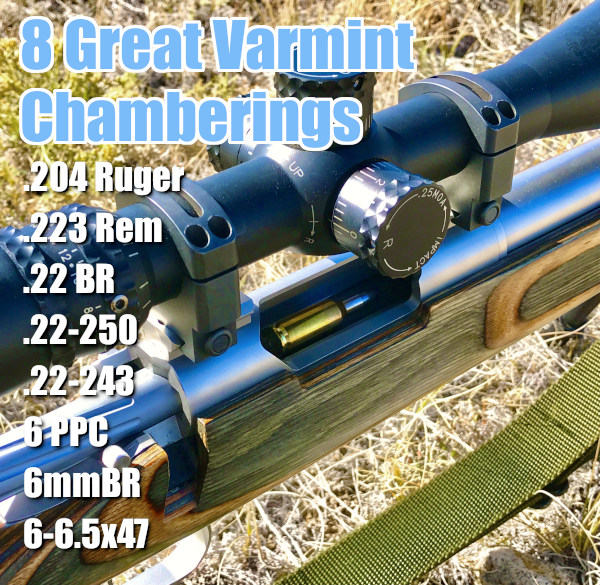
Bill has a large rifle collection, most of which see duty in the varmint fields of Montana, North Dakota, South Dakota, and Wyoming. Here are his key “take-aways” for his eight favorite varmint chamberings: .204 Ruger, .223 Rem, .22-250, .22 BR, .22-243, 6 PPC, 6mmBR, and 6-6.5×47 Lapua (aka 6×47).
Eight Great Varmint Cartridge Types — .204, .224, .243 Calibers
.204 Ruger — This delivers great velocity with the little .20-caliber bullets, with mild recoil. The .204 Ruger easily reaches out to 400 yards, but heavier winds do move the tiny bullet around. Tremendous splat factor under 250 yards. I use Sierra 39gr bullets with IMR 8208 XBR in a Sako 75. Even now, .204 Ruger ammo is relatively easy to find.
.223 Remington — Probably the most popular centerfire rifle round in the USA, the .223 Rem offers inexpensive brass, and is a great choice for AR-15 owners. If you run short on ammo, you can find it nearly everywhere. I often bring one AR-15 and one .223 Rem bolt gun on varmint safaris. My Rem 700 5R 1:9″-twist barrel likes 53gr V-Max bullets.
.22 BR — My .22 BR is my first choice for most prairie dog missions. Accuracy is superb with necked-down 6mmBR Lapua brass — quarter-MOA and blazing fast. With the right twist rate, this chambering can shoot anything from 40gr FB bullets to 80gr VLDs. Load development is easy. Below is my .22 BR ammo for another varmint trip. I use 55gr Sierra BlitzKings with Varget in my 1:12″-twist Shilen-barreled rifle. 60gr Bergers are very accurate with a fairly flat trajectory for useful distances.
.22-250 Rem — A classic varmint cartridge, the .22-250 with 50gr V-Maxs delivers spectacular hits. If three P-Dogs happen to be lined up, I’ve witnessed one .22-250 shot take ‘em all out with a triple hit. I currently have five .22-250-chambered rifles: 3 Sako 75s, one Rem 700, and a single shot Nesika that shoots tiny groups. I favor the very deadly Berger 52gr Varmint HP. Making a custom .22-250? With a 1:8″-twist barrel you can use the full weight range of .22-cal bullets, while spinning the lighter bullets fast for “red mist” effect. Remember this cartridge can be a barrel burner. Don’t shoot too many rounds too quickly.
.22-243 Win — This wildcat is even more potent than the .22-250, delivering devastating results on P-Dogs. Run a .243 Win case slowly through a full-length .22-243 die, with plenty of lube to form the brass. I start with Lapua .243 Win brass. There can be some issues necking-down the brass. Watch for donuts forming at the neck-shoulder junction. I bought my .22-243 rifle not sure how it would perform. But now I love shooting it. My .22-243 delivers half-MOA groups with 41.0 grains RL-22 and Hornady 75gr Amax bullets. With those 75-grainers, it’s great in the wind and good to 600 yards easily.
6 PPC — You may consider the 6 PPC a benchrest competition cartridge only, requiring fire-forming. However I have an original Sako 75 single-shot 6 PPC rifle that I load with Sako-headstamp 6 PPC brass (see below) so no fire-forming is required. This Sako 75 came with a test target that measured 0.113″! With my 6 PPC Sako, I found that 58gr V-Maxs, pushed by Vihtavuori N133, are potent out to 300 yards. [Editor’s NOTE: As the Sako brass is no longer available, new 6 PPC shooters will need to fire-form their brass, or try to find Norma 6 PPC brass.]
6mmBR — The 6mmBR Norma (6BR) offers a nearly unbeatable combination of accuracy, efficiency, and tunability. With the 6BR and a fast twist barrel, you can shoot everything from 40gr flat-base bullets to the latest 105-110gr match bullets. I load Lapua brass, Vihtavuori N135, and Hornady 58, 65, and 75gr bullets for my Krieger 1:14″-twist HV barrel. While this cartridge is capable of long-range accuracy, I usually limit my 6BR shots to 350-400 yards.
6-6.5×47 Lapua — I have a nice 6-6.5×47 Lapua varmint rifle, with Surgeon action and Manners stock. I Cerakoted the barreled action and then bedded the action. Shown below is 6-6.5×47 ammo I loaded for testing. Note how I separated different bullets and powder loads into multiple, labeled bags. Hodgdon H4350 is a great choice for this cartridge — 39 grains H4350 with 105gr Amax was the winner here, but 88gr Bergers also shot well. This cartridge has tremendous “critter dismantling” abilities out to 600-700 yards.
Six Tips for Novice Long Range Varmint Hunters
1. Take twice as much ammo you think you may need. The fields could be particularly rich, or, because of wind or other variables, you may have far more misses than expected.
2. When possible, set up with the wind at your back (or, alternatively, directly ahead). This will minimize the effect of cross-winds. Set up a stake with a ribbon to show wind direction.
3. Bring at least two rifles. Ideally one would be a low-recoil rifle with cheaper components for the closer shots. Then bring a rifle with higher-BC bullets for longer shots where wind is a bigger factor.
4. Check the weather before you head out. Prairie dogs like sunshine and calm conditions. If a cloudy, very blustery day is predicted, considering staying in town and cleaning the rifles.
5. Bring plenty of water on a trip. An adult male should be drinking at least 64 ounces of water (or other liquid) every day — more if it’s very hot or you are sweating a lot.
6. Preferably always hunt with a companion. If you do go out solo, have a Garmin inReach SatComm/GPS for emergencies if there is no cell coverage in your location.
Bonus for Black Rifle Shooters — The Economical 20 Practical
If you want to use an AR-platform rifle in the varmint fields, consider getting a 20-caliber barrel chambered for the efficient, low-recoil 20 Practical cartridge. The 20 Practical is simply a .223 Remington necked down to 20 caliber. The parent .223 Rem cartridge of course works great in an AR, but the 20 Practical offers some notable advantages for high-volume varmint shooters. The 20 Practical delivers very high velocity with very low recoil while still providing outstanding accuracy. The 20 Practical is great option for folks who favor “fast and light” — smaller, lower-mass bullets traveling at very high velocities. This little cartridge can launch 40-grainers at over 3900 fps, and 32-grainers even faster. This makes the 20 Practical a great choice for an AR-based varmint rifle.
20 Practical Ultimate Varminter
A decade ago, as a “proof-of-concept”, AccurateShooter.com created a 20 Practical AR15 Ultimate Varminter with a custom 20-caliber upper from Robert Whitley of AR-X Enterprises, LLC. That project rifle was ultra-accurate — every 5-shot group out of the gun was less than the size of a dime. That gun was auctioned off, but Robert Whitley continues to produce custom 20 Practical AR15 uppers. (The 20 Practical cartridge is simply the .223 Rem necked down to 20 caliber — you can use standard .223 brass and load with standard.223 Rem dies. Just swap in a smaller expander and use smaller neck bushings.)
Targets Shot with Three Different 20 Practical AR Uppers
For more INFO visit www.6mmAR.com, or email: rcw3 [at] erols.com.
The .20 Practical is also a good choice for a bolt-action rifle. Here is what our Forum members have to say…
20 Practical Shooters Explain Why They Love this Little Cartridge
A thread in our Shooters’ Forum asks: “What is your favorite and most versatile round that you have made from a .223 Rem parent case?” Many cartridges were named, but the wildcat cartridge cited most often was the 20 Practical. Here are some comments by Forum members, who explain the appeal of this great little 20-caliber cartridge:
“The 20 Practical is just a hoot to shoot. Outstanding precision, minimal recoil, easy case forming and inexpensive to shoot. What’s not to like? It’s a great way to introduce kids to centerfire, too.” — JLT
“My favorite was and is the 20 Practical. No fire-forming, no neck-turning, and with the increased BC of the 20 Cal bullets, it’s hard to wipe the smile off your face in a prairie dog town[.]” — Region Rat
“Favorite .223 Rem Wildcat? The 20 Practical hands down for me. I have two of them built on Savage actions right now. One has a 20″ BHW barrel and the other has a 26″ Criterion. It is my go-to caliber for shooting up a Prairie Dog town and the ones I have are insanely accurate. Here are some typical 100- and 200-yard groups with my 20 Practicals.” — IA_Shooter
Here are select product images from IWA Outdoor Classics 2023 trade show in Nuremburg (Nürnberg) Germany. We reviewed hundreds of images to find some of the more interesting products on display. We hope our readers enjoy this vicarious look at the IWA Outdoor Classics show.
There are over 220 photos online from the 2023 IWA Outdoor Classics event. You can access them through the IWA 2023 photo archive. Here are a few product images that we thought our readers would enjoy.
Twin CZ 600 Range rifles on display. The CZ 600 Range features a modern wood laminated stock and cold-hammer-forged barred. CZ guarantees 3/4-MOA accuracy at 100 meters.
Young lady looks through the latest Leica GeoVid Pro 8×32 Laser Rangefinder binoculars.
Schmidt & Bender FFP MRAD scope mounted on precision rifle with Masterpiece Arms (MPA) Chassis and 6.5 Creedmoor 1:8″-twist MPA barrel.
The IWA Outdoor Classics show is very much about hunting. Here’s a display of the latest and greatest camo and Hi-Viz (day-glo) apparel for hunters.
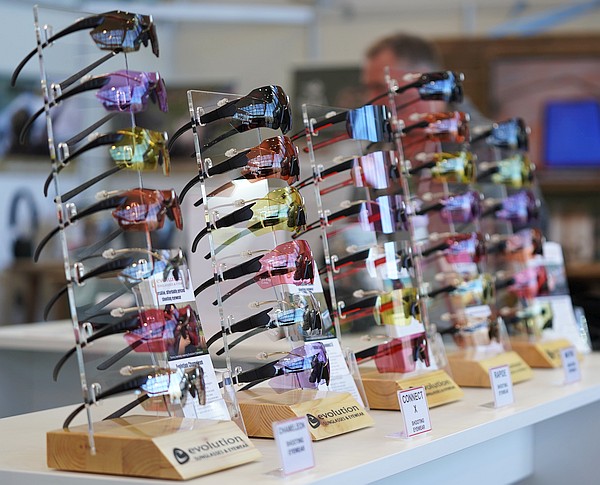
All shooters should ALWAYS wear quality eye protection that meets ANSI Z87.1 standards. This display shows that you can choose from a wide spectrum of lens colors and frame types.
Trio of Pulsar Optics — binoculars, thermal monocular, and thermal imaging binoculars.
Here’s a selection of GECO Express, Plus, and Star ammunition. GECO, now part of the Swiss RUAG group, was founded in Germany by Gustav Genschow in 1887. Today, GECO ammunition is manufactured in Germany, Switzerland, Sweden, and Hungary.
IWA Outdoor Classics features traditional hunting gear, such as these handsome brass hunting horns.
Crowd gathers at the Glock booth in the NürnbergMesse in Bavaria, Germany, home of the IWA Outdoor Classics trade show.
Right now KYGUNCO, a Kentucky firearms and gun gear store, is running a large Tax Time Sale. As part of that sale there are significant discounts on pistols, rifles, and shotguns. CLICK HERE for all sale items.
Among the many special discounts, a SAKO Rifle sale stood out because of the large $494 discount*, and the fact that with each SAKO S20 rifle the buyer gets TWO complete stock sets. You essentially get two rifles in one — simply by changing the two-section stock configuration. You can run a thumbhole “hunter” version with narrow fore-end, and then change to a “precision version” with a more vertical grip, straight run on the buttstock keel, and straighter, more rectangular fore-end. Watch this video to see how the two stock types work with the interchangeable front and rear stock components:
This SAKO Video Shows How S20 Modular Stock Components Work (Worth Watching Guys!)
The SAKO S20 is a modular rifle designed to allow the shooter to change the stock configuration easily for different applications. The S20 Hunter features an ergonomic, thumbhole stock with features any hunter will appreciate. The S20 Precision stock components have a more vertical grip and a straight section on the buttstock — good for riding a bag. Using spacers on the buttpad, the S20 stocks allow the shooter to adjust length of pull. And on both stock variations there is a handy quick adjustment for cheekpiece height. The S20 Hunter also features a specially designed 5-round Cartridge Plus magazine (three for magnum calibers), that provides extra length for those who load their own ammo. Additionally, the S20 Hunter/Precision features quick-detach points for mounting sling hardware on both sides of the stock and soft-touch inserts on the fore-end and pistol grip.
There are four (4) chamberings offered. 6.5 PRC, .30-06 Springfield, and .300 Win Mag are discounted $494.00, while the 6.5 Creedmoor is discounted $291.00.
This content is Copyright 2023 AccurateShooter.com. No reproduction on any other website is authorized. Use of this content without payment of licensing fees is a violation of Federal law.
The Vortex Blog contains an interesting article featuring recommended gear for a coyote hunting trip in late winter/early spring. This Vortex article covers all the items you’ll need: rifle, optics, shooting sticks, insulated clothing, Laser Rangefinder, game calls, carry packs and more.
In the article intro, Vortex notes: “Winter snow and cold temps don’t get Vortex’s Bill Krivanek down. In fact, quite the opposite. This time of year, he’s fired up about calling coyotes and putting a little fur on the ground. “There’s so much to love about these crafty critters”, said Bill. “They nearly always have the advantage. When you get one to come in to shooting range, you’ve really accomplished something. It’s as exciting as hunting gets.” Click the links below for more information about the Vortex Scope and Rangefinder used by Krivanek.
Complete Gear List for Cold Weather Hunting
A. Gloves
B. Milwaukee 2103 Headlamp
C. King’s Camo Snow Shadow®, Insulated Bibs
D. King’s Camo Snow Shadow®, Insulated Jacket
E. Vanguard Scout B62 Bipod
F. Knit Hat
G. Vortex Viper HD3000 Laser Rangefinder
H. FOXPRO® Shockwave Electronic Game Call
I. Open Reed & Closed Reed Mouth Calls
J. Red Rock Outdoor Gear Pack
K. HS Strut Deluxe 2-Way Strut Seat
L. Hornady 55gr V-Max Varmint Express
M. Vortex Viper HS 2.5-10x44mm Scope
N. Aero Precision AR-15
O. Banish 30 Silencer Central Suppressor
CLICK HERE to read the FULL Article with a complete description of each item, shown in the lead photo above. Here are three gear commentaries:
Aero Precision AR Rifle: Bill primarily hunts the Midwest where harsh winters are the norm. You can tell that from the custom rattle-can, snow-camo paint job on his well-worn AR-15. Chambered in .223 Rem, he likes the practical functionality and fast follow-up shots the AR-platform offers — particularly when you call in multiples. His AR is from Aero precision and been an absolute workhorse. Brand of AR-15 doesn’t matter much to Bill, but it does need to be accurate and reliable.
Shooting Sticks: In coyote country, you often need to bring your own rest. A set of shooting sticks is a necessity for Bill. He runs the Vanguard Scout B62 Bipod. These B62 units are fast to deploy, stabilize the rifle, and are easy to adjust when that dog comes in from a spot you didn’t anticipate. They have a swivel head for smooth panning when tracking a moving dog in your scope and easy turns to get on target fast with minimal movement.
Riflescope: Shots are shorter in the Midwest, with a general max of 300 yards. Most are much closer. Bill’s riflescope is the tried-and-true Vortex Viper HS 2.5-10x44mm. The low end of 2.5 with its wide field of view is just as important as the high end of 10. It’s incredibly durable and the optics speak for themselves.
Winter Solace in the Backcountry
There is a nice thread in our Forum appropriately entitled “Winter Time”. You’ll find some great backcountry images taken by our Forum members. Winter is a special time in the outdoors. Forum member JDP explains: “Winter is the best time to shoot! One of the few of life’s ironies that works in my favor. The range is empty and barrels keep cool, no bugs, no waiting on people, no mirage. Yup, this world needs more thin blooded snow birds. This cool weather is terrible and dangerous, tell your friends! Do people get lonely while shooting or something? It’s the true holiday season in multiple ways.”
Forum member DNorton posted: “I live way up north where our white sandy beaches look like this!”
Howa claims that its new Super Lite rifle is the “absolute lightest centerfire rifle on the market”. We can’t confirm that. But at a listed 4 pounds, 7 ounces (without optics), the carbon-fiber stock Super Lite model is certainly very low in weight and mass. That’s an important plus for hunters carrying their gear for long hours in the field.
The Howa Super Lite rifle is currently available in 6.5 Creedmoor and .308 Winchester, two of the most popular hunting chamberings. And Howa’s distributor, Legacy Sports Int’l, states that Super Lite rifles in .243 Winchester and 7mm-08 chamberings should be available by summer 2023.
The Howa Super Lite rifles were first introduced in Kryptek Altitude and Kryptek Obskura designs (see Kypteck Altitude camo in photo above). For 2023 the Howa Super Lite is offered in three new solid color designs — gray, tan, and green. All using the strong but light Stocky’s Carbon Fiber stock, these new Super Lite models feature a black webbing and soft touch for added texture and enhanced grip on the low-mass carbon stock. For 2023, Howa will also offer a walnut-stocked version of the Super Lite rifle. This weighs a bit more — 5 pounds, 9 ounces.
Howa Super Lite Rifle Features
Stock Options: Gray, Tan, Green, and Krypteck Carbon Fiber Stock 4 lbs. 7 oz. (Walnut Stock, 5 lbs. 9 oz.)
Chamberings: 6.5 Creedmoor, .308 Win (.243 Win and 7mm-08 in June 2023)
Stock: Stocky’s Carbon Fiber Stock with Accublock patented Lug Bed
Barrel: 20″ Blued barrel threaded (½”-28) and Suppressor Ready
Trigger: 2-Stage Match Trigger with 3-position Safety
Optics Mounting: Included one-piece Picatinny Rail
Stock Feature: Limbsaver Butt Pad
Warranty: Lifetime Howa Warranty
Accuracy Claim: Sub-MOA 3-shot group at 100 yards with premium factory ammo
The Howa Super Lite also has some interesting mechanical features, including machined receiver and gorged bolt, tool-less firing pin removal, and a reliable M-16 style extractor/ejector. CLICK HERE more information on HOWA Super Lite rifles and the rest of the Legacy Sport Int’ls full product line.
by Colton Reid
In hunting, great opportunities are a rare and precious thing. Their scarcity and the difficulty in distilling clear lessons from those opportunities is what makes hunting one of the most challenging and yet most rewarding activities I have ever pursued. As Tom Hanks succinctly stated in A League of Their Own, “The hard is what makes it great.” But, in my recent hunt in Utah’s high country I was given not only a chance at some of the biggest deer in my life, but also two opportunities to harvest a trophy buck after a heartbreaking series of hard lessons learned.
About the Gear — Tikka T3 Lite in .30-06, SWFA Scope, Leica GeoVid 3200.com LRF Binoculars
Colton was using a Tikka T3 Lite* chambered for the .30-06 Springfield. The scope was an SWFA Super Sniper 3-15x42mm with 0.1 MRAD clicks. Colton painted the Tikka rifle and scope himself with a combination of colors for camouflage. The cheek pad is a piece of balsa wood Colton sanded to correct height and covered with a SKD tactical PIG rifle stock pack. For spotting and ranging Colton employed a set of Leica Geovid 3200.com 10×40 LRF binoculars. Carry bags were from Badlands.
Ammunition: For this hunt, Colton handloaded his .30-06 ammunition with Lapua brass and Sierra 165gr SBT GameKing bullets. Drop was approximately 13″ at 300 yards.
October Hunt in Utah’s Central Mountain Range
In late October I traveled to Utah’s central mountain range for one week trip in pursuit of mule deer. I have never hunted this area before and, to add difficulty, there were several snowstorms expected throughout the week. Simply stated, I was in for a tough hunt. Given the newness of the area and no opportunity to scout pre-season, my strategy was to spend the first couple of days hiking slowly between various vantage points to locate the best animal activity. I saw several mature bucks during this period, but none that I chose to harvest. On day three, my efforts were rewarded with one of those rare opportunities.
This buck was sighted early in the hunt in a family group of does. This image was taken through my Swarovski spotting scope. The buck was about 150 yards away.
Six inches of snow covered the ground. A storm had crept in the night before and began to color a forest of green and brown pines in a picturesque winter white. Snow was still falling as I started my morning hunt in a new area. The temperature, now in the low teens, was a constant reminder to keep my layers on and jacket zipped. I started my hike down a rugged ridgeline road, and periodically peeked through the adjacent pine trees to glass a hillside across a small valley. After several instances of stopping to glass with my Leica Geovid 3200.com 10×40 LRF binoculars, I spotted a monster grazing the exposed grass at the edge of a group of bare poplar trees. At 1100 yards I could easily tell this was a nice 4×4+ buck.
I sat and watched him for several minutes and noticed he was grazing near a group of does that were slowly moving down their hillside and towards the base of mine. The buck, however, was slowly moving up and to the right. If he continued this path he would soon be around the corner of his hill where I could not see. Concerned that he would move out of sight, I decided to attempt a speedy stalk in the hopes of cutting him off. My first mistake. Gathering up my gear, and not knowing the terrain, I took the most direct path I could see. My second mistake. The hope was a direct path would put me into an equivalent altitude on his hillside, where I could make an ethical and successful shot. At least, that was the plan.
As I descended the hillside, I soon realized that the does I spotted were funneling directly towards me. To avoid spooking them I began to traverse the hillside at my current elevation and move to an area that completely changed my site picture of the hillside and where I saw the buck. Great, I had “solved” one problem and created another.
In this new area, I proceeded to again move down my hill and up the buck’s hillside in the hopes of reaching my previously planned location. But, I had no idea what was in front of me. I could not see this “new” area when glassing on the ridge. And now I was close enough to the buck’s area that spooking another deer would likely push the buck. So I had to go slow, and waste time I didn’t think I had.
Moving along the hillside I eventually spotted the poplars that marked where I had seen the buck last. 600 yards away, the trees now obscured the area where the buck had been feeding. Seemingly my only option, I pressed on through the snow. As I reached the 400-yard mark I spotted a young buck and doe less than 50 yards in front of me. I was now faced with a choice to proceed forward and spook these two deer in front of me or move downhill around them and try to climb up directly below where I spotted the big one. I chose the latter. Mistake number 3. Once I moved 100 yards below the young buck and doe, I traversed sidehill directly below where I had spotted the 4×4+ and started my climb.
This buck was spotted among trees early in the hunt. Scroll down to see the larger buck that Colton took on Day 3 of his Utah adventure.
Creeping up to the edge of the poplar trees I saw lots of fresh sign and decided to load a round in the chamber. I couldn’t see very far in front of me due to the snow and slope of the hill, but it seemed I was close. Moving further into the trees I saw nothing but bare trunks and a snow-covered ground. A feeling of disappointment and frustration washed over me. I had missed my window. Without thinking I let my guard down and stood up, mistake number 4. Out of the corner of my eye I saw a blur of brown and white bound away through the trees, only catching glimpses a white rump and large antlers as the buck moved out of the poplar trees and around the corner where I lost sight of him. I was heartbroken. Exhausted and defeated I started back toward the ridge.
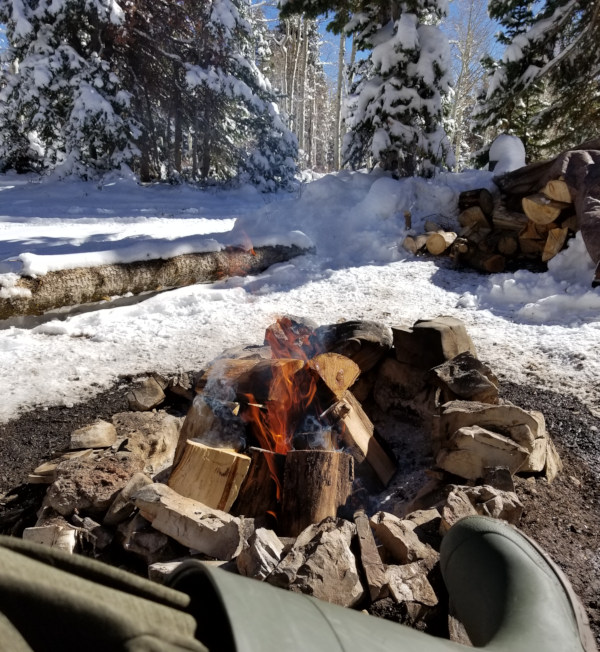
In the higher elevations there was snow everywhere. Winter wonderland in October Utah.
My long hike back to the road gave me time to think. I walked along the ridge of the hill where I spotted the buck and found that this location intersected with the road. As I trudged up the road to my truck, I learned that simply following the road would have given me a good vantage point of the poplar trees and obscured me from view until I reached the ridgeline of the buck’s hill. If only I had known this before!
The whole night I replayed the events in my head. Where did I go wrong? What could I have done better? I decided that my best way to learn from it and that the first hasty decision put me in a tough situation from which I made more poor decisions. If I had sat and watched the deer bed, I would have had more time to figure out an easier stalking route (like the road!) to get a clean and ethical shot above the animal. And since I saw lots of sign in that area, I decided to give it a second try the next day.
The next morning, I was back on the road and stopping at periodic vantage points to glass across the valley. The whole time I was thinking “will I really get a second bite at the apple”?
When I started to glass at the first opening, I slowly and methodically scanned the poplars where I had seen deer the day before and caught a glimpse of a brown spot moving through the trees. I pulled out my tripod for more stability and focused on where I had seen movement.
Lo and behold a nice buck was limping along the trees toward a small grass patch. Yes limping. Having the failure of yesterday’s stalk very fresh in my head I decided to wait until I saw the buck stop moving. After some slow grazing, the buck bedded at the base of a large tree just above his grazing area. Now was the time to move above him.
Because the buck was moving slowly from his limp, I figured I had time to work my way around to the ridgeline that would offer me an ethical shot. Again, learning from yesterday’s failures, I walked along the ridgeline road and periodically glassed the area where the buck was bedded.
During these periodic checks I was not able to see the buck, but there was no reason to think the buck had moved. It also offered several advantages: I refreshed my site picture as I moved to different positions, I checked my range to the poplars, and I found the location and range to where I wanted to shoot. While I walked, I noticed a storm rolling in that would soon be make this stalk much harder. I continued along the road until I found the ridge of the buck’s hill intersected, and I turned to make my way towards the buck.
Click Photo for large, full-frame image of stalking path.
Walking through the trees and slightly below the ridgeline I moved to a spot perpendicular to where the buck should be bedded and crept toward the ridgeline. As I crested the ridge I moved carefully from tree to tree, checking the wind was anywhere but behind me and used my binoculars at each stop to relocate the buck. As I approached a large grassy opening between my trees and the poplars, I spotted him bedded down right where I saw him lay down. He was 330 yards away, but I didn’t have a good angle for a clean vital shot. Where I stood the trees were thinning and I had no intention of blowing my stalk by being seen in the last 30 yards. Dropping to the ground I took off my backpack and army crawled in the snow to a downed log where I could rest my rifle for a shot.
For this Utah hunt, Colton’s bullet choice was the Sierra 165gr SBT GameKing. In this photo, the cartridge in the Tikka magazine has a 168gr Barnes all-copper TSX bullet.
I checked my range and angle — 301 yards and a 5-degree decline from me to the target. No significant wind in any direction. I had sighted in my rifle at 1000 feet above sea level in 75 degree weather and was now at 9500 feet with the temperature a bone-chilling cold. Instead of the 1.1 MRAD dope I estimated 1 MRAD and held directly over vitals. With slow steady breaths I calmed my heartrate, took a deep breath, exhaled halfway and held. A smooth squeeze of the trigger and the rifle roared. Maintaining my sight picture, I re-acquired the buck and cycled the bolt. He was on his side making a last attempt to run. Like a dog chasing a rabbit in his sleep. 20 seconds later and his chase had ended.
When I moved my head from behind the scope, I noticed snow steadily falling all around me. The storm had held until the job was done. As if my rifle was the signal for the heavens to let loose. To say that I was happy in this moment is a gross simplification of what this experience meant to me. I was happy with my success, I was thankful for the opportunity, I was sad at the loss of life of such a majestic creature, I was proud of having learned my lesson from the day before and having executed the best stalk of my life, while also harvesting the biggest buck of my life. My hunt was successful. My hunt was over. And now, the real work had started.
Arriving at the downed deer I checked for life. He had passed. My shot went directly through the buck’s heart, and he had lost most of his blood in the first 15 seconds. As ethical as it gets. The storm was starting to really gain momentum now, so I had to choose to either quarter the deer and hang it for tomorrow or gut it and drag it to the road, which was approximately a mile away. With the snow blanket from previous storms, I decided it would be easiest to drag the deer using my body harness (Muddy Deluxe Deer Drag Harness).
The drag back to the road reminded me of grandpa’s route to school: 20 miles in the snow and uphill both ways. The drag was tough. Each incline felt like I was climbing vertically with a 100-lb. pack. Fortunately, the snow helped the body slide and I made it to my truck in about an hour.
My drive back to camp was dead quiet. I tried to soak in the experience as much as I could. To fully appreciate the opportunity, I had been given. The sacrifice my family had made so that I could be here.
And as Vince Lombardi once noted: “Any man’s finest hour, the greatest fulfillment of all that he holds dear, is that moment when he has worked his heart out in a good cause and lies exhausted on the field of battle — victorious.”
* Colton Reid has the Tikka T3 Lite, which has been superseded by the T3X LITE, which has some enhanced features. The notable T3X LITE upgrades are covered in this Tikka Product Video.
This article is Copyright 2023 AccurateShooter.com. Any republication on any another website gives rise to damages for copyright violations.


 Would you like gun and outdoor industry companies to learn what products you favor, or what types of hunting you prefer. Then you may want to take a



 20 Practical Ultimate Varminter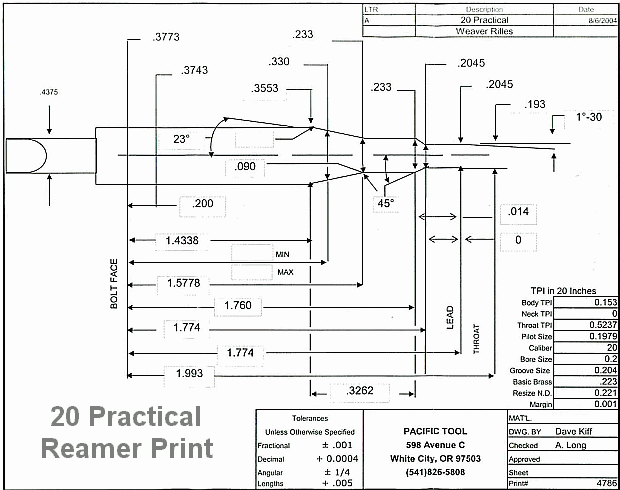







 The next morning, I was back on the road and stopping at periodic vantage points to glass across the valley. The whole time I was thinking “will I really get a second bite at the apple”?