|
|
October 11th, 2013
Would you like a handgun safe that opens instantly when you wave your hand over it? Science fiction? No, with modern RFID technology, this is now a reality. The Gun Box, a sleek, metal-boded handgun safe, employs the latest technology to offer instant access with high security. The basic RF Gun Box opens in response to a personalized RFID chip in a wristband or ring. The Biometric Gun Box offers both Fingerprint-scan and RFID (radio) opening. The premier-level Gun Box has both RFID and Biometric access PLUS a built-in, battery-powered GPS transmitter that tracks the unit’s location if the Gun Box is ever “lifted” by a thief. The top-of-the line model’s internal accelerometer even allows the Gun Box to notify the owner if it is moved, tilted, or opened.
Watch the Video to See How the Gun Box Works (this is pretty amazing).

We like it when an inventor comes up with a “better mousetrap”, or in this case, a better handgun safe. Ryan Hyde, the Utah-based inventor of the Gun Box, is seeking “crowd-funding” donations to move his innovative product to the next level (full production). The Gun Box is seeking $100,000 via its Indiegogo Campaign with funding options ranging from $10 to $390. You can pre-order a Gun Box, or just donate some cash in return for a T-shirt or other swag.


A next-generation gun safe, The Gun Box has many unique features:
- RFID and/or fingerprint access (no traditional key or passcode).
- Alert notifications when Gun Box is opened, moved, or tampered.
- Strong, die-cast aluminum alloy shell 0.15 to .20 inches thick
(3-5 times thicker than most).
- Long-life internal batteries (plus AC power).
- Power-Only (no data transfer) USB Ports
- Fully enclosed internal hinges.
- Pry-resistant lap joint.
- Kensington lock port for security cable.
- GPS tracking.
October 10th, 2013
 Need reading material on the cheap? How about sixty-nine (69) YEARS of Gun Digest articles for just $59.99. That’s not a misprint. Gun Digest is now offering a 3-disc DVD set containing sixty-nine years of Gun Digest archives — over 3000 articles in all. This massive Gun Digest digital collection includes all 69 Annual Editions of Gun Digest, complete with gun values, firearm reviews, collecting tips, and buying guides. You get 69 years of gun history in one spot. As one buyer notes: “You could never find these old issues anywhere else and you get the 2012 and 2013 digest in the set as an additional incentive.”
The Gun Digest 3-DVD set includes each Annual Edition of Gun Digest by Year (1944-2013) in PDF Format. This collection includes Test Fire gun reviews, articles on shooting, hunting, gun collecting, gunsmithing, optics and more. Here’s a sample: Elmer Keith’s classic article on the .44 Magnum
 |
Three Discs VS. Sixteen Feet of Shelf Space
This DVD collection is a treasure trove, as another purchaser of the 3-DVD set explains: “You can occasionally find older editions of this iconic tome, used of course, but nowhere will you get all 69 issues from the start of publication through the 2013 edition in digital form. They are all here… for your reference and enjoyment.” By contrast, 69 years worth of “the print version would require 16 feet or so of shelving.”
|
October 10th, 2013
Shooters who reload at the range, during the course of benchrest matches, or during load development sessions, can benefit from having a portable scale to weigh charges. Even if you throw charges, using click values, a scale allows you to double-check the accuracy of your throws. In addition, having a scale handy lets you weigh and sort components during load development.
Many reloaders prefer “old-fashioned” balance beam scales for range use. They are relatively inexpensive and simple to use. With a beam scale, unlike electronic scales, you don’t have to worry about weak batteries or finding AC power. The problem when using any scale at an outdoor range is wind. Wind can cause powder to blow out of the pan and even a light breeze can actually cause a beam scale to perform erratically.
Beat the Breezes with a Wind Box for your Scale
Forum member Boyd Allen has come up with a smart solution for reloaders who use scales outdoors — a windproof scale enclosure, aka “Wind Box”. This is something that can easily be built at home with common tools. Boyd explains: “Many guys have good set-ups for loading at the range, with clamping mounts for powder measure and press. But they lack a good enclosure for a scale. This is vitally important with beam scales because they have a lot of surface area to catch the wind. With much wind at all, the beam can oscillate to the point that is not really very usable. While a low-profile electronic scale may be less wind-sensitive, breezes DO affect weight read-outs on digital scales. And of course you always have the issue of blowing powder particles.”

Boyd Allen has used his Wind Box successfully for many seasons. He explains: “Some time ago, I got this idea, and was fortunate enough to have a friend, Ed Hellam, who liked the idea well enough to build us both one. He did a fine job, but since this was the prototype there was at least one lesson to learn. The original viewing pane was Plexiglass, and I discovered that it would hold enough static charge to throw the scale off 0.1 grains, so another friend, Bob Smith, modified my Wind Box, replacing the Plexiglass with a tempered glass faceplate. Thank you Ed and Bob….
The essence of the idea is to have a scale set up in a box with a clear cover that can be opened and closed. On one side the trickler handle/control emerges through a ‘just big enough’ hole. You raise the cover, add a sub-target-weight thrown charge to the pan, and then close the cover. With the cover secure, the set-up is protected from the wind, and you can now trickle up to your desired charge. It works very well. The scale in the photo is an old Ohaus that I picked up. It is actually more sensitive than my RCBS 10-10 and works fine. You can adapt this Wind Box design to any beam scale, or portable electronic scale. Simply adjust the dimensions to fit your particular scale and trickler.”

October 7th, 2013
 Here’s a new scope that may be well-suited for short-range varmint hunting (for smaller critters) and for rimfire tactical matches. Bushnell has released a new, affordable 2-7x32mm variable rifle scope with a Bullet Drop Compensating (BDC) reticle configured for the .22 LR rimfire cartridge. Anyone who has shot the .22 LR past 50 yards knows that this round drops a lot in a short distance. The “Drop Zone” BDC reticle, with multiple aiming points out to 125 yards, helps you stay on target. The reticle is calibrated for 38-40 grain, .22 LR high-velocity loads, with a 50-yard zero. This new scope, part of Bushnell’s AR line of scopes, features a 1″ main tube, target-style turrets, and side-focus parallax adjustment. MSRP is $149.99, but web vendors have lower prices. Amazon.com sells the scope for $131.23 with free shipping for Prime Members.
October 6th, 2013
This story has all the ingredients: exotic location, exotic hardware, cool POV video (with John Lee Hooker blues soundtrack), plus something you’ve probably never seen before — a gravity-fed cartridge caddy that loads a PPC round into a benchrest rig with the push of a button. Watch this video to see Benchrest in Argentina with some very cool equipment:
Soundtrack includes John Lee Hooker’s blues classic “Boom, Boom” (starting at 0:28).
This video was filmed by our friend, Frenchman Pascal Fischbach, during his recent visit to Argentina. In Buenos Aires, Pascal met with action-maker extraordinaire Carlos (“Carlito”) Gonzales, creator of the CG Thunderbolt action. The video shows Carlito shooting groups with his CG-actioned benchrest rifle and MCF (“Manual Cartridge Feed”) ammo caddy. Look for the push-button control at the 1:15″ time-mark. The five-shot groups, shown at 1:20″, are pretty impressive. Even more impressive is how flawlessly this trick cartridge-fedding system works.
About Carlito’s Benchrest Rifle
 The rifle features Carlito’s CG thunderbolt action, in a low-profile carbon-fiber stock also made by Gonzales. Up front is a Bukys-style tuner. If you watch the video carefully, you may wonder “how do the cartridges get into the action?”, since you won’t see the shooter (Carlito) pulling rounds from a loading block. Well the secret is that metal contraption to the left of the gun. It is a gravity-fed caddy connected, via cable, to a hand control. After working the bolt to extract a fired case, the shooter can push a button and the next round drops down from the upper left into the left port/right eject action. Simply close the bolt and you’re ready to roll. For more information, visit Benchrest.com.ar or email casagonzalec [at] benchrest.com.ar .


External Horizontal Cartridge-Feeder
The Gonzales loading device is an open-ended, covered metal tray situated on the left side of the action (but it does not touch the gun — it is supported by an arm attached to the front rest). This feeds into the left-side loading port. The cases are gravity-fed, but the shooter has positive control over feeding. A cable with a push-button control runs from the magazine down to the rear foot of the pedestal rest. You just push the button to drop one cartridge from the magazine. We don’t know exactly how the cartridge is released in the magazine itself, but in the video below you can see how the push-button works. This device has been approved for competition by USA and International benchrest sanctioning bodies.

Photo by Rich Pollock of Benchrest.ca

Video Shows Cable-Operated Cartridge Feeder in Action
October 4th, 2013
 Many styles of bipods were used by F-TR shooters at the F-Class U.S. Nationals and World Championships recently held in Raton, NM. Most featured angled arms — either left/right arms or parallel pairs of arms on either side. With such designs, vertical height is controlled by adjusting the angle of the arms (and hence the distance between the feet). Widen the track and the gun goes down; narrow the track and the gun goes up. One bipod design, Dan Pohlabel’s FLEX Bipod, was very different than the norm. On the FLEX, there are no angled arms — the main blade is a solid piece of metal. Each leg has independent control for height via adjustable “feet” on either ends of the main piece. A ratcheting locking lever controls the cant.

Click photo below for full-screen version

Monte Milanuk, who tested an early version of the FLEX Bipod, explains: “The FLEX bipod is a very simple design — no Mariner’s wheel for vertical adjustment, no joystick head, no changing width as it goes up and down. And the FLEX bipod is very light (as are most, these days), but also very durable. An added bonus is that it breaks down very flat for airline travel. Once I take the feet off, remove the ratchet lever (with screw), the whole bipod nestles very nicely in the bottom layer of foam in my gun case (with cuts for the head etc. in the foam). If someone bashes the case hard enough to damage what is essentially a plate of spring steel, then I’ve got bigger worries.”

Monte likes the FLEX Bipod, but notes that it works best if you lean into the gun when shooting: “Not everyone wants a bipod that slides around like a hog on ice. Some people manage to get things tracking straight back and forth, almost like it was constrained by a front rest. Personally, I have a hard time doing that in a repeatable fashion. While the FLEX Bipod shoots quite well with a [loose] hold, it was designed for those of us who like to ‘lean’ into the gun a bit. Quite literally, the idea is that you get the feet to dig in slightly, and push against the rifle butt with your shoulder and the bipod will ‘flex’ or bow forward slightly. It is one of those things that sounds wonky until you try it. It may take a few times to get a feel for it, but once you do, it is surprisingly repeatable.”
The FLEX bipod’s designer, Dan Pohlabel, offers these instructions:
The bipod feet are shipped loose. Note there is a left foot and a right foot. Determine the balance point of your rifle and mount the bipod approximately two inches forward of that point. You may want to move it further forward after shooting. Experiment with its placement to minimize movement of the bipod. When setting up, first grab each foot and ‘dig’ them in to the shooting surface, dirt, gravel, grass, carpet — it doesn’t matter. After making sure each foot has a hold, raise or lower the bipod to your target and use the cant adjustment to level your rifle. Loading the bipod with your shoulder is the preferred method of position. For more info, visit Kreativ-Solutions.com or email flex-bipods [at] kreativ-solutions.com .


October 3rd, 2013
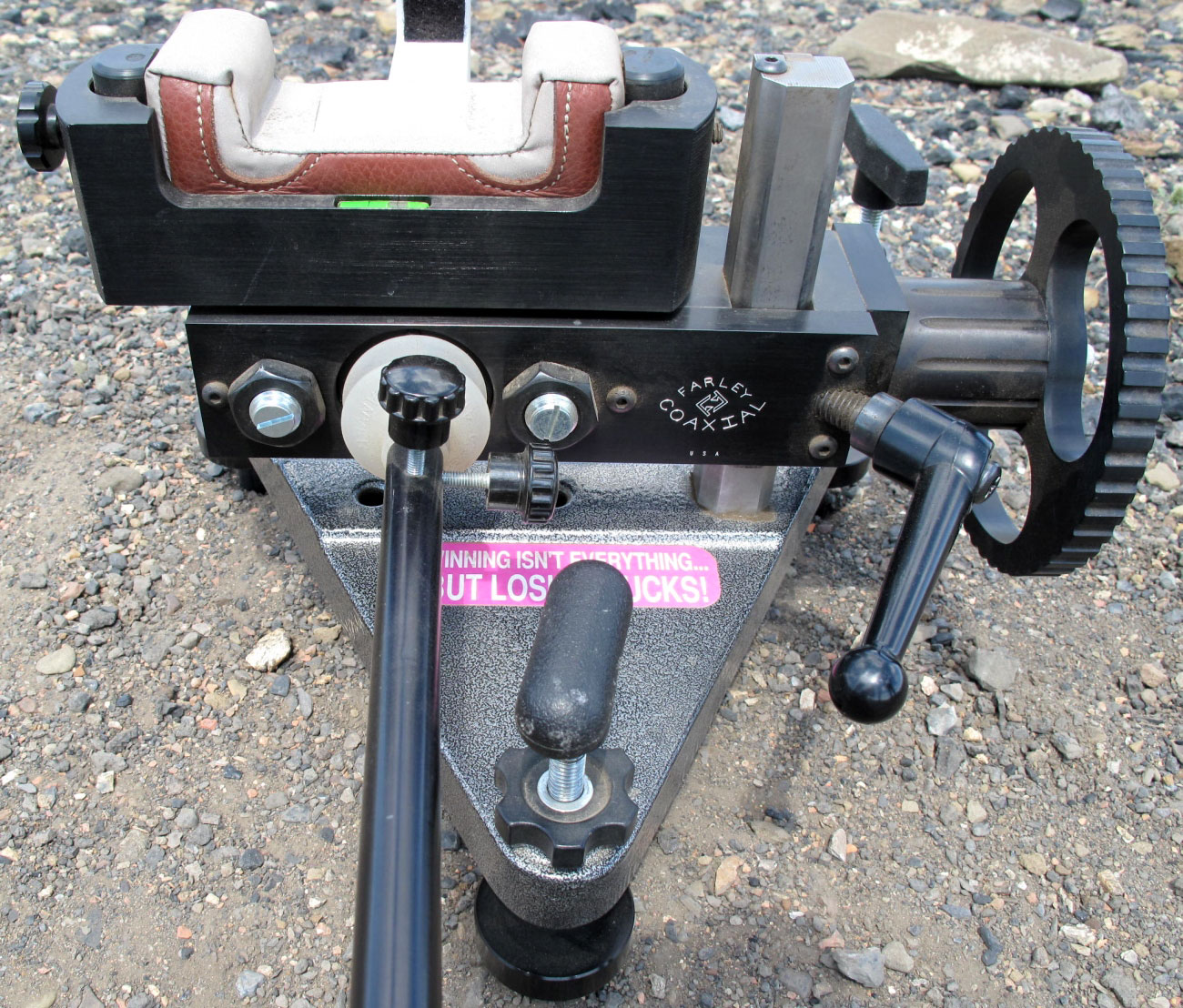
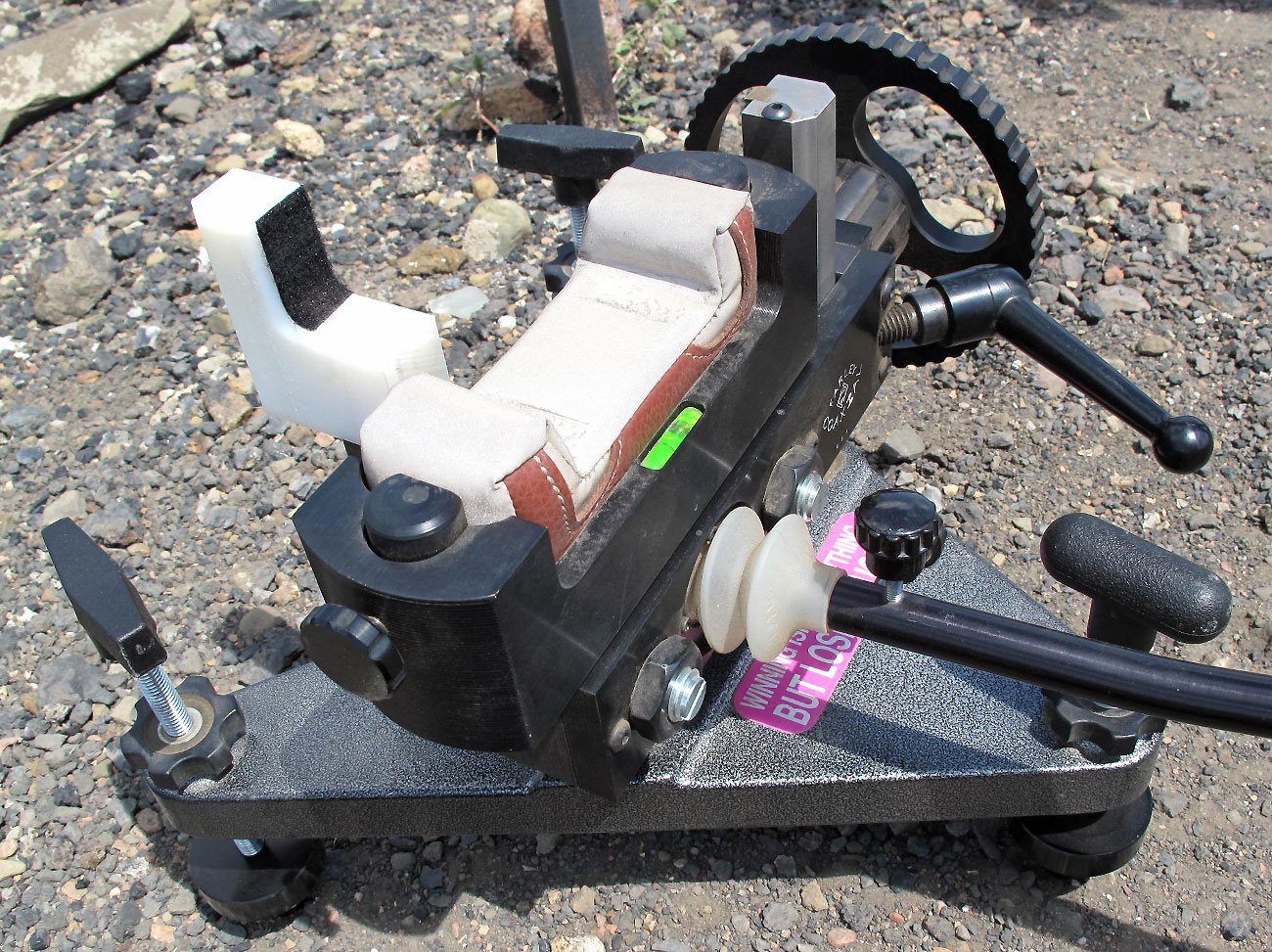
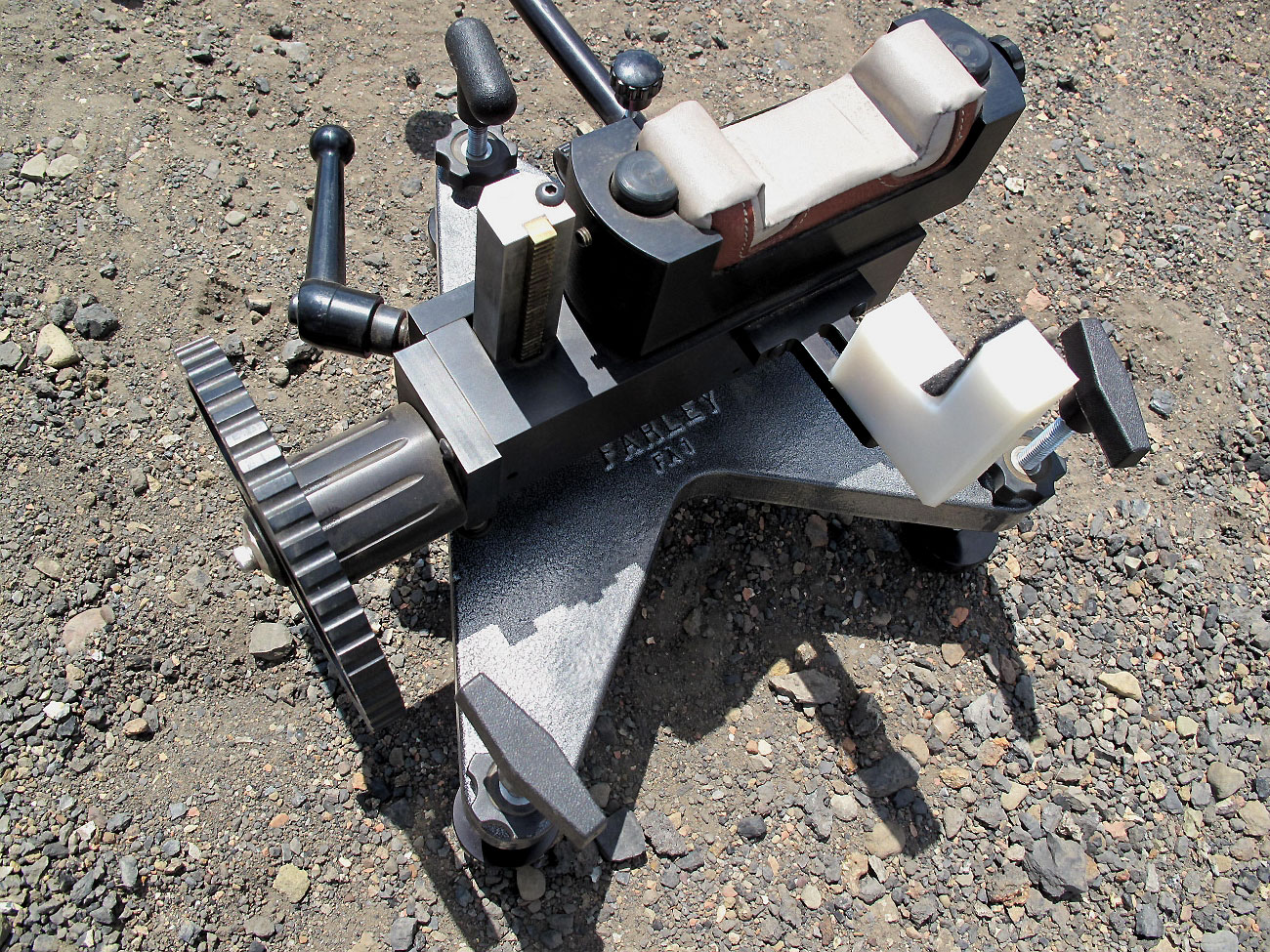
 At the F-Class Nationals in Raton, we saw a wide variety of front rests being used by F-Open shooters. One that caught our eye was a new prototype Farley Coaxial rest brought to the match by our friend Speedy Gonzalez. This one-of-a-kind Farley features a big wheel on the side for gross elevation adjustment, plus an extended locking arm. These two upgrades make the rest easier to use from the prone position. Up front is a new L-shaped Delrin forearm stop (Speedy say this would be black in the production version). Special large-diameter feet with extended “anchor shafts” complete the package. (See bottom photo.) Speedy used this rest at the Nationals and did very well, finishing second in the Master division, and in the top 15 overall among all Open-class shooters.
CLICK Photos Below to See Full-Screen Version.

Speedy says the folks at Farley hope to market the Big Wheel Coaxial with these F-Class upgrades by the end of 2013. Some of the items should be available for purchase separately, as upgrades to current Farley rests. Sorry, no pricing is available at this time.

The rest also sported a new Edgewood front bag with the new light-colored, super-slick bag material. Along with the new bag fabric, Speedy explained that there are subtle changes to the bag design and construction so that it holds its shape better and doesn’t “plump up” in the middle.


October 2nd, 2013
Less weight plus better heat dissipation — Sound good? Here is an innovative barrel technology that promises worthwhile performance benefits for hunters or match shooters. Lothar Walther (LW) has developed a new bi-metal barrel system that cuts weight dramatically while promising significantly-enhanced heat dissipation.
Walther’s Ultra-Lightweight Barrels combine steel with lightweight alloys. This results in a significant weight reduction without the use of carbon fiber, epoxy binders, or other heat-retaining materials. Beginning as an LW50 stainless blank, the barrel is precision-machined to remove excess weight. An outer casing of light-weight alloys is machined and the two are fitted together without adhesives. Basically you end up with the steel inner barrel inside a larger-diameter fluted aluminum outer barrel (see diagram). This gives you the ‘best of both worlds’ — light weight for ease of carry, and thick diameter for rigidity and enhanced heat dissipation. Near the action, the barrel remains all-steel.
The barrels come pre-chambered in your choice of caliber/cartridge, from .22LR up to .338 Lapua Magnum. Walther chambers the barrel — but a gunsmith is still required to finish the shoulder so that the headspace is set correctly for your action. These barrels are not inexpensive. A typical bi-metal Walther Barrel runs $850.00 – $875.00, for barrel lengths from 22″ to 30″. Threading for a muzzle brake or suppressor (if desired) is normally included in that price.
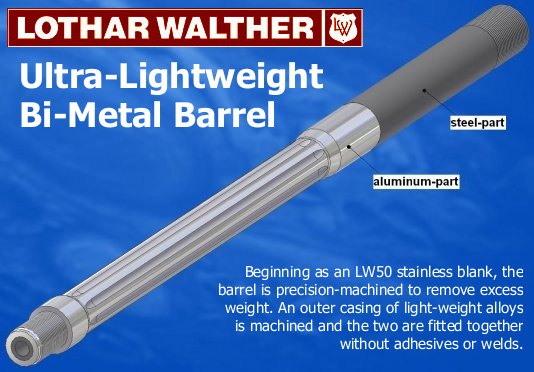
 We haven’t tested one of these bi-metal composite barrels, but the potential for significant weight savings is obvious — aluminum is a lot lighter than steel. What’s more, a metals expert we contacted said that a bi-metal system employing fluted aluminum over steel, if assembled properly, could dissipate heat much better than steel alone (given the same diameter). Stainless steel has a thermal conductivity factor of 16. Aluminum has a thermal conductivity factor of 250.*
Our expert also pointed out that some other composite barrel systems on the market actually increase heat retention because they place insulating materials next to the inner steel barrel. (Carbon, Fiberglass, and Epoxy are all considered “insulating substances” as they have very low thermal conductivity*.) The LW system of aluminum over metal should avoid this mistake, our expert believes. Lothar Walther says: “Unlike solid steel barrels, this barrel sheds heat fast. VERY FAST!”
Half the Weight of Conventional Barrels
How much weight can you save? With a 1.200″ shank diameter and a muzzle diameter of 0.850″, the LW Ultra-Lightweight Barrel is less than half the weight of a standard varmint barrel of the same size. Walther claims its UltraLight Barrel can be “carried for long distances and stand up to heavy firing.” This, LW says, makes these barrels “perfect… for varmint and tactical uses”.
Pre-Chambered Ultra-Lightweight Barrels Available in .22 to .338 Calibers
Lothar Walther offers Ultra-Lightweight barrels in a full range of calibers from .22LR to .338. Each Ultra-Lightweight Barrel comes complete with chamber, crown, and breech threads. These barrels are fluted by the factory. If you order a LW Ultra-Lightweight barrel, Lothar Walter provides the services of a specialist trained in building guns with these barrels. To order one of Lothar Walther’s bi-metal barrels, CLICK HERE or contact Lothar Walthar at the address below:
Lothar Walther Precision Tools, Inc.
3425 Hutchinson Rd. – Cumming, GA 30040
Phone: 770-889-9998 | Fax: 770-889-4919
E-Mail: lotharwalther [at] mindspring.com
Website: www.lothar-walther.com
*Thermal conductivity is the quantity of heat transmitted through a unit thickness in a direction normal to a surface of unit area, due to a unit temperature gradient under steady state conditions. The factor values are based on this formula: W/(m.K) = 0.85984 kcal/(hr.m. °C). Here are thermal conductivty values for common materials: Aluminum, 250; Brass, 109; Steel (Carbon 1%), 45; Stainless Steel, 16; Carbon, 1.7; Brick dense, 1.3; Concrete (medium) 0.7; Epoxy, 0.35; Fiberglass, .04.
Story tip from EdLongRange. We welcome reader submissions.
October 1st, 2013
 Hunting season is here. That means many of you will be heading off into the woods. Along with your rifle and ammo, it’s wise to carry some basic survival gear on your hunt. The NRA has just introduced a cleverly-designed multi-function Survival Tube that fits in a pocket.
This new product combines a fire-starter with a knife sharpener. The NRA Survival Tube’s magnesium fire starter and steel striker can produce sparks in the wettest and windiest conditions. The easy-to-use, diamond-encrusted knife sharpener keeps hunting blades sharp. No one wants a dull knife on a hunting or camping trip. The Survival Tube is wrapped with six feet of 550 paracord, and the lanyard gives you another 31 inches of paracord. The NRA Survival Tube stows easily, or it can be hooked to a backpack loop. Price for this useful product is $19.95 at the NRA Store. That’s not bad, but remember that a $0.99 disposable lighter will start fires just fine in most conditions.

October 1st, 2013
|
Here’s a handy, affordable product that will help you organize gear in your reloading room or “man cave”. Tipton’s new Cleaning Rod Rack (Tipton #100335) can accommodate up to six rods with various size handles. The wall-mounted Rod Rack also has horizontal studs on either end for additional accessories. These are useful for hanging the Tico Tool shotgun cleaning wands that stow in a tube with a plastic hook on the top.
Tipton Cleaning Rod Racks come complete with mounting screws (and screw slots are molded-in). You’ll find Tipton Cleaning Rod racks for under $10.00 at most vendors. They are $7.99 at Cabelas.com, while Amazon.com offers the racks for just $7.99 with free shipping for Amazon Prime Members. |
|


|