At SHOT Show we had the pleasure to talk with Lanny Barnes, a member of the U.S. Olympic Biathlon Team. Along with her twin sister Tracy Barnes, Lanny hopes to compete for Team USA at the 2014 Winter Olympics in Sochi, Russia.
Lanny and Tracy, who hail from Durango, Colorado, learned to shoot before they could ski. That is unusual in biathlon, a sport dominated by Nordic skiing specialists who typically take up shooting only after they have started winning ski races. Under the tutelage of their father, an avid hunter, Lanny and Tracy started shooting at a very young age. Lanny and Tracy were both crack shots before they became competitive skiers. Lanny still enjoys hunting in the Colorado backcountry.
Biathlon is Hugely Popular in Europe
Lanny gave us some new insights into the biathlon game. While biathlon is not widely followed in the United States, it is the most-watched winter sport in Europe according to Lanny. We were also surprised to learn that top-level biathletes do not try to slow their heartbeats during the shooting segment of the competition. Lanny explained that the best competitors train so they can shoot with their hearts beating about 180 times per minute.
Remarkably, with that rapid heart-rate, the movement of the muzzle is more of a flutter than a distinct, heavy rise and fall. Learning to control the amplitude of the muzzle movement with the rapid heart-beat is one of the secrets to success, Lanny tells us. An ultra-accurate, fast-cycling rifle is also very important. Like most top biathletes, Lanny shoots an Anschütz with a straight-pull Fortner action. Lanny tells us that the straight-pull action has made a big change in the sport, speeding up the firing times dramatically. But since all the top competitors can shoot so quickly with modern rifles, that has put a premium on marksmanship. Miss a shot and you may have to do a penalty loop, which can change your standing from front-runner to back of the pack.
Check out the Twins’ Website (Donations Welcome)
Learn more about Lanny and Tracy Barnes on the twins’ website, www.twinbiathletes.com. Though biathlon is a winter sport, Lanny and Tracy train year-round. This requires great commitment and dedication. The Barnes’ quest to compete at the 2014 Winter Olympics also demands a significant budget. If you wish to help Lanny and Tracy in their bid to represent the USA in 2014, you can make a donation (via PayPal) on www.twinbiathletes.com.
AccurateShooter.com’s coverage of SHOT Show showcases products and vendors we think would be of greatest interest to our readers. We visited close to 200 exhibits in four days. But there is much, much more that we don’t have time to cover. At the 2011 SHOT Show, there were nearly 1,600 exhibitors, who collectively occupied 630,000 square feet of booth space (the equivalent of 11 football fields). To get the full SHOT Show experience, check out these photo collections from The NRA Blog. These and other photo collections are found on the NRA Blog’s Picassa Public Photo Gallery.
The big news at the Nightforce Optics booth this year involved Nightforce’s “High-Speed” turret design. First introduced on select models in 2010, now the “high-speed” turrets will be installed as standard equipment on Nightforce’s full line of NXS riflescopes (except compacts). The “High-Speed” turrets basically double the amount of elevation (or windage) travel you get with one full revolution of the turret. Previously, a Nightforce elevation turret delivered 10 MOA of elevation adjustment with one 360° turret rotation. Now, with the “High-Speed” turrets, Nightforce scopes will yield twenty (20) MOA of elevation travel with one full revolution. The “High-Speed” windage knobs will now give 10 MOA of travel in each direction. For mil-based turrets, the amount of elevation travel (per revolution) has been increased from 5 mils (per 360° spin) to 10 mils.
The doubling of adjustment travel (per revolution) really is an important upgrade that should make Nightforce scopes more user-friendly and fool-proof. For most popular cartridges, you should be able to go from 100 to 1000 yards within one 360° spin of the elevation turret. This means you no longer have to worry about which revolution you’re on. There are highly visible index numbers on the turret, so you should be able to just dial an index number (e.g. 9, 12, 18) to zero at any distance from 100 to 1000.
New Velocity 600 and Velocity 1000 Ballistic Compensating Reticles
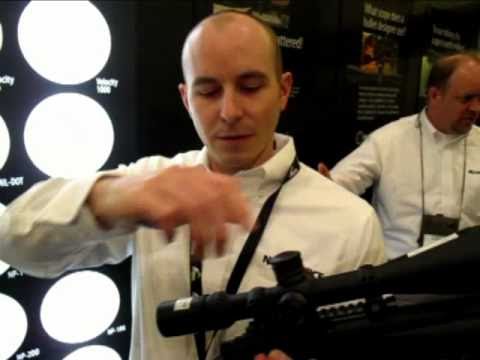
Nightforce will also introduce two new “Velocity” reticles in the summer of 2011, one for 600 yards max, and the other for 1000 yards max range. These will initially be available for the 3.5-15X and 5.5-22X scopes only. Both NF “Velocity” reticles are basically Bullet Drop Compensating reticles that provide hold-over lines for particular yardages. But, you might ask, “How does Nightforce know the ballistic drops for my particular cartridge?” Here’s how it works — the customer sends in his bullet type, bullet BC, and muzzle velocity. Then Nightforce picks one of five (5) calibrated “Velocity” reticles, selecting the hold-over reticle design that most closely matches the actual trajectory of your loads. For most hunters using a common cartridge, one of the five Nightforce “Velocity” reticles should provide a good fit to your load’s ballistics. This isn’t revolutionary — Burris, Leupold, and Zeiss all offer something similar, but it’s good to see Nightforce add this reticle option to its lineup.
We had a chance to chat with Team Smith & Wesson Captain Julie Golob at SHOT Show. Julie is one of the finest action pistol shooters in the world, so she knows a thing or two about shooting competitively on the clock.
Kelly Bachand, our SHOT Show correspondent, is primarily a Palma shooter. In that discipline there’s ordinarily plenty of time between shots. But Kelly, a popular contestant on the TOP SHOT TV series, hopes to branch out into action shooting and multi-gun competition.
Julie gives Kelly some great advice on how to succeed in speed games by finding the “acceptable” sight picture. Julie explains that you need to abandon the “pursuit of perfection” and find a zone of “acceptable” accuracy that lets you to score points while running the stage as fast as possible. As Kelly puts it, you need to find out “what you can get away with” in terms of sight picture. Kelly and Julie also discuss equipment for 3-Gun matches and the differences between open and tactical classes.
SGT Sherri Gallagher of the U.S. Army Marksmanship Unit had a spectacularly successful 2010. First she won the National High Power Championship convincingly, setting records in the process. Then young Sherri earned the title of “Soldier of the Year”. Sherri is the first women ever to be honored as the U.S. Army’s Soldier of the Year.
When we learned Sherri was staffing the USAMU booth at SHOT Show, we headed straight there with the hopes of chatting with America’s premier lady rifle shooter. Our correspondent Kelly Bachand was eager to talk to Sherri, as they are friends who once shot together on the U.S. National Junior team. You should really take the time to watch this video. Sherri is very open and candid about her shooting accomplishments, and she offers advice that will help any shooter.
Report by C.D. Michel
In a dramatic ruling giving gun owners a win in an National Rifle Association / California Rifle and Pistol (CRPA) Foundation lawsuit, this morning Fresno Superior Court Judge Jeffrey Hamilton ruled that AB 962, the hotly contested statute that would have banned mail order ammunition sales and required all purchases of so-called “handgun ammunition” to be registered, was unconstitutionally vague on its face.
The trial Court enjoined enforcement of the statute, so mail order ammunition sales to California can continue unabated, and ammunition sales need not be registered under the law.
The lawsuit was prompted in part by the many objections and questions raised by confused police, ammunition purchasers, and sellers about what ammunition is covered by the new laws created by AB 962. In a highly unusual move that reflects growing law enforcement opposition to ineffective gun control laws, Tehama County Sheriff Clay Parker is the lead plaintiff in the lawsuit. Other plaintiffs include the CRPA Foundation, Herb Bauer Sporting Goods, ammunition shipper Able’s Ammo, collectible ammunition shipper RTG Sporting Collectibles, and individual Steven Stonecipher. Mendocino Sheriff Tom Allman also supported the lawsuit.
The ruling comes just days before the portion of the law that bans mail order sales of so-called “handgun ammunition” was set to take effect on February 1, 2011. The lawsuit, Parker v. California, is funded exclusively by the NRA and the CRPA Foundation. If it had gone into effect, AB 962 would have imposed burdensome and ill-conceived restrictions on the sales of ammunition. AB 962 required that “handgun ammunition” be stored out of the reach of customers, that ammunition vendors collect ammunition sales registration information and thumb-prints from purchasers, and conduct transactions face-to-face for all deliveries and transfers of “handgun ammunition.” The lawsuit successfully sought the declaration from the Court that the statute was unconstitutional, and successfully sought the injunctive relief prohibiting law enforcement from enforcing the new laws.
Trial Court Agrees that Ammo Ban is Unconstitutionally Vague
The lawsuit alleged, and the Court agreed, that AB 962 is unconstitutionally vague on its face because it fails to provide sufficient legal notice of what ammunition cartridges are “principally for use in a handgun,” and thus is considered “handgun ammunition” that is regulated under AB 962. It is practically impossible, both for those subject to the law and for those who must enforce it, to determine whether any of the thousands of different types of ammunition cartridges that can be used in handguns are actually “principally for use in” or used more often in, a handgun. The proportional usage of any given cartridge is impossible to determine, and in any event changes with market demands.
Decision Will Probably Be Appealed but Law Will Still Be Suspended
Constitutional vagueness challenges to state laws are extremely difficult to win, particularly in California firearms litigation, so this success is particularly noteworthy. Even so, an appeal by the State is likely, but the Court’s Order enjoining enforcement of the law is effective immediately, regardless [of the possibility of appeal]. Editor’s Note: An injunction against the application of AB 962s provision will remain in effect until such time as it is vacated by an appellate court. But for the time being, mail-order ammo sales to California can proceed without restriction, as if AB 962 were never signed into law. Until a higher court rules otherwise, the contested provisions of AB 962 are rendered a nullity.
This report provided by C.D. Michel Michel of Michel & Associates, counsel for the NRA in the litigation challenging the California mail-order ammo ban.
Media Day at the Boulder City, Nevada range was a blast — literally. We had a chance to sample some big .338 Lapua Magnum rifles from Barrett and Sako. The recoil on the Sako TRG42 was epic, as it lacked a muzzle brake, and the front sandbag did nothing to tame rearward movement. We’ll provide more info on the TRG42 (and its new folding stock) later this week.
New Tikka T3 Sporter — Master Sporter Reborn
Tikka unveiled an interesting new T3 Sporter, fitted out in a handsome laminated position stock. This seems to be the successor to Tikka’s popular (but long since discontinued) Master Sporter series. We only hope Beretta, Tikka’s parent company, will eventually offer a wider selection of calibers — right now Beretta only plans to sell .223 Rem and 22-250 versions in the USA.
New Tikka T3 Sporter
MRAD is Impressive — and Brutally Expensive
Barrett’s new MRAD “adaptible” rifle was an impressive beast — as it should be at $6000.00 per unit. It did display some very clever engineering that allows a user to switch barrels and even change calibers with no gunsmithing. Check out the video for a review of the many unique features of the MRAD.
Crosman’s Computer-Controlled Airgun
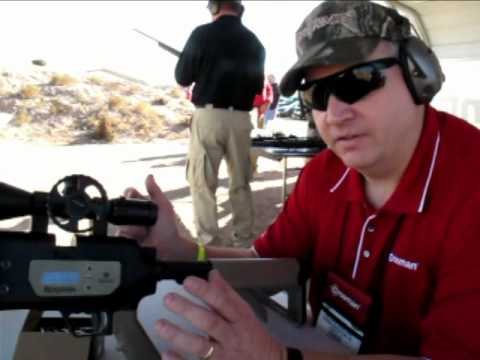
Perhaps the most innovative (or at least technologically advanced) rifle on display wasn’t officially a “firearm” at all. Crosman’s new Benjamin Rogue, pneumatic varmint rifle actually has a microprocessor-controlled “fire control” system. Yes this state-of-the-art airgun actually has an internal computer that monitors the available air pressure, and sets the output level according to the bullet weight and desired velocity. This is no Daisy B-B gun — the Rogue is big and bulky. But it also delivers the hitting power of a 38 Special, all without a single kernel of gunpowder. Crosman’s Rogue will launch a 145gr polymer-tipped Nosler bullet at 850 fps. Just run the numbers and you’ll find the Rogue delivers as much terminal energy as many centerfire pistol cartridges.
Polymer Cartridge Casings from PCP
A Florida-based company, PCP Ammunition, unveiled a truly revolutionary product — polymer-cased ammo. The “cartridges” have a metal rim/base section (like shotgun shells) but nearly all the cartridge body is a tan-colored high-strength polymer. No, this product won’t do reloders much good, but it could be a huge “hit” with the military, as a polymer case is at least 25% lighter than brass. PCP Reps claimed that PCP’s plastic-bodied ammo can withstand loads that would be considered “full presure” in conventional brass. Stay tuned for further updates.
SHOT Show kicks off tomorrow, Tuesday, January 18th. Today your Editor is fortunate enough to be attending the Media Day event, hosted at the Boulder Rifle & Pistol Club, outside Las Vegas.
At Media Day, we’ll be inspecting and testing new firearms to be introduced later this week at SHOT Show. This is a rare opportunity to handle and shoot a wide selection of new firearms, and also to test new optics and other accessories. Stay tuned to the Daily Bulletin for regular updates on our Media Day discoveries, plus all the latest products on display at SHOT Show. We will be interviewing many firearms industry notables, and we’ll try to get photos (and video clips) of the most interesting and innovative new products.
The NSSF, which operates the SHOT Show, also has its own YouTube Channel now. There you can a variety of professional-produced short videos every day for the next week. To watch the NSSF Videos, go to www.YouTube.com/nssfshotshow.
Most of our readers know that AccurateShooter.com completed a major site upgrade late last year. But perhaps you haven’t seen all the new features yet. The site has been completely over-hauled and improved, with a larger format, more photos, better search engine, easier navigation, and database-served articles (to help you find related content faster).
Explore our Updated Website
Visit www.accurateshooter.com, to check out our new home page. There you’ll find a selection of popular articles (that change with each new page visit), a “feed” of our latest Daily Bulletin items, plus links to videos, free targets, free Classified Ads, and of course our popular Cartridge Guides.
New Featured Tubegun Story with Eliseo Video Interview
We just released our latest Featured Gun of the Week Story. This article spotlights a .308 Win tubegun built with an Eliseo (Competition Machine) RTS Chassis. Mark LaFevers, the gun’s owner, assembled the rifle himself and chambered the barrel. And get this — Mark even built his own bipod, bag-riders, scope rings, and advanced muzzle brake. The story is a “must read” for all Tubegunners and .308 Win fans. CLICK HERE to read the story. For a sample, watch the video below, which features an interview with Tubegun guru Gary Eliseo.
This new Tubegun article illustrates some of the cool features of our upgraded website. First, we’ve embedded thumbnail links to related articles within the text. In addition, in the right column you’ll find a set of links to related stories. Just click on the link (as shown by the arrows) to real a new story on a similar topic. This makes it is easy for readers to find interesting, relevant content. All articles are now searchable through a fast search engine. You’ll find a search window at the upper right hand corner of every page in the updated website.
In case you haven’t heard, February 1, 2011 is the last day you can legally purchase handgun ammunition in California, without providing a fingerprint and personal contact information. As if that wasn’t bad enough, the same law that mandates “print and ID” to purchase, also prohibits handgun ammunition sales that are not “face to face”. That effectively bans online and mail-order handgun ammo sales from any source. All these changes were enacted into law with the passage of AB 962 last year.
Given California’s tough new ammo law, most online ammo vendors, including Ammoman.com, Cabelas.com, Grafs.com, and MidsouthShootersSupply.com have announced order deadlines in January. To allow for packing and transit times, these vendors will stop taking handgun ammo orders from California customers 10-17 days before the new law goes into effect.
So when are the Vendor-imposed Deadlines for ammo purchases? Well today, February 14 is the last day Californians can purchase handgun ammunition from Grafs.com. MidsouthShootersSupply is cutting off orders on January 20th. You have another day if you order from Cabelas.com — it will continue to take handgun ammo orders from Californians through January 21, 2011.
Smallbore Rifle Shooters Will Be Affected by New Law
Unfortunately, AB 962’s definition of “handgun ammunition” is vague, and California’s Department of Justice has failed to provide any meaningful clarification. This means that mail-order ammo vendors will have to halt shipments of ammo that could be used in both rifles and pistols. Take .223 Remington for example. Most people would consider that a rifle cartridge. However, Keltec and other manufacturers make pistols chambered for the .223 Rem. Most importantly, virtually all rimfire ammo will be embargoed because 17 Mach 2, 17 HMR, .22 LR, and .22 WMR are all used in pistols. So, you Californians needing .223 Rem, or rimfire ammo for your rifles better place your orders soon.


 At SHOT Show we had the pleasure to talk with Lanny Barnes, a member of the U.S. Olympic Biathlon Team. Along with her twin sister Tracy Barnes, Lanny hopes to compete for Team USA at the 2014 Winter Olympics in Sochi, Russia.


 We had a chance to chat with Team Smith & Wesson Captain

 Report by C.D. Michel



 SHOT Show kicks off tomorrow, Tuesday, January 18th. Today your Editor is fortunate enough to be attending the Media Day event, hosted at the Boulder Rifle & Pistol Club, outside Las Vegas.
 Most of our readers know that AccurateShooter.com completed a major site upgrade late last year. But perhaps you haven’t seen all the new features yet. The site has been completely over-hauled and improved, with a larger format, more photos, better search engine, easier navigation, and database-served articles (to help you find related content faster).

 In case you haven’t heard, February 1, 2011 is the last day you can legally purchase handgun ammunition in California, without providing a fingerprint and personal contact information. As if that wasn’t bad enough, the same law that mandates “print and ID” to purchase, also prohibits handgun ammunition sales that are not “face to face”. That effectively bans online and mail-order handgun ammo sales from any source. All these changes were enacted into law with the passage of AB 962 last year.


