Want to become a pro shooter? Here’s your chance. Smith & Wesson is now soliciting new shooters interested in joining Team Smith & Wesson for the 2010-2011 competitive season. Applications, which will be accepted until April 30, 2010, are available online at Champions.smith-wesson.com. The selection process is open to all shooters interested in becoming a part of a winning team. You must have the “right stuff” of course.
To evaluate each applicant, Smith & Wesson has developed a cumulative point system to award sponsorships to prospective S&W Team members. Selection criteria includes, but is not limited to, match level, performance, experience and exposure. Over the course of last year’s season, the 20 members of Team Smith & Wesson won a total of 28 state, 31 regional, 9 national, 5 international and 18 world championship titles.
Julie Goloski — Captain of Team Smith & Wesson Womens’ Team.
Tom Kelly, Vice President of Marketing for Smith & Wesson states: “By becoming a member of Team Smith & Wesson, you will have the opportunity to showcase your skills in matches across the country while serving as a representative to one of the largest and most prestigious firearms manufacturers in America.” For more information regarding Team Smith & Wesson, including team member bios, match recaps and to access an application, visit www.smith-wesson.com and click on the Champions Icon on the left side of the homepage.
Just days after surprising the firearms industry with the announcement that the Marlin Firearms factory in North Haven, Connecticut would be shut down, executives of Remington Arms today dropped another bombshell concerning the fate of Marlin, a Remington subsidiary. This morning, Remington released a statement declaring that Marlin would be “re-constituted” as a multi-product outdoor gear manufacturer, with a primary focus on fishing tackle and equipment.
In the wake of Remington’s decision to shut down the North Haven plant by mid-2011, laying off all 265 Marlin employees in the process, many questions remained as to the fate of legendary arms-maker Marlin, which has been building firearms in Connecticut continuously since 1870. When the Marlin plant closure was announced, Remington, part of the Cerberus Freedom Group of companies, would neither confirm nor deny that Marlin firearms, particularly the popular lever-action rifles, would still be produced. Sources inside Remington were quoted as saying that Marlin rifle production would be relocated to Remington’s Ilion, New York facilities.
Now it appears that Remington has other, quite radical plans for Marlin, which surely reflect the strategic goals of Remington’s parent, Cerberus Capital Management, a private holding company. Cerberus has no doubt “seen the writing on the wall”, recognizing that gun sales are in a steep decline following the buying frenzy precipitated by the Democratic election victories in 2008. To protect its investment in Marlin, Cerberus saw the need to shift Marlin into a whole new market. That’s certainly a bold strategy, but is it wise?
AccurateShooter.com was able to reach one high-level Remington insider with insights into the latest Marlin transition. Our source confirmed that “most of the Marlin firearms line will survive, but not every product will be staged into production right away. Only the most popular rifles will be transitioned into immediate production at Remington plants in Ilion, New York and elsewhere.” Our source explained that building Marlin rifles outside Connecticut is not easy: “Understand that most of the machines and tooling in North Haven were quite antiquated. It’s not even worth moving most of the big equipment. We have to figure out how to replace that junk before we can start building lever guns again.”
“Marlin’s real focus”, our source continued, “will be the fishing stuff — and that’s where 90% of our resources will be allocated. Our market research shows we can sell more rods and reels, at a higher profit margin, than we can old-fashioned rifles. Demographically, fishing is growing while rifle shooting has become a cultural anachronism — a hobby for old white guys. With the Marlin name and trademark, we realized we had a perfect platform to get into the fishing market. Ask most Americans what a Marlin is… nine out of ten will say it’s a fish, not a rifle. Since most consumers already connect the name Marlin with fishing, it made perfect sense to change the company’s focus. And now’s the perfect time to do it, what with the imminent North Haven plant closure.”
While devotees of Marlin rifles may lament the passing of yet another storied American gunmaker, anglers nationwide, who outnumber rifle shooters by nearly 3 to 1, have reason to celebrate. The “rebirth” of Marlin as a rod, reel, and tackle manufacturer promises to offer fishing enthusiasts a wide range of new products, proudly marketed with the “Made in USA” legend. Shown above is Marlin’s new “Fish Eagle II” Rod and Reel combo, complete with Marlin’s signature lever action. The fishing gear industry is currently dominated by foreign manufacturers. Marlin’s movement into the fishing market gives anglers a chance to “buy American” again.
We just got the complete F-Class Nationals match results from Jim O’Connell of the Sacramento Valley Shooting Center. Jim provided two (2) MS-Word documents, one for F-Open and the other for F-TR. Jim added: “Thanks to the California Grizzlies (target pullers) for all their work and helping to make the Saturday and Sunday shoots more enjoyable. Thank you all for your support of the Folsom Shooting Club and we hope to see you at future matches.”
The Hickory Groundhog Shoot, the nation’s most popular groundhog shooting competition, will be held Saturday, April 3rd in Vale, North Carolina. Now in its 30th year, this is the biggest Varmint competition on the East Coast, with over $4000.00 worth of prizes awarded each year, including $1000.00 in cash.
You can compete individually or as part of 3-man teams. The entry fee is $25 per gun, plus (optional) $10 per team. There will also be a 500-yard Egg Shoot with a $2.00 entry fee.
Custom or Factory Classes — Simple Rules — Valuable Prizes
There are two classes, custom and factory, and the rules are pretty basic. You can run pretty much anything but a rail gun in custom class, and you can use any kind of front rest (including one-piece rests). A “factory” gun must be “bone stock” as purchased and you are limited to bipod, sandbags, or basic pedestal style front rest. The only modifications allowed for factory class are: 1) bedding job; and 2) trigger tuning (without replacement parts). Competitors may enter one gun in each class, but the fee is $25.00 per gun.
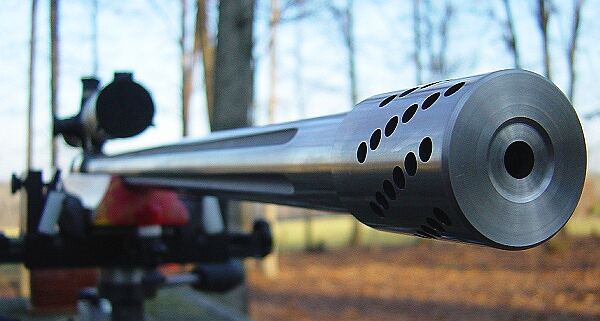
This year, ALL targets will be at known distances: 100, 300, and 500 yards. That should be a cake walk for you 1000-yard shooters. In the past, 6BRs, 6BR Improveds and the mid-size 6mms have been the calibers to beat. To see what it takes to win, read this article about Harold Seagroves’ Spencer-built 6BR (below), which has won the Hickory Shoot multiple times.
The range will be open for practice Monday through Friday the week preceding the match. The practice range is open ’til 6:00 pm Tu-Thurs, but will close at 1:00 pm on Friday. The match will start 8 o’clock sharp Saturday morning, April 3rd. If you have any questions call Larry Willis, Bulls Eye Sporting Goods, (704) 462-1948, or visit www.BullseyeLarry.com. To find the actual range using online maps or your GPS, use this address: 8216 Will Hudson Road, Lawndale, NC 28090.
A decade ago, Prof. John Lott wrote More Guns, Less Crime, a ground-breaking book that used advanced statistical analysis to prove that gun ownership by law-abiding citizens can reduce violent crime rates. Lott was initially assailed by the mainstream media, who refused to believe Lott’s numbers.
Now, it appears that the national media is grudgingly accepting that the increase in concealed weapon permits in many states has been associated with reductions in violent crime and in particular a notable decline in murder rates. MSNBC.com, a website known generally for its liberal-leaning news reports, recently ran an article on citizen gun carry that reveals that crime has dropped significantly in “shall-issue” states where concealed weapons permits are available to law-abiding citizens. MSNBC.com states that it is too simplistic to credit gun-toting citizens for the reduction in crime (which may have had other causes), but the statistics are noteworthy. MSNBC.com reports: “From its beginnings in the 1980s, the ‘right-to-carry’ movement has succeeded in boosting the number of licensed concealed-gun carriers from fewer than 1 million to a record 6 million today, according to estimates from gun-rights groups that are supported by msnbc.com’s research.”
Disagreement Persists as to Causes for Reduced Crime Rates
While MSNBC.com explains that the connection between lawful gun ownership and crime rates is “hotly debated” and not completely understood, MSNBC.com does acknowledge that crime rates have fallen virtually everywhere that “right to carry” laws were adopted. MSBNC.com quotes John Pierce of Opencarry.org: “Firearms in the hands of law abiding citizens prevent 1 million robberies, murders and rapes every year.” On the other hand, MSNBC.com cites a Harvard professor, Dr. David Hemenway, who claims that the available research is inconclusive and that “when it comes to concealed-carry laws, neither side can make a legitimate claim about their effects on crime”.
No matter how you feel about the new Health Care Reform Act, there is at least ONE aspect of the legislation that should please you, thanks to the Gun Owners of America (GOA). Here’s the deal — at the insistent request of the GOA, a special provision was added to the health care reform bill that expressly FORBIDs any “wellness program” (public or private) from collecting (or distributing) any information about gun ownership. Why is this important? If such information was collected, health care providers could pass on the information to insurers who might then charge gun-owners higher rates based on perceived “unhealthy lifestyles” or higher risk factors.
In addition to the ban on information collection, the GOA, through the efforts of Senator Majority Leader Harry Reid of Nevada, added a second critical protection to the new legislation. According to the Slate Blog, the GOA “won another provision forbidding private insurers participating in the bill’s exchanges from charging higher premiums, or denying coverage, or denying wellness discounts on the basis of gun ownership.” The “exchanges” mean the state-level insurance pools from which citizens may purchase health insurance if they are not currently covered.
Will this make a difference? You bet. One web reader, commenting on the Slate story, explained: “I’ve worked as a consultant to insurance companies and I can promise you they [the insurance companies] will not only use that data to charge you and your family more for insurance (dangerous activities), but then also pool their data and sell their data to any company or government agency that has the cash to pay the price. Is that what you wanted from health care?”
Obviously there are many other controversial issues associated with the new Health Care Reform Act. However, thanks to the GOA and Nevada Senator Harry Reid, at least firearm owners can take some comfort that health care providers and insurers will NOT be asking questions about our guns, and using the answers to raise our rates… or worse.
Marlin Firearms, now owned by Remington Arms (part of Cerberus Capital Management’s Freedom Group), is going to shut down its North Haven, Connecticut manufacturing facility. This marks the end of a legendary period of gun-making in New England. Marlin has produced firearms in Connecticut since 1870, when the company was founded by John M. Marlin.
A Marlin spokesman indicated that the plant will be closed by June, 2011, and all 265 employees will be terminated via phased lay-offs starting in May, 2010. The Marlin plant closure, announced late Thursday (March 24th), came as a surprise to both Marlin employees and North Haven community leaders. Marlin plant workers reported being “blindsided”. One worker told WTNH Channel 8 that: “We never saw this coming… we were told to attend a mandatory meeting at 3:30… And then boom [that was it].” Remington has not yet issued an official statement about the factory closure, but one insider speculated that the plant was closed to “avoid union wage pressure driving retail cost upward and making the product less competitive in the modern firearms market.”
Marlin is currently head-quartered in Madison, North Carolina. There is no indication that the production of Marlin rifles will be halted — production will likely be shifted to Freedom Group factories in other states. The Shooting Wire reports that: “According to Remington Arms sources, the facility is being decommissioned and the manufacturing relocated to Remington’s Ilion, New York facilities; the Marlin lines are not moving offshore.” The production relocation will apply to Marlin products, and, presumably, to the other brands made by Marlin: Harrington & Richardson, New England Firearms, and L.C. Smith.
Marlin’s founder, John M. Marlin, learned his trade during the Civil war, working at the Colt plant in Hartford, Connecticut. In 1870, according to Marlin’s website, Marlin “hung out his sign on State Street in New Haven, manufacturing his own line of revolvers and derringers.” The Marlin enterprise was purchased by Frank Kenna in 1924, and the Kenna family maintained ownership until Remington acquired Marlin in 2008.
Click Arrow Lower Left to Play Report from WTNH-TV Channel 8 in New Haven:
This weekend, March 27-28, the Arizona Game and Fish Department hosts its Outdoor Expo 2010 at the largest public shooting complex in the nation — the Ben Avery Shooting Facility, located just west of Interstate 17 on Carefree Highway. At the Expo, you can try out many different shooting disciplines. Plus there will be archery classes, mounted (horseback) shooting demos, wildlife info sessions, and many other outdoor activities. This is a very popular event — the 2009 Expo drew over 35,000 visitors. Both Admission and parking are FREE.
Outdoor Expo visitors will be able to test the latest firearms from companies like Glock, Smith & Wesson, and Ruger. Visitors can also try a variety of specialty shooting disciplines, such as cowboy action shooting, black powder, tactical pistol, and silhouette shooting.
Shotgun fans can shoot skeet, trap or sporting clays at Ben Avery’s enhanced Clay Target Center. Kids can shoot .22s and air guns while learning more about firearm safety. Guests (of all ages) can take an archery class or try out “3D Archery” on a walking course through the desert. There will be many exciting demonstrations at the 2009 Outdoor Expo. Visitors can witness a Dillon Aero mini-gun demonstration or even shoot a vintage Gatling Gun.
Gary Marbut, president of the Montana Shooting Sports Association, has revealed that once-fired military brass is being converted into scrap metal rather than being sold in reloadable condition with revenues going to the U.S. Treasury. The destruction or mutilation of once-fired brass runs contrary to the efforts of Congressional leaders to ensure that fired military brass be resold rather than destroyed. Marbut claims that once-fired brass is now being destroyed as the result of “sweetheart side deals with installation commanders that [are] being aggressively promoted by ATK.”
According to Marbut, ATK/Alliant Techsystems has encouraged military base commanders to sell their used cartridge brass directly to ATK. The brass is then demilled and rendered down to scrap metal for use in ATK’s future new cartridge production. Marbut states: “ATK even provides portable equipment to demil tons of cartridge cases at the military installations, destroying the brass for reloading purposes. Because the destroyed cartridge case brass is not suitable for reloading, it cannot command a price driven by auction for the highest-value use of reloading. Military installation commanders sell the Alliant-destroyed brass to ATK at a private, non-auction, special price. Commanders are willing to accept the reduced price because the sale proceeds go to the commanders’ discretionary accounts and not back to the U.S. Treasury via Government Liquidations.”
As a result of this reported arrangement between military commanders and ATK, Marbut believes, millions of used military cartridge cases, which otherwise could enter the commercial market for surplus brass, are being destroyed rather than sold at auction for fair value. In a time when there are still acute shortages of reloading components, this reduces the supply of reloadable brass, while depriving the U.S. Treasury of sales proceeds. Marbut calls for Congressional action to stop the “sweetheart deals” and ensure that “expended military brass of civilian-usable calibers generated domestically goes through the public auction process.” Marbut believes that “will benefit the U.S. Treasury, America’s gun owners, and the adequacy of the ammunition marketplace.”
Bryan Litz, author of Applied Ballistics for Long Range Shooting, informed us that sophisticated new ballistics software is now available for Android OS phones. While there are ballistics programs that run on iPhones, as well as programs for Palm or Windows PDAs (Personal Digital Assistants), Bryan believes that the new Ballistics App, called SHOOTER, is the first such program for Android operating system (OS) products — such as Motorola’s Droid phone and Google’s new Nexus phone.
Bryan explained: “The SHOOTER App can be found in the Google marketplace by searching for ‘Ballistics’. I became interested in this program when I got my Android phone. There are several good programs out there for iPhones and PDAs. But SHOOTER is the first program I know of for Android. In my opinion, it won’t be topped by anything else. If you have an Android smartphone, I highly recommend checking out this application. The program is easy to install and run. Outputs are available as a single-shot solution or as a table. There is a ‘Lite’ version of SHOOTER that you can download for free, and the ‘full’ version is $9.99.”
The new “Shooter” Program for Android OS has an impressive list of features:
G1 and G7 BC capability, with the option to input ‘velocity banded’ BCs.
Angle Compensation (Up or Down Angle can be measured using the built-in inclinometer).
Bullet Library which includes Litz-measured “true” BCs.
Rifle and ammo profiles (for storing load info for all your guns).
Atmosphere effects (pressure, temp, and humidity).
Spin drift (requires bullet length and twist rate inputs).
Coriolis effect (works best with GPS-equipped Android phones).
Bryan revealed: “I was heavily involved in the development of this program and can vouch for the accuracy of the solution. The actual solver is very similar to the one used in my programs and in the JBM online Ballistics Program. SHOOTER’s calculations normally match my numbers and JBM’s numbers within round-off error (0.1″ at 1000 yards).”


 We just got the complete F-Class Nationals match results from Jim O’Connell of the Sacramento Valley Shooting Center. Jim provided two (2) MS-Word documents, one for F-Open and the other for F-TR. Jim added: “Thanks to the California Grizzlies (target pullers) for all their work and helping to make the Saturday and Sunday shoots more enjoyable. Thank you all for your support of the Folsom Shooting Club and we hope to see you at future matches.”




 A decade ago, Prof. John Lott wrote


 Shotgun fans can shoot skeet, trap or sporting clays at Ben Avery’s enhanced Clay Target Center. Kids can shoot .22s and air guns while learning more about firearm safety. Guests (of all ages) can take an archery class or try out “3D Archery” on a walking course through the desert. There will be many exciting demonstrations at the 2009 Outdoor Expo. Visitors can witness a Dillon Aero mini-gun demonstration or even shoot a vintage Gatling Gun.

 Bryan Litz, author of


