If you have ever turned a large quantity of case-necks using power assist, you know that a carbide mandrel can make the job go easier, with better end results. In our experience, when using carbide mandrels (as opposed to ordinary steel), the cases move more smoothly with less heat build-up. Pat Reagin of PMA Tool explains why carbide neck-turning mandrels work better:
Carbide offers several advantages over conventional steel and stainless steel when making any tooling, specifically neck-turning mandrels:
Dimensional Stability — Carbide maintains its dimensions indefinitely during heating and cooling. This eliminates the need to allow the mandrel time to cool every few cases.
Coefficient of Friction and Wear-Resistance — Carbide exhibits a low coefficient of friction value as compared to all steels and wears up to 100 times longer. This reduces (but does not eliminate) the amount of lubricant required.
Galling Resistance — Carbide has exceptional resistance to galling and welding at the surface. This basically eliminates the chance of getting a case stuck on a mandrel due to insufficient lubrication.
Given the benefits of carbide neck-turner mandrels, you may be asking “where can I get one?” Sinclair Int’l offers carbide mandrels for Sinclair neck-turners for $49.99, in a full range of calibers: 17, 20, 22, 6mm, 25, 6.5mm, 270, 30, and 338.
$49.95 Carbide Mandrels from PMA Tool
PMA Tools now also offers carbide mandrels in a full variety of sizes. At $49.95 each, PMA’s carbide mandrels are priced competitively with Sinclair’s mandrels. PMA offers carbide mandrels in .17, .20, .22, 6mm, 6.5mm, 7mm and .30-caliber. These will work with Sinclair Int’l and 21st Century neck-turners, as well as PMA neck-turners. PMA tells us: “We now have carbide neck-turning mandrels in stock. These mandrels are made with high-tech CNC grinding-machinery, and should give you excellent results. We hope to be add other larger-caliber carbide mandrels to our lineup in the future.”
You can now purchase an exact reprint of Howell’s classic book for $59.98. This 600-page hardcover (8 1/2″ x 11″) resource features 450 pages of diagrams, all drawn to the same 1.5x scale. The collection of cartridge diagrams includes many “cartridge blueprints” available nowhere else, including many obscure wildcats. Howell’s book includes sections on: case specs, use of forming dies, fire forming, cartridge annealing, case capacity variables, chamber pressure variables, and powder selection. CLICK to ORDER.
Here are reviews from two book purchasers:
“This is an absolutely incredible [book] for wildcatters, ballistic students and serious cartridge handloaders. It provides the critical dimensions (imperial and metric as well as displacement) for about 1840 cartridges[.] The first 100 pages explain the mechanics of cartridge forming. The cartridge drawings are in B&W, very legible and easy to copy or scan[.] Especially on the metric side there are a few notable cartridge ommissions… but it does not detract from the overall importance of this magnificent work, which I consider the best of the genre. A great buy for serious cartridge students at any price.” — Pierre Van W.
“This book has earned the reputation of being THE authority in the field of reliable dimensions for small arms cartridges. The author [lists] which cases are useful in making other cases which may not be available. This is the bedrock technical book for this subject area and is a necessity for any hardcore reloader. It is worth more than the price asked.” — Gene C.
Editor’s Note: A couple of guys who had the original edition of this book said they found a few errors in dimensions when comparing Howell’s diagrams with SAAMI specs. Before you spec a reamer or invest in dies, you may want to double-check dimensions found in this book.
Book tip from EdLongrange. We welcome reader submissions.
At the request of our readers, we have launched a “Deals of the Week” feature. Every Monday morning we offer our Bargain Selections. Here are some of the best deals on hardware, reloading components, and shooting accessories. Be aware that sale prices are subject to change, and once clearance inventory is sold, it’s gone for good. You snooze you lose.
1. Amazon– Vortex 1-4×24 Crossfire Scope
A big change is coming in the Service Rifle game. Starting next year, Service Rifle shooters will be allowed to use optical sights with max magnification of 4.5X. Here’s an affordable option if you want to upgrade your service rifle with a scope. The Vortex 1-4x24mm Crossfire II Scope with V-Brite Reticle is now just $221.95.
2. Southern Shooters — 17 HMR Ruger American Rimfire Rifle
With ballistics far superior to a .22 LR, the 17 HMR is ideal for Prairie Dogs and small varmints out to 180 yards or so. Now you can get a reliable, name brand 17 HMR rifle for under $250.00. That’s right, Southern Shooters is selling the 17 HMR Ruger American Rimfire, with 22″ barrel, for just $244.21. FFL required. For other vendors with this rifle, CLICK HERE.
3. Bruno’s — 5% Off In-Stock Inventory and FREE Shipping
Here’s an awesome end-of-year special from Bruno Shooters Supply. Right now, Bruno’s is offering 5% off nearly all in-stock items. On top of that, through the end of the year you can get FREE ground shipping in the mainland US (Hazmat charges still apply). If you need hardware (barrels, stocks, actions), optics (scopes, LRFs, spotters), or reloading supplies (powder, primers, bullets, brass), you can find it at Bruno’s.
4. Midsouth — Hornady L-N-L Auto Charge Scale/Dispenser
The RCBS ChargeMaster is more widely used than the Hornady Auto Charge, but the Hornady unit works fine and is quite a bit more affordable. Now, with this Midsouth special, you can grab an Auto Charge for less than HALF what an RCBS ChargeMaster costs these days. That’s a bargain in our book.
5. Bullets.com — Handgun Safe $49.95
This pistol safe keeps your handguns secure while still permitting instant “push-button” access. The three-button lock can be personalized with 3- to 8-digit codes, and there is a key override. This safe will hold two (2) full-sized pistols and can also store passports, cash, or other valuables. The spring-loaded door gives you near-instant response. The all-steel case also includes mounting holes for fixing the safe to floor or shelf.
6. Sinclair International — Last Chance for 2015 RCBS Rebates
Get $50 back on $300 through December 31, 2015. Customers who purchase $50 of RCBS tools and accessories can receive a $10 rebate, or those who buy $300 in RCBS products will receive a $50.00 rebate. All RCBS products qualify for this rebate program. But you have to act quickly– qualifying purchases must be made before midnight on December 31, 2015. LINK: RCBS Products at Sinclair International.
6. GTD Distributors — Ruger LC9S Pro Carry Pistol $339.95
The Ruger LC9s Pro is a compact 9mm carry pistol that weighs just 17.2 ounces. It is one of Hickok 45’s favorite CCW guns, and he’s tried just about everything. The LC9s was a striker-fired upgrade of the original LC9. It has a smooth, short-travel trigger that breaks at about 5.5 pounds (compared to 8 pounds for the original LC9). This latest LC9s “Pro” model has the same enhanced trigger as the LC9s plus a simpler manual of arms. The LC9s Pro dispenses with the thumb safety and annoying magazine disconnect. LINK: Hickok 45 LC9s Pro Review.
8. Amazon — $4.95 Handgun Hangers 4-Pack
Save shelf space with these handy Handgun Hangers. These hangers provide the most efficient way to store a large handgun collection. Pistols hang below the shelf, opening up all the space above the shelf for other items. A four-pack of hangers costs just $4.95. WARNING: Before putting pistols on hangers, make sure your handguns are UNLOADED, with no round in the chamber.
9. Amazon — Howard Leight Electronic Muffs (Best Seller)
Every shooter should own a pair of Electronic muffs — they are great when you are doing spotting duties or are working near the firing line. They allow you to hear ordinary conversations while still providing vital hearing protection. Right now Amazon.com has the Howard Leight Impact Sport Electronic Muffs on sale for just $39.86. These NRR 22 muffs are currently Amazon’s #1 seller in the category. NOTE: For regular, sustained shooting we recommend muffs and/or earplugs with a higher NRR rating.
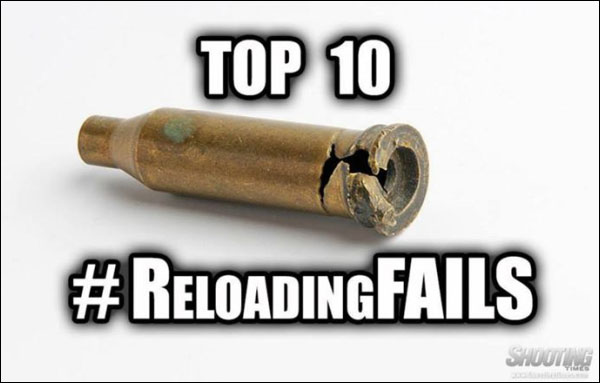
Shooting Times has released an article entitled “Ten Most Common Reloading Mistakes”. Listed below are the Top Ten mistakes hand-loaders can make, at least according to Shooting Times. What do you think of this list — does it overlook some important items?
Top Ten Reloading Mistakes According to Shooting Times:
1. Cracked Cases — Reloaders need to inspect brass and cull cases with cracks.
2. Dented Cases — Dents or divets can be caused by excess case lube.
3. Excessive Powder Charge — Overcharges (even with the correct powder) can be very dangerous.
4. Primers Not Seated Deep Enough — “High” primers can cause functioning issues.
5. Crushed Primers — Some priming devices can deform primers when seating.
6. Excess Brass Length — Over time, cases stretch. Cases need to be trimmed and sized.
7. Bullets Seated Too Far Out — If the bullet is seated too long you may not even be able to chamber the round. Also, with hunting rounds, bullets should not engage the rifling.
8. Burrs on Case Mouths — Ragged edges on case mouths can actually shave bullet jackets.
9. Excess Crimp — This is a common problem with pistol rounds loaded on progressives. If case lengths are not uniform some cases will get too much crimp, others too little.
10. Inadequate Crimp — This can be an issue with magnum pistol cartridges in revolvers.
Do you agree with this list? We think some important things are missing, such as not adjusting full-length sizing dies properly. This can cause the shoulder to be pushed back too far (or not far enough). Another common mistake is using brass that is worn out, i.e. stretched in the case-head area from multiple cycles of hot loads. We also think the #1 error a reloader can make is using the wrong powder altogether. That can be a fatal mistake. See what happens when you load pistol powder in a rifle.
Christmas is almost here, so today we’re featuring a hand-picked collection of “stocking stuffers” for precision shooters. So as not to bust your holiday budget, all of our selections are priced under $10.00. These items are handy tools that you’ll use over and over again at the range and/or at your loading bench (so you’re allowed to buy them for yourself, even after Christmas). Our AccurateShooter staffers use most of these items, including the Loading Blocks, Ballistol, Mirage Shades, Crocogators, and Barrel Bags.
Gifts $1 to $5
Surveyors Tape
$1.99
Safety Eyewear
$1.99
Hood Kwik Estimator
$2.50
Barrel Mirage Shade
$4.95
Surveyors’ Tape. Always watch the wind when you shoot. Inexpensive, Day-Glo Surveyors’ Tape (aka “Flagging Tape”), attached to a stake or target frame, makes a good wind indicator. It will flutter even in mild breezes, alerting you to both angle and velocity shifts. This should be part of every range kit. Don’t leave home without it.
Safety Eyewear ANSI Z87.1. Yes you can get ANSI-approved Safety Eyewear for under two bucks. At that price you should pick up a half-dozen sets, just so you have extras. We recommend that shooters wear eye protection at all times when handling firearms. This eyewear special is offered by CDNN Sports. Call 800-588-9500 to order.
Hood Kwik Estimator. Here’s a very handy tool to measure your 6mm groups. Bracket the group within the diverging lines of the Kwik Estimator and you’ll instantly get a good approximation of the actual group size. No more trips to the tool box for calipers. The inexpensive Kwik Estimator fits in a shirt pocket. (Thanks to Boyd Allen for this suggestion.)
Sinclair Barrel Mirage Shade. For high-volume varminters, and competitors who shoot fast in warm weather, a mirage shield is absolutely essential. This prevents hot air rising off the barrel from distorting the image in your scope. The aluminum Sinclair shield can be trimmed to fit, and comes with stick-on Velcro attachments. Two lengths are available: 18″ for short BR barrels, and 24″ for longer barrels.
Gifts $6 to $10
Dewey Crocogator
$6.50
Ballistol Aerosol Lube
$8.99
Sinclair Barrel Bag
$9.95
Sinclair Load Block
$9.99
Dewey Crocogator. The Crocogator tool, with knurled “teeth” at both ends, is simple, inexpensive, and compact. Yet nothing zips though primer-pocket gunk faster or better. Unlike some cutter-tipped primer pocket tools, the Crocogator removes the carbon quick and easy without shaving brass. One end is sized for large primer pockets, the other for small.
Ballistol Aerosol Lube. Ballistol is a versatile, non-toxic product with many uses in the reloading room. We have found it is ideal for lubricating cases for normal full-length sizing. It is clear, not gooey or chalky like other lubes. It is very, very slippery, yet is easy to apply and just as easy to wipe off. As you lube your cases, the Ballistol will also clean powder fouling off the case necks. For heavy-duty case forming and neck expansion, we’ll still use Imperial die wax, but for every-day case sizing, Ballistol is our first choice. It also helps prevent your dies from rusting and it even conditions leather. Ballistol is a favored bore cleaner for Black Powder shooters because it neutralizes acidic powder residues.
Sinclair Barrel Bag. If you run a switch-barrel rig, or take spare barrels to a big match, this simple but effective barrel bag will protect your valuable steel. The bag is moisture-resistant vinyl on the outside with a soft, quilted interior to protect the barrel’s finish and delicate crown. There are two sizes: one for barrels up to 26 inches, the other for barrels up to 31 inches. Both sizes are priced at $9.95 per bag. That’s cheap insurance for those priceless barrels.
Sinclair ‘Poly’ Loading Block. We’ve tried wood and injection-molded loading trays, and we prefer Sinclair’s white polyethylene loading blocks. They featured chamfered holes properly sized for the particular case you reload. The blocks are heavy enough to be stable on the bench, and the “dishwasher-friendly” material is easy to clean. The standard Poly Loading Block holds 50 cases, while the Competition Loading Block holds 25 cases with a tray for empties. For a bit more money, there’s also a Heavy-Duty 50-case model with an extra-thick 1″ base.
Here is an interesting new measuring device from L.E. Wilson, makers of precision hand dies, case trimmers, and other precision tools. This new Case Gage Depth Micrometer measures shoulder “bump”, so you can determine your headspace both before and after Full-Length sizing. With this Depth Micrometer, you can ascertain exactly how much your FL-sizing die is pushing back the shoulder during the sizing process. While you can measure shoulder setback with comparators on calipers, this Wilson Depth Mic is much more handy. Just place your sized round in the base gage and then slip the micrometer over the top. Take a measurement before FL sizing and then, after sizing, click the micrometer top to verify the amount of shoulder set-back. The measurement is quick and repeatable — very slick.
This is one more nice product from the folks at L.E. Wilson. The $110.00 tool comes with a Gage Block and micrometer top with .001 gradations. The Depth Mic top is compatible with all other Wilson case L.E. Wilson Gages (one size works for all).
Product Tip from EdLongrange. We welcome reader submissions.
Bryan Litz with his F-TR Nat’l Championship-winnning rifle, and the man who built it, John Pierce.
Bryan Litz knows something about bullet shapes and dimensions. He’s the chief designer of many of Berger’s projectiles, including the successful line of Hybrid bullets. Bryan also understands how bullets actually perform in “real world” competition. Bryan won BOTH the Mid-Range and Long-Range National F-TR Championships this year, a remarkable accomplishment. With Bryan’s technical expertise combined with his shooting skills, few people are better qualified to answer the question: “how should I sort bullets when loading for competition?”
Bullet Sorting Strategies — OAL vs. Base to Ogive
At the 2015 Berger Southwest Nationals, Forum member Erik Cortina cornered Bryan Litz of Applied Ballistics. Erik was curious about bullet sorting. Knowing that bullets can be sorted by many different criteria (e.g. weight, overall length, base to ogive length, actual bearing surface length etc.) Erik asked Bryan to specify the most important dimension to consider when sorting. Bryan recommended sorting by “Base to Ogive”. Litz noted that: “Sorting by overall length can be misleading because of the nature of the open-tip match bullet. You might get a bullet that measures longer because it has a jagged [tip], but that bullet might not fly any different. But measuring base to ogive might indicate that the bullet is formed differently — basically it’s a higher resolution measurement….”
Ballistics Q & A in Shooter’s Forum
Got more questions about bullets? Our Shooters’ Forum has a special area for Bullets & Ballistics topics. There you can get your own questions about bullets and ballistics answered by Bryan Litz and other experts from Applied Ballistics.
Rodney Wagner shot the smallest 5-shot, 600-yard group in the history of competitive rifle shooting. First measured at a mere 0.349″, then certified on the IBS Record books at 0.336″, Rodney’s group is mind-blowingly small — and it was centered for a 50 score. This amazing group shows what can be done with a great gun, a talented shooter, and superb hand-loaded ammunition. Today’s Tech Tip reveals some of Rodney’s reloading methods that helped him put five shots you could cover with a dime into a target 600 yards away.
Creating Ultra-Accurate Benchrest Ammunition
Rodney takes great care in loading his brass, and he employs a few tricks to get superior consistency.
Fire-Forming — To prepare his cases for fire-forming, Rodney starts by turning his Lapua brass to just past where the new neck-shoulder junction will be: “I just cut enough for the 6mm Dasher neck. A little bit of the cut shows on the shoulder after forming.” Then Rodney runs a .25-caliber K&M mandrel through the whole neck, expanding the neck diameter. After the entire neck is expanded, Rodney re-sizes the top section with a Wilson bushing, creating a false shoulder. Then, as further insurance that the case will be held firmly in place during fire-forming, Rodney seats his bullets long — hard into the lands. When fire-forming, Rodney uses a normal 6mmBR load of 29.8 grains of Varget: “I don’t like to stress my brass before it has been hardened. I load enough powder to form the shoulder 95%. Any more than that is just wasted.” Rodney adds: “When fire-forming, I don’t want to use a super-hard primer. I prefer to use a Federal 205, CCI 200, or Winchester — something soft.” Using a softer primer lessens the likelihood that the case will drive forward when hit by the firing pin, so this helps achieve more consistent “blow lengths”.
Ammo Loading — Rodney is fastidious with his brass and weighs his charges very precisely. Charges are first dispensed with an RFD manual powder measure, then Rodney trickles kernel by kernel using a highly-precise Sartorius GD-503 laboratory scale. He tries to maintain charge-weight consistency within half a tenth of a grain — about two kernels of Varget powder.
One important technique Rodney employs is sorting by bullet-seating force. Rodney batch-sorts his loaded rounds based on seating force indicated by the dial gauge on his K&M arbor press: “I use a K&M arbor press with dial indicator strain gauge. When I’m loading I pay lots of attention to seating effort and I try to batch five rounds that feel the same. For record rounds I try to make sure I get five of the same number (on the dial). When sorting based on the force-gauge readout, you need to go slow. If you go too fast the needle will spike up and down before you can see it.”
In practice, Rodney might select five rounds with a gauge value of 25, then another five with a gauge read-out of 30 and so on. He places the first five like-value rounds in one row of his ammo caddy. The next like-value set of five will go in the next row down. By this method, he ensures that all five cartridges in a five-round set for a record target will have bullets seated with very consistent seating force.
Unlike some top shooters, Rodney does not regularly anneal his cases. However, after every firing, he does tumble his Dasher brass in treated corncob media. After sizing his brass, before seating the bullets, he runs a nylon brush in the necks: “The last thing I do before firing is run a well-worn 30 caliber nylon brush in the necks, using a small 6-volt drill for power. This is a quick operation — just in and out the neck”. Sometimes, at the end of the season, he will anneal, but Rodney adds: “If I can get 10 firings out of the case I’ve done good.” He usually makes up new brass when he fits a new barrel: “If it is a good barrel (that I may shoot at the Nationals), I’ll usually go ahead and prepare 200 pieces of good brass.”
Tips for 600-Yard Shooters New to the Game
In the course of our interview with Rodney, we asked if he had any tips for shooters who are getting started in the 600-yard Benchrest Game. Rodney offered some sensible advice:
1. Don’t try to go it alone. Find an old-timer to mentor you. As a novice, go to matches, watch and ask questions.
2. Go with a proven cartridge. If you are shooting 600 yards stick with a 6mmBR or one of the 6BR improveds (BRX or Dasher). Keep it simple. I tried some of the larger cartridges, the 6XC and 6-6.5×47 Lapua. I was trying to be different, but I was not successful. It wasn’t a disaster — I learned something. But I found the larger cases were not as accurate as a 6BR or Dasher. Those bigger cartridges are competitive for score but not for group.
3. You don’t have to spend a fortune to be competitive. Buy a used rifle from somebody and find out if you like the sport. You can save a lot with a used rifle, but do plan on buying a new barrel immediately.
4. Don’t waste weeks or months struggling with a barrel that isn’t shooting. My best barrels, including this record-setting Brux, started shooting exceptionally well right from the start.
Rodney’s record group was measured at 0.349″ at the match, then IBS record-certified at 0.336″.
It may seem obvious, but you need to be careful when changing primer types for a pet load. Testing with a .308 Win rifle and Varget powder has confirmed that a primer change alone can result in noteworthy changes in muzzle velocity. To get more MV, you’ll need a more energy at some point in the process — and that potentially means more pressure. So exercise caution when changing primer types
We are often asked “Can I get more velocity by switching primer types?” The answer is “maybe”. The important thing to know is that changing primer types can alter your load’s performance in many ways — velocity average, velocity variance (ES/SD), accuracy, and pressure. Because there are so many variables involved you can’t really predict whether one primer type is going to be better or worse than another. This will depend on your cartridge, your powder, your barrel, and even the mechanics of your firing pin system.
Interestingly, however, a shooter on another forum did a test with his .308 Win semi-auto. Using Hodgdon Varget powder and Sierra 155gr Palma MatchKing (item 2156) bullets, he found that Wolf Large Rifle primers gave slightly higher velocities than did CCI-BR2s. Interestingly, the amount of extra speed (provided by the Wolfs) increased as charge weight went up, though the middle value had the largest speed variance. The shooter observed: “The Wolf primers seemed to be obviously hotter and they had about the same or possibly better ES average.” See table:
Varget .308 load
45.5 grains
46.0 grains
46.5 grains
CCI BR2 Primers
2751 fps
2761 fps
2783 fps
Wolf LR Primers
2757 fps
2780 fps
2798 fps
Speed Delta
6 fps
19 fps
15 fps
You can’t extrapolate too much from the table above. This describes just one gun, one powder, and one bullet. Your Mileage May Vary (YMMV) as they say. However, this illustration does show that by substituting one component you may see significant changes. Provided it can be repeated in multiple chrono runs, an increase of 19 fps (with the 46.0 grain powder load) is meaningful. An extra 20 fps or so may yield a more optimal accuracy node or “sweet spot” that produces better groups. (Though faster is certainly NOT always better for accuracy — you have to test to find out.)
WARNING: When switching primers, you should exercise caution. More speed may be attractive, but you have to consider that the “speedier” primer choice may also produce more pressure. Therefore, you must carefully monitor pressure signs whenever changing ANY component in a load.
A while back, we featured a portable reloading bench built on a Black & Decker Workmate. That proved a VERY popular do-it-yourself project so we’re showing it again, in case you missed it the first time.
Texan Robert Lewis made himself a great portable reloading bench from plywood mounted to a Black & Decker Workmate. The bench, roughly 22″ x 19″ on top, folds up to fit easily in your car’s trunk or behind the seats in a pick-up truck cab. Four recessed bolts hold the wood top section to the collapsible B&D Workmate.The sides and back of the unit are attached to the base with small nails. There is a small shelf (also nailed in place) which can be used to clamp a powder measure or hold a scale. Shown in the photo is a Harrell’s Benchrest measure and Harrell’s single-stage “C” press.
The whole unit can be built for about $65.00 with pine, or $80.00 with oak (as shown). Robert explained: “The Workmate was $40. If someone bought a 2’x4′ sheet of 3/4″ oak plywood, I think it is around $30. Using pine plywood would be about half that. Fasteners were $3. Spar Urethane would be $5.”
Robert told us: “I used a couple ideas I found on the web. The Larry Willis website gave me the idea to use the Black and Decker Workmate as a base. I found the Workmate on sale for $40 and the top is made from oak plywood I had in my shop. I sealed the wood with three coats of Spar Urethane. The whole thing folds into a nice package for transportation to and from the range.”
Editor’s NOTE: In the time that’s transpired since we first ran this story, the price of a Black & Decker workmate has gone up. However you can still pick a WM225 Workmate for under $65.00. Target is currently selling WM225 Workmates for $64.99.


 $49.95 Carbide Mandrels from PMA Tool


 Christmas is almost here, so today we’re featuring a hand-picked collection of “stocking stuffers” for precision shooters. So as not to bust your holiday budget, all of our selections are priced under $10.00. These items are handy tools that you’ll use over and over again at the range and/or at your loading bench (so you’re allowed to buy them for yourself, even after Christmas). Our AccurateShooter staffers use most of these items, including the Loading Blocks, Ballistol, Mirage Shades, Crocogators, and Barrel Bags.


 One important technique Rodney employs is sorting by bullet-seating force. Rodney batch-sorts his loaded rounds based on seating force indicated by the dial gauge on his K&M arbor press: “I use a K&M arbor press with dial indicator strain gauge. When I’m loading I pay lots of attention to seating effort and I try to batch five rounds that feel the same. For record rounds I try to make sure I get five of the same number (on the dial). When sorting based on the force-gauge readout, you need to go slow. If you go too fast the needle will spike up and down before you can see it.”

 A while back, we featured a portable reloading bench built on a Black & Decker Workmate. That proved a VERY popular do-it-yourself project so we’re showing it again, in case you missed it the first time.


