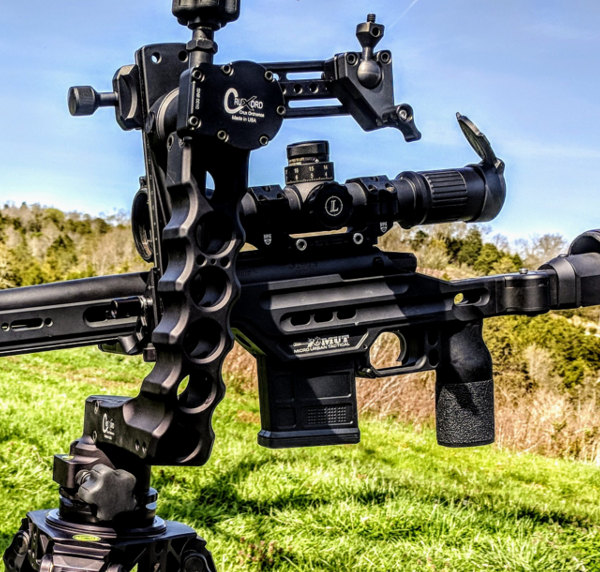
Tactical-style rifles with metal modular chassis are all the rage right now, and there’s a new player in the game, the T/C Long Range Rifle. It looks good. We like the chassis features, and the chambering choices: 6.5 Creedmoor, .243 Win, and .308 Win. The rifle comes with a 5R-rifled, fluted barrel, and a Performance Center trigger adjustable from 2.5 to 3.5 pounds. The threaded barrel is fitted with a factory muzzle brake. Notably, this rifle ships with a One-MOA three-shot accuracy guarantee.
At the NRA show in Dallas, Thompson/Center Arms announced the launch of a new bolt-action, chassis-style rifle — the Performance Center T/C Long Range Rifle (LRR). The T/C Long Range Rifle is built on an aluminum chassis stock that features an adjustable cheek piece and butt plate for a custom fit, with an angled toe on the buttstock that should work well with bags. The forearm has Magpul® M-LOK® slots for quick, easy mounting of accessories. The new Performance Center T/C Long Range Rifle also includes a 20 MOA Picatinny-style rail. That helps provide more elevation for long-range applications.
GunsAmerica checked out the T/C LRR at the NRA Show and said this new rifle looks impressive — the stock is well-designed, and overall fit & finish is good. One observer noted: “Could this be the Ruger RPR killer?” Read Full Report HERE with many large photos.
With a $1211.00 MSRP, this rifle should have a “street price” around $1000. So it will compete directly with the Ruger Precision Rifle. If the T/C LRR proves accurate, it could be a major player in the PRS Factory division. That class is limited to $2000.00 for the rifle and $3000.00 for rifle and optics.
The new Performance Center T/C Long Range Rifle has been on display at Thompson/Center Booth #8555 during the NRA Annual Meetings this weekend in Dallas, Texas. Available in both a Black and Flat Dark Earth (FDE) finish, the Performance Center T/C Long Range Rifle ships with one 10-round detachable magazine, a Caldwell Pic Rail XLA Bipod, and soft case.
Tony Miele, General Manager of Performance Center, said, “With the growing popularity of long range, precision shooting, we wanted to ensure our customers had an option available from the Performance Center. We’ve teamed up with Thompson/Center to design the new Long Range Rifle.” NOTE: Thompson/Center Arms (T/C) is a Smith and Wesson company.
The National Shooting Sports Foundation (NSSF), the trade association for the firearms, ammunition, hunting and shooting sports industries, Board of Governors today unanimously voted to expel Dick’s Sporting Goods from membership for conduct detrimental to the best interests of the Foundation.
Dick’s Sporting Goods recently hired a Washington D.C.-based government affairs firm, for “[l]obbying related to gun control.” Dick’s Sporting Goods CEO Edward W. Stack announced earlier this year the retail chain would end sales of modern sporting rifles, voluntarily raise the age to 21 to purchase firearms in their stores and called for more restrictive legislation. Dick’s later announced they would destroy the remaining modern sporting rifle inventory. NSSF responded that business decisions should be individually made, but was nonetheless disappointed and the decision does not reflect the reality of the vast majority of law-abiding gun owners.
Nosler’s line of RDF™ (Reduced Drag Factor) bullets feature very high Ballistic Coefficients, hybrid-type ogives, and tight, factory-closed meplats. Nosler’s RDF bullets were designed to be very competitive match projectiles for their respective bullet weights. Now offered in four calibers, Nosler RDF bullets genuinely deliver excellent performance for the price. Shooters, particular PRS competitors, have found the RDFs deliver the flat trajectory and high BC necessary to reach the podium.
Nosler is proud of its RDF bullets, which feature tight, uniform meplats: “Nosler knows what gives competitive shooters an edge, isn’t an edge at all. It’s a point. With the highest in-class Ballistic Coefficient and smallest, most consistent meplat, RDF is the flattest-shooting match bullet in its class. Now available in more calibers and weights, the RDF’s meticulously-optimized compound ogive and long, drag-reducing boat-tail make achieving peak accuracy a snap”.
Experience RDF, the Flattest-Shooting Match Bullet:
RDF bullets are also available in Nosler factory ammunition in a variety of popular cartridge types. Nosler factory ammo lets you spend more time at the range and less at your reloading bench. Look for RDF bullets loaded in Nosler’s “Match Grade” Ammunition. Below is the .264-caliber, 140 grain RDF loaded in 6.5 Creedmoor, a popular chambering for PRS and tactical shooters.
Story based on report by Paul Phillips of Global Precision Group
Extreme Long Range (ELR) shooting continues to evolve, with new forms of competition “pushing the envelope” of marksmanship (and ballistics) at distances out to 4900 yards (2.8 miles) and beyond. The latest big-time ELR shooting match was the World’s Longest Shot Challenge (WLSC) in Texas. This match was held at the Valdina Ranch, 1700+ acres of gorgeous hill country property, located about 1.5 hours west of San Antonio, Texas. The event attracted 28 shooters competing in four classes. Each competitor could be supported by a spotter and a wind coach, shooting as a three-person team.
Key “Take-Aways” from the 2018 WLSC Match:
1. Prototype Berger .375 Caliber Bullet is a Winner
The new .375 caliber monolithic Berger bullet designed by Bryan Litz was used by the first and second place finisher in the above .338 Caliber class. It performed great and the ultra-high BC was confirmed.
2. Team Applied Ballistics Dominated
The combined Applied Ballistics Team made first-round impacts at 1760, 2000, 2200, and 2400 yards. Also, 11 out of the 12 impacts total at 2200 yards belonged to Team AB. And Team AB’s Chris Palka had the top score overall, in his first-ever major ELR competition. That demonstrates how well the AB ballistics solutions work. By yardage, Chris recorded 68280 points total, as follows: 1760×6, 2000×10, 2200×9, 2400×3, 2680×4.
Christopher Palka (Team AB), shooting his first-ever ELR match, finished First Overall. Tactiholics Photo.
3. Got Doppler? Advanced Radar Technology for ELR
To shoot at these extreme ranges, you need rock-solid BC information on your projectiles. Luckily Applied Ballistics brought a Doppler Radar and allowed competitors to shoot their ammo to give them personalized ballistic information.
Top Shots By Class
Above .338 Non-Factory (mostly .375 CheyTac)
.338 and under Factory (mostly .338 Lapua Mag)
.338 and under Non-Factory (mostly .338 Edge)
Chris Palka 68280 HIGH SCORE
Paul Phillips 57360
Chase Stroud 47520
Pete Contacos 44360
Paul Phillips 20080
Chris Wiencke 14160
Tim Seller 25760
Eddie 14560
Calvin 11200
NOTE: There was also a fourth class at the WLSC, the “Above .338 Factory Class” (.50 BMG) with Jay Divorsky scoring 14560.
WLSC Match Procedures and Scoring:
Competitors shot with time limits at each distance: 5 minutes to make 5 shots at each plate. Hits on steel scored points, with a big premium on first-round hits. The point values (for hits) were based upon standard ELR practice: 5 times the distance on the first shot, 4 times the distance on the second shot, and so on. In this ELR match each team may have three members: Shooter, Wind Coach, and Spotter.
Paul Phillips reported: “After drawing names randomly for shooting order, on Day One we shot 36″ metal plates at 1760, 2000, 2200, and 2400 yards. The second day was elimination day — you had to make impact on each target at least once to advance to the next distance. These targets started at 2680 ranging out to 4900 yards. We had winds from 4-8 mph on the first day and 6-15 mph on the second day which made it very challenging.”
Proof in the Shooting — AB Solvers and Berger Bullets
Bryan Litz of Applied Ballistics stated: “This event was a successful test of several new things. Berger’s prototype .375 caliber solid bullets worked well in numerous guns and tracked perfectly to the most distant targets. Radar measurements of these new bullets indicate extraordinary performance as well. The AB Team also had a couple new staff members shooting their first ELR competition (Chris Palka and Chris Wiencke) who both did well with Chris Palka actually winning the event. This match was a successful demonstration of the science of accuracy being used to put rounds on target. The thing about science, is that it works the same for everyone. The ballistic software and Custom Drag Model (CDM) data that we used to put first-round hits on targets out to 2400 yards is the same software that’s available to everyone in the AB devices (Kestrel, Sig Kilo, Garmin Fortrex) and Mobile Apps.”
The AB ELR Team dominated the Podium in the above .338 Non-Factory Class. Chris Palka was high scorer followed by Paul Phillips (Second) and Chase Stroud (Third). The top two finishers were using Applied Ballistic Weapon Division Rifles sending the new Berger .375-Cal solid bullets designed by Bryan Litz. The third place finisher shot a .375 CheyTac with 400 grain Cutting Edge Laser bullets.
In the .338 and under Factory Class there were mostly .338 Lapua Magnums. These .338s did very well and two out of the three shooters made it to the two-mile plate. The final standings in the 338 and under Factory Class: Peter Contacos (first), Paul Phillips (second), Chris Wiencke (Third). Both Paul and Chris were shooting 300 grain Berger bullets.
Title Sponsor ELRHQ, a McMillan company, brought tables full of gear. Everything was on display: scopes, bipods, mats, bags, triggers, actions, brakes, stocks, LabRadars, TargetVision target cams, and more. ELRHQ.com is a great one-stop online vendor with the latest and greatest gear for those interested in the ELR discipline and precision shooting.
The match was organized by Travis Walla who did a great job. The event ran smoothly and shooters say the Texas BBQ was great. Travis posted: “We had an awesome event, thanks to all of our sponsors that helped make this event a huge success. We also had a awesome opportunity for those that shot this match — they were able to shoot across the Oehler Research 88 and Applied Ballistics LLC radar at the same time out to 2400 yards on Saturday afternoon. Thanks again…”
Looks like MasterPiece Arms (MPA) stocks are a top choice for the tactical game. MPA chassis systems have been used to WIN 5 of the last 12 matches in the Precision Rifle Series (PRS). The MPA BA Chassis was used by David Preston to win the Carolina PRS Match, Defiance Long Range Shooting Experience (LRSE), and Rocky Mountain Mayhem PRS Match; by Matt Brousseau to win the Bushnell Lonestar Challenge; and by Matt Rooks to win the MPA Spring Shootout. Five of twelve works out to a 42% win percentage — pretty impressive considering all the stock/chassis options on the market today.
The MPA BA Chassis was recently surveyed to be the number one chassis/stock system used by PRS competitors in the PRS 2017 Finale Gear Survey. It experienced a 900% increase in use in 2017 from 2016, which was by far the biggest jump among all chassis systems used by PRS competitors.
MPA’s president, Phil Cashin, is an active PRS shooter. He finished in the top 100 in 2017 and qualified for the finale last year. Cashin, shown in the video below, regularly tests out new ideas and upgrades in actual competition and he regularly seeks out feedback from top tactical competitors. As they say, competition improves the breed.
MPA Production Class Rifle
MPA also offers a PRS Production Class Rifle (PCR) using the MPA Chassis system mated to a Savage Model 12 action. Production Class rifles may cost no more than $2000.00 before optics. Designed specifically for the new PRS Production Class, MPA’s PCR Competition Rifle offers many premium features yet stays under the $2,000 Class limit. The Savage action is upgraded with a Rifle Basix 2-lb trigger, and the adjustable, modular chassis offers a bag rider, barricade stop, and built-in bubble level.
For more information on the MasterPiece Arms product line of rifles, chassis systems and accessories, visit www.Masterpiecearms.com.
Did you know you can damage your hearing even if you are wearing the best hearing protection available? Well, have you ever heard of concussion (or concussive) hearing loss? There is no amount of anything you can put in or over your ears to protect you from concussion loss. My audiologist explained to me the concussion comes through the facial bone structure and damages the ear’s tiny bones.
Editor’s NOTE: This may be the most important tech article we’ve run all year. It explains how you can suffer inner ear damage and hearing loss even if you use earplugs or muffs. Read that again — hearing loss even with typical hearing protection. This kind of concussive hearing loss can result from shooting with muzzle brakes in confined spaces. Using a suppressor (aka sound moderator) can reduce the risk of concussive hearing loss. You may not have the ability to use a suppressor, but this article explains how you should be more mindful of your hearing.
Why I Use a Suppressor (Preventing Concussive Hearing Loss)
It must have been the road noise. I thought I was having a hard time hearing my five year old daughter speaking to me on my cell phone because of the road noise. That old SUV was kind of loud inside. Until I switched the phone to my left ear and suddenly I could hear her just fine. Wait, what just happened? I moved the phone back to the right ear and there was that muffled voice again. That’s when I knew I had a problem.
“What?” Lots of us in the shooting community have lost some hearing along the way due to our time on the range or in the field. Those of us who hunt have certainly discharged a firearm or three without ear protection and without concern for our hearing. After all, it’s just one shot, right? How much can it hurt?
Actually, that one shot DOES hurt your hearing. Any sound over 140 dB is immediate hearing loss. It just happens to be killing a small amount of our hearing so most of us continued the practice without a care. Living with hearing loss now makes me wish I could go back 20 years and better protect my hearing. I can’t change what I did in the past, but going forward I can certainly do the most to protect the hearing I still have.
I decided to shoot about a year’s worth of matches with just braked rifles. That year is when I lost significant hearing in my right ear and some in the left. I’ve gone back to shooting only suppressed rifles whenever possible.
I shot my first suppressed firearm, a .22 LR pistol, in 2003. After a few rounds I wondered why everyone (who can do so legally) didn’t shoot suppressed? No one drives without a muffler. Why would you? Point is I immediately appreciated the hearing protection benefits of suppressors. That passion got me into the business of selling suppressors and it wasn’t long before I was one of the biggest retailers for companies like AAC, SWR, SilencerCo, Ops Inc. and others. [Editor: The author’s business, Accurate Ordnance, no longer sells suppressors. So this article is NOT a sales pitch. Mark just wanted to share his experience so others might protect their hearing.]
Did you know you can damage your hearing even if you are wearing the best hearing protection available? You’ve heard guys say, “I’ll wear plugs and muffs, so I’ll be just fine shooting that .50 BMG!” Well, ever heard of concussion (or concussive) hearing loss? Yeah, I hadn’t either. I’ll sum it up the way the last audiologist I spoke with about my hearing loss did – there is no amount of anything you can put in or over your ears to protect you from concussion loss.
A hand grenade went off right next to a buddy of mine. He lost some hearing as a result of the blast. No one is really surprised by that. I mean it is an EXPLOSION. It’s loud. Duh. But I had no idea the blast from a muzzle brake could basically hurt my hearing the same way. The doctor explained to me the concussion comes through the facial bone structure and damages the ear’s tiny bones. Same thing as what can happen through any TBI (traumatic brain injury).
I’ve owned quite a few different suppressors over the years and have shot just about everything out there. I’m still as big a fan as ever. However, I wanted to see if using a suppressor in PRS (Precision Rifle Series) and similar matches was actually a hindrance. Some people feel the added length and weight of a suppressor can make getting into some shooting positions slower or problematic. So I decided to shoot about a year with a muzzle brake instead of a suppressor. I sure regret that decision…
Getting Headaches at PRS Matches Was Warning Sign
It is fairly common in PRS matches to shoot through pipes, vehicles, inside “shoot houses” and around other obstacles that echo a rifle’s blast. I noticed I was starting to get headaches about halfway through a day of PRS match shooting. I knew the issue wasn’t hydration. I mean look, if you are peeing every other stage down at the amazing CORE range facility in mid-summer you are NOT dehydrated. So, what was causing the headaches? It wasn’t until I went back to shooting suppressed in those same environments that it became clear the little mini concussions from that muzzle brake was causing my headaches. And of course the doctors confirmed that.
Let me stop here and say I am NOT anti-brake. Muzzle brakes are useful tools and for some situations are the best tools. An aggressive brake can be more effective at reducing recoil than a good suppressor. A suppressor does add some recoil reduction, just not as much as most quality brakes. Don’t forget to factor other variables, such as caliber and rifle weight, into the equation though. For example, a 15-lb 6mm Creedmoor rifle doesn’t need much recoil reduction in the first place.
So, I started shooting matches long before the PRS even existed and always shot suppressed in those days. The suppressors made communication with a partner or RO easier and it was just a more pleasant shooting experience. On the recommendations of a few people I decided to shoot about a year’s worth of matches with just braked rifles. That year is when I lost significant hearing in my right ear and some in the left. I’ve gone back to shooting only suppressed rifles whenever possible and especially at matches. I’ve only once or twice found the extra length of the suppressor made it a little more inconvenient to run a stage, but not by much. Trust me, the points I missed were not because I took two extra seconds getting the muzzle in a port or window.
My hearing is something I value and will do everything to protect from this point forward. You’ll never again see me on a match field with an un-suppressed rifle. To me the minimal gains of running a braked rifle aren’t worth losing more hearing.
Choosing a Suppressor — What to Consider
Okay, so I have hearing loss that I can’t get back and realize I need to go back to shooting matches with a suppressor. But which one? I’ll still be shooting matches with custom fit plugs so I just need something to add a little recoil reduction and kill that concussion.
At our shop, Accurate Ordnance, we generally recommend direct-thread suppressor solutions to our customers. The main reason for that is all the problems we’ve seen with other fast-attach muzzle devices. It doesn’t take much tolerance stacking to result in accuracy issues. There are a few exceptions for us and the Rugged Suppressors products top the list. Since the Razor 762 uses a muzzle brake adapter on the rifle to attach the suppressor, I can use the same suppressor on my .223 Rem training rifle. My primary match rifles are chambered in 6mm Creedmoor and 6.5 Creedmoor and the muzzle threads on those is a standard 5/8×24. My .223 Rem training rifle has .5×28 threads on the muzzle, which is standard for that caliber. Thus, the muzzle adapter interface lets me share the suppressors between all the rifles. And on that .223 Rem training rifle I have the option of switching the end cap on any of the Rugged products to a .223 aperture size, which makes the suppressors slightly more sound efficient (meaning quieter).
The Everyday Sniper Podcast is a streaming audio series about long range shooting, precision rifles, firearms, training, and industry updates. The podcast is a joint effort of Sniper’s Hide and Mile High Shooting. Podcast host Frank Galli is well known to precision shooters. Frank, a military veteran, is the founder of Sniper’s Hide, and he regularly tests tactical rifles and related equipment. He also runs the Sniper’s Hide Team Challenge each year. This year’s Challenge runs June 1-3 in Washington State.
For the Everyday Sniper podcast, Galli has brought together firearms industry experts, top gunsmiths, and ace shooters. They share their knowledge and on-the-range experience. You’ll find a wealth of information on tactical and long-range gear, plus tips on PRS competition and more.
Here are the three latest Everyday Sniper podcasts:
This episode include Seekins After Action Report along with Glen Seekins interview. Frank notes: “During my ride back from Idaho I talk about my trip to Seekins Precision and then follow it up with my interview where we talk about Glen’s history and his six degrees of separation between Sniper’s Hide and Seekins.”
Click to launch Podcast on Everyday Sniper Website:
Everyday Sniper Episode 46:
Magpul Pro 700, Bedding Chassis, Wind Video and more
April 17, 2018
Welcome to the Everyday Sniper Podcast. Frank here, Mike is at MHSA working the counter. In this episode we talk about the new Magpul Pro 700 Chassis, and the KRG Bravo Chassis. Other topics include: Wind Video, Technology Sucks, Suppressor Follow-up, Busted Shoulder.
Click to launch Podcast on Everyday Sniper Website:
The Everyday Sniper Episode 45:
Tripods, Truing, and Terrain
April 15, 2018
Mike and Frank return with Part Two of weekly recap conversation. In this episode, they expand on key points of the previous episode, and cover some additional topics:
Tripod Shooting – RRS
Positions with Tripod
Training getting in and out of position
Getting closer vs shooting subsonic
Seekins Precision Rifles
RRS Dovetail Accessories
SP10M vs SP10
AA Targets Truing Targets
We want to congratulate Bryan Litz and his talented team at Applied Ballistics LLC. We have followed Bryan’s career as a bullet designer, ballistician, author, software product developer, and ELR pioneer. His team leads the world in advancing the science of long range shooting. And it looks like all the hard work has paid off — Applied Ballistics has secured a major contract to develop extreme long-range sniper capability for the U.S. Military.
Applied Ballistics LLC, a Michigan-based tech company, has been awarded a $1,300,000 contract by the Combating Terrorism Technical Support Office (CTTSO) to execute Phase 1 of the Extreme Sniper Strike Operations (ESSO) project.
Phase 1 of the ESSO project is focused on advancing the predictive capabilities of modern ballistic solvers by performing Doppler radar measurement and modeling of current service rounds at Extreme Long Range (ELR) as a function of gyroscopic stability, and refining the models of secondary ballistic effects such as spin rate decay and spin drift at ELR. Phase 1 will conclude with the ballistic modeling enhancements being integrated into the existing Applied Ballistics ecosystem of electronic devices which are currently deployed by numerous U.S. and allied armed forces around the world. Phase 1 is scheduled for completion in late 2018.
Phase 2 of the ESSO project is a potential follow on (2019) that focuses on the development and fielding of an advanced ELR sniper rifle system designed to drastically increase first-round hit probability at ELR on man-sized targets. The Applied Ballistics Weapons Division is currently conducting research and development on weapons platforms, as well as new cartridge and bullet options, that will maximize ELR ballistic performance from lightweight, practical, magazine-fed systems.
Bryan Litz, owner of Applied Ballistics LLC, said: “Our team of Aerospace, Mechanical, Electrical and Computer Science Engineers, and Technicians will apply our combined experience including years of testing and competing in ELR Shooting to the successful completion of the ESSO program objectives. This means extending the maximum effective range of U.S. and allied snipers, achieving decisive overmatch on the battlefield. I can’t imagine a better application of Applied Ballistics’ collective efforts.”
Applied Ballistics has developed ballistics software for mobile Apps. AB’s software has been integrated into numerous products including Kestrels, Laser Rangefinders, and “Smart” optics.
Applied Ballistics Seminar in Utah, June 2-3, 2018
Applied Ballistics will offer a Ballistics Seminar June 2 and 3, 2018 at the Snowbird Cliff Lodge, Salt Lake City, Utah. This will include two full days of instruction with lectures plus Q&A sessions. The $625 cost of the seminar includes all 5 AB books, both AB DVD sets, AB Analytics, and Swag Bag.
CLICK HERE to Register. NOTE: Through April 17th, get $100 Off with discount code ABSEM100.
About Applied Ballistics, LLC:
Applied Ballistics’ mission is to be a complete and unbiased source of external ballistics information for long range shooters. We believe in the scientific method and promote mastery through understanding of the fundamentals. The results of our work are passed on to the government and shooting communities through clear and helpful instructional materials, as well as easy-to-use ballistic software running on many products.
The Sureshot Armament Group (SAG) has developed a modular aluminum chassis for the vintage, straight-pull Swiss K31 rifle. This chassis transforms an old classic into a modern, fast-cycling tactical rig. The SAG Lightweight K31 Rifle Chassis is CNC-Machined from aluminum. Hard anodized, it weighs just 2 lbs. 13 ounces. It offers adjustable cheek piece and butt-pad, with a three-inch LOP adjustment range. Believe it or not, installing a vintage K31 into this SAG stock is an easy bolt-on process. No modification of the K31 action is required.
The chassis-builder SAG states: “The main idea behind the SAG Lightweight K31 Rifle Chassis was to give the shooter …ergonomics of a Tube-gun but with lines of the classic rifle. The chassis ‘wraps’ the shooter around the rifle, moving bolt operation under the shooters cheek to allow the marksman to maintain cheek weld during the whole shooting series.” The chassis design also allows a more forward optics placement for better eye relief.
SAG Lightweight K31 Rifle Chassis Features:
CNC-Machined Aluminum with hard-anodized matte finish
Easy bolt-on installation to Swiss K31
Adjustable Cheek Piece (0-30mm)
Adjustable Buttpad to set LOP (11.5” – 14.5”)
KEYMOD Interface on fore-end and buttstock
Accepts any AR-type pistol grip
Overall chassis weight: 2 lbs. 13 oz. (1280 grams)
Chassis MSRP: €950 ($1163.00 USD)
About Switzerland’s Original Karabiner Model 1931 (K31)
The Karabiner Model 1931 (K31) is a magazine-fed, straight-pull bolt action rifle. It was the standard issue rifle of the Swiss armed forces from 1933 until 1958, though examples remained in service into the 1970s. It has a 6-round removable magazine, and is chambered for the 7.5×55mm Swiss Gewehrpatrone 1911 cartridge (aka GP 11).
Wiki Photo by Bouterolle, CC BY-SA 3.0
Although the K31 is a straight-pull carbine broadly based on previous Swiss “Schmidt–Rubin” service rifles and carbines, the K31 was not designed by Colonel Rudolf Schmidt (1832–1898) as he was not alive in 1931 to do so. Mechanical engineer Eduard Rubin (1846–1920) was the designer of the 7.5×55mm Swiss ammunition for which previous Swiss service rifles and the K31 are chambered. The Karabiner Model 1931 was a new design by the Eidgenössische Waffenfabrik in Bern, Switzerland under Colonel Adolf Furrer (1873–1958). The Karabiner Model 1931 replaced both the Model 1911 rifle and carbine and was gradually replaced by the Stgw 57 from 1958 onwards.
Practical/Tactical shooting disciplines such as the Precision Rifle Series are today’s fastest-growing forms of rifle shooting competition. More and more shooters are enjoying the fun of tactical-style matches shot “on the clock” from a host of challenging positions. PRS competitors must rapidly engage a number of reactive and steel targets, while shooting offhand, prone, behind barricades, off tripods, and from a wide range of other positions.
The popularity of the original centerfire PRS format, which now draws hundreds of competitors at major matches, spawned a PRS spin-off for rimfire shooters. A year ago, the Precision Rimfire Challenge (PRC) was launched. Modeled on centerfire PRS competition, the PRC is a new .22 LR rimfire shooting game. Call it “PRS Lite” — a practical-style, multi-stage match shot with .22 LR bolt-action and self-loading rimfire rifles.
With the success of rimfire tac comps, the PRS has decided it’s time for air-gunners to join the fun. Starting in May 2018, the PRS will offer airgun side-matches at the most popular PRS events, including the High Mountain Shootout (June), Heatstroke Open (July), and GAP Grind (October). Sponsored by AirGun WareHouse, the new PRS airgun side-matches will be run as a new, season-long Precision Rifle AirSoft Series (PRASS). Competitors can use a variety of pneumatic airguns from makers such as Beretta, Crosman, FN Airsoft, and KWA Airsoft.
“The Precision Rifle AirSoft Series (PRASS) is perfect for newcomers to the tactical game who want to start with a low-cost, ultra-safe competitive experience that still offers the look and feel of the PRS tactical lifestyle. It’s great for young people as well as individuals who may be wary of real firearms. This may prove ideal for Millenials.” — PRS Competition Committee
If PRS (PR-“Es”) costs too much, try PRASS (PR-“Ass”), the AirSoft version. With AirSoft rifles costing less than $150.00, PRASS is way more affordable!
PRS Marketing VP Jeff Wilson expects the AirSoft Series to be a huge success: “We know that most purchasers of tactical-style rifles rarely, if ever, actually shoot their guns because it takes too much time to train, and the cost of ammo is prohibitive. In addition, many new shooters are sensitive to the noise and recoil of actual firearms. And, let’s face it, some guys want to look tough, but they’re really just weenies. Our AirSoft Series addresses all those concerns. The guns are inexpensive, the ‘ammo’ costs pennies, and the air is always free!” Wilson also noted that airguns provide an ideal introduction to the shooting sports for newcomers: “Airguns are easy to shoot, and they can be purchased without background checks or waiting periods. They are great starter tools for new shooters. You can experience our full PRS tactical lifestyle at a fraction of the price. While these days PRS is just too costly for many, PRASS will be affordable for all!”
The AGM MK96 AirSoft Rifle looks just like the real thing. Yet it costs just $131.95 with optic. That’s less than 5% of what a good centerfire PRS rig would cost! CLICK HERE to order — No FFL Required!
The Precision Rifle AirSoft Series (PRASS) Offers Low-Cost Tactical Fun:


 With a $1211.00 MSRP, this rifle should have a “street price” around $1000. So it will compete directly with the Ruger Precision Rifle. If the T/C LRR proves accurate, it could be a major player in the PRS Factory division. That class is limited to $2000.00 for the rifle and $3000.00 for rifle and optics.