British Lee-Enfield Model SHT’22/IV Rifle, courtesy www.iCollector.com.
Our friend Dennis Santiago was a technical advisor for History Channel’s Top SHOT TV show. One of the notable Top Shot episodes involved the “Mad Minute”, a marksmanship drill practiced by the British Army in the decades preceding World War I. Dennis observed that the Top Shot competitors didn’t fare too well in their “Mad Minute” attempts, not scoring many hits in the alloted one-minute time period. That prompted Dennis to give it a try himself — seeing how many hits he could score in one minute with an authentic Lee-Enfield rifle. So, a while back, Dennis ran the drill at a range in California.
Dennis, an active high power rifle competitor and instructor, enjoyed his “Mad Minute” exercise, though he assures us that this takes practice to perfect. Dennis tells us: “Here is a ‘Mad Minute’ drill, done using a period correct Lee-Enfield (SMLE) No.1 Mk III rifle and Mk VII ammo. I got to the Queen’s Regulations (15 hits in one minute) on the second run and put a good group on the target at 200 yards. This is ‘jolly good fun’ to do every once in a while. This is ‘living history’ — experiencing a skill from a time when the sun never set on the British Empire.”
“Mad Minute” was a pre-World War I term used by British Army riflemen during training at the Hythe School of Musketry to describe scoring a minimum of 15 hits onto a 12″ round target at 300 yards within one minute using a bolt-action rifle (usually a Lee-Enfield or Lee-Metford rifle). It was not uncommon during the First World War for riflemen to greatly exceed this score. The record, set in 1914 by Sergeant Instructor Alfred Snoxall, was 38 hits. (From WikiPedia.)
Want to See More “Mad Minute” Action with a Modern Tubegun?
In 2012, Gary Eliseo ran a “Mad Minute” exercise using a modern, .308 Win Eliseo RTM Tubegun of his own making. Gary ended up with 24 hits on a bull target set at 300 yards. (Gary actually had 25 hits in 25 rounds fired, but the last round hit just after the 60-second time period expired.) Note how Gary pulls the trigger with the middle finger of his right hand. This allows him to work the bolt faster, using his thumb and index finger. CLICK HERE for Eliseo Tubegun Mad Minute story.
Watch Gary Elesio Shoot the ‘Mad Minute’ (Starts at 4:47 on Video)
NOTE: In an interesting coincidence, Dennis Santiago was actually in the pits pulling targets for Gary during Eliseo’s 2012 “Mad Minute” exercise.
History of the Mad Minute Commentary by Laurie Holland
The original military requirement of the “Mad Minute” saw the soldier ready to fire with a round in the chamber, nine in the magazine, safety on. This course of fire is still followed by the GB Historic Breechloading Arms Association and other bodies in their recreated “Mad Minute” competitions.
The first 10 would go quickly, but reloads were critical, this not done by a magazine change as Gary did with the RTM or in a modern tactical or semi-auto rifle, but through slick use of ‘chargers’. It is this aspect which fouls so many of my colleagues up as it is very easy to cause a jam and a large part of 60 seconds can go in sorting it out!
Charger clips were selected for those that just held the rounds firmly enough to stop then falling out, were sand-papered and polished with a stove / fireplace polish called ‘Zebrite’ so that the rimmed rounds would slip through the clips like corn through a goose.
If you’re unfamiliar with the cock-on-closing Enfield action, it seems clumsy. With intensive practice it is very smooth and can be operated incredibly quickly. The trick is to whip the bolt back onto its stop and initiate a rebound movement that takes it and the cartridge well into the chamber thereby reducing the effort required to close the bolt and chamber the round.
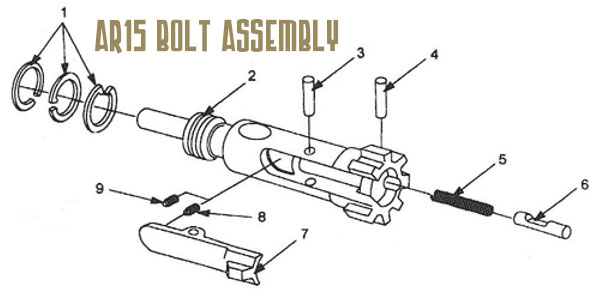
We call them “black rifles”, but that shouldn’t refer to all the carbon and gunk on the inside. AR-platform rifles can be maintenance-intensive beasts. But some AR owners make the situation worse by not regularly cleaning important small parts, or by using too much oily/greasy lubricants in the wrong places. A properly maintained and lubricated AR15 can shoot hundreds of rounds (between cleanings) without a problem. If you learn where (and where not) to apply lubricant, you’ll find that your AR will run more reliably and the task of cleaning the bolt and bolt carrier will be less of a burden.
Here is a good video that explains AR-15 Cleaning and Maintenance. In this 30-minute NSSF video, Gunsite Academy instructor and gunsmith Cory Trapp discusses the proper way to clean and maintain the AR-15 carbine. Very knowledgeable, Trapp provides rock-solid advice for AR owners. Along with cleaning producedures, this video explains how to inspect key components and how to function-test your AR before each shooting session.
Popular YouTube Channel Smarter Every Day recently released a fascinating video featuring rifle suppressors with see-through acrylic sleeves. The team filmed shots through the suppressors using ultra-high-speed (110,000 frame per second) cameras. When played back in super-slow-motion, you can see the flame propagate through the suppressor and the bullet move through each baffle before it exists the muzzle. Notably, you can see different internal flame effects depending on the baffle design. Watch the results in the video below — it’s mesmerizing:
See Through Suppressor in Super Slow Motion (110,000 fps) — Click Arrow to Watch:
The high speed transparent silencer video is pretty neat. It certainly demonstrates, to some extent, the violence that happens inside centerfire rifle suppressor when firing.
At Thunder Beast Arms Corp. we have carefully studied the forces/pressures operating inside suppressors. The “uncorking” pressure when the bullet exits the muzzle is typically in the 8,000 to 15,000 psi range, but some combinations of cartridge and barrel length can extend this up to the 25,000 psi range. Job #1 of a suppressor designer is to build a suppressor that won’t explode. Job #2 is to build one that quiets down the muzzle report significantly. Doing that well, with the minimum amount of material, is the tricky part.
Suppressor design is both art and science, and we approach our R&D from three sides: experience, experimental testing, and computation.
There are a lot of opinions about how to design a quiet suppressor. Many of these are based on preconceived notions of how suppression “should work”. These theories may or may not work when built and tested in the real world. Where the rubber hits the road is experimental testing. I would say that a majority of knowledge about “How to design a quiet suppressor” comes from building hundreds or thousands of prototypes and testing them with good equipment in a cogent experimental process. Some of those theories pan out, but many of them do not.
Thunder Beast Arms Tests its Suppressors in the Lab and in the Field.
Scientific Software Aids Design
We have also made a large investment in computation fluid dynamics (CFD) and finite-element analysis (FEA) software and use it in addition to other computer-model analysis to look at the physics that occurs inside the suppressor. This type of analysis gives information about material effects that is pretty much impossible to get any other way. Even so, the computer cannot tell you how to design a
suppressor, and the results must always be checked and compared to reality.
Thunder Beast Arms Corporation was started ten years ago with the goal of producing the best precision rifle suppressors. Our current ULTRA series in .223, 6.5 mm, .308, and .338 calibers provides industry-leading suppression performance with very light weight.
Savage Introduces 10/110 Stealth Evolution in Six Popular Chamberings
Savage has just introduced the new 10/110 Stealth Evolution Chassis Rifle in six chamberings, including the PRS-pleasing 6mm Creedmoor and 6.5 Creedmoor. This rifle will be offered in right-hand and left-hand models. Big Boomer fans can order a .300 Winchester Magnum or the .338 Lapua Magnum.
The 10/110 Stealth Evolution pairs a heavy fluted 5R barrel with a monolithic aluminum chassis finished in bronze Cerakote. The hard polymer-ceramic coating resists abrasion, corrosion, and impact damage. The rifle features a factory-blueprinted 10/110 action, matched with user-adjustable AccuTrigger. The Stealth Evolution comes standard with an extra-long top rail and factory muzzle brake. MSRP for standard calibers is $1799.00 (.300 Win Mag $1999.00 MSRP; .338 Lapua Magnum $2149.00 MSRP).
AccurateShooter Comment: We like the availability of the 6mm Creedmoor chambering, which is finding favor among many PRS shooters. The 6mm CM has less recoil and a flatter trajectory — plus 6mm bullets are cheaper. Savage did the 6mm version right. At 26″, the barrel is long enough, and the 1:7.5″ twist can stabilize the new 110gr SMKs. That Magpul PRS GEN3 stock looks good — controls are tucked away and the toe can be used with a sand-bag. Some other tactical stocks have rails and/or other “pointy bits” that snag on a rear bag. In .223 Rem or 6mm Creedmoor, this rifle would be a good choice for Prairie Dog safaris. We do wish Savage offered a front sled for bag use though.
Here Todd Jarrett nails three steel targets and a pop-up orange clay bird. Watch full video below.
If you are a fan of 3-Gun competition, tune in to Shooting USA this week. The latest episode, which airs Tuesday October 3 and Wednesday October 4, features the 2017 USPSA Multi-Gun Nationals in Boulder City, Nevada. You can see many of the nation’s top 3-Gun shooters attacking some very challenging stages with pistols, rifles, and shotguns. CLICK HERE for TV Schedule.
Multi-gun competition has evolved considerably since it started 30 years ago. The firearms are more sophisticated, the optics are better, and the stage times are much faster. Still, the challenge remains the same: How fast can you shoot multiple targets, with the score determined by speed and accuracy? For the best in the sport, the answer is very fast indeed, but Match Director Pete Rinsing has a few tricks up his sleeve to challenge competitors on never-before-seen courses of fire at the USPSA Multi-Gun Nationals held in April 2017.
Todd Jarrett highlights from 2017 USPSA Multi-Gun Nationals. Check out 300-yard prone rifle at 00:30, and blazing rifle-pistol-shotgun transitions at 00:50:
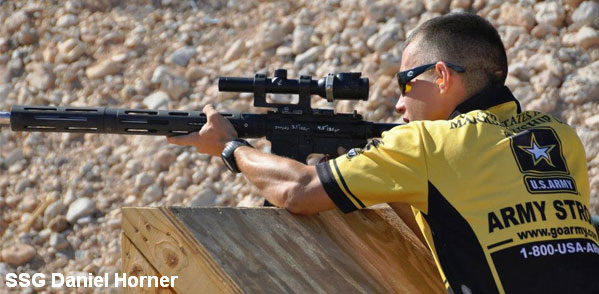
Most people compete in the Tactical Division, including 8-time Champion, SFC Daniel Horner of the U.S. Army Marksmanship Unit. Competitors in that division are not allowed a bipod, so many competitors utilize structures on the stage to stabilize their long gun. Regardless of division, the USPSA Multi-Gun Nationals is a true test of manipulating three different weapons, under pressure, on run-and-gun courses of fire. And the pressure is definitely on when a National Championship is on the line.
The 2017 Fort Benning Multi-Gun Challenge will be held November 16-19, 2017. This year there will be at least 12 stages, plus more than 40 guns on the prize table!
Rifle, pistol, shotgun. More guns = more fun. If you are curious about multi-gun matches, check out this video from Shooting USA. This episode covers the 3-Gun Match at Fort Benning, Georgia. This one-of-a-kind match is the only multi-gun competition where civilians can run-and-gun on an active U.S. Army installation. What’s more, at this match competitors get to ride in a Stryker armored vehicle and shoot Army weapons such as the M249 SAW and M203 Grenade launcher. The lure of playing with military hardware, along with the quality of the stages, makes this a hugely popular 3-Gun event which quickly sells out every year.
Interested in 3-Gun Shooting? Here’s an in-depth report on the Fort Benning Multi-Gun Challenge:
Getting Started in 3-Gun Competition
Thinking of getting started in 3-Gun competition? In this NSSF video, Top Shot Finalist Chris Cerino reviews the hardware you’ll need for multi-gun matches. Chris talks about carbine configurations — including barrel, handguard, and optics options. In reviewing shotguns, Chris discusses shotshell caddies and the high-capacity extended tubular magazines now available. Cerino also demonstrates pistol techniques and explains the key features of a belt/holster rig for 3-Gun competition.
SSG Dan Horner of the USAMU, a past winner of the 3-Gun Nation Championship, is one of the country’s best multi-gun competitors. Here Horner offers some tips on 3-Gun hardware, and safety procedures:
Adapting to New Equipment
There’s a lot of hardware in 3-Gun Competition. To succeed you need mastery of ALL the tools: “New competitors should know how to operate all their equipment. They should spend time getting familiar with their equipment. I spend exponentially more time ensuring the gear is right than I do shooting.”
Safety in 3-Gun Competition
Everyone practicing with shotguns, rifles and pistols must keep safety as top priority. “Obviously, safety is the No. 1 priority, but after that, the focus should be on developing specific skills,” noted Horner. A good three-gunner must not only be fast, but he or she must also be accurate and be able to adapt to a wide variety of shooting positions. And strategy is involved too. Successful 3-gunners develop a ‘plan of attack’ for each stage.
Check out that bolt assembly. It features a fluted stainless bolt body, laser-engraved Titanium shroud, and Titanium dragon-scale bolt knob with polished stainless handle.
You haven’t seen a Ruger Precision Rifle (RPR) like this before. Forum member TerryH has customized his Second-Gen 6.5 Creedmoor RPR with a wicked purple finish, snazzy stainless/titanium bolt, and slick HDPE (polymer) bag-riders front and rear. The mods on this Hot Rod Ruger don’t stop there. Terry added a Seekins hand rail, Timney trigger, ergonomic grip, and more…
For his Hot Rod Ruger, Terry has the right skill set, learned on the job: “I work in a body shop and have pretty much custom-painted all my stuff for many years. For this 6.5 CM RPR, colors of choice are House of Kolor PBC-65 Passion Purple and black covered with Cerakote MC-161 matte clear.” Terry even painted his Bald Eagle rest purple to match his Hot Rod RPR.
Terry reports: “I’m shooting an RPR in 6.5 CM. It has a Patriot Valley Arms 26″ barrel. Josh at PVA is making a thread protector for me so I can remove the Mad Scientist brake. The butt stock has a V-Tab adjustable butt plate and Wiebad check rest pad. Glass is a currently a Vortex Gen I PST 6-24x50mm but I have a Golden Eagle on layaway”. To learn more about this rifle or ask TerryH questions about the build, visit this Shooters’ FORUM THREAD.
Ruger Precision Rifle Modifications: Chassis and Hanguards Painted Passion Purple
Patriot Valley Arms 26″ Barrel with Brake
Timney Trigger with Ambi Safety
Custom HDPE (Polymer) Bag-Riders front and Rear
V-Tab adjustable butt plate and Wiebad cheek-pad
Seekins Rail
Good Accuracy with Factory Ammunition
Terry reports: “The RPR is shooting .3 MOA @ 100 with factory Fed American Eagle 140s.” Terry plans to start handloading for the rifle with the goal of shooting F-Class matches next year: “I’ve successfully shot steel out to 1140 yards on the range but [I don’t know] if that will actually translate well in a match. I’m committed to practicing as much as I can and starting to shoot some matches in 2018.”
Front and Rear Bag-Riders with Protektor Rear Bag and Upgraded Bald Eagle Rest
Terry has engineered a slick set-up for F-Open competition and load testing. Up front is a Bald Eagle rest upgraded with windage knob mod, stainless F-Class feet, and longer adjusters. Terry also “changed the hardware to all stainless and added a couple of levels”. In the rear, Terry runs a Protektor Doctor rear bag with 1″ ear spacing.
The really impressive additions are custom HDPE bag-riders Terry crafted himself: “I realized that the butt stock wasn’t going to cut it on the rear bag and even though I got the 2 1/4″ front bag and the Seekins rail is 2″ wide and flat that it wasn’t as stable or smooth as I’d like.” So Terry made his own front and rear bag-riders from HDPE, a material similar to Delrin. Currently the front unit is 2.25″ wide, but Terry will be changing that to a 3″-wide front sled: “I decided that I’d get a 3″-wide front bag and mill a new front bag-rider. I’m going to recess the center to fit around the hand guard and I’ll mill a recess on the bottom of that one.”
Shown below is the Hot Rod Ruger before Terry added the HPDE Bag-Riders front and rear. Terry says the rifle now handles much better with the bag riders, and he plans to upsize the front sled to 3″ width.
Bling’s the Thing. Below is the Hot Rod Ruger’s bolt assembly. It features a custom flat-fluted bolt shaft, laser-engraved Titanium shroud and Titanium dragon-scale knob with polished stainless handle. Terry confesses: “I simply can’t resist anything shiny!”
Proper eye protection is ‘must-have’ gear for shooting sports. In addition to providing reliable impact protection, good shooting glasses should be comfortable, fog-free, and not interfere with your preferred hearing protection. Those who require corrective lenses also need to consider the various options available. In a past episode of their Weekly Gear Review, the 6.5 Guys discuss a variety of shooting glasses they have tried, including examples from DeCot, Oakley, and Wiley-X. Ed and Steve outline the key considerations when choosing eye protection, and then review practical aspects of eyewear design and construction that enhance comfort and functionality in the field.
The 6.5 Guys (Ed and Steve) offer a number of smart tips consider safety eyewear, helping you select the most effective safety glasses at an affordable price. Here are the 6.5 Guys’ KEY Take-aways when choosing shooting glasses, including prescription eyewear:
Key Things To Consider When Choosing Eye Protection
1. Avoid polarized lenses or lenses that reduce light transmission significantly (except for action shooting in very bright conditions with large, close targets).
2. Avoid frame designs that interfere with prone shooting.
3. Avoid designs that easily fog.
4. Avoid frame designs with thicker temples that are uncomfortable to wear underneath hearing protection.
5. Select lenses with an appropriate degree of ballistic protection. CLICK HERE to learn more about eyewear safety standards.
6. When you get your prescription, be sure your ophthalmologist includes the interpupillary distance. This is a critical measurement particularly for heavier prescriptions.
7. If you have a complicated prescription select a vendor who will actually spend time with you to address any concerns.
Safety First — Your Eyes Are Irreplaceable Accurate shooting begins and ends with the human eye. Your career as a marksman could be cut short if you don’t use good eye protection every time you go to the range and/or handle a firearm.
Every year, 1,000,000 people suffer serious eye injuries. Shooting is hazardous; it is estimated that there are 30,000 firearms-related eye injuries each year (if you include paintball sports.) After paintball, general hunting accidents comprise most firearms-related eye injuries.
Quality eye protection need not be expensive. You can find comfortable, ANSI Z87.1-certified shooting glasses for under $10.00.
If you select shooting glasses carefully, and ensure that your eyewear is safety-certified, inexpensive shooting glasses can perform very well. But you need to avoid cheap, soft-plastic lenses that claim “impact resistance” without satisfying a testing standard.
We’ve seen new shooting disciplines emerge in recent years (3-Gun, PRS, ELR to name a few) and now we’re seeing another trend — shooting matches that combine action shooting with precision Long Range competition. The latest and greatest example of that is the Nosler King of the Range event slated for late October in Oregon. 3-Gun, Long Range, and a combined match title will all be up for grabs in this two-day, combo event. Competitors can shoot either the 3-Gun or Long Range match, or shoot both, going after the title of “King of the Range”.
It is unusual for a 3-Gun action match to be combined with a long-range competition, because few venuea offer the right combination of terrain and facilities for both disciplines. Mason Payer, Nosler Marketing Manager says: “The size and varied terrain of the COSSA park facility [near Bend, OR] presents the opportunity to combine both 3-Gun and Long Range, making this a truly multi-discipline match that will be fun for and challenging for everyone.”
The Nosler King of the Range, presented by MGM Targets and COSSA, will be a combined-match format, spread over two days of competition. Day One will feature 5 or 6 stages of 3-Gun, while Day Two will be comprised of 5-6 stages of Long Range, for both Bolt Guns and Gas Guns.
Nosler King of the Range Course of Fire:
Day 1: Match consists of 5-6 stages of 3-Gun that run anywhere from 30 to 160 seconds.
Day 2: Long Range 5-Stage Match with Bolt Guns out to 1000 yards and Gas Guns out to 800 yards.
NOTE: Separate rifles can be used for the 3-Gun half and the Long Range half.
The Nosler Cup 3GN Long Range Match will be comprised of approximately 10 stages of challenging precision shooting. This will be a standard 3-Gun match running concurrent with the long range match. Ten stages with 6-8 rifle targets per stage, and 4-10 pistol targets on most stages.
The Nosler Cup 3-Gun Match, hosted by COSSA, will be a one-day competition, featuring 5-6 stages of running and gunning. Shooters will have the opportunity to shoot on Saturday OR Sunday (either day).
GAP Grind PRS Competition and Vintage Sniper Rifle at Talladega — that’s what you get in a double-feature episode of Shooting USA TV, now available on YouTube. This is a killer episode, with great coverage of two rapidly-growing shooting sports. The GAP Grind is the biggest PRS tactical match of the year, while Vintage Sniper Rifle matches have proven popular with competitors of all ages, from 18 to 80. Learn all about these shooting disciplines in this 48-minute Shooting USA production. Photos, unless otherwise indicated, come from Ramia Whitecotton’s GAP GRIND 2016 photo album
PRS Competition — the GAP Grind
This Shooting USA episode features the Bushnell GAP Grind Pro-Am, a tough tactical/practical match in Tennessee with 300 competitors. Conducted in association with the Precision Rifle Series (PRS), the GAP Grind features a Pro/Am format — new shooters partner with an experienced shooters for the two-day, 25-stage event. This year John Scoutten teamed up with novice shooter Jen Hodson.
Yes this video includes the GAP Grind PRS match. Click the arrow and it should begin with the PRS segment, 28 minutes into the episode:
One stage required the use of “human support” by one’s team-mate. Here Shooting USA’s John Scoutten provides a strong shoulder for female competitor Jen Hodson.
Lots of Action, with 20+ Stages
The GAP Grind is a notoriously challenging, “high tempo” match with minimal down-time between stages. Over the course of 20+ stages, competitors will fire 200+ shots at a variety of steel, paper, moving, and reactive targets out to 1,200 yards. Targets vary in size/difficulty based on the shooter’s position, distance, and time allotted. Most stages include “stressors” — i.e. time limits or required movement(s).
On the first day of the Bushnell GAP Grind, teams are scored together. On the second day team members still work together but scores are logged individually. This is a difficult event with awkward positions, barriers, and other challenges. Targets vary in size, shape, and distance. One of the toughest targets is the 500-Yard Mover. And the shooting platform (below) offered a double-decker challenge…
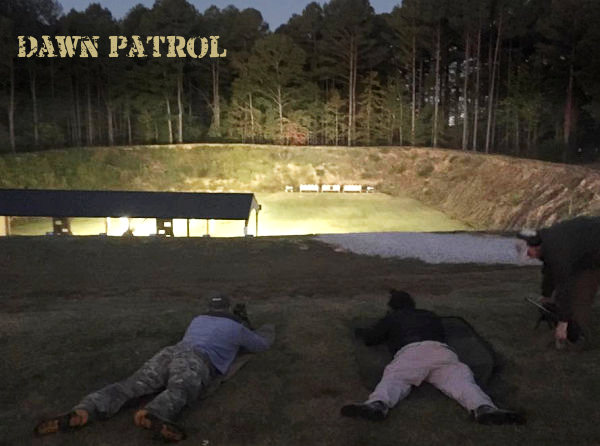
Here’s a “Dawn Patrol” shot from Bryan Sikes. He mastered this stage: “6:00 am cold bore — nailed it!”
Vintage Sniper Rifle Competition at Talladega
In this episode, Shooting USA features the Vintage Sniper Match at the CMP’s Talladega Marksmanship Park. This is a popular two-man team event, for shooter and spotter, using military rifles in service up to 1953. One added challenge is the time limit. The team has only 20 seconds to complete each shot — That’s 20 seconds for the spotter to read the conditions, and for the shooter to pull the trigger.
File photo from Vintage Sniper match at Camp Perry. At Talladega, there are video target monitors at each shooting station.
Guns of Grandfathers…
In this episode two USAMU marksmen, SGTs Daniel Crody and Robert Shoup, compete with an Springfield M 1903 A4 reproduction topped with a vintage optic. “For me it holds a little bit of sentimental value,” says SGT Crody. “I did have two grandfathers in World War II. It is definitely a pleasure holding a piece of history… and to be able to see and feel what these guys had as far as tools to operate with.”
“It’s a match that brings a different type of competitor out. It brings a nostalgic competitor out. You’ll see World War II time-period rifles, sniper-type rifles that were used during World War II, Korean War era,” says the CMP’s Chief Executive Officer, Mark Johnson. “The optics are either original optics or current reproduction of old optics.”


 Lee-Enfield No. 4 Rifle (1943), courtesy Arundel Militaria.



 The high speed transparent silencer video is pretty neat. It certainly demonstrates, to some extent, the violence that happens inside centerfire rifle suppressor when firing.




 Accurate shooting begins and ends with the human eye. Your career as a marksman could be cut short if you don’t use good eye protection every time you go to the range and/or handle a firearm.




 Guns of Grandfathers…


