Curious about suppressors (aka “silencers”, “moderators”, or “cans”)? Below you’ll find an informative NSSF Infographic that covers the history, legal status, design, and operation of modern-day suppressors.
Here’s a cool video showing how suppressors work. This video features see-through rifle suppressors filmed with ultra-high-speed (110,000 frame per second) cameras. When played back in super-slow-motion, you can see the flame propagate through the suppressor and the bullet move through each baffle before it exists the muzzle. Check it out!
See Through Suppressor in Super Slow Motion (110,000 fps) — Click Arrow to Watch:
Suppressor Facts — What You Need to Know
In this infographic, the NSSF provides the history, specifications, benefits and uses of firearm suppressors. Don’t suppress your knowledge!
Suppressors reduce gunfire sound levels by using baffles that contain expanding gasses exiting a firearm’s muzzle when ammo is discharged. Suppressors are similar to car mufflers that were, in fact, developed in parallel by the same inventor in the early 1900s. Well-designed suppressors typically reduce the gun sound levels by 30-35 decibels (dB). Suppressors are becoming more popular even though it still takes many months to get approved. In fact, the number of suppressors registered with the ATF grew by over 1 million from 2011 to 2017. That’s a 355% increase.
Image Courtesy NSSF. This story is based on an NSSF Article.
‘Tis the season of gift-giving — Christmas is just 3 weeks away. Perhaps you’re considering giving a a first rifle to your grandson or perhaps a carry pistol to a spouse. When making a gun gift to a friend or family member, however, there are some very important legal considerations. Also the rules on firearms gift transfers vary from state to state. Bottom line here — you need to know the law BEFORE you deliver that shiny new firearm to a family member, close friend, or relative.
The first thing to remember if you’re thinking about giving someone a gun is that … it’s a gun! You already know that ownership of a firearm brings with it some serious legal and ethical obligations that other consumer products don’t. So let’s look at some questions you may have about giving a firearm as a gift.
Image Courtesy NSSF
The first question you have to ask is whether the intended recipient can legally own the firearm where he or she lives. With more than 20,000 different gun laws on the books, even the kinds of firearms that law-abiding citizens can own vary from place to place. For example, juveniles (under age 18) generally speaking are precluded by law from possessing a handgun. Check out the Bureau of Alcohol, Tobacco, Firearms and Explosives (ATF) website for an overview of local laws and, whatever you do, don’t forget that you can never under any circumstances transfer a firearm to someone you know — or have reasonable cause to believe — legally can’t own one. That’s a federal felony, so be careful.
There’s no federal law that prohibits a gift of a firearm to a relative or friend who lives in your home state. Abramski v. United States, a recent Supreme Court decision involving a “straw purchase” of a firearm did not change the law regarding firearms as gifts. The following states (California, Colorado, Connecticut, Delaware, New York, Oregon, Rhode Island, Washington State) and the District of Columbia require you to transfer a firearm through a local firearms retailer so an instant background check will be performed to make sure the recipient is not legally prohibited from owning the gun. Maryland and Pennsylvania require a background check for private party transfer of a handgun. There are exceptions, so it’s important to check the law of your state or ask your local firearms retailer.
Consider a Gift Card Instead of Direct Gift
The ATF recommends that if you want to give someone a new firearm, rather than going to a gun store and buying the gun on your own, consider instead purchasing a gift certificate/card from your favorite gun retailer. Then give that gift card as the present. That way the recipient can choose the exact gun he or she wants, and there’s no question about who is “the actual buyer of the firearm,” which is a question any purchaser must certify on the Federal Form 4473 at the time of purchase. The Gift Card option avoids any “straw purchaser” issues.
Intra-Family Transfers and Antique Arms
What if you want to give “Old Betsy,” your favorite old deer rifle, to your son or daughter as a college graduation gift? Again, in most states, there’s no law that says you can’t, but some states require even intra-family transfers to go through a licensed dealer. Remember, you can never transfer a firearm directly to another person who is a resident of a different state. In that case, you must transfer the firearm through a licensed dealer in the state where the person receiving the gift resides. Using a gift certificate from a firearms retailer near where the recipient lives might be a good solution. Pre-1898 antique firearms are generally exempt from the dealer requirement. [But check with the laws in your jurisdiction]. Be safe and check with your dealer or local law enforcement before you hand over your prized possession.
Regulations on Firearms Shipping to Third Parties
When you intend to transfer a gun, there are important rules on interstate shipping*. Generally speaking, you can only ship a handgun by common carrier (but not U.S. Mail) and a long gun by U.S. Mail or common carrier to a federally licensed dealer, but not to a non-licensed individual. With all carriers, federal law requires you to declare that your package contains an unloaded firearm. To be safe, always consult your carrier in advance about its regulations for shipping firearms. Also check your state laws on transfers.
*Different rules may apply to shipping to parties IN-STATE or shipping firearms to yourself in temporary care of others. Always consult your own state laws, but here are some FAQs copied directly from the ATF.GOV website:
Many of the best videos on reloading products and methods have been produced by Gavin Gear of UltimateReloader.com. Over the last 12 years, Gavin has released 465 videos showcasing reloading products, gunsmithing techniques, and gun testing. Thanks to Gavin’s movie-making skills and hard work, his GavinToobe YouTube Channel recently achieved the 100,000 subscriber milestone. Over the years Gavin’s videos have received over 17.7 million views. Gavin’s videos have benefited shooting enthusiasts and hand-loaders around the globe, and we congratulate Gavin and UltimateReloader.com!
Gavin posted: “Twelve years ago I started my YouTube channel. Shortly thereafter I started publishing ammunition, reloading and shooting sports content. In 2017 I quit Microsoft to work on Ultimate Reloader full time, and on 11/26/2019 I surpassed the 100,000 subscriber mark. WOW, it’s been sooooo much work, but sooooo much fun. Special thanks to my family for putting up with all of the times I’ve worked on this project ‘after hours’. I feel totally blessed. Very much appreciate my community, and also Jonathan Patton for helping me to understand online communities better. I also really appreciate Hornady for their help in getting me started (my first partner). Neil Davies — that’s you. Thanks everyone!”
To mark this major milestone, we’re featuring five of Gavin’s popular videos. The first is his 2019 Black Friday video covering bargains from Midsouth, Starline, KMS Squared, and Inline Fabrication.
Black Friday 2019 Special Bargains
Epic Reloading Hardware Test — 14 Single-Stage Presses
In this remarkable video, Gavin review fourteen (14) single-stage reloading presses. This is the most comprehensive reloading press comparison test ever done by anyone:
Most Popular Video — .223 Rem vs. 5.56×45
This is Gavin’s #1 Video of all time. His .223 Rem vs. 5.56×45 video has been viewed over 1.9 million times. It provides key facts about the similarities (and a few differences) between the .223 Remington cartridge and the 5.56x45mm NATO round.
1000 Yards with .224 Valkyrie
With 50,000+ views, this is one of Gavin’s most popular field shooting videos. Shooting on his scenic “home range” in the Washington mountains, Gavin developed a tack-driving load using Berger 80.5 gr bullets. See 100-yard results and Gavin’s remarkable first-round hit on steel at 1000 yards!
Buck Fever — Right in the Back Yard!
In this video, Gavin uses his new 300 PRC rifle to bag an impressive buck just 100 yards from his shop. For those of you who have hiked miles on a hunt, only to return home empty-handed, this will seem amazing. And yes, Gavin’s 300 PRC cartridge dropped the animal like a stone.
Want to build your own accurized M1 Garand? Then consider signing up for the CMP’s Advanced Maintenance Class (AMC), a 3-day program for students with mechanical aptitude and a desire to work on M1 Garand rifles. Each student will assemble his own CMP Special M1 Garand Rifle with a USGI receiver. This will be a “keeper” Garand that the AMC student takes home. Tuition cost for the 2020 AMC is $1018.50. In addition, participants purchase a rifle at extra cost — $850 for a Field Grade Special, or $1050 for a CMP Special. Students must provide their own accommodations in Anniston, Alabama.
Class Registration is Now Open
You can now register for the Civilian Marksmanship Program’s (CMP) 2020 Advanced Maintenance Clinics. Interested persons may register now through January 31, 2020 with a lottery held 2/1/20 to choose participants. Individuals may register through the CMP Website HERE.
Students will build and purchase either a CMP Special Rifle or a CMP Field Grade Special during the 3-day course. The receiver will be a USGI manufacture. Each 3-Day Advanced Maintenance Class will be led by highly-qualified Custom Shop staff members. On the third day, students will visit the Talladega Marksmanship Park as VIP guests of the CMP. At Talladega, each AMC student will have a chance to fire the M1 Garand they built in the class, shooting at Talladega’s high-tech electronic targets.
CMP 2020 Advanced Maintenance Class (AMC) Dates:
February 25-27; February 28-March 1 (Buddy Class)
March 31-April 2
April 3-5; April 17-19; April 20-22 (Buddy Class)
May 12-14; May 15-17
June 9-11; June 12-14 (Buddy Class)
August 18-20; August 21-23
October 13-15 (GCA Event); October 16-18 (Apple Seed Event)
December 8-10; December 11-13 (Buddy Class)
This class is not intended for gunsmiths — no prior armorer experience is required. Students will assemble their own CMP Special rifle, priced at $850 or $1050. Class topics will include:
– Commercial barrel installation, chambering, and headspace
— Component function, selection, and inspection
— Fitting and proper assembly of a complete CMP Special rifle
— Discussion of malfunctions and their remedies
— Accurizing techniques for the M1 Garand
How to Register
Applicants must register via the CMP Competition Tracker system website before February 1, 2020. An electronic Registration Lottery will randomly assign the 20 available seats for each class date. NOTE: Registering for multiple classes is permitted, but no applicant will be selected for more than one slot. Total cost for the 2020 AMC will be $1,868.50 or $2,068.50, depending upon rifle selection (Field Grade or CMP Special). FORMER AMC PARTICIPANTS MAY REGISTER FOR 2020.
Ever wondered what caused a particular bulge or marking on a case? And more importantly, does the issue make the case unsafe for further use? Sierra Bullets Ballistic Technician Duane Siercks offers some insight into various issues and their causes in two Case Diagnostic articles from the Sierra Blog.
Incipient Case-Head Separation
This is a Winchester .308 Win case that has a real issue. This case has a very obvious incipient case head separation in the process of becoming a complete failure.
This is most commonly caused by over-sizing the case causing there to be excess headspace on the case. After a few firings and subsequent re-sizing, this case is just about ready to come completely apart. Proper die adjustment is certainly a requirement here. Of course this case is not safe to reuse.
Excessive Pressure (Load Too Hot)
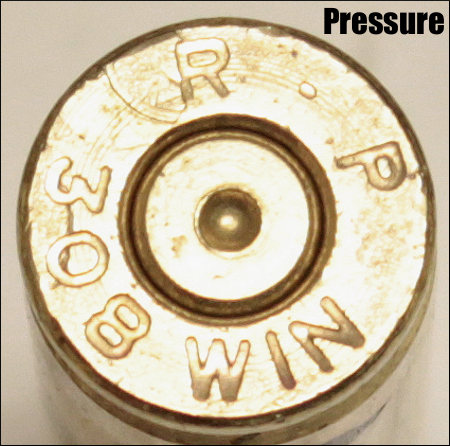
If you will notice in the picture of the case rim, there are two pressure signs to notice. First, look at the primer. It is basically flattened to about the max of what could be considered safe. If this was the only pressure sign noted, I would probably be fine with this load, but would constantly keep an eye on it especially if I was going to use this load in warmer temperatures. This load could easily cross into the “excess pressure” realm very quickly.
There is another sign of pressure that we cannot ignore. If you’ll notice, there is an ejector mark apparent that is located over the “R” of the R-P headstamp. This absolutely tells us that this load would not have been in the safe pressure range. If there were any of these rounds loaded, they should not be fired and should be dis-assembled. This case should not be reloaded.
Split Case-Neck
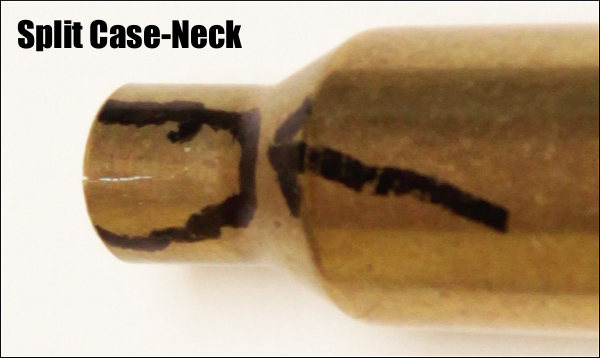
Here we have an R-P .22-250 case that has died the death. Everything looks fine with this case except the neck is split. This case must be tossed.
A split neck is a normal occurrence that you must watch for. It is caused by work-hardening of the brass. Brass cases get harder with age and use. Brand new cases that are stored for a period of time can become hard enough that they will split like this case within one to two firings. I have had new factory loads do the same thing. Then as we resize and fire these cases repeatedly, they tend to get harder and harder. Eventually they will split. The life of the case can be extended by careful annealing practices. This is an issue that would need to be addressed in an article by itself. Of course this case is no longer usable.
In the classes that I teach, I try to use examples like this to let the students see what they should be looking for. As always, if we can assist you, whether you are new to reloading or very experienced, contact us here at Sierra Bullets by phone at 1-800-223-8799 or by email at sierra@sierrabullets.com.
Dented Case Body
Here we have a Lake City 7.62×51 (.308 Win.) case with two heavy marks/dents in the case body.
This one may be a bit of a mystery. It appears as if this case may have been caught in the action of a semi-auto rifle when the firearm jammed or the case failed to clear during the cycling process. I probably would not reload this case just to prevent any feeding problems. This also appeared to be a factory loaded round and I don’t really see any pressure issues or damage to the case.
Multiple Problems — Lake City 5.56×45 unknown year.
This case has suffered multiple failures and cannot be re-used. First its has have a very rounded shoulder that is split. Upon first look it was obvious that this round had been a victim of excess pressure. The firearm (perhaps an AR?) was apparently not in full battery, or there was possibly a headspace issue also. While taking a closer look, the primer was very flat and the outside radius of the primer cup had been lost. High pressure! Then I also noticed that there was an ejector mark on the case rim. This is most certainly an incident of excessive pressure. This case is ruined and should be discarded.
It is very important to observe and inspect your cases before each reloading. After awhile it becomes second nature to notice the little things. Never get complacent as you become more familiar with the reloading process. If ever in doubt, call Sierra’s Techs at 1-800-223-8799.
You’d like to protect your hearing, and maybe you’re a little curious about how your rifle might shoot suppressed. So you’re thinking of buying a suppressor (aka “can”, “moderator”, “silencer”). You can’t just get one off the shelf at Walmart. Acquiring a suppressor requires filling out paperwork and paying a Federal $200 Tax Stamp. Plus there is typically a pretty long wait. However, the good news is that suppressor ownership is now legal in 42 of the 50 American states — that’s 84%! For most American adults, getting a suppressor is legal, provided pass the required background checks.
States Where Suppressor Ownership is Allowed
Currently, the following 42 states allow private ownership of suppressors: AL, AK, AZ, AR, CO, CT, FL, GA, ID, IN, IA, KS, KY, LA, ME, MD, MI, MN, MS, MO, MT, NE, NV, NH, NM, NC, ND, OH, OK, OR, PA, SC, SD, TN, TX, UT, VT, VA, WA, WV, WI, WY.
Note: Even if you live in one of the states listed, you should still verify that owning a suppressor is legal in your area. Some states may have municipal- or county-based restrictions.
States Where Suppressor Ownership is Prohibited
Unfortunately, there are still eight (8) States that forbid private ownership of suppressors. The eight No-Go States are: California, Delaware, Hawaii, Illinois, Massachusetts, New Jersey, New York, Rhode Island. In these eight states, private ownership of suppressors (aka “silencers”) is forbidden. Hopefully that a few of those eight hold-out states will change their laws in the months ahead.
Looking Inside a Suppressor in Action
Popular YouTube Channel Smarter Every Day recently released a cool video featuring rifle suppressors with see-through acrylic sleeves. The team filmed shots through the suppressors using ultra-high-speed (110,000 frame per second) cameras. When played back in super-slow-motion, you can see the flame propagate through the suppressor and the bullet move through each baffle before it exists the muzzle. Watch the results in the video below — it’s mesmerizing:
See Through Suppressor in Super Slow Motion (110,000 fps) — Click Arrow to Watch:
Suppressors, On Average, Reduce Noise Levels about 30 Decibels
In an article for Ammoland, gunwriter Sam Hoober says that you can expect about 30 decibels (dB) of noise reduction from the average suppressor: “Looking at a few different products, SilencerCo attests their suppressors reduce the sound pressure of a 9mm gunshot to anywhere from 125.7 dB to 131.5 dB, depending on the model. Advanced Armament Co, another popular supplier, attests a 23 dB to 33 dB reduction or down to 127 dB. Liberty Suppressors, another manufacturer, attests a reduction of 24 dB to 38 dB, depending on model and other factors. In short, we can presume something on the order of 30 dB of attenuation as an average.”
Using that 30 dB number you can quickly discern that you’ll still need hearing protection — good hearing protection — when shooting any suppressed firearm (even a .22 LR). “Spikes of 130 dB and more can result in permanent hearing damage instantly”. Source: NRA Blog.
Story idea by Boyd Allen. We welcome reader submissions.
What would you do if you had a LIVE Round stuck in a chamber? Well, don’t hammer a wood dowel in the barrel, that’s for sure. Here is a tale of stupidity that could have injured the rifle owner. This account appeared on the Facebook Page of Brock & Norris Custom Rifles, a gunsmith shop in the United Kingdom.
Live, Loaded Round Stuck in Chamber — What NOT to Do!
Commentary by gunsmith Mike Norris
Here is a cautionary tale. A client came into the workshop with a problem which could have had very serious [even deadly] consequences. And it is not the first time we have seen this. Firing neck-sized-only ammunition, the client attempted to load a round which then jammed solid in the chamber. The bolt would not close and the round was unable to be extracted.
The problem was compounded by various attempts to push the loaded round from the chamber with cleaning rods and the assistance of a hammer (I kid you not!). All of which damaged the bore and the crown, culminating in a wooden dowel being hammered into the barrel which subsequently broke off in the bore. The end result was a barrel that was totally wrecked.
One Facebook friend posted: “Fortunate avoidance of a ‘Darwin Award’. I can hear it: ‘Go on hammer the bolt, she’ll go!’. We’re missing a ‘face palm’ emoji here.”
The Problem Started with a Neck-Sized Case
The moral of this story is DO NOT NECK SIZE cases. Mike advises: “Full-length size cases correctly. You only move the shoulder back 1 to 1.5 thousandths and the case will feed and extract EVERY TIME. Yes you will have to trim cases occasionally but it is one hell of a site cheaper and safer than jamming a live round in the barrel and wrecking the barrel trying to remove it. Not to mention the risk to life and limb!”
What Should Have Been Done in this Situation?
Mike was asked the best method for removing a stuck round. He stated: “The Grease Gun Method on a threaded barrel works*. However, in this case, this was not remotely possible due to 20 inches of wooden dowel being broken off in the bore as well. The live round (yes it was live!) was attempted to be removed by hammering on a brass cleaning rod (an actual hammer was used) to try to dislodge it. That brass rod broke, so then a wooden dowel was employed, and THAT broke as well.”
Mike cautions that, when a live, loaded round is involved you must be very careful: “Do not be taking chances with your own safety or others around you. When it is safe to do so, get the rifle to a professional. By the way he WILL [chide you] for being daft in the first place and then bringing the problem into his premises. Expect to be charged for the expertise to remove said obstruction, In the past I even had a client send me a loading die with a live .338 Lapua round in it through the Post no less!”
* This YouTube Video shows the successful removal of a jammed FIRED (not live) case from an AR15 barrel. You can see the fired case eject at 15:35 time-mark, after the primer pops out first. But note, this was NOT a live, loaded round. Extreme caution must be excercised with live rounds.
Are you looking for a muzzle brake for your rifle? Then you MUST check out the epic Muzzle Brake Test performed a few seasons back by PrecisionRifleBlog.com. This massive, data-driven field test was organized by PRB head honcho Cal Zant. Over a period of months, Cal and his team tested 20+ muzzle brakes designed for 6mm, 6.5mm, and .30-caliber precision rifles. Hundreds of hours went into this research, which provided vital new insight and empirical data for several aspects of muzzle devices. Cal put a huge amount of labor/engineering into these tests and his findings deserve to be widely read.
The Muzzle Brake Overview Article covers designs, specs, and prices of 20+ brakes. Then separate, detailed PRB articles cover sound levels, recoil reduction results, ability to stay on target, muzzle blast/ground effects and more. SEE PRB Muzzle Brake Test Results SUMMARY.
Recoil Reduction
Cal created a system to directly measure the entire recoil force signature of each muzzle brake using high-speed sensors. Although the recoil cycle happens very quickly (around 1/100th of a second), his test equipment could record up to 1,000 force data points during a single recoil cycle! He fired over 1,000 rounds of match-grade ammo through four different rifles: 6XC, 6.5 Creedmoor, .308 Win, and the monster .300 Norma Magnum. He literally spent thousands of dollars on this part of the test, to ensure he got it right.
Cartridge Types Tested: 6XC, 6.5 Creedmoor, .308 Win, and .300 Norma Magnum
Ability To Stay On Target
David Tubb helped Cal develop this part of the test, because David believes this is the most important aspect of a muzzle brake. Using a laser and high-speed camera, Cal was able to objectively quantify how well each design helped you stay on target.
Noise Level
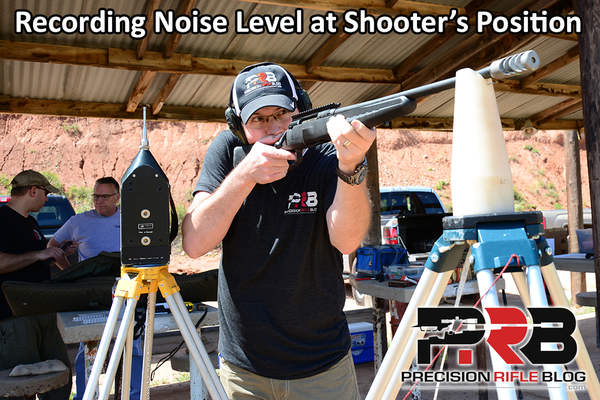
Muzzle brakes are loud, but some are louder than others … three to four times as loud. Cal enlisted the help of an expert from the suppressor industry to precisely measure how much louder each muzzle brake made a rifle. Each brake was tested in accordance with MIL-STD-1474D using calibrated military-approved equipment, and the noise level was also tested at the shooter’s position.
Recoil Reduction Summaries by Caliber
In the detailed summaries of recoil reduction test results, PRB provides hard data that might surprise a few people and even dispel a few myths. Particularly interesting is Zant’s comparison of recoil reduction with a suppressor compared to muzzle brakes. How do you think the suppressor performed compared to the brakes? You may be surprised.
We see comparison tests of cars, cameras, and other hardware. But how about chronographs? What could we learn by setting up three different chronographs, and running a 20-shot string over all three at the same time. One of our Forum members, Randy S. (aka AAA) did that very test with three of the best chronographs you can buy: LabRadar, MagnetoSpeed, and an Oehler model 35P. The MagnetoSpeed was attached to the barrel of an F-Class rig, with the LabRadar placed on the left side of the shooting bench. The Oehler 35P was positioned about 23 feet downrange. The photo above shows the set-up. A 20-shot string was recorded with the results in a spreadsheet.
AAA talks about this interesting experiment in a Shooters’ Forum Thread. Here is his report:
Comparison Testing Three Chronographs
We all have our favorite chronograph. Each gives a number, but how would that number compare to the same round fired with another chronograph? I wanted to know so a friend and I set up the following test with three chronographs: LabRadar, MagnetoSpeed V3, and Oehler Model 35P.
For the test we fired Berger 105gr VLDs over the three chronographs simultaneously. The test rifle was my 6mm BR Ackley (BRA) F-class rig with fire-formed brass and 200 rounds on the new barrel.
Chronogaphs Tested
LabRadar
MagnetoSpeed V3
Oehler Model 35P
Temperature: 86 deg. F
Elevation: 854 feet
Cartridge: 6mm BRA (105gr Berger VLD)
Time between shots: 45 seconds
To start off, five rounds were fired to make sure all systems were recording and to warm the barrel. Then the test was 20 shots fired across all three instruments with 45 seconds between shots. The Oehler was set 7.5 yards from the muzzle so 12 FPS was added to the recorded value.
We were using the internal trigger on the LabRadar. The manual says the Vo indicated is the actual muzzle velocity when using the internal trigger, but not if using the Doppler. The 12 FPS Oehler adjustment (back to MV) was based on the Berger Ballistics Calculator.
The LabRadar Chronograph is on sale now through 12/7/2019. Buy for $499.95, a $60.00 savings.
Results of the Triple Chronograph Shoot-Out:
LR-M is FPS variance between LabRadar and MagnetoSpeed V3. LR-O is FPS variance between LabRadar and distance-adjusted Oehler 35P. You can see all three chronos were very consistent. ES was identical with the MagnetoSpeed and Oehler 35P, while SD was identical with the LabRadar and Oehler 35P.CLICK HERE for spreadsheet.
The tester, Randy S. (aka AAA) says: “Judge for yourself, but I was impressed by all.”
This is a manufacturer’s photo showing the Magnetospeed V3 as mounted. This is NOT the test set-up.
Comments by Forum Members
Our Forum members expressed interest in this Triple Chronograph test. Some confirmed that the LabRadar and Magnetospeed give very similar FPS numbers, based on their own tests:
“Great test and thanks for sharing. I’ve tested my MagnetoSpeed and LabRadar together and results are always within 2-4 FPS of one another.” — Big D
“Very happy to see your numbers support my decision to buy a MagnetoSpeed. Had read reports comparing it to the Oehler and the numbers I get seem to be supported by my long range shooting results. Many thanks for taking the time and effort [to perform] this comparative test. Always good to get actual test results.” — Texas10
“I did a 4-shot test with my MagnetoSpeed and another shooter’s LabRadar a couple of days ago. The results were within 4 fps with the LabRadar being optimistic.” — Pat Miles
Forum Member Powderbreak studied AAA’s original spreadsheet from the chronograph trio test, then figured out the shot-by-shot FPS variance between the machines. He concluded that all the machines performed very well. Powderbreak posted:
Analyzing the Triple Chronograph Test — What Can We Conclude?
AAA did a great job of comparing the 3 chronos. What conclusions can be drawn?
1) I have not checked the manufacturer’s claims of accuracy, but the three chronos are very close to one another. There is no way for us to determine the actual true velocities, but we do not need to do so. Any of the chronos would be more than adequate for an accurate shooter.
2) The resolution of the three chronographs is actually pretty astounding. One foot per second (FPS) is a resolution of 0.033%.
3) AAA did a great job of reloading a very consistent round. With an extreme spread of 33 fps out of 3014 for 20 rounds, that is only 1.09% total spread of velocities.
4) There is a closer velocity match between the MagnetoSpeed and the LabRadar, but that does not mean the Oehler is less accurate. There is simply an offset between the Oehler and the other two. This could be due to the greater distance, the location, or the internal working of the Oehler.
5) Believe your chronograph, it is probably the most accurate reloading tool that you own.
Brian Litz of Applied Ballistics carefully explained the operation, set-up, accuracy and comparison of AB’s chronographs in his books. [Those books] are well worth the money, and give great insight into the workings of chronographs.” — Powderbreak
You may not realize it… but to get the optimum BC from your bullets (i.e. the lowest aerodynamic drag), you must spin the bullets fast enough. Bullet drag increases (as expressed by lower BC) if the bullet spins too slowly. Bryan Litz of Applied Ballistics explains how BC changes with twist rates…
More Spin, Less Drag
In this article, we look at how twist rate and stability affect the Ballistic Coefficient (BC) of a bullet. Again, this topic is covered in detail in the Modern Advancements book. Through our testing, we’ve learned that adequate spin-stabilization is important to achieving the best BC (and lowest drag). In other words, if you don’t spin your bullets fast enough (with sufficient twist rate), the BC of your bullets may be less than optimal. That means, in practical terms, that your bullets drop more quickly and deflect more in the wind (other factors being equal). Spin your bullets faster, and you can optimize your BC for best performance.
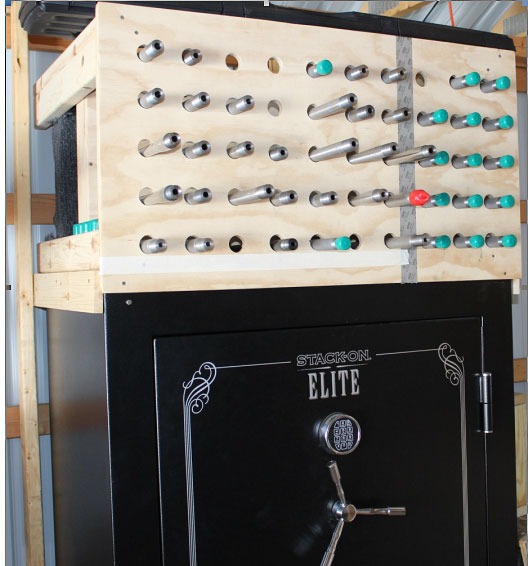
Any test that’s designed to study BC effects has to be carefully controlled in the sense that the variables are isolated. To this end, barrels were ordered from a single barrel smith, chambered and headspaced to the same rifle, with the only difference being the twist rate of the barrels. In this test, 3 pairs of barrels were used. In .224 caliber, 1:9” and 1:7” twist. In .243 caliber it was 1:10” and 1:8”, and in .30 caliber it was 1:12” and 1:10”. Other than the twist rates, each pair of barrels was identical in length, contour, and had similar round counts. Here is a barrel rack at the Applied Ballistics Lab:
Applied Ballistics used multiple barrels to study how twist rate affects BC.
“The Modern Advancements series is basically a journal of the ongoing R&D efforts of the Applied Ballistics Laboratory. The goal of the series is to share what we’re learning about ballistics so others can benefit.” –Bryan Litz
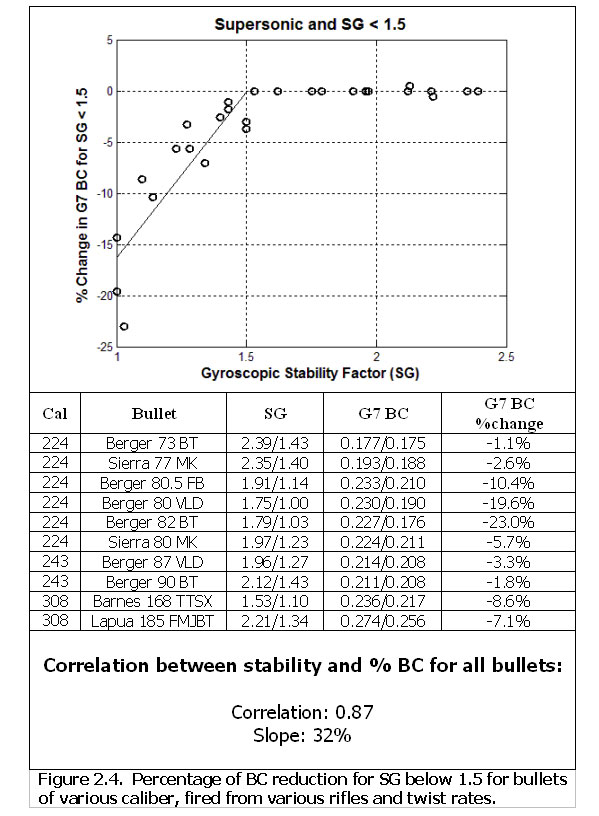
Barrel twist rate along with velocity, atmospherics, and bullet design all combine to result in a Gyroscopic Stability Factor (SG). It’s the SG that actually correlates to BC. The testing revealed that if you get SG above 1.5, the BC may improve slightly with faster twist (higher SG), but it’s very difficult to see. However, BC drops off very quickly for SGs below 1.5. This can be seen in the figure below from Modern Advancements in Long Range Shooting.
The chart shows that when the Gyroscopic Stability Factor (SG) is above 1.5, BC is mostly constant. But if SG falls below 1.5, BC drops off dramatically.
Note that the BC drops by about 3% for every 0.1 that SG falls below 1.5. The data supports a correlation coefficient of 0.87 for this relationship. That means the 3% per 0.1 unit of SG is an accurate trend, but isn’t necessarily exact for every scenario.
It’s a common assumption that if a shooter is seeing great groups and round holes, that he’s seeing the full potential BC of the bullets. These tests did not support that assumption. It’s quite common to shoot very tight groups and have round bullet holes while your BC is compromised by as much as 10% or more. This is probably the most practical and important take-away from this test.
To calculate the SG of your bullets in your rifle, visit the Berger Bullets online stability calculator. This FREE calculator will show you the SG of your bullets, as well as indicate if your BC will be compromised (and by how much) if the SG is below 1.5. With the stated twist rate of your barrel, if your selected bullet shows an SG of 1.5 (or less), the calculator will suggest alternate bullets that will fully stabilize in your rifle. This valuable online resource is based directly on live fire testing. You can use the SG Calculator for free on the web — you don’t need to download software.


 The first question you have to ask is whether the intended recipient can legally own the firearm where he or she lives. With more than 20,000 different gun laws on the books, even the kinds of firearms that law-abiding citizens can own vary from place to place. For example, juveniles (under age 18) generally speaking are precluded by law from possessing a handgun. Check out the
  Consider a Gift Card Instead of Direct Gift

 Class Registration is Now Open