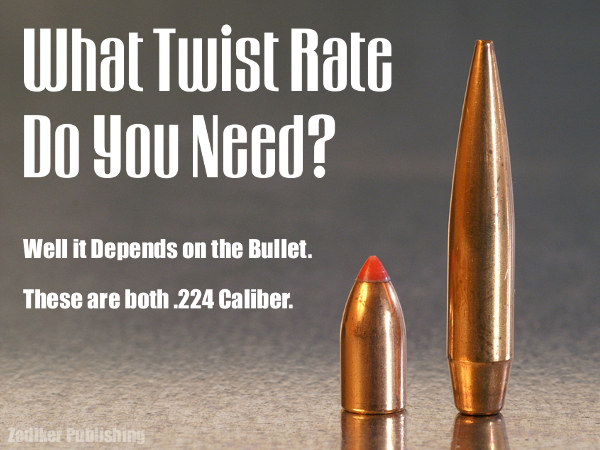
Here’s an extreme range of .224-Caliber bullets: 35gr varmint bullet and 90gr match bullet. Of course, along with bullet length/design, you need to consider MV when choosing twist rate.
Even with the same caliber (and same bullet weight), different bullet types may require different rates of spin to stabilize properly. The bullet’s initial spin rate (RPM) is a function of the bullet’s muzzle velocity and the spin imparted by the rifling in the barrel. You want to ensure your bullet is stable throughout flight. It is better to have too much spin than too little, according to many ballistics experts, including Bryan Litz of Applied Ballistics. Glen Zediker has some basic tips concerning barrel twist rates and bullet stability. These come from his latest book, Top Grade Ammo.
Choosing the Right Twist Rate
I’d always rather have a twist too fast than not fast enough. Generally… I recommend erring toward the faster side of a barrel twist decision. 1:8″ twist is becoming a “new standard” for .224 caliber, replacing 1:9″ in the process. The reason is that new bullets tend to be bigger rather than smaller. Don’t let a too-slow twist limit your capacity to [achieve] better long-range performance.
Base your next barrel twist rate decision on the longest, heaviest bullets you choose to use, and at the same time realize that the rate you choose will in turn limit your bullet choices. If the longest, heaviest bullet you’ll shoot (ever) is a 55-grain .224, then there’s honestly no reason not to use a 1:12″. Likewise true for .308-caliber: unless you’re going over 200-grain bullet weight, a 1:10″ will perform perfectly well.
Bullet Length is More Critical than Weight
Bullet length, not weight, [primarily] determines how much rotation is necessary for stability. Twist rate suggestions, though, are most usually given with respect to bullet weight, but that’s more of a generality for convenience’s sake, I think. The reason is that with the introduction of higher-ballistic-coefficient bullet designs, which are longer than conventional forms, it is easily possible to have two same-weight bullets that won’t both stabilize from the same twist rate.
Evidence of Instability
The tell-tale for an unstable (wobbling or tumbling) bullet is an oblong hole in the target paper, a “keyhole,” and that means the bullet contacted the target at some attitude other than nose-first.
Increasing Barrel Length Can Deliver More Velocity, But That May Still Not Provide Enough Stability if the Twist Rate Is Too Slow
Bullet speed and barrel length have an influence on bullet stability, and a higher muzzle velocity through a longer tube will bring on more effect from the twist, but it’s a little too edgy if a particular bullet stabilizes only when running maximum velocity.
My failed 90-grain .224 experiment is a good example of that: I could get them asleep in a 1:7″ twist, 25-inch barrel, which was chambered in .22 PPC, but could not get them stabilized in a 20-inch 1:7″ .223 Rem. The answer always is to get a twist that’s correct.
These tips were adapted from Glen’s newest book, Top-Grade Ammo, available at Midsouth. To learn more about this book and other Zediker titles, and read a host of downloadable articles, visit ZedikerPublishing.com.
For decades, ShootingUSA has been a leading video resource for the shooting sports and hunting. This popular cable TV show covers shooting matches, and provides expert information on precision shooting, gun maintenance, optics, and defensive firearms use. Here are five interesting videos all worth watching. Learn about wind-reading, gun maintenance, and optics.
1. Reading the Wind — SGT Sherri Jo Gallagher of USAMU
Sergeant Sherri Jo Gallagher of the U.S. Army Marksmanship Unit (USAMU) shows us how to read the wind in given conditions, and how to apply your wind assessment when aiming down-range. During her time with the USAMU, Sherri won the National High Power Championship, and was the first woman in history to earn the U.S. Army “Soldier of the Year” honors. Sherri comes from a legendary family of shooters — she was raised by Ace Marksman Mid Tompkins and mother Nancy Tompkins, the first female to win the NRA National High Power Championship.
2. Field-Stripping and Cleaning AR-Platform Rifles
Let’s face it — Black Rifles run dirty. On AR-platform rifles, the gas system blows carbon and powder residues back into the action and bolt carrier group. Accordingly, you need to clean ARs early and often, and you should fully disassemble the bolt carrier to access parts and recesses which accumulate greasy lube and hard carbon. This helpful video shows how to field-strip and clean AR-platform rifles. If you own an AR, this is definitely worth viewing. With over 1.9 million views, this is the #1 most-watched video on Shooting USA’s YouTube Channel.
2. MOA Defined — Jim Scoutten Explains Minute of Angle
Minute of Angle (MOA) — this is the most common measurement of group size, and hence rifle accuracy. You hear about shooters hoping to shoot 1 MOA or “half-MOA”, but many folks could not give you a precise definition. In fact MOA is an angular measurement that equates to one-sixtieth of one degree of Arc. In this video, host John Scoutten defines MOA. He then demonstrates how MOA translates to accuracy on target. He demonstrates one-half-MOA accuracy with a Les Baer Custom rifle. This company offers a three-shot, half-MOA guarantee for its rifles.
4. How to Adjust for Parallax
Most precision rifle scopes have parallax adjustment, typically a knob on the left side of the scope. but what exactly is “Parallax” and why do you need to adjust optics to ensure the parallax setting is optimal? In this Shooting USA video, John Paul of JP Rifles defines parallax and explains why you need to set parallax correctly for the distance to your target. The video then shows how to adjust parallax correctly, a process which should start with the scope’s ocular focus.
5. How to Mount a Riflescope
When mounting a scope you want to use quality rings, and ensure that the scope is leveled properly. In addition, you need to adjust the fore/aft position of the scope so that eye relief is correct. Ideal scope position may be different when shooting from the bench vs. shooting prone. In this Shooting USA video John Paul of JP Rifles reviews scope mounting basics.
With the 6mm Dasher cartridge becoming popular with PRS/NRL competitors as well as the benchrest crowd, we thought it was time to re-visit a special rifle chambered for the 6mm Dasher wildcat. This gun has a great story behind it. Forum member Bob A. (aka “Killshot”) used his “Forum Classifieds Special” to beat all comers in the F-Class Division in the American-Canadian Match and the Long Range Regional Match in 2013 in Sacramento, CA.
Bob’s 6mm Dasher sports a blue-printed Rem 700 action. Who says you need a high-dollar custom action to run with the big dogs? In fact, this same gun, built with components sourced from AccurateShooter Forum Classified Ads, set a Sacramento F-Class range record of 200-17X a few years back. In this story, Bob talks about the build, and he explains his methods for loading ultra-accurate Dasher ammo.
Bob’s Budget-Build Dasher F-Classer
I wanted to build a proper rifle for F-Open but needed to keep it simple and, well, cheap. I found a solid “base” to build on in the form of a Dave Bruno-built, “pre-owned” 6-6.5×47 Lapua that I located in the AccurateShooter Forum classifieds in late 2011. The base action was a trued and blue-printed Remington 700 receiver circa 1971 with a spiral-fluted bolt. It was in a Shehane ST1000 stock painted sky blue and had a Jewell 1.5-oz BR trigger. I sent the bolt to Greg Tannel (Gretanrifles.com) to have the firing pin hole bushed and sleeved, the ejector removed and the hole filled and the face trued. I upgraded to Tannel’s Light Steel firing pin assembly while it was out.
Having the working bits completed, I needed a barrel. So I went to the AccurateShooter classifieds again and found a 1:8″-twist, 30″ x 1.25″ (diam.) Bartlein with a 0.236″-land bore. I called Dave Kiff and explained my pursuit and he recommended his PT&G “world record” 6 Dasher reamer (.2704″ no-turn neck and .104″ freebore). A month or so later the reamer and gauges arrived.
I had the barrel chambered by Marc Soulie of Spartan Precision Rifles (510-755-5293, Concord, CA). Marc is a great builder and I’m pleased to call him a friend.
The rifle got its good looks from a Pennsylvania artist named Kenny Prahl. His Prahl Designs shop (724-478-2538) added the white ghost-flames over the existing sky blue metallic paint.
Looks Great, Shoots Better
Fire-forming showed great promise — ten-shot groups of half an inch at 200 yards were typical. I lost only one case to a split neck and the “blow lengths” are good and consistent. This was followed up with load development which saw 100-yard, five-shot groups in the .1s and .2s as the rifle showed its preference for Reloder 15 over Varget powder, and for CCI 450s over all other primers. The bullet of choice was the ever-popular Berger 105gr Hybrid Target.
In February 2012 I began shooting the Dasher in monthly club matches at the Sacramento Valley Shooting Center, the home range of a number of excellent F-Class, Benchrest and High Power shooters. Using a Farley Coaxial rest up front (also picked up from a WTB ad on AccurateShooter’s Forum) and an Edgewood bag in the back, I gradually improved my gun-handling to the point where I could shoot a respectable score. This was very different from the bipod shooting I’d done in the past in F/TR.
Dasher Loading Tips
My chamber is set up for blue box Lapua 6mmBR brass. My case preparation is straight-forward. I fire-form with virgin cases right out of the box. I don’t size them but I will give the primer holes a good look and clean up the flash hole with a .058″ bit in a pin vise. To fire-form, I seat a Berger 108gr BT .030″ into the lands over a standard 6mmBR load of Varget.
For match loads, I use Alliant Reloder 15. While Varget is less sensitive to temp changes, RL15 has given me lower extreme spreads and better long range control. [Bob acknowledges that every barrel is unique, so a different powder, such as H4895 might work better for you.]
I clean my fired cases with stainless steel media in a Thumler’s rotary tumbler after every firing. I anneal after every other firing using a Bench-Source machine which is very well made and easy to operate. I use a Whidden full length bushing die with Redding bushings for sizing.
After sizing, I chamfer the inside of the neck with the K&M tool which has a pilot rod centered in the flash hole. Then I’ll give the neck and mouth a “once over” with some 0000 steel wool. I finish loading off with a Redding Competition Seating Die with the micrometer top.
I use a carbide ball on the expander rod of the full length sizing die. I use a .266″ TiN-coated bushing and the ball just kisses the inside walls of the sized neck. I get very consistent neck tension this way and have had no issue with split necks.
Seating Depth Considerations
With fire-formed brass, the junction of the bullet’s bearing surface and boat-tail is above the neck/shoulder junction of the case, so I have no issues with donuts. You can see how a loaded round looks in the photo at left. For occasional trimming, I use a very nice little Possum Hollow trimmer that indexes on the case shoulder.
We first featured this story in 2010, but the results of this rimfire ammo test have been of such widespread interest that we try to bring the test to readers’ attention every year.
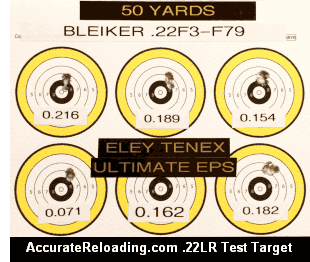
In 2010, the staff of AccurateReloading.com Forum completed a massive .22LR Rimfire Ammunition Testing Project. Some 55 different types of ammo were tested, using a highly-accurate Swiss-made Bleiker rifle, with a 2-stage trigger. All ammo varieties were tested at 50 yards, 75 yards, and 100 yards, shooting five, 5-shot groups at each distance. Though these tests were completed some time ago, many readers have requested a “reprint” of the ammo rankings, so we’ve republished this data below.
The results are fascinating to say the least (and perhaps eye-opening). The tester observed: “I got some amazing groups, and some which are, frankly, absurdly bad! This has re-enforced what I had experienced with 22 ammo in the past — that is being consistently inconsistent.”
While we strongly caution that .22LR rimfire ammo may work well in one gun and not another, and ammo performance can be improved through the use of barrel tuners, the AccurateReloading.com research provides invaluable guidance for smallbore shooters. Overall, the testers burned through over 4,000 rounds of ammo, and you can see the actual test targets online. To read all the test reports, and view target photos visit AccurateReloading.com.
0.162 Eley Tenex Ultimate EPS
0.164 Lapua Midas Plus
0.177 Lapua Polar Biathlon
0.187 Eley Match EPS
0.193 Eley Match
0.203 Lapua Midas M
0.215 Lapua Center X
0.216 Western Value Pack
0.229 Lapua Signum
0.241 Lapua Master L
0.243 Eley Pistol Match
0.256 Olin Ball
0.256 Akah X-Zone
0.261 Lapua Midas L
0.261 Lapua Master M
0.263 Eley Tenex Semi Auto
0.270 Lapua Super Club
0.272 Eley Tenex
0.303 Lapua Standard Plus
0.312 CCI Standard Velocity
0.319 RWS R 50
0.319 Eley Standard
0.328 SK High Velocity
0.339 Eley Club Xtra
0.340 Winchester T22
0.356 Federal Champion
0.362 Eley Subsonic HP
0.371 CCI Mini Mag
0.376 Federal American Eagle
0.377 Norinco Target
0.380 Sellier & Bellot Club
0.384 Eley Club
0.387 Eley Sport
0.388 Totem
0.392 Swartklip Match Trainer
0.398 Federal Gold Medal
0.403 Swartklip HV
0.409 Eley Match Xtra Plus
0.424 Sellier & Bellot Std
0.443 Remington Target
0.461 Lapua Crow HP
0.475 Eley Silhouex
0.479 Magtech
0.498 Eley High Velocity
0.513 Winchester Super X
0.516 Kassnar Concorde
0.539 CCI Blazer
0.560 Winchester Supreme Pistol
0.576 Norinco Pistol Revolver
0.593 SK Standard
0.611 Sellier And Bellot HP
0.626 SK Standard HP
0.686 Logo HV
0.956 Pobjeda Target
0.274 Lapua Center X
0.283 Lapua Standard Plus
0.295 Eley Tenex Ultimate EPS
0.307 Lapua Midas M
0.329 Lapua Master M
0.346 Eley Match
0.373 Lapua Polar Biathlon
0.399 RWS R 50
0.432 Lapua Midas L
0.448 Eley Tenex Semi Auto
0.467 Eley Match EPS
0.474 Lapua master L
0.491 Eley Match Xtra Plus
0.494 CCI Standard
0.496 Eley Subsonic HP
0.507 Eley Sport
0.512 Federal American Eagle
0.513 SK High Velocity
0.514 Eley Standard
0.516 Eley Tenex
0.516 Lapua Crow HP
0.532 Western Value Pack
0.533 Fed. Champion Target
0.535 Lapua Midas Plus
0.564 Akah X Zone
0.566 Olin Ball
0.573 Eley Club Xtra
0.616 Lapua Signum
0.631 Winchester T22
0.639 Swartklip HV HP
0.641 Eley Club
0.642 Eley Silhouex
0.647 CCI Mini Mag
0.679 Eley Pistol Match
0.682 Swartklip Match Trainer
0.690 Federal Gold Medal
0.692 Remington HV
0.703 Lapua Super Club
0.720 Winchester Super X
0.738 Eley High Velocity
0.759 Kassnar Concorde
0.765 Sellier And Bellot Club
0.770 Winch. Supreme Pistol
0.770 Norinco target
0.775 CCI Blazer
0.802 Norinco Pistol Revolver
0.841 LVE Logo HV
0.855 Sellier & Bellot Std
0.871 Magtech
0.923 Sellier & Bellot HP
0.934 SK Standard HP
1.017 Remington Target
1.257 Totem Standard
1.442 SK Standard
1.578 Pobjeda target
0.455 Eley Match
0.510 Lapua Midas Plus
0.549 Lapua Midas M
0.611 Lapua Polar Biathlon
0.611 Eley Tenex Ultimate EPS
0.619 Eley Match EPS
0.622 Eley Club
0.630 Lapua Center X
0.631 RWS R50
0.679 Eley Tenex Semi Auto
0.694 Lapua Midas L
0.729 Eley Tenex
0.739 Lapua Master L
0.753 Lapua Super Club
0.785 Lapua Master M
0.831 Eley Sport
0.851 Eley Match Xtra
0.859 Lapua Standard Plus
0.867 Akah X-Zone
0.877 Eley Pistol Match
0.907 Norinco Target
0.924 Eley Silhouex
0.939 CCI Standard
0.952 Eley Subsonic HP
0.963 Magtech
0.970 Olin Ball
0.978 Kassnar Concorde
0.995 Eley Club Xtra
1.009 Western Value Pack
1.032 Federal Champion
1.087 Norinco Pistol Revolver
1.100 CCI Mini Mag
1.112 Lapua Crow HP
1.143 Winchester T22
1.142 Federal Gold Medal
1.144 federal American Eagle
1.156 Swartklip Hollo Point
1.165 Lapua Signum
1.170 Swartklip Match Trainer
1.175 Fed. Champion Value Pk
1.182 SK high Velocity
1.201 Totem
1.224 Winchester Super X
1.358 Eley Standard
1.367 Remington High Velocity
1.375 CCI Blazer
1.414 Eley High Velocity
1.450 Remington Target
1.504 LVE Logo
1.813 SK Standard
1.879 S&B Club
1.947 S&B Hollow Point
2.073 SK Standard HP
2.221 S&B Standard
2.266 Pobjeda Target
EDITOR: Note to the trolls, whiners, and nay-sayers. Yes, this test is nearly a decade old. Yes, some newer types of ammo are missing. Yes, it would be nice to shoot the ammo in other rifles (we all know that different rifles can have different ammo preferences). That said, this is still the most comprehensive, thorough rimfire ammunition test ever conducted and the results are invaluable. We are grateful that the AccurateReloading.com team put the time and effort into this “Mother of All Rimfire Ammo Tests”. The rimfire shooting community should acknowledge AccurateReloading.com’s testers for their hard work.
“The overturning moment MW tends to rotate the bullet about an axis, which goes through the CG (center of gravity) and which is perpendicular to the plane of drag….
Ruprecht Nennstiel, a forensic ballistics expert from Wiesbaden, Germany, has authored a great resource about bullet behavior in flight. Nennstiel’s comprehensive article, How Do Bullets Fly, explains all the forces which affect bullet flight including gravity, wind, gyroscopic effects, aerodynamic drag, and lift. Nennstiel even explains the rather arcane Magnus Force and Coriolis Effect which come into play at long ranges. Nennstiel’s remarkable resource contains many useful illustrations plus new experimental observations of bullets fired from small arms, both at short and at long ranges.
Shadowgraph of .308 Winchester Bullet
A convenient index is provided so you can study each particular force in sequence. Writing with clear, precise prose, Nennstiel explains each key factor that affects external ballistics. For starters, we all know that bullets spin when launched from a rifled barrel. But Nennstiel explains in greater detail how this spinning creates gyroscopic stability:
“The overturning moment MW tends to rotate the bullet about an axis, which goes through the CG (center of gravity) and which is perpendicular to the plane of drag, the plane, formed by the velocity vector ‘v’ and the longitudinal axis of the bullet. In the absence of spin, the yaw angle ‘δ’ would grow and the bullet would tumble.
If the bullet has sufficient spin, saying if it rotates fast enough about its axis of form, the gyroscopic effect takes place: the bullet’s longitudinal axis moves into the direction of the overturning moment, perpendicular to the plane of drag. This axis shift however alters the plane of drag, which then rotates about the velocity vector. This movement is called precession or slow mode oscillation.”
Raise Your Ballistic IQ
Though comprehensible to the average reader with some grounding in basic physics, Nennstiel’s work is really the equivalent of a Ph.D thesis in external ballistics. You could easily spend hours reading (and re-reading) all the primary material as well as the detailed FAQ section. But we think it’s worth plowing into How Do Bullets Fly from start to finish. We suggest you bookmark the page for future reference. You can also download the complete article for future reference and offline reading.
Hunting season is right around the corner. We know many readers have acquired a new hunting rifles, or perhaps are using new ammo or a new optic. If you’ve got new gear, you’ll want to zero your hunting rig properly. Here’s how…
Here’s a simple procedure that lets you get a solid zero in just four shots. Of course you probably want to fire a few more rounds to confirm your zero before you head off to your hunting grounds, but this will let you get on-target with a minimum amount of time and ammo expended. (This assumes your scope is securely mounted, and the bases are not drastically out of alignment.)
QUICK-TIP: The Key to this procedure is Dialing to Shot One Point of Impact (POI). Re-aim at center of target after SHOT ONE. Then with the rifle motionless, use the turrets to put the middle of the cross-hair on the first shot location.
1. First, remove the bolt and boresight the rifle. Adjust the position of the rifle so that, looking through the bore, you can see the center of the target with your eyes. Secure the rifle in the rests to maintain its position as boresighted. Then, without moving the rifle, center the reticle. That should get you on paper. With the rifle solidly secured in front and rear rests or sandbags, aim at the center of a target placed at your zeroing distance (50 or 100 yards). Confirm there are no obstructions in the barrel! Then load and fire SHOT ONE. Then, return the gun to the exact position it was when you pulled the trigger, with the cross-hair centered on the target as before.
2. Locate, in the scope, where your first bullet landed on the target. Now, while you grip the rifle firmly so it doesn’t move, have a friend adjust the turrets on your scope. While you look through the scope, have your friend turn the windage and elevation turrets until the cross-hairs, as viewed through the scope, bisect the first bullet hole on the target. Use the turrets to move the center of the reticle to the actual position of shot number one. IMPORTANT: Dial the crosshairs to the hole — don’t move the rifle.
3. After you’ve adjusted the turrets, now re-aim the rifle so the cross-hairs are, once again, positioned on the target center. Keep the rifle firmly supported by your rest or sandbag. Take the SECOND SHOT. You should find that the bullet now strikes in the center of the target.
4. Take a THIRD SHOT with the cross-hairs aligned in the center of the target to confirm your zero. Make minor modifications to the windage and elevation as necessary.
5. Finally, shoot the rifle from a field rest (shooting sticks, bipod, or rucksack) as you would use when actually hunting. Confirm, with SHOT FOUR, that your zero is unchanged. You may need to make slight adjustments. Some rifles, particularly those with flexy fore-arms, exhibit a different POI (point of impact) when fired from a bipod or ruck vs. a sandbag rest.
This Video Shows the Process Described Above:
Fouling Shots and Cold Bore Condition
If you recently cleaned your rifle, you may want to fire two or three fouling shots before you start this procedure. But keep in mind that you want to duplicate the typical cold bore conditions that you’ll experience during the hunt. If you set your zero after three fouling shots, then make sure the bore is in a similar condition when you actually go out hunting.
What anti-corrosion products really fight rust effectively? You’ll hear many opinions, but what do actual field tests reveal? One rifle shooter, who posts on YouTube as BlueonGoldZ, wanted to separate myth (and marketing claims) from reality, so he completed his own long-term rust test using metal samples. First he used ordinary tap water spray, and then he did a second, longer-duration test with a salt-spray solution. Nine different products were tested: Break Free CLP, Corrosion-X, Frog Lube, M-Pro 7, Outers, Pro-Shot Zero Friction, Rem Oil, Slip 2000, and Tetra Gun Triple Action CLP.
BlueonGoldZ initially examined each product for its “beading” properties with a normal tap water spray. But the main test involved many multiple weeks of exposure after a “dense” salt-water spray. (No rust formed after two weeks tap water exposure, so the test was accelerated with salt-water exposure).
The clear winners in the test, as shown by the screen shot above, were Corrosion-X (Best), and Frog-Lube (Second Best). The photo shows the test samples two weeks after being sprayed with salt water. The results are pretty dramatic — you can see with your own eyes what happened. We think this is a very useful bit of real-world research.
Results from Similar Long-Term Salt Exposure Test
Unfortunately, BlueonGoldZ’s test did NOT include Eezox, which we have found to be extremely effective (on a par with Corrosion-X). In another long-term test of corrosion preventatives, the two best rust fighters were Eezox and Corrosion-X in that order. Since that test was completed, Corrosion-X, already an excellent product, has been enhanced. CLICK HERE for Long-Term Salt Exposure Test Report.
A couple seasons back, Bill did a fascinating barrel cut-down test on a .338 Lapua Magnum rifle. Bill, a skilled gunsmith who runs 782 Custom Gunworks, cut down the barrel from 30″ to 17″ in one-inch increments. During the cut-down process, Marr measured velocities at each barrel length, shooting four rounds after each cut. As you’d expect, there was a huge change in velocity from long to short. Speeds were measured at the muzzle with a Magnetospeed barrel-mounted chronograph.
If you’re looking for max velocity with the .338 LM, go long. With 250-grain Sierra MK bullets, the peak velocity Bill measured was 2942 FPS at the full, 30-inch length. This decreased pretty steadily down to 2547 GPS at the shortest 17″ length. That’s an average decrease of 30.4 FPS per inch from 30″ to 17″.
Bill also tested 300-grain Sierra MatchKings. This is interesting because Randy Wise ran 300-grain bullets (Berger Hybrids) in a 26″ factory barrel for his ELR record. Peak velocity was 2833 FPS at 30″, 2799 FPS at 26″, and 2492 FPS at the shortest 17″ length. Interestingly, velocity at 29″ was higher than at 30″ for the 300-grainers. Bill notes: “The 300 SMK load showed a slight increase from 30 to 29″. I’ve recorded this in other tests and it seems to be more common with a heavier load. I suspect it is primarily due to the small sample sizes being used along with the relative proximity of muzzle velocities in adjacent lengths.”
At each new (shorter) barrel length, velocity was measured with a MagnetoSpeed chronograph using two different loads, 250gr SMKs with H4831sc and 300gr SMKs with Retumbo. Four shots were fired at each length with each load, a total of 112 rounds.
Load #1: 250gr Sierra MK, Lapua brass, CCI #250 primer, H4831SC, OAL 3.720″.
Load #2: 300gr Sierra MK, Lapua brass, Win WLRM primer, Retumbo, OAL 3.720″.
.338 LM Barrel Cut-Down Test Results Summary
.338 Lapua Magnum with 250gr Sierra MatchKings
After shortening the barrel from 30″ to 17″, total velocity reduction for the 250-grainers was 395 FPS, an average loss of 30.4 FPS per 1″ cut. The amount of velocity loss per inch rose as the barrel got shorter, with the biggest speed reduction, a loss of 55 FPS, coming with the cut from 18″ to 17″.
Start Velocity: 2942 FPS | End Velocity: 2547 FPS | Average Loss Per Inch: 30.4 FPS
We know that many of our readers will soon travel by air to attend major matches in Raton, New Mexico. The Spirit of America Match runs September 7-13, and the F-Class Mid-Range and Long-Range Nationals follow September 15-22. If you’ll be venturing to Raton, or to another destination by air in the weeks ahead, you need to be careful when transporting firearms through airports both in the USA and in other countries. It is important that you comply with all Homeland Security, TSA, and Airline policies when transporting guns and ammunition. Following the rules will help ensure you (and your gear) make it to your destination without hassles, delays or (God forbid), confiscations.
The NRA F-Class Mid-Range Nationals (Sept. 15-18) and Long Range Nationals (Sept. 19-22) will be held at the NRA Whittington Center 1000-Yard Range in Raton, New Mexico.
Good Advice from an Airport Police Officer
To help our readers comply with rules and regulations for air travel, we offer these guidelines, courtesy “Ron D.”, a member of our Shooters’ Forum. Before he retired, Ron D. served as a Police Officer assigned to Chicago’s O’Hare airport. Here Ron offers some very important advice for shooters traveling with firearms and expensive optics.
First, Ron explains that airport thieves can spot bags containing firearms no matter how they are packaged: “Don’t think you’re safe if your guns are placed in cases designed for golf clubs or trade show items. Baggage is X-Rayed now and cases are tagged with a special bar code if they contain firearms. It doesn’t take long for bad guys to figure out the bar coding for firearms.”
Carry-On Your Scopes and Expensive Items
Ron advises travelers to avoid placing very expensive items in checked baggage: “When traveling by air, carry on your rangefinder, spotting scope, rifle scope, medications, camera, etc. You would be surprised at the amount of people that carry-on jeans and shirts, but put expensive items in checked baggage. Better to loose three pairs of jeans than some expensive glass.”
Mark Bags to Avoid Confusion
Ron notes that carry-on bags are often lost because so many carry-on cases look the same. Ron reports: “People do accidentally remove the wrong bag repeatedly. I frequently heard the comment, ‘But it looks just like my bag.’ When de-planing, keep an eye on what comes out of the overhead that your bag is in. It’s easy to get distracted by someone that has been sitting next to you the whole flight. I tie two streamers of red surveyors’ tape on my carry-on bag.” You can also use paint or decals to make your carry-on bag more distinctive.
General Advice for Air Travelers
Ron cautions: “Keep your hands on your items before boarding. One of the most often heard comments from theft victims was, ‘I just put my computer down for a minute while I was on the phone.’ Also, get to the baggage claim area quickly. If your family/friends can meet you there, so can the opportunists. Things do get lost in the claim area. Don’t be a Victim. Forewarned is forearmed.”
Important TSA Tips on Firearms and Flying
Choosing a Rifle Transport Case
Ron advises: “Buy the best [rifle case] that you can afford. Don’t cry when your $3,000+ Benchrest rifle has a cracked stock or broken scope. Think about what it would be like to travel across the country (e.g. to Montana or the Cactus Classic) and arrive with a damaged rifle. Remember the Samsonite commercial. (For you younger shooters, it shows a monkey throwing the suitcase around in his cage at the zoo.) Baggage handling is NOT a fine art. There is no guarantee that your rifle case will be on top of all the other baggage. Then there is shifting of baggage in the belly of the plane. Ponder that for a while. Rifle and pistol cases must be locked. It doesn’t take a Rocket Scientist to figure out that a simple pry tool will open most case locks. There is not much that you can do to disguise a rifle case. It is what it is, and opportunists know this. Among thieves, it doesn’t take long for the word to get around about a NEW type of case.”
This Plano Double Scoped Rifle Case offers the functionality and durability of an SKB-type hard case for HALF the money. This is now just $111.64, while the equivalent SKB is around $240.00.
You may have heard the phrase “blueprinting an action”, but do you know what that really means? Do you know what operations are done to an action during the blueprinting process? To help you understand, gunsmith Bill Marr of RifleShooter.com has created a helpful article showing a Rem 700 blueprinting job start to finish. This article spotlights how the procedures can be done with manual tools. Bill, who runs 782 Custom Gunworks Ltd., can also perform many of these operations with modern automated machinery. In fact, Bill has written a follow-up article on Truing a Rem 700 receiver with a Lathe.
Bill explains: “Blue-printing, or truing a rifle action, ensures the receiver face, threads, lugs, bolt lugs, and bolt face are square to the center line of the receiver.” In Bill’s informative article, Bill shows how he blueprints a Remington 700 short action receiver with .308 Win bolt face. He covers the following procedures step by step:
Action Disassembly
Ream Minor Diameter of Receiver Threads
Square the Receiver Lugs
Square the Face of the Receiver
Lap the Bolt Lugs
Square the Bolt Face
We use the bushings to guide the receiver tap. This chases the threads and ensures they are square.
2. Truing the Receiver Face
Using the receiver facing tool, the front of the receiver is trued. The tool is placed over the tap and turned by hand. We used Do Drill to lubricate it.
3. Lapping the Lugs
The bolt lapping tool screws into the front of the action and applies rearward pressure on the bolt face. A little bit of lapping compound is placed on the front of the receiver lugs. The bolt handle is then raised and lowered repeatedly. Note — it is critical that we do not get any lapping compound on any other surfaces.
4. Truing the Bolt Face
On this bolt, the central part of the bolt face was low. After the truing operation, this Rem 700 bolt face is now completely square to the action.
IMPORTANT: Rifleshooter.com states: “This article highlights our project and is presented for information purposes only. This provides an overview of the process and should not be attempted without the guidance and supervision of an experienced gunsmith“.



 Increasing Barrel Length Can Deliver More Velocity, But That May Still Not Provide Enough Stability if the Twist Rate Is Too Slow


 Dasher Loading Tips
 I use a carbide ball on the expander rod of the full length sizing die. I use a .266″ TiN-coated bushing and the ball just kisses the inside walls of the sized neck. I get very consistent neck tension this way and have had no issue with split necks.
 In 2010, the staff of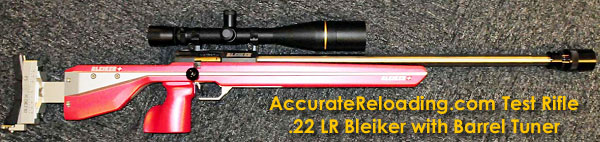


 First, Ron explains that airport thieves can spot bags containing firearms no matter how they are packaged: “Don’t think you’re safe if your guns are placed in cases designed for golf clubs or trade show items. Baggage is X-Rayed now and cases are tagged with a special bar code if they contain firearms. It doesn’t take long for bad guys to figure out the bar coding for firearms.”


