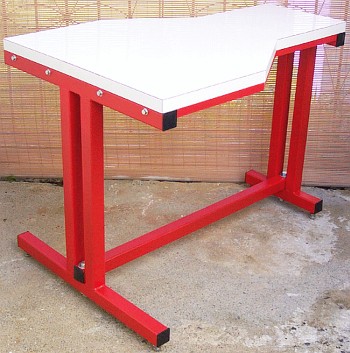
Do you like the Chris Byrne bench at left? For more details, CLICK HERE.
FREE Bench Plans on the Web
Building your own portable shooting bench is a great do-it-yourself project. You can build a sturdy bench for well under $100 in materials. Compare that to some deluxe factory-built benches which may cost $600.00 or more. You’ll find a wide assortment of home-built shooting bench designs (both portable and fixed) on the internet. Renovation Headquarters has links to FREE Plans and building instructions for fourteen (14) different shooting benches. There are all-wood shooting bench designs as well as benches that combine a wood top with a metal sub-frame or legs.
Heavy Wood Bench That Converts to Three Sections for Transport
In addition to the fourteen benches mentioned above, here is an interesting break-down bench design. Call it a “semi-portable” bench. The legs and frame are made from stout 4×4 post segments so the bench is fairly heavy. However, this bench can break down into three (3) sections for easier transport to and from the range. Dado-cut channels assure proper top alignment. This might be a good choice if you plan a multi-day excursion to a location without fixed benches. This three-leg bench design can be made from easy-to-locate materials. Note: The dimensions of this bench are are larger than typical fixed benches to accommodate 50 BMGs and other big rifles. CLICK HERE for more details.
The folks at Applied Ballistics have a new toy — a large trailer filled with all the latest and greatest tech gear for testing long-range ballistics. Bryan Litz reported: “The maiden voyage for the AB Mobile Lab in Texas this week was a huge success! We look forward to supporting more long range shooting events.” Mitchell Fitzpatrick was there in the Lone Star state with fellow Applied Ballistics staffer Christopher Palka. The Applied Ballistics team will be trailering the Mobile Lab to Indiana where it will be on hand for the NRA National Championships at Camp Atterbury this month.
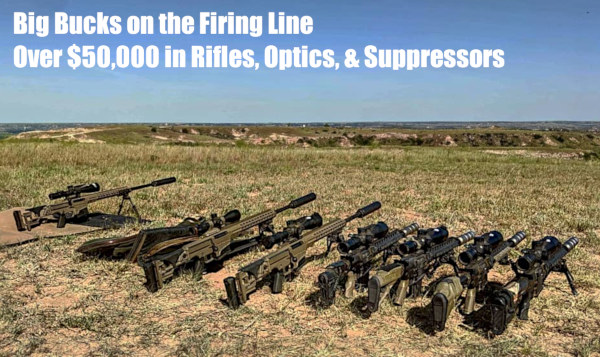
Ten rifles, heaps of cables, huge Doppler Radar unit, military-grade Laser RFs on tripods, spare barrels, safety gear — all ready for action in Texas.
About the Applied Ballistics Mobile Lab
Q: What is the basic purpose of the Applied Ballistics Mobile Lab?
Mitchell Fitzpatrick: The Mobile Lab allows us to effectively carry out ballistics testing in the field and at events. It has most of the capabilities of our normal lab, but on wheels.
Q: What hardware and electronics are carried in the Mobile Lab? What are its capabilities?
Bryan Litz: The Mobile Lab will transport most everything that’s in the main lab including the Doppler radar. This rig is new and we haven’t fully outfitted it yet. The load-outs will be somewhat flexible depending on the venue we are supporting.
The three rifles on the left are Barrett MRADS, $6000-$6154 MSRP, before optics.
NOTE to Readers — Check back at the end of the day. We will have more technical information from Bryan Litz and the Applied Ballistics team…
Need a new barrel for your Rem-actioned hunting or tactical rifle? Here’s a great DIY option for riflemen. McRee’s Precision offers complete, no-gunsmithing re-barreling kits for Remington and Rem-clone actions. These feature a high-quality, pre-chambered “PRE-FIT” stainless barrel from Criterion, a Savage-style barrel nut, a recoil lug, and a special barrel-nut wrench. Most of the Pre-Fit barrels are 24″ long and threaded at the muzzle. CLICK Here for all Pre-Fit barrel specs.
With this system you can easily re-barrel your favorite Remington rifle yourself in less than an hour. You don’t need to pay gunsmithing fees, or wait weeks (or months) for a busy smith to do the job. And the price is under $500.00. Kits are currently available for these chamberings: 6.5 Creedmoor, 6mm Creedmoor, .243 Win, .308 Win, .308 Winchester Magnum. You can buy with confidence — McRee’s Precision offers a Half-MOA Accuracy Guarantee with its pre-fitted barrel kits.
The stainless steel Barrel Nut is set up for 1 1/16 x 16 barrel threads, while the stainless steel recoil lug has a 1/8 inch removable locator pin and is set up for 1.0625 dia barrel threads.
McRee’s Precision sells Rem-action Pre-Fit barrel packages (complete with barrel nut, recoil lug, and wrench) starting at $489.52. Choose from five chamberings: 6.5 Creedmoor, 6mm Creedmoor, .243 Win, .308 Win, and .300 Win Mag. These Pre-Fit barrel kits come ready-to-install. All you need to do is remove your current barrel, place the recoil lug, spin on the new tube, follow the instructions for setting head-space with standard go/no-go gauges, then torque the barrel nut against the lug. NOTE: You may require a barrel vise and action wrench to remove the original barrel. Chambering-specific headspace gauges required. Minor inletting changes may be needed forward of the action.
The folks at McRee’s Precision say their Pre-Fit system offers many advantages: “Remington Pre-Fitted Barrel Kits have become popular over the years. If Savage can do it, why not for our Remingtons? Our [Criterion-supplied] barrels are spec’d to the McRee standard of performance. There are several places to get the tools required to remove your factory barrel correctly. Once you have your barrel removed all you have to do is follow the normal Savage procedure to install your new barrel. We recommend that you contact your local gunsmith for the install. Feel free to call us with any questions.”
Product Tip from Ed LongRange. We welcome readers’ submissions.
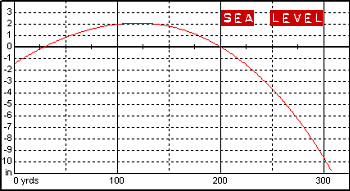
You can do your own experimental calculations using JBM Online Ballistics (free to use). Here is an extreme example, with two printouts (generated with Point Blank software), one showing bullet trajectory at sea level (0′ altitude) and one at 20,000 feet. For demonstration sake, we assigned a low 0.2 BC to the bullet, with a velocity of 3000 fps.
One of our readers asked “What effect does altitude have on the flight of a bullet?” The simplistic answer is that, at higher altitudes, the air is thinner (lower density), so there is less drag on the bullet. This means that the amount of bullet drop is less at any given flight distance from the muzzle. Since the force of gravity is essentially constant on the earth’s surface (for practical purposes), the bullet’s downward acceleration doesn’t change, but a bullet launched at a higher altitude is able to fly slightly farther (in the thinner air) for every increment of downward movement. Effectively, the bullet behaves as if it has a higher ballistic coefficient.
Forum member Milanuk explains that the key factor is not altitude, but rather air pressure. Milanuk writes:
“In basic terms, as your altitude increases, the density of the air the bullet must travel through decreases, thereby reducing the drag on the bullet. Generally, the higher the altitude, the less the bullet will drop. For example, I shoot at a couple ranges here in the Pacific Northwest. Both are at 1000′ ASL or less. I’ll need about 29-30 MOA to get from 100 yard to 1000 yards with a Berger 155gr VLD @ 2960fps. By contrast, in Raton, NM, located at 6600′ ASL, I’ll only need about 24-25 MOA to do the same. That’s a significant difference.
Note that it is the barometric pressure that really matters, not simply the nominal altitude. The barometric pressure will indicate the reduced pressure from a higher altitude, but it will also show you the pressure changes as a front moves in, etc. which can play havoc w/ your calculated come-ups. Most altimeters are simply barometers that read in feet instead of inches of mercury.”
As Milanuk states, it is NOT altitude per se, but the LOCAL barometric pressure (sometimes called “station pressure”) that is key. The two atmospheric conditions that most effect bullet flight are air temperature, and barometric pressure. Normally, humidity has a negligible effect.
It’s important to remember that the barometric pressure reported on the radio (or internet) may be stated as a sea level equivalency. So in Denver (at 6,000 feet amsl), if the local pressure is 24″, the radio will report the barometric pressure to be 30″. If you do high altitude shooting at long range, bring along a Kestrel, or remember to mentally correct the radio station’s pressure, by 1″ per 1,000 feet.”
If you have been waiting to purchase a chronograph… now is a great time to buy. You can get the affordable MagnetoSpeed Sporter for under $180.00. You can set up this device in a few minutes, and you never have to go downrange to fiddle with a tripod or fuss with wires. The MagnetoSpeed Sporter is simple and effective — a no-hassle solution.
See MagnetoSpeed Sporter Chronograph Features Reviewed in Video
We’re impressed by the Sporter chrono, as are other shooters — this unit is very popular. Like the MagnetoSpeed V3, the Sporter faithfully records shots, even in complete darkness. Shot strings are recorded digitally and can be transferred to a smart phone via MagnetoSpeed’s XFR accessory (and Apps).
The MagnetoSpeed Sporter chrono is less than half the price of previous MagnetoSpeed models. This is big news for shooters who always wanted a MagnetoSpeed but found the $379.00 cost (for V3 model) too pricey. The new Sporter Chronograph costs just $179.00 at Brownells and $179.00 at Amazon.
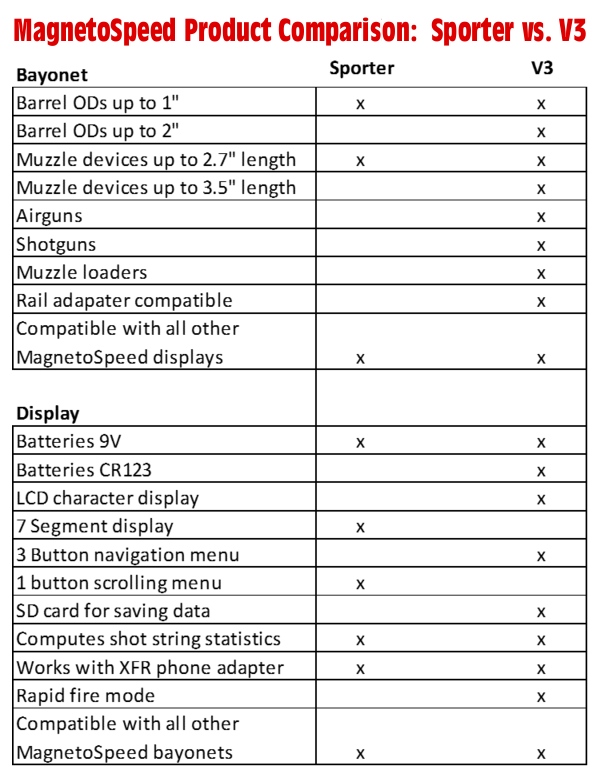
The Magnetospeed Sporter offers most of the features of the more expensive models (see chart below for details) and has a updated sensor. MagnetoSpeed says its new Sporter is “Ideal for contoured rifle barrels (sporter barrels) and long-barreled revolvers.” The Sporter Chronograph Kit (shown above) includes: Bayonet Sensor, 3.5 foot Data Cable, Remote Display (with Battery), Strap with thumb nut, Two V-block spacers, and compact storage box.
Q: Will the Sporter Chrono work with thicker barrel (i.e. greater than 1″ diameter)?
A: The manufacturer recommends the $399.00 V3 model for thicker barrels. But, wink-wink, if you have a 1.25″ barrel you can get this to work, based on what we’ve seen.. If you have a really fat barrel (up to 2.0″ diameter), get the V3. Magnetospeed also says the V3 is needed for airguns, shotguns, and muzzleloaders.
Click Image for Full-Screen Photo
The Sporter Chrono attaches quickly and easily. It has a 3.5-foot-long cord, and will work with Muzzle Brakes and Flash-hiders up to 2.7″ long.
We know that Competition Machine (Gary Eliseo) makes great chassis systems and Pierce Engineering (John Pierce) makes great actions. But sometimes a project comes together even better than one can imagine. The folks at Pierce Engineering recently completed an Eliseo Tubegun that displayed some mind-blowing accuracy during initial testing. This was a special rifle built to a client’s spec in .22 PPC.
After his team completed the rifle, John Pierce took the Tubegun to the range to make sure everything was working right. The rifle was chambered for the .22 PPC, a known accuracy cartridge. Would this cartridge shoot in this gun? Heck yeah was the answer! The first two shots out of the gun were touching. That was promising enough. But then John drilled a five-shot group that was basically one hole! Here is that target. First two shots upper left, then the five-shot group below and to the right. Chassis-maker Gary Eliseo commented: “that’ll do just fine…”
Disclaimer: John shot some more groups with this Tubegun that were definitely NOT one-holers. That first five-shot masterpiece could not be duplicated. However, we’re told that the rifle shot other groups in the 2s, 3s, and 4s — impressive performance for a rifle designed for prone and position shooting. This shows how well the Pierce action mates to the Competition Machine chassis.
And if the owner ever wants to show off a “wallet group” for his new rifle — well he’s got that, thanks to John’s great trigger-pulling and rifle-building. Using On-Target software we measured that five-shot group at 0.189″ (see photo at right). That’s crazy small for a new gun with zero load development. That’s also a testimony to the quality of the Norma .22 PPC brass.
Why the .22 PPC Chambering?
The customer owns other Eliseo Tubeguns, but wanted something that combined extreme accuracy with very low recoil. He also wanted to be able to shoot factory brass without fire-forming. Norma makes very high-quality .22 PPC cartridge brass that is an easy load and shoot solution. In fact the folks at Pierce Engineering custom-loaded a quantity of .22 PPC ammo for this Tubegun and shipped it off to the customer along with the new rifle. NOTE: Loading ammo is not something that Pierce normally does, but this was a special client request.
This article, in longer form, appears on the USAMU Facebook page, as part of the “Handloading Hump Day Series”. This article explores three different “Philosophies” of precision reloading. Some handloaders seek to produce ammo that yields the very tightest groups (without factoring in the wind). Other shooters load their ammo to deliver the highest safe velocity. That’s because a projectile launched at higher velocity will drift less in the wind. The theory is that even if fast ammo doesn’t produce the tightest groups in zero wind conditions, it will yield higher scores in a the real world (where the wind blows). Lastly, some handloaders favor ammo that is ultra-consistent across a wide temperature range. This last philosophy dictates selection of a powder that is temp-insensitive, even if it may not produce the very best raw accuracy (or speed).
What’s Your Handloading Philosophy?
Objectives of Reloading — Accuracy, Velocity, Temp Stability What do you, the reader, primarily value in your handloads?
Viewpoint ONE: Accuracy Trumps Everything
Some shooters prize consistent, excellent medium/long range accuracy enough that they’re willing to give up some extra velocity (and reduced wind deflection) to obtain that. Their underlying philosophy could be stated: “Superior accuracy is present for every shot, but the wind isn’t”. One’s ability to hold well, aim well and read the wind are all factors in making this type decision. The photo below shows stellar raw accuracy. This is an 0.67″, 10-shot group at 300-yards fired from a text fixture. The group measures just 0.67″. (This shows the USAMU’s 600-yard load with 75gr bullets).
Viewpoint TWO: Load to Highest Safe Velocity for Less Wind Drift
Some shooters value obtaining the highest safe velocity, even if one’s pure, consistent mechanical accuracy at medium/long range isn’t quite as brilliant. The theory here seems to be that a really good hold extracts as much mechanical accuracy from the rifle/ammo as possible, and faster bullets equal occasional “bonus” points snatched from the jaws of wind.
[For example] one of the USAMU’s many Service Rifle National Champions revealed his philosophy. It can be stated thus: a super-accurate, but [relatively] “slow” load “required him to have a Ph.D. in wind reading for every shot, while a faster, but less accurate load netted him more points.”
Note — this was not mere speculation; his score book data backed up his claims, due to less wind effects. Remember, however, this fellow has a consistent, National Championship-level hold, and other Champions on the same team would have opted differently.
Viewpoint THREE: Temperature Stability Is Key
Still another approach is to place heavy emphasis on fine accuracy with absolute stability in changing temperatures. When this writer was actively earning his Distinguished Rifleman badge, that was his goal. The reason? Sighting shots are not allowed in EIC (“Leg”) matches. The first shot out of the barrel was for score. It had to be 100% consistent, with very reliable, predictable elevation and wind deflection regardless of the ambient temperature — even if it wasn’t the lowest wind deflection possible.
Naturally, selecting a powder that is insensitive to temperature changes is a key element here. Elevation zeros and wind effects HAD to be consistent every time. Hunters and military snipers might be among those who fall into this camp, as well as those in pursuit of their Distinguished Rifleman badges.
Contrast that with a traditional High Power shooter who gets two sighter shots before each event (offhand, sitting rapid, prone rapid, prone slow fire.) If there is a zero change on any given day, he/she can correct during sighters. This writer well remembers talking with another very high-level Service Rifle competitor who was happy to have high temperatures boost the velocities of his ammunition above their usual level… As far as this SR competitor was concerned, 60-80 fps more velocity -– even if only due to high ambient temperatures -– meant less wind deflection, and he was mighty happy to have it.
Particularly in the summer, with hot daily conditions, you need to be concerned about temperature stability. Loads worked up in winter may not work in the summer time.
This article has been confined to NRA High Power Rifle competition, which has relatively generous 10-ring dimensions in relation to the accuracy of well-built competition rifles. Hopefully, it will provide food for thought. For some, this might be an opportunity to ensure that one’s load development approach helps them attain their desired results.
Project by Shiraz Balolia, President of Grizzly Industrial
The lowboy stock you see above started as an experiment. I had an extra Masterclass F-Class stock that had gone through two actions, four beddings, and multiple modifications over the years. I figured that there was nothing to lose if the experiment did not work out.
After deciding on the design, the stock was carefully leveled in every direction and milled to the precise dimensions for attaching the side pieces, which would be glued to the original stock.
Curly Maple and Bubinga wood were laminated to get the exact thickness of the side pieces so that the total width of the fore-end would be just under the total width allowed for F-Open stocks.
Two guide pins made of Bubinga were drilled through each side so that the sides would not move when glued to the milled stock.
Once the sides were glued to the blank, the stock was once again trued on the mill so it was perfectly flat and square with the back (see below).
The stock was then sent to Keith Weill at KW Precision who did an incredible bedding job on the new BAT M action. The stock was then sent out for spraying a clear finish. Normally I spray my own stocks, but I did not have time for this stock, so that part was subbed-out. The finger grooves and “Shiraz” inlay had been done by me a few years prior during the old stock’s heyday.
Modified Stock Has Significantly Lower Center of Gravity
The rifle was then assembled, a March 10-60x56mm High Master scope was installed, and break-in was completed on the new barrel. At the range, the stock performed great. The stock rides one-half-inch lower in the front bag and really feels good.
Bartlein Barrel Is Chambered in .300 WSM
I was pleased to find that the Bartlein barrel I have on this gun cleaned up very well during barrel break-in and this “experiment” may turn into this being one of my best-performing guns. All of my F-Open match guns are .300 WSM (Winchester Short Magnum), and so is this one.
Are you a do-it-yourself kind of guy with a creative eye? Then you’ll love the Target Generator from the folks at ShooterShed.com. This free, interactive webpage allows you to design a variety of fun targets, including grids, benchrest-type Score Shooting targets, sight-in targets, and even playing card targets. Choose the paper size and orientation (vertical or horizontal), then select the number of target elements on the page. For example, you could have four (4) bulls or 52 playing cards. You can include a grid on the target, or tell the program to include load information blocks. For bullseye targets, you can control the number, color, and spacing (diameter) of the rings. LINK to TARGET GENERATOR.
The program provides a preview of each target you generate. If you like a particular design, save the file, and then print as many targets as you want. Check it out, this program is fun and handy to use. Here are four (4) targets your Editor created just for this article. With a bit of practice, you can be generating your own custom targets in minutes. Have fun.
About the Creator of the Target Generator
The Target Generator program was created by Rod Brown of Sheridan, Wyoming. Rod tells us: “I build custom rifles and coach shooters. I’ve got a 100-yard range out my back door. I shoot short- and long-range benchrest competitively around the country. I’m a full-time software development consultant and an FFL holder. When I’m not developing custom software for my clients, I’m usually fiddling in the shop, building a custom benchrest rifle, traveling to a match, chambering a barrel, or reloading some ammunition.
Story tip from Boyd Allen. We welcome reader submissions.
Ever wish you could look inside your rifle, to see how the trigger and fire-control system work? Well now that is possible with the magic of 3D computer graphics. Modern software allows detailed “cutaway” side-views (see below), as well as 3D views with 360° rotation. The software can also provide X-Ray-type views into the gun’s internals — as you can see above. And computer animation can show the complete firing process from trigger pull to chambering of the next round.
Rem 700 Cutaway View from Right Side
This article covers two different animations — a bolt-action, and a self-loading “gas gun”. The first video features the popular Rem 700 action, probably the most successful American bolt-action ever created. The second video offers a lengthy exploration of the AR15/M16 platform.
READERS — Take the time to watch these videos! The Rem 700 animation is really outstanding! EVERY bolt-action shooter should watch this video all the way through.
Cutaway 3D Animation of Rem 700 Action — Watch Video
The Model 700 series of bolt-action rifles have been manufactured by Remington Arms since 1962. All are based on basically the same centerfire bolt action. They are typically sold with an internal magazine depending on caliber, some of which have a floor-plate for quick-unloading, and some of which are “blind” (no floor-plate). The rifle can also be ordered with a detachable box magazine. The Model 700 is a development of the Remington 721 and 722 series of rifles, which were introduced in 1948.
The Rem 700 is a manually-operated bolt action with forward, dual opposed lugs. It features “Cock On Opening”, meaning the upward rotation of the bolt when the rifle is opened cocks the firing pin. A cam mechanism pushes the firing pin’s cocking piece backward. The bolt face is recessed, fully enclosing the base of the cartridge. The extractor is a C-clip sitting within the bolt face. The ejector is a plunger on the bolt face actuated by a coil spring. The bolt is of 3-piece construction, brazed together (head, body. and bolt handle). The receiver is milled from round cross-section steel.
This video was made with the help of the World of Guns: Gun Disassembly interactive encyclopedia with 3D rendering. This remarkable web-based software allows users to view the inner workings of hundreds of different rifles and pistols — everything from a .22 LR Ruger to a .55-caliber Boys Anti-Tank rifle. There are also 25,000+ parts diagrams. This is a remarkable technical resource. SEE MORE HERE.
Cutaway 3D Animation of AR15/M16 Action — Watch Video
The AR platform rifles are a semi-automatic version of the M16. These feature distinctive upper and lower receivers which can be readily separated via front and rear pins. The upper includes the barrel, handguard, forward gas tube, and bolt assembly, while the lower contains grip, trigger group, fire selector, and mag well. In addition the lower is attached to the stock which encloses the buffer assembly.
The original ArmaLite AR-15 was a select-fire, air-cooled, gas-operated, magazine-fed rifle designed by American gun manufacturer ArmaLite in 1956. It was based on Armalite’s AR-10 rifle chambered for the 7.62×51 NATO (.308 Win). In 1959, ArmaLite sold its rights to the AR-10 and AR-15 to Colt. Some key modifications were made — most notably, the charging handle was re-located from under the carrying handle to the rear of the receiver. The redesigned rifle was adopted by the U.S. military as the M16 carbine, which went into production in March 1964.
These videos found by Boyd Allen. We welcome reader submissions.







 One of our readers asked “What effect does altitude have on the flight of a bullet?” The simplistic answer is that, at higher altitudes, the air is thinner (lower density), so there is less drag on the bullet. This means that the amount of bullet drop is less at any given flight distance from the muzzle. Since the force of gravity is essentially constant on the earth’s surface (for practical purposes), the bullet’s downward acceleration doesn’t change, but a bullet launched at a higher altitude is able to fly slightly farther (in the thinner air) for every increment of downward movement. Effectively, the bullet behaves as if it has a higher ballistic coefficient.



 Disclaimer: John shot some more groups with this Tubegun that were definitely NOT one-holers. That first five-shot masterpiece could not be duplicated. However, we’re told that the rifle shot other groups in the 2s, 3s, and 4s — impressive performance for a rifle designed for prone and position shooting. This shows how well the Pierce action mates to the Competition Machine chassis.




 This video was made with the help of the


