Lyman has introduced two new Turbo®Sonic Ultrasonic Cleaning units, a large 6.3-quart model TS-6000 and a smaller 23.6 oz. model TS-700. Along with the original mid-sized TS-2500 model introduced in 2011, Lyman now offers a full line-up of three (3) ultrasonic cleaning units: large, medium, and small. By most reports the TS-2500 worked well, so we expect the new TS-6000 and TS-700 will also handle ultrasonic cleaning duties well.
TS-6000
The large Model TS-6000 processes up to 1300 9mm cases or four handgun frames in less than 15 minutes (when the built-in heater is used). This workhorse is powered by two industrial-grade transducers and has an integral drain and hose for easy solution changes. The unit’s two-color LED display panel controls five different timed cleaning cycles.
TS-700
The small-footprint Model TS-700 fits in tight spaces. This unheated model handles up to 100 9mm cartridge cases. The compact TS-700 can also clean parts such as dies, muzzle brakes, and mould blocks. Note: Lyman recommends using its Steel & Stainless Steel Solution for dies and other steel components. The TS-700 features oscillation circuitry and five (5) timed cleaning cycles.
TS-2500
The mid-sized TS-2500 model, with heated tank, shown below, process up to 900 9mm cases per cleaning cycle. Introduced in 2011, this product has been widely adopted by hand-loaders. The TS-2500 will clean cases inside and out, including primer pockets, in less than 15 minutes.
Lyman TS-6000 and TS-2500 Units Can Heat Solution for Faster Cleaning
Ultrasonic cleaning machines employ ultrasonic cavitation to gently lift and dissolve carbon, dirt, lubricants, and other residues left on fired cases and small metal parts. Lyman’s TS-6000 and TS-2500 TurboSonic cleaning units feature tank heaters to warm the cleaning solution. Because ultrasonic cavitation works faster and better with a warm solution, Lyman claims its machines’ built-in heaters will speed up your cleaning job, by cutting processing time.
Lyman Cleaning Solutions (Three Types) — Lyman now offers its Brass Cleaning Solution and Steel & Stainless Steel Cleaning Solutions in 4 oz., 16 oz. and 32 oz. sized bottles. For even more versatility a new 16 oz. Jewelry Solution is available. For more information visit www.lymanproducts.com.
Berger Bullets has released a new, 250-grain .338 caliber Hybrid OTM Tactical bullet. This is a slippery projectile, with an impressive .349 G7-model Ballistic Coefficient (.682 G1 BC). This new bullet gives Berger TWO heavyweight .338-cal bullets in its line-up — Berger already offered a 300gr OTM Tactical Hybrid with a .419 G7 BC, and a whopping .818 G1 BC. Berger tells us: “The .338-Cal 250gr and 300gr Hybrid OTM Tactical bullets were optimized for use in the .338 Lapua Magnum cartridge, but will work great in other cartridges as well.”
The new .338 cal, 250gr Hybrid was designed by Bryan Litz. The new 250-grainer’s Hybrid design blends a tangent ogive with a secant ogive. These blended shapes yield outstanding ballistic performance, yet the blended Hybrid design is normally less “finicky” about seating depth position than are secant-ogive, VLD-style bullets. Hence less load tuning should be required with the Hybrids compared to VLD designs. According to Bryan, these thick-jacket OTM Tactical bullets have been optimized for specific cartridges. They should be successful at either magazine-feedable lengths or loaded long for single-shot firing situations, which can allow for more powder capacity and higher velocities.
.338 Cal Hybrids for Long-Range Hunting?
While Berger officially says that the new 250gr Hybrid and its larger 300gr cousin are “not recommended for hunting”, large .338-caliber bullets with similar construction, such as the Sierra 300gr Match King, have been used successfully by long-range hunters for many years. One experienced hunting guide told us: “This combination of bullet diameter and bullet weight has proven to be a very effective on elk and other large game.” Berger’s 250gr and 300gr OTM Hybrids offer a higher BC option than other bullets in this caliber and weight ranges. Berger does plan, in the future, to offer .338 caliber 250-grain and 300-grain Hybrid Hunting bullets.
Loaded Ammo with new .338 Hybrids Available from Bryan Litz
Bryan Litz’s ammunition business, Applied Ballistics Munitions, now offers loaded .338-caliber ammo for two cartridges: .338 Edge and .338 Lapua Magnum. This ammo (for both cartridge types) is offered with your choice of either the 300gr OTM Hybrid or the new 250gr and 300gr OTM hybrid. If you’re not familiar with the .338 Edge, this is a 300 Remington Ultra Magnum necked-up for the .338 bullet. The .338 Edge has become popular with long-range hunters.
Story tip from EdLongrange. We welcome reader submissions
Quite a few popular powders have been hard to get lately. Some folks have been worried about shortages in anticipation of the fall elections. However major vendors are reporting that the brown trucks have arrived with large shipments from Alliant, Hodgdon, and Western Powder. Most of the most popular powders for precision reloaders are now in stock. If you’ve been waiting on your favorite powder, now is time to stock up.
Grafs.com is showing good availability of the most popular Hodgdon powders including Varget, H4350, H4831SC, H4198, and the new Superformance powder developed with Hornady. Grafs.com also has 1-lb containers of the new CFE-223 powder in stock, but 8-lb CFE-223 jugs are currently sold out. This powder is working well for the AR and varmint shooters who have tried it.
Midsouth Shooters Supply reports that Ramshot TAC is back in stock in large quantities. Ramshot TAC is a versatile double-based rifle powder. TAC has the ability to provide some of the industry’s highest velocities for 80gr bullets in the .223 Rem chambering while adhering to SAAMI pressure guidelines. TAC is known for ease of metering and good load density. It is well-suited for both .223 Rem, and .308 Winchester.
Powder Valley Inc. (PVI) tells us that it just received a large shipment of Alliant powder. Alliant (an ATK company) produces popular rifle powders including Reloder 15, 17, 19 and 22, AR-Comp, Power Pro 2000, and Power Pro Varmint. All these are in stock now at PVI.
Recently, an AccurateShooter team including contributing writer German Salazar visited the Nammo Talley facility in Mesa, Arizona. We were given access to the new Rimfire Service Center and the .338 Lapua Magnum loading facility. The Rimfire Service Center is a brand new facility dedicated to supporting top-level rimfire shooters in all disciplines, including Prone, 3-Position, Silhouette, Benchrest and more. Lapua has over 2 million rounds of various grades of match ammunition on hand for shooters to test and purchase. The RSC has a 100-meter test tunnel where groups are measured under ideal conditions with electronic sensor-equipped “paperless” target frames placed at 50 meters and 100 meters. Shooters can make appointments to visit the center and test ammo in their own rifles. A detailed report on the RSC has just been released on German’s Rifleman’s Journal website.
.338 Lapua Manufacturing and Testing
The .338 Lapua Magnum facility is a super-sized version of the rimfire facility. With a 300-meter tunnel and pressure testing equipment on hand, Nammo’s engineering and loading staff have the ability to develop perfect loads for government clients with a variety of specific requirements. The loading facility has equally impressive technology and is well worth reading about. CLICK HERE to read German’s article about the .338 LM facility.
AccurateShooter.com will have more information on these two state-of-the-art facilitites, including video footage in the coming weeks. So stay tuned!
The Dolphin Gun Company, based in the United Kingdom, has developed a very stable, yet lightweight wide-base bipod, ideal for F-TR shooters. We expect Dolphin’s new Trakker bipod will also be popular with varmint hunters and some tactical shooters.
Trakker bipods are available in two confirgurations, “Standard” and “Long”. Perhaps they would be better named “Wide” and “Extra-Wide” — the “Long” version has extended legs which can provide a wider base and/or extra elevation. Both versions provide a very stable platform for prone shooting, and both versions are available with either Sling-swivel or rail attachments (see photos below).
Here’s the great news — these Trakker bipods are very light, yet sturdy. The standard version weighs just 21.2 ounces (600 grams), while the long version tips the scales at 24.7 ounces (700 grams). This will help shooters “make weight” in F-TR class even if they have a very long barrel, or jumbo-sized scope. Trakker bipods are offered with multiple color choices: natural (silver) alloy, matte black powder coat, or other powder coat color of the customers’ choice (extra charge may apply for custom colors).
Dolphin’s Trakker bipods have been extensively tested by top F-TR shooters in Europe and we have heard that these bipods work extremely well. They are stable yet easy to adjust, and they are quite a bit lighter than most wide-base bipods on the market. Retail price in the UK is £165.00, which translates to $267.00 US Dollars, but this does not include overseas shipping or possible customs charges. Americans can order direct from Dolphin at this time and Dolphin will ship to the states. (Dolphin is currently in discussions with a US-based company that would produce the Trakker bipod for the North American market, under license). For more information, visit DolphinGunCompany.co.uk or email mik [at] mikdolphin.demon.co.uk. NOTE: The Dolphin Gun Company website is pretty slow. You may have to try multiple times to load the pages.
About Dolphin Gun Company
Dolphin Gun Company was formed several years ago by Mik Maksimovic and Pete Hobson, two active, competitive F-Class shooters. Both Mik and Peter come from engineering backgrounds. They first set up Dolphin Gun Company to build their own competitive shooting gear. From hobby gunsmithing and preparing their own rifles and equipment, Mik and Pete quickly progressed to building rifles for other shooters and creating top-of-the-line shooting accessories such as the Trakker bipod.
Product Tip from Boyd Allen. We welcome reader submissions.
About 24 miles east of Oceanside, California (near the Camp Pendleton Marine base) is the Pala Reservation. On that Native American land you’ll find a Casino Resort, plus an excellent shooting range. Each month, shooters come to Pala for the Varmint Silhouette Match hosted by the North County Shootist Association. Normally there is one match, held on the first Sunday of even month. But in May, you can “double your fun” because there will be TWO (2) matches. The first will be held this Sunday, May 6th, 2012. The second match takes place on Sunday, May 20th. On both match days, gates open at 7:30 am with practice from 8:00 am to 9:00 am. On Friday, May 4th, the range will be open for practice 9:00 am – 1:00 pm, while on Friday, May 18th, the range opens at 10:30 am.
Course of Fire: Five Yardages, 50 Critters
At five different yardages, ten steel “critter” targets are set as follows: 200 Meters – Field Mice (“pikas”); 300 meters – Crows; 385 meters – Ground Squirrels; 500 meters – Jack Rabbits; 600 yards – Prairie Dogs. The folks at Pala run a tight ship, cycling multiple relays efficiently, so everybody gets to shoot 50 targets (10 each at five different yardages), and the show is usually completed by 1:00 pm. There’s a one-hour sight-in period starting at 8:00 am, and the match starts at 9:00 am sharp. Newcomers should definitely arrive no later than 7:45 am, because you may need that full sight-in period to acquire solid zeros at all five yardages. CLICK HERE for full match INFO.
What to bring to Pala You’ll need an accurate rifle, plus at least 80 rounds of ammo (bring 100 rounds if you have no idea about your come-ups at these distances). You can shoot either rested prone (F-Class style), from bipod, or from a portable bench with front pedestal and rear bag. Most guys shoot from benches. Any rifle 6.5 caliber or under is allowed, with no weight restrictions. Any good varmint rifle can be competitive. Muzzle brakes are permitted. Spotter assistants are allowed, so bring a friend along — he/she can shoot in a different relay. Bring cleaning gear if your rifle can’t run 80+ rounds without losing accuracy. Pastry snacks are often provided, but bring water, a sandwich and your preferred non-alcoholic beverage. You’ll spend some time in the sun helping to set targets, so bring a hat, sunglasses, and sunscreen.
Fun Weekend for the Whole Family There is a deluxe Indian Casino/Spa a half-mile from the range. So don’t hesitate to bring the wife. If she’s not a shooter, she can enjoy a fancy brunch or spa treatment while you’re having fun mowing down metal critters. Pala is a 30 minutes from the Pacific Ocean and beautiful beaches, so you can make this a weekend holiday for the whole family — kids love sand and surf.
For the second year, the National Shooting Sports Foundation (NSSF) will make available $100,000 in challenge grants to help expand shooting sports programs at local Boy Scouts of America Councils. The challenge grants from NSSF are available to qualifying BSA Councils that plan to expand their activities in the shooting sports. Such programs teach Scouts marksmanship skills, firearm and range safety, and teamwork.
“Our challenge grant program extends our longstanding partnership with the Boy Scouts of America and presents councils with a great opportunity to teach Scouts about the shooting sports and safe, responsible firearms ownership,” said Melissa Schilling, NSSF’s director of recruitment and retention. “Target shooting is one of the most popular Scouting activities, and NSSF hopes even more Scouts will gain knowledge of the shooting sports by taking advantage of these grants.”
NSSF Grants Supplement Matching Funds
BSA Councils applying for a grant must specifically earmark funds for shooting sports programs and provide matching funds at least equal to the grant request. NSSF will provide funding to the first 50 qualifying applicants up to a maximum of $2,000 in matching support.
Councils must use awarded funds toward the purchase of equipment and supplies for their shooting sports activities from an NSSF member retailer. Examples of qualifying purchases are ammunition, eye and ear protection, firearms, targets and shooting vests.
How to Apply for NSSF Grants
Applicants may view NSSF BSA Council Challenge Grant guidelines and application procedures at www.nssf.org/bsagrant. For more info, contact Melissa Schilling at NSSF at mschilling [at] nssf.org.
Nancy Tompkins will be bringing out a new Second Edition of her popular book: Prone and Long-Range Rifle Shooting. Nancy hopes to have Second Edition books available by mid-June, 2012. The enhanced Second Edition will feature updates to the current chapters, more photos, plus an entirely new chapter on F-Class Shooting. The Second Edition will be issued as a hardback only, for increased durability. Price isn’t set yet, but Nancy hopes to keep the price “under $40.00″. The book will be available from Sinclair Int’l and direct from Nancy who plans to have a new website for the book running by the end of May.
While visiting the new Lapua Rimfire Test Center in Mesa, Arizona, we had a chance to chat with Nancy, and learn about the Second Edition of Prone and Long-Range Rifle Shooting. Watch the video to hear Nancy talk about her plans for the updated version of her book.
Tompkins Book a Must-Read for Long-Range Shooters
Nancy’s updated treatise is a must-read for serious Palma, F-Class, and High Power shooters. The sections covering Mental & Physical training and Reading Wind & Mirage will benefit all precision shooters, regardless of discipline. Other topics include Shooting Fundamentals, International Competition, and Loading for Long Range. Nancy Tompkins has won the National Long Range Championships four times, and is the first woman ever to win the National High Power Championship. (The second was Nancy’s daughter SGT Sherri Gallagher.) Nancy has also won the prestigious Wimbledon Cup, and is a 5-time Leech Cup winner. Nancy has been on six Palma Teams (as both a shooter and a coach). (Note: photo shows First Edition of book.)
They have been on the market for nearly a year, but you may not know that Redding sells a line of Micrometer Seater assemblies, which can be used to upgrade Redding’s standard ½-20 thread seater dies. These replacements allow you to enjoy the ease-of-use and precision of a micrometer seater, without buying a whole new die. Redding states that “the new Bullet Seating Micrometers are a direct [retro-fit] replacement for the original seating plugs and can easily be changed from one die to another.” Unfortunately, these add-on micrometer stems haven’t started shipping yet, and Redding has not provided a firm delivery date (or price). We are hoping the products will start arriving by mid-summer.
NOTE: the seater assemblies are a component of the bullet seating die. These are not the dies themselves. It is the top portion of the die that contains the plunger, which pushes the bullet into the case. And here is something important: these new Bullet Seating Micrometers are available for both traditional tangent ogive bullet shapes as well as for VLD (secant ogive) bullets.
That’s right, Redding now offers micrometer seater assemblies made specifically for Berger VLD bullets. These Seating Micrometers allow you to convert a standard seater to a Micrometer seater optimized for VLDs. That’s great news for VLD fans. Eric Stecker of Berger Bullets tells us: “We have confirmed with Redding that each of the new micrometer plugs in the VLD group were designed based on Berger VLD bullets. We provided all of our VLD bullets to Redding, from which they took deliberate measurements and made these new plugs.”
New VLD-specific Seater Stems Improve Bullet Seating Depth Consistency
Stecker explains how the new VLD-specific seater assemblies produce better, more accurate ammo: “Many shooters have problems getting the VLD bullets to shoot because of the bullet seater die they are using. VLD bullet noses are so long and sharp that, in many dies, the bullet tip bottoms out in the bullet seater stem instead of touching on the side of the ogive like it should. Seating depth inconsistencies up to .025″ can occur if the seater stem bottoms out on the bullet tip. The worst part is that many shooters have no idea that this is the root cause of their poor performance. This new product can help turn a frustrating shooting experience into an enjoyable one.”
Story tip from Edlongrange. We welcome submissions from our readers.
Our story on Gary Eliseo’s “Mad Minute” drill drew comments from readers worldwide, including C. Lemmermann from Denmark, who wrote: “In Scandinavia we have this competition called ‘Stangskyting’. It’s similar to the ‘Mad Minute’ but we only have 25 seconds to hit the target [at] 200-300m distance with a 6.5×55 [target rifle].” In the Stangskyting video below a shooter named Børklop puts 16 rounds on target in just 25 seconds. (He starts with a round in the chamber and cycles through three, 5-round magazines). Børklop’s performance, with just a sling and iron sights, is impressive. He’s shooting a Sauer 200 STR target rifle with 5-round magazine. Note that Børklop manipulates the Sauer’s bolt with his thumb and index finger, while pulling the trigger with his middle finger.
This Guy Could Break the “Mad Minute” Record
Børklop’s rate of fire, 16 rounds in 25 seconds, is the equivalent of 38.4 rounds in 60 seconds. That’s a notable number because the record for the “Mad Minute”, a British Army marksmanship drill, is 38 rounds in one minute. That record was set in 1914 by Sergeant Instructor Alfred Snoxall, and still stands. So as you watch Børklop, keep in mind that Snoxall shot that fast for a full minute with a Lee-Enfield nearly 100 years ago!
Børklop has an average cycling time of 1.56 seconds per shot, starting with a round in the chamber. To beat the record of 38 rounds, he would need to make seven mag changes in sixty seconds. All those mag swaps could reduce his average time per shot, making it difficult to achieve 38 hits in a minute. But, if Børklop could use 10-round mags with his Sauer STR, this guy has the skills to break the record.
To emphasize the capabilities of the WWI-era British shooter who set the record, Snoxall shot as fast as Børklop does, but Snoxall reloaded with stripper clips. Snoxall’s SMLE (Lee-Enfield) rifle also had relatively crude open sights and the stock was far less ergonomic than Børklop’s Sauer STR stock.
Here’s another Stanskyting video showing John O. Ågotnes shooting rapidfire with his Sauer 200 STR (Scandinavian Target Rifle) chambered in 6.5×55. By our count, Ågotnes manages 17 shots within the 25-second time period. That rate of fire (17 in 25 seconds) equates to 40.8 rounds in one minute!


 Lyman has introduced two new Turbo®Sonic Ultrasonic Cleaning units, a large 6.3-quart model TS-6000 and a smaller 23.6 oz. model TS-700. Along with the original mid-sized TS-2500 model introduced in 2011, Lyman now offers a full line-up of three (3) ultrasonic cleaning units: large, medium, and small. By most reports the TS-2500 worked well, so we expect the new TS-6000 and TS-700 will also handle ultrasonic cleaning duties well.


 .338 Cal Hybrids for Long-Range Hunting?
 Quite a few popular powders have been hard to get lately. Some folks have been worried about shortages in anticipation of the fall elections. However major vendors are reporting that the brown trucks have arrived with large shipments from Alliant, Hodgdon, and Western Powder. Most of the most popular powders for precision reloaders are now in stock. If you’ve been waiting on your favorite powder, now is time to stock up.


 Recently, an AccurateShooter team including contributing writer German Salazar visited the Nammo Talley facility in Mesa, Arizona. We were given access to the new

 The


 You’ll need an accurate rifle, plus at least 80 rounds of ammo (bring 100 rounds if you have no idea about your come-ups at these distances). You can shoot either rested prone (F-Class style), from bipod, or from a portable bench with front pedestal and rear bag. Most guys shoot from benches. Any rifle 6.5 caliber or under is allowed, with no weight restrictions. Any good varmint rifle can be competitive. Muzzle brakes are permitted. Spotter assistants are allowed, so bring a friend along — he/she can shoot in a different relay. Bring cleaning gear if your rifle can’t run 80+ rounds without losing accuracy. Pastry snacks are often provided, but bring water, a sandwich and your preferred non-alcoholic beverage. You’ll spend some time in the sun helping to set targets, so bring a hat, sunglasses, and sunscreen.
 There is a deluxe Indian Casino/Spa a half-mile from the range. So don’t hesitate to bring the wife. If she’s not a shooter, she can enjoy a fancy brunch or spa treatment while you’re having fun mowing down metal critters. Pala is a 30 minutes from the Pacific Ocean and beautiful beaches, so you can make this a weekend holiday for the whole family — kids love sand and surf.
 For the second year, the
 Nancy Tompkins will be bringing out a new Second Edition of her popular book: Prone and Long-Range Rifle Shooting. Nancy hopes to have Second Edition books available by mid-June, 2012. The enhanced Second Edition will feature updates to the current chapters, more photos, plus an entirely new chapter on F-Class Shooting. The Second Edition will be issued as a hardback only, for increased durability. Price isn’t set yet, but Nancy hopes to keep the price “under $40.00″. The book will be available from
 Tompkins Book a Must-Read for Long-Range Shooters
 They have been on the market for nearly a year, but you may not know that Redding sells a line of
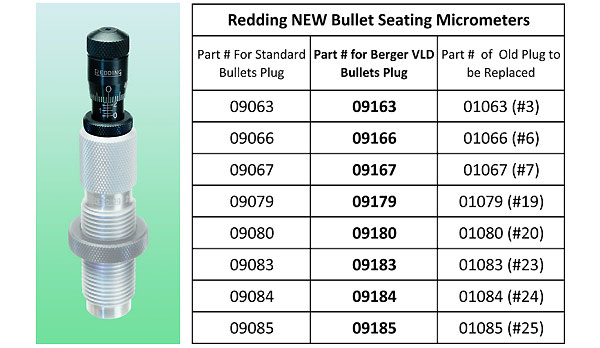
 That’s right, Redding now offers micrometer seater assemblies made specifically for Berger VLD bullets. These Seating Micrometers allow you to convert a standard seater to a Micrometer seater optimized for VLDs. That’s great news for VLD fans. Eric Stecker of Berger Bullets tells us: “We have confirmed with Redding that each of the new micrometer plugs in the VLD group were designed based on Berger VLD bullets. We provided all of our VLD bullets to Redding, from which they took deliberate measurements and made these new plugs.”


