Vihtavuori markets a full line of quality, European-made powders for rifles and pistols. Finland-based Vihtavuori is operated by the same parent company, Nammo, that owns Lapua and Berger Bullets. If you haven’t tried Vihtavuori powders yet, you may be pleasantly surprised. For loading .45 ACP, our favorite powder is VV N320 — it burns clean and is very accurate. Likewise, VV makes excellent powders for rifle applications — from small varmint cartridges to large magnums.
New Reloading Data Released Vihtavuori offers free reloading data on its website, and through a free Mobile App. And now those resources are even more complete…
Last week, Vihtavuori added new reloading data for ten different cartridge types, including some of the most popular pistol and rifle cartridges. You’ll find new pistol data for 9mm Luger and .45 ACP, and extensive new load data for .223 Rem, .260 Rem, .308 Win, and .30-06 Springfield (among others). Overall the 2018 data update features over 20 new bullets, with more than 140 new lines! All new data is also available in FREE Vihtavuori Reload App for iOS and Android. The updated online information supplements Vihtavuori’s Reloading Databases, which have dedicated sections for Rifle Cartridges, Pistol Cartridges, and Cowboy Action.
New Reloading Data is available for these TEN cartridge types:
In recent months, Sierra has unveiled four very serious, ultra-high-BC MatchKing bullets in .224, .264 (6.5 mm), and .308 calibers. And just last week Sierra has released initial load data for these four new projectiles. CLICK HERE to get the latest official load data for these four new bullets.
High-BC MatchKings Tipped at Factory
Sierra recently released a new-for-2018, 95-grain .224 projectile, Sierra product #1396, with a claimed G1 BC of 0.600 — mighty impressive for a .22-caliber bullet. Next up is the new 6.5mm (.264 caliber) 150-grainer with an 0.713 G1 BC. This could be a game-changer for the 6.5-284 and new 6.5 PRC short magnum. There are also two new .308-caliber MatchKings, a 200-grainer with 0.715 G1 BC, and a new 230-grainer with a stunning 0.800 G1 BC. Many of these New Generation MatchKings now come “tipped” from the factory for more uniform BC.
Sierra Bullets has LOAD DATA for these four new bullets. If you handload for .223 Remington, 22-250, 6.5 x284 Norma, .308 Winchester, or .300 Winchester Magnum, check out this new reloading data.
When two or more guys get together at a shooting range, sooner or later, a challenge will ensue. It’s a guy thing — guys are competitive. We’ve seen it on varmint hunting trips too: “Bet I can hit that P-dog at 700 yards.” “No you can’t.” “Yes I can.” “Wanna Bet?”
You know how it goes. There are challenges for pride, bragging rights, and often some money is involved, or perhaps a six-pack.
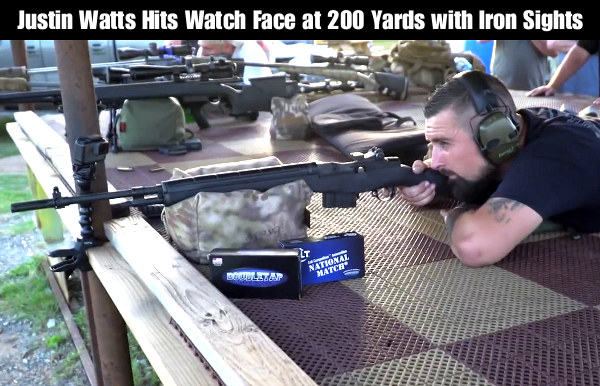
In this GunVenture video, three shooters take on the challenge of hitting the face of a watch at 200 yards using an M1A rifle with standard iron sights. The rules were exact — you had to hit the FACE of the watch, not just the strap. And the bullet had to penetrate the center of the watch — no splash shots or ricochets allowed. Not an easy shot — we figure that watch face is about 1.5″ in diameter or roughly 0.75 MOA at 200 yards. They were shooting factory .308 Win ammo with 155gr bullets — a Palma load.
GunVenture Video — 200 Yard Watch Challenge with Iron Sights M1A
One of the shooters, range owner Justin Watts, rose brilliantly to the challenge. You can see Justin’s remarkable shot at 3:20 time mark. Holding slightly for wind, he drilled the watch face dead center, obliterating it, but leaving most of the band intact. At 4:25 the video reveals that the whole center of the watch (the works) was blown out, leaving nothing but a rubber doughnut. Mighty Impressive.
After making the impressive shot, Justin explained to his buddies what they did wrong. Among other things they did not compensate for the wind. Justin also observed that the first shooter sent his shot right because of the M1A’s heavy trigger pull: “Probably what happened is the trigger pull is so heavy [he] pulled it to the right. Most of the time when you have a right-handed shooter and a heavy trigger like that, it’s going to pull you off to the right.”
Wouldn’t it be cool if you could shoot .22 LR rimfire ammo from your regular hunting/tactical rifle. That would be ideal for low-cost training right? Well, this IS possible, provided you have a rifle that was designed with a .22 LR conversion in mind. One such firearm is the Sauer 202 from Germany. This impressive centerfire rifle is available with a factory-engineered .22 LR rimfire conversion. Read on to learn how it works…
Sauer 202 Rifle: .308 Win/6.5×55 with .22 LR Conversion
Forum member “Tooms” sent us a report on his very special Sauer 202 with a .22 LR conversion kit. Sauer 202 rifles feature a “Quick-change barrel system”. The barrel is clamped into the receiver with crossbolts providing tension. This allows barrels to be swapped in a few minutes with simple tools. Tooms, from Denmark, explains: “The rifle began as a Sauer 202 Avantgarde Gold in .308 Win. I have added a 6.5×55 match barrel, plus a wide flat-bottom match fore-arm with rail for handstop and bipod. The .22 LR system [originally] cost $1000.00 [including] barrel, bolt, magazine well assembly, and magazine. The barrel is attached by three cross-bolts and the magazine well assembly is attached by one screw that fits into the barrel.”
Using this “Quick-change system”, Tooms can easily remove his centerfire barrel and swap in a .22 LR barrel. Then he places the factory conversion kit into the magazine well. This kit provides a rimfire bolt, a fitted sleeve for the rimfire bolt, and a magazine housing. This is a full Sauer factory-designed system so it works flawlessly. With the bolt closed, you can see the “new” .22 LR chamber in the front section of the loading port. On the silver section of the bolt you can see the rimfire extractor on the side.
The 22LR Conversion Really Works
The Sauer 202 Varmint rifle shoots very well with the 22LR conversion, as the 50m target at right shows. Though quite expensive, the conversion kit essentially transforms your centerfire rifle into fully functional, mag-fed precision rimfire. That makes the Sauer 202 much more versatile as a hunting platform. It also allows you to cross-train with inexpensive ammo. You don’t have to purchase another scope, trigger, or stock. And you enjoy the exact same stock fit and ergonomics whether you’re shooting centerfire or rimfire. In some countries where gun ownership is severely restricted, it may be easier, from a legal standpoint, to purchase a 22LR conversion kit than to obtain a permit for a second rifle.
To learn more about the complete line of Sauer 202 rifles visit the J.P. Sauer USA website. You’ll also find more information on the primary J.P. Sauer & Sohn German website, www.Sauer.de.
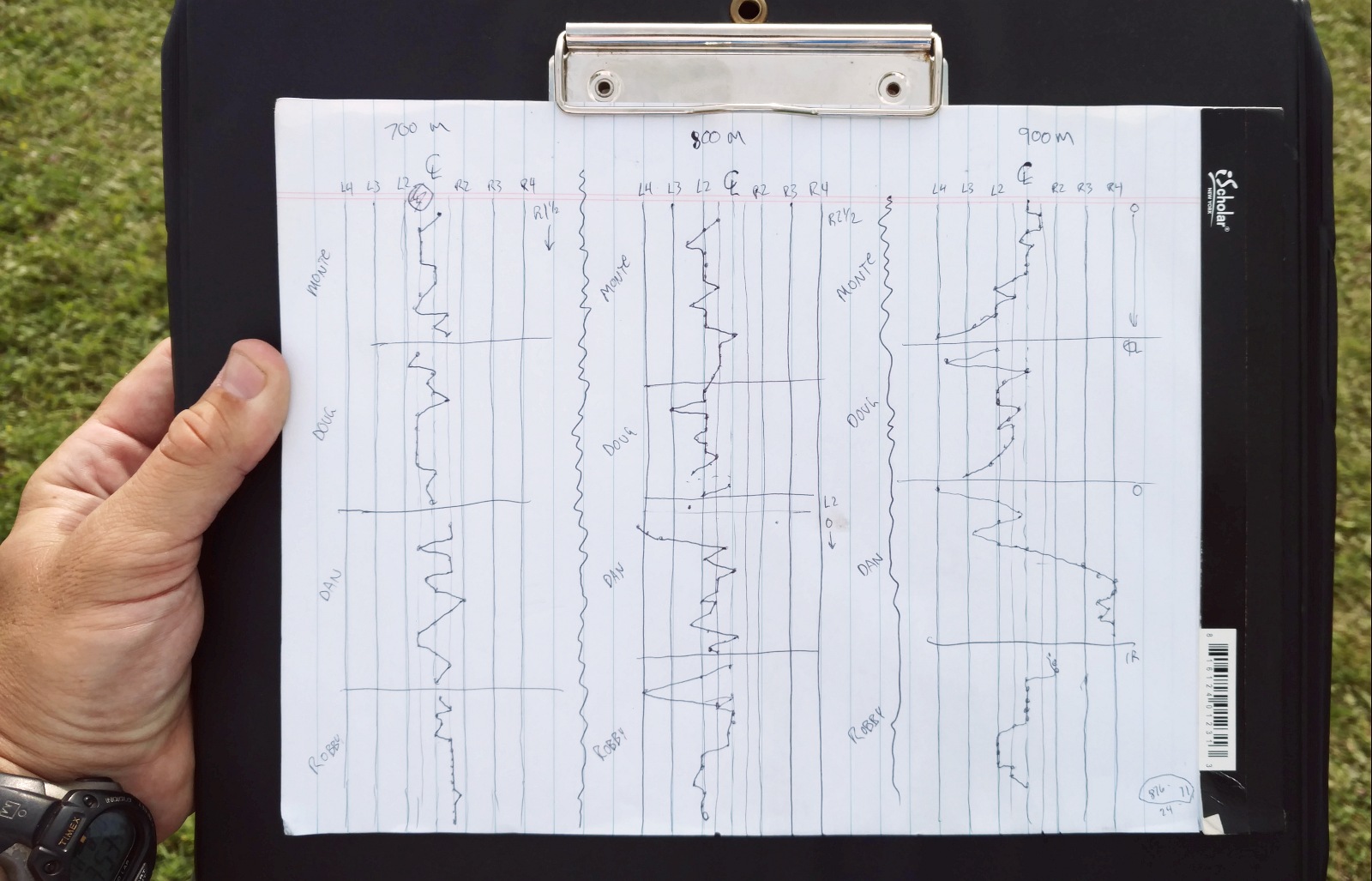
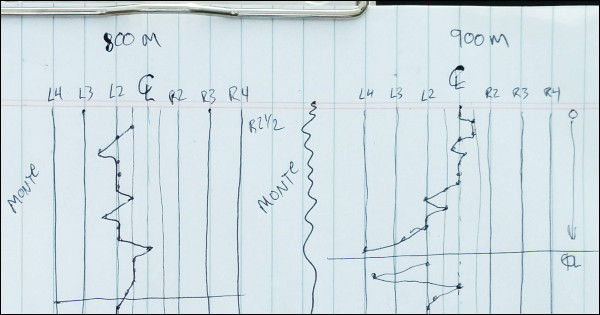
CLICK HERE to see full-screen version of Wind Plot.
The Battle of Nations begins. Today is Day 1 of international team competition at the 2017 F-Class World Championships (FCWC) in Ottawa, ON, Canada. Talented teams, in their nation’s colors, will be competing for glory and national pride.
Team shooting is very different than individual competition. Typically a team coach makes the wind calls for the shooters. In some cases (where the rules allow), the wind coach even dials elevation and windage changes for the active shooter. For the wind coach to do his job effectively, he must follow the changes in the wind and determine what the correct wind call should have been for each shot. (In other words — what was the “right call”)
Past F-TR USA Nat’l Champ Bryan Litz was wind coach for the winning 4-man LUM F-TR Team at the 2017 Canadian F-Class Championships, which preceded the FCWC Worlds. Here Bryan explains how he uses a Wind Plot to make better wind calls, helping his team-mates maximize their scores.
Wind Plot Methodology by Bryan Litz
The wind plot I use is a running history of what the correct wind call was for every shot fired. The more you shoot, the more history you have in a condition, and I find that very useful information. This kind of plot IS NOT showing where the bullet hit, and is NOT showing what you held. It’s showing what you should have held to center each shot. IMO, this is the most valuable information to have when guessing where to hold next for each shot. Here are some key points:
1. I always look for blocks of stable conditions to shoot in and wait out the rest.
2. If the wind plot shows drastic changes, either I’m not picking the right time to shoot or it’s just a really unstable wind condition.
3. When you see many shots using the same hold (e.g. Robby’s 700m and 900m strings on plot), it can indicate very fast shooting and fast pit service.
Q. What are the numbers and Markings on this Wind Plot?
Litz: The wind plot represents the rings on the target. Left 2 for example, is the 5 line on the international target, while Left 2 is the 10 line on the USA target. F-Class shooters and coaches talk about wind holds in relation to these rings. A Left 2 hold isn’t left 2 MOA or 2 MILS, it’s the second ring from center. The vertical lines on the plot represent the rings going out from center, 4 or 5 in each direction. A left or right 5 hold is edge of black on the int’l target.
Q: What Does this Specific Plot Reveal?
Litz: Looking at the plot, from left to right is 700m, 800m, and 900m that we shot progressively through the day. Top to bottom shows each shooter in sequence (shooters names are shown by their blocks). To the right I note what was on the gun for that shooter, and note when it changes. Often times we run the same wind on the gun for several shooters but if it changes, I note what the new windage is and continue on. For example if we’re settled into a condition where we’re shooting Vs with a right 3 hold, I might adjust the scope 1 MOA right because a right 3 hold is equal to 1 MOA. So we can move the scope and start shooting with a center hold.
Q. Are you Plotting Where the Bullet Hits?
Litz: Not exactly. This kind of plot IS NOT specifically showing where the bullet hit, and IS NOT showing what the shooter held. It’s showing what the shooter should have held to center each shot. IMO, this is the most valuable information to have when guessing where to hold next for each shot.
On each shot, the shooter or coach takes a guess about where to hold, and fires the shot. If the bullet hits the center, you plot the point right where you held because it was the correct hold. However, if you miss the call, you plot what hold was required to put that shot in the center. For example if you shoot a right 3 and hit where you held, the correct call would have been “center”. In this way, you’re building a history of what you should have done, which may or may not be what you actually did. This shows you the trends, and brackets which can be used to make future decisions.
Q: Is this Type of Wind Plot Something New?
Litz: I didn’t invent this method, it’s been around a long time. Vertical can be plotted the same way. In team matches, we have a plotter who is advising on elevation trends and suggesting corrections. But, as wind coach, my job is the horizontal so I only keep the wind plot. I have learned lots of strategies from my coaches Emil Praslick and Steve Hardin.
There are many ways to plot and many standard work sheets for this. They’re all tools and the key is to find something that works for you in different situations. I don’t keep a plot when I am personally behind the trigger string firing because I lose more points when I take the time to do it vs. just shooting fast. When pair firing or coaching, I can keep the wind plot without compromising the shooting.
Team Australia used plots and comms linking coaches to help win the 2013 F-Open Team World Championship. We expect other teams will follow suit in Canada in 2017.
Know Your Goal — Keep It Simple
Know your goal of plotting. The simplest plot is where you write the shot number where it hit on a target face. This kind of plotting is useful for evaluating shooter performance because it shows how big the group is (in particular the vertical dispersion). However keeping a plot like this does little to help you figure out the wind. It just shows you what shots you messed up on. It does nothing to help you find the center. [Editor: That’s a whole different matter with many variables.] The wind plot I use is a running history of what the correct wind call was for every shot fired. The more you shoot, the more history you have in a condition, and I find that very useful information.
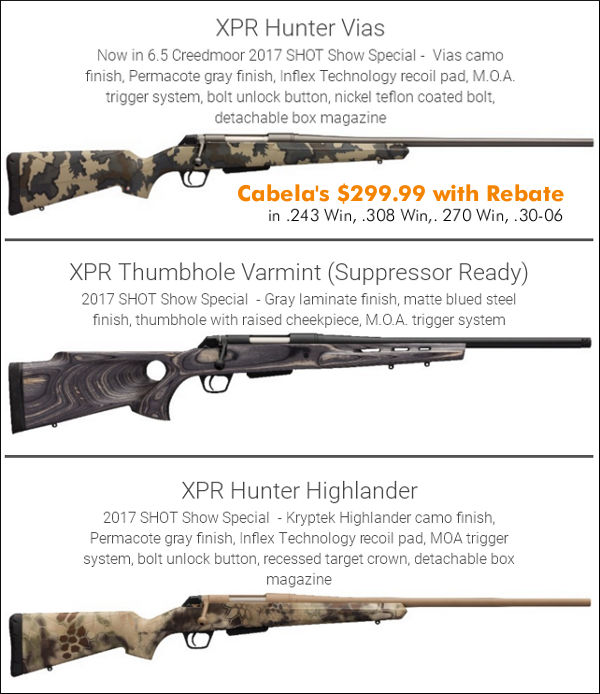
Are you or a friend/family member looking for a good hunting rifle at a great price? Check out this promotion for the Winchester XPR. This is a fine-handling rig with a smooth bolt and some of the best camo finishes you can get. Right now at Cabelas.com the Winchester XPR in Vias Camo is on sale for $399.99. But here’s the kicker, Winchester is offering a $100.00 Mail-In Rebate. That drops your net cost to just $299.99. That’s an insanely good deal.
You’ll also find other versions of the Winchester XPR on sale at other vendors. Here are some of our favorite XPR variants (and there are a dozen others):
The Winchester Rebate is good through September 30, 2017. It also applies to Winchester SX3, SX4, and SXP Shotguns. CLICK HERE for Rebate Form.
Our friend Doan Trevor is creating a new raffle rifle. This will be raffled off this fall to support the USA Palma Team. Doan is donating his labor and building the stock from a walnut blank. Pierce Engineering will supply the action and Brux Barrels will provide the barrel.
Doan tells us: “I have volunteered to build another raffle rifle for the U.S. Palma National Rifle Team. Work has begun. I am hoping to have this completed for the Spirit of America Match in Raton, NM this fall. The action has been donated by Pierce Engineering and the long Palma barrel has been donated by Brux Barrels. The one item we are lacking at this point is a Remington-style competition trigger.”
Doan says he will craft the stock from hand-selected American Walnut: “This is [my own] Doan Trevor prone design, modified to be used for F-TR. This can be shot either prone or F-TR (with bipod). This will be similar to the stock that I custom-designed for Derek Rodgers, which won several National Championships and other awards.” The photos below show Doan crafting the wood and starting the bedding on the 2017 U.S. Palma Team Raffle Rifle:
Another Doan Trevor Raffle Rifle — for the Veterans’ Team
What will the rifle look like when it’s complete? We can’t show you that yet, but here’s another custom Palma rifle Doan crafted for the 2011 U.S. Veterans’ Team. Doan says: “This is the finished rifle for the U.S. Veterans Palma Team raffle for 2011. It carries a unique serial number signifying the 2011 World Championships in Australia.”
This is a very interesting development. Federal will produce a line of Federal Gold Medal ammunition loaded with Berger Bullets match projectiles and GM Match primers. The new Gold Medal Berger ammo will initially be offered for: .223 Remington, 6.5 Grendel, 6.5 Creedmoor, and .308 Winchester. We expect this ammo to attract the attention of tactical and PRS shooters — Berger projectiles are currently favored by top PRS competitors. Depending on caliber, three different high-BC bullet types will be used: BT Target, Hybrid OTM, or Juggernaut OTM. These all feature a boat-tail design with a high BC for bullet weight. The 6.5 calibers will use Berger’s popular 130gr Berger Hybrid OTM bullet while the .308 Win uses the 185gr Juggernaut.
This new Gold Medal Berger ammo uses Federal Gold Medal match primers, Federal brass, and specially-formulated propellants. All the ammo is well under SAAMI-spec max OALs to function 100% in magazines. Federal says this ammo will “adhere to Federal Premium’s strictest specifications for accuracy, pressure and velocity”. This new GM Berger ammo line could be a match-worthy alternative for guys who don’t want to hand-load. We’re going to try some in 6.5 Creedmoor and see how it performs in terms of accuracy, ES/SD, ballistics, and temp stability. Should be an interesting test…
FEATURES of Gold Medal Berger Ammo:
• Most popular bullets at Precision Rifle Series events
• High ballistic coefficient
• Less wind drift and drop (than typical factory ammo)
• Excellent long-range accuracy
• Gold Medal match primer
Estimating Actual Cost per Round by Caliber
This article comes from the USAMU, which provide shooting and reloading tips on its Facebook Page. This week’s USAMU TECH TIP outlines a ballpark-estimate method of calculating the actual cost per round of different calibers. Some applications, and some shooters, by virtue of their high level of competition, require the very best ballistic performance available — “Darn the cost, full speed ahead!
If you are in serious contention to win a major competition, then losing even a single point to inferior ballistic performance could cost you a national title or record. However, this “horsepower” does come at a cost! Some calibers are barrel-burners, and some offer much longer barrel life. Look at this comparison chart:
Estimated Cost Per Round by Cartridge Type
Below are some estimated total expense per round (practice and competition) based on component costs, type used, expected barrel life and a standard, chambered barrel cost of $520.00 across calibers.
5.56x45mm: $0.46/round (barrel life 6,000 rounds)*
6mmBR: $0.81/round (barrel life 2800 rounds)
6XC: $0.97/round (barrel life 2200 rounds)
.308 Win: $0.80/round (barrel life 4500 rounds)
6.5-284: $1.24/round (barrel life 1100 rounds)
*Note the high round count estimate for 5.56x45mm. This is a bit deceptive, as it assumes a period of “lesser accuracy” use. The USAMU says: “Much of the difference you see here between 5.56 and .308 is due to using the 5.56 barrel for 100-200 yard training with less-expensive, 55gr Varmint bullets after its long-range utility is spent”.
Moreover, while some applications require specialized, high-cost components, others do not. And, if the shooter is still relatively new to the sport and hasn’t refined his skill to within the top few percentile of marksmen, a more economical caliber choice can help stretch a limited budget. Translation: More skill per dollar!
In this post, the prices for all items mentioned here were taken from a major component supplier’s current advertisements, and all brass was of top quality, except in the case of 5.56mm. There, 200 top-quality, imported cases were reserved for 600-yard shooting, and the other brass used was once-fired Lake City surplus.
Cartridge cases were assumed to be loaded 10 times each. [Your mileage may vary…] Bullet prices assumed the use of less-expensive, but good-quality match bullets for the bulk of shooting as appropriate.
The cost of top-tier, highly-expensive match bullets was also calculated for a realistic percentage of the shots fired, based on ones’ application. Barrel life by caliber was taken from likely estimates based on experience and good barrel maintenance.
Brass Costs Based on 10 Loads Per Case
Often, handloaders may calculate ammunition cost per round by adding the individual costs of primers, powder charges and projectiles. Many don’t consider the cost of brass, as it is reloaded several times. Here, we’ll consider the cost of enough top-quality brass to wear out a barrel in our given caliber, at 10 loads per case, except as noted above.
Don’t Forget Amortized Barrel Costs
Few shooters factor in the full, true cost of barrel life. Depending on caliber, that can dramatically increase the cost per round. For example, consider a long-range rifle in 6.5/284 caliber. This cartridge performs amazingly well, but at a cost. Ballpark estimated barrel life [in a top-quality barrel] is 1100 rounds. Some wear out faster, some last longer, but this gives a rough idea of what to expect.
Accurate barrels are a joy to use, but they are an expendable resource!
A top-quality barrel plus installation was estimated at about $520.00. At 1100 rounds, barrel life adds $0.47 per round to our total cost. Thus, what had started out as an [components-only estimate, with brass cost] of $0.76/round now totals $1.24 per shot!
Cost Considerations When Choosing a Catridge Type
Some shooters might ask themselves if they could meet their present needs with a more economical caliber. If so, that equates to more practice and matches per available dollar, and more potential skill increase on the available budget.
Each shooter knows his skill level, practice needs, and shooting discipline’s requirements. Some might shoot NRA Service Rifle or Match Rifle using a 5.56mm with a long barrel life. Others might be Match Rifle shooters faced with choosing between, say, a 6mm BR vs. 6XC. A realistic assessment of ones needs, performance-wise, may help guide the shooter toward a caliber that’s most optimized to their needs at the moment.
Admittedly, the factors affecting cost for any individuals circumstances can vary significantly. However, hopefully this will provide one useful method of evaluating one’s training and competition choices, based on their skill, goals and needs.
For load development, some guys shoot 3-shot groups. Other guys shoot 5-shot groups, or even 10-shot strings. But for testing its projectiles, Sierra Bullets takes it to another level entirely. A while back Sierra was testing its .30-Caliber 175gr HPBT MatchKing in the Sierra uynderground tunnel. The results are show above — a FIVE HUNDRED Round group!
The tunnel testers sent five full boxes of bullets down-range. Here are 500 Shots shot in a 300 meter tunnel. The group size is 2.82 inches (that’s edge to edge of the farthest shots, less the bullet diameter). This was a pressure/velocity test for a commercial customer. The Cartridge was .308 Win, loaded at 2.800″.The powder was Reloder 15. A 26″ barrel was shot from a return to battery rest. The gun was cleaned every 125 rounds and two foulers shot.
What do you think — could you beat this group from a bench for 500 rounds?
One Facebook poster joked: “500-round group? Everyone knows anything less than 1000-round groups are a waste of time and statistically irrelevant.”
Sierra’s 300 Meter Testing Tunnel
Ever wonder how (and where) Sierra tests its bullets? The answer is underground, in a 300-meter test tunnel located under Sierra’s factory in Sedalia, Missouri. The photo above shows the construction of the tunnel back in May, 1990. Like most bullet manufacturers, Sierra does live-fire bullet testing of its projectiles. Sierra’s 300-meter test range is the longest, manufacturer-owned underground bullet test facility in the world. Sierra offers free tours of the test tunnel as part of Sierra’s Factory Tour Program.


 Vihtavuori offers free reloading data on its website, and through a free Mobile App. And now those resources are even more complete…




 When two or more guys get together at a shooting range, sooner or later, a challenge will ensue. It’s a guy thing — guys are competitive. We’ve seen it on varmint hunting trips too: “Bet I can hit that P-dog at 700 yards.” “No you can’t.” “Yes I can.” “Wanna Bet?”


 The 22LR Conversion Really Works