Here’s a little known fact that may startle most readers, even experienced gunsmiths: your barrel wears out in a matter of seconds. The useful life of a typical match barrel, in terms of actual bullet-in-barrel time, is only a few seconds. How can that be, you ask? Well you need to look at the actual time that bullets spend traveling through the bore during the barrel’s useful life. (Hint: it’s not very long).
Bullet-Time-in-Barrel Calculations
If a bullet flies at 3000 fps, it will pass through a 24″ (two-foot) barrel in 1/1500th of a second. If you have a useful barrel life of 3000 rounds, that would translate to just two seconds of actual bullet-in-barrel operating time.
Ah, but it’s not that simple. Your bullet starts at zero velocity and then accelerates as it passes through the bore, so the projectile’s average velocity is not the same as the 3000 fps muzzle velocity. So how long does a centerfire bullet (with 3000 fps MV) typically stay in the bore? The answer is about .002 seconds. This number was calculated by Varmint Al, who is a really smart engineer dude who worked at the Lawrence Livermore Laboratory, a government think tank that develops neutron bombs, fusion reactors and other simple stuff.
On his Barrel Tuner page, Varmint Al figured out that the amount of time a bullet spends in a barrel during firing is under .002 seconds. Al writes: “The approximate time that it takes a 3300 fps muzzle velocity bullet to exit the barrel, assuming a constant acceleration, is 0.0011 seconds. Actual exit times would be longer since the bullet is not under constant acceleration.”
We’ll use the .002 number for our calculations here, knowing that the exact number depends on barrel length and muzzle velocity. But .002 is a good average that errs, if anything, on the side of more barrel operating life rather than less.
So, if a bullet spends .002 seconds in the barrel during each shot, and you get 3000 rounds of accurate barrel life, how much actual firing time does the barrel deliver before it loses accuracy? That’s simple math: 3000 x .002 seconds = 6 seconds.
Gone in Six Seconds. Want to Cry Now?
Six seconds. That’s how long your barrel actually functions (in terms of bullet-in-barrel shot time) before it “goes south”. Yes, we know some barrels last longer than 3000 rounds. On the other hand, plenty of .243 Win and 6.5-284 barrels lose accuracy in 1500 rounds or less. If your barrel loses accuracy at the 1500-round mark, then it only worked for three seconds! Of course, if you are shooting a “long-lived” .308 Win that goes 5000 rounds before losing accuracy, then you get a whopping TEN seconds of barrel life. Anyway you look at it, a rifle barrel has very little longevity, when you consider actual firing time.
People already lament the high cost of replacing barrels. Now that you know how short-lived barrels really are, you can complain even louder. Of course our analysis does give you even more of an excuse to buy a nice new Bartlein, Krieger, Shilen etc. barrel for that fine rifle of yours.
Forum member Bill Goad’s 6XC II Hunter Rests in a Whitetail Rack taken this past year.
One of the most popular items in our Shooters’ Forum is the ongoing “Pride and Joy” thread. Since 2009, Forum members have posted photos and descriptions of their most prized rifles. Here are some of the most recent “Pride and Joy” rifles showcased in our Forum. Do you have a gun you’d like to see featured there? Just Register for the Forum and you can add your favorite gun to the list.
TT Freestyle’s Husband and Wife Borden Benchrest Rifles
Here’s a pair of “His and Hers” rigs delivered by Santa in December. Forum member TT Freestyle reports: “After our rookie year in Short Range Benchrest with good used equipment, my wife and I decided we liked it enough to get two new Bordens for Christmas!”
FalconPilot’s Fabulous F-Classer in Shurley Claro Walnut Stock
This beauty belongs to Forum member FalconPilot. He tells us that his “Lastest F-Classer features a Shurley Brothers SOD stock in beautiful Claro Walnut.” Components include Bat M action, Bix-N-Andy trigger, and Nightforce Comp scope. FalconPilot has several barrels for this Open-Class rig, including tubes chambered for .284 Win and 6mm Dasher.
Eric’s Blacktical .308 Win for Precision Rifle Series
Forum member Eric32 spent months building out this rifle, “getting it to work just right for PRS”. Designed for practical/tactical matches, this rugged rig features a blue-printed Rem 700 action (with 1.5-lb 40X trigger) in an XLR Element chassis. On the end of the .308 Bartlein 5R barrel is a JP brake. Other components include: PiG skins barricade grips, Atlas Bipod, and GGG bungee sling. On top is a SWFA HD 5-20x50mm optic with Vortex scope level and custom throw-lever.
Forum member Willow reports: “Here is my new F-Open gun. It features a hydro-dipped LowBoy stock and LH Barnard Model P action with ‘V’ bedding block. The barrel is a straight profile 32″, 1:8.5″ twist Bartlein 5R, chambered in 280AI by Matt Paroz”. On top is a Vortex 10-60x52mm Golden Eagle in a Spuhr 3001 mount. Willow says his lightning bolt rig is a shooter: “After 42 rounds through the barrel, I’m liking what I am seeing so far”. Check out that trick aluminum base for his rear Edgewood bag.
Stinnett’s 6.4×47 Lapua Tactical Rig
Forum member Stinnett tells us: “This is my third 6.5×47 Lapua rifle — the 6.5×47 is the best cartridge ever! I’m not a huge fan of muzzle brakes. I look at them as tools — use the correct tool for the job. The ’47 doesn’t need a brake. .308 Winchester and up need muzzle brakes. For this rifle, I’m going to start out with 123gr Scenars and Reloder 15. I also like to shoot the 123gr SMKs and Varget. The SMKs are much less seating-depth sensitive. Very easy to find a load! Also gonna try the Berger 130 Hybrids and H4350.”
Components: McMillan A5 adjustable stock in GAP Camo, Stiller TAC 30 A/W action, Jewell HVR trigger, Badger bottom metal and DBM, Atlas Bipod, Nightforce NXS F1 3.5-15×50 with MLR 2.0 reticle. Metal has been Cerakoted graphite black.
6mm BRX Benchgun with Home-Made Cherry/Redheart Stock
You have to give credit to a guy who crafts his own custom wood stock. This 6mm BRX benchgun features a custom-built laminated stock featuring Cherry wood with vivid Redheart pieces on the sides and Redwood Burl on the buttplate. The front of the stock is 4″ wide. The action is a Benchrest Borden RBLP Right Eject unit, with custom titanium scope rings on top. Owner Erick C. is proud of this stock, saying it is “the best one I’ve built so far”. We agree it’s a beauty.
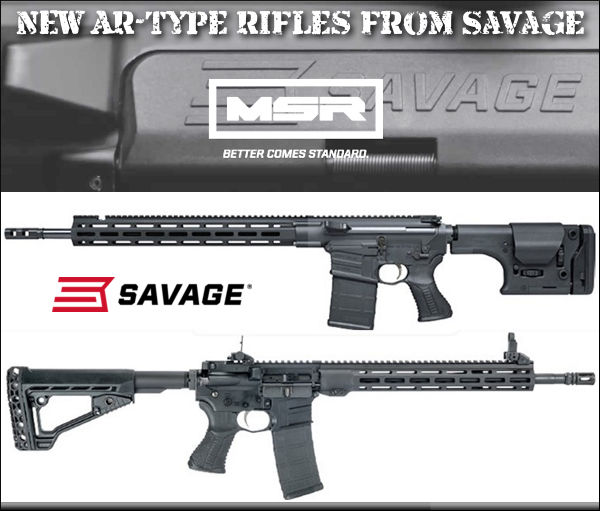
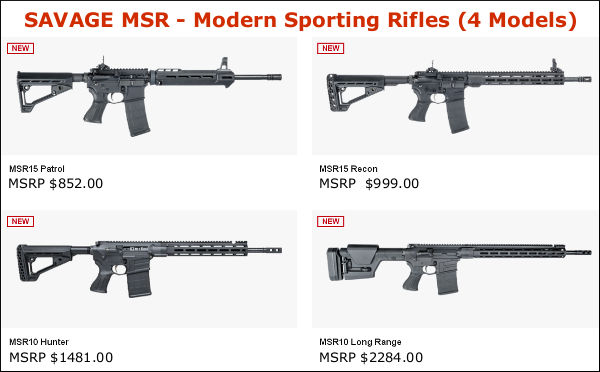
Savage Arms has joined the black rifle bandwagon with its new MSR Series of gas guns. Savage will offer four AR-style semi-automatic rifles in 2017. Savage will offer a variety of buttstock configurations, barrel lengths, along with some interesting chambering options. The MSR 15 Patrol and Recon feature a .223 Wylde target chamber for use with 223 Rem. or 5.56x45mm. The MSR 10 Hunter and MSR 10 Long Range models are AR-10 platform rigs offered in 6.5 Creedmoor and .308 Win chamberings. The top-of-the-line MSR 10 Long Range model carries a hefty $2284 MSRP price-tag, but it does include a two-stage AR Blaze target trigger, adjustable gas block, and a genuine Magpul® PRS Gen3 buttstock.
While most of the engineering of the MSR series is classic AR, there are some interesting features and notable upgrades. The MSR 10 Long Range offers a non-reciprocating, left-side charging handle (along with conventional rear charging handle). All the MSR rifles have high-quality barrels with a durable surface hardening treatment known as Melonite QPQ. This should make the rifles run longer (with higher round count) before needing replacement barrels. Bill Dermody of Savage states: “These are high-performance barrels you’d have to buy as an upgrade with standard AR-15s.”
Savage MSR Notable Features:
Non-reciprocating SIDE charging handle on MSR 10 LR (plus normal charging handle)
1:8″-twist Barrels, Melonite QPQ hardening, 5R rifling (MSR 15 Patrol and Recon)
1:8″ or 1:10″-twist Barrels, Melonite QPQ hardening, 5R rifling (MSR 10 Hunter and LR)
Conventional AR-Type Gas System (No Op Rod)
Adjustable Gas Block (MSR 10 Hunter and LR)
Modular-Style Fore-end/Handguard
Flip-up Front and Rear Sights
Field Test of Savage MSR 15 Patrol
YouTube ace .22 Plinkster got his hands on one of the very first Savage MSR 15 Patrol M4 models. In this video, he tests it for function and accuracy, finding the MSR 15 to be “a good shooter”. He adds: “The Patrol is Savage’s entry-level M4. Because this rifle is brand new … you may want to check out Savage’s website at www.SavageArms.com.”
This Twang ‘N Bang video explains the key features of the MSR 10 Long Range, including the side charging handle and QPQ-treated barrel. It also describes the specs of the other three models.
Savage’s new MSR 10 Hunter and MSR 10 Long Range are purpose-built modern sporting rifles for game hunting and long-range shooting. Both are available in .308 Winchester and 6.5 Creedmoor chamberings. Both models are built on compact, lightweight frames and feature adjustable gas blocks, plus the MSR 10 Long Range is equipped with a non-reciprocating, side-charging handle (see below).
On the AR-15 platform, the new MSR 15 Patrol and MSR 15 Recon are chambered in .223 Wylde for safe, reliable function with both 223 Rem. and 5.56x45mm ammo. All Savage MSRs offer premium features such as 5R button-rifled barrels with Melonite QPQ surface hardening, new BLACKHAWK! furniture, upgraded sights and more. To learn more about Savage’s new line of MSR rifles, visit www.Savagearms.com/msr.
The folks at Sierra Bullets asked a few staff bulletsmiths a classic question about guns: “If you could own only one firearm which one would you choose?” There were many interesting answers including a “cheater” response — the drilling — which is really two guns in one. The most-often mentioned chambering was the venerable .30-06. Respondents cited its versatility, hunting prowess, and ready availability of ammo. The popular .308 Winchester, as expected, got mentions as did its cousins the .243 Win and 7mm-08. There were quite a few votes for classic lever guns, as well as 12-gauge shotguns. Two bulletsmiths cited the .22 LR, and we can certainly see the logic in that answer. The little rimfire cartridge is versatile, quiet, and inexpensive.
We ask our readers the same question — if you could only have one long gun, what type of firearm would it be? List the gun type and chambering in the comments section.
If You Could Have Just One Long-Gun — ANSWERS:
Media Relations Manager Carroll Pilant answered: “I would NEVER own only one gun. If I HAD to pick one, it would be a drilling in 12 gauge over .30-06.”
Ballistic Technician Rich Machholz answered: “The early tang safety Ruger M77s pretty much have all you could want in a bolt gun, but I do like the Winchester lever guns and the combination guns, particularly the drillings. Since I have the first two, I’m going for a Doug Turnbull 1886 or a side by side 20 gauge over .223 drilling.”
Ballistic Technician Philip Mahin answered: “More than likely it would have to be a bolt action .30-06. The reliability is legendary on a wide range of game animals and factory ammunition has still been available at my local stores even in these tough times.”
Ballistic Technician Duane Siercks answered: “If I had to boil it all down to one gun, it would probably be a .30-06. I have a Remington 700C (custom shop gun) that has worked very well for anything and everything I have ever wanted to do with it.”
Ballistic Technician Paul Box answered: “A .22 Rimfire.”
Chief Ballistician Tommy Todd answered: “Remington 700 in .308 Winchester.”
VP – Sales & Marketing Matt Reams answered: “A light weight Kimber in 25-06.”
Production Toolsetter Brad Vansell answered: “Savage weather warrior 7mm-08 is my rifle of choice.”
Production Toolsetter Dan Mahnken answered: “The .308 Winchester rifle — [based on the] wide range of bullets made and the wide range of things that one can hunt with it.”
Process Engineer David Palm answered: “Savage action 243 Winchester.”
Ballistic Technician Gary Prisendorf answered: “Probably a .22 LR. It may not be the best choice, but you could use it for about anything if you really had to.”
Production Manager Chris Hatfield answered: “Beretta A300 Outlander 12 gauge.”
Right now Precision Reloading is running a BIG SALE on Sierra MatchKing (MK) and Tipped MatchKing (TMK) Bullets. These bullets are being offered at deep discounts, with very low prices (some close to wholesale). Precision Reloading says you can save up to $37.00 on 500-ct boxes. Here are just a few examples of the dozens of types of Sierra Bullets on Sale.
Sierra 30 Cal, 200gr HPBT MK, 100 for $35.57 (marked down from $40.29)
Sierra 7mm, 183gr HPBT MK, 100 for $38.37 (marked down from $43.39) (Great new bullet)
Sierra 6.5mm, 142gr HPBT MK, 500 for $167.74 (marked down from $187.69)
Sierra 6.5 mm, 130gr TMK, 100 for $30.58 (marked down from $34.59)
Sierra 6mm, 95gr TMK, 500 for $138.75 (marked down from $156.89)
Sierra 22 Cal, 80gr HPBT MK, 500 for $117.08 (marked down from $132.39)
Sierra 22 Cal 77gr TMK, 100 for $26.19 (marked down from $29.69)
NOTE: This Sierra Bullets Sale runs through October 31, 2016, so you’ll want to place your order before the end of the month.
Sierra offers the widest selection of .30-Caliber match bullets in the world today, producing bullets suited to nearly every form of long-range competition. Along with classic HPBT and HP MatchKings, Sierra now offers the new Tipped MatchKing (TMK) line, which feature an acetal resin tip. The major advantage of adding a tip to the bullet is the reduction of drag, producing a more favorable ballistic coefficient. Another benefit is improved feeding in magazine-fed firearms.
Here’s an item for tactical and Precision Rifle Series (PRS) shooters. Howa is releasing a new rifle with a modular metal chassis. The new Howa HCR (Howa Chassis Rifle) combines a Howa 1500 barreled action with a modern, fully-adjustable aluminum chassis. The Howa’s MSRP is $1299.00, so the HCR is directly competitive with the Ruger Precision Rifle (RPR). Available chamberings are: .223 Remington, .243 Winchester, 6.5 Creedmoor, and .308 Winchester.
Mounted on an AR-style buffer tube system, the Howa HCR utilizes the fully adjustable LUTH-AR MBA-3 stock. Length of Pull is adjustable form 12.5″ to 16.75″. Comb height is also adjustable to fine tune for scope height-over-bore. Weight with a 24″ barrel is 10.2 pounds (before optics), so this Howa HCR is lighter that some similar rifles on the market.
Howa HCR Features
• Howa 1500 Barreled Action with 20″ and 24″ Heavy Barrel options
• Black 6061-T6 Aluminum Chassis with Free-Float M-LOK Forend
• LUTH AR Buttstock with LOP Adjustment (12.5″ to 16.75″) and Adjustable Comb
• 10-RD ACCURATE Detachable, Teflon-coated Steel Magazine
• Two-Stage H.A.C.T. Trigger
• 3 Position Safety
The HOWA HCR features an adjustable, two-stage HACT trigger, set for about 3 pounds (combined stages). Crisp and repeatable, this is an excellent trigger for a factory gun. In our opinion, the HACT trigger is clearly superior to the trigger on the Ruger RPR, as well as the Savage AccuTrigger. And there is no annoying Glock-style safety lever in the middle of the trigger blade.
Available in .223 Rem, .243 Win, 6.5 Creedmoor and .308 Win chamberings.
NOTE: For all chamberings, 24″ barrels are offered, with 20″ options for the .223 Rem and .308 Win as well. Twist rates are 1:9″ for .223 Rem, 1:10″ for .243 Win, 1:8″ for 6.5 Creedmoor, and 1:10″ for .308 Win. We think .243 Win shooters will NOT be happy with the 1:10″ twist. We would prefer to see a 1:8″-twist for the .243 Win so it can shoot the 105-115 grain 6mm bullets. Most competitive 6mm shooters will want a true 8-twist or even a 1:7.5″.
We congratulate Norman Houle, the 2016 National High Power Champion, and John Whidden, the 2016 National Long Range Champion. Norm secured his win with an impressive 2384-130X score. Along with the title of National Champion, Norm received a Mumma Trophy Plaque, a National Champion Medallion, Krieger Barrels Certificate, Trijicon Scope, and Geissele Certificate. In second place was last year’s champion, SFC Brandon Green of the USAMU. Brandon, who won the 2015 and 2013 High Power Championships, finished with a score of 2381-120X. In third place was SGT Nick Mowrer with 2381-114X, a very impressive score with a Service Rifle. (SGT Mowrer won the Service Rifle Championship.)
John Whidden is always strong at Camp Perry (file photo from past event).
Whidden Wins Long Range Championship
In the Long Range Competition (Tompkins Trophy Match), John Whidden of Whidden Gunworks topped the field with a very strong 1240-77X performance. This victory secured John’s fourth Long Range National title. As in the High Power Championship, in the Long Range event SFC Brandon Green also finished in second place (1238-67X). Rounding out the Long Range podium was William Gelet with a 1238-57X tally. With his Long Range Championship win, Whidden took home a Tompkins Trophy Plaque, a Gold Championship Medallion, and a $500 Berger Bullets Certificate.
John campaigned three rifles he smithed himself. These feature Barnard actions in modified Anschutz smallbore stocks. For the open-caliber events, John shot .243 Win-chambered rifles with 6mm 105gr Berger Hybrids. For the Palma matches he shot a .308 Win with 155gr Berger Hybrids. John’s ammo was loaded on Whidden dies of course. During the Long Range cycle, matches were shot with both iron sights and scopes. John had two different .243 Win rifles, one fitted with iron sights, the other with a scope.
High Power Hardware: The Guns of Perry
We thought our readers would like to see some of the ultra-accurate rifles campaigned by High Power competitors at Camp Perry. Both bolt-action and self-loading rifles are popular. Among bolt guns, Tubb 2000s and Eliseo tubeguns are popular. Semi-auto AR platform “Space Guns” offer some advantages (particularly during rapid-fire and for standing position), and are favored by many of the top marksmen. Many Camp Perry High Power competitors are also shooting less exotic AR service rifles.
Tubb 2000 with a shortened handguard, and custom hand support bracket forward of mag well.
The modern AR Space Gun, scoped version. Note the side charging handle, and absence of forward assist. A block fitted under the handguard helps with the standing position. The scope is mounted on a “piggy-back” rail that extends forward of upper receiver’s built-in rail.
Derek Rodgers, the only shooter to win both the F-Open and F-TR National Championships, has done it again. While shooting the Santa Fe Trail LR Regional match in Raton, New Mexico, it looks like Derek set a new 1000-yard record. Derek nailed his 1000-yard target, recording a 200-14X score — that’s twenty (20) shots for record, all tens with 14 in the X-Ring. Derek told us: “Yesterday at Raton New Mexico’s Whittington Center, I shot a 200-14X, which should be a new pending F-TR National Record at 1000 yards.” Derek took special pride in this accomplishment, as he held the F-TR record before: “I’m happy to have the record back. I have had three of the last four records”. Well done Derek!
Derek Rodgers .308 Win F-TR Rifle Equipment List:
McMillan Xit stock, Kelbly Panda LBLP action, Bartlein .308 Win barrel (32″, 1:11.25″ twist), Nightforce NXS 8-32x56mm scope. Note that Derek shoots right-handed, but with a LEFT BOLT. This allows him to stay in position better while cycling the bolt with his LEFT hand.
This impressive performance by Derek shows that the best F-TR rifles can rival the big F-Open rigs for pure accuracy, even though the favored F-Open chamberings, such as .284 Win and .300 WSM, are still ballistically superior to the venerable .308 Winchester used by nearly all F-TR competitors. For his record-breaking load, Derek used Berger 200gr Hybrid Target bullets in Lapua .308 Win (small primer pocket) brass, pushed by Hodgdon Varget powder.
There are hundreds of cartridge types capable of winning in F-Open. For F-TR you can shoot either the .223 Rem or .308 Win, but you have many load options. This article will focus on proven choices, currently used by the top F-Class shooters in the world. Our discussion will analyze cartridge selection based on the four different F-Class sub-disciplines: Open Mid-Range, Open Long-Range, F-TR Mid-Range, and F-TR Long Range.
Click image to view full-screen photo.
Mid-Range F-Open Cartridges
For starters, a .300 WSM is certainly capable of winning mid-range matches but it is not ideal. So what is ideal, and why? F-Class Mid-Range matches usually are usually shot at 300, 500, or 600 yards — or all three. At those distances the 6mm and 6.5mm cartridges rule. In moderate conditions, the 6mm Dasher is unbeatable. Its low recoil along with its super grouping ability and good ballistics make it my number one choice for Mid-Range.
Best bullets for the 6mm Dasher are: Vapor Trail 103gr, Berger 105 Hybrid, 108 BT, and 105 VLD (hunting). Best powders are: Varget, H4895, and Reloder 15.
Choices for Mid-Range in Tougher Conditions:
We all know that conditions are not always “moderate” that’s why something a little bit bigger will save you a “Nine” or two. The 6.5X47 Lapua was designed for 300-meter competition, but as soon as it was released, it was adopted by F-Class, benchrest, and tactical shooters. It offers great ballistics with very low recoil and big “accuracy window”. Lapua makes great brass for it (no surprise there) and Berger makes great bullets: 130gr VLD, 140gr VLD, 140gr Hybrids. Best powders in most barrels are Varget and H4350, I don’t use double-based powders such as Reloder 17 and the Vihtavuori N500 series because of their unpredictable performance day to day (greater temp sensitivity).
The 6.5X47 Lapua necked down to 6mm is also a great option for mid range matches. I was able to easily get 3200 fps with 105 hybrids and H4350.
Choice for Long-Range F-Open Competition
In Long-Range F-Open Class (out to 1000 yards), the big, high-BC bullets rule. If I had to pick one cartridge for F-Class (both mid- and long-range) I would pick the .284 Winchester or one of its variants. The .284 Win is currently dominating in F-Open competition. It offers great barrel life, it is super-easy to tune and its recoil is very manageable. The best bullets for it by far (in my opinion), are the Berger 180 Hybrids. But Sierra’s new 183gr MK bullet (with factory-uniformed meplats) seems to perform very well as does the Berger 180 VLD. Best powders for the .284 Win are H4350 and H4831SC.
Long-Range Only F-Open Cartridge
As much as I like the .284 Win, for long-range competitions I like the .300 WSM even more. If you look at a .300 WSM and a 6mm Dasher side by side, they appear almost identical in geometry — the .300 WSM looks like an “super-sized” Dasher. Both cartridges are currently the “darlings” of long-range benchrest due to their extraordinary grouping ability and huge “node’’ windows. Big accuracy windows allow loads to perform well in different conditions and geographical locations. That’s obviously very important if you travel to compete. The .300 WSM loaded with Berger 215gr or 230gr Hybrids is very tough to beat at long range, and it is currently my number one choice.
The 7mm RSAUM is another outstanding long-range round. It resembles a 6BR on steroids and it is almost as easy to tune. Best bullets for it are Berger 180gr Hybrids, 195gr EOLs, and Sierra’s 183gr MatchKing. Best powders for the 7mm RSAUM are: H4350, H4831SC, and VV N160.
Top Caliber/Bullet Combos for F-TR
In F-TR competition, the choice is clear — a .308 Win throated for Berger 185gr BTLRs and 200gr Hybrids will win in mid-range AND long-range comps. Many championships have been won, and many records set with those two bullets in the .308 Win. To quote Danny Biggs (a two times FTR National Champion) “The 185 BTLR is the best bullet for .308 Win ever made”.
The Berger 215gr Hybrids have been used to win many competitions including recently the 2015 F-Class Nationals. Bryan Litz won both the Mid-Range and Long-Range 2015 Championships using 215s. Bryan’s rifle is shown below:
I recommend chambers throated for the 185/200 grain projectiles over the 215/230 grain bullets. The reason is that if you have your barrel throated out for the 215s or the 230s, you could have a “slow” barrel and max out on pressure before the desired velocity is reached. Optimum freebore for the 230s is too long for the 185/200s, so you would be limited to using only 215/230gr bullets in that barrel.Furthermore, the recoil increase with heavier bullets is substantial, causing the rifle to be more difficult to shoot.
.223 Rem — Not A Competitive Option
I would stay away from the .223 Remington. On paper the 90gr VLD will shoot inside most .308 Win loads even at a 1000 yards. But in reality, on average, the .223 Rem, regardless of what powder/bullet combo is used, cannot compete with the .308 Win. [Editor: The equipment lists at major F-TR matches will confirm Kovan’s conclusion here.]
Conclusion (and Other Options)
This article covers only the (currently) most popular cartridge/bullet combos for F-Class (F-Open and F-TR). As I said in the beginning, many cartridge types are capable of winning but are not listed due to their low popularity, case design, or lack of quality components. All of the above information is based on my personal experience and it is meant to help new shooters choose the right cartridges for F-Class matches. Thanks for reading and good luck — Emil Kovan
Emil Kovan Competition History:
– 2014 F-Class Open National Champion
– 2015 F-Class Open National Championship, Silver Medal
– F-Class Open National Championship Teams, 2015, 2014, 2013, Shooting Team Member
– Over 15 wins in Regional and State Championships in Palma, F-TR, F-Open
This week’s episode of Shooting USA TV features the 2015 Palma World Championships. The World Fullbore Championships and ICFRA World Long Range Palma Team Championship were held at Camp Perry this past summer. The last time the USA hosted the Palma Championship was 1992 in Raton, New Mexico. The event won’t return to the USA for another 28 years. If you want to see the world’s best sling shooters in action, tune in to this episode of Shooting USA on the Outdoor Channel.
This Team Championship is a prestigious match at 800, 900 and 1,000 yards with national squads competing for the prized Palma Trophy (see below). The 2015 Team Championship was secured by the talented United Kingdom squad.
Palma Team World Championships
The Team Palma match is the oldest, continuously-running rifle match in the world. This event was first held in 1876 in Creedmoor, New York as a challenge match to mark America’s Centennial. British Commonwealth nations were invited and the American team won the first title. The Palma World Championships currently take place every four years. This summer the event was held in the USA, with the top eight teams in the world competing at Camp Perry in Ohio. The next Palma Team World Championships will be held in New Zealand in 2019.
“It’s fantastic. It is the greatest honor you could ever get to represent your country. We wouldn’t give it up for anything,” says Australia Palma Team Member, Ben Emms. The match itself takes place over two days, with each team shooting at 800, 900 and 1,000 yards. Competitors shoot a modern target rifle with iron (aperture) sights. All rifles are chambered for the .308 Win (7.62×51) with 155-grain bullets. Wind calls are made by each team’s Wind Coach. “His job is very complex. He’s up there, he’s watching the mirage, the wind flags, and paying attention to the other targets down range,” says American Team Member Amanda Elsenboss.
The top individual shooter in the 2015 Team match was Great Britain’s Toby Raincock, who dropped only one point over two days to finish with 449-55V, a new record individual score that will be very hard to surpass. The next best individual score was the 447-49V by fellow Brit Jon Underwood. The top American shooter was John Whidden, who finished with a 445-45V.
The Palma Team Trophy
Originally named the Centennial Trophy, in honor of the Centennial celebration of the independence of the United States of America, the Palma Trophy was commissioned from Tiffany’s at a cost of $1,500. The trophy was a full-sized replica of a Roman Legion standard, executed in bronze with silver and gold inlay. On the banner of the standard was the legend, “In the name of the United States of America to the Riflemen of the world”. Above the banner was an eagle, bearing in its talons a wreath of palm leaves and a plaque on which was the single word, “PALMA”, the Latin word for palm tree, which was used by the Romans to signify victory, or the ultimate in excellence.
Because the word Palma was so easily seen, the trophy soon became known as the “Palma Trophy”, and by 1878 was referred to officially by that name. The sriginal seven and one-half foot trophy is now lost, having not been seen since at least 1954. Serving in its place is a copy which was commissioned by Dr. Herbert M. Aitken of Eau Claire, WI. The copy was made from the original Tiffany blue-prints at a cost of $32,500. Dr. Aitken has given this copy of the Palma Trophy to the NRA for use in the Palma Match. The trophy is retained by the winning team until the next Palma Match.
In 2008, the Palma Trophy was returned to the NRA, and it was decided that the trophy, once refurbished, will travel to the host nation for the match every four years, then returned to the NRA for safekeeping.
The first competition for the Palma Team was a challenge match for which the British Commonwealth nations were invited. The match was fired in 1876 at the old Creedmoor Range on Long Island as part of the Centennial celebration of the United States. Teams representing Scotland, Ireland, Canada, Australia, and the United States took part. The match is currently fired on a four-year interval.


 Gone in Six Seconds. Want to Cry Now?




 The HOWA HCR features an adjustable, two-stage HACT trigger, set for about 3 pounds (combined stages). Crisp and repeatable, this is an excellent trigger for a factory gun. In our opinion, the HACT trigger is clearly superior to the trigger on the Ruger RPR, as well as the Savage AccuTrigger. And there is no annoying Glock-style safety lever in the middle of the trigger blade.


 .223 Rem — Not A Competitive Option
 Emil Kovan Competition History:

 “It’s fantastic. It is the greatest honor you could ever get to represent your country. We wouldn’t give it up for anything,” says Australia Palma Team Member, Ben Emms. The match itself takes place over two days, with each team shooting at 800, 900 and 1,000 yards. Competitors shoot a modern target rifle with iron (aperture) sights. All rifles are chambered for the .308 Win (7.62×51) with 155-grain bullets. Wind calls are made by each team’s Wind Coach. “His job is very complex. He’s up there, he’s watching the mirage, the wind flags, and paying attention to the other targets down range,” says American Team Member Amanda Elsenboss.
 The Palma Team Trophy


