Widener’s Reloading & Shooting Supply has published a helpful introduction to reloading powders. Widener’s online Guide to Smokeless Powders shows the various types of powders, and explains how the differences in powder kernel/flake size and shape, and burn rate affect performance. We recommend you visit Widener’s website and read the Powder Guide in full.
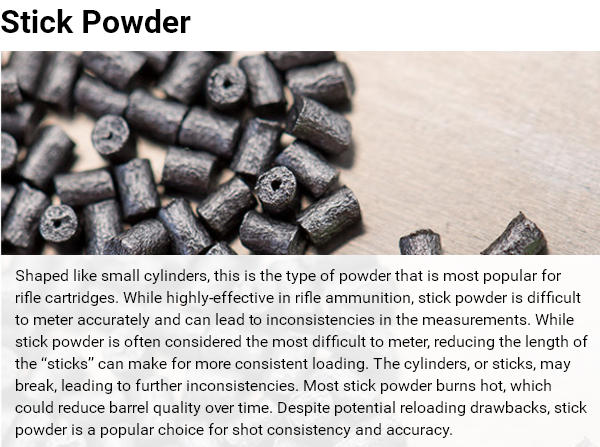
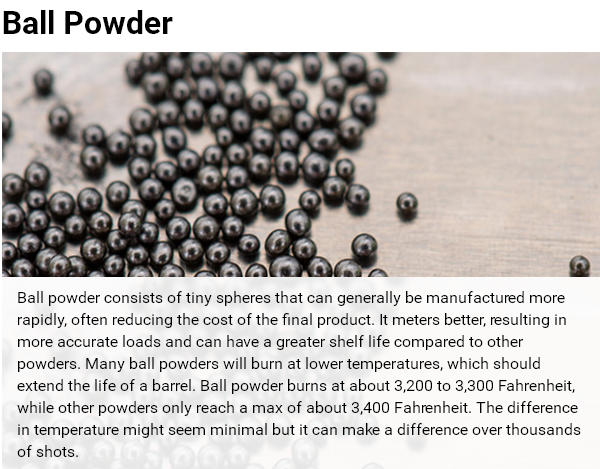
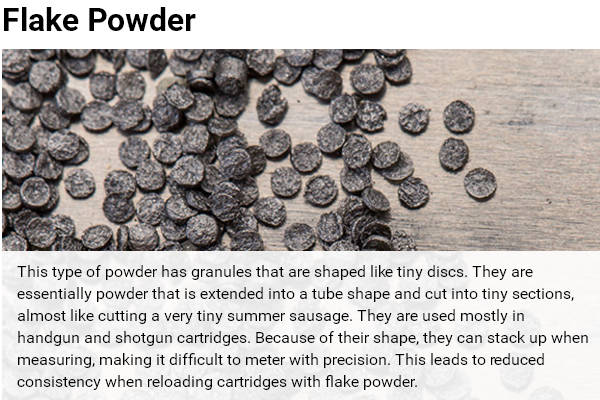
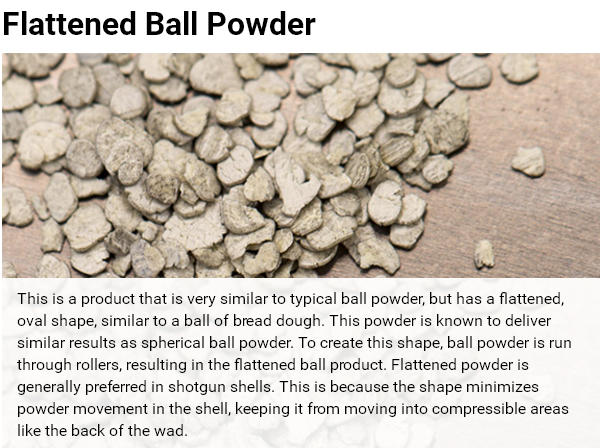
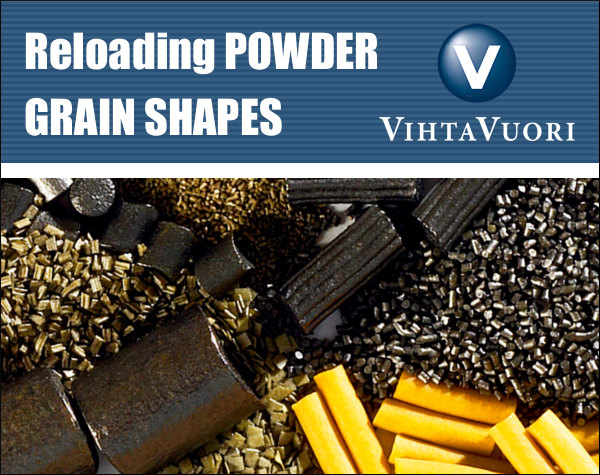
Take a close look at these illustrations which show the key differences between the four main powder types: extruded (stick) powder, ball (spherical) powder, flattened ball powder, and flake powder.
Burn Rate Basics
Widener’s Guide to Smokeless Powders also has a useful discussion of Burn Rate (a confusing topic for many hand-loaders). Wideners explains: “While a gun powder explosion in the cartridge seems instantaneous, if you slow it down you will actually find that each powder has a different ‘burn rate’, or speed at which it ignites.” This video shows powders with two very different burn rates. Watch closely.
Different burn rates suit different cartridge types notes Widener’s: “In general a fast-burning powder is used for light bullets and low-speed pistols and shotguns. Medium-rate powders are used for magnum pistols, while high-velocity, large bore rifle cartridges will need slow powders[.]
It should be noted that burn rate does not have a standardized unit of measurement. In fact, burn rate is really only discussed in comparison to other powders; there is no universal yardstick. Specifics will change by cartridge and bullet types[.]”
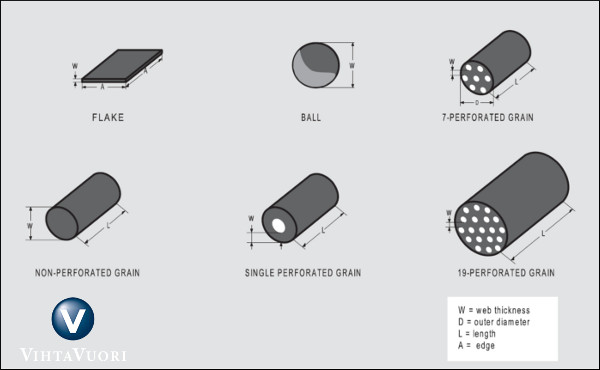
The shape of powder grains has a profound effect on the performance of the powder charge, as it concerns both pressure and velocity. There are multiple powder shapes including flake, ball, and extruded or “stick” (both solid and perforated).
So how does powder grain shape affect pressure and muzzle velocity?
In general, it can be said that powder that burns progressively achieves a desired muzzle velocity at lower maximum pressure than a powder that burns neutrally, not to mention a degressive powder. As grain size increases, the maximum pressure moves towards the muzzle, also increasing muzzle blast. Muzzle velocity and pressure can be adjusted by means of the amount of powder or loading density, i.e. the relationship between the powder mass and the volume available to it. As the loading density increases, maximum pressure grows.
All Vihtavuori reloading powders are of the cylindrical, single-perforated extruded stick type. The differences in burning rate between the powders depend on the size of the grain, the wall thickness of the cylinder, the surface coating and the composition. Cylindrical extruded powders can also have multi-perforated grains. The most common types are the 7- and 19-perforated varieties. A multi-perforated powder grain is naturally of a much larger size than one with a single perforation, and is typically used for large caliber ammunition.
Other types of powder grain shapes include sphere or ball, and flake. The ball grains are typically used in automatic firearms but also in rifles and handguns. The ball grain is less costly to produce, as it is not pressed into shape like cylindrical grains. Flake shaped grains are typically used in shotgun loadings.
Web thickness in gunpowder terminology means the minimum distance that the combustion zones can travel within the powder grain without encountering each other. In spherical powders, this distance is the diameter of the “ball”; in flake powder it is the thickness of the flake; and in multi-perforated extruded powders it is the minimum distance (i.e. wall thickness) between the perforations.
The burning rate of powder composed of grains without any perforations or surface treatment is related to the surface area of the grain available for burning at any given pressure level. The change in the surface area that is burning during combustion is described by a so-called form function. If the surface area increases, the form function does likewise and its behavior is termed progressive. If the form function decreases, its behavior is said to be degressive. If the flame area remains constant throughout the combustion process, we describe it as “neutral” behavior.
The cylindrical, perforated powders are progressive; the burning rate increases as the surface area increases, and the pressure builds up slower, increasing until it reaches its peak and then collapses. Flake and ball grains are degressive; the total powder surface area and pressure are at their peak at ignition, decreasing as the combustion progresses.
Widener’s Reloading & Shooting Supply has published a helpful introduction to reloading powders. Widener’s online Guide to Smokeless Powders shows the various types of powders, and explains how the differences in powder kernel/flake size and shape, and burn rate affect performance. We recommend you visit Widener’s website and read the Powder Guide in full.
Take a close look at these illustrations which show the key differences between the four main powder types: extruded (stick) powder, ball (spherical) powder, flattened ball powder, and flake powder.
Burn Rate Basics
Widener’s Guide to Smokeless Powders also has a useful discussion of Burn Rate (a confusing topic for many hand-loaders). Wideners explains: “While a gun powder explosion in the cartridge seems instantaneous, if you slow it down you will actually find that each powder has a different ‘burn rate’, or speed at which it ignites.” This video shows powders with two very different burn rates. Watch closely.
Different burn rates suit different cartridge types notes Widener’s: “In general a fast-burning powder is used for light bullets and low-speed pistols and shotguns. Medium-rate powders are used for magnum pistols, while high-velocity, large bore rifle cartridges will need slow powders[.]
It should be noted that burn rate does not have a standardized unit of measurement. In fact, burn rate is really only discussed in comparison to other powders; there is no universal yardstick. Specifics will change by cartridge and bullet types[.]”
We’ve told fans of Hodgdon H4350 to give Alliant Reloder 16 (RL16) a try. In our tests, Reloder 16 has proven a very promising rival to H4350 for accuracy, low ES/SD, and temp stability.
Now you can get the advantages of Reloder 16 in a slower powder formulated for magnum cartridges — Reloder 26 (RL26). Alliant says RL26’s burn speed falls between that of Reloder® 22 and Reloder® 33. That means it’s slower than H4831 but faster than powders that would suit the .338 Lapua Magnum. Reloder 26 has a high bulk density that allows larger powder charges, and high velocities. RL26 also provides a consistent, controlled response to temperature changes.
We are hearing very good things about RL26 from friends and Forum members who are testing it with big calibers for Long Range applications. Accuracy is good and velocities are impressive. Alliant says RL26 “incorporates EI® technology to produce extremely high velocities in magnum cartridges”. In big magnums, shooters have reported gaining 100+ fps with RL26 compared to H1000 or Retumbo. And to our surprise some guys have even tried replacing H4350 with RL26 (in smaller cartridge types) and they have picked up meaningful velocities. We don’t think Alliant ever intended RL26 as a substitute for H4350, but if you’ve got the case capacity… it may be worth a try.
Alliant Reloder 26 Features
EI® technology delivers high velocities in magnum cartridges
Contains proprietary de-coppering additive
Controlled temperature stability
Excellent lot-to-lot consistency
Formulation contains no DNT or DBP
Made in Switzerland for Alliant Powder
Alliant’s Tech Expert Talks about Reloder 26
What are the characteristics of Reloder 26? That question was answered recently by Paul Furrier who works for ATK, the parent company of Alliant Powders. Posting in our Shooters’ Forum, Paul writes:
“Reloder 26 is produced in Switzerland by our extremely capable partner Nitrochemie. I have seen it stated that they [it is] made by Bofors, so that is incorrect. I have also noticed people are equating … Reloder 26 to Reloder 25. Reloder 26 is definitely slower burning than Reloder 25, so there shouldn’t be any confusion there either.”
Speed and More Speed with RL 26
Think of Reloder 26 as a high-velocity powder for big cartridges. Furrier explains: “Reloder 26 is produced with Nitrochemie’s latest generation EI® process technology. This is the same impregnation coating process used to produce Reloder 17, Reloder 33, and Reloder 50 for us, and it is fantastic. Reloder 26 [offers] great ballistic efficiency, high bulk density so you can get more of the slow powder into the case to harness the energy, and decent, predictable extreme temp response. Reloder 26 is not as flat at temps as the TZ or Australian materials, but it is very manageable, usually in the 0.5 fps/°F range (depending on the application). Just as important, the pressure increases at hot are very manageable. We are using quite a bit of this RL26 powder in our Federal factory ammo due to the fantastic ballistics and accuracy.” — Paul Furrier, ATK
The shape of powder grains has a profound effect on the performance of the powder charge, as it concerns both pressure and velocity. There are multiple powder shapes including flake, ball, and extruded or “stick” (both solid and perforated).
So how does powder grain shape affect pressure and muzzle velocity?
In general, it can be said that powder that burns progressively achieves a desired muzzle velocity at lower maximum pressure than a powder that burns neutrally, not to mention a degressive powder. As grain size increases, the maximum pressure moves towards the muzzle, also increasing muzzle blast. Muzzle velocity and pressure can be adjusted by means of the amount of powder or loading density, i.e. the relationship between the powder mass and the volume available to it. As the loading density increases, maximum pressure grows.
All Vihtavuori reloading powders are of the cylindrical, single-perforated extruded stick type. The differences in burning rate between the powders depend on the size of the grain, the wall thickness of the cylinder, the surface coating and the composition. Cylindrical extruded powders can also have multi-perforated grains. The most common types are the 7- and 19-perforated varieties. A multi-perforated powder grain is naturally of a much larger size than one with a single perforation, and is typically used for large caliber ammunition.
Other types of powder grain shapes include sphere or ball, and flake. The ball grains are typically used in automatic firearms but also in rifles and handguns. The ball grain is less costly to produce, as it is not pressed into shape like cylindrical grains. Flake shaped grains are typically used in shotgun loadings.
Web thickness in gunpowder terminology means the minimum distance that the combustion zones can travel within the powder grain without encountering each other. In spherical powders, this distance is the diameter of the “ball”; in flake powder it is the thickness of the flake; and in multi-perforated extruded powders it is the minimum distance (i.e. wall thickness) between the perforations.
The burning rate of powder composed of grains without any perforations or surface treatment is related to the surface area of the grain available for burning at any given pressure level. The change in the surface area that is burning during combustion is described by a so-called form function. If the surface area increases, the form function does likewise and its behavior is termed progressive. If the form function decreases, its behavior is said to be degressive. If the flame area remains constant throughout the combustion process, we describe it as “neutral” behavior.
The cylindrical, perforated powders are progressive; the burning rate increases as the surface area increases, and the pressure builds up slower, increasing until it reaches its peak and then collapses. Flake and ball grains are degressive; the total powder surface area and pressure are at their peak at ignition, decreasing as the combustion progresses.
The shape of powder grains has a profound effect on the performance of the powder charge, as it concerns both pressure and velocity. There are multiple powder shapes including flake, ball, and extruded or “stick” (both solid and perforated).
So how does powder grain shape affect pressure and muzzle velocity?
In general, it can be said that powder that burns progressively achieves a desired muzzle velocity at lower maximum pressure than a powder that burns neutrally, not to mention a degressive powder. As grain size increases, the maximum pressure moves towards the muzzle, also increasing muzzle blast. Muzzle velocity and pressure can be adjusted by means of the amount of powder or loading density, i.e. the relationship between the powder mass and the volume available to it. As the loading density increases, maximum pressure grows.
All Vihtavuori reloading powders are of the cylindrical, single-perforated extruded stick type. The differences in burning rate between the powders depend on the size of the grain, the wall thickness of the cylinder, the surface coating and the composition. Cylindrical extruded powders can also have multi-perforated grains. The most common types are the 7- and 19-perforated varieties. A multi-perforated powder grain is naturally of a much larger size than one with a single perforation, and is typically used for large caliber ammunition.
Other types of powder grain shapes include sphere or ball, and flake. The ball grains are typically used in automatic firearms but also in rifles and handguns. The ball grain is less costly to produce, as it is not pressed into shape like cylindrical grains. Flake shaped grains are typically used in shotgun loadings.
Web thickness in gunpowder terminology means the minimum distance that the combustion zones can travel within the powder grain without encountering each other. In spherical powders, this distance is the diameter of the “ball”; in flake powder it is the thickness of the flake; and in multi-perforated extruded powders it is the minimum distance (i.e. wall thickness) between the perforations.
The burning rate of powder composed of grains without any perforations or surface treatment is related to the surface area of the grain available for burning at any given pressure level. The change in the surface area that is burning during combustion is described by a so-called form function. If the surface area increases, the form function does likewise and its behavior is termed progressive. If the form function decreases, its behavior is said to be degressive. If the flame area remains constant throughout the combustion process, we describe it as “neutral” behavior.
The cylindrical, perforated powders are progressive; the burning rate increases as the surface area increases, and the pressure builds up slower, increasing until it reaches its peak and then collapses. Flake and ball grains are degressive; the total powder surface area and pressure are at their peak at ignition, decreasing as the combustion progresses.
Widener’s Reloading & Shooting Supply recently published a helpful introduction to reloading powders. Widener’s online Guide to Smokeless Powders shows the various types of powders, and explains how the differences in powder kernel/flake size and shape, and burn rate affect performance. We recommend you visit Widener’s website and read the Powder Guide in full.
Take a close look at these illustrations which show the key differences between the four main powder types: extruded (stick) powder, ball (spherical) powder, flattened ball powder, and flake powder.
Burn Rate Basics
Widener’s Guide to Smokeless Powders also has a useful discussion of Burn Rate (a confusing topic for many hand-loaders). Wideners explains: “While a gun powder explosion in the cartridge seems instantaneous, if you slow it down you will actually find that each powder has a different ‘burn rate’, or speed at which it ignites.” This video shows powders with two very different burn rates. Watch closely.
Different burn rates suit different cartridge types notes Widener’s: “In general a fast-burning powder is used for light bullets and low-speed pistols and shotguns. Medium-rate powders are used for magnum pistols, while high-velocity, large bore rifle cartridges will need slow powders[.]
It should be noted that burn rate does not have a standardized unit of measurement. In fact, burn rate is really only discussed in comparison to other powders; there is no universal yardstick. Specifics will change by cartridge and bullet types[.]”
The shape of powder grains has a profound effect on the performance of the powder charge, as it concerns both pressure and velocity. There are multiple powder shapes including flake, ball, and extruded or “stick” (both solid and perforated).
So how does powder grain shape affect pressure and muzzle velocity?
In general, it can be said that powder that burns progressively achieves a desired muzzle velocity at lower maximum pressure than a powder that burns neutrally, not to mention a degressive powder. As grain size increases, the maximum pressure moves towards the muzzle, also increasing muzzle blast. Muzzle velocity and pressure can be adjusted by means of the amount of powder or loading density, i.e. the relationship between the powder mass and the volume available to it. As the loading density increases, maximum pressure grows.
All Vihtavuori reloading powders are of the cylindrical, single-perforated extruded stick type. The differences in burning rate between the powders depend on the size of the grain, the wall thickness of the cylinder, the surface coating and the composition. Cylindrical extruded powders can also have multi-perforated grains. The most common types are the 7- and 19-perforated varieties. A multi-perforated powder grain is naturally of a much larger size than one with a single perforation, and is typically used for large caliber ammunition.
Other types of powder grain shapes include sphere or ball, and flake. The ball grains are typically used in automatic firearms but also in rifles and handguns. The ball grain is less costly to produce, as it is not pressed into shape like cylindrical grains. Flake shaped grains are typically used in shotgun loadings.
Web thickness in gunpowder terminology means the minimum distance that the combustion zones can travel within the powder grain without encountering each other. In spherical powders, this distance is the diameter of the “ball”; in flake powder it is the thickness of the flake; and in multi-perforated extruded powders it is the minimum distance (i.e. wall thickness) between the perforations.
The burning rate of powder composed of grains without any perforations or surface treatment is related to the surface area of the grain available for burning at any given pressure level. The change in the surface area that is burning during combustion is described by a so-called form function. If the surface area increases, the form function does likewise and its behavior is termed progressive. If the form function decreases, its behavior is said to be degressive. If the flame area remains constant throughout the combustion process, we describe it as “neutral” behavior.
The cylindrical, perforated powders are progressive; the burning rate increases as the surface area increases, and the pressure builds up slower, increasing until it reaches its peak and then collapses. Flake and ball grains are degressive; the total powder surface area and pressure are at their peak at ignition, decreasing as the combustion progresses.
Outstanding New Powder from Alliant — Reloder TS 15.5 New Product Review by DasherDude
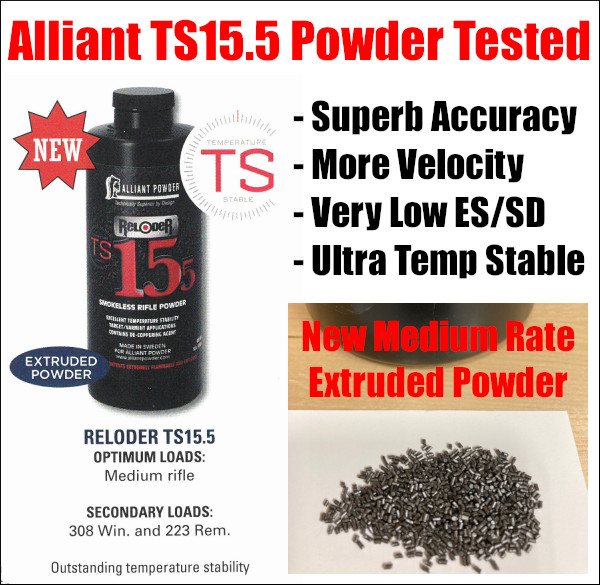
Alliant has devloped a new temperature-stable powder for long range applications. According to Alliant, this is a “slower burning version of the popular RL 15 with TZ technology” and brings some significant advantages over RL 15 and powders in the similar burn rate range (like Varget). The powder is named “Reloder TS 15.5″ (RL TS 15.5) and is created using the same TZ technology used in Reloder 16 (RL 16) and Reloder 23 (RL 23) whereby it manipulates the response of the propellant and resists the natural tendency to generate more pressure at higher temperatures and less pressure at lower temperatures. That makes RL TS 15.5 extremely stable across the full temperature range a shooter may encounter.
When Can You Get This New Alliant RL TS 15.5 Powder?
Alliant tells us that new RL TS 15.5 should start arriving on dealer’s shelves by the end of the month. Officially: “We will be putting it into distribution probably in April 2021 sometime”. Remember you heard about this powder here first.
The burn rate of RL TS 15.5 lies between RL 15 and RL 16 making it ideal for loading heavier bullets in .308 Win, 6.5 Creedmoor, 6mm Creedmoor, .223 Rem, and 6mm wildcats such as the 6mm Dasher or 6 BRA (BR Ackley). Being a bit slower than RL 15, new TS 15.5 offers higher velocities for the same charge weight as well as ability to load heavier charges for additional velocity without generating excessive pressure.
Testing Reloder TS 15.5 in 6 Dasher and .308 Winchester
I got a chance to test a pre-production powder sample of RL TS15.5 from Alliant. In my own tests with my 6mm Dasher and .308 Win, I extensively compared it with Varget that I normally use in these cartridges. In both cases, the results were nothing short of spectacular.
Powder Characteristics and Metering
This is an extruded powder and looks and feels similar to RL 16. The kernels are about 0.03 – 0.04 grains each (with the resolution of A&D FX 120i scale). RL TS 15.5 meters very well, although I had to slightly adjust the AutoTrickler to get it to meter perfectly.
As I found, later in the testing, that the powder compresses before it can generate excessive pressure in the Dasher, a drop tube helps to fill the case more efficiently if higher charges and velocities are desired.
6mm Dasher Test Rifle and Load
For testing I used my 6mm Dasher benchrest match rifle. This has a BAT 3L action, 28″ Krieger barrel, and McMillan stock. I use Lapua brass with CCI 450 primers to propel Berger 105gr Hybrids and this combination shoots quite well.
Test Firearm: 6mm Dasher, Bat 3L, 28″ 6mm HV Krieger Barrel, McMillan Stock.
Components: Lapua fire-formed brass, CCI 450 primers, Berger 105 grain Hybrid
Powder: Alliant Reloder TS 15.5
Load Testing and Velocities
Test in 6mm Dasher — Excellent Velocity, Low ES/SD
The testing comprised of shooting groups at 100 yards with increasing powder charges (OCW method) and then selecting a node. That node was found at 33.4 grains. The accuracy was excellent with remarkably low Extreme Spread and Standard Deviation (ES/SD)
My usual load is 32.9 grains of Hodgdon Varget which runs 2925 fps with an ES of around 12 fps and SD around 5 fps. For comparison, 32.9 grains of RL TS 15.5 delivered a velocity of 3022 fps. That is 97 fps greater than Varget for the same load weight (of RL TS15.5).
When used in the 6 Dasher, RL TS 15.5 had ES of 13 for 28 Shots — Remarkable!
More Velocity Plus Consistent ES/SD With the Dasher since the new node (the sweet spot) was found at 33.4 grains, that resulted in a velocity of 3050 fps (a 125 fps velocity increase) from the same rifle setup. Not only did the velocity increase, but the SD was lowered to 3.6 with an ES of 13 (calculated over 28 shots). You read that right… 13 fps ES over 28 shots!
At 34 grains without any drop tube, the load was compressed. However, there were no pressure signs. That indicates that the 6 Dasher cartridge can be loaded with a higher charge, if a drop tube was used.
.308 Winchester Velocity Results
Similar results (velocity gains) were obtained from my .308 Win with Berger 200.20X bullets. For the same charge of 44.2 grains, I recorded about 100 fps higher velocity with RL TS 15.5, compared to Varget.
Accuracy Results at 100 and 300 Yards — Very Impressive
How does RL TS 15.5 shoot on paper? Very well indeed.
6mm Dasher Load Testing with Various RL TS 15.5 Charge Weights
The groups on paper told similar stories. For the OCW method, I shot groups of increasing charges at 100 yards and then selected 33.4 grains as the optimum charge (incidentally, it was one ragged hole).
While testing at 300 yards, the conditions were very windy but since I was testing for vertical, the point of aim was kept the same for every shot. No attempt was made to correct for wind, so the groups spread horizontally (15 mph, 3 o’clock wind) but the vertical spread of all the groups was under 0.3 MOA. That gives me great hopes for the long-range capabilities of the powder.
Thoughts and Conclusions
For the past year, Alliant powders have been a welcome surprise for this tester and they have found a home in my reloading room. I struggled to find a load for my .284 Win with H4831sc and H4350 before trying out Reloder 16 and voila, it was perfect.
I have used Hodgdon Varget powder for a long time in both my 6mm Dasher and my .308 Winchester. With the .308 Win I’ve used various bullets from 168 to 200 grains. Varget has served me well. I do always need to keep the powder charge in check and so the velocities are held back a bit. Now RL TS 15.5 looks like a very impressive competitor to Varget.
With Reloder TS 15.5, Alliant seems to have delivered a harmonious mix of great accuracy, higher velocities, and lower SDs without creating excessive pressure. All of this is delivered with a very temperature-stable package. The higher velocities may allow some shooters to hit a new, better-performing node. These qualities are highly sought after by long range shooters. Accordingly, I have no qualms in saying that Alliant has created a winner here.
Alliant Official Load Data for Reloder TS 15.5
Along with the cartridge types shown below, Alliant has also released load data for .30-06 Springfield, 7x57mm Mauser, .270 Win, .260 Rem, 6.5 Grendel, .257 Roberts, 22-250 Rem, and 224 Valkyrie. CLICK for all data (larger format).
The shape of powder grains has a profound effect on the performance of the powder charge, as it concerns both pressure and velocity. There are multiple powder shapes including flake, ball, and extruded or “stick” (both solid and perforated).
All Vihtavuori reloading powders are of the cylindrical, single-perforated extruded stick type. The differences in burning rate between the powders depend on the size of the grain, the wall thickness of the cylinder, the surface coating and the composition. Cylindrical extruded powders can also have multi-perforated grains. The most common types are the 7- and 19-perforated varieties. A multi-perforated powder grain is naturally of a much larger size than one with a single perforation, and is typically used for large caliber ammunition.
Other types of powder grain shapes include sphere or ball, and flake. The ball grains are typically used in automatic firearms but also in rifles and handguns. The ball grain is less costly to produce, as it is not pressed into shape like cylindrical grains. Flake shaped grains are typically used in shotgun loadings.
Web thickness in gunpowder terminology means the minimum distance that the combustion zones can travel within the powder grain without encountering each other. In spherical powders, this distance is the diameter of the “ball”; in flake powder it is the thickness of the flake; and in multi-perforated extruded powders it is the minimum distance (i.e. wall thickness) between the perforations.
The burning rate of powder composed of grains without any perforations or surface treatment is related to the surface area of the grain available for burning at any given pressure level. The change in the surface area that is burning during combustion is described by a so-called form function. If the surface area increases, the form function does likewise and its behavior is termed progressive. If the form function decreases, its behavior is said to be degressive. If the flame area remains constant throughout the combustion process, we describe it as “neutral” behavior.
The cylindrical, perforated powders are progressive; the burning rate increases as the surface area increases, and the pressure builds up slower, increasing until it reaches its peak and then collapses. Flake and ball grains are degressive; the total powder surface area and pressure are at their peak at ignition, decreasing as the combustion progresses.
So how does the shape affect pressure and muzzle velocity? In general, it can be said that powder that burns progressively achieves a desired muzzle velocity at lower maximum pressure than a powder that burns neutrally, not to mention a degressive powder. As grain size increases, the maximum pressure moves towards the muzzle, also increasing muzzle blast. Muzzle velocity and pressure can be adjusted by means of the amount of powder or loading density, i.e. the relationship between the powder mass and the volume available to it. As the loading density increases, maximum pressure grows.






 With the Dasher since the new node (the sweet spot) was found at 33.4 grains, that resulted in a velocity of 3050 fps (a 125 fps velocity increase) from the same rifle setup. Not only did the velocity increase, but the SD was lowered to 3.6 with an ES of 13 (calculated over 28 shots). You read that right… 13 fps ES over 28 shots!


