|
|
March 27th, 2010
 Lyman Products has introduced a new Universal Case Prep Tool Set that contains all the tools need for chamfering case-necks and uniforming primer pockets on all common sizes of brass. The new Tool Set features eight (8) separate tools, all with ergonomic handles with rubber inserts. A handy zippered case with elastic straps allows you to keep the tools organized on your loading bench. The Tool Set, Lyman product #7810212, includes large and small primer pocket reamers, large and small primer pocket cleaners, outside deburring tool, inside (VLD) chamfer tool, and large and small primer pocket uniformer tools. Lyman Products has introduced a new Universal Case Prep Tool Set that contains all the tools need for chamfering case-necks and uniforming primer pockets on all common sizes of brass. The new Tool Set features eight (8) separate tools, all with ergonomic handles with rubber inserts. A handy zippered case with elastic straps allows you to keep the tools organized on your loading bench. The Tool Set, Lyman product #7810212, includes large and small primer pocket reamers, large and small primer pocket cleaners, outside deburring tool, inside (VLD) chamfer tool, and large and small primer pocket uniformer tools.
MSRP for the Universal Case Prep Tool Set is $69.95, but we expect the Set to sell for about $55.00 retail. Currently, Midsouth Shooters Supply has the 8-piece Case Prep Tool Set in stock for $51.30 (Midsouth item 015-7810212).

March 25th, 2010
Gary Marbut, president of the Montana Shooting Sports Association, has revealed that once-fired military brass is being converted into scrap metal rather than being sold in reloadable condition with revenues going to the U.S. Treasury. The destruction or mutilation of once-fired brass runs contrary to the efforts of Congressional leaders to ensure that fired military brass be resold rather than destroyed. Marbut claims that once-fired brass is now being destroyed as the result of “sweetheart side deals with installation commanders that [are] being aggressively promoted by ATK.”

According to Marbut, ATK/Alliant Techsystems has encouraged military base commanders to sell their used cartridge brass directly to ATK. The brass is then demilled and rendered down to scrap metal for use in ATK’s future new cartridge production. Marbut states: “ATK even provides portable equipment to demil tons of cartridge cases at the military installations, destroying the brass for reloading purposes. Because the destroyed cartridge case brass is not suitable for reloading, it cannot command a price driven by auction for the highest-value use of reloading. Military installation commanders sell the Alliant-destroyed brass to ATK at a private, non-auction, special price. Commanders are willing to accept the reduced price because the sale proceeds go to the commanders’ discretionary accounts and not back to the U.S. Treasury via Government Liquidations.”
As a result of this reported arrangement between military commanders and ATK, Marbut believes, millions of used military cartridge cases, which otherwise could enter the commercial market for surplus brass, are being destroyed rather than sold at auction for fair value. In a time when there are still acute shortages of reloading components, this reduces the supply of reloadable brass, while depriving the U.S. Treasury of sales proceeds. Marbut calls for Congressional action to stop the “sweetheart deals” and ensure that “expended military brass of civilian-usable calibers generated domestically goes through the public auction process.” Marbut believes that “will benefit the U.S. Treasury, America’s gun owners, and the adequacy of the ammunition marketplace.”
CLICK HERE to read full story: Military Cartridge Brass Destruction 2010 – Round 2
March 1st, 2010
Creedmoor Sports notified us that they have Geissele Triggers (for AR platform rifles), and Lapua Brass in stock. These triggers are often back-ordered for months, so if you need one, you should give Creedmoor a call at 800-273-3366. Chose the Geissele GT-SR trigger for $279.00, or the new SSA model for $170.00.

If you have been looking for Lapua Brass, Creedmoor has ample quantities for most of the popular cartridges: .223 Rem, .220 Russian, 6mmBR, .243 Win, 6.5×47 Lapua, 6.5-284 Norma, .308 Win, 30-06, .338 Lapua Magnum.
CLICK HERE for Lapua Brass at Creedmoor Sports
You may want to stock up now while supplies are available. To give you an idea on price, Creedmoor sells a 100-ct box of .308 Win Brass for $75.95.
February 13th, 2010
 This may surprise you. We’ve learned that the time interval between neck-sizing operation and bullet seating can have dramatic effects on neck tension (as measured by the force required to seat bullets). Controlling neck tension on your cases is a very, very important element of precision reloading. When neck tension is very uniform across all your brass, you’ll see dramatic improvements in ES and SD, and your groups will shrink. Typically you’ll also see fewer fliers. Right now, most reloaders attempt to control neck tension by using different sized neck bushings. This does, indeed, affect how firmly the neck grips your bullets. But time of loading is another key variable. This may surprise you. We’ve learned that the time interval between neck-sizing operation and bullet seating can have dramatic effects on neck tension (as measured by the force required to seat bullets). Controlling neck tension on your cases is a very, very important element of precision reloading. When neck tension is very uniform across all your brass, you’ll see dramatic improvements in ES and SD, and your groups will shrink. Typically you’ll also see fewer fliers. Right now, most reloaders attempt to control neck tension by using different sized neck bushings. This does, indeed, affect how firmly the neck grips your bullets. But time of loading is another key variable.
James Phillips discovered that time is a critical factor in neck tension. James loaded two sets of 22 Dasher brass. Each had been sized with the SAME bushing, however the first group was sized two weeks before loading, whereas the second group was neck-sized just the day before. James noticed immediately that the bullet seating effort was not the same for both sets of cases — not even close.
 Using a K&M Arbor press equipped with the optional Bullet-Seating Force Gauge, James determined that much more force was required to seat bullets in the cases which had been neck-sized two weeks before. The dial read-out of seating force for the “older” cases was in the 60s, while the seating force for the recently-neck-sized cases was in the 20s. (These numbers loosely correspond to the amount of force required to seat the bullet). Conclusion? In the two weeks that had elapsed since neck-sizing, the necks continued to get tighter and stiffen. Using a K&M Arbor press equipped with the optional Bullet-Seating Force Gauge, James determined that much more force was required to seat bullets in the cases which had been neck-sized two weeks before. The dial read-out of seating force for the “older” cases was in the 60s, while the seating force for the recently-neck-sized cases was in the 20s. (These numbers loosely correspond to the amount of force required to seat the bullet). Conclusion? In the two weeks that had elapsed since neck-sizing, the necks continued to get tighter and stiffen.
When we first posted this information, it spawned some debate. Many people said they have observed the same thing, but the question is why? Something seems to happen over time that makes the necks less “springy”. Our theory is that, over time, the necks (as sized) are taking a “set” and seem to lose elasticity or the ability to stretch. When they are freshly sized, the neck material seems to be more ductile and expands more readily as the bullet is seated.
In a comment to this post, Steve Blair offered this explanation of how case necks can change over time: “When [metal] material is cold worked, the lattice stresses induced may not be uniform and immediately realized. The grain structure can continue to change for some time, becoming harder and less ductile as the lattice deforms further. Seating a bullet in a case neck provides ongoing radial stress to which the metal will respond over time.”
Concerning the seating force numbers (20 vs. 60) — keep in mind that the K&M simply has a dial read-out activated by a Belleville washer stack with a link rod. This isn’t an ultra-precise measure of force. But you CAN feel the difference between a 20 dial position and a 60. If you use the K&M you’d see what I mean -– the needle tends to swing back and forth as the bullet is seating. What you want to watch for is the max reading and “spikes” in the seating force. I think what is going on is the resistance to seating goes up as the brass becomes less elastic over time.
Lesson learned: For match rounds, size ALL your cases at the same time. If you want to reduce neck tension, load immediately after sizing.
Whether or not you accept the notion that case-neck bullet seating resistance rises with time (you’ll need to do your own experiments), it makes sense to size all your match cases at the same time, and then seat all the bullets you need for a match at the same time. If, for example, you need 200 rounds for an upcoming match, you don’t want to size all 200 cases and seat 100 bullets the same day, and then load the remaining 100 rounds three weeks later. Almost certainly you’ll find some difference in neck tension. That variance in neck tension may show up on the target.
This brings up another point — to minimize velocity variances from round to round, it makes sense to shoot the ammo you load in the same order it was loaded (or exact inverse order). That way, if you have some scale drift over time, causing small changes in powder charges, the shot-to-shot variation is reduced.
January 25th, 2010
Lapua arguably has the best line of match-grade cartridge brass you can buy in the USA. And now Lapua has made its brass even better. Starting this month, when you purchase 100 pieces of Lapua brass, your cases will arrive in a handsome blue plastic box. Snapped in place under the box lid is a rectangular plastic grid that fits in the bottom of the box. Pop the grid loose and slide it into the box. Side supports molded into the lower section hold the grid in place.

Voila, instant Ammo Box! Each grid contains holes for fifty (50) loaded rounds or empty cases. The convertible plastic container/ammo box is a great idea that Lapua executed very nicely. Now you have even more motivation to purchase your cartridge brass from Lapua.

Brass delivered in the blue convertible blue plastic boxes has already started to arrive. We confirmed with Powder Valley that its most recent shipments of Lapua brass have arrived in the blue plastic boxes. Note, however, that pre-existing inventories of Lapua brass, from Powder Valley and other vendors, will continue to ship in cardboard boxes until the older supplies are exhausted.
January 21st, 2010
 We had a long chat with Eric Stecker, Berger Bullet’s Master Bulletsmith. Eric had some interesting revelations. First he noted that Berger’s production in 2009 was up 50% compared to the previous year. Berger is now running 24-hour shifts to meet demand. And Berger isn’t resting on its laurels. A new .338 bullet is going into production, and Berger now has the means to produce .416s and even 50-caliber bullets. Berger also has multiple new prototype long-range bullets in development. Eric let me look at them and hold them but he requested that we NOT publish photos as the bullet profiles are somewhat radical. Eric revealed that a new series of short-range 6mm bullets in the 60-grain range are probably going to be released later this year. These borrow some design ideas from the successful Euber FB bullets, with refinements to improve ballistics. We had a long chat with Eric Stecker, Berger Bullet’s Master Bulletsmith. Eric had some interesting revelations. First he noted that Berger’s production in 2009 was up 50% compared to the previous year. Berger is now running 24-hour shifts to meet demand. And Berger isn’t resting on its laurels. A new .338 bullet is going into production, and Berger now has the means to produce .416s and even 50-caliber bullets. Berger also has multiple new prototype long-range bullets in development. Eric let me look at them and hold them but he requested that we NOT publish photos as the bullet profiles are somewhat radical. Eric revealed that a new series of short-range 6mm bullets in the 60-grain range are probably going to be released later this year. These borrow some design ideas from the successful Euber FB bullets, with refinements to improve ballistics.
We covered many other topics during our interview, including the status of the new Berger Reloading handbook, and the differences between the G1 vs. G7 Ballistics models. Click on the video link below to learn all the latest info from Berger.

January 21st, 2010
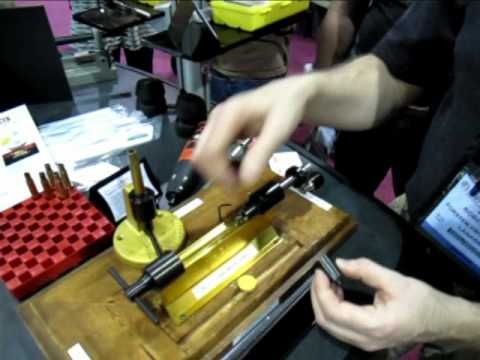
We saw a cool new product at the Forster Products booth. Forster has introduced a new 3-in-1 Carbide cutting tool that works with all existing Forster case trimmers. This unit does three jobs at the same time. It trims the case to length, it puts a 14-degree chamfer on the INSIDE of the neck, AND (last but not least), it cuts a 30-degree chamfer on the OUTSIDE of the neck. It does this all quickly and efficiently — in a matter of a few seconds. We tested the new tool ourselves on a few cases. The tool is solid and well made. The carbide cutting tips do perform a very clean cut. Be aware, however, if you have turned your necks already, you may have to reset the blade positions before you start trimming your brass.

Forster’s CFO, Robert Ruch, demonstrates the 3-in-1 case trimming/chamfering tool in the video below. As you can see, the tool turns very smoothly (no chatter) and the job is finished in a few seconds. The actual cutting time, per case, is just a few second. The tool has an MSRP of $70.00, but we expect it to sell for around $50.00 at major vendors. It can be fitted on Forster trimmers and other hand lathes with a .490″ shaft diameter.
January 20th, 2010
 At the request of AccurateShooter.com, respected Benchrest ace Lou Murdica tested the brand new, early production Norma 6PPC brass. Lou shot 30 cases (both turned and unturned) over the past few days, and he endorses the Norma brass without hesitation. Lou says “the Norma PPC brass is great brass. Without a doubt this will be highly competitive brass in the short-range benchrest group”. Lou did observe that the necks on the Norma brass were slightly thinner than on Lapua 220 Russian brass, but that really doesn’t matter. With a slight neck turn, Lou declares, “the Norma PPC brass is as good as any out there.” At the request of AccurateShooter.com, respected Benchrest ace Lou Murdica tested the brand new, early production Norma 6PPC brass. Lou shot 30 cases (both turned and unturned) over the past few days, and he endorses the Norma brass without hesitation. Lou says “the Norma PPC brass is great brass. Without a doubt this will be highly competitive brass in the short-range benchrest group”. Lou did observe that the necks on the Norma brass were slightly thinner than on Lapua 220 Russian brass, but that really doesn’t matter. With a slight neck turn, Lou declares, “the Norma PPC brass is as good as any out there.”
Lou said, based on his testing, the Norma brass holds pressure well, and the accuracy is outstanding. Lou shot five 5-round groups, as in a match course of fire, and his largest group was “around 0.148″ at 100 yards.
If you’re a short-range benchrester, definitely watch this video and listen to Lou. He thinks this new Norma brass will “change the game”. Note — Lou said most PPC shooters can shoot the Norma cases with no change in their powder recipes. So you won’t lose any velocity using Norma’s new brass. Lou was very impressed with Norma’s new offering, enough so that he declared: “I would go right for the Norma right now if I could put a bunch in my hand.”

January 17th, 2010
 Grafs.com has a handy new case lube unit from SmartReloader, the Swiss-owned “yellow” brand now competing with RCBS (Green) and Lee (Red). The SR-104 case lube pad/tray is so new you won’t even find it on the parent SmartReloader’s company website. Grafs.com has a handy new case lube unit from SmartReloader, the Swiss-owned “yellow” brand now competing with RCBS (Green) and Lee (Red). The SR-104 case lube pad/tray is so new you won’t even find it on the parent SmartReloader’s company website.
The SmartReloader Case Lube Unit is very nicely thought out. A closed-cell-foam lube pad is positioned in the middle. On left and right sides are small trays that can hold your lube bottle or cartridge cases. But the real brilliant feature of the design is the dual-purpose yellow pad cover/brass holder. When flipped open, the hinged cover has slots to hold your cases just like a reloading tray. When you’ve finished lubing your cases, fold the yellow lid back and it completely covers and protects the sticky lube pad. That’s really smart. Now you don’t have to worry about your lube pad attracting dirt, tumbler dust, and even unlucky insects that might wander across it.

If you still prefer to lube your cases on a rolling pad (there are easier methods in this Editor’s opinion), you should check this product out. The new SmartReloader Case Lube Unit costs just $12.99 at Grafs.com, item VBSR01702.
December 21st, 2009
 |
This is potentially big news for short-range Benchresters and for varminters who shoot PPC variants. Norma has resumed production of 6PPC brass — at least on a prototype basis. NOTE: We don’t have many specifics. Norma has not firmly committed to exporting production 6PPC brass to the USA, nor has Norma announced a product release date. However, we received the following email today:
“After some work Norma has just started production of 6 PPC cases again. A new double-press has been installed which allows us to work-harden the case better. Internal tests are promising and we wonder if you would be interested to test a bunch.”
That’s it… we’ve shared all that we know for now. |
|


