|
|
December 15th, 2009
Darrell Jones, a talented benchrest shooter from Tennessee, has launched a new business that will provide a much-needed service for precision shooters. Darrell’s company, DJ’s Brass Restoration Service, will take your old, many-times-fired brass, and help bring them back to life. Darrell first cleans the cases inside and out using an ultrasonic bath. Then Darrell carefully anneals each case, employing temp indicators to insure the correct amount of heat is applied for the proper duration.

Combined Ultrasonic Cleaning and Case Annealing
The Basic Service starts at $20.00 per hundred cases — and that includes ultrasonic cleaning AND annealing. (Flat rate USPS shipping is extra.) Note: very large cases (such as the .338 Lapua) or damaged, dented cases may cost more. In addition to the Basic Service, Darrell offers a 4-Step Full Service starting at $25.00 per hundred cases (plus shipping). Full Service brass restoration includes:
• Uniform primer pockets
• Chamfer case mouths
• Ultrasonic cleaning and polishing
• Anneal case necks

Ultrasonic Muzzle Brake Cleaning
In addition to cleaning and annealing cartridge brass, Darrell offers Ultrasonic Cleaning for muzzle brakes. This removes carbon buildup to restore critical bullet clearance requirements. The price is $15.00 per brake (plus shipping).
Restoring Your Brass Can Save Time and Money
Your match-quality brass represents a significant investment of money and prep/sorting time. With 100 pieces of new premium brass costing as much as $100.00, we think Darrell’s service is a great deal for shooters who want to extend the life of their brass. We expect his cleaning/annealing service will soon be in high demand. (In addition, on a custom-order basis, for an additional fee, Darrell can trim cases to a specified OAL.) Also, if you have spent many hours turning necks or forming wildcat cartridges, DJ’s Brass Restoration can save you the hassle of trimming, sorting, turning and prepping new cases. You have a lot of time invested in those turned necks and fire-formed cases… you don’t want to toss the brass after a few firings.
For more information, visit DJsBrass.com, or call Darrell at (901) 826-1503. As a special benefit for AccurateShooter.com members, Darrell is now offering free return shipping on any order over 500 pieces (limited time offer). IMPORTANT: Contact Darrell for shipping instructions BEFORE sending any brass for processing. ALL BRASS MUST BE DE-PRIMED before you send it.
December 5th, 2009
 We have confirmed that Lapua will produce and distribute 22-250 cartridge brass starting in early 2010. The official product release will be at SHOT Show in Las Vegas (Jan. 19-22). We don’t have production samples yet, but there are about 1000 pieces of brass in the hands of testers in the United States at this time. This stuff is for real — CLICK THIS LINK for PHOTOS. We have confirmed that Lapua will produce and distribute 22-250 cartridge brass starting in early 2010. The official product release will be at SHOT Show in Las Vegas (Jan. 19-22). We don’t have production samples yet, but there are about 1000 pieces of brass in the hands of testers in the United States at this time. This stuff is for real — CLICK THIS LINK for PHOTOS.
 One of the folks lucky enough to get his hands on the new Lapua 22-250 brass is writer/shooter Steven Boelter, author of the Rifleman’s Guide to Rimfire Ammunition. Steven has measured and inspected the new brass and he says it appears to be “on a par, quality-wise, with Lapua’s 220 Russian and 6BR brass”, which is saying a lot. Steve adds that: “[what I have] is in fact part of a pre-production run, and the main stuff will be ready for second quarter, 2010″. Steven is working on an article for Precision Shooting magazine that will include exact dimensions for the new brass, as well as initial load testing results. An exact release date for Steven’s article has not yet been set, but Boelter hopes the story will come out in January or February. One of the folks lucky enough to get his hands on the new Lapua 22-250 brass is writer/shooter Steven Boelter, author of the Rifleman’s Guide to Rimfire Ammunition. Steven has measured and inspected the new brass and he says it appears to be “on a par, quality-wise, with Lapua’s 220 Russian and 6BR brass”, which is saying a lot. Steve adds that: “[what I have] is in fact part of a pre-production run, and the main stuff will be ready for second quarter, 2010″. Steven is working on an article for Precision Shooting magazine that will include exact dimensions for the new brass, as well as initial load testing results. An exact release date for Steven’s article has not yet been set, but Boelter hopes the story will come out in January or February.
Boelter can’t say much more about the brass prior to publication of the article. But we can confirm that it has a large primer pocket, standard 22-250 rim size, and it is annealed like other premium Lapua brass. Steven has posted a couple photos of the brass on the Saubier.com web site.
We’re always excited when Lapua decides to expand its line of cartridge brass. For 22-250 shooters, who will now have a new ultra-high-quality brass option, the news of Lapua 22-250 brass must be like an early Christmas present.
Link to Lapua 22-250 Brass Photo

Above is a QuickDESIGN diagram of the 22-250 Remington cartridge based on CIP Metrics converted to English units. This is NOT the official print for the new Lapua 22-250 brass, which may vary slightly in dimensions. We suggest you get the actual production brass in hand before ordering new chamber reamers or dies.
August 11th, 2009
Do you frequently need to trim lots of cases, but can’t afford a powered trimmer such as the $280.00 Gracie machine? For manual trimming we like the L.E. Wilson units, and now there’s an upgrade that promises to increase the efficiency of your Wilson trimmer.

Sinclair Int’l has introduced a new Carbide Cutter Upgrade Kit that installs in place of a standard Wilson case trimmer cutter and crank handle. Very hard and ultra-sharp, the carbide cutter cuts quickly on contact without grabbing and leaves a nicely finished, square case mouth that is ready for deburring. With the carbide tip and larger, more comfortable handle, you should be able to trim cases more quickly, with less effort. The carbide cutter should also hold its edge longer than regular tool-steel cutter tips. The upgrade kit (item 05-4600) costs $69.95 and works with all Wilson case trimmer models (excluding 50 BMG).
August 11th, 2009
Grafs.com is currently offering Prvi Partisan .223 Remington brass at very attractive prices. 100 cases cost just $22.99, and that includes shipping (but not the $4.50/order handling charge). Bulk orders of 500 or 1000 cases are even less. This is boxer brass, fully reloadable. The PRVI brass is very good brass for the price. We have tried it in the Prvi Partison loaded ammo as well as in reloads. The brass holds pressure well and is more weight-consistent than some brands of domestic .223 brass. This is a good choice for large-quantity varmint loads.

NOTE: Some lots of Prvi Partisan milsurp 5.56×45 loaded ammo have arrived in the US with crimped primer pockets. When reloaded, those cases may require prep with a primer pocket swager to ease primer seating. The unloaded, new .223 Rem brass sold by Graf & Sons is UNPRIMED and has not been crimped, so you should have no difficulty seating primers.
July 30th, 2009
Hand loaders have been awaiting the release of the Hornady Lock-N-Load™ Power Case Prep Center, ever since it was displayed at the 2009 SHOT Show. Midsouth Shooters Supply finally received its first shipment of the Hornady prep centers and put them on sale for $313.80, promptly selling out. More units are on the way.
The folks at Midsouth reported: “We finally received our first shipment of the Hornady Lock-N-Load Case Prep Center! We were so excited to see how one worked -– so we pulled out of the box and checked it out. Set up time was about three minutes and noise level was low. However, we discovered that you’ll need a Hornady or Redding shell holder for the caliber you are trimming (or prepping). RCBS and Lyman shell holders do NOT work with this Prep Center. We also learned that you’ll need to order the Large and Small Primer Pocket Reamers separately. Both large (005-390751) and small (005-390750) reamers cost $6.60 each.”

Midsouth concluded that: “Overall the Hornady Prep Center is a really sturdy piece of equipment.” Midsouth said the trimming/prepping tools work great and the machine is easy to clean. The improved T-bar handle gives better control over case height when trimming. At first, the Hornady’s $300+ price may seem steep. However, if you purchase BOTH an RCBS Trim Pro Power Trimmer ($260.12) and Trim Mate Case Prep Center ($108.58), you’d spend $368.70 combined. Buying the Hornady gives you an all-in-one machine that is more efficient to use, and occupies a smaller footprint on your loading bench.
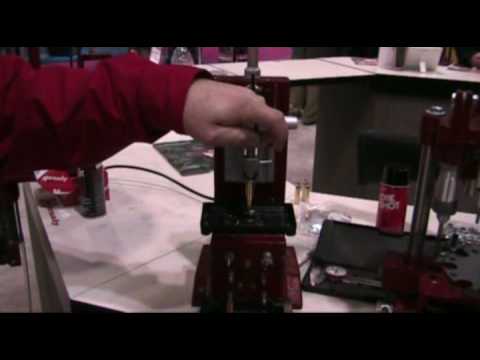
Below is a video demonstration of the Hornady Case Prep Center at SHOT Show 2009. Click on the “HQ” button for the higher resolution version which shows the tool operation more clearly.
July 9th, 2009
 Large quantities of Lapua brass, for most of the popular cartridge types, have recently arrived at many vendors including Bruno Shooters Supply, Graf & Sons, and MidwayUSA. Large quantities of Lapua brass, for most of the popular cartridge types, have recently arrived at many vendors including Bruno Shooters Supply, Graf & Sons, and MidwayUSA.
Bruno’s has almost all types of Lapua brass in stock and here are some sample prices: 6mmBR brass for $63.00/100; .308 Win for $55.00/100; 220 Russian for $74.00/100; 6.5×47 for $85.00/100. Note — if you’re thinking about building a tactical rifle, the 6.5×55 brass is just $55 per hundred (same price as .308 Win, but much cheaper than 6.5×47).
Bruno’s also has received large supplies of Berger 6mm 105gr VLD bullets. These have been out of stock for several months. Call (623) 587-7641 for pricing.
Grafs.com has Lapua 6mmBR brass for $69.59/100, 220 Russian for $79.99/100, and 6.5×47 brass for $91.99/100, but those prices include shipping. Grafs has most other varieties of Lapua brass in stock, including 222 Rem, 223 Rem, 243 Win, 6.5×55, 6.5-284, .308 Win, and 338 Lapua Mag.
April 5th, 2009
[This item last appeared a year ago in our Daily Bulletin, generating considerable interest among readers. By popular request, we’re reprinting this story, in case you missed it the first time around. — Editor]
Precision shooters favor premium brass from Lapua, Norma, or RWS. (Lake City also makes quality brass in military calibers.) Premium brass delivers better accuracy, more consistent velocities, and longer life. Shooters understand the importance of good brass, but many of us have no idea how cartridge cases are actually made. Here’s how it’s done.
The process starts with a brass disk stamped from strips of metal. Then, through a series of stages, the brass is extruded or drawn into a cylindrical shape. In the extrusion process the brass is squeezed through a die under tremendous pressure. This is repeated two or three times typically. In the more traditional “draw” process, the case is progressively stretched longer, in 3 to 5 stages, using a series of high-pressure rams forcing the brass into a form die. While extrusion may be more common today, RWS, which makes some of the most uniform brass in the world, still uses the draw process: “It starts with cup drawing after the bands have been punched out. RWS cases are drawn in three ‘stages’ and after each draw they are annealed, pickled, rinsed and subjected to further quality improvement measures. This achieves specific hardening of the brass cases and increases their resistance to extraordinary stresses.” FYI, Lapua also uses a traditional draw process to manufacture most of its cartridge brass (although Lapua employs some proprietary steps that are different from RWS’ methods).

After the cases are extruded or drawn to max length, the cases are trimmed and the neck/shoulder are formed. Then the extractor groove (on rimless cases) is formed or machined, and the primer pocket is created in the base. One way to form the primer pocket is to use a hardened steel plug called a “bunter”. In the photos below you see the stages for forming a 20mm cannon case (courtesy OldAmmo.com), along with bunters used for Lake City rifle brass. This illustrates the draw process (as opposed to extrusion). The process of draw-forming rifle brass is that same as for this 20mm shell, just on a smaller scale.


River Valley Ordnance explains: “When a case is being made, it is drawn to its final draw length, with the diameter being slightly smaller than needed. At this point in its life, the head of the draw is slightly rounded, and there are no provisions for a primer. So the final drawn cases are trimmed to length, then run into the head bunter. A punch, ground to the intended contours for the inside of the case, pushes the draw into a cylindrical die and holds it in place while another punch rams into the case from the other end, mashing the bottom flat. That secondary ram holds the headstamp bunter punch.

The headstamp bunter punch has a protrusion on the end to make the primer pocket, and has raised lettering around the face to form the headstamp writing. This is, of course, all a mirror image of the finished case head. Small cases, such as 5.56×45, can be headed with a single strike. Larger cases, like 7.62×51 and 50 BMG, need to be struck once to form a dent for the primer pocket, then a second strike to finish the pocket, flatten the head, and imprint the writing. This second strike works the brass to harden it so it will support the pressure of firing.”
Thanks to Guy Hildebrand, of the Cartridge Collectors’ Exchange, OldAmmo.com, for providing this 20mm Draw Set photo. Bunter photo from River Valley Ordnance, RVOW.com.
March 28th, 2009
 Harrell’s Precision sells “semi-custom” full-length bushing dies for the PPC and 6BR chamberings. While the Harrell brothers do not cut the die to spec, they carry a large selection of dies made with slightly different internal dimensions. When you send in your fired brass, the Harrells choose a die from inventory with just the right amount of sizing (diameter reduction) at the top and bottom of the case. Given the quality, and precise fit, Harrell’s full-length dies are a good value at $70.00 plus shipping. Harrell’s Precision sells “semi-custom” full-length bushing dies for the PPC and 6BR chamberings. While the Harrell brothers do not cut the die to spec, they carry a large selection of dies made with slightly different internal dimensions. When you send in your fired brass, the Harrells choose a die from inventory with just the right amount of sizing (diameter reduction) at the top and bottom of the case. Given the quality, and precise fit, Harrell’s full-length dies are a good value at $70.00 plus shipping.
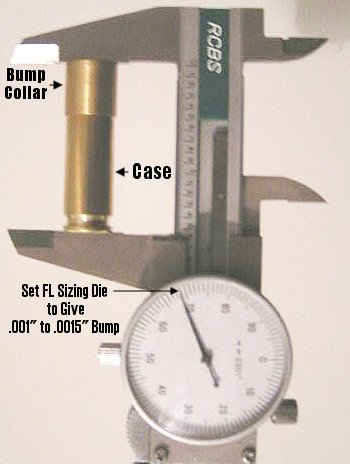
 Bump Measuring Collar Bump Measuring Collar
The Harrell brothers provide a nice bonus item with each full-length die — a neat, little shoulder bump measuring device as shown in the photo at right. Hornady/Stoney Point sells a stand-alone tool that does the same job, but the Harrell’s bump collar is simpler and faster. To measure your shoulder bump, simply place the Harrell’s bump collar over the front of your deprimed case (before sizing) and measure the OAL with your calipers. Then size the case in your full-length die, replace the collar and repeat the measurement. You want to set your die so the shoulder moves back about .001″ to .0015″ for most applications. (With semi-auto guns you may want more bump.)
When measuring for shoulder bump, you need to remove the primers first. Our friend Boyd Allen explains: “Use a decapping tool or die to remove the fired primer before taking the initial measurement. When working to thousandths, even the raised edge of a crater or a slightly raised primer can throw you off by a significant amount.”
March 18th, 2009
Over the past few days, there has been a storm of controversy surrounding sales of surplus U.S. military cartridge brass. The concern arose because DOD Surplus, LLC had announced to wholesale brass purchasers that future shipments of spent cartridge cases would have to be “mutilated” and sold as scrap metal. (DOD Surplus, LLC sells surplus brass under a contract with the Department of Defense.)
Shooters nationwide, fearing that surplus U.S. military brass would no longer be available, protested loudly to members of Congress and Department of Defense officials.
We are pleased to report that the “mutilation” requirement has been rescinded, and vendors such as Georgia Arms and GI Brass will continue to sell reloadable surplus cartridge cases obtained from the U.S. military.
 How the Controversy Arose How the Controversy Arose
The Department of Defense (DOD), on behalf of all the branches of the military, collects fired shell cases. Rather than sell surplus brass directly, the DOD has disposal contracts with DOD Surplus, LLC and Government Liquidation, LLC, two private companies. These companies aggregate and sell the brass in bulk to wholesalers, primarily through online auctions.
DOD Surplus, LLC had notified Georgia Arms that future lots of surplus brass would be subject to a NEW multilation requirement, effectively rendering the brass useless for reloading.
Where did that “mutilation” requirement come from? Was this some evil, new directive from the White House? Apparently not. Here’s what happened. Surplus brass has been handled under a “DEMIL B” product category. Prior to 11/2008, DEMIL B items required no mutilation for sale to the public. That policy changed last November, but several exemptions (waivers) were granted. Expended munitions brass was covered by a waiver.
After the new administration took office, some new manager, probably in the Defense Logistics Agency (DLA), eliminated ALL exemptions for DEMIL B products. Why this was done, we don’t really know. It appears no consideration was given to the impact on the shooting industry. But this elimination of the DEMIL B brass waiver was communicated to DOD Surplus, LLC last week. DOD Surplus, LLC, in turn, told its purchasers that milsurp brass would have to be mutilated (rendered unusable) from here on out.

Surplus Brass Now Re-Classified DEMIL Q, so No Mutilation Required
Yesterday, March 17, at 5:15 pm a letter cosigned by Senator Tester (D-MT) and Senator Baucus (D-MT) was faxed to the Department of Defense asking DOD to reverse its new policy requiring destruction of fired military cartridge brass. That joint letter, combined with thousands of email messages sent to Washington, convinced the DOD to reverse the recent change in surplus brass policy.
At 5:30 PM on the 17th, the DOD faxed Senator Tester’s office announcing that the policy requiring multilation of surplus brass had been rescinded. Specifically, surplus military cartridge brass has been reclassified as a “DEMIL Q” product (not “DEMIL B” as before). DEMIL Q requires no product mutilation unless the item is sold to a foreign country.
BOTTOM LINE: Stocks of U.S. Military surplus cartridge brass will continue to be offered for sale, via wholesalers, to the general public. Problem solved. As announced by Georgia Arms: “DOD Surplus, LLC, has rescinded its prior directive that ALL small arms spent casings be mutilated rather than recycled. This was a huge victory for common sense and we would like to thank each and every person who made an effort and played a role in correcting this mistake.”
March 8th, 2009
We announced that a new shipment of Lapua cartridge brass is due to arrive within a couple weeks. Both importers, Graf & Sons and Kaltron, have ordered large quantities. However, some cartridge types, including 6mmBR, do not appear to be included in this container.
We’ve checked around, and most everybody seems to be sold out of 6mmBR, 220 Russian, and .308 brass. You may want to check with E. Arthur Brown, www.eabco.com. That company’s shopping cart system is still showing availability of Lapua brass of most types, including 6mmBR. No guaranties however — you may want to call E. Arthur Brown first before placing your order: (320) 834-3000, or for Orders Only, 1-800-950-9088.


|


