The better, up-to-date ballistics programs let you select either G1 or G7 Ballistic Coefficient (BC) values when calculating a trajectory. The ballistic coefficient (BC) of a body is a measure of its ability to overcome air resistance in flight. You’ve probably seen that G7 values are numerically lower than G1 values for the same bullet (typically). But that doesn’t mean you should select a G1 value simply because it is higher.
Some readers are not quite sure about the difference between G1 and G7 models. One forum member wrote us: “I went on the JBM Ballistics website to use the web-based Trajectory Calculator and when I got to the part that gives you a choice to choose between G1 and G7 BC, I was stumped. What determines how, or which one to use?”
The simple answer to that is the G1 value normally works better for shorter flat-based bullets, while the G7 value should work better for longer, boat-tailed bullets.
G1 vs. G7 Ballistic Coefficients — Which Is Right for You?
G1 and G7 refer both refer to aerodynamic drag models based on particular “standard projectile” shapes. The G1 shape looks like a flat-based bullet. The G7 shape is quite different, and better approximates the geometry of a modern long-range bullet. So, when choosing your drag model, G1 is preferrable for flat-based bullets, while G7 is ordinarily a “better fit” for longer, boat-tailed bullets.
Drag Models — G7 is better than G1 for Long-Range Bullets
Many ballistics programs still offer only the default G1 drag model. Bryan Litz, author of Applied Ballistics for Long Range Shooting, believes the G7 standard is preferrable for long-range, low-drag bullets: “Part of the reason there is so much ‘slop’ in advertised BCs is because they’re referenced to the G1 standard which is very speed sensitive. The G7 standard is more appropriate for long range bullets. Here’s the results of my testing on two low-drag, long-range boat-tail bullets, so you can see how the G1 and G7 Ballistic coefficients compare:
G1 BCs, averaged between 1500 fps and 3000 fps:
Berger 180 VLD: 0.659 lb/in²
JLK 180: 0.645 lb/in²
The reason the BC for the JLK is less is mostly because the meplat was significantly larger on the particular lot that I tested (0.075″ vs 0.059″; see attached drawings).
For bullets like these, it’s much better to use the G7 standard. The following BCs are referenced to the G7 standard, and are constant for all speeds.
Many modern ballistics programs, including the free online JBM Ballistics Program, are able to use BCs referenced to G7 standards. When available, these BCs are more appropriate for long range bullets, according to Bryan.
[Editor’s NOTE: BCs are normally reported simply as an 0.XXX number. The lb/in² tag applies to all BCs, but is commonly left off for simplicity.]
SHOT Show 2013 kicks off in two weeks in Las Vegas. One of our top priorities is to talk with the bullet makers from Berger, Hornady, Lapua, and Nosler.
At SHOT Show 2012 we chatted with Berger Ballistician Bryan Litz about Berger’s popular line of Hybrid bullets. Berger now offers a wide range of Hybrids in multiple calibers and weights. In fact, for .30-Caliber shooters, Berger now offers six different Hybrid match bullets, with weights from 155 grains up to 230 grains. New .338 Cal Tactical Hybrids were released in 2012 and big .375 Cal, and .408 Cal Hybrids are in the works (read more below).
Bryan tells us: “The hybrid design is Berger’s solution to the age old problem of precision vs. ease of use. This design is making life easier for handloaders as well as providing opportunities for commercial ammo loaders who need to offer a high performance round that also shoots precisely in many rifles with various chamber/throat configurations.”
For those not familiar with Hybrid bullets, the Hybrid design blends two common bullet nose shapes on the front section of the bullet (from the tip to the start of the bearing surface). Most of the curved section of the bullet has a Secant (VLD-style) ogive for low drag. This then blends in a Tangent-style ogive curve further back, where the bullet first contacts the rifling. The Tangent section makes seating depth less critical to accuracy, so the Hybrid bullet can shoot well through a range of seating depths, even though it has a very high Ballistic Coefficient (BC).
In the video we asked Bryan for recommended seating depths for 7mm and .30-Caliber Hybrid bullets. Bryan advises that, as a starting point, Hybrid bullets be seated .015″ (fifteen thousandths) off the lands in most barrels. Watch the video for more tips how to optimize your loads with Hybrid bullets.
Berger is Developing New Large-Caliber and Hunting Hybrids
In related news, Berger announced that it will be offering a series of .338-caliber Hybrids. First Berger is reintroducing the Gen 1 .338 Cal, 300gr Hybrid bullet in Berger’s Hunting line. Berger will also be making a 250gr Hybrid Hunting bullet using the same type of jacket as the original Gen 1 300gr Hybrid bullet. In addition, Berger has released a .338 Cal 250gr Match Hybrid OTM Tactical bullet, along with a 300gr Match Hybrid OTM Tactical projectile.
More big bullets are on the drawing board. Our source says “.375 Caliber and then .408 Caliber are the next new calibers to be made at Berger”. These are in the design phase, and Berger needs to build a new machine, so the .375s and .408s will not be available until 2013 at the earliest.
Bryan Litz, Ballistican for Berger Bullets, is actually a trained rocket scientist, not to mention a skilled long-range shooter. Bryan’s books on Ballistics and Precision Long Range Shooting have been recognized as the leading resources of their kind in print. Now you can save money on Bryan’s highly-regarded books through a special holiday promotion.
Bryan tells us: “For a limited time, we are taking an additional $5 off the retail price of our titles Applied Ballistics for Long Range Shooting 2nd Ed. (regularly $49.95, $44.95 on sale) and Accuracy and Precision for Long Range Shooting (regularly $34.95, $29.95 on sale). And, by purchasing direct from Applied Ballistics you can get your copy autographed by the author”.
Here are what others are saying about these books.
“Got my copy of Accuracy and Precision for Long Range Shooting and can’t put it down! Exceptionally well done! Both this and Applied Ballistics for Long-Range Shooting” are definite requirements for all long range shooters!” — Eric K.
“Thanks, Brian. You have opened up a whole new ‘world’ in shooting, for those of us who love shooting and hunting, but don’t have the academic background to really appreciate the intricacies of science.” — Terje N.
As we reported a few weeks ago, Bryan Litz has written a new book, Accuracy and Precision for Long Range Shooting. We know many readers have pre-ordered Bryan’s latest book. Here’s the good news. Bryan reports that most pre-orders for the new book shipped yesterday, and the rest will go out today.
We asked Bryan to explain the differences between his original Applied Ballistics for Long Range Shooting resource book and the new Accuracy and Precision book. Here is Bryan’s explanation…
The first book, Applied Ballistics for Long-Range Shooting, covers the elements of long range shooting and explains how all the various mechanisms of external ballistics affect trajectories. It’s also the book that contains detailed drawings, BC and stability data for hundreds of bullets.
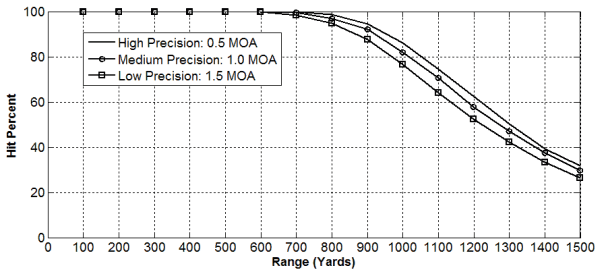
The new book, Accuracy and Precision for Long Range Shooting explains the impact of external ballistic effects in terms of “hit percentage”. For example, if you choose to ignore Coriolis Effect in your ballistic solution, how much will your hit percentage be reduced on a 10″ target at 1000 yards? How about a 5″ target at 500 yards? How much would your hit percentage be improved on a 15″ target at 1200 yards if you reduce wind uncertainty from +/-3 mph to +/-2 mph?
There are also numerous performance comparisons between different classes of cartridges. For example: how much higher is hit percentage for a .338 Lapua Magnum than a .308 Winchester for common environments and targets?
The new book identifies accuracy and precision effects and defines their effects separately. Did you ever wonder why it’s so easy to shoot a 10 inch GROUP at 1000 yards, but how difficult it is to HIT A 10″ TARGET at 1000 yards on the first shot? Shooting a 10 inch group is precision, but centering the group is a challenge of accuracy.
It’s quite common for long range shooters to focus 90% of their effort on the precision aspect, and only 10% on accuracy. To actually hit targets, you need a balance of accuracy and precision, with accuracy becoming increasingly more important as range is extended. — Bryan Litz
Bryan Litz, chief Ballistician for Berger Bullets (and a trained rocket scientist) has authored an impressive new book: Accuracy and Precision for Long Range Shooting. Bryan’s new book is a companion to his successful treatise, Applied Ballistics for Long-Range Shooting. Now in its Second Edition, Litz’s Applied Ballistics book has become the “go-to” Ballistics book for precision shooters worldwide.
While Bryan’s first book covers the science of ballistics and trajectory calculation, his new book examines practical issues involved in long-range accuracy. Bryan explains: “In a nutshell, this book focuses on the uncertainties of practical shooting which affect hit percentage on various size targets. In other words, classic ballistics teaches you how to calculate windage and elevation corrections. This book will help you understand what your chances are of hitting a target under certain conditions, and how to improve those chances through training and design.
Practical Examples
Does a low ES/SD really make a difference at long range? Absolutely. In Chapter 6, you can see that reducing muzzle velocity variation from 20 fps Standard Deviation (SD) to 10 fps SD improves hit percentage on a 5″ circle at 500 yards from 83% to 93%.
Ever wonder how much spin drift, Coriolis affect, or using G1 vs. G7 BC’s affect your chances of hitting a target? In Chapter 10 for example, you’ll learn that ignoring spin drift in ballistic calculations reduces hit percentage on a 10″ target from 21% to 15% at 900 yards for a specified environment and cartridge.
The new book is divided into three main sections. Part 1 focuses on Precision, which explores how hit percentage is related group size. Litz explains the variable that affect group size: muzzle velocity variation, range estimation error, wind estimation error, and inherent rifle precision
Part 2 focuses on Accuracy, which is how well the group is centered around the aim-point. Topics include: leveling your sights, trajectory modeling and secondary effects, calibrating ballistic solutions, and live fire verification.
Part 3 focuses on Weapon Employment Zone (WEZ) analysis. WEZ evaluates firearm effectiveness in terms of hit percentage. The author applies WEZ in the contexts of score shooting, varmint and big game hunting, and tactical shooting. WEZ is also used to compare hit percentage for the 300 Win Mag vs. .338 Lapua Mag.
Book is 300-page, Hard-Cover Format
Accuracy and Precision for Long Range Shooting is a 6″x9″ hardcover book with 300 pages, and retails for $34.95. The book is currently at the printers, and should begin shipping by October 15, 2012. In the mean time, you can pre-order and save $5 off the regular $34.95 retail price.
Berger Bullets has announced a new series of “Classic Hunter” Hybrid bullets designed to fit and feed in magazines and perform well in barrels with SAAMI standard chambers. Berger’s Eric Stecker explains: “For the first time in Berger’s history we’ve purposefully designed Hybrid-shaped hunting bullets that comply with the restrictive dimensional standards set by SAAMI. We did this so that hunters can shoot ammo loaded with Berger Hunting bullets in their factory rifles while feeding through a magazine.”
Berger came up with a new hunting bullet design because SAAMI standard dimensions significantly limit the length of the nose (negatively affecting external ballistics performance) in two ways. First, the length from the end of the neck to the tip of the bullet of SAAMI standard ammo is typically so short that to make an ogive that will allow bearing surface to be forward of the neck it must be blunt and therefore have a low BC. The other way SAAMI limits nose length is by specifying longer throat lengths than are optimal. Stecker notes: “When you have a long throat, the nose can’t be too long or the jump to the rifling is considerable. This is typically bad for precision and accuracy. So what you end up with is stubby nose bullets with low BC and poor external ballistics performance.”
To overcome SAAMI-imposed design contraints, Berger’s Bryan Litz designed Hybrid hunting bullets with noses short enough to conform to SAAMI dimensional standards. These bullets should be popular among those who hunt with factory rifles and feed their ammo through a magazine. The bullets use a dual-curve ogive design. As you move forward along the bearing surface, the ogive curve starts as a tangent tangent curve (which is forgiving of seating depth). As you continue forward on the nose the tangent curve transitions into a secant curve. Secant ogives are known to be more efficient in the wind (VLD bullets are pure secant ogives).
When you combine these two shapes you get the best of both worlds (less sensitivity to seating depth differences and improved external ballistics performance). Since these new Berger Classic Hunter bullets must have a nose length that is short enough to comply with SAAMI standards we get the most external ballistics performance possible by making the nose with Bryan’s Hybrid design.
Eric Stecker is enthusiastic about the new Hybrid Hunting Bullets: “We know that this bullet design works [well] because we tested it not only in media but also on game. I took these bullets with me to New Zealand to test them on several animals of various sizes and at various ranges. I know from firsthand experience that hunters who try this bullet in the field will be happy that they did.”
Product Tip by EdLongrange. Product Photos by Robert Whitley, 6mmAR.com.
The Spirit of America Match at Raton, New Mexico has concluded. Bryan Litz provided this quick wrap-up last evening: “Just a short time to report the winners before heading to the awards dinner. Larry Bartholome won F-Open, Trudie Fay won F-TR, and Nancy Tompkins won the sling class. The match came down to the last relay at 1000 yards. The photo at right shows a common result in the switching winds. Lots of target uprights were damaged and shooters grateful for hanging a six by half an inch! Congratulations to all competitors for persevering [in] Raton’s difficult conditions!”
Below are match photos taken by Bryan Litz. You’ll find more Spirit of America Match photos on the Applied Ballistics Facebook Page.
Report by Bryan Litz
Day 3 of the Spirit of America Individual Aggregate (Thursday, 9/13/2012) started out cold and misty. Everyone was pretty much wearing every shred of clothing they had to get thru the morning, but the afternoon warmed up nicely. Short range was typical; constant and relatively calm at 300 and 500, but the wind kicked up about the time we started shooting 600 and some points started falling. After lunch we shot 900 yards and the points really started falling! As expected, the chaos shook up the standings quite a bit.
Controversy in Sling Class
In the sling class, Noma Mayo was the high shooter at 4 points down. Noma shot a miss at 600 yards, challenged it, and lost the challenge. She finished the range, then later went to the stat house and had the miss removed from her score card. A formal protest was filed, but her amended score stood (without a miss). Needless to say, the result is somewhat controversial, especially considering that Noma is in contention to win the tournament. The current standings in the individual sling aggregate are: Nancy Tompkins at 6 points down, Noma Mayo at 8 points down, and Bryan Litz at 9 points down.
Trudie Fay Continues to Lead F-TR
In F-TR, Trudie Fay continues her dominant performance at 13 points down to win the day. Trudie is also leading the F-TR aggregate with one day to go. Tomorrow is the Raton 8-man team match.
Larry Bartholome won the F-Open class at 7 points down for the day (Aggregate standings were not posted as of when we left the range so it’s difficult to calculate those full standings).
Here is Bryan Litz’s latest report from the Spirit of America Match, underway at the Whittington Range in Raton, New Mexico. You can follow Bryan’s posts on the Applied Ballistics Facebook Page.
Report from Raton
Today was the second day of individual Fullbore shooting at the Spirit of America match. Some clouds moved in for part of the day and showered on us for about 15 minutes in the afternoon, but other than that the weather was good. There was wind, but nowhere near bad for Raton.
David Crandall won the sling class with the only clean for the day, followed by Bryan Litz, Bob Steketee, and Rick Hunt who were all down 1 point. For the Aggregate standings, Bryan and Nancy Tompkins are tied at 898, but Bryan has 57 Xs to Nancy’s 55. That’s a narrow margin with two days remaining!
Bill Litz, Bryan Litz, Michelle Gallagher, Nancy Tompkins
F-Class Results
Results in F-Open are interesting in that the top three places for todays shooting are also the same top 3 in the Aggregate. The winners for today, and leaders in the F-Open class are [familiar names]: Jim Murphy, Larry Bartholome, and Danny Biggs. These guys are three of the best F-class shooters in the USA. They’ll be difficult to catch.
Top three in F-TR today were: Trudie Fay, Ray Gross, and Darcy Spenst. Local shooter and U.S. Palma Team member Trudie Fay is also leading the F-TR aggregate by a decent margin. This comes as no suprise, as Raton is Trudie’s home range and she’s won the sling class of this tournament in the past. South African Ivan Lamprecht is second in the aggregate so far (Ivan is shooting ammo provided by Applied Ballistics Munitions!). Ray Gross of Team Sinclair is in 3rd place, despite having a miss on the first day of the tournament! Were it not for that, Ray would be leading by (up to) 7 points. Bill Litz (of Applied Ballistics Munitions) got off to a great start today, only losing 5 points in the morning (300, 500 and 600 yards). Bill’s new rifle built by John Pierce of Pierce Engineering is shooting the 215 grain Berger Hybrids EXTREMELY well. In Bill’s words: “That thing’s a freakin’ laser!”.
Two more days of individual shooting remain (on Thursday and Saturday), so we’re only half way through the tournament. Tomorrow’s 4-man team match will conclude the Team Aggregate.
Berger Bullets just announced the completion of the first-ever Berger Bullets Reloading Manual (1st Ed.). This $29.00, 829-page manual will be available to the public starting in October, 2012. Eric Stecker notes: “Our team worked very hard to create a thorough manual which gives the shooter everything they come to expect from a reloading manual, along with several extra items we hope the shooters will find interesting and useful. We spent a considerable amount of time putting together loads for seventy-one different cartridges. The majority of powders used to develop the loads for each cartridge were selected due to the fact that they result in 90% or higher fill ratio. It is generally believed that powders which have a fill ratio over 90% will perform best in a given case, since the powder will not be moving around as much in the case.”
The new Berger Manual includes many informative technical articles. Noted Editor John Barsness tackles the subject of Lot to Lot Powder Variations with skill and experience. He provides the shooter with a much greater understanding of why loading manuals do not list the same loads from manual to manual, yet are more consistent than shooters might think. Other technical sections written by Ballistician Bryan Litz include: G1 vs. G7 Ballistic Coefficients, Form Factor: A Useful Analysis Tool, and The Effects of Cartridge Overall Length (COAL) and Cartridge Base to Ogive (CBTO).
With new rifle shooters in mind, the manual also spotlights ten different types of rifle-shooting activities, each explained by an expert in that discipline/activity. Among these ten activity-focus segments, Short Range Benchrest is covered by Walt Berger, High Power and Across the Course Competition is explained by Sherri Jo Gallagher, while Nancy Tompkins wrote the Palma, Long Range & Fullbore segment. Precision Hunting is covered by John Burns.
There are several other informational sections that will enhance readers’ understanding of reloading techniques and the shooting sports. This includes everything from Handloading Basics for new and novice shooters, to an article on Statistics for Handloading for more advanced shooters looking to better understand their work processes and thereby improve their results on the target.
Another interesting feature in the Manual is a profile of company founder Walt Berger. This segment, tracking back to 1920s and 1930s, explains how Walt overcame great odds and built a successful enterprise when almost everyone around him was convinced he would fail.
Overall, this book represents a massive amount of work by numerous individuals over many years. Eric Stecker explains: “One of the reasons it took so long to complete this manual is because we wanted to include as much good information as we could provide. It is my opinion that we have succeeded in this effort and I am proud that we are ready to provide a quality loading manual which will help rifle shooters at all levels.”
Collector-Edition Signed Copies Available for Pre-Order
The retail price is $29.00. Berger is accepting pre-orders for the Reloading Manuals, which will begin shipping in October. The first 3,000 manuals have been signed by Walt Berger, Eric Stecker, Bryan Litz and Michelle Gallagher. Bryan Litz tells us: “Walt, Eric, Michelle and I spent many hours last week signing 3,000 copies of the book. We went through many boxes of Sharpies… it was quite the task!” To place an advance book order, call 714-447-5422 or CLICK HERE for Berger’s Online Shopping Cart.


 The better, up-to-date ballistics programs let you select either G1 or G7 Ballistic Coefficient (BC) values when calculating a trajectory. The ballistic coefficient (BC) of a body is a measure of its ability to overcome air resistance in flight. You’ve probably seen that G7 values are numerically lower than G1 values for the same bullet (typically). But that doesn’t mean you should select a G1 value simply because it is higher.
 Drag Models — G7 is better than G1 for Long-Range Bullets


 The new book,


 When you combine these two shapes you get the best of both worlds (less sensitivity to seating depth differences and improved external ballistics performance). Since these new Berger Classic Hunter bullets must have a nose length that is short enough to comply with SAAMI standards we get the most external ballistics performance possible by making the nose with Bryan’s Hybrid design.

 The Spirit of America Match at Raton, New Mexico has concluded. Bryan Litz provided this quick wrap-up last evening: “Just a short time to report the winners before heading to the awards dinner. Larry Bartholome won F-Open, Trudie Fay won F-TR, and Nancy Tompkins won the sling class. The match came down to the last relay at 1000 yards. The photo at right shows a common result in the switching winds. Lots of target uprights were damaged and shooters grateful for hanging a six by half an inch! Congratulations to all competitors for persevering [in] Raton’s difficult conditions!”


 There are several other informational sections that will enhance readers’ understanding of reloading techniques and the shooting sports. This includes everything from Handloading Basics for new and novice shooters, to an article on Statistics for Handloading for more advanced shooters looking to better understand their work processes and thereby improve their results on the target.


