In most parts of the country it’s still too early for a prairie dog safari. Spring has barely sprung, and the critters haven’t come out to play. If you are missing the fun of a prairie dog hunt, here’s an arcade-type shooting game that lets you blast the critters to your heart’s content. Just use your mouse to move the crosshair and click to shoot. A hit on a can is worth one point, a hit on a prairie dog is worth two.
Hint: Try re-centering the crosshair after each shot — that way you never have to move more than halfway across the screen when the p-dog pops up. Go to it and have fun!
WARNING: LOUD AUDIO with SHOOTING NOISES!! If you click on this link, a page will load and very loud audio starts running automatically. If you are at work, turn down your speakers!
NOTE: When the new page loads, if you click “Play Game” the loud talking will stop.
This article originally appeared in the Sierra Bullets Blog
Get the Sierra Bullets tech staff together and you have an impressive brain trust, with a vast amount of knowledge about all things shooting- and hunting-related. We asked a variety of Sierra Bullets staffers, all avid hunters, about their favorite hunting venues. Here are their answers to the question: “If you could hunt anything, anywhere in the world, where would you go and what would you hunt?”
Africa topped the list of “dream hunting locations” by a landslide. Canada and Alaska were both picked twice, with other destinations each favored by one staffer:
Africa 6 votes (Kudu, Eland, Cape Buffalo, Leopard, Lion, Plains Game)
Canada 2 votes (Moose, Black Bear)
Alaska 2 votes (Dall Sheep)
Wyoming 1 vote (Antelope)
US Rocky Mountains 1 vote (Elk)
Argentina 1 votes (Doves)
Australia 1 vote (Non-specific)
Carroll Pilant (Ballistics Technician): “Back to Africa for kudu and eland.”
Rich Machholz (Ballistic Technician): “African Cape Buffalo with my longtime friend Lloyd in Zimbabwee.”
Tommy Todd (Chief Ballistician): “Free Range African plains game”
Matt Reams (VP Sales & Marketing): “Probably a leopard. Africa is cool to see and that is a pretty scary/dangerous hunt that would be very thrilling.”
Dan Mahnken (Production Resource Mgr.): “Africa and the African lion. More exciting that way it’s a 50/50 chance for both of us.”
Brad Vansell (Toolsetter): “Anything in Africa, or Australia.”
Philip Mahin (Ballistic Technician): “Canadian Moose”
Duane Siercks (Ballistic Technician): “What? I can’t make a list! My next hunt that I dream about would be to go to Canada for a very large black bear.”
Paul Box (Ballistic Technician): “Alaska – Dall Sheep.”
Craig Westermier (Machine Shop Lead): “Dall Sheep in Alaska.”
David Palm (Process Engineer): “Elk anywhere in the Rockies.”
Gary Prisendorf (Ballistician): “Doves in Argentina.”
Chris Hatfield (Production Manager): “Anything in Australia would be cool.”
Darren Leskiw (Plant Engineer): “I’ve been hunting one time near Douglas, Wyoming and it was beautiful country. I’d love to go back and spend more time there and tag another antelope.”
Hunting in Wyoming
SNS Outfitters & Guides is the largest pronghorn antelope outfitter in North America with over 750,000 acres of leased land. SNS boats a 96% success rate on antelope hunts.
In the above video, a spokesman for Horus Vision explains how and why scopes can experience zero shift. First, just cleaning the gun can cause a small shift in point of impact. Second, when you re-tighten rings and ring bases, this can cause a change in zero. Horus recommends that you use a torque wrench to confirm that you maintain the same torque settings each time. The same goes for action screw tension — tensioning your action screws can shift the point of impact.
Other factors that can cause a change in zero:
Temperature
Dramatic ranges of temperature will change your zero, because the air density affects the velocity of the bullet. With increased temperature, there may be a higher velocity (depending on your powder).
Gun Handling and Body Position
You rifle’s point of impact will be affected by the way you hold the gun. A “hard hold” with firm grip and heavy cheek weld can give you a different POI than if you lightly address the gun. Even when shooting a benchrest gun, the amount of shoulder you put into the rifle can affect where it prints on paper.
Type of Rifle Support — Bench vs. Field
Whenever you change the type of rifle support you use, the point of impact can shift slightly. Moving from a bipod to a pedestal rest can cause a change. Similar, if you switch from a mechanical rest to sandbags, the gun can perform differently. That’s why, before a hunt, you should zero the gun with a set-up similar to what you would actually use in the field — such as a rucksack or shooting sticks.
Transportation of Firearms
Even if you don’t mishandle your weapon, it is possible that a shift of zero could occur during transport. We’ve seen zero settings change when a tight plastic gun case put a side load on the turrets. And in the field, if the turret knobs are not covered, they can rub against clothing, gear, storage bags, scabbard, etc. If the knobs turn, it will definitely move your reticle slightly and cause your point of impact to be off.
The IWA Outdoor Classics trade show, aka “Euro SHOT Show”, opened today, March 6th, in Nuremberg, Germany. For the next four days (March 6-9), 1383 exhibitors will show their products at the Nuremberg Exhibition Centre. This is a hugely popular event — last year’s IWA Outdoor Classics trade show attracted 39,244 visitors from 117 countries, and attendance should be even higher this year. IWA is Europe’s biggest combined trade show for the hunting, shooting, and civilian/military security industries. And this year, IWA Outdoor Classics was coordinated with EnforceTac, a two-day Law Enforcment/Security trade show held in Nuremberg March 4-5, 2015.
IWA even features an indoor Archery Range. For many years, the Archery Range (located in Hall 5) has been a popular gathering place where exhibitors and visitors can practice their skills and learn about the latest archery products up close and personal.
About the IWA Outdoor Classics Trade Show
What is now the IWA Outdoor Classics trade show began 42 years ago as Germany’s national product show for gunsmiths and gun retailers. That product show started modestly in 1973 with less than 100 exhibitors. Over the past four decades IWA Outdoor Classics has grown into a massive event, drawing the major players in the hunting, security, and shooting sports industries. In the firearm universe, the IWA event is second only to America’s SHOT Show in importance. This video (produced in 2013) shows IWA highlights from the past four decades:
Below is the top half of a Walmart ad intended to sell hunting rifles and accessories. We’re pleased that Walmart still stocks guns, ammo, and gear on its shelves. But look carefully at the fellow in the tree-stand. He’s got some nice camo clothing, but a few items are missing that might help this hunter in his quest to take home a buck. Apparently Walmart’s ad-makers aren’t too experienced with shooting.
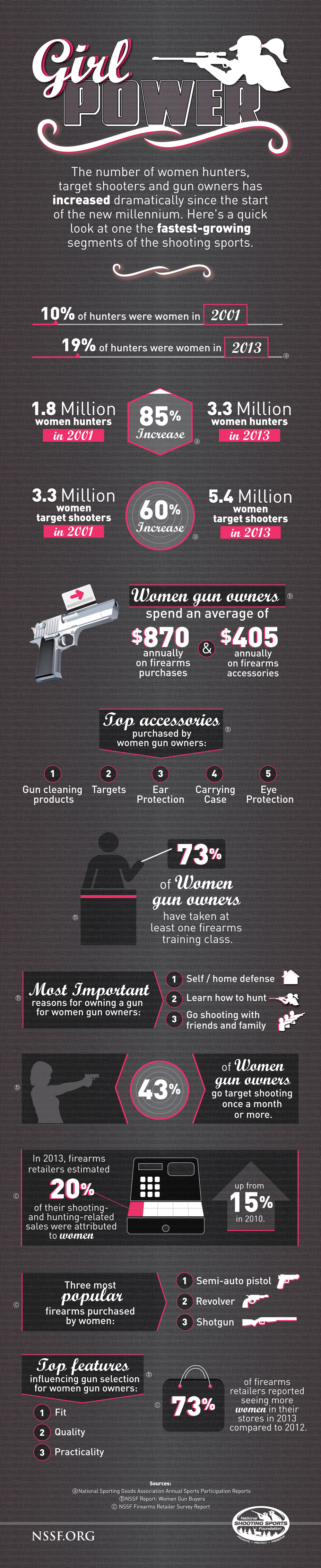
The number of women target shooters, hunters, and gun owners has increased dramatically since the start of the new millennium. Consider this, women now comprise 19% of hunters. That’s an 85% increase since 2001. Women are also more important as a purchasing segment of the the shooting market. Women gun owners spend nearly $1300.00 per year on guns and shooting accessories, $870 of that on firearm purchases. That number has gun-makers paying attention — even if some of you guys spend more than that each year just on powder!
Jessie Duff, sponsored by Taurus and Weatherby
Women are definitely becoming a more important segment of the hunting/shooting world. This is a good thing. The larger the “fan base” for the shooting sports, the less political pressure there will be to close ranges and restrict the activities of target shooters and hunters.
Click either image to see a full-size “Girl Power” Infographic.
In her latest video, Kirsten Joy Weiss shows off the 300 AAC Blackout, a popular .30-caliber cartridge for AR-platform rifles. Kirsten explains the advantages for the 300 BLK for hunters as well as those using an AR for self-defense. The 300 BLK is popular with suppressor owners because it works well with heavy bullets launched at subsonic velocities.
Reasons to Shoot a 300 AAC Blackout:
— You can use your current AR Bolt, Bolt Carrier, Buffer, and Magazine. The only part you need to change is the barrel.
— 300 BLK conforms to state hunting regulations which may require a cartridge larger than .22 Caliber. The 300 BLK shoots .308 caliber bullets.
— Lapua now sells 300 AAC Blackout brass so no case-forming is required. Just load and shoot.
— You can shoot light bullets supersonic or heavier bullets subsonic. The subsonic capabilities of the 300 BLK make it ideal for use with a suppressed AR.
— With a .30-caliber bore and a modest powder charge, barrel life is outstanding with the 300 BLK.
— You can make 300 BLK cartridges from fired .223 Rem brass, which is plentiful and cheap.
— The .300 BLK performs well with some very accurate powders, such as Hodgdon H4198 and IMR 4227.
The 300 AAC Blackout was created by Advanced Armament Corp. and Remington primarily for the military as a way to shoot .30-caliber bullets from the M4/AR15 platform while using standard magazines. As explained by Robert Silvers, AAC’s R&D Director: “Now there is a way to shoot 30 caliber from your AR while still using normal magazines with full capacity. Even the bolt stays the same, and all that changes is the barrel.” For more information visit www.300aacblackout.com and download the 300 BLK Cartridge Information Guide (PDF).
SAAMI, the industry standards organization, adopted and standardized the AAC 300 Blackout in 2010. The SAAMI diagram for the 300 BLK is shown above. Lapua now makes 300 BLK cartridge brass.
300 BLK for 3-Gun Competition
The 300 AAC Blackout has been touted as an important new hunting round, but we see it more as a specialized “rule-beater” 30-cal option that lets 3-Gun competitors “make major” with a low-recoil cartridge that also offers long barrel life. For those who need to run a .30-caliber cartridge from a standard AR15 platform (as opposed to the AR10), the 300 AAC Blackout makes some sense. But for hunters using a bolt gun, there are any number of tried and true options, such as the 7.62×39, .30-30, and, of course, the .308 Winchester (7.62×51 NATO).
Nosler has just introduced a new cartridge, the 28 Nosler. This new 7mm hunting round delivers magnum-class velocities in a cartridge that fits a standard action. The 28 Nosler is capable of launching a 160gr Accubond at 3300 fps. The 28 Nosler uses the same parent case as the 26 Nosler, introduced in 2014. Designed for a maximum COAL of 3.340″, the 28 Nosler will operate in a standard action that is lighter (and more compact) than a magnum action.
The 28 Nosler offers serious knock-down power for the long-range hunter. The factory 185gr Accubond load retains over 2000 ft/lbs. of energy at 600 yards, and remains supersonic well past 1000 yards. Nosler factory ammo will be offered with 160gr and 185gr bullet-weight options.
Previewing the 28 Nosler:
For hand-loaders, Nosler will also offer 28 Nosler cartridge brass. It will be interesting to see whether some F-Class competition shooters experiment with the 28 Nosler (and heavy match bullets) as an alternative to the .284 Winchester or short magnums (WSM or RSAUM).
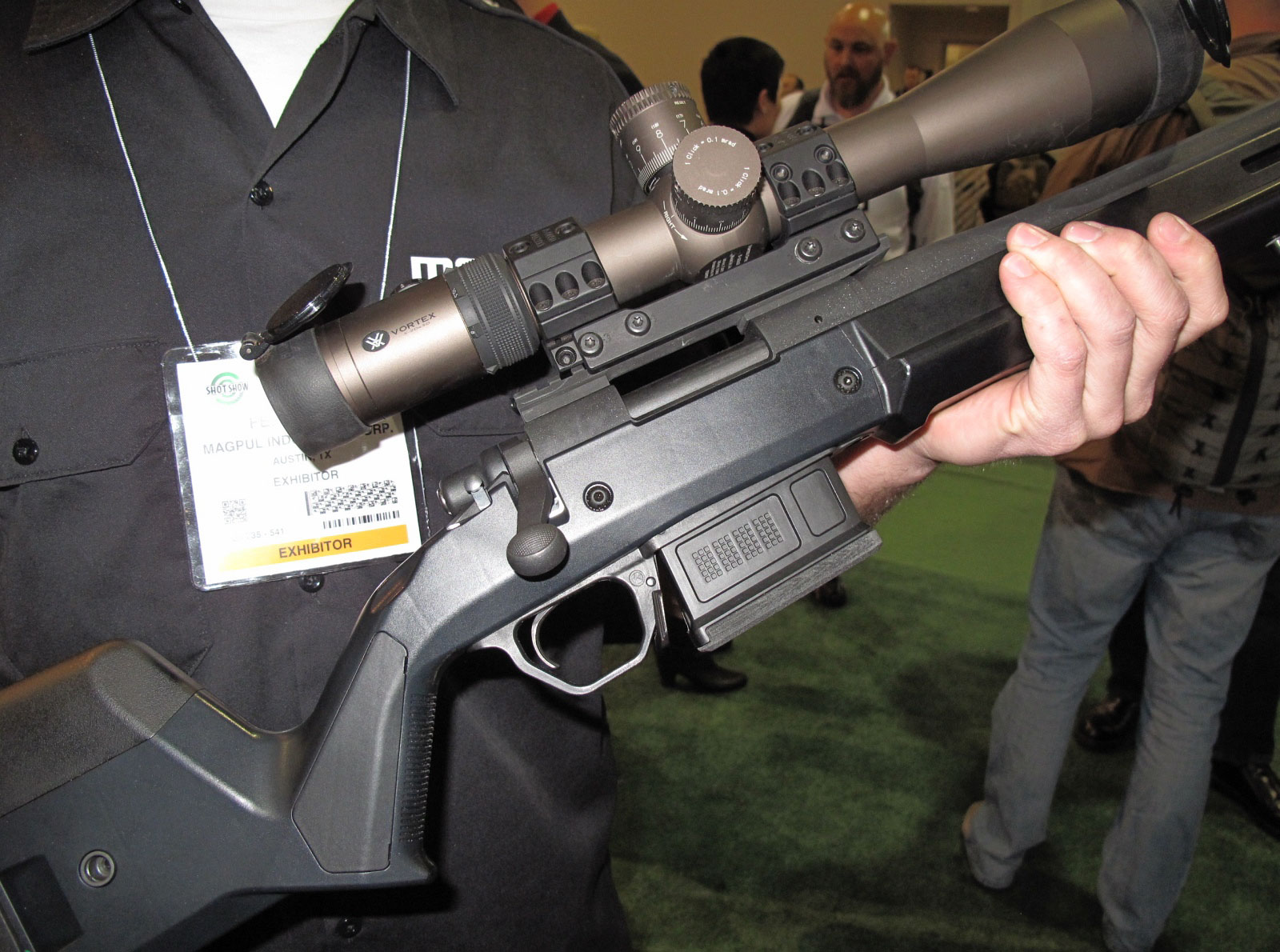
Our readers wanted more information on the $259.95 Magpul Hunter 700 stock, so here it is. We got our hands on the new product. The polymer shell is strong and stiff — not like the “Tupperware” plastic stocks you’ll find on some factory offerings. The stock comes standard with a flush bottom plate. However, for $70 more you can get a polymer magwell unit that allows use of new MagPul 5-round and 10-round magazines. The stock features an anodized aluminum V-block that allows easy installation of a Rem 700-footprint action.
CLICK Photo to See Full-Screen Image:
But perhaps the most important element of this stock can’t be shown in photos. INSIDE the stock is a metal “skeleton” that extends from the middle of the fore-end back into the grip. This skeleton, an important design innovation, gives the stock great strength and rigidity. It is sort of like a race car with a tube chassis under the body work. We suspect Magpul is working on a patent.
Gear Report by Kip Staton Magpul jumped feet-first into the bolt-action precision rifle market by dropping a teaser video of their Hunter 700 chassis/stock system. Feast your eyes on this video that shows Magpul’s new chassis system in action:
The Hunter 700 (MSRP $259.95) is built around a ruggedly anodized aluminum bedding block, and utilizes a standard Magpul SGA cheek riser and spacers (from the shotgun line). It also features forward M-LOK slots, as well as multiple points to mount swivel studs and QD sockets. Weight is a svelte 2.9 pounds, and the system is compatible with factory Remington 700 bottom metal. And that’s not all.
By removing a spacer in the stock, end-users can convert the rifle to feed from the company’s new steel/polymer Bolt Action Magazine Well, which accepts standard AICS pattern magazines. MSRP for the conversion is an impressive $69.95, and that price even includes a mag. But — hold on — it gets even better (look at the photo carefully).
Yup. It feeds from PMAGs. New, AICS-compatible PMAGs. The PMAG-5 7.62 AC is a fully-featured polymer magazine, with an anti-tilt follower and MSRP of $34.95. Interestingly, the magazine holds five (5) rounds to comply with hunting regulations, but the follower features a trimmable, pre-scored stop that allows users to increase capacity by a single round for other purposes.
Magpul promises that this is just the beginning for their precision rifle accessory line, hinting at a larger-capacity PMAG-10 7.62 AC in the future, as well as other calibers. Anybody running AICS pattern mags (and that’s quite a few serious precision rifle guys) should be stoked about these new products.
About the Writer
Kip Staton is a freelance gun writer based in North Texas, and loves to blog about news within the firearms industry and his perceptions on marksmanship at KipStaton.com. He served as the weekend range manager of the North Texas Shooter’s Association from 2010-2012, at which point he began performing sales consultations for a major online firearms retailer. Currently, Kip is a content marketer, copywriter and digital strategist for an award-winning Dallas marketing agency.
To read more gear reviews by Kip, visit KipStaton.com.


 In most parts of the country it’s still too early for a prairie dog safari. Spring has barely sprung, and the critters haven’t come out to play. If you are missing the fun of a prairie dog hunt, here’s an arcade-type shooting game that lets you blast the critters to your heart’s content. Just use your mouse to move the crosshair and click to shoot. A hit on a can is worth one point, a hit on a prairie dog is worth two.






 Nosler has just introduced a new cartridge, the




 About the Writer


