For more than a century, makers of rifle stocks have used large, complicated mechanical duplicators to reproduce stock designs. These contraptions rely on mechanical linkages to follow the lines of a stock and reproduce the shape on a new blank. Now new 3D scanning technology and CNC milling systems may render the mechanical stock duplicator obsolete. Laser Design Inc. (LDI) has developed a system of scanning lasers that creates an ultra-precise 3D model of a gunstock. Digital CAD data from the scans is then used to program a CNC milling machine that produces exact duplicates of the original stock.
Keystone Sporting Arms, LLC, of Milton, PA, has already started producing rifle stocks modeled on designs derived from laser scans. Keystone, one of the nation’s biggest producers of gunstocks, turned to the laser-scanning technology after Keystone purchased another stock-maker. Keystone wanted to continue to produce the acquired company’s legacy models. However, there were no CAD models for those older stock designs. Keystone had already invested heavily in the machining equipment and needed to be able to quickly generate CAD data from scanning a master model of the stock.
Keystone owner Steve McNeal knew that 3D laser scanning was able to produce excellent results when reverse-engineering rifle stocks. When an object is hard to measure manually or with a touch probe due to its irregular surface contours, non-contact 3D laser scanning can produce accurate CAD data very quickly. The Keystone stock scans were done with a 7-axis Faro Platinum articulating arm fitted with an SLP-330 laser probe. LSI’s technical experts helped Keystone create crisp well-defined edges and corners in the data files — this is key to the reverse-engineering process. The scanning process is fast, and exporting directly to MasterCAM for milling is extremely efficient.
Amazingly, the scans from a single stock contained over 18 million data coordinates. This enormous amount of data was then exported to MasterCAM to create the CNC toolpaths. From start to finish, the project took only three hours for the scanning, data editing, and export to MasterCAM.
How Laser Scanning Works
Scanning free-form shapes and irregular surfaces, such as curved gun stocks, is an ideal application for a non-contact laser scanner. Because the scanning system projects a line of laser light onto surfaces while cameras continuously triangulate the changing distance and profile of the laser line as it sweeps along, the problem of missing data on an irregularly-shaped surface is minimal. The operator moves the laser line back and forth over the area until the complete surface is captured. The capture progress is continuously monitored by the operator on the computer screen. The system measures details and complex geometry so that the object can be exactly replicated digitally. Laser scanners measure articles quickly, picking up to 75,000 coordinate points per second.
Scanning a gun stock offers certain special challenges. Most of the gun stock had a smoothly finished surface which produces excellent scan data with very precise tolerances. However, the front end of the stock, which had a rough wood grain, needed sanding to yield more usable 3D data. A feature that was somewhat challenging to scan was a 1.5″ hole in the stock. To capture the sides and bottom of the hole the scan technician positioned the laser directly over the top of the hole so the laser could “see” the bottom, then at a 45-degree angle for the sidewalls.
Bushnell Inc. and Leupold & Stevens have settled their respective lawsuits relating to the Leupold True Ballistic Range® (TBR) technology, and the Bushnell Angle Range Compensation (ARC) technology. So ends the legal battle of competing angle-compensation indication systems. In February, Leupold & Stevens sued Burris, Bushnell, and Zeiss for patent infringement in federal court for the District of Oregon. Then, in a separate action in the District of Kansas, Bushnell sued Leupold & Stevens for patent infringement. This week, after months of negotiations, the two companies dismissed their claims against each other, the two sides having reached an amicable settlement. The terms of the settlement were not disclosed, but neither company will be required to discontinue selling any of its products.
“We are pleased with the settlement, because it allows our customers to go on using and enjoying Bushnell laser rangefinders with our patented ARC technology, and we can focus our resources and energy on further developing and marketing new and innovative products,” said Phil Gyori, Executive Vice President of Marketing at Bushnell.
Previously, in March, Leupold removed Carl Zeiss Optical from Leupold’s patent suit. Though originally named as a defendant, Zeiss was dismissed from the suit because its products do NOT incorporate an inclinometer to compensate for angled shots. The inclinometer is a key element of Leupold’s patent.
Imagine a riflescope that could sense target distance and shift from wide field-of-view/low magnification for closer shots to higher magnification for longer-range shots. Just think of the benefits for a hunter. He could just place his cross-hairs on a buck and the scope would automatically zoom to the optimal magnification. Does this sound like science fiction?
Well the Defense Advanced Research Projects Agency (DARPA) is betting millions of tax dollars that an auto-adjusting rifle scope will soon be science FACT. DARPA recently awarded Lockheed Martin a $3.93 contract to develop a “next generation” Dynamic Image Gunsight Optic, aka DInGO. The DInGO scope automatically calculates the range with a low power laser rangefinder, digitally zooms in on it and accounts for environmental conditions such as wind using sensors built into the scope. It then projects the bullet’s point-of-impact calculated from the embedded ballistics computer. DInGO is based on Lockheed Martin’s One Shot Advanced Sighting System, which utilizes similar technology to automatically transmit crosswind information to a sniper’s scope and move the crosshairs to show the corrected point of aim.
“Current scopes are optimized for a single target range, impacting soldiers’ effectiveness and survivability when engaging targets at different distances,” said Dan Schultz, vice president and general manager of Lockheed Martin’s Mission Systems & Sensors Ship & Aviation Systems business. “DInGO will solve this problem, significantly increasing soldiers’ ability to rapidly reconfigure optics for use from short to long ranges and improving marksmanship capabilities for all soldiers.”
While DInGo scope technology will first be implemented for the military on M-4 and M-16 rifles, eventually this automatic ranging/zooming system could be adapted to hunting rifles. Such a system would be great for game hunters. When the prey appears at close range, the scope would provide a relatively low magnification level for enhanced field of view. If the animal was much farther away, the scope would autmatically increase magnification to allow more precise aiming. Hopefully this will be one example of military technology “trickling down” to the general public for sporting use.
Other Scopes with Built-In Laser Rangefinders
Both Burris and Zeiss currently offer hunting scopes with integrated laser-rangefinders that calculate holdover, based on target distance. The Burris Eliminator even projects the calculated aiming (hold) point as a red dot on the vertical crosshair. Shown below is the view through the lens of the Burris Eliminator scope, with the red dot showing holding point. Just place the red dot on the center of the target and pull the trigger. However, neither the Burris nor Zeiss rangefinding scopes automatically adjust magnification/field of view. Zooming in or out must still be done manually. That’s where the DInGO system offers something radically new.
An integrated laser sight can be very useful on a defensive handgun. When properly adjusted, the laser displays a small red circle where your shot will impact. When shooting at night, or in a crisis situation where you don’t have time to carefully align font and rear iron sights, a laser sight can be a life-saver. Some people also believe that laser sights can have a deterrent effect — if the bad guy sees the red dot shining on his body, he may withdraw, if you’re lucky.
The problem with most handgun laser installations is that they are bulky or the laser can be obscured by your fingers/hands when holding the gun. Crimson Trace has developed a series of grips with integrated lasers. These work pretty well but we’ve found that you can still obscure the beam with your hands with the smaller pistols. You can mount a laser in front, under the barrel, but then you’ll have trouble finding a holster to fit.
LaserLyte, a small company in Arizona, offers an impressive new system that may be the most practical laser mount yet devised for “carry” pistols used for personal defense. The compact laser and battery are integrated into the rear sight. This mounts the laser up away from the hands. So, you never have to worry about blocking the beam with your fingers, and you can use any “normal” holster.
Introduced in 2009, the LaserLyte Rear Sight Laser (RSL) has proven very popular. It is priced at $199.95, and there are models to fit Glock, Springfield XP, Smith & Wesson M&P, Ruger SR, and other popular handguns. LaserLyte Rear Sight Laser modules come with a one-year limited warranty.
The Modern Pentathlon is a 5-discipline Olympic event that combines Horse Riding, Running, Swimming, Fencing, and Shooting. Whether there will really be any “shooting” anymore is questionable if Pentathlon officials succeed in their plan to replace air pistols with laser devices. That’s right, the Snowflakes in Hell Blog reports that the UIPM, the international governing body for Modern Pentathlon, intends to replace air pistols with laser “pistols”, ostensibly to reduce the environmental impact of lead pellets. We think this is just a “feel-good” move reflecting anti-gun political agendas. Pentathlon air pistols fire tiny 7-grain pellets that are easily captured by bullet traps, so there is virtually no environmental risk.
UIPM President, Klaus Schormann, defended the plan to replace air pistols with laser devices, stating: “The decision to introduce non-air pistol shooting was the second big step for the sport following the decision in 2008 to change to the combined run/shoot format. This is a significant development in terms of lowering the environmental impact of the sport.”
Sebastian, creator of the Snowflakes in Hell Blog, observed: “The reasoning of the [UIPM] committee is disturbing. I hope this doesn’t portend bad things to come with other Olympic shooting sports, whose environmental footprint is arguably worse.”
One Blog reader astutely commented: “It would have been trivially easy to mandate lead-free pellets, if the ‘lead poisoning’ argument were the real reason behind this change. Replacing air pistols with lasers instead of a much simpler requirement to use nontoxic shot suggests that it was the ‘gun-ishness’ of the air pistols, and not the environmental impact, that may have been the primary driver here.”
EDITOR’s Comment: One wonders if the UIPM’s next move will be to replace fencing foils and sabres with Wii computer-game controllers — in the interest of safety. And shouldn’t the UIPM replace Pentathletes’ four-legged equine mounts with hobby-horses to reduce solid waste and methane emissions?
Bushnell has released a new Legend 1200 ARC laser rangefinder (LRF) with a claimed 1,200-yard capability on highly reflective objects. Bushnell claims the Legend 1200 will range a tree out to 850 yards, or a deer-sized animal out to 475 yards.
A compact 4.3″ x 2.9″ x 1.7″ size, the Legend 1200 weighs just 7.4 ounces. This is small and light enough to carry in a shirt pocket. The Legend 1200 features a multi-coated 6X optic and all external lens surfaces are coated with RainGuard HD. With a $349.00 MSRP, the Legend 1200 is available in black or Realtree® AP™ camouflage.
Built-In Angle Compensation
The Legend 1200 has a built-in inclinometer so it can give you true horizontal yardage for up-angle and down-angle shots. That is very important for hunters and tactical shooters who must rapidly adjust for shot angle to ensure a hit. In Rifle Mode the Legend 1200 calculates the angle and indicates the holdover required in either inches or MOA (user selectable output). The range of angle measurement is -90 to +90 degrees.
A new feature in the Legend 1200 is Variable Sight-In Distance capability or VSI™. In Rifle Mode, users can select between 100, 150, 200 or 300 yard sight-in distances to accommodate their shooting styles and preferences. Other standard features include SCAN, Bulls Eye and Brush Modes for better targeting and accuracy. The Legend 1200 ARC is rubber armored and fully waterproof. It comes with a carrying case, lanyard and 3-volt CR2 battery.
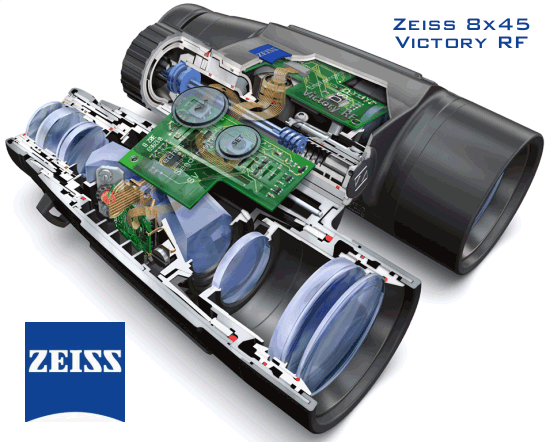
At SHOT Show 2009, we were impressed with the new Zeiss Victory laser rangefinder (LRF), listing it as one of the highlights of the 2009 Show.
A companion product line, the Zeiss Victory range-finding binoculars, have won a series of prestigious awards. Introduced in early 2008, the Zeiss Victory RF was named a “Leading Edge: The Best of What’s Next” product by National Geographic Adventure magazine, which wrote: “Zoom in on an object through the Zeiss Victory 8×45 rangefinding binoculars and a crisp LED display will give you its exact distance — as if you had Million Dollar Man eyesight. Traditional high-end Zeiss lenses and workmanship and a waterproof body complete this first-of-its-kind package.”
The Victory RF, claimed to be the world’s first premium binoculars with digital laser rangefinder, LED Display AND Ballistic Information System (BIS), also won the prestigious Red Dot Design Award in addition to the Chicago Athenaeum: GOOD DESIGN™ Award. Both are international awards that recognize the best design innovations of the year.
Zeiss Victory RF Binoculars Features:
• Ranges from 10 yards to 1,300 yards.
• Integrated design — Victory RF binoculars are the world’s first binoculars with a hinge bridge that do not require a separate laser emitter.
• Tightly focused Beam — The laser beam used in the Victory RFs is narrow with minimal beam divergence, so you can range small targets even at long distances.
• Accurate “One-Touch” rangefinding for a steadier image.
• Ballistic Information System (BIS) that automatically calculates required aiming hold-over at the ranged distance.
Great Performance, but Extremely Expensive
What’s the downside of the Zeiss Victory RF binoculars? They cost a fortune. The Zeiss Victory 8×45 version retails for about $2900.00, while the 10×45 model runs about $3,000. That makes the Zeiss Victory RF Binoculars MORE Expensive than the Leica 8×56 Geovids which have a much larger objective, providing better low-light performance (and a larger exit pupil). And, you can get the smaller 8×42 BRF Geovids for $2245 at Adorama.com and other large online vendors.
Are the 8×45 Zeiss Victory RFs worth $750 more than the 8×42 Leica Geovids? You’ll really have to make that decision for yourself. The Geovids are a known quantity, having proven themselves in the field over many years. The Zeiss Victory RF offers more sophisticated software (with the BIS), and we think the Victory is more secure and comfortable to hold.
It’s twelve days ’til Christmas, there’s snow on the ground and your rifles are packed away for the winter. How do you maintain that competitive edge through the slow winter months? The LaserPower training kit from Anschütz could be the answer. This is a complete system with a Laser-equiped rifle and a 5-target biathlon-style remote target station. “Shoot” the rifle, and if you aim correctly, green lights appear on the target station one by one after each shot. This is a set-up that both adult competitors and juniors can enjoy. If you’re looking for the “ultimate” Christmas gift for your kids, this might be it. The LaserPower rifle kit retails for $763.00 from NealJGuns.com. According to Anschütz, the LaserPower unit is not restricted by any firearms law so it can be used with kids as young as six years old. No FFL is required for purchase.
The unit features a 4.8-lb, laser-equipped rifle, with adjustable iron sights, an ambidextrous (right-hand or left-hand) hardwood stock, and a two-stage model 5066 trigger. In weight and dimensions, the LaserPower rifle is ideal for junior shooters, though it has been used successfully by adult biathletes for training. Below are two videos. The first video shows how the LaserPower system is assembled and operated. The second video shows the LaserPower in use at a European Biathlon training tournament.
Here’s a sweet deal for a hunter looking for a 3-9 power scope and laser rangefinder for a low total cost. Currently, SWFA (Riflescopes.com) is offering a Package Deal. For just $349.95 total you get a Nikon 3-9×40 ProStaff BDC Scope, plus a Nikon ProStaff Laser 550 Rangefinder (with case). Nikon even kicks in a $50.00 Nikon ProGear Gift Card.
The 12.3″-long scope features low-profile windage and elevation knobs and weighs just 13.7 ounces. The ProStaff Rangefinder has a 6x21mm viewing lens, weighs just 6.3 ounces and is small enough to fit in a shirt pocket. The ProStaff 550 Rangefinder, by itself, sells for $185-$200 at other web vendors. This rangefinder has received generally quite positive reviews from Cabela’s customers. We suggest you read those reviews (in full) to decide whether the unit will meet your needs.
Bullet-Drop-Compensating Reticle
Nikon’s BDC reticle features a conventional medium plex crosshair augmented by four hollow circles placed below center on the verticle line. The small circles provide additional aiming points corresponding to Point of Impact at different distances. This way, the theory goes, a hunter can easily move from one distance to another without the need to click different elevations with his scope turrets.
The standard Nikon BDC is designed to be used with most standard centerfire cartridges with typical bullet weights, providing aiming points out to 500 yards with a 100-yard sight-in. With magnum cartridges and typical bullet weights, the same scopes with BDC reticles offer aiming points out to 600 yards with a 200-yard sight-in.
Many of our Forum members have tried Nikon scopes with the BDC reticle. The general consensus was that the crosshairs are quite thick so this reticle is best suited for larger game out to 300 yards or so. At longer ranges, the reticle can obscure small targets such as prairie dogs. For deer and antelope, this can be a good reticle choice.


 For more than a century, makers of rifle stocks have used large, complicated mechanical duplicators to reproduce stock designs. These contraptions rely on mechanical linkages to follow the lines of a stock and reproduce the shape on a new blank. Now new 3D scanning technology and CNC milling systems may render the mechanical stock duplicator obsolete. Laser Design Inc. (LDI) has developed a system of scanning lasers that creates an ultra-precise 3D model of a gunstock. Digital CAD data from the scans is then used to program a CNC milling machine that produces exact duplicates of the original stock.


 Well the Defense Advanced Research Projects Agency (DARPA) is betting millions of tax dollars that an auto-adjusting rifle scope will soon be science FACT. DARPA recently awarded Lockheed Martin a $3.93 contract to develop a “next generation” Dynamic Image Gunsight Optic, aka DInGO. The DInGO scope automatically calculates the range with a low power laser rangefinder, digitally zooms in on it and accounts for environmental conditions such as wind using sensors built into the scope. It then projects the bullet’s point-of-impact calculated from the embedded ballistics computer. DInGO is based on Lockheed Martin’s One Shot Advanced Sighting System, which utilizes similar technology to automatically transmit crosswind information to a sniper’s scope and move the crosshairs to show the corrected point of aim.
 An integrated laser sight can be very useful on a defensive handgun. When properly adjusted, the laser displays a small red circle where your shot will impact. When shooting at night, or in a crisis situation where you don’t have time to carefully align font and rear iron sights, a laser sight can be a life-saver. Some people also believe that laser sights can have a deterrent effect — if the bad guy sees the red dot shining on his body, he may withdraw, if you’re lucky.
 The
The  UIPM President, Klaus Schormann, defended the plan to replace air pistols with laser devices, stating: “The decision to introduce non-air pistol shooting was the second big step for the sport following the decision in 2008 to change to the combined run/shoot format. This is a significant development in terms of lowering the environmental impact of the sport.”
 EDITOR’s Comment: One wonders if the UIPM’s next move will be to replace fencing foils and sabres with Wii computer-game controllers — in the interest of safety. And shouldn’t the UIPM replace Pentathletes’ four-legged equine mounts with hobby-horses to reduce solid waste and methane emissions?
 Built-In Angle Compensation