Precision Rifle Series (PRS) 22 Finale on Shooting USA
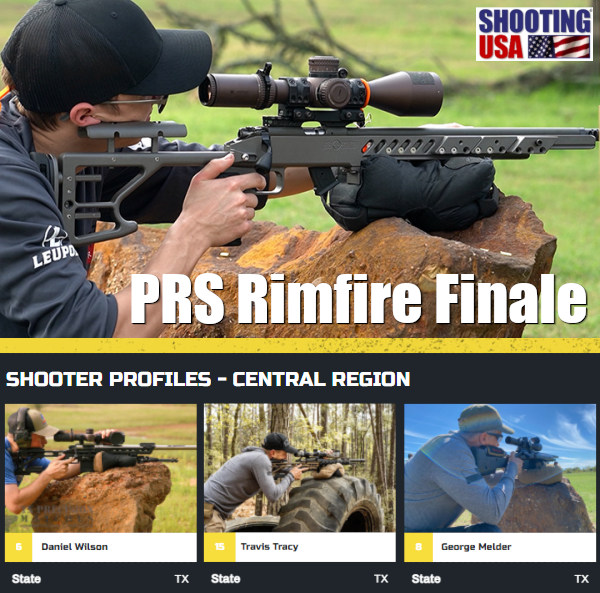
This week Shooting USA showcases the first-ever PRS Rimfire Finale. This new rimfire discipline is akin to Precision Rifle Series (PRS) centerfire tactical competition, but shot with .22 LR rimfire rifles. The inaugural PRS Rimfire Finale drew nearly 150 competitors to Texas, where shooters could compete without the cost of expensive centerfire ammo and without the need for a 1000-yard range. SEE: PRS Rimfire Series Info.
Shooting USA SHOW TIMES: This Shooting USA Episode airs Wednesday, December 21, 2022 at 9:00 PM Eastern and Pacific; 8:00 PM Central. If you miss the regular broadcast, you can stream the show online at any time on Vimeo for $0.99 per episode.
PRS Rimfire Finale — Nearly 150 Shooters in Texas
PRS and NRL tactical matches are among the fastest-growing competitive shooting disciplines. And rimfire tactical disciplines are actually growing even faster (than centerfire PRS/NRL) because .22 LR ammo is much cheaper than centerfire ammo, and there are many more ranges where rimfire matches can be held. PRS Rimfire offers the same kind of fun without the high cost of centerfire ammo and/or countless hours spent hand-loading. Rimfire PRS also offers generally less expensive rifles, and a whole lot less recoil. That’s why PRS Rimfire (as well as NRL22) has become so popular. And in the first year of the PRS Rimfire series, the Finale drew close to 150 competitors. The Finale Match was held at the Triple C Shooting Facility in College Station, Texas.
The Triple C Shooting Facility hosted the First Annual PRS Rimfire Finale. At this excellent Texas venue, match directors set out 20 unique courses of fire. There were the standard props you’d expect to see at any Precision Rifle match — tractor tires, wire spools, concrete culverts, and even cross tie bunkers. And the target placements were certainly challenging. Many of the stages had cross-course target lay-outs. This makes wind-reading much more challenging, especially with the relatively slow, low-BC .22 LR cartridges used in PRS rimfire competition.
Tune in to Shooting USA TV on Wednesday 12/21/22. You’ll enjoy the coverage of this popular PRS rimfire sport that is growing rapidly. Notably, the National Rifle League (NRL) now conducts many more NRL22 matches than NRL centerfire matches. And competitors of course are drawn by the fun/challenge of a tactical match with much lower ammo costs — $0.15-$0.25/rd vs. $1.00/rd or more (counting brass, primer, bullets, powder, and barrel wear). And there are many more viable venues, because you only need a 300-yard (max) range to conduct a rimfire tactical match.
Our friends, Ed Mobley and Steve Lawrence, aka the “6.5 Guys”, have written an excellent article on getting started in practical/tactical competition. If you are new to the game, these tips can help you save money, progress faster, and have more fun. Here are article highlights, but we recommend you read the full story,5 Tips for Attending Your First Precision Rifle Match, onwww.65guys.com.
We often meet people who are new to long range precision shooting, and want to improve their knowledge and skill level. However, they aren’t sure if they are ready to sign up to compete in a match. They often ask, “What knowledge or skills are necessary to compete in a match?” Others may state, “I need to purchase this gear or that gear before I can attend a match”. For those guys who have a strong interest in precision rifle shooting, and who wish to chec out a precision rifle match, below are Five Tips to make it a positive experience.
TIP ONE: Make Plans and Commit to Go
First you need to start by finding a match to attend. This may entail a little bit of research and investigative work on your part to find what matches are scheduled in the next few months. We recommend starting with any match that may be within a reasonable driving distance. This may likely be a local “club” match, many of which are held on a regular basis. These make great venues because it will provide an opportunity to meet some of the regular attendees as well as shooters that are from your geographic area. Additionally, most of the smaller matches are a little more relaxed in terms of level of competitiveness.
Once you decide on the match you want to attend, do your homework. This means finding out if you need to pre-register or pre-pay the match fee. Commit to going by registering for the match and putting it on your schedule. Be sure to find other useful information for questions such as:
— What time should I arrive?
— Is there a mandatory safety briefing for new shooters at that venue?
— What is the travel time required to get to the match site?
— How many stages will there be?
— Is there a description of the stages available before the match?
— How many rounds should you bring?
— Are there special equipment requirements? (E.g. do you need chamber flags, is there a pistol stage?)
TIP TWO: Bring What You Have
(Don’t Spend a Fortune at the Start)
Some new shooters often assume they need a custom match rifle or all of the miscellaneous shooting gear associated with long range precision shooting to compete in match. While having a Kestrel weather meter and a high quality laser range finder and other shooting accoutrements are invaluable kit, you will find other shooters at your first match that will provide you with the information and coaching you need to get on target.
In fact, the only gear you really need to bring is a scoped rifle with a bipod and ammo capable of consistently shooting within one MOA. Also, be sure to know the ballistic drops or have a ballistic drop table prepared for your rifle/ammo to dial the correct DOPE on your scope for different target ranges. Many of the other participants at the match will be willing to let you borrow a support bag, bipod, tripod or other gear if you need one — just ask. Don’t use the excuse of not having the right gear to delay getting out to a match!
One reason not to make a big initial investment in a new rifle and assorted gear before competing, is we’ve seen a number of people come into the sport and try it for a year and then make the decision to move on to something else.
TIP THREE: Be Prepared to Learn
As a new shooter at a match, there is no better opportunity to learn. We often look to our local club matches as a group ‘training’ session to prepare for the bigger matches. You will find competitors at all levels of skill and many of your fellow shooters will enthusiastically provide helpful advice once they learn you are new to the sport. Take advantage of the opportunity to ask questions if you would like ideas for how to engage a stage, but also be sure to do more listening than talking as you receive guidance and tips from more experienced competitors.
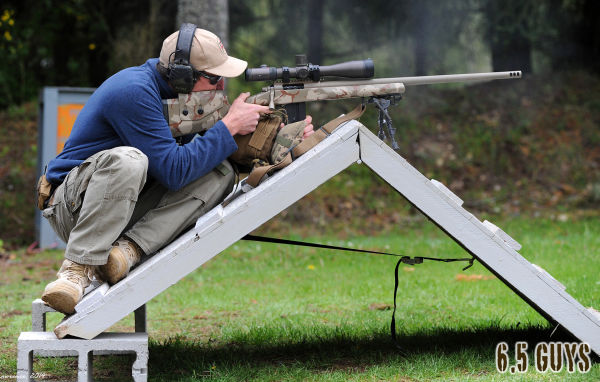
Watch and observe other shooters and how they approach and ‘game’ a specific stage or course of fire. You’ll begin to recognize which shooting positions work best for different scenarios, and maybe even come up with some new ones that no one has thought of before.
Seeing what the better shooters do is an invaluable instructional tool. You can use your smart phone’s video camera to record other shooters (with their permission). When you’re ready to shoot, ask another shooter to record your performance. Watching yourself will point out needed areas of improvement.
After each match conduct an informal after action review and summarize for yourself the things that went well and what you should continue to do. You should also identify the specific shooting skills you should develop and make a plan to integrate the appropriate practice drills into your practice sessions. Finally, if you maintain a shooter’s data book or journal you’ll want to note things such as:
After Action Review – How you did, what went well, things you need to work on in practice. Stage Observations – Successful methods used for specific courses of fire. Note barricades, positions used, specific gear used for stages. Gear Observations – How your rifle/gear performed, what new items you should add to your “buy list”.
TIP FOUR: Be Safe and Have Fun
You’ve all heard a parent or teacher say, “It’s all fun and games until someone loses an eye.” The same can be said of the shooting sports. Safe handling of firearms is the number one rule at any match, and comes before the FUN part in terms of importance.
Before all matches start there will always be some form of a mandatory safety briefing. Make sure you know, understand, and follow any unique safety protocols for the match you attend. Some matches require all rifles have chamber flags inserted and are stowed in bags/cases while not on the firing line — other matches may not. If you run afoul of any safety rules, you risk the chance of being disqualified from a stage or worse, the entire match.
The second rule is simply have fun. This starts with having a good attitude throughout the day. Keep in mind that as a new competitor you should think of a match as a solid day of practice and training. If you blow a stage, use it as an opportunity to diagnose what you could have done differently or what you need to improve on — then smile and drive on.
Any day at the range or shooting is a good day. A match is an opportunity to hang out with like-minded people who are passionate about shooting and impacting targets far-far away. Life is great when you are doing what you enjoy!
TIP FIVE: Make Friends
There is no better way to meet lots of precision rifle shooters and make friends than at a match. The people that attend the tactical precision matches on a regular basis are those that have ‘fallen into the deep end of the pool’ and are really into the sport. As a result, they have become part of the local precision shooting community. As you strike up conversations at the match, find out if your new-found friends visit specific forum boards or social media outlets, or if there are other matches they attend.
Precision shooters tend to congregate and share information in different corners of the Internet. It will serve you well to meet some of the guys in person at matches and be able to connect a face to a screen name. As you develop your friendships and develop a level of trust, you will find opportunities become available to shoot with others in your local area, or get ‘read-in’ on a secret honey-hole of a spot to shoot long distance. Additionally, the local shooting community will often find it more convenient to sell or trade gear and equipment locally than deal with buyers/sellers that are out of state.
Getting Started in PRS/NRL — One Man’s Story
My name is Jeff Cosgrove. I have shot for 20+ years but I found my interest in shooting was dwindling over time. I got somewhat bored with shooting paper at 100 yards or plinking cans out in the desert. About 3 years ago I decided I wanted to shoot long range. I picked up a used MPA in .300 Win Mag and started shooting long range with a new buddy. That day I fell in love with guns all over again.
With that new .300 WM I found my reloads were not up to my expectations (high ES/SD), so I purchased all new reloading hardware. One of my purchases was a used Benchsource Annealer. The guy I bought that from asked if I had ever tried PRS and he invited me to check out a match. So I went to a local PRS event as a spectator. I looked at many rigs and took notes. By the end of the day I knew this was something I really wanted to do. I then acquired a used chassis rifle that I thought would work well for PRS.
After working with that first PRS rifle, a 6.5 CM with Stiller Tac30 action, MDT chassis, and Proof Carbon-wrapped barrel, I quickly learned that gun did not handle and balance the way I hoped. It was too light in the front, the ergos were poor, and scope eye relief was not optimal. So I decided to build my own GEN 2 PRS rifle, a switch-barrel rig that I now use in competition. READ FULL Story HERE.
Load Development Using 6.5 Guys Custom Spreadsheet
To hold and analyze his load development data, Jeff uses the spreadsheet from 65Guys.com. this can really help identifying your best load. The Excel spreadsheet is detailed, yet makes it simple to analyze your data. You can even copy and paste your chronograph data if your chrono logs on to a SD card.
In this 6.5 Guys video Steve provides an overview and tutorial for using the Excel load development analysis model that he has developed. The Excel Load Development Analysis Spreadsheet version 2.0 is FREE. Download from the 6.5 Guys Load Development Page.
NOTE: If that direct link does not work, CLICK HERE, then look for the “Load Development Analysis Model Version 2.0″ link in the second paragraph.
In this video Steve explains some key statistical concepts for performing load data analysis. He also provides tips and guidance for determining the optimal load for your rifle as you analyze the load data you’ve collected.
Good Resource for PRS/NRL Newbies — Practical Shooter’s Guide
Marcus Blanchard, $19.99 Paperback, $9.99 Kindle
Thinking of getting started in the Practical/Tactical shooting game? Looking for ways to be more stable when shooting from unconventional positions? Then you may want to read Marcus Blanchard’s Practical Shooter’s Guide (A How-To Approach for Unconventional Firing Positions and Training). Unlike almost every “how to shoot” book on the market, Blanchard’s work focuses on the shooting skills and positions you need to succeed in PRS matches and similar tactical competitions. Blanchard provides clear advice on shooting from barricades, from roof-tops, from steep angles. Blanchard says you need to train for these types of challenges: “I believe the largest factor in the improvement of the average shooter isn’t necessarily the gear; it’s the way the shooter approaches obstacles and how they properly train for them.”
Rimfire is hot now. Across the nation, .22 LR rimfire disciplines are now the fastest growing types of rifle competition. And with today’s featured rig, the Competition Machine (Eliseo) Universal Match Rimfire Rifle (UMRR), you can shoot a variety of matches — NRA rimfire, NRL22, NRL22X, PRS Rimfire, local silhouette-style steel matches, even local rimfire benchrest matches (with a bag-rider fitted up front).
Compared to shooting centerfire, rimfire shooting is much less costly. You can get pretty good match ammo for under $8.00 per box. That works out to just 16 cents per round. Compare that to $1.20 or more per round for handloaded centerfire ammunition. And you don’t have to deal with the persistent shortages of powder and primers, or spend hours hand-loading. With rimfire, just open your .22 LR ammo box, load your magazine, and shoot.
Versatile, Accurate, Affordable — Universal Match Rimfire Rifle
If you’re a Palma shooter and want to shoot rimfire with a rifle with identical ergonomics and “feel” as your centerfire tubegun, Gary Eliseo’s new Universal Match Rimfire Rifle (UMRR) is your logical choice. Or if you are looking for a high-quality bolt-action chassis rifle for NRL22 (rimfire tactical) competition, this is a great option. Running a smooth Tikka T1x action, the UMRR offers match-grade performance at an attractive price — $1750.00 for the Sport-Target model with 20″ Tikka factory barrel.*
The Tikka T1x action is a smooth, short-throw action that cycles quickly and easily:
Gary Eliseo, head honcho of Competition Machine in Arizona, explained the features of the UMRR: “Our Universal Match Rimfire Rifle system has all the features of its big brother the Universal Match Rifle System (UMRS) and will accept all the same accessories and attachments. The rimfire UMRR is identical in size to the centerfire version so it’s possible to have your centerfire and rimfire rifles set up exactly alike.” That’s ideal for guys who compete in both centerfire and smallbore matches, and likewise it is ideal for cross-training using lower-cost rimfire ammo.
The UMRR is built around the excellent Tikka T1x platform. Gary notes: “We have accurized and tuned the T1x to give the best possible performance from factory barrel and trigger. The UMRR can also be customized with a high-end match barrel and trigger. By just changing the attachments, the UMRR can be used in multiple shooting disciplines like NRL22 and NRA rimfire competitions.” Gary also noted that Tikka recently updated the T1x bolt and magazine for improved feeding and extraction. See video below.
Sport-Target UMRR Shows Excellent Accuracy with Factory Barrel
Eliseo confirms that the Sport-Target UMRR with factory Tikka barrel and trigger is easily capable of sub-MOA precision. Check out those five-shot groups shot at 50 yards. The smallest group (.210″) works out to 0.40 MOA, while the largest group (0.39″) is 0.74 MOA. Remember this is with Tikka factory barrel!
The Sport-Target UMRR with factory Tikka barrel and trigger is capable of sub-MOA precision.
The Sport-Target version uses the factory 20″ Tikka barrel with threaded muzzle that has been set back and re-chambered so the bullet will engrave the rifling, which increases the precision of the rifle significantly. The excellent Tikka trigger is tuned to a pull weight of one pound. Overall the UMRR is a great choice as an XTC/LR prone trainer or NRL competition rifle at very reasonable cost.
Superb Accuracy from UMRR Match-Target Model
The Match-Target version comes with a top of the line Benchmark match barrel and Eley match chamber with the muzzle configured for your application to accept a front sight, tuner, or threaded, there are several aftermarket single-stage or two-stage match triggers available. Current Eliseo Rifles price for the UMRR Match-Target is $2400.00.*
The Match Target with Benchmark match barrel is capable of competing at the highest level. Shown above are 50-meter sling targets and Lapua 50-meter test center results. The bottom box shows 20 shots with a superb 10.52 average score.
Updates from Tikka Improve the T1x Action and Magazine
Gary noted that Tikka recently made an update to the Tikka bolt and magazine to improve feeding and extraction. Tikka replaced a wire-type system with a solid ejector element in the magazine. Gary says that improves the reliability of both feeding and extraction. Watch the video to see how this works.
Centerfire Accesories Will Work on UMRR
Gary notes that all the centerfire UMRS attachments will fit the UMRR, including handstop, rear balance weights, Picatinny scope rail, ARCA accessory rail, rear bag-rider, bipod mount, and front bag riding attachments. This easy adaptability makes the UMRR a true multi-discipline system for smallbore matches, NRL22/PRS rimfire competition, and cross-training.
Adapt the UMRR Easily to Multiple Shooting Disciplines
The UMRR can be easily configured for NRL, PRS, or NRA rimfire competitions by just changing the attachments. The UMRR is built on the excellent Tikka T1x barreled action that’s been accurized and bonded into the UMRR chassis system. Gary says the UMRR feeds .22 LR rounds flawlessly from the Tikka 10-round magazine, especially with the new, improved magazines. The UMRR is currently available in two basic configurations, both of which can be customized to your specifications.
Two Versions — Sport-Target and Match-Target
The Sport-Target version of the UMRR uses the factory 20″ Tikka barrel with threaded muzzle. Gary can tune the excellent Tikka T1x trigger down to a pull weight of around one pound, though for tactical work he says you may want to leave it stock. Gary tells us the Sport-Target is a great choice as an XTC/LR prone trainer or NRL22 competition rifle.
Match Target UMRR with Benchmark Custom Barrel
The Match-Target version comes with a top-of-the-line Benchmark match barrel and Eley match chamber with the muzzle configured for your application to accept a front sight, tuner, or suppressor. There are several aftermarket single-stage or two-stage match triggers available.
Tikka T1x — Quality Rimfire Technology from Finland
Gary Eliseo’s impressive UMRR is based on the smooth, reliable Tikka T1x rimfire action shown below. Note the nice craftsmanship of action, bolt, mag system, and trigger group. There is an extensive review of the T1x (.17 HMR version) on Britain’s GunMart.net website.
Gary Eliseo of Competition Machine. Here is UMRR designer Gary Eliseo at the 2017 Berger SW Nationals. Gary is a talented rifle marksman who competes in both smallbore and high power disciplines.
* Price is subject to change. Price may be increased based on increased costs of actions, barrels, and components. Contact Eliseo Rifles for current pricing.
Precision Rifle Series (PRS) 22 Finale on Shooting USA
This week Shooting USA showcases the first-ever PRS Rimfire Finale. This new rimfire discipline is akin to Precision Rifle Series (PRS) centerfire tactical competition, but shot with .22 LR rimfire rifles. The inaugural PRS Rimfire Finale drew nearly 150 competitors to Texas, where shooters could compete without the cost of expensive centerfire ammo and without the need for a 1000-yard range. SEE: PRS Rimfire Series Info.
Shooting USA SHOW TIMES: This Shooting USA Episode airs Wednesday, August 24, 2022 at 9:00 PM Eastern and Pacific; 8:00 PM Central. If you miss the regular broadcast, you can stream the show online at any time on Vimeo for $0.99 per episode.
PRS Rimfire Finale — Nearly 150 Shooters in Texas
PRS and NRL tactical matches are among the fastest-growing competitive shooting disciplines. And rimfire tactical disciplines are actually growing even faster (than centerfire PRS/NRL) because .22 LR ammo is much cheaper than centerfire ammo, and there are many more ranges where rimfire matches can be held. PRS Rimfire offers the same kind of fun without the high cost of centerfire ammo and/or countless hours spent hand-loading. Rimfire PRS also offers generally less expensive rifles, and a whole lot less recoil. That’s why PRS Rimfire (as well as NRL22) has become so popular. And in the first year of the PRS Rimfire series, the Finale drew close to 150 competitors. The Finale Match was held at the Triple C Shooting Facility in College Station, Texas.
The Triple C Shooting Facility hosted the First Annual PRS Rimfire Finale. At this excellent Texas venue, match directors set out 20 unique courses of fire. There were the standard props you’d expect to see at any Precision Rifle match — tractor tires, wire spools, concrete culverts, and even cross tie bunkers. And the target placements were certainly challenging. Many of the stages had cross-course target lay-outs. This makes wind-reading much more challenging, especially with the relatively slow, low-BC .22 LR cartridges used in PRS rimfire competition.
Tune in to Shooting USA TV on Wednesday 8/24/22. You’ll enjoy the coverage of this popular PRS rimfire sport, which we expect to grow significantly in 2022 and beyond. Notably, the National Rifle League (NRL) now conducts many more NRL22 matches than NRL centerfire matches. And competitors of course are drawn by the fun/challenge of a tactical match with much lower ammo costs — $0.15-$0.25/rd vs. $1.00/rd or more (counting brass, primer, bullets, powder, and barrel wear). And there are many more viable venues, because you only need a 300-yard (max) range to conduct a rimfire tactical match.
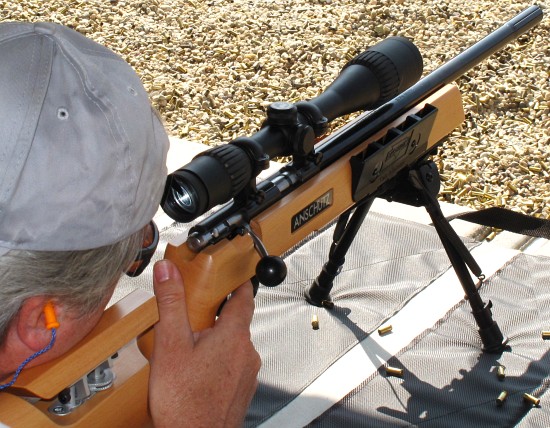
AccurateShooter’s Editor trains with .22 LR Anschutz model 64R back in 2008.
Rimfire Tactical Matches Aren’t Really New
NRL22 and PRS rimfire shooting disciplines are fun, affordable forms of competition. We’re pleased to see the rapid growth of NRL22 and PRS rimfire. However, the concept of a rimfire tactical/practical match is not new — at least on the West Coast. Way before anyone every heard of PRS, California shooting clubs conducted “Rimfire Tactical” matches. These matches were first fired nearly two decades ago. CLICK HERE to read our comprehensive Rimfire Tactical report from way back in 2008. That article includes free targets, ballistics charts, and a complete run-down on suitable rimfire rifles.
The Concept Behind the Rimfire Tactical Match by Bill Erwin
Many guys who shoot long-range tactical matches practice with .22 LR rifles of similar configuration. Rimfire ammo is way more affordable than centerfire, you do not need a big range facility, and shooting rimfire saves wear and tear on your centerfire rifle. Further, for learning how to read the wind, there really is no better training tool than a 22 LR, even as close as 50 yards. Check out this table showing how a .22 LR ballistics compare to .308 Win:
.22 LR vs. .308, Distances for Equal 10 MPH Wind Drift
This table shows the corresponding distances at which a 10 mph full-value crosswind pushes a .22 LR bullet and .308 projectile the same amount. Values are based on 0.130 BC for a 40gr .22 LR bullet, and 0.496 BC for 175gr .308 bullet.
22 LR 40gr 1050 fps
50 yd Wind 1.0″
75 yd Wind 2.2″
100 yd Wind 3.8″
125 yd Wind 5.8″
150 yd Wind 8.2″
175 yd Wind 11.0″
200 yd Wind 14.3″
.308 Win 175gr 2650 fps
130 yd Wind 1.07″
180 yd Wind 2.15″
230 yd Wind 3.68″
280 yd Wind 5.63″
330 yd Wind 7.98″
380 yd Wind 10.71″
440 yd Wind 14.56″
This table shows how the .22 LR can be an effective substitute for a .308 Win during training. Because the smaller bullet drifts more in the wind, a .22 LR rimfire shooter will experience roughly the same crosswind effects as if he was shooting a 175gr .308 Win twice as far out. So, rimfire work can teach you to dope the wind like a .308 Win, but at less than half the distance. Shooting a .22 LR at 100 yards is like shooting a .308 Win (with 175gr SMK) at 230 yards.
SPECIAL BONUS–Rimfire Tactical Precision Targets
These FREE targets by DesertFrog are offered in Adobe Acrobat format for easy printing. CLICK HERE to download all six targets as a .ZIP archive.
Rimfire Training Target for Fun Matches
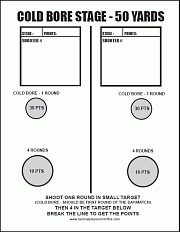
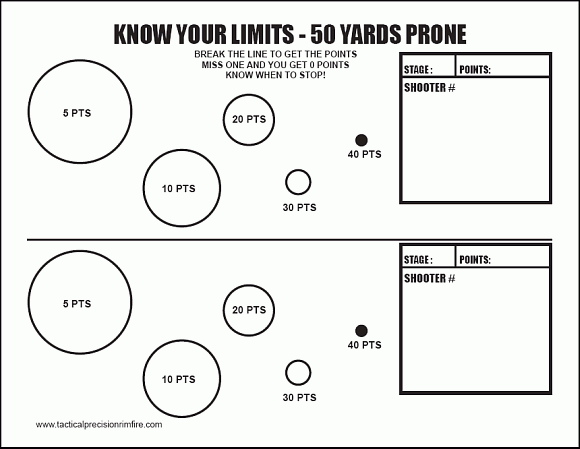
Here’s a rimfire training target with “big to small” target circles. Start with the largest circles, then move to the smaller ones in sequence. This systematic drill provides increasing challenge shot-by-shot. Novices often are quite surprised to see their accuracy improve as they move from bigger to smaller aiming points. That provides positive feedback — always a good thing.
Right Click and “Save as” to download printable PDF versions of target.
Looking for a very affordable first rifle? Or maybe you’re equipping a Scout troop with rimfires for marksmanship training. Here’s one of the best low-cost options you can find among .22 LR rimfire rigs. The Rossi RS22 is a reliable, semi-auto rifle that comes equipped with barrel-mounted iron/fiber optic sights. There are also dovetails on the receiver for mounting scope rings. The RS22 also takes most Mossberg 702 magazines.
The Rossi RS22 features an 18″ free-floating barrel, adjustable fiber optic sights and a synthetic Monte Carlo stock. For added accuracy, 3/8″ dovetail mounts allow the mounting of a scope or other optic.
Rossi RS22 Specifications:
Model: RS22 Semi-Auto, .22 LR
Barrel: 18″ Free-floating
Stock: Black Monte Carlo Synthetic Stock
Overall Length: 36.25″
Weight: 4.1 lbs.
NOTE: The Rossi RS22 on sale has a matte black stock.
Two Video Reviews of Rossi RS22
The above video review of the Rossi RS22 confirms its reliability and build quality. The reviewer praised the fiber-optic iron sights and liked the magazines. After fitting a scope to the rifle’s built-in dove-tail, the tester got excellent accuracy with CCI ammo at 25 yards. Ten shots basically formed one half-inch hole. (See video 8:24 – 8:50 and target at right.) That’s good enough for an NRL22 match. Pretty impressive for a $120 rifle!
Gunblast.com also tested the Rossi RS22. This “dandy little rifle” performed great, with flawless semi-auto feeding and cycling for hundreds of rounds. Accuracy was quite good. The tester praised the fit and feel of the stock and noted it has sling swivel studs and well-protected sights. The RS22 can also use 25-round Mossberg magazines.
Rimfire tactical-style matches are now one of the fastest-growing types of rifle competition in the country. The USA has seen a big growth in rimfire tactical matches over the last five years. NRL22 and PRS Rimfire matches are held throughout the country. Right now there are probably ten times as many rimfire tactical matches as sanctioned PRS and NRL centerfire matches. The reason is simple — rimfire ammo is much less costly, and clubs can run challenging rimfire tactical matches at nearly any outdoor gun range that allows shooting out to 200+ yards.
The National Rifle League (NRL) started off sponsoring major centerfire tactical matches, similar to PRS competitions. That proved successful so the NRL added a .22 LR Rimfire series, called NRL22. The NRL22 rimfire discipline has been a major success, as rimfire guns are fun to shoot and ammo is very affordable. The most popular NRL22 matches have drawn up to 200 rimfire competitors. And now PRS has its own PRS .22 Rimfire series. The big NETT PRS .22 match in Terrell, Texas takes place today July 2, 2022.
Precision Rimfire Match with Through-the-Lens Video
Here’s an interesting video featuring a top-tier .22 LR MDT-chassis rifle. The host, Pieter “Piet” Malan from South Africa, runs the excellent Impact Shooting YouTube Channel, which now has 320+ videos on target shooting and hunting. This video features a TriggerCam unit attached to the scope, so you can see hits on the targets, just as the shooter does.
NRL22 — Affordable, Challenging Rimfire Competition Series
NRL22 is a great way to get into competition shooting with minimal expense. There are five (5) classes: Open, Base, Ladies, Young Guns (8-16) and Air Rifle. Base Class is for the budget-minded shooter — the combined MSRP of Rifle and Optic may not exceed $1200.00 (so you could spend $700 on a rifle and $500 on a scope for example). That keeps the sport affordable. Open, Youth, and Ladies Classes have no price limits on Rifle and Optic. Visit NRL22.org to find an NRL22 match near you.
Precision Rimfire Competition Match Report
This excellent video covers a big rimfire precision match, the King of 0.28 Miles event, held at the Rush Lake Range in MN. The video shows multiple stages with targets out to 300 yards, followed by a 465-yard challenge. Host Dave shot the match with a Vudoo Gunworks V22 rifle in a Grayboe Ridgeback stock, with a Trijicon Accupower 4.5-30x56mm FFP scope. The ammo was Lapua Center-X, a top-tier choice.
Introduction to the .22 LR Rimfire Precision Game
The Modern American Rimfire Series (MARS) was created to offer “a practical/tactical event” that could be shot at modest distances. David Luu founded MARS (intially as the Mid-Atlantic Rimfire Series) to provide PRS-type competition at shorter ranges with more affordable ammo. Though the distances are shorter, the challenge remains: “Shooting a .22 LR at 200-yards is like shooting a .308 at 1,000-yards”, Luu told Guns.com. In this video, to help beginners get started, Luu provides a shortlist of beginner tips and tricks for rimfire PRS. The lead photo in this article come from the MARS website.
Rimfire Ammo Selection — Why Comparison Testing Is Important
Every gun and barrel is different, so you should test various ammo types in YOUR rifle. Additionally, you can benefit from lot testing with particular ammo types to optimize your ammo choice even more. If you’re serious about rimfire accuracy, lot testing can be very helpful, whether at your own rage or a testing center. There is no replacement for starting with a good lot of ammunition your rifle likes.
First Rimfire Precision Match — Lessons Learned
Here’s a helpful video for folks getting started in the Precision Rimfire game. Our buddy F-Class John, a top F-Open competitor (and YouTube video creator), is getting starting in the .22 LR precision discipline. Here he provides lessons learned from his first .22 LR precision match.
Tripod Review — Options for Precision Rimfire Shooters
The NRL22 match format is a great shooting discipline. NRL22 offers a high fun factor at relatively low cost. You don’t have to reload match ammo. A couple of 50-round boxes of .22 LR ammo will get you through the match. While some people bring lots of gear to matches, that’s by choice and not by necessity. You can keep it simple and still be competitive (and win).
Tips for NRL22 Competitors by Jonathan Ocab
I am a match director at my gun club and run our local NRL22 matches. People often ask me for tips for competing in NRL22. First, I recommend getting the course of fire for the month in advance and practicing those stages at the range. Here are other specific tips that should help NRL22 competitors improve their gun-handling and match results.
1. Dry Fire Practice — If you are not able to do live fire practice at the range, I encourage shooters to practice their shooting positions at home via dry fire. Setup props or barricades with pasters or other faux targets on a wall in the garage or inside the house and run through each stage.
2. Scope Magnification Level — The most common issue I see with newer shooters in NRL22 is the tendency to maximize their scope magnification. The timer will start, and the shooter gets into position on a target, but the scope is set to 15x or higher and the shooter can’t find the target. The shooter lowers the magnification, locates the target, and then increases the magnification again, takes the shot, transitions to another target, and repeats the process of decreasing magnification, locating target, etc. Novice NRL22 shooters should try using the mid-range magnification. Try shooting 7x-12x and learn to balance field of view and target image.
Precision Rifle Series (PRS) 22 Finale on Shooting USA
This week Shooting USA showcases the first-ever PRS Rimfire Finale. This new rimfire discipline is akin to Precision Rifle Series (PRS) centerfire tactical competition, but shot with .22 LR rimfire rifles. The inaugural PRS Rimfire Finale drew nearly 150 competitors to Texas, where shooters could compete without the cost of expensive centerfire ammo and without the need for a 1000-yard range. SEE: PRS Rimfire Series Info.
Shooting USA SHOW TIMES: This Shooting USA Episode airs Wednesday, June 15, 2022 at 9:00 PM Eastern and Pacific; 8:00 PM Central. If you miss the regular broadcast, you can stream the show online at any time on Vimeo for $0.99 per episode.
PRS Rimfire Finale — Nearly 150 Shooters in Texas
PRS and NRL tactical matches are among the fastest-growing competitive shooting disciplines. And rimfire tactical disciplines are actually growing even faster (than centerfire PRS/NRL) because .22 LR ammo is much cheaper than centerfire ammo, and there are many more ranges where rimfire matches can be held. PRS Rimfire offers the same kind of fun without the high cost of centerfire ammo and/or countless hours spent hand-loading. Rimfire PRS also offers generally less expensive rifles, and a whole lot less recoil. That’s why PRS Rimfire (as well as NRL22) has become so popular. And in the first year of the PRS Rimfire series, the Finale drew close to 150 competitors. The Finale Match was held at the Triple C Shooting Facility in College Station, Texas.
The Triple C Shooting Facility hosted the First Annual PRS Rimfire Finale. At this excellent Texas venue, match directors set out 20 unique courses of fire. There were the standard props you’d expect to see at any Precision Rifle match — tractor tires, wire spools, concrete culverts, and even cross tie bunkers. And the target placements were certainly challenging. Many of the stages had cross-course target lay-outs. This makes wind-reading much more challenging, especially with the relatively slow, low-BC .22 LR cartridges used in PRS rimfire competition.
Tune in to Shooting USA TV tonight. You’ll enjoy the coverage of this popular PRS rimfire sport, which we expect to grow significantly in 2022 and beyond. Notably, the National Rifle League (NRL) now conducts many more NRL22 matches than NRL centerfire matches. And competitors of course are drawn by the fun/challenge of a tactical match with much lower ammo costs — $0.15-$0.25/rd vs. $1.00/rd or more (counting brass, primer, bullets, powder, and barrel wear). And there are many more viable venues, because you only need a 300-yard (max) range to conduct a rimfire tactical match.
Our friends, Ed Mobley and Steve Lawrence, aka the “6.5 Guys”, have written an excellent article on getting started in practical/tactical competition. If you are new to the game, these tips can help you save money, progress faster, and have more fun. Here are article highlights, but we recommend you read the full story,5 Tips for Attending Your First Precision Rifle Match, onwww.65guys.com.
We often meet people who are new to long range precision shooting, and want to improve their knowledge and skill level. However, they aren’t sure if they are ready to sign up to compete in a match. They often ask, “What knowledge or skills are necessary to compete in a match?” Others may state, “I need to purchase this gear or that gear before I can attend a match”. For those guys who have a strong interest in precision rifle shooting, and who wish to chec out a precision rifle match, below are Five Tips to make it a positive experience.
TIP ONE: Make Plans and Commit to Go
First you need to start by finding a match to attend. This may entail a little bit of research and investigative work on your part to find what matches are scheduled in the next few months. We recommend starting with any match that may be within a reasonable driving distance. This may likely be a local “club” match, many of which are held on a regular basis. These make great venues because it will provide an opportunity to meet some of the regular attendees as well as shooters that are from your geographic area. Additionally, most of the smaller matches are a little more relaxed in terms of level of competitiveness.
Once you decide on the match you want to attend, do your homework. This means finding out if you need to pre-register or pre-pay the match fee. Commit to going by registering for the match and putting it on your schedule. Be sure to find other useful information for questions such as:
— What time should I arrive?
— Is there a mandatory safety briefing for new shooters at that venue?
— What is the travel time required to get to the match site?
— How many stages will there be?
— Is there a description of the stages available before the match?
— How many rounds should you bring?
— Are there special equipment requirements? (E.g. do you need chamber flags, is there a pistol stage?)
TIP TWO: Bring What You Have
(Don’t Spend a Fortune at the Start)
Some new shooters often assume they need a custom match rifle or all of the miscellaneous shooting gear associated with long range precision shooting to compete in match. While having a Kestrel weather meter and a high quality laser range finder and other shooting accoutrements are invaluable kit, you will find other shooters at your first match that will provide you with the information and coaching you need to get on target.
In fact, the only gear you really need to bring is a scoped rifle with a bipod and ammo capable of consistently shooting within one MOA. Also, be sure to know the ballistic drops or have a ballistic drop table prepared for your rifle/ammo to dial the correct DOPE on your scope for different target ranges. Many of the other participants at the match will be willing to let you borrow a support bag, bipod, tripod or other gear if you need one — just ask. Don’t use the excuse of not having the right gear to delay getting out to a match!
One reason not to make a big initial investment in a new rifle and assorted gear before competing, is we’ve seen a number of people come into the sport and try it for a year and then make the decision to move on to something else.
TIP THREE: Be Prepared to Learn
As a new shooter at a match, there is no better opportunity to learn. We often look to our local club matches as a group ‘training’ session to prepare for the bigger matches. You will find competitors at all levels of skill and many of your fellow shooters will enthusiastically provide helpful advice once they learn you are new to the sport. Take advantage of the opportunity to ask questions if you would like ideas for how to engage a stage, but also be sure to do more listening than talking as you receive guidance and tips from more experienced competitors.
Watch and observe other shooters and how they approach and ‘game’ a specific stage or course of fire. You’ll begin to recognize which shooting positions work best for different scenarios, and maybe even come up with some new ones that no one has thought of before.
Seeing what the better shooters do is an invaluable instructional tool. You can use your smart phone’s video camera to record other shooters (with their permission). When you’re ready to shoot, ask another shooter to record your performance. Watching yourself will point out needed areas of improvement.
After each match conduct an informal after action review and summarize for yourself the things that went well and what you should continue to do. You should also identify the specific shooting skills you should develop and make a plan to integrate the appropriate practice drills into your practice sessions. Finally, if you maintain a shooter’s data book or journal you’ll want to note things such as:
After Action Review – How you did, what went well, things you need to work on in practice. Stage Observations – Successful methods used for specific courses of fire. Note barricades, positions used, specific gear used for stages. Gear Observations – How your rifle/gear performed, what new items you should add to your “buy list”.
TIP FOUR: Be Safe and Have Fun
You’ve all heard a parent or teacher say, “It’s all fun and games until someone loses an eye.” The same can be said of the shooting sports. Safe handling of firearms is the number one rule at any match, and comes before the FUN part in terms of importance.
Before all matches start there will always be some form of a mandatory safety briefing. Make sure you know, understand, and follow any unique safety protocols for the match you attend. Some matches require all rifles have chamber flags inserted and are stowed in bags/cases while not on the firing line — other matches may not. If you run afoul of any safety rules, you risk the chance of being disqualified from a stage or worse, the entire match.
The second rule is simply have fun. This starts with having a good attitude throughout the day. Keep in mind that as a new competitor you should think of a match as a solid day of practice and training. If you blow a stage, use it as an opportunity to diagnose what you could have done differently or what you need to improve on — then smile and drive on.
Any day at the range or shooting is a good day. A match is an opportunity to hang out with like-minded people who are passionate about shooting and impacting targets far-far away. Life is great when you are doing what you enjoy!
TIP FIVE: Make Friends
There is no better way to meet lots of precision rifle shooters and make friends than at a match. The people that attend the tactical precision matches on a regular basis are those that have ‘fallen into the deep end of the pool’ and are really into the sport. As a result, they have become part of the local precision shooting community. As you strike up conversations at the match, find out if your new-found friends visit specific forum boards or social media outlets, or if there are other matches they attend.
Precision shooters tend to congregate and share information in different corners of the Internet. It will serve you well to meet some of the guys in person at matches and be able to connect a face to a screen name. As you develop your friendships and develop a level of trust, you will find opportunities become available to shoot with others in your local area, or get ‘read-in’ on a secret honey-hole of a spot to shoot long distance. Additionally, the local shooting community will often find it more convenient to sell or trade gear and equipment locally than deal with buyers/sellers that are out of state.
Do you own a Ruger 10/22? Here’s a new product you may want to acquire. Luth-AR’s new Modular Chassis Assembly (MCA) offers adjustability and features that can transform a 10/22 into a much more effective rifle for rimfire gun games. Priced at just $189.95, the new MCA-22 modular chassis is great for NRL22 competition, Tactical 22 matches, Steel Challenge, Practical Rimfire Challenge matches, as well as casual plinking.
The new MCA-22 Rimfire Chassis is compatible with the original Ruger 10/22 barreled action as well as 10/22 clone actions such as the PRP Rubicon.
A well-known seller of AR parts and accessories, Luth-AR now offers the MCA-22 Modular Chassis Assembly for 10/22-style rimfire barreled actions. The MCA-22 was developed by Roth Performance in conjunction with Luth-AR.
The MCA-22 Rimfire Chassis provides improved ergonomics and adjustability along with M-LOK mounting options. This can make your 10/22 more effective for rimfire competition shooting and general recreation use. The Ruger 10/22 (or similar) receiver, trigger group, and barrel can be easily installed in the MCA-22 chassis, which accepts standard or bull barrels with the use of an insert.
MCA™-22 features:
— Easy to install, light weight chassis and cost effective.
— Constructed with high-strength glass filled nylon, 6061 aluminum and steel.
— Designed for comfort and ergonomic control for wide range of body types.
— Ambidextrous goose-neck style pistol grip with palm swell.
— Aggressive grip panel and front grip strap texturing.
— Click-adjustable cheek piece.