Idaho-based Hooker Tactical Safety & Defense has introduced an interesting new product that records images and video directly from your scope’s eyepiece, while still allowing the shooter to look through the scope. This system, dubbed the Third-Eye Sharp Shooter Eye-Cam (“Eye-Cam”), fits a small (8 oz.) video camera directly to the eyepiece of a riflescope. The Eye-Cam outputs live video to an iPhone, lap-top computer, or DVR. One can easily imagine the benefits of such a system for tactical and law enforcement marksmen, as well as game hunters. The key elements of a tactical engagement can be recorded, in real time, for later review and analysis. Or a hunter can record the results of his shot at a “once-in-a-lifetime” bull elk.
No Scope Modifications Required
The water-, shock-, and dust-resistant Eye-Cam is easily installed, with no modifications to your scope. Your scope’s zoom, elevation, and windage controls are not altered, and there are no changes to point of aim or point of impact. Unlike most other video adapters for scopes, the compact Eye-Cam does NOT block off the shooter’s view through the eye-piece. You can continue to use the scope normally. Hooker Tactical claims that the Eye-Cam does not distort or change the image viewed through the scope: “The clarity of the image… is as accurate and dependable as if the [Eye-Cam] was not there.”
Comment: Despite Hooker’s claims, we do suspect that the shooter would notice a slight reduction in brightness, and possible softening of focus at the edges — simply as the result of having another piece of glass placed between his eye and the scope’s actual eyepiece.
Sharp Shooter Eye-Cam Costs $2370.00
The Hooker Tactical Eye-Cam retails for $2370.00. It weighs just 8 ounces. Hooker offers a variety of flexible collars that fit over scope eyepieces, allowing the Eye-Cam to be adapted to most popular scopes. Eye-Cams ship with collar of choice, video cables, power cable, 9-volt power supply, and a handy storage pouch. Hooker Tactical stands behind its product with a 2-year unconditional warranty for repair and replacement “with proper usage”. For more info, visit www.HookerTactical.com, or call Hooker Tactical at (208) 527-3395.
Editor’s Comment: This is an intriguing product. While the Eye-Cam’s utility for hunters and law enforcement marksmen is obvious, we think the Eye-Cam could benefit competition shooters as well. The Eye-Cam could be particularly effective in shooter training, allowing a coach to see how well his student actually responds to hold-off calls and wind reads. The recorded video could also allow a shooter to review the effects of mirage as he proceeded through a course of fire. Video would also help a shooter develop techniques to hold the gun more steady and have a better follow-through.
While the Hooker Tactical Eye-Cam is very expensive ($2370.00), we think this is the predecessor of future products that will provide a variety of digital viewing/recording options for rifle shooters. As such products evolve (and become more affordable), we predict digital viewing technology will benefit precision shooters in many ways.
Low-Cost Alternative MeoPix iPhone Adapter for Spotting Scopes
The Third-Eye Sharp Shooter Eye-Cam costs a whopping $2370.00. For a tiny fraction of that price (about $70), Meopta’s MeoPix digi-scoping adapter lets you record stills and movies directly to an iPhone from a spotting scope.
Though you won’t be able to record what you actually see through your riflescope, the Meopta adapter will perform many of the functions of the Eye-Cam, such as recording the results of hunting shots — so long as you’ve got your spotter aimed at the target. Meopta’s simple but cleverly-designed MeoPix lets you easily record photos and videos from your range and hunting sessions. Anything you can see through the spotting scope can be captured by an iPhone. Hunters can capture images of distant prey, and record successful shots on game.
The MeoPix bracket is a universal-type device that was developed to allow the iPhone 4 or 4s models to interface with ANY binocular or spotting scope eyepiece (fitted cup required). When mated to a long-range optic, the MeoPix transforms a smart phone into a handy, long-range photo and movie capturing tool. The Apple-approved MeoPix adapter attaches securely to the iPhone. Meopta claims the MeoPix bracket ensures precise alignment and excellent image quality.
Eye-Cam Tip by EdLongRange. We welcome reader submissions.
Background: Last year, when Leupold introduced its 1.1-8x24mm FFP Mark 8 CQBSS scope at a whopping $3,999.00 price, jaws dropped in the shooting world. Folks rightly wondered whether anyone (other than Uncle Sam) would pay four grand for a small, compact scope, even if it did offer a broad magnification range and other innovative features.
U.S. Optics SN-8 Is Thousands Cheaper than Mark 8
Well U.S. Optics has just undercut Leupold by a couple thousand dollars, providing a much more affordable 1-8X option for tactical shooters and 3-gunners. If you were thinking about the Mark 8, you better take a close look at the new 1-8x28mm SN-8 from U.S. Optics. From what we can see, the SN-8 performs on a par with the Mark 8, plus it features a true 1X magnification on the low end — which is best for fast, both-eyes-open target engagement. The new SN-8 is offered in two models. The 1-8x28mm SN-8 Standard version retails for $1945.00, while the higher-end version with Red Dot-equipped eyepiece runs $2445.00, still substantially under the cost of Leupold’s Mark 8. These new SN-8s should start shipping in June, 2012.
New “Slim-Line” Hunting Scopes from U.S. Optics
For 2012, U.S. Optics is bringing out a series of compact, light-weight “Slim-Line” hunting optics: 1.5-6X, 1-4X, and 3.2-17X. Though they offer a significant weight-savings over typical hunting scopes, these new Slim-Line hunting scopes are built for hard use, and U.S. Optics backs them with an impressive, transferrable, “full lifetime” warranty. Prices start at $1100.00 and the Slim-Line Hunting scopes should hit the market in late March or April, 2012. We like what U.S. Optics is doing with this “Slim-Line” scope series. For daylight deer and varmint hunting, many hunters are better served with a compact 1.5-6X variable, than with a large, bulky high-power scope with a relatively small field of view.
At SHOT Show, in addition to its all-new SN-8, U.S. Optics also showcased its innovative dual-focal-plane tactical scopes. Offered in 1-4X and 1.5-6X, these offer the best of both worlds. The FFP reticle allows consistent ranging at all magnifications, while the Second Focal Plane functionality allows more precise aiming, since reticle line thickness does not increase as the magnification goes up.
While we were somewhat disappointed that we didn’t see many all-new precision rifles at Media Day 2012, there were plenty of new riflescopes on display. Among the most impressive new optics were rugged new high-zoom-range, First Focal Plane (FFP) tactical scopes from Hensoldt (Carl Zeiss), Leupold and Trijicon. These new scopes all featured fat tubes, compact overall length, and abundant elevation travel. These lastest top-end FFP tactical scopes offer as much as 26-power in a form factor not much bigger than a “normal” 4-16X scope.
New 3.5-26x50mm Hensoldt Was Outstanding
Hensoldt showcased a very impressive, prototype 3.5-26x56mm FFP tactical scope. Though this scope offers a whopping 7.4X zoom range and 26-power on top, this new Hensold is relatively compact. The reticle in these prototype versions was a very useful (and simple) milradian-based reticle that we hope Hensoldt retains in the production versions. The Hensoldt boasted an impressive 36 Mils of total elevation travel in two (2) turns of the turret. The new Hensoldt still shares the same superior glass and compact size that puts these scopes at the top of their class. We tested a prototype mounted to an Accuracy International AX 338. Expect the production version to be the same size and cost approximately $4000.00.
As you can see in the video, the new Hensoldt coupled with the new Accuracy Int’l AX in 338 Lapua Magnum worked very effectively at 900 meters in some tricky winds. This combination made it fairly easy to break clay pigeons on the bank at 900 meters. Off camera this combination continued to show great accuracy and very effective design features.
New Leupold MK-8
Leupold showed off a brand new MK-8 3.5-25x56mm with a Horus reticle and a beefy main tube. Again, this featured a lot of elevation in one turn as well as a pinch-and-turn locking turrets. This is a big leap forward for Leupold and we feel this will be well-received in the tactical world. Along with the new MK8, we also sampled Leupold’s new MK6 3-18x50mm. This shared similar features as the 3.5-25, and was incredibly compact as well. We expect the MK8 to sell near $4000 and the MK6 to be substantially less, likely under $3000 according to company reps.
Trijicon made a departure from their standard fare and jumped into the tactical scope world with a beefy Front-Focal Plane 3-15x50mm. This featured a well-executed MOA-based reticle and turrets with 30 MOA per turn (a Milrad version offers 10 Mils per turn). The Trijicon showcased the “short and fat” appearance that seems to be the latest design trend in tactical scopes. But though the Trijicon had a fairly short OAL (for its zoom range), it was still quite heavy at 47 ounces. The glass in this prototype version was disappointing for a scope that will retail in the $4K range. Reps told us the production version glass would be much improved. (It had better be, if Trijicon hopes to play in this stratospheric price range.)
It was apparent at Media Day 2012 that scope companies have worked hard to provide more features and more performance in their high-end tactical scopes. Consequently, the latest generation of scopes offer some very interesting and useful innovations — wider zoom range, more compact size, more elevation travel per rotation, and “goof-proof” turret mechanisms. We can only hope that, with more competition in this market, prices may become more reasonable. $4000 is an awful lot of money to pay for a scope.
Zeiss Sports Optics has introduced a new “Duralyt” line of affordable hunting scopes — all made in Germany. The new 30mm CONQUEST Duralyt line-up has 1.2-5×36, 2-8×42 and 3-12×50 models. All three premium German-made Duralyt riflescopes are available with illuminated reticle #60 or non-illuminated reticle #6. The illuminated versions are great for low-light hunting, but they are much more costly. Illuminated model MSRPs run $200-$300 more than the unlit versions.
The CONQUEST Duralyt scopes are nitrogen-filled to remain waterproof and fog-proof. The illuminated reticle #60 features an extremely fine red dot in the center of the crosshairs. When turned off, the dot disappears and it looks identical to reticle #6). The daylight-visible illuminated reticle #60 was developed using fiber optic nanotechnology that produces the finest illuminated dot in its class –- covering just 0.3 inches at 100 yards on 12x magnification.
Duralyt prices, starting at $949.99 MSRP, are affordable when compared to other premium 30mm, European-made optics. Michael Jensen, President of Carl Zeiss Sports Optics, states: “The CONQUEST Duralyt represents the best value for a European-engineered riflescope. These riflescopes feature the mechanical precision that you expect from ZEISS, large fields of view, incredible daylight illumination and image quality that is absolutely outstanding for this class.”
Conquest Duralyt 1.2-5x36mm #60
wide field of view for dangerous game and tactical applications. $949.99 MSRP; $1,249.99 with illum.
Conquest Duralyt 2-8x42mm #6
Light, compact, best magnification choice for most hunting. $999.99 MSRP, $1299.99 with illum.
Conquest Duralyt 3-12x50mm, #60
50mm objec. for xlnt low light performance. $1049.99 MSRP; $1,349.99 with illum.
Here’s something that can save you lots of time and aggravation on a varminting trip. This little $110 gizmo is great for varmint hunters and any one who needs to make a quick shot in shifty wind conditions. Instead of the traditional 1/4-MOA hash marks, the Kenton windage turret features markers corresponding to the wind drift your ammo will encounter at various distances (with 10 mph full value winds). You just dial the distance.
Custom-Calibrated Windage Knobs
Kenton Industries’ Tuned Windage Compensator (TWC) has built-in windage marks for 10 mph cross-winds at 100-1000 yards. How do they do that? Well the knobs are calibrated either for specific calibers/loads, or they can make custom knobs using your observed field data. The knobs can compensate for various wind speeds (2-20 mph) and angles (15°- 90°), by applying some simple conversion ratios. As a general rule, with a “full-value”, i.e. 90°, crosswind, the wind drift will go up or down in direct proportion to the change in windspeed. That means, for example, a 10 mph crosswind will push the bullet twice as much sideways as a 5 mph crosswind.
Two versions of Kenton’s TWC knobs are offered. The $109.95 TWC #1 features calculated ballistics for standardized factory ammo for the caliber and barrel length you specify. The $109.95 TWC #2 feature customized windage settings based on bullet BC, environmental conditions, elevation, and ballistic information you provide.
Custom Elevation Knobs
Kenton also makes a $109.95 elevation-compensating TTC knob, that can be customized to your rifle. With this elevation turret, yardages are marked in 50-yard increments, and you can literally just “dial in your distance”. However, to work effectively the TTC knob must be tailored to a particular load (velocity and bullet). Moreover, actual bullet drop will differ with changes in altitude, temperature, and shooting angle — so it’s not as simple as it sounds, and you may need multiple knobs if you shoot a variety of loads. Kenton offers it TTC #1 model calibrated for standardized factory ammo. The TTC #2 is calibrated out to the maximum effective range of your cartridge based on bullet type, muzzle velocity, altitude, and temperature. Select the type of yardage format to be used. The #2 is recommended for wildcatters or for those who want to adjust to specific conditions. Lastly, a TTC #3 elevation knob is offered that relies on the purchaser’s actual recorded drop data from the field. The TTC #3 elevation knob will be calibrated based on the click-value or MOA you provide for each 50-yard increment.
Nikon has raised the bar in Spotting Scope technology. It has introduced the first-ever spotters with built-in Vibration Reduction. This may be a significant breakthrough. Image stabilization has revolutionized hand-held photography, and it could definitely improve the practical functioning of spotting scopes. If you have ever used a big, heavy spotting scope, you know that it is easy to induce vibration and shaking — merely with a heavy hand on the focus knob. And when the wind blows, a big scope acts like a sail, so it can wobble and vibrate in gusts. Just a small amount of shake or vibration can make it difficult to see your target, slowing down your target acquisition time considerably.
Nikon’s new 85mm EDG Fieldscopes are the first spotting scopes on the planet with lens-adjusting image stabilization. The EDGs employ a lens-shift type VR (Vibration Reduction) system that counters vibration and shaking. According to Nikon, the EDG VR system greatly reduces external vibrations caused by wind and the operational vibrations occurring during focusing, panning and tilting. Nikon claims its VR system reduces vibration to 1/8th the level of a conventional spotting scope.
HOW IT WORKS — This system uses two independent Angular Velocity sensors to detect pitching (vertical movement) and yawing (horizontal movement). Both sensors then detect diagonal movements. Upon the detection of movement, the sensors provide instructions to the two Voice Coil Motors (VCM) that command and control the Vibration Reduction-optical system to eliminate the shake or blurring. These sensors can detect movement every 1/1000 second. The system can effectively reduce vibrations by roughly 88% (compared to a conventional spotting scope), providing the equivalent of a shutter speed approximately two stops faster.
So how much does this new VR technology cost? Hold on to your hat — MSRP for the 85mm EDG VRs (either body style) is a shocking $5,499.95! At least that includes eyepiece and protective case. We can only hope that, as this technology matures, it will be implemented at much lower cost. Consider that $200.00 point-and-shoot cameras now offer image stabilization. Given time, we can expect the vibration reduction systems to go down in price, and to become commonplace in premium spotting scopes.
Available in a straight or angled body, the all-new EDG VR Fieldscopes come standard with a 20-60x Zoom Eyepiece, ED (Low-Dispersion) glass, and multi-coated lenses. The 85mm EDGs feature a five-meter close focus distance and waterproof, fogproof construction. Weighing in at just over 84 ounces (w/o batteries), the straight-body EDG is 14.9″ long, while the angled version is 15.7″ long. Nikon’s VR system takes four AA batteries which provide roughly 17 hours of battery life with alkaline batteries and up to 32 hours with lithium. While the VR function can be manually activated, an auto power-off function helps conserve battery life. Seven optional EDG eyepieces are available. Three tripod mount screw holes permit flexible mounting.
As a Cyber Monday Special, SWFA.com is offering 20% off its popular SS 5-20x50mm Tactical riflescope. This is a First Focal Plane (FFP) scope with 30mm body and side parallax focus. The turret clicks (Elevation & Windage) are 0.1 Mrad to match the illuminated mil-based reticle. Turrets have 10 Mils per revolution, with 30 Mils (100+ MOA) of total elevation travel. Regular price for this scope is $1299.95.
TODAY ONLY, November 28 (until midnight CST), the scope is 20% off with Coupon Code “20Off”. That cuts the cost to $1039.99 — a great price on a full-featured illuminated FFP tactical scope.
Discount tip from EdLongrange. We welcome reader submissions.
As a last-minute “surprise”, MidwayUSA has added a selection of Leupold VX-I and VX-II riflescopes to its list of Black Friday Bargain items. You can now save from $50.00 to $100.00 off the normal price of these popular, lifetime-guaranteed hunting scopes. Here are some of the Leupold scopes on sale today through 11/28/2011:
Leupold VX-I Rifle Scope 3-9x50mm LR Duplex
Was $319.99, now $249.99 – Save $70.00
Leupold VX-I Rifle Scope 3-9x40mm Duplex
Was $229.99, now $179.99 – Save $50.00
Leupold VX-II Ultralight Scope 3-9x33mm LR Dplx
Was $379.99, now $279.99 – Save $100.00
Leupold VX-II Rifle Scope 6-18x40mm Adj. Obj. LRV Duplex
Was $529.99, now $449.99 – Save $80.00
Amazon.com just listed 15 more Pentax PF-80ED Angled spotting scopes at $684.95 with FREE Shipping. While this price does NOT include eyepiece (20-60X zoom costs another $320.00 or so), this is a great deal on a high-quality 80mm spotting scope with great glass. You need to spend $2000.00 or more for a spotting scope that will significantly out-perform the Pentax PF-80ED. Also the Pentax eyepieces (purchase separately) are outstanding. READ MORE here.
Disclosure: AccurateShooter.com has an affiliate relationship with Amazon.com.
One cannot discuss one of the most useful tools for long range shooters, The Slope Doper, without saying something about its inventor, David Rolls. David was a bold man, bigger than life, who dedicated his life to the service of others. Yet, he was full of fun and a little mischief. He had little tolerance of fools (a man after my own heart), but had great respect for those who deserved respect. It was a loss to all when he passed away in August 2008 at the young age of 61. That being said let me tell you of how he lived and what he accomplished with The Slope Doper.
David Rolls’ Background
David worked for years with the Baltimore City Fire Department as a firefighter and paramedic, retiring at 45. Not being content to sit around, he applied for a job with the Sheriff’s Department of Mineral County, West Virginia and graduated from the state police academy. No small feat for a man of any age, let alone one in his forties. David rose to the rank of Sergeant and held that rank until his passing. As a firefighter, paramedic and police officer, he was the kind of man you would want if you were in a tight spot. He never backed down when it came to helping others. Throughout his life he was active in the Boy Scouts and community activities. He was a lifetime member of the NRA holding the status of Golden Eagle and Certified Firearms Instructor.
As a shooter, David was intensely interested in tactical competitions and was a member of the American Sniper Association. Long distance tactical shooters are frequently faced with the problem of making adjustments when shooting uphill or downhill, as well as windage and normal bullet drop. Chucks Hawks provided a superb discussion of the effects of uphill/downhill shooting for the hunter. I strongly urge every reader to look up Chuck’s article to better understand the problem.
Even knowing that we will be shooting over our target (or at best higher than our aiming point), most hunters do not know how to make the required adjustments in the field. Something had to be devised that could be used quickly in the field by the average hunter. Enter David P. Rolls!
Slope Doper Debuts in 1998 at Storm Mountain
After a great deal of thought, David showed up at the Carlos N. Hathcock II Charity Sniper Competition at the Storm Mountain Training Center in 1998 with a prototype of his Slope Doper. It was somewhat crude by comparison to the current day production model, consisting of a laminated paper protractor with a weight and string, but it worked. It allowed a shooter to determine the impact point of his bullet when shooting at any angle. David had succeeded in combining the science of mathematics with the practicality required for field use. It should be noted that military shooters have used protractors for years, but they had to subtract numbers to arrive at the correct angle. Dave’s invention placed the zero degree point at the top of the arc, virtually eliminating the possibility of error. Ever the perfectionist, with an eye to the future, he asked his best friend, Fred Fischer to design a “professional” version with AutoCad, which Fred gladly did. Fred also had contacts with a manufacturer who happened to be a shooter and they were off. Fred still chuckles when he remembers all of the last minute changes that Dave came up with, but at least they had the basic artwork locked into the AutoCad program to go into production. The rest is history.
The Quantico marine sniper instructor who was the first military member to see a production version of the Slope Doper (and incidentally a member of the two-man team who won the Carlos Hathcock Sniper Competition) was impressed enough by it to remove his personal protractor from his data book and replace it with the Slope Doper David gave him. The Slope Doper is now standard issue with the Marine Corp sniper weapon system; The Slope Doper is packed with each rifle and its accessories. The pointer is easily replaceable with string and a weight if it is lost and the printing on both sides is actually fire resistant. It is mil spec and made to withstand combat conditions. It is aluminum rather than plastic, so that it will not break in cold conditions.
To understand how the Slope Doper works, it is best for me to let David tell you in his own words:
To begin with, you must understand that when you shoot up or downhill, gravity has a diminished effect on your projectile such that if you do not make any adjustment for angle, you will likely shoot over your target. This applies at long distances (greater than 300 yards) at slight angles and at severe angles (greater than 30 degrees) at lesser distances. With slight angles at short distances the adjustment may not be enough to worry about. The Slope Doper is a photo etched, anodized, aluminum plate that has two scales inscribed along an arc. The first scale tells you the angle in degrees, the inner scale gives you the cosine of the angle (what I call the “Slope Angle Factor”) at 10 degree intervals.
To use the Slope Doper, you must first know the range to your target. Next you have your partner (guide) hold the Slope Doper along side the bore centerline of your rifle while you take aim and read the Slope Angle Factor. If you are alone, you can sight your target along the top edge of the Slope Doper and capture the pointer with your thumb and then read the Slope Angle Factor. If you are not at an exact Slope Angle Factor, it is easy to interpolate. Now take the known distance and multiply that by the Slope Angle Factor. The answer you get is the effective range. You should now shoot as if the actual distance is the lesser distance (at 30 degrees, a Slope Angle Factor of 0.87, 500 yards becomes 435 yards). All other environmental factors, like wind, are still in effect at the actual distance (500 yards of wind is still 500 yards of wind).
To make my life easier, I attached some Velcro to the back of my Slope Doper and on the forend of my rifle. After using my rangefinder for distance, I simply point my rifle at the target, capture the pointer with my thumb, read the Slope Angle Factor, make a quick mental calculation and shoot. If you are an experienced shooter with a scope that has a mil dot reticule, the back of the slope doper has your ranging formulas. The Slope Doper is a must-have for every person who hunts in mountainous country, from the Appalachians to the Rockies. It will help prevent you from missing your quarry. It is a bargain when compared to the $300 – $500 we pay for our rangefinders and binoculars. You can purchase the Slope Doper directly from the Slope Doper Website for $24.95 plus $5.00 shipping (PayPal or mail-order). U.S. Tactical Supply also sells the Slope Doper for $24.95.
A final note: I was watching the Outdoor Channel last week and watched a hunter on a ridge shoot over a 6×6 bull elk in the valley below. The elk disappeared, and the show ended with the hunter and guide talking about the thrill of the chase, even though they missed the elk. Good for public relations, but not so good for the freezer. They should have had The Slope Doper!


 Sharp Shooter Eye-Cam Costs $2370.00
 Low-Cost Alternative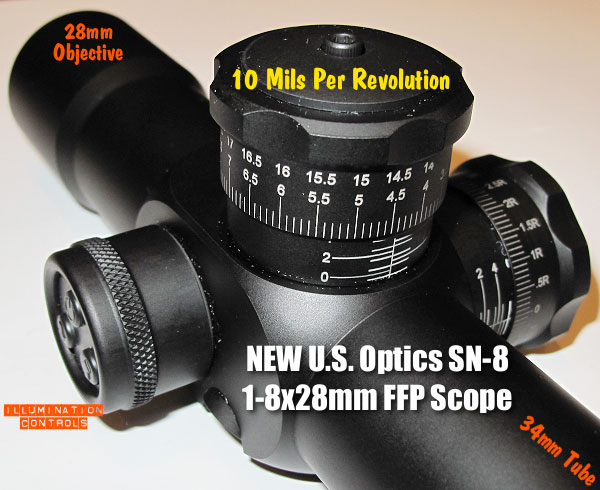


 Trijicon made a departure from their standard fare and jumped into the tactical scope world with a beefy Front-Focal Plane 3-15x50mm. This featured a well-executed MOA-based reticle and turrets with 30 MOA per turn (a Milrad version offers 10 Mils per turn). The Trijicon showcased the “short and fat” appearance that seems to be the latest design trend in tactical scopes. But though the Trijicon had a fairly short OAL (for its zoom range), it was still quite heavy at 47 ounces. The glass in this prototype version was disappointing for a scope that will retail in the $4K range. Reps told us the production version glass would be much improved. (It had better be, if Trijicon hopes to play in this stratospheric price range.)


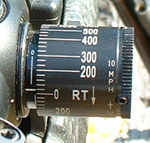 Here’s something that can save you lots of time and aggravation on a varminting trip. This little $110 gizmo is great for varmint hunters and any one who needs to make a quick shot in shifty wind conditions. Instead of the traditional 1/4-MOA hash marks, the Kenton windage turret features markers corresponding to the wind drift your ammo will encounter at various distances (with 10 mph full value winds). You just dial the distance.


 As a Cyber Monday Special, SWFA.com is offering 20% off its popular SS 5-20x50mm Tactical riflescope. This is a First Focal Plane (FFP) scope with 30mm body and side parallax focus. The turret clicks (Elevation & Windage) are 0.1 Mrad to match the illuminated mil-based reticle. Turrets have 10 Mils per revolution, with 30 Mils (100+ MOA) of total elevation travel. Regular price for this scope is $1299.95.
 As a last-minute “surprise”, MidwayUSA has added a selection of
 One cannot discuss one of the most useful tools for long range shooters,


