|
|
March 16th, 2010
MidwayUSA has cut the price on its Frankford Arsenal 6″ Electronic Calipers from $21.99 to just $12.99. This stainless steel caliper features a high-contrast LCD readout, and it comes with a fitted plastic case and 1.55 volt battery. With the touch of a button the tool switches from inch units to Metric units and back again. Claimed measuring accuracy (resolution) is +/- .001″.

We’ve used Frankford Arsenal calipers before. Though they won’t compare to a Mitutoyo, they are adequate for many basic reloading tasks. You can use these as a backup tool carried in your range bag or vehicle glovebox. The $12.99 price (good through March 31, 2010) is the lowest we’ve seen from MidwayUSA in a long time. Unlike some of the no-name electronic calipers sold on eBay or at Harbor Freight, the $12.99 Frankford Arsenal caliper are CE Certified and carry a one-year warranty against manufacturing defects.
February 25th, 2010
 How would you like a full-length sizing die perfectly fitted to your fired brass? At one time that required you to purchase a die blank, a special undersized reamer (a chamber reamer is too big), and send the work out to a skilled gunsmith. You could expect to have $250-$350 tied up in your custom die when all was said and done. How would you like a full-length sizing die perfectly fitted to your fired brass? At one time that required you to purchase a die blank, a special undersized reamer (a chamber reamer is too big), and send the work out to a skilled gunsmith. You could expect to have $250-$350 tied up in your custom die when all was said and done.
Now Hornady’s custom shop offers a much less expensive alternative. For $121-$140, plus shipping, Hornady will produce a custom-made die based on your reamer print, spec sheet or fired brass. Lonnie Hummel and his team of skilled machinists have produced custom dies for many top shooters. Scott Parker had Hornady produce a custom full-length die for Scott’s 6BRX. Scott reports: “The die is great. I’m very impressed. The die is a perfect fit for my brass and the sized brass has very low run-out.”
Hornady’s non-bushing custom full-length sizing dies cost $121.00 for cases up to 2.60″ COAL, or $140.00 for cases 2.60″-2.99″ long. Add $20-$25.00 if you want a custom, non-micrometer seater die also. Hornaday also offers custom “match grade” bushing dies — both FL-sizing dies and bushing neck-sizers. These “match grade” (bushing-equipped) sizing dies (FL, or neck-only) cost $152.00 up to 2.60″, or $166.00 for longer dies.
To order any type of Hornady custom die (bushing or non-bushing) we recommend you send 3 or 4 fired cases along with a reamer print to Lonnie Hummel at Hornady Mfg., Box 1848, Grand Island, NE, 68802. Give Lonnie a call first at (800) 338-3220, ext. 208, to discuss design details and get an estimated delivery date.

February 13th, 2010
 This may surprise you. We’ve learned that the time interval between neck-sizing operation and bullet seating can have dramatic effects on neck tension (as measured by the force required to seat bullets). Controlling neck tension on your cases is a very, very important element of precision reloading. When neck tension is very uniform across all your brass, you’ll see dramatic improvements in ES and SD, and your groups will shrink. Typically you’ll also see fewer fliers. Right now, most reloaders attempt to control neck tension by using different sized neck bushings. This does, indeed, affect how firmly the neck grips your bullets. But time of loading is another key variable. This may surprise you. We’ve learned that the time interval between neck-sizing operation and bullet seating can have dramatic effects on neck tension (as measured by the force required to seat bullets). Controlling neck tension on your cases is a very, very important element of precision reloading. When neck tension is very uniform across all your brass, you’ll see dramatic improvements in ES and SD, and your groups will shrink. Typically you’ll also see fewer fliers. Right now, most reloaders attempt to control neck tension by using different sized neck bushings. This does, indeed, affect how firmly the neck grips your bullets. But time of loading is another key variable.
James Phillips discovered that time is a critical factor in neck tension. James loaded two sets of 22 Dasher brass. Each had been sized with the SAME bushing, however the first group was sized two weeks before loading, whereas the second group was neck-sized just the day before. James noticed immediately that the bullet seating effort was not the same for both sets of cases — not even close.
 Using a K&M Arbor press equipped with the optional Bullet-Seating Force Gauge, James determined that much more force was required to seat bullets in the cases which had been neck-sized two weeks before. The dial read-out of seating force for the “older” cases was in the 60s, while the seating force for the recently-neck-sized cases was in the 20s. (These numbers loosely correspond to the amount of force required to seat the bullet). Conclusion? In the two weeks that had elapsed since neck-sizing, the necks continued to get tighter and stiffen. Using a K&M Arbor press equipped with the optional Bullet-Seating Force Gauge, James determined that much more force was required to seat bullets in the cases which had been neck-sized two weeks before. The dial read-out of seating force for the “older” cases was in the 60s, while the seating force for the recently-neck-sized cases was in the 20s. (These numbers loosely correspond to the amount of force required to seat the bullet). Conclusion? In the two weeks that had elapsed since neck-sizing, the necks continued to get tighter and stiffen.
When we first posted this information, it spawned some debate. Many people said they have observed the same thing, but the question is why? Something seems to happen over time that makes the necks less “springy”. Our theory is that, over time, the necks (as sized) are taking a “set” and seem to lose elasticity or the ability to stretch. When they are freshly sized, the neck material seems to be more ductile and expands more readily as the bullet is seated.
In a comment to this post, Steve Blair offered this explanation of how case necks can change over time: “When [metal] material is cold worked, the lattice stresses induced may not be uniform and immediately realized. The grain structure can continue to change for some time, becoming harder and less ductile as the lattice deforms further. Seating a bullet in a case neck provides ongoing radial stress to which the metal will respond over time.”
Concerning the seating force numbers (20 vs. 60) — keep in mind that the K&M simply has a dial read-out activated by a Belleville washer stack with a link rod. This isn’t an ultra-precise measure of force. But you CAN feel the difference between a 20 dial position and a 60. If you use the K&M you’d see what I mean -– the needle tends to swing back and forth as the bullet is seating. What you want to watch for is the max reading and “spikes” in the seating force. I think what is going on is the resistance to seating goes up as the brass becomes less elastic over time.
Lesson learned: For match rounds, size ALL your cases at the same time. If you want to reduce neck tension, load immediately after sizing.
Whether or not you accept the notion that case-neck bullet seating resistance rises with time (you’ll need to do your own experiments), it makes sense to size all your match cases at the same time, and then seat all the bullets you need for a match at the same time. If, for example, you need 200 rounds for an upcoming match, you don’t want to size all 200 cases and seat 100 bullets the same day, and then load the remaining 100 rounds three weeks later. Almost certainly you’ll find some difference in neck tension. That variance in neck tension may show up on the target.
This brings up another point — to minimize velocity variances from round to round, it makes sense to shoot the ammo you load in the same order it was loaded (or exact inverse order). That way, if you have some scale drift over time, causing small changes in powder charges, the shot-to-shot variation is reduced.
January 30th, 2010
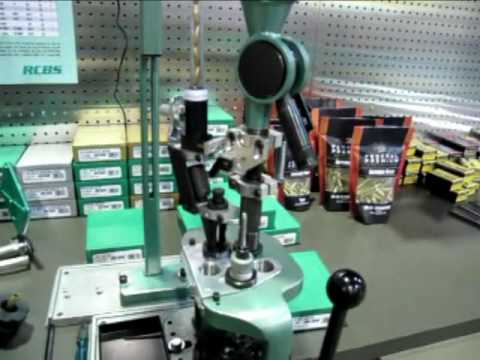
Kent Sakamoto of RCBS showed us the new RCBS products for 2010. The big news for reloaders is an automated, .22-caliber bullet feeder for the RCBS Pro 2000 progressive press. This caliber-specific bullet feeder cycles 22-cal bullets directly into a modified seating die. Now you can load all kinds of 22-cal cartridges without even handling the bullets. The bullet feeder is a simple, bolt-on upgrade to the Pro 2000 press, and it can also be adapted to Hornady’s Lock-N-Load progressive, according to Sakamoto. The new bullet feeder utilizes the RCBS electric collator/hopper, which feeds the bullets from an elevated bin. The 22-cal bullet feeder will be available in March 2010, with a 30-cal version to be released later in the year.
At Media Day, RCBS also showcased its long-awaited new AmmoMaster chronograph. Designed as an affordable, entry-level chrono, the new RCBS AmmoMaster is completely self-contained. All components, including cables and sky-screen, pack up into the central chrono “body” which is shaped like a giant cartridge case. The detachable control/display assembly (shaped like a bullet) can be positioned on your shooting bench for ease of access. The AmmoMaster chrono retails for about $125.00, making it one of the most affordable chronos on the market. It is available right now at leading vendors, including MidwayUSA (product #911572).
January 22nd, 2010
Gas gunners take note — for 2010 Redding has created new “National Match” reloading sets in .223 Remington, .308 Winchester, and 30-06 Springfield. These new three-die sets are designed expressly for the AR15, M1A, and M1 Garand used in High Power comps and Garand matches. These kits include a full-length sizing die, a Competition Seater Die, and a taper crimp die. Previously these dies were only offered individually. If you’re shooting an AR, Garand, or M1A, these new sets may be just what you need.

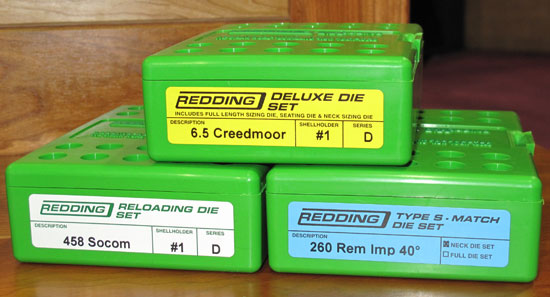
In addition to the National Match die sets, Redding has added new calibers to its die catalog for 2010. Complete die sets will now be offered for the popular 6.5 Creedmoor, the 260 Rem Improved 40° (also know as the 260 Ackley), and the 458 Socom. This should please the growing numbers of High Power shooters using the 6.5 Creedmoor, and the tactical guys looking for more velocity than a standard 260 Rem can deliver.
New Complete Basic Reloading Set
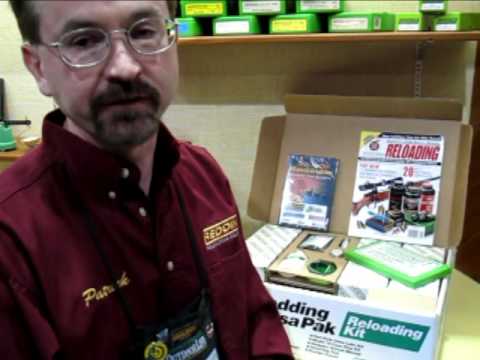
For shooters just getting started in reloading, Redding has put together a new basic reloading package that contains virtually everything you need except a press and dies. Redding’s new Versa Pak includes a reloading scale, powder measure, case trimer, powder trickler, case lube pad, funnel, deburring tool, and other case prep tools. In addition, the Versa Pak comes with the Hodgdon Reloading Manual and Redding’s excellent Advanced Handloading DVD. The Versa Pak will retail for about $350.00. That may sound like a lot, but if you add up the cost of all the gear included in the Versa Pak, it is a good value. You’ll also save time (and shipping costs) by acquiring all the essential tools at one time.
January 22nd, 2010
Hornady is late to the party with its first electronic powder scale and dispenser, but the new Hornady AutoCharge looks impressive. This product competes directly with RCBS’s popular ChargeMaster 1500. Similar in size and layout to the ChargeMaster, the new Hornady AutoCharge has three (3) speed modes, and will be more affordable than the Chargemaster. We like the idea of three user-selectable speeds, a feature not found on other digital dispensers from Lyman, PACT, and RCBS. The Hornady Autocharge also has calibration weights suited to both low and high powder charges. Hornady claims accuracy of ± 0.1 grain, the same as the ChargeMaster.
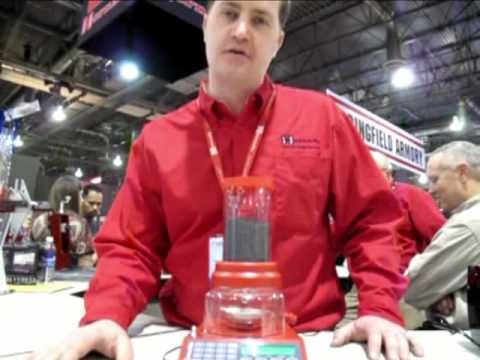
Hornady won’t start shipping the AutoCharge until April, 2010, so we’ll have to wait until late spring to get a test unit. Then we can see how the AutoCharge performs and see if it can really deliver repeatable ± 0.1 grain precision. We do predict that when the AutoCharge starts shipping in April, it will offer stiff competition for the RCBS ChargeMaster. Hornady’s red AutoCharge will sell for approximately $300.00. That’s about $75 less than the RCBS ChargeMaster 1500 scale/dispenser.

January 21st, 2010
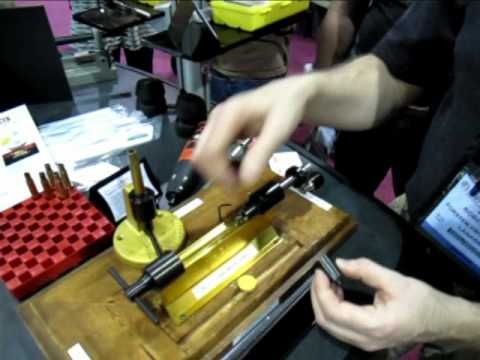
We saw a cool new product at the Forster Products booth. Forster has introduced a new 3-in-1 Carbide cutting tool that works with all existing Forster case trimmers. This unit does three jobs at the same time. It trims the case to length, it puts a 14-degree chamfer on the INSIDE of the neck, AND (last but not least), it cuts a 30-degree chamfer on the OUTSIDE of the neck. It does this all quickly and efficiently — in a matter of a few seconds. We tested the new tool ourselves on a few cases. The tool is solid and well made. The carbide cutting tips do perform a very clean cut. Be aware, however, if you have turned your necks already, you may have to reset the blade positions before you start trimming your brass.

Forster’s CFO, Robert Ruch, demonstrates the 3-in-1 case trimming/chamfering tool in the video below. As you can see, the tool turns very smoothly (no chatter) and the job is finished in a few seconds. The actual cutting time, per case, is just a few second. The tool has an MSRP of $70.00, but we expect it to sell for around $50.00 at major vendors. It can be fitted on Forster trimmers and other hand lathes with a .490″ shaft diameter.
January 12th, 2010
You can quickly access loads for Alliant powders via Alliant’s Online Reloading Guide. There you’ll find hundreds of recipes for rifle loads, pistol loads, and shotshell loads. While it’s great to have web-based reloading info when you have a live internet connection, you can also download the Alliant Reloaders’ Guide in PDF format. That way you can archive the guide on your computer, or keep the file on a portable computer for use in the field or workshop.

CLICK HERE to download ALLIANT RELOADER’S GUIDE (PDF format).
Alliant’s 47-page PDF Reloader’s Guide includes recipes for shotgun, pistol, and rifle. This guide includes important safety instructions, plus reloading data for most popular cartridges. The guide includes Alliant’s new Reloder 17 and Power Pro powders. Unfortunately the listed loads for centerfire rifles only include Speer bullets.
FREE Reloader’s Guide Print Version Offered
You can also CLICK HERE to order a FREE printed version of the 2010 Alliant Powder Reloader’s Guide. Just fill out your name and address. Allow 3-4 weeks for delivery.
January 7th, 2010
 Hodgdon Powder Company announced that an error occurred in printing of the 2010 version of the Hodgdon Annual Manual. Pages 108 and 109 in the manual, which cover 7mm caliber load data, appear in reverse order. But don’t despair — you can get a free correction from Hodgdon. Do not use the 7mm caliber data as it appears in the 2010 Hodgdon Annual Manual until the corrected copy is received. Hodgdon Powder Company announced that an error occurred in printing of the 2010 version of the Hodgdon Annual Manual. Pages 108 and 109 in the manual, which cover 7mm caliber load data, appear in reverse order. But don’t despair — you can get a free correction from Hodgdon. Do not use the 7mm caliber data as it appears in the 2010 Hodgdon Annual Manual until the corrected copy is received.
Contact Hodgdon Powder Company for a free reprint of pages 108-109. You can phone 913-362-9455, fax 913-362-1307, or send email to help@hodgdon.com. You can also send postal mail to: Hodgdon Powder Co., 6231 Robinson, Shawnee Mission, KS 66202
All Hodgdon, IMR®, and Winchester® reload data is also available on-line at hodgdon.com, imrpowder.com, and wwpowder.com in the Reloading Data Center.
December 6th, 2009
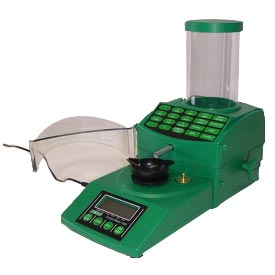
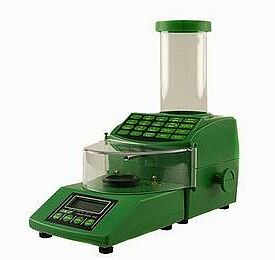 The RCBS ChargeMaster 1500 electronic powder scale and dispenser is the most popular product of its kind on the market. In our original Electronic Powder Dispenser Comparison Test, the ChargeMaster normally dispensed most kinds of powder faster than competitive units from Lyman and PACT. However, after the initial release of the ChargeMaster 1500, RCBS “tweaked” the software a bit to achieve more consistent charge-throws. This slowed down the process somewhat. Some owners have wanted to speed up their ChargeMaster. This IS possible with a relatively simple reprogramming. Most of the internal parameters of the Chargemaster can be modified, under guidance from the tech staff at RCBS. The RCBS ChargeMaster 1500 electronic powder scale and dispenser is the most popular product of its kind on the market. In our original Electronic Powder Dispenser Comparison Test, the ChargeMaster normally dispensed most kinds of powder faster than competitive units from Lyman and PACT. However, after the initial release of the ChargeMaster 1500, RCBS “tweaked” the software a bit to achieve more consistent charge-throws. This slowed down the process somewhat. Some owners have wanted to speed up their ChargeMaster. This IS possible with a relatively simple reprogramming. Most of the internal parameters of the Chargemaster can be modified, under guidance from the tech staff at RCBS.
Gunsmith and Forum member NAT Lambeth reports: “I thought My RCBS ChargeMaster 1500 Combo was fast enough. But I still called RCBS and asked for the programing changes to see if I could speed it up. It was a lot easier than I thought. My 1500 Combo was taking from 15-30 seconds to dispense the powder to the tenth of a grain. I reprogrammed the numbers and now it takes between 7 and 15 seconds to dispense to a tenth. This effectively doubled my loading speed. I only changed the HSB_A1, HSB_B1, and BSP_C1 settings.”
Key ChargeMaster Parameters with Default Settings
HSB_A1 (15.68) Grains under target weight to go from full to high speed
HSB_B1 (3.42) Grains under target weight to go from high to slow speed
BSP_C1 (1.08) Grains under target weight to go from slow to final trickle speed
Nat cautions that you should talk to a RCBS tech before attempting to re-program your ChargeMaster: “You will benefit from talking to the RCBS tech. I have now gone back and played with the numbers a couple of times. (The numbers given to me by the tech at RCBS were still a little conservative.) I think each machine may have its own likes and dislikes. If you get too aggresive with lowering your numbers it will over-throw your intended load.”
 Source for ALL the Parameters Source for ALL the Parameters
There is an extensive discussion of RCBS ChargeMaster programming on the South Africa Hunting Rifle Shooting Assn. (SAJSV) Forum. In this SAJSV Forum ARTICLE, Jaco Brink lists virtually all the programming codes. Importantly, Jaco also provides the default values for various parameters. This is very important, because the ChargeMaster does not have a “return to default” option. Once you change any value, if you want to return to the original value you must enter it manually. Jaco cautions: “I have to advise you to only make changes to your scale if you are confident to do so, and remember that there is not a ‘return to default’ setting in the scale. If all else fails return your scale to the default settings [I have listed].”
CLICK HERE for list of RCBS ChargeMaster Default Programming Values
Use a McDonald’s Straw to Reduce “Over-Throws”
Jaco Brink provided another useful tip to avoid “over-throws” (excess charge weight): “The RCBS employee advised me to take a McDonnell’s straw (because it is thicker than a normal straw), cut off about a half inch piece and put it into the tube where the powder exits. This caused the last [few kernels] of an extruded powder to cluster less, and reduced the amount of overthrows dramatically.”
CLICK HERE for more ChargeMaster 1500 optimization TIPS.
|


