If you will be flying with firearms this holiday season, you should read this article. You need to familiarize yourself with current Federal Regulations on gun transport before you get anywhere near an airport. Thankfully, the Transportation Security Administration (TSA) has a web page that states the important requirements for airline passengers traveling with firearms and/or ammunition.
TSA Tips on Traveling with Firearms:
You’ll want to visit the TSA Firearms and Ammunition webpage, and read it start to finish. In addition, before your trip, you should check the regulations of the airline(s) with which you will fly. Some airlines have special requirements, such as weight restrictions.
Here Are the TSA’s Key Guidelines for Travel with Firearms:
1. All firearms* must be declared to the airline during the ticket counter check-in process.
The term firearm includes:
– Any weapon (including a starter gun) which will, or is designed to, or may readily be converted to expel a projectile by the action of an explosive.
– The frame or receiver of any such weapon.
– Any firearm muffler or firearm silencer.
– Any destructive device.
2. The firearm must be unloaded. As defined by 49 CFR 1540.5 – “A loaded firearm means a firearm that has a live round of ammunition, or any component thereof, in the chamber or cylinder or in a magazine inserted in the firearm.”
3. The firearm must be in a hard-sided container that is locked. A locked container is defined as one that completely secures the firearm from being accessed. Locked cases that can be pulled open with little effort cannot be brought aboard the aircraft.
4. If firearms are not properly declared or packaged, TSA will provide the checked bag to law enforcement for resolution with the airline. If the issue is resolved, law enforcement will release the bag to TSA so screening may be completed.
5. TSA must resolve all alarms in checked baggage. If a locked container containing a firearm alarms, TSA will contact the airline, who will make a reasonable attempt to contact the owner and advise the passenger to go to the screening location. If contact is not made, the container will not be placed on the aircraft.
6. If a locked container alarms during screening and is not marked as containing a declared firearm, TSA will cut the lock in order to resolve the alarm.
7. Travelers should remain in the area designated by the aircraft operator or TSA representative to take the key back after the container is cleared for transportation.
8. Travelers must securely pack any ammunition in fiber (such as cardboard), wood or metal boxes or other packaging specifically designed to carry small amounts of ammunition.
9. Firearm magazines and ammunition clips, whether loaded or empty, must be securely boxed or included within a hard-sided case containing an unloaded firearm.
10. Small arms ammunition, including ammunition not exceeding .75 caliber for a rifle or pistol and shotgun shells of any gauge, may be carried in the same hard-sided case as the firearm, as long as it follows the packing guidelines described above.
11. TSA prohibits black powder or percussion caps used with black-powder.
12. Rifle scopes are not prohibited in carry-on bags and do not need to be in the hard-sided, locked checked bag.
More Airline Travel Tips from Tom McHale
Tom McHale has written an excellent article for the Beretta Blog, Ten Things You Need to Know about Flying with Guns. We suggest you visit the Beretta Blog to read this informative story. Here are two of Tom McHale’s Travel Tips:
Weigh your gun case and ammunition
Most airlines will allow up to 11 pounds of ammunition. And, like any luggage, you will be charged more for any baggage weighing more than 50 pounds. This sounds like a lot, but when traveling to the Crimson Trace Midnight 3 Gun competition last year, my case with shotgun, rifle, pistol and ammunition tipped the scale past the 50 pound mark.
Pack ammo in the same locking case
This is another area that’s misunderstood and full of internet myth. Your ammo just needs to be stored in some type of safe container and not loose. Technically, you can keep ammunition in magazines, but I wouldn’t recommend it. It meets the letter of the law storage requirement, but too many airline and TSA agents will give you grief. Use a plastic ammo box or original cardboard packaging and you’ll be fine carrying that in the same lockable case as your gun.
*Please see, United States Code, Title 18, Part 1, Chapter 44 for information about firearm definitions.
If you plan to travel far from home this year with firearms, then you should research legal requirements before you head to the airport or hit the road in your car or truck. To help Road Warriors, The Shooting Wire website recently published an excellent article concerning Travel with Firearms. This helpful article by Joe Balog features smart advice from 3-Gun competitor Rich Yoder.
Here are Highlights from the Travel with Firearms Article…
Traveling by Road:
Regulations for transporting firearms in a vehicle vary from state to state. Some are quite lenient, while others are much stricter. Within many states, gun transportation laws also vary considerably from jurisdiction to jurisdiction. If possible, keep your gun cases locked in your vehicle’s trunk or truck bed, as long as your bed has weather-tight and lockable security. If your guns are outside the passenger compartment, in a case, unloaded, and kept separate from ammunition, you’ll be in compliance with all but the strictest of local and state gun laws.
Traveling by Air:
When checking in at the airport, travelers need to declare that they are traveling with a gun. At that point, airline personnel will quickly advise the traveler of the need to open his or her case and inspect the firearm. Always wait for the TSA inspector before unlocking or opening the case, and only do so when clearly directed to do so by TSA personnel. Never take a firearm out of its case in an airport.
You have the right to remain with your firearm at all times during the inspection process. Never leave your firearm until the inspection is complete, the case has been re-locked, and you are in possession of the key or combination.
Traveling Overseas:
There are additional steps during international travel. Specifically, guns must clear customs in the destination country, and once again when entering back into the United States. Multiple government forms may need to be completed and carried with the firearm, like U.S. Customs Form 4457. Be sure to check into all required paperwork well before traveling.
Airport photo by Politikaner under Creative Commons License.
Thanksgiving is almost here. We know many readers will soon be traveling to spend the holiday with family members. If you will be flying with firearms this November, you should read this article. You need to familiarize yourself with current Federal Regulations on gun transport before you get anywhere near an airport. Thankfully, the Transportation Security Administration (TSA) has a web page that states the important requirements for airline passengers traveling with firearms* and/or ammunition.
You’ll want to visit the TSA Firearms and Ammunition webpage, and read it carefully. In addition, before your trip, check the regulations of the airline(s) with which you will fly. Some airlines have special requirements, such as weight restrictions.
Here are the TSA’s key guidelines for travel with firearms:
More Airline Travel Tips from Tom McHale
Tom McHale has written an excellent article for the Beretta Blog, Ten Things You Need to Know about Flying with Guns. We suggest you visit the Beretta Blog to read this informative story. Here are two of Tom McHale’s Travel Tips:
Weigh your gun case and ammunition
Most airlines will allow up to 11 pounds of ammunition. And, like any luggage, you will be charged more for any baggage weighing more than 50 pounds. This sounds like a lot, but when traveling to the Crimson Trace Midnight 3 Gun competition last year, my case with shotgun, rifle, pistol and ammunition tipped the scale past the 50 pound mark.
Pack ammo in the same locking case
This is another area that’s misunderstood and full of internet myth. Your ammo just needs to be stored in some type of safe container and not loose. Technically, you can keep ammunition in magazines, but I wouldn’t recommend it. It meets the letter of the law storage requirement, but too many airline and TSA agents will give you grief. Use a plastic ammo box or original cardboard packaging and you’ll be fine carrying that in the same lockable case as your gun.
*SEE United States Code, Title 18, Part 1, Chapter 44. A “firearm” is defined as: any weapon (including a starter gun) which will, or is designed to, or may readily be converted to expel a projectile by the action of an explosive; the frame or receiver of any such weapon; any firearm muffler or firearm silencer; and any destructive device. As defined by 49 CFR 1540.5 a loaded firearm has a live round of ammunition, or any component thereof, in the chamber or cylinder or in a magazine inserted in the firearm.
We know that many of our readers will be heading to Canada soon to attend the F-Class World Championships at the Connaught Ranges outside Ottawa. If you’ll be flying North in August, or venturing to another destination by air, you need to be careful when transporting firearms through airports both in the USA and in other countries. It is important that you comply with all Homeland Security, TSA, and Airline policies when transporting guns and ammunition. Following the rules will help ensure you (and your gear) make it to your destination without hassles, delays or (God forbid), confiscations.
To help our readers comply with rules and regulations for air travel, we offer these guidelines, courtesy “Ron D.”, a member of our Shooters’ Forum. Before he retired, Ron D. served as a Police Officer assigned to Chicago’s O’Hare airport. Here Ron offers some very important advice for shooters traveling with firearms and expensive optics.
First, Ron explains that airport thieves can spot bags containing firearms no matter how they are packaged: “Don’t think you’re safe if your guns are placed in cases designed for golf clubs or trade show items. Baggage is X-Rayed now and cases are tagged with a special bar code if they contain firearms. It doesn’t take long for bad guys to figure out the bar coding for firearms.”
Carry-On Your Scopes and Expensive Items
Ron advises travelers to avoid placing very expensive items in checked baggage: “When traveling by air, carry on your rangefinder, spotting scope, rifle scope, medications, camera, etc. You would be surprised at the amount of people that carry-on jeans and shirts, but put expensive items in checked baggage. Better to loose three pairs of jeans than some expensive glass.”
Mark Bags to Avoid Confusion
Ron notes that carry-on bags are often lost because so many carry-on cases look the same. Ron reports: “People do accidentally remove the wrong bag repeatedly. I frequently heard the comment, ‘But it looks just like my bag.’ When de-planing, keep an eye on what comes out of the overhead that your bag is in. It’s easy to get distracted by someone that has been sitting next to you the whole flight. I tie two streamers of red surveyors’ tape on my carry-on bag.” You can also use paint or decals to make your carry-on bag more distinctive.
Many readers will fly to Ottawa, ON, Canada in two weeks to attend the F-Class World Championships.
Choosing a Rifle Transport Case
Ron advises: “Buy the best [rifle case] that you can afford. Don’t cry when your $3,000+ Benchrest rifle has a cracked stock or broken scope. Think about what it would be like to travel across the country (e.g. to Montana or the Cactus Classic) and arrive with a damaged rifle. Remember the Samsonite commercial. (For you younger shooters, it shows a monkey throwing the suitcase around in his cage at the zoo.) Baggage handling is NOT a fine art. There is no guarantee that your rifle case will be on top of all the other baggage. Then there is shifting of baggage in the belly of the plane. Ponder that for a while. Rifle and pistol cases must be locked. It doesn’t take a Rocket Scientist to figure out that a simple pry tool will open most case locks. There is not much that you can do to disguise a rifle case. It is what it is, and opportunists know this. Among thieves, it doesn’t take long for the word to get around about a NEW type of case.”
This Plano Double Scoped Rifle Case offers the functionality and durability of an SKB-type hard case for HALF the money. This is now just $111.19, while the equivalent SKB is around $240.00.
General Advice for Air Travelers
Ron cautions: “Keep your hands on your items before boarding. One of the most often heard comments from theft victims was, ‘I just put my computer down for a minute while I was on the phone.’ Also, get to the baggage claim area quickly. If your family/friends can meet you there, so can the opportunists. Things do get lost in the claim area. Don’t be a Victim. Forewarned is forearmed.”
Before he retired, Forum member Ron D. served as a Police Officer assigned to Chicago’s O’Hare airport. Ron offers some excellent advice for shooters traveling with firearms and expensive optics.
First, Ron explains that airport thieves can spot bags containing firearms no matter how they are packaged: “Don’t think you’re safe if your guns are placed in cases designed for golf clubs or trade show items. Baggage is X-Rayed now and cases are tagged with a special bar code if they contain firearms. It doesn’t take long for bad guys to figure out the bar coding for firearms.”
Carry-On Your Scopes and Expensive Items
Ron advises travelers to avoid placing very expensive items in checked baggage: “When traveling by air, carry on your rangefinder, spotting scope, rifle scope, medications, camera, etc. You would be surprised at the amount of people that carry-on jeans and shirts, but put expensive items in checked baggage. Better to loose three pairs of jeans than some expensive glass.”
Mark Bags to Avoid Confusion
Ron notes that carry-on bags are often lost because so many carry-on cases look the same. Ron reports: “People do accidentally remove the wrong bag repeatedly. I frequently heard the comment, ‘But it looks just like my bag.’ When de-planing, keep an eye on what comes out of the overhead that your bag is in. It’s easy to get distracted by someone that has been sitting next to you the whole flight. I tie two streamers of red surveyors’ tape on my carry-on bag.” You can also use paint or decals to make your carry-on bag more distinctive.
Choosing a Rifle Transport Case
Ron advises: “Buy the best [rifle case] that you can afford. Don’t cry when your $3,000+ Benchrest rifle has a cracked stock or broken scope. Think about what it would be like to travel across the country (e.g. to Montana or the Cactus Classic) and arrive with a damaged rifle. Remember the Samsonite commercial. (For you younger shooters, it shows a monkey throwing the suitcase around in his cage at the zoo.) Baggage handling is NOT a fine art. There is no guarantee that your rifle case will be on top of all the other baggage. Then there is shifting of baggage in the belly of the plane. Ponder that for a while. Rifle and pistol cases must be locked. It doesn’t take a Rocket Scientist to figure out that a simple pry tool will open most case locks. There is not much that you can do to disguise a rifle case. It is what it is, and opportunists know this. Among thieves, it doesn’t take long for the word to get around about a NEW type of case.”
General Advice for Air Travelers
Ron cautions: “Keep your hands on your items before boarding. One of the most often heard comments from theft victims was, ‘I just put my computer down for a minute while I was on the phone.’ Also, get to the baggage claim area quickly. If your family/friends can meet you there, so can the opportunists. Things do get lost in the claim area. Don’t be a Victim. Forewarned is forearmed.”
This photo shows some of the handguns actually found by the TSA in carry-ons last year.
Here’s an important reminder to our readers who have concealed-weapon carry permits — don’t overlook your carry gun when traveling through airports. Many travelers with carry permits are forgetting weapons stashed in carry-on luggage. The TSA is encountering more firearms than ever, and those weapons are normally confiscated with their owners subject to penalties.
In 2014, according to TSA.gov, 2,212 firearms were discovered in carry-on bags at checkpoints across the country (that’s a 22% increase over 2013). Of those, 1,835 (83 percent) were loaded. Firearms were intercepted at a total of 224 airports.
Another problem is that Carry Permit holders may enter an airport with their guns still on their person. Here are actual examples:
A 94-year-old man attempted to enter the checkpoint at LaGuardia Airport with a loaded .38 caliber revolver clipped to his belt.
A loaded .380 caliber firearm was discovered strapped to the ankle of a passenger who walked through a metal detector at Cincinnati/Northern Kentucky International Airport.
A loaded .380 caliber firearm was discovered in the rear pocket of a San Antonio International Airport passenger during advanced imaging technology screening.
If you are traveling by air, make sure you remove all firearms from your person (or carry-on luggage), unload the firearm(s), place any weapon in a locked, hard-sided container, and declare them as checked baggage. Anything else can land you in jail.
Here are the TSA guidelines for transporting firearms as checked baggage:
Comply with regulations on carrying firearms where you are traveling from and to, as laws vary by local, state and international governments.
Declare all firearms, ammunition and parts to the airline during the check-in process. Ask about limitations or fees that may apply.
Firearms must be unloaded and locked in a hard-sided container and transported as checked baggage only. Firearm parts, including firearms frames and receivers, must also be placed in checked baggage and are prohibited in carry-on baggage.
Replica firearms may be transported in checked baggage only.
Rifle scopes are permitted in carry-on and checked bags.
All firearms, ammunition and firearm parts, including firearm frames, receivers, clips and magazines are prohibited in carry-on baggage.
Shooting Industry Magazine has released a helpful blog article concerning airline travel and firearms. Written by well-known shooting instructor, gun writer (and part-time police officer) Massad Ayoob, the article covers key points travelers must understand before carrying firearms into an airport zone. In his article Flying with Firearms, Ayoob warns travelers that “State gun laws change frequently” and that “our country is a 50-piece patchwork quilt of gun laws”.
Here are some of the recommended resources gun-toting travelers should consult before they head to any airport in the United States:
Flying with Firearms — Familiarize Yourself With The Laws by Massad Ayoob
State gun laws change frequently, including reciprocity on concealed-carry permits even in the gun-friendly “red states.” Here are a few sources I recommend for you and your customers.
Online, the best and most up-to-date source of gun laws I’ve found is www.Handgunlaws.us. For smart phones, the best app I can recommend is Legal Heat (www.mylegalheat.com).
The Transportation Security Administration (TSA) and the Federal Aviation Administration (FAA) are the authoritative sources on flying with firearms.
The controlling TSA regulation can be found at www.tsa.gov, search “Firearms.” The FAA’s controlling regulation is 108.11. To view the FAA’s controlling regulation, visit the U.S. Government Printing Office: www.gpo.gov/fdsys, click “Advanced Search” and enter “14 CFR 108.11” — the first result contains the report.
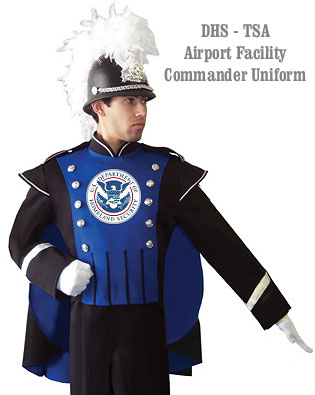
The federal Department of Homeland Security (DHS) now has over 200,000 employees and spends upwards of $59,500,000,000 (59.5 billion dollars) annually (See DHS 2013 budget*). Recently, in response to Sequestration cutbacks, DHS released thousands of illegal immigrant detainees, citing budgetary reasons. However, just before the Sequestration went into effect, the DHS managed to find $50,000,000 for new Transportation Safety Authority (TSA) uniforms. With 58,400 TSA employees at present, that works out to $856 per uniform — enough for some mighty fine outfits, as you can see.
We wondered what our $50 million tax dollars were buying, so we researched the TSA uniform bid solicitation. Here are exclusive photos of the new TSA uniform designs which have “passed muster” so far. These illustrations show the handsome uniforms selected from the final round of bid submissions, pending Agency approval. We think they look pretty sharp!
This Sunday on Tom Gresham’s Gun Talk radio show, the discussion is about traveling with firearms when flying, how to protect your property from disappearing while in the care of airlines, and what to do when a gun is stolen in transit.
One of Tom’s friends, a well-known firearms instructor, will tell his story of how one of his pistols was recently stolen while in the custody of Southwest Airlines, after he had declared the firearms with the airline and had them checked by TSA. When his locked case arrived, the padlocks had been cut off the case, and one of the pistols was missing. He filed a police report, contacted the airline, and also talked with the Transportation Security Administration.
Neither the TSA nor Southwest Airlines will take responsibility for the stolen firearm. No one wants to talk about who cut the padlocks off the case. Southwest says it isn’t their responsibility. TSA says it’s the airline’s responsibility. The police don’t appear to be very excited about the fact that a pistol was taken in the airport environment.
“All this leads to the question,” said show host Tom Gresham, “does this happen so often that no one really finds it to be unusual? Both the TSA and Southwest Airlines have been invited to appear on this Sunday’s national broadcast. At this time, it’s uncertain whether either will provide a spokesperson.
In its 16th year of national syndication, Tom Gresham’s Gun Talk Radio airs live on Sundays from 2:00 to 5:00 pm Eastern, and runs on more than 115 stations, plus on XM (Ch. 165) Satellite Radio. All Gun Talk shows can be downloaded as podcasts via the GunTalk Archive site.
The November 2010 digital edition of Shooting Sports USA has been released, and it’s definitely worth reading. The lead story explains the correct positions for 3-P smallbore and air rifle shooting. This is a well-organized, easy-to-understand article, packed with large photos from start to finish. If you are a three-position shooter (or want to be), you should definitely read this article.
Silhouette Competition History
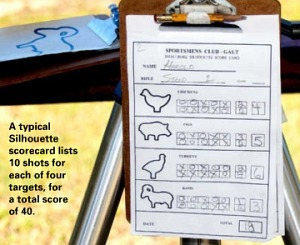
In addition to the position shooting story, the current edition of Shooting Sports USA has an excellent article by Jock Elliot on Metallic Silhouette shooting. Elliot covers the evolution of the sport from its origins in Mexico, to today’s popular rimfire and centerfire silhouette programs that attract thousands of shooters throughout the USA. Elliot explains the silhouette courses of fire and interviews top silhouette shooters including 11-year-old Mallory Nichols, the youngest master in the history of silhouette shooting.
Traveling with Firearms — Helpful Tips
Both competitive shooters and hunters can benefit from Shooting Sports USA’s guide to traveling with firearms, found on pages 9-10 of the November edition. There, you’ll find short reviews of recommended travel cases, plus travel tips from experienced shooters. Carroll Pilant of Sierra Bullets explains why he now marks his ammo: “I color code my primers with a Magic Marker. I was on my way to Brazil for the IHMSA match and TSA dumped all my ammo into a pile to weigh it. If they hadn’t been all the same loads, I would have been in trouble.”
In addition to the November issue, you can read previous editions of Shooting Sports USA. Click on the “Archives” tab at the bottom of the page, after you’ve launched the November issue in your browser. Visit ShootingSportsUSA.com to request a free Digital Edition of Shooting Sports USA each month.


 First, Ron explains that airport thieves can spot bags containing firearms no matter how they are packaged: “Don’t think you’re safe if your guns are placed in cases designed for golf clubs or trade show items. Baggage is X-Rayed now and cases are tagged with a special bar code if they contain firearms. It doesn’t take long for bad guys to figure out the bar coding for firearms.”


 The federal Department of Homeland Security (

 This Sunday on Tom Gresham’s
  “All this leads to the question,” said show host Tom Gresham, “does this happen so often that no one really finds it to be unusual? Both the TSA and Southwest Airlines have been invited to appear on this Sunday’s national broadcast. At this time, it’s uncertain whether either will provide a spokesperson.
 Silhouette Competition History


