|
|
August 21st, 2008
High Power shooters have a bunch of gear to carry to the firing line–pad, shooting jacket, scope stand, spotting scope, ammo, log-book and rifle(s). If you’re shooting F-Class, add a heavy front rest and 15-lb sand-bag to the list. A range cart makes life much easier, particularly if the shooting area’s a long way from the parking lot. Creedmoor Sports makes a folding range cart that is very popular with the iron sights crowd. This unit features 14″ ball-bearing wheels and the frame is made from solid aluminum–not lightweight tubing that can bend or crack. Lift a simple locking lever and the cart folds. The cart can be completely dis-assembled, without tools, to fit in a suitcase (collapsed size 30″ x 17″ x 8″). The Creedmoor cart retails for $499.00, and that includes a rifle case, tray, and rain-cover. The rifle case doubles as a rack/holster.


If $499.00 isn’t in the budget, or you’d like to build your own range cart with a lockable storage compartment, you should look at the carts used by Cowboy Action shooters. These wooden carts are heavy, but they provide a stable platform for multiple guns and a nice, solid perch for sitting. There are many do-it-yourself designs available. One of our favorites is the GateSlinger cart shown below. This well-balanced design breaks down into two pieces for transport. Click Here for cart plans, and read this “How-to Article” for complete instructions with many photos.

| The least expensive way to go is to purchase a Dolly (Hand Truck) at Harbor Freight, or a large warehouse store such as Home Depot. Make sure to get one with wheels at least 10″ in diameter, or you’ll have problems in rough terrain. The bigger the wheels the better. Normally you can find dollies for under $30.00. Just bolt a large box or milk crate to the bottom, and voilà, instant range cart. You can clamp a piece of wood at the top with slots for barrels on one side and a flat tray for ammo on the other. Use bungee cord or leather straps to hold the barrels in place. Having built a couple all-wood range carts (both collapsible and one-piece), this editor can assure you that starting with an inexpensive welded hand truck is the cheapest, simplest way to go overall. You can buy oversize, spoked wheels from NorthernTool.com. (From the Northern Tool home page, search for “spoked wheels”.) |
 |
August 21st, 2008
 Beijing isn’t the only location where shooters from many nations are competing this month. The United States Int’l Muzzle-Loading Team turned lead bullets and shot into gold, silver and bronze medals at the 23rd World Muzzle Loading Championships, held August 11-16 in Adelaide, Australia. 205 competitors, representing 17 nations, vied for honors with a variety of muzzle-loading arms, ranging from matchlock muskets to sophisticated percussion target rifles and pistols. Both original antiques and modern replica guns are used, competing in different divisions. Beijing isn’t the only location where shooters from many nations are competing this month. The United States Int’l Muzzle-Loading Team turned lead bullets and shot into gold, silver and bronze medals at the 23rd World Muzzle Loading Championships, held August 11-16 in Adelaide, Australia. 205 competitors, representing 17 nations, vied for honors with a variety of muzzle-loading arms, ranging from matchlock muskets to sophisticated percussion target rifles and pistols. Both original antiques and modern replica guns are used, competing in different divisions.

Top honors were taken by Dr. Michael Arnette, whose score of 93 in the original division of the “Lamarmora” 50-meter offhand percussion rifle-musket event not only won the gold, but set a new world record in the process. Arnette took the same gun to the 100-meter line for the “Minie” prone match, shooting well enough to help a team of Arnette, Allan Godshalk, Gary Crawford, Frank Kapper, and Tony Ulisse take 3rd place in the “Grand Prix de Versailles”, an aggregate for military longarms that is often considered the overall world team championship. An equally strong performance was turned in by Harry Sparks, who took both gold and bronze in individual shotgun events.
CLICK HERE for Photo Gallery from Adelaide
The World Muzzle Loading Championships are held biennially, with Pacific and European Zone Championships in the off years. The 24th World Championships will be held in Portugal in August 2010. CLICK HERE for more info on precision long-range muzzle-loader shooting.
August 20th, 2008
Recently we covered the first SoCal Rimfire Tactical Precision Match. Your editor had a chance to attend the second match on August 9. I can testify that match Director Bill Irwin presided over a fun, well-orchestrated competition with an interesting variety of stages. Competitors engaged paper targets and steel at various distances, plus clay birds and other reactive targets. For one stage, Irwin set building nails set in vertical sticks. The object was literally to drive the nails into the wood with your 22LR bullets. Easier said than done, I assure you. Here’s a “highlight video” from the August 9, match.

Stills courtesy RKSimple and Shooter65
SAKO FinnFire ‘Range’ — Accurate, Ergonomic, and RELIABLE
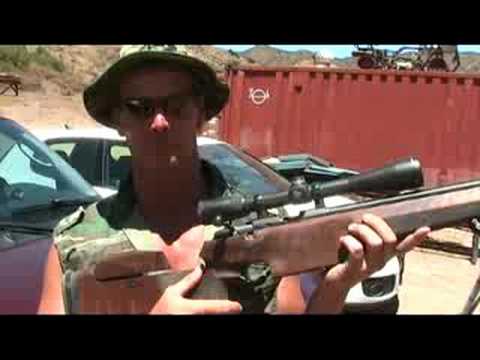
To my surprise, at the match I witnessed quite a few malfunctions, both in bolt-action rifles and self-loading 22s. One 10/22 was particularly troublesome, and the normally reliable Savage MKII BTVS models gave some problems when cycled rapidly. One rifle that ran flawlessly throughout the match was the handsome SAKO FinnFire ‘Range’ belonging to Mark E. from Huntington Beach.

This gun has a stock that is virtually identical to the stocks on Tikka’s centerfire Master Sporter rifles. With that stock, the FinnFire boasts ergonomics and dimensions similar to a centerfire tactical rifle, making it ideal for cross-training. Mark talks about his FinnFire in the video below.
August 19th, 2008
Denver Instrument, maker of the MXX and Timberline Series of precision balances, has created a helpful guide explaining how to get the best performance from a digital scale. Denver Instrument knows that, to achieve and maintain a very high level of accuracy with digital scales, they must be calibrated regularly, leveled properly, and kept away from sources of interference. Unfortunately, some reloaders treat their electronic scales as if the machines were toasters — something to place on a tabletop, plug into an outlet, then “set and forget.” There’s a better way to set up your scale and keep it functioning optimally. Here are ten guidelines provided by Denver Instrument. Follow these “TEN Commandments” and you’ll benefit:
 10 COMMANDMENTS OF GOOD BALANCE USE 10 COMMANDMENTS OF GOOD BALANCE USE
ONE: Thou shalt choose the best resting spot. The performance of your balance depends greatly on the surrounding environment. Choose a location away from the main traffic flow of the room, especially doors. Also be aware of heating and cooling vents as these produce air movement. You can adjust the environmental settings on your balance to provide the best performance in the chosen location. Balances must be placed away from magnets as they affect the weigh cell performance.
TWO: Thou shalt avoid vibrations. Vibrations can come from large machinery in production environments and from fume hoods in laboratories. An alternative to fume hoods are Power Safety Workstations which are designed specifically for use with a balance.
THREE: Thou shalt watch temperature changes. On an analytical balance a one degree temperature change can cause a 1 digit (0.0001g) drift. Although Denver balances have temperature correction built-in, it is still important to calibrate your balance when the temperature changes significantly. Choosing to place your balance in a temperature controlled room, away from sunlight, and calibrating often helps minimize the effects of temperature.
FOUR: Thou shalt calibrate often. Upon installation and each time the balance is moved you should calibrate your balance. For example moving an analytical balance to a location that is only 13 feet higher changes the weight reading from 200.0000 g to 199.9997 g; which means the result is 0.0003 g lighter than the actual mass.

FIVE: Remember to check the level. The instrument should be leveled upon installation with all feet (two front feet for round pan units, four feet for square pan units) touching the countertop. If the level changes, the balance should be re-leveled and recalibrated. As an example, a 200g sample would weigh 0.0025 g less when tilted at an angle of 0.3°.
SIX: Honor thy weights. Keep in mind that weights are only as reliable as their quality and certification. Remember, a 1 g does not weigh precisely 1.00000 grams. Weights should be recertified annually. Denver Instrument offers recertification services on all weights 1 mg to 5 kg. Check to make sure you have selected the proper weight class for your balance. The weight tolerance should be better than balance readability. Always use tweezers or gloves when handling weights as smudges and indentations change the value of the weight. Keep weights in cases so they don’t get scratched or dusty.
SEVEN: Thou shalt always use a small container and weigh in the center of the pan. Especially when using an analytical balance, the effects of air buoyancy increase as the sample container size increases. Using a small sample container will minimize the effects. Items placed on the pan provide a downward force. Placing them directly in the center of the pan keeps corner loading errors at a minimum.
EIGHT: Thou shalt not unplug. To perform within published specifications balances must have power applied for 30 minutes to 48 hours depending on the resolution of the balance. Denver balances have a standby mode which turn the display to standby but keep power cycling through the electronics.
NINE: Thou shalt not ignore static. Static is one of the most common weighing “noises”. It can cause reading to appear too high, too low or just be unstable. Denver balances include grounding methods to reduce the effects of static. However sometimes extra supplies are needed. Consider anti-static weigh dishes, anti-static brushes or low tech ways to increase the humidity of the chamber like placing damp cotton balls or glass wool in a small vial in the corner of the analytical draft shield.
TEN: Thou shalt clean often. Dirty weigh pans and powder in weighing chamber can contribute to static issues and lead to a wide variety of problems. Denver weigh pans are made from stainless steel and can be cleaned using a variety of household and laboratory chemicals. A small paint brush can be used to get power away from the edges of the draft shield for easy clean up.
August 19th, 2008
Alliant Powder, a division of ATK, has issued the following safety notice concerning Alliant Blue Dot powder, a popular propellant for handgun loading:

Alliant offers a FREE detailed, 43-page Reloader’s Guide with recipes for shotgun, pistol, and rifle cartridges. This guide includes important safety instructions, plus reloading data for most popular cartridges. Unfortunately the guide does not yet include Alliant’s new Reloder 17 and the listed loads for centerfire rifles only include Speer bullets.

CLICK HERE to download ALLIANT RELOADER’S GUIDE (.pdf format).
August 18th, 2008
Army Specialist K. C. Eusebio of the United States Army Marksmanship Unit (USAMU) edged out B. J. Norris to win his second Steel Challenge World Speed Shooting title in Piru, California. Eusebio finished with a record time of 79.16. K.C. first won the Steel Challenge while still in High School — an amazing performance for such a young shooter. K.C. has set speed-records for many of the Steel Challenge’s stages, including “Smoke & Hope” shown in the video. Eusebio’s win is the third time an Army Marksmanship Unit member has taken the title in the past four years. Staff Sergeant Max Michel took the title in 2005 and 2007. Below is exclusive video taken by AccurateShooter.com at the Steel Challenge on August 16.
CLICK HERE or on screen to WATCH VIDEO.

In the women’s division Kay Clark-Miculek took her seventh Women’s Steel Challenge title with a time of 105.85. Miculek now has twice as many titles as any other female shooter. In the Limited Category, Phil Strader of the US Shooting Academy’s 93.49 time was good enough to defeat 2006 World Champion JJ Racaza by just over 9 tenths of a second.

August 18th, 2008
While covering the 2008 Steel Challenge, this editor tried a new style of shooter’s earplug, the 3-flange SmartFit™ from Howard Leight. First, let me say that I have, in recent years, always used the bullet-shaped soft foam earplugs because they offer the highest Noise Reduction Rating — up to 32 db NRR.
 But I am VERY impressed with the SmartFits. I want you guys to know that these are VERY different than other ridged plugs on the market. Some other brands use a stiff plastic that is downright painful. Not the SmartFits. These are made of a very soft, “conforming” polymer that is surprisingly comfortable. Simple body heat actually causes the advanced material to conform to the ear channel. For me, SmartFits were at least as comfortable as soft foam plugs. If you wet the SmartFits slightly, they slide in very easily. You don’t have to roll them up with your fingers. There is a half-inch-long stub on the outside of each plug. This makes it very easy to insert or remove the units. I can definitely pop these into my ears more quickly than with the foam plugs. And, using the little stub, they come out super-fast. But I am VERY impressed with the SmartFits. I want you guys to know that these are VERY different than other ridged plugs on the market. Some other brands use a stiff plastic that is downright painful. Not the SmartFits. These are made of a very soft, “conforming” polymer that is surprisingly comfortable. Simple body heat actually causes the advanced material to conform to the ear channel. For me, SmartFits were at least as comfortable as soft foam plugs. If you wet the SmartFits slightly, they slide in very easily. You don’t have to roll them up with your fingers. There is a half-inch-long stub on the outside of each plug. This makes it very easy to insert or remove the units. I can definitely pop these into my ears more quickly than with the foam plugs. And, using the little stub, they come out super-fast.
The set of SmartFit plugs I tried were fitted with a braided nylon connecting cord. The cord is plenty strong and doesn’t pull out like the stretchy rubber cords on some other sets of plugs. This is a sturdy connection appropriate to a product marketed as a “multiple-use” earplug.

Sound Rating — 25 db NRR, But They Seem Quieter
The Howard Leight SmartFits are only rated to 25 db NRR. That’s “middle of the pack” noise reduction — better than most muffs but not as good as some plugs. I can tell you, however, that these things really cut sound, and in the field they performed as well or better than some foam plugs with higher ratings. With both SmartFit plugs in my ears, gun noises were masked very effectively. And to my surprise, I really couldn’t talk with someone at all unless I removed at least one SmartFit plug. With some other ear plugs I’ve found you can still hear voices even with a plug in each ear. That tells me the “real world” effectiveness of the SmartFits may be higher than the rating suggests.
Bottom line: These SmartFits are comfortable, easy to insert/remove, sturdy, and they last a long time. The SmartFits can be cleaned easily with soap and water, and they can be purchased with a flip-top dispenser for secure storage. Great Product that really works. I now keep two sets of SmartFit plugs in my range kit. There are times when I’ll still use foam plugs, but for most situations I think the SmartFits are easier to use.
August 17th, 2008
The IBS 100/200 yard Group Benchrest Nationals were held from August 11-16th at the Kelbly’s range in North Lawrence, Ohio. When the dust settled, Harley Baker, IBS 2007 Group Shooter of the Year, was the big winner, taking the Two-Gun, Three-Gun, and Four-Gun overall. Mark Buettgen, Gene Bukys, and Jack Neary also shot extremely well — these three shooters all finished in the top four in the multi-gun standings. Harley Baker triumphed over a field of roughly 150 shooters including benchrest Superstars Tony Boyer, Wayne Campbell, Joe Krupa, and Bart Sauter. Bill Goad won the Light Varmint Grand Agg, while Tony Boyer won the Heavy Varmint Grand. Ryan Kelbly was the top junior shooter.

Here are the top ten finishers in the multi-gun combined Aggregates:
| 2-Gun Overall |
3-Gun Overall |
4-Gun Overall |
1. HARLEY BAKER 0.2093
2. MARK BUETTGEN 0.2121
3. GENE BUKYS 0.2240
4. JACK NEARY 0.2253
5. BILL GOAD 0.2265
6. BOB SCARBROUGH 0.2286
7. TONY BOYER 0.2345
8. L. HOTTENSTEIN 0.2401
9. JEFF SUMMERS 0.2407
10. SMILEY HENSLEY 0.2418 |
1. HARLEY BAKER 0.2062
2. JACK NEARY 0.2230
3. MARK BUETTGEN 0.2258
4. GENE BUKYS 0.2280
5. SCOTT WATSON 0.2383
6. BOB SCARBROUGH 0.2392
7. L. HOTTENSTEIN 0.2409
8. BILL GOAD 0.2411
9. JOE KRUPA 0.2454
10. GEORGE WALDREP 0.2457 |
1. HARLEY BAKER 0.2245
2. JACK NEARY 0.2351
3. GENE BUKYS 0.2379
4. MARK BUETTGEN 0.2381
5. L. HOTTENSTEIN 0.2511
6. HARRY ROWALD 0.2532
7. JOE KRUPA 0.2551
8. BOB SCARBROUGH 0.2585
9. LARRY COSTA 0.2615
10. JEFF SUMMERS 0.2636 |
While the multi-gun Agg results were, not surprisingly, in the low twos, there was some spectacular shooting done at the match in specific events. At 100 yards, the top five shooters in BOTH the Light Varmint AND Heavy Varmint Class all posted “Teen Aggs”. This shows you the kind of accuracy these rifles (in the hands of ace shooters) can deliver:
| Light Varmint 100-yard Aggregate |
Heavy Varmint 100-yard Aggregate |
1. BILL GOAD 0.1614
2. GENE BUKYS 0.1686
3. PAT CANNING 0.1880
4. DAVE DOHRMAN 0.1894
5. BOB SCARBROUGH, JR. 0.1920 |
1. TONY BOYER 0.1552
2. LOWELL HOTTENSTEIN 0.1736
3. JOE KRUPA 0.1798 (tied)
3. SCOTT WATSON 0.1798 (tied)
5. GEORGE KELBLY, SR. 0.1872 |
Complete IBS 100/200 Nationals Match Results are posted on the IBS website. You can also download Target by Target Details as a .pdf file.
August 16th, 2008
Breaking News: Pfc. Vincent Hancock, a USAMU shooter from Georgia, captured the Gold medal in men’s skeet-shooting, topping Norway’s Tore Brovold in a shoot-off to win the gold. Definitely check out the VIDEO below–you have to see how fast this kid is!!
CLICK HERE to Watch Vince Hancock’s Skeet Shooting. Click “Best Shots” for Quick Highlights.

Though just 19 years old, Hancock is a World Champion and current world record holder. Previously this summer he captured the Gold Medal in the Men’s Skeet event at the 2008 ISSF World Cup for Shotgun in Suhl, Germany, June 12. A prodigy of sorts, Hancock won his first ISSF World Championship at the ripe young age of 16, competing in Lonato, Italy.
Hancock’s fast reflexes and superb eyesight have put him at the top of the game in International Skeet shooting, a discipline that demands quick reactions. Hancock explains: “Compared to American, International’s targets travel 20 miles per hour faster at 60 miles per hour. After you yell, ‘Pull’, the targets can be released anywhere from immediately to three seconds later, keeping you on your toes. You have to hold your gun down, with the butt below a line on your vest and then mount after you call for the target. And three of the stations send out two targets; in American skeet you can have your gun mounted, and you don’t have any doubles.”
CLICK HERE for Shotgunning Tips from Vince Hancock
|


