|
|
September 24th, 2010
 It’s comforting to know that our U.S. Border Patrol (USBP) personnel are not only competent with firearms — some of them are among the finest shooters in the entire law enforcement community. At the recent National Police Shooting Championship held in Albuquerque, NM, USBP agents dominated the individual and team competition, outshooting LEO competitors from around the country. It’s comforting to know that our U.S. Border Patrol (USBP) personnel are not only competent with firearms — some of them are among the finest shooters in the entire law enforcement community. At the recent National Police Shooting Championship held in Albuquerque, NM, USBP agents dominated the individual and team competition, outshooting LEO competitors from around the country.
Vadasz Wins Second NPSC Title
Senior U.S. Border Patrol Agent Robert Vadasz topped the field of over 400 competitors to secure his second National Police Shooting Individual Championship in three years. Vadasz dropped a mere 19 shots throughout the tournament, finishing with a 2981-221x score. Finishing second was Customs & Border Protection agent Doug Goff, with 2976-199x. U.S. Border Patrolman Kevin Worrell finished thrid with 2973-193x.
 “It’s an honor to be here, again,” said Vadasz. “Your gun jams, it slips off the post, your foot cramps, or your ammunition betrays you; there are a lot of things that can go wrong. This year, everything came together, and it feels great.” “It’s an honor to be here, again,” said Vadasz. “Your gun jams, it slips off the post, your foot cramps, or your ammunition betrays you; there are a lot of things that can go wrong. This year, everything came together, and it feels great.”
In team competition, U.S. Border Patrol squads turned in great performances. USBP Teams finished first and second in the Open Class Revolver 4-Officer Event, with USBP Blue Team scoring 2372-163X, and USBP Gold Team finishing second with 2356-131X. In the Open Class Semi-Auto 4-Officer Team event, the USBP Blue Team scored 2357-147X to finish a close second to the winning CBP Blue Team, which took the title with a 2360-134X tally.

Photos courtesy the NRA Blog.
September 24th, 2010
We recently reported that Trudie Fay of Raton, NM, shooting on her home range, was the Fullbore winner at the Spirit of America Match. Trudie and many other shooters set new National records during the course of the match. Trudie fired an aggregate score of 1781-104x, which was an Open, Civilian, and Woman’s National Record. Second place, with a Senior National Record, was Tom Whitaker. High Grand Senior was Johnie Franklin, high Junior was Kyle Doney, high Service was Emily Windmassinger.
 There were also new records set in F-Class competition, in both F-Open and F-TR classes. High F-Open shooter was Danny Biggs with a score of 1777-88x. Danny’s score was an Open, Civilian and Grand Senior National Record. High Senior was Jim Murphy firing 1766-90x. There were also new records set in F-Class competition, in both F-Open and F-TR classes. High F-Open shooter was Danny Biggs with a score of 1777-88x. Danny’s score was an Open, Civilian and Grand Senior National Record. High Senior was Jim Murphy firing 1766-90x.
Michelle Gallagher was the high F-TR shooter firing a score of 1717-62x. Michellle’s score was an Open, Civilian and Woman’s National Record. Daniel Borwiecki of the Marine Corps Rifle Team was the high Service shooter. Robert Depp was the high Senior and Alan Canavan was high Grand Senior.
Trudie Rides in Style
The winners were “chaired,” holding their rifle and hoisted in the air by the competitors. Trudie Fay, wearing white gloves, was carried in Raton’s timber sedan chair by the Fullbore competitors. Danny Biggs, the F-Class winner, was carried in a rocking chair by the F-Class competitors. Michelle Gallagher, the F-TR winner, was carried in a captain’s chair. All were carried off the 1000-yard line to the Bald Eagles Clubhouse while bagpipe music was played.
Report courtesy Jan Raab and the NRA Blog.
September 24th, 2010
 This Sunday, September 26, Tom Gresham’s Gun Talk Radio will broadcast live from the Gun Rights Policy Conference in San Francisco, CA. Host Tom Gresham will interview speakers and attendees at the 25th Annual Gun Rights Policy Conference (GRPC), a free, 3-day conference that focuses on all facets of gun rights — past, present and future. Speakers at this year’s GRPC include Alan Gottlieb, Alan Gura, former congressman Bob Barr, Joseph Tartaro, Prof. John Lott, Massad Ayoob, Larry Pratt, Jeff Knox, and more. This Sunday, September 26, Tom Gresham’s Gun Talk Radio will broadcast live from the Gun Rights Policy Conference in San Francisco, CA. Host Tom Gresham will interview speakers and attendees at the 25th Annual Gun Rights Policy Conference (GRPC), a free, 3-day conference that focuses on all facets of gun rights — past, present and future. Speakers at this year’s GRPC include Alan Gottlieb, Alan Gura, former congressman Bob Barr, Joseph Tartaro, Prof. John Lott, Massad Ayoob, Larry Pratt, Jeff Knox, and more.
M1 Garand and M1 Carbine Import Controversy
Also on the show this Sunday, Tom talks with Montana Senator Jon Tester about the Senator’s recent letter to Secretary Clinton and the State Department, regarding the rejection of South Korea’s proposal to sell its surplus of American-made M1 Carbines and M1 Garand rifles to the U.S. “I count myself among many gun rights advocates who fundamentally disagree with the State Department’s reasoning. Rejecting the responsible sale of legal firearms over hypothetical concerns that they could be used for “illicit purposes” sets a dangerous precedent and it is contrary to the Second Amendment rights of law-abiding Americans,” writes Senator Tester.

In its 15th year of national syndication, Tom Gresham’s Gun Talk Radio airs live on Sundays from 2pm – 5pm Eastern, and runs on over 100 stations, plus SIRIUS XM Satellite Radio. All Gun Talk shows can be downloaded as podcasts through Apple iTunes, the Gun Talk iPhone App, or at Gun Talk’s Podcast Library. More information is available at www.guntalk.com.
September 23rd, 2010
Stiller’s Precision Firearms has been chosen to supply the action (receiver) for the new, updated MK 13, .300 Win Magnum sniper rifle for Crane Naval Weapons Center. The contract, valued at $2,000,000, calls for Stiller’s Precision to produce long actions for the latest version of the MK 13. The Navy could not simply upgrade its M40 sniper rifles from 7.62×51 to the larger, harder-hitting .300 Win Mag cartridge, because the M40 has a short action. The new MK 13 will employ a Rem-style long action in a modified Accuracy International Chassis. Current MK 13s feature an AICS stock, and a Knights forward rail mount or a MARS rail, with a Nightforce scope. Suppressors from various manufacturers are being tested for the latest MK 13.
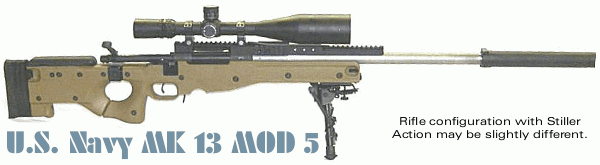
MK 13 Action Will Eventually Be Offered to Civilian Market
Jerry Stiller tells us: “[For the MK 13 contract], we submitted samples and won out over the competition in a field type of test using all the submitted actions for consideration. The Navy is putting our action on new AI Chassis systems with new high-quality barrels. Hopefully, when we complete the first phase of the contract for them this year, we will make the same action available to the general public. We will keep everyone informed of what is available as it happens.”

September 23rd, 2010
 The AccurateShooter.com Forum reached another milestone yesterday. We just passed the 12,000 mark in registered members. Not counting the Moderator, who is Member 1, our 12,000th member is “Kitch” from Florida, and we added four more members just this morning. The AccurateShooter.com Forum reached another milestone yesterday. We just passed the 12,000 mark in registered members. Not counting the Moderator, who is Member 1, our 12,000th member is “Kitch” from Florida, and we added four more members just this morning.
If you haven’t visited our Forum recently, you should do so. You’ll find tons of useful information, and many of our Forum members are national-level benchrest and High Power shooters. Plus many talented gunsmiths and parts designers participate in the discussions.
FREE Classifieds In Forum
If you are buying or selling guns or shooting accessories, the Marketplace Area in our Forum offers FREE Classified Ads. As an example of the kind of precision rifles you’ll find in our Classifieds, below is a very nice 6mm Dasher posted for sale by Forum Member Fletcher. It has all top-flight components: Kelbly Action, Krieger gain-twist barrel, Shehane “Indian Blanket” Tracker 1000 laminated stock. CLICK HERE to see current price and more photos.

The latest ads appear on the right side of the Forum. Buyers will find some great bargains every day. Registered Forum members can place ads (with free photo hosting), in one of three categories:
- Guns, Actions, Stocks, & Barrels
- Tools, Dies, Rests, Reloading Components & Misc
- Scopes, Optics, Sights, Rings, Bases Etc.
September 22nd, 2010
Our readers were very interested in the recent announcement that Remington Arms was selected to build the new M24E1 Sniper Weapon System, the successor to the venerable M24 Sniper Rifle used by the U.S. Army for many years.

 New Leupold Scope for M24E1 New Leupold Scope for M24E1
A key component of the M24E1 system is the new Leupold Mark 4 6.5-20x50mm Extended Range/Tactical (ER/T) M5 riflescope (34mm locking version). This scope features First Focal Plane (FFP) Horus ranging reticles (H27 or H58), side parallax adjustment, and a beefy 34mm maintube.
Other key features of the new ER/T include M5 windage and elevation adjustment dials with audible, tactile 1/10 (0.1) milrad clicks to match the mil-based Horus reticles. An elevation zero-stop helps prevent under-rotation in high-stress situations. The eyepiece offers long eye relief and it employs a “lockable” fast-focus design to ensure that the reticle remains in sharp focus. The scope has an auto-locking elevation adjustment.
 With either a Horus H27 or H58 reticle in the front focal plane, the scope can accurately range at all magnification settings (the reticle magnifies with the image). The 34mm maintube allows for ample windage and elevation adjustment — a full 100 MOA of elevation and 100 MOA of windage adjustment. With either a Horus H27 or H58 reticle in the front focal plane, the scope can accurately range at all magnification settings (the reticle magnifies with the image). The 34mm maintube allows for ample windage and elevation adjustment — a full 100 MOA of elevation and 100 MOA of windage adjustment.
The Mark 4 6.5-20x50mm ER/T M5 Locking Adjustment riflescope is waterproof, fog proof and shock proof. With its M5 Locking Adjustment, the scope’s platform is unique in the Mark 4 ER/T line. It is controlled under International Traffic in Arms Regulations (ITAR) and limited to domestic and international government sales only.
September 22nd, 2010
 In Switzerland, universal military training is required of young men, and after military service, Swiss men retain their military weapons, including assault rifles, in their homes. In addition, target shooting remains a hugely popular activity among the Swiss. Though it has a population of just 7,000,000, Switzerland boasts over 2,000 rifle ranges. Each year, close to 200,000 Swiss participate in the Eidgenössisches Feldschiessen (annual shooting skills exercise). A several hundred-year-old tradition, the Feldschiessen (aka Tiro Federale in Campagna) is the largest shooting event in the world. In Switzerland, universal military training is required of young men, and after military service, Swiss men retain their military weapons, including assault rifles, in their homes. In addition, target shooting remains a hugely popular activity among the Swiss. Though it has a population of just 7,000,000, Switzerland boasts over 2,000 rifle ranges. Each year, close to 200,000 Swiss participate in the Eidgenössisches Feldschiessen (annual shooting skills exercise). A several hundred-year-old tradition, the Feldschiessen (aka Tiro Federale in Campagna) is the largest shooting event in the world.
Shooting service rifles at 300m is typical at many Feldschiessen matches. Some Swiss ranges boast the latest high-tech equipment. At one of the popular ranges, 400 electronic targets served thousands of shooters. And get this — the Swiss government provides free ammunition at each year’s Feldschiessen. Contrast that with California — which recently passed legislation requiring citizens to provide thumbprints and personal data just to purchase ammo. Switzerland views armed citizens as a vital national asset. California views shooters as a pariah class that should be eliminated.

Swiss Gun-Control Advocates Call for Change
Despite the popularity of shooting in Switzerland, and the nation’s tradition of maintaining an armed citizenry, there are groups seeking to restrict gun ownership and require that military arms be removed from homes and stored in military barracks. Both sides of the issue are covered in a video report from World Radio Switzerland. You should definitely watch the video. In it, Marc Heim, a Swiss citizen, explains that the Swiss government seeks to maintain “a very high state of readiness for the Swiss military and population. The [goal] has always been that, within 24 to 48 hours, Switzerland could mobilize a pretty large army.” Heim still has the Stgw 57 (7.5×55) rifle he trained with, as well as the rifles used by his father, and grandfather before him. Heim’s young son, in his 20s, keeps a modern, fully-automatic Sig 550. That is the rifle Marc Heim and his son would take to the Feldschiessen.

CLICK HERE for Story and VIDEO on Swiss Gun Tradition (Highly Recommended)
Reasons for Armed Citizenry in Switzerland
Marc Heim believes that it is important for Switzerland to retain a “citizen army”. His belief was strengthened after he visited a Holocaust museum: “That’s when it all hit me… I want to be free and never in a situation where they could just march us off to ovens or prisons… or just take away our freedom. The key to freedom is the ability to be able to defend yourself, and if you don’t have the tools to do that then you are at the mercy of anyone who wants to put you away. And the tools for that are guns.”
September 21st, 2010
Here’s a word to the wise — not all full-length sizing dies are properly dimensioned to carry out the important task of “bumping” shoulders back on fired cases. With some dies the task may simply be impossible (without die or shell-holder modification). In fact, you may find that your attempt to bump the shoulder may actually INCREASE the dimension from base of case to shoulder datum!
 We recently had some four-times fired 6mmBR Lapua brass. Using a Harrell’s collar that indexes off the shoulder, we measured the length from base of case to top of collar at 1.570″ (with primer removed). We noticed a little more resistance to bolt closure compared to fresh brass, so we decided to bump the shoulders back two thousandths. As a point of reference, we measured the same dimension (base of case to top of Harrell’s collar, primer out) as 1.5675″ on once-fired Lapua 6mmBR brass. We recently had some four-times fired 6mmBR Lapua brass. Using a Harrell’s collar that indexes off the shoulder, we measured the length from base of case to top of collar at 1.570″ (with primer removed). We noticed a little more resistance to bolt closure compared to fresh brass, so we decided to bump the shoulders back two thousandths. As a point of reference, we measured the same dimension (base of case to top of Harrell’s collar, primer out) as 1.5675″ on once-fired Lapua 6mmBR brass.
 This Can’t Be Right … This Can’t Be Right …
To bump our shoulders we had an RCBS Gold Medal bushing full-length sizing die. Per the manufacturer’s instructions, we started with the die backed off 1/2 turn from contact with the shell-holder with the press ram at full height. We lubed and sized one case and then measured it. The shoulder had not moved. OK, no problem, we screwed the die down to contact the shell-holder (at full ram height) and tried again. This time the measured dimension was actually longer by a couple thousandths. The brass which measured (with collar) 01.570″ before sizing now measured 01.572″ — we were going in the wrong direction!
“Bumped” Shoulder Stretched .003″
Frustrated, we screwed the RCBS die in 1/8th turn past touching to allow “cam-over” which is necessary with some presses to actually push the shoulder back. We sized the case again, and this time the dimension had grown another .001″, to a total length of 1.573″! Wondering if there was something wrong with our calipers, we took the full-length sized brass (which previously had chambered just fine) to our 6BR rifle and tried to chamber it. Sure enough, the headspace had been lengthened by .003″ and the brass would not chamber at all.
 Die Was Too Long Inside to Bump Shoulders Properly Die Was Too Long Inside to Bump Shoulders Properly
What was going on? Here’s the explanation: the interior cavity of the die was too long so the shoulder surface inside the die was never actually making contact with the shoulder of the brass — and the die could not be screwed down any further. As the RCBS die, which was fairly tight in the bottom half, reduced the diameter of the brass, the case actually grew in length. While the brass was sized at the bottom it grew upwards because the “shoulder” section on the inside of the die was too high. As we “squeezed” the brass at the bottom it simply flowed upwards, increasing headspace.
With this RCBS die, in its current configuration, there was no way we could bump the shoulder back, even by .001″. The die would likely function effectively if we ground a few thousandths off the bottom, but we don’t think a die user should be obliged to make such a modification.
Lesson Learned: If your full-length die can’t bump your brass even when it is screwed down all the way (to cam-over if necessary), then you need a different die or you need to modify your die. As proof of this, we took out my trusty Redding 6mmBR full-length sizing die. This was set up (from experience), one-half turn off contact with the shell-holder. In that position, the Redding die easily bumped the shoulder of a fired case .002″ with no trouble whatsoever. We started at 1.570″ and ended up 1.568″ — right where we wanted to be. The task that couldn’t be done with the RCBS Gold Medal FL Die was accomplished easily with the Redding die. After lubing the case, we simply raised the ram to full height, and this moved the shoulder back .002″ as measured with the Harrell’s collar positioned on the shoulder.
September 21st, 2010
 The 25th Annual Gun Rights Policy Conference (GRPC) will be held this upcoming weekend, September 24-26, in San Francisco, CA. Ironically (or perhaps deliberately?) the conference convenes in one of the most gun-hostile cities in North America. Past GRPCs have covered the latest firearms trends and outlined strategic plans to expand gun rights. This year GRPC organizers will focus on critical issues such as: city gun bans, youth violence, “smart” guns, concealed carry, federal legislation, legal actions, gun show regulation, state and local activity. Noted legal experts will also preview the upcoming court cases and revisit the U.S. Supreme Court landmark decision in D.C. v. Heller. The 25th Annual Gun Rights Policy Conference (GRPC) will be held this upcoming weekend, September 24-26, in San Francisco, CA. Ironically (or perhaps deliberately?) the conference convenes in one of the most gun-hostile cities in North America. Past GRPCs have covered the latest firearms trends and outlined strategic plans to expand gun rights. This year GRPC organizers will focus on critical issues such as: city gun bans, youth violence, “smart” guns, concealed carry, federal legislation, legal actions, gun show regulation, state and local activity. Noted legal experts will also preview the upcoming court cases and revisit the U.S. Supreme Court landmark decision in D.C. v. Heller.

The team of “distinguished experts” has not yet been finalized, but past speakers have included: Alan M. Gottlieb, Wayne LaPierre, Larry Elder, Ken Hamblin, John Lott, Sandy Froman, Massad Ayoob, Tom Gresham, Alan Gura, Reps. Bob Barr and Chris Cannon and many others. This event is co-hosted by the Second Amendment Foundation, which offers free online registration.
NOTE: Books, monographs and other materials — enough to start a Second Amendment library — are FREE, as are Saturday luncheon, Friday and Saturday evening receptions, and morning/afternoon snacks. Other meals, travel costs, and lodging costs must be paid by attendee.
September 21st, 2010
The United States Army’s Joint Munitions and Lethality Contracting Center has awarded Remington Arms a 5-year contract to upgrade 3,600 current M24 sniper rifles to the new M24E1 Sniper Weapon System. The major change will be a conversion from the 7.62mm NATO (.308 Winchester) cartridge to .300 Winchester Magnum to provide “additional precision engagement capability and range”. The contract, potentially worth over $28 million, was awarded after a 9-month competitive evaluation. CLICK HERE for Remington Press Release.
The Army’s new M24E1 sniper rifle will share the Rem 700 long action (receiver) and trigger from the currently-fielded M24, but little else. (The Army specifically required that the M24E1 be built around the same 700 series long action and fire control system.) The M24E1 is considered a “total conversion upgrade”, by which the barrel, stock, magazines, muzzlebrake, suppressor, and even the optics will be changed. The M24E1 will carry a 6.5-20×50 variable power Leupold scope with a first focal plane (FFP) reticle that includes .300 Win Magnum bullet-drop compensation markings.

To the new M24E1s, Remington will fit 24″, 10-Twist (5R) hammer-forged barrels, chambered in .300 Win Mag. After the change in chambering, the most notable difference between the M24 and M24E1 is the new modular metal chassis/stock. There are a variety of adjustments in the rear buttstock section, which also folds forward for easier transport. The forearm has removable Mil Std 1913 Picatinny Rails to allowing fitting of night-vision devices and other accessories. Click Here for Forearm Photo.
M24E1 Contract Follows Production of 15,000 M24s By Remington
It is no great surprise that Remington won the contract to upgrade the older M24 sniper rifles. Remington has been produced nearly 15,000 M24 Sniper Weapon Systems for the military over the past 22 years. The M24E1 may be seen as the “natural evolution” of the Army’s existing Rem sniper platform. While the M24E1 rifle looks radically different on the outside, it remains much the same on the inside. According to Remington:
This long tradition of production and repair makes Remington the natural choice to upgrade this venerable system[.] Current operations in Southwest Asia exposed the need for a more powerful and longer-range sniper round. The baseline M24 was designed from inception to chamber a longer and more powerful round than the 7.62mm NATO, so an obvious solution to the capability gap was to finally exploit the M24’s long bolt action and chamber it for .300 Winchester Magnum.
|


