Leupold is now offering Custom Dial System (CDS®) elevation turrets in more models of VX-3 and VX-3L riflescopes. These CDS turrets have a dial calibrated for load ballistics supplied by the scope owner, with markings that correspond to range yardages. So, instead of dialing-in a specified number of clicks from a ballistics table, you simply dial to the indicated yardage (see demo at right). For example, to hit a target at 500 yards, you simply spin the dial to the “5” mark on the turret. You can order multiple dials, set up for different loads.
New VX-3 CDS models include the 4.5-14x40mm AO, 4.5-14x40mm Side Focus, and 4.5-14x50mm Side Focus. The new VX-3L CDS model is the 4.5-14x56mm Side Focus.
How the CDS™ System Works The CDS System works by laser-inscribing your scope’s elevation dial to match your load, velocity and conditions. Each CDS dial is custom-calibrated based on key ballistic factors: Caliber, Bullet Weight, Bullet Type, Ballistic Coefficient, Muzzle Velocity, Average Elevation, and Average Temperature.
With CDS turrets mounted on a VX-3/VX-3L scope, you can quickly get on target by dialing the elevation to different ranges with a custom adjustment matched to your rifle- and load-specific ballistics. Leupold CDS riflescopes comes with standard ¼-MOA click adjustment dials. VX-3 CDS models include a coupon redeemable for one FREE custom-engraved CDS dial. Additional dials may be purchased for $59.99 each. All you need to swap between dials is a small screw-driver to work a simple set-screw. One-Revolution stops are available for custom dials.
Pat Mundy, communications manager for Leupold & Stevens, Inc., explained, “When you purchase a CDS riflescope, contact us with your ballistic data and shipping information, then we’ll send you a dial custom built to match the caliber and load you are using. It’s as simple as that. There are no adjustment covers to lose and the CDS makes your VX-3 even more accurate and rugged.”
Excellent ballistics apps have been available for iPhones and Android phones for quite some time. Well, Windows-phone users can now join the party. Ballistica, a $5.99 software App for WP7-OS smartphones (ver. 7.5+), is now on the market. Ballistica has all the features you’d expect from a modern ballistics solver. To get a solution, first enter your bullet info, MV, and BC (either G1 or G7). Then input the target distance, up/down angle, temp, altitude, barometric pressure, wind speed and wind angle. The program will create a drop chart with values of your choosing (MOA clicks or Mils). Conveniently, you can save Ballistic Profiles for particular loads (bullet/velocity combinations). CLICK HERE for Ballistica USER MANUAL (PDF file).
The user interface for Ballistica is simple and straightforward, with five primary screens:
Projectile Page: Enter data on bullet of choice: Caliber, Weight, Sight Height, BC (G1 or G7). Conditions Page: Set ambient conditions such as altitude, humidity, and wind direction/velocity. Target Page: Set target distance, target speed, and up/down line of sight angle. Chart Page: Shows POI drop chart with distance intervals you select. Mil- or MOA-segmented clicks. Quick Shot Page: This provides a fast firing solution at one distance. You can change variables as conditions change.
Video Review of Ballistics for Windows Phones
If you have a Windows-OS smart phone, Ballistica is definitely worth checking out. A FREE trial version is available. The trial version lets you access most of the features, however, you won’t be able to save profiles. You can download Ballistica from the Windows Phone Marketplace. You’ll find a “Try for Free” link for the free version right below the purchase link. You can also download a FREE USER Manual for Ballistica. NOTE: Ballistica requires Windows Phone ver. 7.5 or higher.
Hunters and the Sundance Film Festival are two things you normally don’t hear in the same sentence. On Sunday that changed when a short documentary film about a group of female hunters from South Carolina won the prestigious film festival’s Shorts Audience Award, and earned director Maria White a $5,000 prize. The 13-minute film, “The Debutante Hunters”, directed by Maria White, was the audience favorite among 700 short films submitted to the Festival. The film tells the story of women and why they hunt. Director White had the idea for the movie after going on a hunt: “This was a world I wanted to explore, where a woman can be feminine, a mother, a daughter, and still be a total bad-ass.”
The short film, set up for internet streaming by Yahoo.com, has been viewed over half a million times, garnering 50,000+ votes from movie fans. Director White revealed that she hopes to develop the short film into a TV or cable series, using the additional eleven hours of footage she has compiled.
Many precision-oriented shooters are discovering that the “middle ground” in cartridge size is optimal for the 100gr to 115gr match bullets. With a mid-sized cartridge, you can run these pills faster than a 6BR or Dasher, without giving up much, if any, accuracy to a 6BR or BR Improved. The most accurate 600-yard rifle at this Editor’s local club is a 6-6.5×47. It can shoot as tight as a 6BR past 300 yards, plus it offers better ballistics, pushing 105 Bergers at 3140 fps.
If you’re considering a mid-sized 6mm cartridge for your next rifle, you’re probably wondering WHICH mid-size 6mm cartridge is best. We are often asked “what’s the difference between the 6×47 Swiss Match, the 6XC, and the 6.5×47 Lapua necked down to 6mm?” All three cartridges have 30° shoulders and fit a .308-sized boltface. However, alone among the three, the 6mm-6.5×47 has a small primer pocket and small flash hole. The 6×47 Swiss Match (made by RUAG), and the 6XC (produced by Norma), have a large primer pocket and large flash hole, just like a .308 Winchester.
Forum member DesertLefty has provided a line-up photo, with 6mmBR and .260 Rem cases provided for comparison. As you can see, the three mid-sized cases (6x47SM, 6.5×47 Lapua, and 6XC) are very similar. The Swiss Match has the longest neck, while the 6XC enjoys the highest capacity. But performance is very similar among the three cartridges (with the 6.5×47 necked down to 6mm). The same powders, (particularly H4350, Reloder 17, and IMR 4007SSC) work well in the 6×47 SM, the 6XC, and the 6-6.5×47 Lapua. The parent 6.5×47 Lapua case is rated at 63090 psi, while the new CIP rating for the 6XC is 63844 psi (4400 BAR). Both the necked-down Lapua brass and the Norma-brand 6XC brass can hold stout loads. Though the 6mm-6.5×47 has slightly less powder capacity than the 6XC, max velocities with 105-108gr bullets are quite similar. However, you should not substitute loads from the 6XC directly to the 6mm-6.5×47 or vice-versa. Because of the different case capacities and primer sizes, you should work up loads separately for each cartridge.
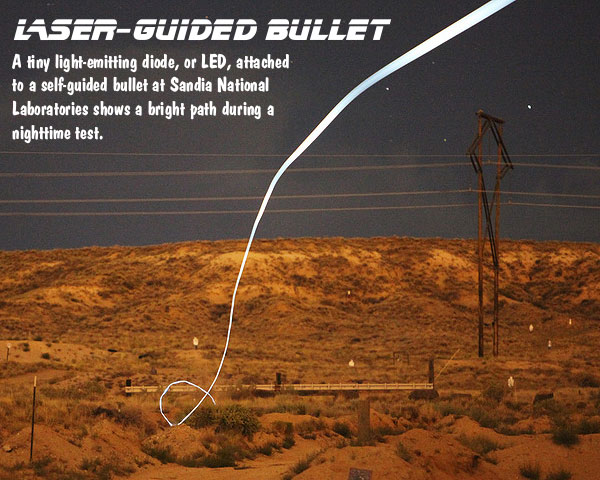
Two Sandia National Laboratories engineers, both hunters, have developed a patented design for a laser-guided bullet. The 4″-long laser-guided projectile has made hits at ranges up to 2000 meters. No this is NOT an April Fools’ joke. The projectile shoots from a smooth-bore rifle and uses small, movable fins to adjust its trajectory. The fins are controlled by micro-sized actuators in response to signals from a tiny, onboard laser-sensor. Plastic sabots provide a gas seal and protect the delicate fins while the projectile is in the firearm’s barrel.
Click Here for Video News Report on Sandia-developed Guided Bullet
Sandia researchers Red Jones and Brian Kast (and colleagues) have invented a dart-like, self-guided bullet for small-caliber, smooth-bore firearms that could hit laser-designated targets at distances of more than a mile. “We have a very promising technology to guide small projectiles that could be fully developed inexpensively and rapidly,” Jones said. Researchers have had initial success testing the design in computer simulations and in field tests of prototypes, built from commercially available parts, Jones said. While engineering issues remain, “we’re confident in our science base and we’re confident the engineering-technology base is there to solve the problems,” he said.
Sandia’s design for the four-inch-long bullet includes an optical sensor in the nose to detect a laser beam on a target. The sensor sends information to guidance and control electronics that use an algorithm in an eight-bit central processing unit to command electromagnetic actuators. These actuators steer tiny fins that guide the bullet to the target.
Fin-Stabilization — Like on a Guided Missile
The guided projectile is shot from smooth bore barrel with no rifling. While conventional bullets are spin-stabilized, Scandia’s guided bullet doesn’t spin in flight. To enable the guided bullet to adjust its trajectory toward a target and to simplify the design, the spin had to go, Jones said. As on most guided missiles, fins both stabilize and steer the projectile. But on this projectile, the fins are tiny — just a few millimeters tall.
The bullet flies straight due to its aerodynamically stable design, which consists of a center of gravity that sits forward in the projectile and tiny fins that enable it to fly without spin, just as a dart does, he said. The four-inch-long bullet has actuators that steer tiny fins that guide it to its target.
Projectile Flies at 2400 fps — More Speed Is Possible
Testing has shown the electromagnetic actuator performs well and the bullet can reach speeds of 2,400 feet per second, or Mach 2.1, using commercially available gunpowder. The researchers are confident it could reach standard military speeds using customized gunpowder.
Sub-MOA Accuracy at 1000m — No Matter What the Wind Does
Computer aerodynamic modeling shows the design would result in dramatic improvements in accuracy, Jones said. Computer simulations showed an unguided bullet under real-world conditions could miss a target more than a half mile away (1,000 meters away) by 9.8 yards (9 meters), but a guided bullet would get within 8 inches (0.2 meters), according to the patent.
The prototype does not require a device found in guided missiles called an inertial measuring unit, which would have added substantially to its cost. Instead, the researchers found that the bullet’s relatively small size when compared to guided missiles “is helping us all around. It’s kind of a fortuitous thing that none of us saw when we started,” Jones said.
As the bullet flies through the air, it pitches and yaws at a set rate based on its mass and size. In larger guided missiles, the rate of flight-path corrections is relatively slow, so each correction needs to be very precise because fewer corrections are possible during flight. But “the natural body frequency of this bullet is about 30 hertz, so we can make corrections 30 times per second. That means we can over-correct, so we don’t have to be as precise each time,” Jones said.
Projectile Becomes More Stable After Launch
Researchers also filmed high-speed video of the bullet radically pitching as it exited the barrel. The bullet pitches less as it flies down range, a phenomenon known to long-range firearms experts as “going to sleep.” Because the bullet’s motions settle the longer it is in flight, accuracy improves at longer ranges, Jones said. “Nobody had ever seen that, but we’ve got high-speed video photography that shows that it’s true,” he said. (See below)
The NRA is offering a smart new variation of the classic Ammo Box that helps you keep your range items organized. You can store your ammunition in the bottom, and then put your smaller items in divided trays above. The top compartment is perfect for holding stuff such as jags, patches, brushes, sight inserts, bullet comparators, and small tools. Three interior trays with removable dividers are included.
This Modular Ammo Can and Dry Box features dual hinges, a weather seal around the lid, and slots for locks. The carry handle folds flush with the top of the lid so you can stack these boxes vertically. Made from heavy-duty high-density polyethylene, the NRA modular Ammo Can / Dry Box is completely resistant to solvents and chemicals, making it ideal for storing cleaning supplies as well as ammunition and small parts.
The box is a bit pricey at $31.95, but remember that it’s waterproof, modular, stackable and lockable. The OD Green Ammo Can/Dry Box carries up to 70 pounds of equipment and can hold the weight of a full grown adult. To order, visit the NRAStore.com and add item SA 24410 to your shopping cart.


 With CDS turrets mounted on a VX-3/VX-3L scope, you can quickly get on target by dialing the elevation to different ranges with a custom adjustment matched to your rifle- and load-specific ballistics. Leupold CDS riflescopes comes with standard ¼-MOA click adjustment dials. VX-3 CDS models include a coupon redeemable for one FREE custom-engraved CDS dial. Additional dials may be purchased for $59.99 each. All you need to swap between dials is a small screw-driver to work a simple set-screw. One-Revolution stops are available for custom dials.
 Excellent ballistics apps have been available for iPhones and Android phones for quite some time. Well, Windows-phone users can now join the party.


 Hunters and the
  If you’re considering a mid-sized 6mm cartridge for your next rifle, you’re probably wondering WHICH mid-size 6mm cartridge is best. We are often asked “what’s the difference between the 6×47 Swiss Match, the 6XC, and the 6.5×47 Lapua necked down to 6mm?” All three cartridges have 30° shoulders and fit a .308-sized boltface. However, alone among the three, the 6mm-6.5×47 has a small primer pocket and small flash hole. The 6×47 Swiss Match (made by RUAG), and the 6XC (produced by Norma), have a large primer pocket and large flash hole, just like a .308 Winchester.