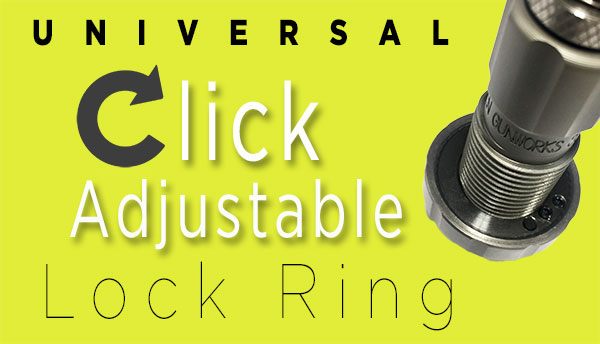
With the Whidden Click-Adjustable Sizer Dies, you can change shoulder bump by .001″ (one-thousandth) with a simple click. Fast. Easy. Precise.
As handloaders have become more aware of shoulder bump and proper adjustment of the sizer die in recent years, there has become a need for an easier way to adjust the sizer die properly. For most folks, with their conventional dies, it takes lengthy trial trial and error to get the shoulder setback correct. Anyone who has done this can attest that it can be a slow and annoying job.
Whidden Gunworks has solved the problem with the innovative Click Adjustable Sizer Die. Patent No: 10,393,488. This die and lock ring work together to give the user a clicking feel to the adjustment just like a high end rifle scope. Each click moves the shoulder bump exactly .001″ so you can easily find the exact shoulder bump that you desire.
The Click Adjustable option is available on Whidden Custom Sizer dies as well (7/8”-14 format dies only)! Included with the Click Adjustable Sizer Die is a Shoulder Bump Gauge. This gauge attaches to standard calipers and allows measurement from the case shoulder to the base. Using the Shoulder Bump Gauge with the Click Adjustable Sizer Die will make the proper sizer die setup easier than ever before.
Click-adjustable die sets are available with both bushing and non-bushing configurations. Along with these complete die sets, Whidden Gunworks offers a separate click-adjustable ring to use with existing dies. Priced at $54.95, the Whidden Click-Adjust Lock Ring represents a modest investment for a major gain in die ease-of-use and precision adjustability.
The Whidden Universal Click Adjustable Lock Ring you can instantly turn your sizer die into a Click Adjustable Die. This ring works with any 7/8 OD sizer of any brand with adjustable shoulder bump. Simple in design, the inner and outer ring can rotate independently of each other. Each click is metered in true 1 thousandths adjustment and has 0.100″ total available travel. These work great with nearly all sizing 7/8 OD sizing dies, and one verified purchaser noted: “Not only are they useful on reloading dies, but it’s the cat’s meow on the Giraud Power Trimmer Case Holders.”
Dillon Users Take Note: The Whidden Click Adjustable Sizing Die will not work with the Dillon 550 or 650 progressive reloading press systems. The Universal Click Adjustable Lock Ring is not compatible with the Dillon floating toolhead.
SHOT Show 2022 is one week away. The 2022 event kicks off with Media Day at the Range on Monday, January 17, 2022. Then the indoor event runs Tuesday the 18th through Friday the 21st. There will be over 2300 exhibitors from all 50 states and 78 nations. This year will see the biggest show ever in terms of floor space. SHOT Show occupies TWO large exhibit halls in 2022 — the Venetian Expo and the brand new Caesars Forum. Total exhibit space for the 2022 show in these two venues is more than 800,000 net square feet — equivalent to more than 18 acres (about 14 football field). And with these twin halls, SHOT Show boasts 13.9 miles of aisles!
SHOT Show FACTS AND FIGURES
– The “SHOT” in SHOT® Show stands for Shooting, Hunting, and Outdoor Trade.
— SHOT Show 2022 will have 800,000 square feet of Exhibit Space with 13.9 MILES of Aisles. The floor space is equivalent to 14 football fields.
— 2022 SHOT Show will have more than 2,300 exhibitors, including the Suppliers Showcase.
— More than 55,000 professionals in the shooting, hunting, outdoors and law enforcement industry are expected to attend, along with 2000+ media members.
— Firearms and ammunition are a $7.1 billion industry. The total economic impact of the gun/ammo/hunting industry is more than $63 billion, which supports more than 342,000 jobs.
— SHOT Show generates millions of dollars in revenue to fund NSSF programs including Firearms Training programs, Project ChildSafe, National Shooting Sports Month, and the +ONE mentoring initiative.
— This is the 44th Annual SHOT Show and the 23rd in Las Vegas. The first SHOT Show was in 1979 in St. Louis, Missouri. The 2021 show was virtual due to the pandemic. Las Vegas has been home to the show continuously since 2010.
Biggest SHOT Show Ever — 800,000 Square Feet of Products
Based on current bookings, SHOT Show 2022 will encompass over 800,000 net square feet. To put it into perspective, the largest SHOT Show on record, the 2008 event, encompassed 714,000 net square feet at the Las Vegas Convention Center. That year outdoor tents needed to be added to fill overflow exhibit space. You can view the 2022 SHOT Show layout here:
Click image for full floor-plan with Level 1, Level 2, and Supplier Showcase.
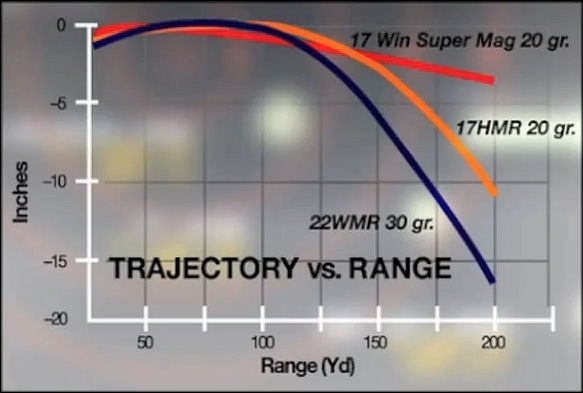
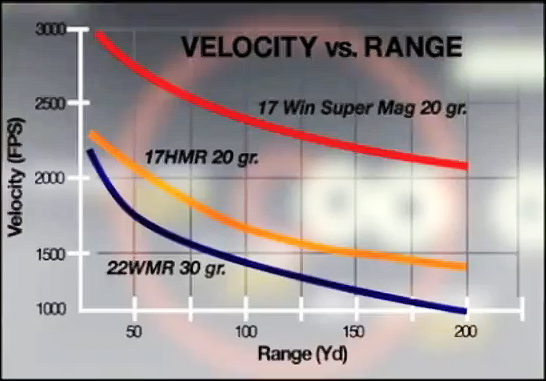
The .17 Winchester Super Magnum (aka .17 WSM) is the fastest, flattest-shooting rimfire cartridge ever created. The .17 WSM cartridge, as you can see below, is significantly larger than the .17 HMR, and can deliver a 3000-fps muzzle velocity with a 20gr bullet, compared to about 2375 fps for .17 HMR 20gr ammo. That’s 26% more speed, which translates to a much flatter trajectory — a big deal when you’re shooting small varmints out to 300 yards.
The .17 WSM has been around for a while, but there have been limited selections of rifles chambered for this speedy rimfire round. Savage is changing that. Savage just announced that it will offer its A17-series rifles chambered in .17 WSM. Currently choose from two models with laminated wood stocks: the A17 WSM Sporter and A17 WSM Target Thumbhole. Both rifles feature a delayed-blowback, semi-automatic action specifically designed for the 17 HMR and 17 WSM cartridges. And both rifles boast 22″ button-rifled barrels, user-adjustable AccuTriggers, and 10-round rotary-feed internal magazines.
Between the two, the Target Thumbhole model ($709 MSRP) would be our choice for varmint work, as the stock has nice ergonomics and shoots better off the bags, with a thicker, wider forearm. The A17 WSM Target Thumbhole model also has a 22″ fluted heavy target barrel. This is better for high-volume varmint sessions than the standard-contour barrel on the Sporter model ($619 MSRP).
Savage Action Should Work Well with the .17 WSM Cartridge
Savage is proud of its new .17 WSM rifles: “We are launching the A17 chambered for .17 WSM in two of our more popular configurations [with laminate stocks]. Both are designed for target shooting and varmint hunting applications[.] The new A17 WSM Sporter and A17 WSM Target Thumbhole pair the dynamic rimfire cartridge with Savage’s A Series semi-automatic action for exceptional accuracy and fast follow-up shots.”
“Savage has seen outstanding performance from the .17 WSM cartridge and felt it could be optimized in new platforms. The A Series rifles have a delayed blowback design that accommodates this caliber with limited modifications, making it an ideal action for the WSM cartridge.” — Jessica Treglia, Savage Arms Senior Brand Manager.
A17 WSM Target Thumbhole Features
Gray wood-laminate thumbhole stock
Delayed-blowback action
Hard chrome bolt with oversized bolt handle
Case-hardened receiver
Fluted 22″ heavy target button-rifled barrel
8-round rotary magazine
User-adjustable AccuTrigger™
$709.00 MSRP
Commentary — This Could be a Great Varmint Option, IF the Ammo Becomes Available
If we were in the market for a new rifle for serious, high-volume ground squirrel and prairie dog varmint safaris, we would seriously consider this new A17 in .17 WSM. With a rimfire cartridge you don’t have to bother with handloading. And you should enjoy significantly better barrel life than a larger centerfire cartridge burning much more powder — provided you don’t shoot too fast and over-heat your barrel. Also, you won’t struggle to find primers. However, unfortunately .17 WSM ammo is hard to find right now, as we explain below. Be aware of the ammo shortage issue.
Related Article Links for More .17 WSM Information
New 3000 FPS Rimfire Round
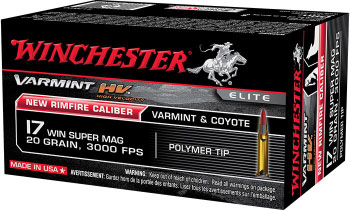
A few years back Winchester created a high-velocity 17-caliber rimfire cartridge, the .17 Winchester Super Magnum (aka .17 WSM). Winchester has offered .17 WSM ammo with a choice of three bullet types: 20gr plastic tip (Varmint HV), 25gr plastic tip (Varmint HE), and a 20gr JHP (Super-X). The 20-grain varieties boast a 3000 FPS muzzle velocity, earning honors as the fastest Rimfire ammo ever made.
.17 Winchester Super Mag Specifications
Symbol
Sub Brand
Bullet Weight
Muzzle Velocity
S17W20
Varmint HV
20-gr Plastic Tip
3,000 fps
S17W25
Varmint HE
25-gr Plastic Tip
2,600 fps
X17W20
Super-X
20-gr JHP
3,000 fps
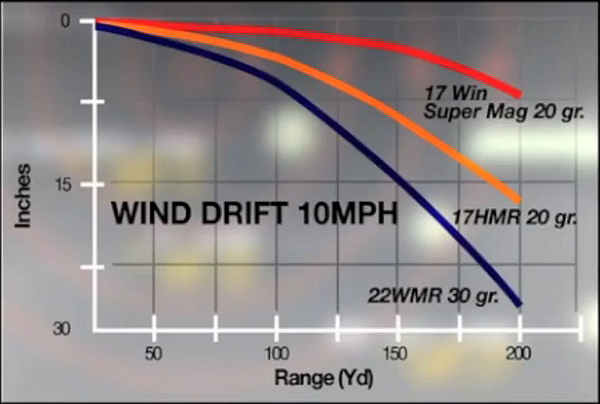
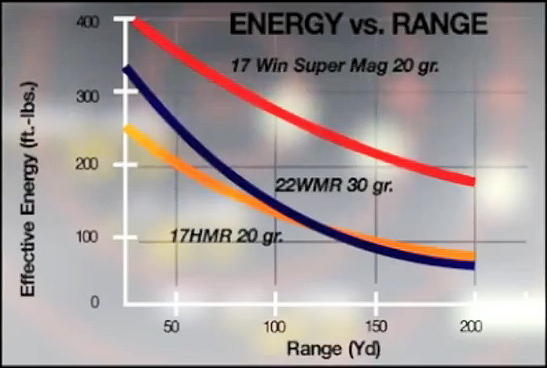
Winchester claims that all .17 WSM ammo types shoot much flatter than the .22 Win Mag and .17 HMR, while delivering 150 percent more energy than both. In addition, the .17 WSM “bucks the wind” better than any other rimfire ammo — exhibiting significant less horizontal drift at extended ranges.
Click Boxes to View Larger Charts
.17 WSM Ammunition is “Unobtanium” Right Now
Since its introduction, .17 WSM ammo has been sold by multiple companies including Browning, Federal (American Eagle), Hornady, and Winchester. Right now it is very hard to find ANY .17 WSM ammo. You have to look far and wide. On January 9, 2022 we checked with five major online vendors and found no .17 WSM ammunition in stock at Midsouth, MidwayUSA, Natchez, Precision Reloading, and Locked&Loaded. Every variety was listed as “Out of Stock” or “Temporarily Unavailable”. That’s discouraging. Hopefully more .17 WSM ammo will be appearing on dealer’s shelves in the months ahead.
The .375 EnABELR cartridge was developed to offer magazine-feeding capabilities with the highest-BC solid bullets available. The .375 EnABELR cartridge is slightly shorter than a .375 CheyTac so it allows the round to mag-feed. Applied Ballistics is currently using brass made by Peterson. The .375 EnABELR has achieved impressive velocities — 2990 FPS — with prototype Berger 379-grain solid bullets fired from a 1:7″-twist 30″ barrel. Applied Ballistics may also test 1:8″-twist and 1:9″-twist barrels. READ Bullet Testing Report.
The .375 EnABELR cartridge was designed to offer .375 CheyTac performance in a slightly shorter package: “The problem with the .375 CheyTac is that, when loaded with the highest performance .375 caliber bullets (379-407 gr Berger Solids, and the 400-425 grain Cutting Edge Lazers) the round is not magazine feed-able in any action that’s sized for CheyTac cartridges.
Here is Mitchell Fitzpatrick, shooting the 375 EnABELR in an ELR Competition.
“Knowing the .375 CheyTac produced substantial performance, and that it was just too long for magazine feeding, made it easy to converge on a design for the .375 EnABELR. We just had to make the case short enough to achieve magazine length with the desired bullets, while adding a little more diameter to keep the case capacity similar to the .375 CheyTac. The resulting basic shape is quite similar in proportions to the successful .338 Norma Magnum Cartridge which, interestingly, was selected as the cartridge for General Dynamics Lightweight Medium Machine Gun (LWMMG).”
Before you load that nice new cartridge brass for the first time, run an expander mandrel down the case necks. This will iron out dents and provide more uniform neck tension. Chose a mandrel diameter that provides appropriate neck tension.
Lapua brass is so good that you’ll be tempted to just load and shoot, if you have a “no-turn” chamber. However, some minimal case prep will ensure more uniform neck tension. Keeping your neck tension very uniform allows more consistent bullet seating. That, in turn, usually yields better accuracy, and lower Extreme Spread and Standard Deviation (ES/SD). Lapua brass, particularly 6mmBR, 6.5×47, 6.5 Creedmoor, and .308 Win comes from the factory with tighter-than-optimal necks. Before you seat bullets, at a minimum, you should inside chamfer the case mouths, after running an expander mandrel down the necks. The expander mandrels from both Sinclair Int’l and K&M will both leave the necks with enough neck tension (more than .001″) so you can then seat bullets without another operation. We suggest putting a bit of lube on the mandrel before running it down the necks — but remove any lube that gets inside the necks before seating bullets.
Both Sinclair and K&M Tools make a die body specifically to hold expander mandrels. The Sinclair version, is shown above. This $32.99 unit fits caliber-specific expander mandrels ($9.99) which measure approximately .001″ less than bullet diameter for each caliber. This is an updated “Gen II” design that completely captures the mandrel within the die so the mandrel cannot pull out. It also has an O-ring in the die cap that allows the mandrel to self-center within the case neck. Sinclair now offers three sizes of die bodies for expander mandrels: .17 -.338 Caliber (#749-011-715WS); .357 – .50 caliber (#749-008-843WS), and a special .50 Cal die body for large-diameter 50 BMG presses (#749-009-163WS, $39.99). All Generation II dies are machined from stainless steel and the standard diameter 7/8-14 dies include the Sinclair Stainless Steel Split Lock Ring.
Once you run the Sinclair expander mandrel down the necks of Lapua brass, after you account for brass spring-back, you’ll have about .002″ neck tension*. This will make the process of seating bullets go much more smoothly, and you will also iron out any dents in the case mouths. Once the case mouths are all expanded, and uniformly round, then do your inside neck chamfering/deburring. The same expander mandrels can be used to “neck-up” smaller diameter brass, or prepare brass for neck-turning.
Forum member Mike Crawford adds: “These expanders can also reduce runout from offset seating. Prior to bullet seating, expand the sized necks to force thickness variance outward. With the Sinclair system, the necks will springback fine, and will not be pulled out of center. This leaves plenty of tension, and bullets seated more centered. I do this, even with turned necks, to get improved seating.”
Mandrels vs. Expander Balls on Decapping Rods
If you haven’t acquired an appropriate expander mandrel for your brass, but you DO have a full-length sizing die with an expander ball, this will also function to “iron out” the necks and reduce tension. However, using a die with an expander ball will work the necks more — since you first size them down, then the ball expands them up again. Typically (but not always), run-out is worse when using an expander ball vs. an expander mandrel.
* This .002″ tension is what we have observed with Lapua 6mmBR, 6.5×47, 6.5 Creedmoor, and .308 Win brass. This might vary with much smaller or larger cases, and of course a different brand of brass might yield different results. If you get too little tension with your current mandrel, you can get a smaller-diameter mandrel from 21st Century Shooting. 21st Century even offers low-friction Titanium Nitride-coated mandrels.
The online video format is a superior method of presenting information on reloading techniques, rifle maintenance, marksmanship skills, scope operation and much more. But with millions of videos on YouTube, it can be hard to cherry-pick the best videos for serious shooters and competitors. That’s why we offer this Saturday at the Movies Series. Each week we will select a variety of very informative videos by knowledgeable shooters and handloaders. Here are our first five Saturday Select videos for 2022.
Reading the Wind — How to Determine Wind Speed
Keith Glasscock is a top-tier F-Class shooter who has finished second at the F-Class Nationals multiple times. Keith is also a highly-respected wind coach with a background in commercial aviation — so he really understands wind and weather. In this video Keith explains the best techniques for reading the speed of the wind. He notes that you can’t simply rely on the Kestrel in your hand because the wind speed can vary significantly between the firing line and the targets. Keith shows how to look at multiple signs (including flags, grass movement, and mirage) to better understand wind velocity. See more of Keith’s videos on his Winning in the Wind YouTube channel.
Rodzilla T-Rex Front Rest Review — State-of-the-Art Beast
In this video our friend F-Class John reviews the impressive T-Rex front rest from Rodzilla.This recently-introduced joystick front rest from Rodzilla really represents significant innovation. The new T-Rex offers impressive capabilities based on the innovative design by creator Rod Brackage (the “Rod” in Rodzilla”> that can truly take your shooting experience to the next level. F-Class John used this rest in F-Open competition and really likes it. CLICK HERE for John’s full review with three videos and many more photos.
How BAT Actions Are Made and BAT Factory Tour
Note: This has loud music as the start — lower volume if at work.
Ultimate Reloader’s Gavin Gear is a skilled and respected video producer. This Ultimate Reloader video shows how top-end BAT rifle actions are crafted with modern CNC machinery. This is one of Gavin’s most popular videos, with 763,000+ views. If you are interested in accurate rifles for benchrest, F-Class, Long Range, or PRS/NRL you should definitely watch this video. Visit Gavin’s YouTube Channel to see dozens of other informative, well-made videos.
Protect Your Dog’s Hearing with Mutt Muffs
Do you take your dog(s) hunting, or to the shooting range? Well dogs need hearing protection too! Loud gunshots from pistols, rifles, or shotguns can cause permanent hearing damage to your canine. Prevent canine hearing loss with Mutt Muffs — protective earmuffs designed especially for dogs. In the Precision Riflecraft video, the host shows how to fit Mutt Muffs to your dogs and help your canines tolerate the muffs in place. Available in five sizes (XS, S, M, L, XL), these cost under $60 on Amazon.
How to Use Ballistics Solvers — Bryan Litz Lesson
A past national F-TR champion, Bryan Litz is a brilliant engineer and trained rocket scientist. He is also the founder of Applied Ballistics LLC (AB), the world’s leading source of ballistics software. AB software now comes integrated into some Kestrel handheld wind-reading units, with accompanying Applied Ballistics Apps that run on your mobile devices. In this short video Bryan explains how to use ballistics solvers to determine your bullet’s drop and drift at long range. If you don’t have the AB App on your smartphone you can also use the excellent JBM Ballistics Solver, available FREE on the internet.
If the battery on your safe’s electronic lock is more than a year old, or if it is not giving you the right voltage, replace it today!
Well it’s a New Year folks — 2022 is here, so change those Gun Safe Keypad Batteries!
By this time, many of our readers have stashed their guns away in the safe for the remainder of the winter. It’s easy to just tuck the guns away and forget about them. But there’s something you should do before you shut the safe door. If you have a safe with an electronic keypad, you should replace the battery every year as a precautionary measure. Trust us, you don’t want to come back in a few months and find that the keypad memory is kaput, and you’re locked out. That can lead to frustration and an expensive locksmith visit.
Here’s a true story. I have one safe with a Sargent & Greenleaf (S&G) keypad. A couple years back, in early December, I went to get into the safe. I punched in the correct combination, but all I got was a rapid “beep, beep, beep, beep” after I finished the last combination entry. I tried again to ensure I entered the combination correctly (I did). But again, the locking system responded with multiple rapid beeps indicating something was wrong. And the safe would not open. Now I was worried….
I popped out the battery holder (which slides in from the bottom of the keypad housing on the door). I removed the battery and tested it with a volt-meter. The 12-month-old Duracell 9-volt battery only registered 6.1 volts.
Low voltage was the problem. I went down to the store and got a couple new 9V batteries. I tested the new batteries and both measured 9.4 volts output. I slipped one of the new 9V batteries into the keypad housing, punched in the combination and everything worked OK again. Eureka.
Most electronic locks for safes WILL “remember” the combination for a period of time even when the battery is low (and the keypad’s “brain” should retain the combination when you remove the battery for replacement). However, a dead battery, or extended periods of low voltage can give you problems. Don’t rely on wishful thinking…
A while back, our friend Vince Bottomley in the UK wrote an excellent article for Target Shooter Magazine. Vince offers “solid-gold” advice for new F-TR and F-Open shooters. Vince reviews the cartridge options, and offers suggestions for a shooter’s first (and hopefully affordable) F-Class rifle. Vince also reviews various bipod choices for F-TR and discusses optics options (from $300 to $3000).
Getting Started in F-Class by Vince Bottomley
As membership secretary of a large club, one of the questions I’m frequently asked – “What’s the best way to get started in F-Class?” My club has an F-Class shoot every couple of weeks at ranges from 300 to 1000 yards and, not surprisingly, it’s very popular.
F-TR or Open Class?
From a shaky start way back in 2004, the F-TR Class is now proving as popular as Open Class and, at GBFCA League shoots and club shoots, many shooters choose to start with a 308, shooting off a bi-pod – in other words F-TR. In Open Class, the 7mm WSM soon established itself as the “must have” cartridge – if you wanted to win but, the WSM’s appetite for barrels eventually brought another 7mm cartridge into play – the 284 Winchester. This 50-year-old stalwart was revived a decade or so ago as the 6.5-284 and indeed this cartridge found some favor with F-Class pioneers – before the potency of the WSM was discovered. If you don’t mind shelling out for a couple of barrels per year (barrel life is about 750 rounds with the WSM) go for the 7mm WSM but, if you require a decent round-count, then opt for the .284 Win and learn to read the wind a bit better!
F-TR Rifle at the Ben Avery Shooting Facility in Phoenix, Arizona.
Scopes for F-Class
If you will be shooting 1000 yards then I would recommend at least 32 power and preferably a variable – like the 8-32. The cheapest “usable” scope in this range is the Sightron 8-32x56mm SIII. It’s a great scope for the money and at under $1000 (in the USA) it’s half the price of some of its competitors. It’s also light – at 1.5 lbs – and there are some great reticles for the F-Class shooter – like the LRMOA.
Springfield Armory’s new 9mm SA-35 pistol has been chosen as the NRA’s American Rifleman Handgun of the Year, and 2022 Golden Bullseye Winner. The NRA Publications Golden Bullseye Awards acknowledge important new products. The winners are selected by a committee of NRA Publications staff, representing more than a century of collective experience in the shooting and hunting industry.
Compared to the classic Browning Hi-Power pistol on which it is based, the new SA-35 offers enhanced controls, modern sights, improved feed ramp design, beveled mag-well, and increased 15-round capacity. Additionally, the SA-35 dispenses with the magazine disconnect as found in the original design. This provides the ability for magazines to drop freely. The new SA-35 also features forged steel parts for strength and durability.
“We are incredibly proud that the SA-35 has been given this prestigious award,” said Dennis Reese, CEO of Springfield Armory. “With this pistol, we have taken a revered design and updated it for today’s shooters.”
Springfield Armory’s new SA-35 semi-auto pistol takes advantage of modern materials and manufacturing techniques, while retaining the appeal of the J.M. Browning’s original P-35 design. The 9mm features a forged carbon steel frame and slide and a cold hammer-forged barrel.
Enhancements include subtle but significant changes to barrel feed ramp and extractor geometry to ensure the SA-35 will work with today’s defensive rounds. A factory-tuned trigger, 15-round flush-fit magazine, beveled magazine well, re-contoured “no-bite” hammer design, modern Tactical Rack sights, extended thumb safety and more round out the package. The SA-35 is compatible with the original pistol’s design, ensuring access to the broad selection of aftermarket parts and accessories available.
Guns America has done a thorough Review of the new Springfield Armory SA-35.
The modern SA-35 is based on the original Browning Hi-Power, aka the P-35. The Browning Hi-Power military pistol, considered the best 9mm handgun of all time by some collectors, is one of the most widely-used handguns in history, and is found in over fifty countries.
The initial Browning Hi-Power design came from John Moses Browning, but was then finalized by Dieudonné Saive at Fabrique Nationale (FN) in Belgium. Browning died in 1926, several years before the design was finalized. There have been many variants based on the Browning Hi-Power and many clones as well. See: Top Ten 9mm Handguns of All Time.
The Civilian Marksmanship Program (CMP), starting this month, have authorized CMP League Matches at CMP-affiliated clubs throughout the USA. This will give shooters the ability to enjoy CMP-type competitions at their local ranges. The new CMP League Match Program will be open to any CMP-Affiliated Clubs. Participants’ average scores will be computed by CMP’s Competition Tracker, with awards distributed to the top competitors from around the country.
Beginning January 2022, the CMP will sanction a series of simulated head-to-head rifle, pistol, and CMP Games events for competitors to participate in from their home ranges. A CMP sanctioned match is an event hosted or sponsored by a CMP affiliated organization, where match sponsors agree to use CMP Competition Rules in conducting CMP Highpower Rifle, CMP Pistol and CMP Games competitions. Types of League Matches and available timeframes will include:
Rifle: March 15 – June 15 and/or August 15 – November 15
50 shot National Match Course (Non-EIC) (Full or Reduced)
4X20 (80 shots, Individual) (Full or Reduced)
Pistol: Outdoor Pistol League May 1 – October 31; Indoor Pistol League November 1 – April 30
30 Shot National Match Pistol Course (full or reduced)
900 Pistol Aggregate (.22 Rimfire, Centerfire, .45 Caliber or Service Pistol)
CMP Games Type Match: March 15-June 15 and/or August 15 – November 15
30 Shot As-Issued Military Rifle Course | Carbine | Rimfire Sporter
How to Get Your Local Club Involved
Interested clubs will need to fill out an application and also submit a match program. Once approved, the match director will be sent a spreadsheet to record official scores that will be compared among other participating clubs. Fees for these events include $10 per league to sanction, plus $2 per competitor.
CMP League INFO, including applications and match instructions, can be found on the CMP website at CMP.org/competitions/cmp-league-matches. Or call CMP Competition Support at 419-635-2141, ext. 714.



 – The “SHOT” in SHOT® Show stands for Shooting, Hunting, and Outdoor Trade.


 New 3000 FPS Rimfire Round


 Well it’s a New Year folks — 2022 is here, so change those Gun Safe Keypad Batteries!