Most of our readers are rifle guys, but it’s definitely fun to shoot a pistol match a few times a year. You don’t need a lot of equipment, and if you shoot IDPA (Int’l Defensive Pistol Assn.) matches, you can really win with a $400 pistol and $20.00 worth of bulk 9mm ammo. That’s a bargain compared to what you’ll spend on a competitive Benchrest or F-Class rig and custom rifle hand-loads.
If you want to get into the IDPA game, Shooting Sports USA has a good article that explains the basic rules and classifications. IDPA is not your grandad’s bullseye pistol match. There is movement and action. Stages are timed, and competitors engage targets from cover if available. Singled-handed shooting is sometimes required, as is shooting while moving. You can compete with pretty much any handgun suitable for self-defense — but no $4000 Raceguns with fancy optics. The fact that you can be 100% competitive without spending a ton of money is what makes IDPA so popular.
Shooting Sports USA polled IDPA shooters at the 2016 IDPA Nationals to determine their favorite gun brands and models. The #1 choice was the 9mm Glock 34 for the SSP (Standard Service Pistol) and ESP (Enhanced Service Pistol) Classes. Next most popular was the Smith & Wesson M&P Pro.
Along with SSP and ESP, there are three other main IDPA classes: Custom Defensive Pistol (CDP) for .45 ACPs (mostly 1911 types), Concealed Carry Pistol (CCP), and Revolver (REV). All classes have a minimum power factor. Scores are based on time and shot placement on the IDPA target.
IDPA Scoring System
The official IDPA Target (right) has multiple scoring zones. If you don’t hit the target’s center mass zone or head zone (both appear green in illustration), you drop one or three points. Here’s the formula: Score (in seconds) = Time + Points Down + Penalties. In IDPA, “points down” (and penalties) are added to your time. If you hit the outer edge of the target, you get 3 points down. Nearer center can be 1 point down. Center hit or head shot is 0 points down. See IDPA Scoring for Dummies.
Five Tips for New IDPA Shooters
This Editor got his start in competitive shooting with local IDPA matches. I shot a 9mm Glock 34, and a 9mm SIG Sauer P226, and even did one match with a .38 Spl S&W Snubbie. I eventually settled on the SIG P226, as it fit my hand better than the Glock, was more accurate, and was every bit as reliable. The P226 also pointed better than the Glock for me — something that helps with target acquisition. Here are FIVE TIPS for new IDPA competitors:
1. Dry-Fire Practice at Home
You can improve your grip and sight acquisition dramatically with 30 minutes of dry-firing every week. Get some quality snap caps and go to it. One tip — don’t do this in your back-yard if the nosy neighbors can see. We had one friend who was dry-firing in his yard and got an unexpected visit from the local police (with guns drawn). That can turn out badly to say the least…
2. Practice One-Handed Shooting (Both Strong-Hand and Weak-Hand)
Most of the worst misses I saw during IDPA matches were during stages requiring one-handed shooting. A lot of pistol shooters have spent all their time shooting two-handed. That’s the best technique, but in an IDPA match, you may be required to shoot one-handed. If you’re a righty, shooting with the left hand only will feel really weird, and your accuracy will be poor unless you practice. We suggest starting your one-handed training with a rimfire pistol, then transition to your centerfire pistol.
3. For 9mm, Don’t Bother to Hand-load Your Ammo
This may seem like sacrilege, but if you’re only shooting one match a month, it’s probably not worth the time and money to reload 9x19mm. I did reload my 9mm ammo on a progressive for a couple years. After looking at money and time, I just started buying bulk commercial 9mm which worked fine. I was only saving a few cents per round by reloading, and that wasn’t worth the time invested.
4. Get a Good Holster That Fits Right
In IDPA matches you normally draw from holster during the match. I saw a lot of people struggle because they had Kydex holsters that would not release easily, or leather holsters that fit too tight or rocked during draw. Try a few different brands at the local store.
5. Be Smooth, Be Calm, and AIM Your Shots
Many folks come into IDPA thinking it’s all about speed. But there are score zones on the official IDPA target, so you need to focus and AIM. Don’t just “run and gun”. If you stay calm, align your sights in the center of the target for EVERY shot, you will end up with a higher score with fewer “points down”. Speed will come with time. It is better to make sure each one of your shots is a hit.
Tired of carrying old-fashioned paper Score Books? Well now you can go digital — Creedmoor Sports offers a full-featured Scoring Book App that lets you plot your shot locations/scores using an Android device or Apple iPhone or iPad. The price is right — FREE! Just visit the Apple App Store or Google Play Store to download the App for FREE.
Record Match and Practice Data
This new App, available for free in the Apple App Store, and the Google Play Store provides all the same functions and capabilities of the traditional, spiral-bound print-format Creedmoor Rifle Data/Score Book, but with the convenience and ease of recording your match and practice information with your mobile device. With this App you can break your 20 shot slow-fire segments into either 10- or 20-shot targets, and also opt for sighting shots. All the specific event data can also be recorded, such as location, wind, light etc., along with wind and elevation adjustments.
COMMUNICATIONS Restrictions: In some matches you are not allowed to have electronic communication ability, so you may have to set your iPhone to “Airplane Mode”, or use this only with an iPod (which does not have two-way communication capability).
With inflation and rising prices, it’s more important than ever to take advantage of discounts and promotions. We’ve located the latest Discount Codes for Brownells Purchases that can save you 10% (or more) on your purchases. These Brownells Discount Codes qualify you for significant savings on guns, ammo, parts, and reloading components at Brownells. Use these Codes during check-out and the savings will reduce your net cost. For example, save $55 on a $500 purchase, $30 off $300, or $25 off $250 –saving 10% or more. If you’re planning a big buy, use code AUGUST120 to save a whopping $120 on a purchase of $1000 or more. NOTE: Some of these discount codes expire at the end of August, while others may expire at any time, so don’t hesitate. If one Code doesn’t work, try another.
You may have heard the phrase “blueprinting an action”, but do you know what that really means? Do you know what operations are done to an action during the blueprinting process? To help you understand, gunsmith Bill Marr of RifleShooter.com has created a helpful article showing a Rem 700 blueprinting job start to finish. This article spotlights how the procedures can be done with manual tools. Bill, who runs 782 Custom Gunworks Ltd., can also perform many of these operations with modern automated machinery. In fact, Bill has written a follow-up article on Truing a Rem 700 receiver with a Lathe.
Bill explains: “Blue-printing, or truing a rifle action, ensures the receiver face, threads, lugs, bolt lugs, and bolt face are square to the center line of the receiver.” In Bill’s informative article, Bill shows how he blueprints a Remington 700 short action receiver with .308 Win bolt face. He covers the following procedures step by step:
Action Disassembly
Ream Minor Diameter of Receiver Threads
Square the Receiver Lugs
Square the Face of the Receiver
Lap the Bolt Lugs
Square the Bolt Face
We use the bushings to guide the receiver tap. This chases the threads and ensures they are square.
2. Truing the Receiver Face
Using the receiver facing tool, the front of the receiver is trued. The tool is placed over the tap and turned by hand. We used Do Drill to lubricate it.
3. Lapping the Lugs
The bolt lapping tool screws into the front of the action and applies rearward pressure on the bolt face. A little bit of lapping compound is placed on the front of the receiver lugs. The bolt handle is then raised and lowered repeatedly. Note — it is critical that we do not get any lapping compound on any other surfaces.
4. Truing the Bolt Face
On this bolt, the central part of the bolt face was low. After the truing operation, this Rem 700 bolt face is now completely square to the action.
IMPORTANT: Rifleshooter.com states: “This article highlights our project and is presented for information purposes only. This provides an overview of the process and should not be attempted without the guidance and supervision of an experienced gunsmith“.
This week, as part of the annual Sturgis Motorcycle Rally, there will be shooting range demo days — the inaugural GUNFEST 2022 presented by GunBroker.com. This 3-day event at the Buffalo Chip Shooting Complex gives visitors the opportunity to test out the latest firearm products, ammunition, accessories and more in a supervised, controlled environment.
Participating companies include: AMMO Inc., Bellmark, Boss Bullets, GunBroker, IWI, KelTec, Kimber, SIG Sauer, Silencer Central, Springfield Armory, Umarex, and Walther.
GUNFEST 2022 offers visitors the chance to try out live ammunition, thermal optics, air guns, shotguns, rifles, and handguns in private shooting lanes. The event is free and open to the public — but shooters must purchase the ammunition they use.
GUNFEST is a three-day shooting event held August 5th, 6th, and 7th at the Sturgis Buffalo Chip Shooting Complex. General admission is free but shooters must pay for ammo. Attendees will have the opportunity to try out new firearms and suppressors. The event runs from 8:30 am to 3:00 pm on Friday, Saturday, and Sunday, August 5-7, 2022.
Location: Buffalo Chip Shooting Complex – 20622 Fort Meade Way, Sturgis, South Dakota
Guidelines for Participation at GUNFEST
Participants must first register with valid ID. Those who want to test firearms must then purchase an “ammunition punchcard” offering 25, 50, 75, or 100-round ammunition “round experiences”.
The event website explains: “When you decide what firearm you’d like to experience you will let the Sponsor booth’s representative know what you’d like to shoot. The Sponsor booth’s representative will then have their assigned GUNFEST RANGE OFFICER escort you and the firearm you’ve selected to experience into 1 of the Sponsor’s private shooting lanes.
It is here, AND ONLY HERE, ammunition will be provided to the participant to shoot at the various steel targets down range within the assigned range lane. NO ammunition will leave the range firing line and NO REFUNDS on ammunition purchases.”
This Video was filmed in 2017 at the Sturgis Shooting Complex during Rally Week:
Any long range shooter knows that wind is our ultimate nemesis. The best ways of overcoming wind are to measure what we can and use computers to calculate deflection. The Applied Ballistics Kestrel is a great tool for this. As good as our tools may be, we don’t always have them at our fingertips, or they break, batteries go dead, and so on. In these cases, it’s nice to have a simple way of estimating wind based on known variables. There are numerous wind formulas of various complexity.
The Applied Ballistics (AB) Wind Hack is about the simplest way to get a rough wind solution. Here it is: You simply add 2 to the first digit of your G7 BC, and divide your drop by this number to get the 10 mph crosswind deflection. For example, suppose you’re shooting a .308 caliber 175-grain bullet with a G7 BC of 0.260 at 1000 yards, and your drop is 37 MOA. For a G7 BC of 0.260, your “wind number” is 2+2=4. So your 10 mph wind deflection is your drop (37 MOA) divided by your “wind number” (4) = 9.25 MOA. This is really close to the actual 9.37 MOA calculated by the ballistic software.
WIND HACK Formula
10 mph Cross Wind Deflection = Drop (in MOA) divided by (G7 BC 1st Digit + 2)
Give the AB wind hack a try to see how it works with your ballistics!
Some Caveats: Your drop number has to be from a 100-yard zero. This wind hack is most accurate for supersonic flight. Within supersonic range, accuracy is typically better than +/-6″. You can easily scale the 10 mph crosswind deflection by the actual wind speed. Wind direction has to be scaled by the cosine of the angle.
Though the worst shortages are behind us, quality ammunition remains hard to find, or fairly costly, particularly for popular cartridge types such as .22 LR, 9x19mm (9mm Luger), .357 Mag, .223 Rem (5.56×45) and 6.5 Creedmoor. And 12ga shotguns ammo has also been in short supply. In this article we list 15 reliable online sources for factory-loaded ammo. You may want to bookmark this page so you can quickly scan and price-check multiple vendors. In addition, you can use a service such as AmmoSeek.com. NOTE: There are complex laws restricting online ammo purchases by California residents.
Why Should You Shop for Ammo Online?
By shopping online for ammo, you can save money, get a wider selection, and often get bulk discounts. GunDeals.com explains the advantages: “Online purchases will save you a lot of money, and that is the biggest advantage, but that is not all, it will also save your time, deliveries are usually really fast, but one of the most important advantages is definitively the huge selection. You will be able to find any ammo brand online[.]” With online retailers you can quickly compare prices, and you will often get a discount on a large order (300 rounds or more) that is not available in local stores. Note, with some large vendors such as Cabela’s and Sportsman’s Warehouse you can order online then pick up in a local store.
Are There Restrictions on Online Ammo Purchasing?
In most (but not all) U.S. states is it legal to order ammunition online to be shipped to your residence. However, you MUST check your State and local laws and regulations. In some states and/or cities, it is ILLEGAL to purchase ammunition online for shipment across state lines with direct delivery. For example, in California, all ammo must be purchased from a licensed ammo dealer/vendor with a state background check (so much for the Second Amendment)*. Likewise Washington DC, Hawaii, and Alaska do not allow online ammunition purchases. And there are restrictions in New York City.
*In some instances ammo can be purchased online from an out-of-state seller who will then ship to an authorized, in-state California vendor who may transfer the ammo for a fee with background checks as required by CA law.
We are often asked “Can I get more velocity by switching primer types?” The answer is “maybe”. The important thing to know is that changing primer types can alter your load’s performance in many ways — velocity average, velocity variance (ES/SD), accuracy, and pressure. Because there are so many variables involved you can’t really predict whether one primer type is going to be better or worse than another. This will depend on your cartridge, your powder, your barrel, and even the mechanics of your firing pin system.
BE SAFE: Be cautious when changing primer types. Glen Zediker recommended decreasing your load ONE FULL GRAIN when changing to a different primer type, one that you haven’t used before.
Interestingly, however, a shooter on another forum did a test with his .308 Win semi-auto. Using Hodgdon Varget powder and Sierra 155gr Palma MatchKing (item 2156) bullets, he found that Wolf Large Rifle primers gave slightly higher velocities than did CCI-BR2s. Interestingly, the amount of extra speed (provided by the Wolfs) increased as charge weight went up, though the middle value had the largest speed variance. The shooter observed: “The Wolf primers seemed to be obviously hotter and they had about the same or possibly better ES average.” See table:
Varget .308 load
45.5 grains
46.0 grains
46.5 grains
CCI BR2 Primers
2751 fps
2761 fps
2783 fps
Wolf LR Primers
2757 fps
2780 fps
2798 fps
Speed Delta
6 fps
19 fps
15 fps
You can’t extrapolate too much from the table above. This describes just one gun, one powder, and one bullet. Your Mileage May Vary (YMMV) as they say. However, this illustration does show that by substituting one component you may see significant changes. Provided it can be repeated in multiple chrono runs, an increase of 19 fps (with the 46.0 grain powder load) is meaningful. An extra 20 fps or so may yield a more optimal accuracy node or “sweet spot” that produces better groups. (Though faster is certainly NOT always better for accuracy — you have to test to find out.)
WARNING: When switching primers, you should exercise caution. More speed may be attractive, but you have to consider that the “speedier” primer choice may also produce more pressure. Therefore, you must carefully monitor pressure signs whenever changing ANY component in a load. In his books, the late Glen Zediker recommended decreasing your load ONE FULL GRAIN when changing to a different primer type, one that you haven’t used before.
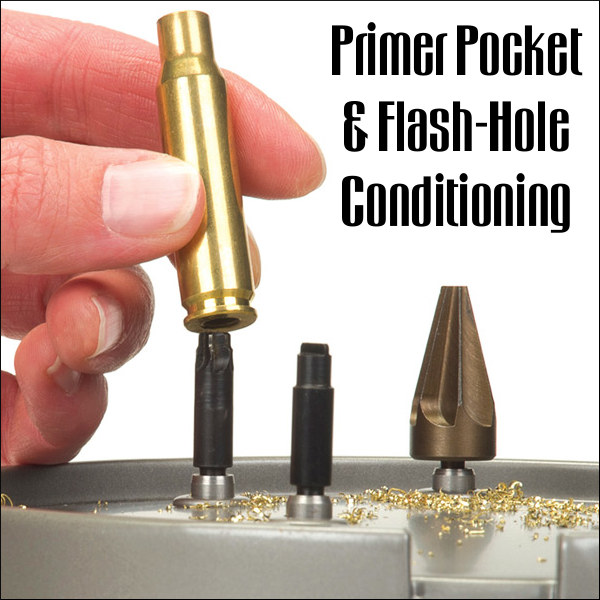
In the past the U.S. Army Marksmanship Unit published a series of reloading “how-to” articles on its USAMU Facebook page. One “Handloading Hump Day” article covered two basic case prep chores — uniforming primer pockets and deburring flash-holes. Visit the USAMU Facebook page for other tips.
Primer Pocket & Flash-Hole Conditioning
This week, we’ll address a question that frequently arises: “Do you uniform primer pockets and deburr flash-holes?” As we tailor our handloading methods to the specific needs of each instance, the answer, not surprisingly, is “Sometimes!” However, don’t flip that dial just yet, as what determines our approach may be helpful in deciding how to address one’s own techniques. Moreover, we have a buried “Easter Egg” morsel that may bring a chuckle, as well as useful safety information!
Generally, the USAMU Handloading Shop does not uniform primer pockets (PP) or deburr flash holes (FH) of our rifle brass. We’re certainly not against it… Rather, this reflects the very high volume of ammunition we load, the fact that very few cases are ever re-loaded for a second firing, and the types of brass we use. However, as a need is perceived, we DO deburr flash holes. Of interest, we have fired many very small, 1000-yard test groups and aggregates using weight-selected, domestic brass that had not had PPs uniformed or FHs deburred.
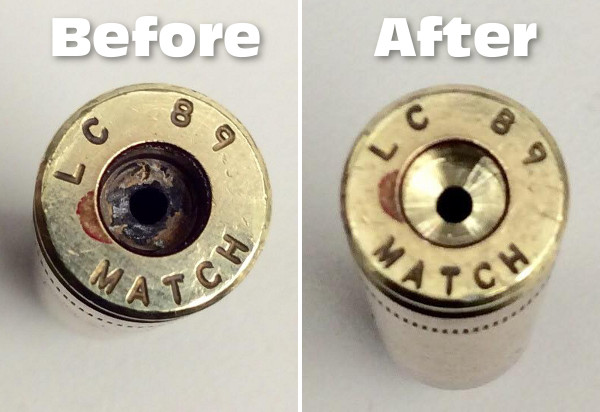
Before and After — On the left is a fired, deprimed 7.62×51 case with primer residue intact. On the right the primer pocket has been uniformed to SAAMI specs. Note the shiny finish at the bottom of the pocket — evidence of the the removal of metal when uniforming the primer pocket.
As to the type cases we use, many thousands of our long-range 5.56mm cases come to us from the arsenal with the primer of our choice pre-installed and staked-in, per usual practice. Obviously, we cannot uniform either FHs or PPs on this live, primed brass. However, after careful sorting, inspection and preparation, we do obtain match-winning results with it.
Shooters who reload their brass several times may decide to uniform PPs and deburr FHs, especially on their “300-yard and beyond” brass. Here, they will use the cases many times, while the uniforming is performed only once. Also, most handloaders only process moderate amounts of brass, compared to our multi-thousand round lots.
Having high quality Long Range (LR) brass helps. Many of the better brass manufacturers [make] their flash holes so that no burrs are created. Still, it does pay to inspect even THESE manufacturer’s products, as occasional slips are inevitable. Very rarely, some of the best makers will have a significant burr in, say, 1 per 1000 or 2000 cases, and it’s worth catching those.
Exceptions can always be found. Recently, we began processing a large lot of match brass from a premier manufacturer. We were startled to find that every case had a significant burr in the FH — something we’d never before seen from this maker. We then broke out the FH deburring tools and went to work.
Some observers have noted that it can be difficult to truly verify the contribution to accuracy of these procedures — particularly when firing from the shoulder, in conditions. Members of this staff, as individual rifle competitors, do often perform these operations on their privately-owned LR rifle brass. One could ascribe this to the old High Power Rifle maxim that “if you think it helps, then it helps.”
However, a World Champion and Olympic Gold/Silver medalist here commented on his own handloading (for International competition, which demands VERY fine accuracy). He noted that he did seem to see a decline in accuracy whenever he did not uniform FHs, deburr FHs and clean primer pockets before each reloading. (One might be tempted to counter that only a truly World Class shooter could reliably detect the difference.) However, with the wisdom of decades experience, our Champion also remarked that “It could have been that I just wasn’t shooting as well that day.”
For those who do opt for these procedures, note that various tool models may have adjustable depth-stops; pay attention to the instructions. Some FH-deburring tools (which enter the case mouth, not the primer pocket) are dependent upon uniform case length for best results.
Above is a flash-hole deburring tool on an RCBS powered case-prep unit. These case prep machines can save a lot of pain and misery, helping one perform various functions quickly and efficiently.
Watch this video to see how a sound suppressor (aka “silencer”, “moderator”, or “can”) is constructed, start to finish. It’s more complicated than you might expect — there are quite a few stages in the process. The video below shows the fabrication of a SilencerCo Octane 45 suppressor:
SilencerCo writes: “What, exactly, goes into making a silencer? It may be more than you’d expect. From cutting metal to chemical baths, to extensive quality control every step of the way, our streamlined process is more than just a few steps. Watch our newest video, HOW IT’S MADE: Octane 45, to catch a glimpse behind SilencerCo’s doors.”
How Loud Are Unsuppressed Rifles?
Firearms Are Loud — 140 dB to 175 dB. ASHA explains: “Almost all firearms create noise that is over the 140-dB level. Exposure to noise greater than 140 dB can permanently damage hearing. A small .22-caliber rifle can produce noise around 140 dB, while big-bore rifles and pistols can produce sound over 175 dB. Firing guns in a place where sounds can reverberate, or bounce off walls and other structures, can make noises louder and increase the risk of hearing loss. Also, adding muzzle brakes or other modifications can make the firearm louder. People who do not wear hearing protection while shooting can suffer a severe hearing loss with as little as one shot[.]” Source: ASHA, Recreational Firearm Noise Exposure.
How Much Does a Good Suppressor Really Reduce Firearm Sound Levels?
That depends on the rifle, the cartridge, and the effectiveness of the suppressor. American Hunter explains: “Suppressors retard the speed of propellant gases from the cartridge that rapidly expand and rush out of the barrel. It’s these gases that produce the loud boom that’s heard for miles. A suppressor’s series of internal baffles slows these gases so they are not all released at once, thereby muffling the sound.” Many good commercial suppressors can achieve 30-35 dB sound suppression. However, Zak Smith of Thunder Beast Arms says: “There are a bunch of manufacturers who publish values that are not reproducible, or use an ad-hoc test instead of a mil-spec test. In many cases we’ve tested the exact same suppressors they’ve advertised with 30-40 dB reductions and found they are actually in the high 20s instead.”
Again, for this reason, we recommend that hunters use ear protection, such as electronic muffs, even when shooting suppressed.


 Along with SSP and ESP, there are three other main IDPA classes: Custom Defensive Pistol (CDP) for .45 ACPs (mostly 1911 types), Concealed Carry Pistol (CCP), and Revolver (REV). All classes have a minimum power factor. Scores are based on time and shot placement on the IDPA target.
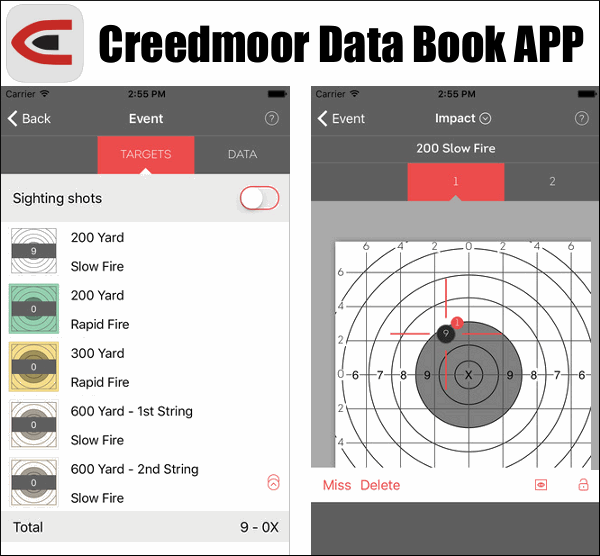
 Tired of carrying old-fashioned paper Score Books? Well now you can go digital —