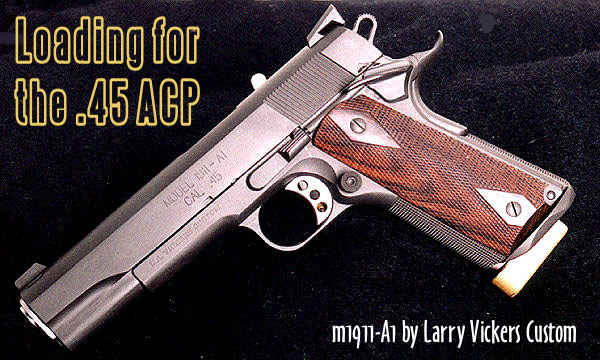
There’s an interesting thread in our Shooters Forum right now — all about good choices for a .45 ACP handgun. If you’re considering getting your first .45 ACP pistol, you should read that thread. If you already own one or more .45 ACP handguns, this article offers some good tips on handloading options.
Good Powder Choices for the .45 ACP
We know that many of our readers own .45 ACP handguns and load for this extremely accurate “classic” cartridge. When selecting a powder for the .45 ACP, there are many good options. All the major powder manufacturers make propellants with appropriate density and burn rate characteristics for the .45 ACP. Popular choices include: AA #5 (Accurate Powder); Bullseye (Alliant); Clays, HP-38, and Titegroup (Hodgdon); VV N310 and N320 (Vihtavuori); and WW 231 and WST (Winchester). We’ve tried all those powders in a variety of .45 ACP handguns. When we consider all the factors that make for a good pistol powder, we think Vihtavuori N320 is one of the best available propellants for the .45 ACP.
Vihtavuori N320 is very accurate, it meters well, and it burns clean, with minimal smoke and flash. If you haven’t tried VV N320 yet, you should.
Pros and Cons of Different Powders for the .45 ACP
This Editor has personally tried out eight or more different powders for the .45 ACP. Bullseye works but it is very dirty (both smoke out the barrel and sooty powder fouling on case). Though it otherwise burns clean, Titegroup leaves a singular (and nasty) high-temp flame streak on your brass that is hard to remove. AA #5 is a good choice for progressive press newbies as you use more powder so a double charge will (usually) be obvious. I like AA #5 but N320 was more accurate. Clays burns clean but some powder measures struggle with flake powders like this. WW 231 offered excellent accuracy and metered well, but it kicked out sparks with little pieces of debris that would hit me in the face. Who wants that?
I personally tried all the powders listed above with lead, plated, and jacketed bullets. After testing for accuracy, consistency, and ease of metering, I selected VV N320 as the best overall performer.
Vihtavuori N320
No powder tested was more accurate (WW 231 was equally accurate).
Meters very well in all kinds of powder measures.
Produces very little smoke from muzzle.
Does not put nasty burn streak on brass like Tite-Group does.
Low Flash — you don’t get particles and sparks flying out like WW 231.
Cases come out from gun very clean — so you can tumble less often.
Forum member and gunsmith Michael Ezell agrees that N320 is a good choice for the .45 ACP. Mike has also found that WW 231, while accurate, produces sparks and a large flash. Mike writes: “I first started using N320 after my first night shoot, while shooting IDPA/IPSC matches. It was astonishing how much of a fireball the WW 231 created. I was literally blinded by the flash while trying to shoot a match. As you can imagine, that didn’t work out very well. I went from WW 231 to N320 and never looked back…and the flash from it was a fraction of what a kid’s sparkler would give off. I have nothing but good things to say about [N320] after using both. Night shoots are a real eye-opener! When it comes to a personal protection… there is, statistically, a very high chance that if you ever have to use a gun to protect yourself or your family, it’ll be in the darkness[.] Being blinded by muzzle flash (and deafened by the noise) are things that should be considered, IMO.”
This Editor owns a full-size, all-stainless S&W 1911. After trying numerous powders, I found VV N320 delivered the best combination of accuracy, easy metering, consistency, clean burning qualities, and low muzzle flash. My gun has proven exceptionally accurate using N320 with bullets from 180 grains to 230 grains — it will shoot as accurately as some expensive customs I’ve tried. At right is 5-round group I shot offhand at 10 yards with my 5″ S&W 1911.
NOTE: The bullet hole edges are sharp because I was using semi-wad-cutters, and the target paper is thick. Rounds were loaded with Vihtavuori N320 and 200-grain SWCs from Precision Bullets in Texas. We shoot Precision’s coated bullets in many of our pistols. These projectiles are accurate and they seem to reduce fouling in our pistol barrels. You can learn about them in this video:
Hunting season is here. For hunters that means many hours may be spent searching for animals through spotting scopes and binoculars — “glassing” for game. And when the hunter does find a good buck or doe, he’ll need to know the animal’s precise distance, so that demands a good laser rangefinder. Being carried in the field, the scopes on hunting rifles need to be tough and durable, and every hunting scope should have good low-light performance. And when the hunter finally takes his shot, his scope better be properly zeroed. Today’s Saturday at the Movies showcase is all about Hunting Optics. We offer eight great videos that help you select the right riflescope, spotting scope, rangefinder, and binoculars for your next hunt.
Comparison of Seven Popular Deer Hunting Scopes
This is summary review of seven (7) popular hunting scopes, as available in 2020 (there may be newer variants). This video consist mostly of manufacturer-created marketing content with a few minutes of independent reviews. Consider this video a place to start when shopping for a new hunting optic. You’ll want to check independent reviews when you select a particular model. The seven riflescopes featured in the video are: Athlon Optics Argos BTR, Leupold VX-3i 3.5-10x50mm, Leupold VX-R 4-12x40mm, NightForce SHV 5-20x56mm, Nikon Buckmasters II, Vortex Crossfire II, Vortex Viper HS SFP.
Optics Selections for Mountain Hunts
Here’s a good video by an avid hunter who treks in remote, mountainous zones. The host has learned what works… and what’s worth the weight to carry: “I’ve found that the combination of 10×42 binoculars and a 27–60x80mm spotting scope is the sweet spot for mountain hunting. This pairing balances weight with reach, allowing me to keep moving but also reach out and see well-hidden animals. In some cases, I will make use of an 18×56 binocular, but this is reserved for non-backpack hunts. With 25 years of mountain hunting experience, I can whole-heartedly recommend my preferred binocular pair as a fantastic and versatile set-up for northern mountain hunts at the very least.”
Ultimate Spotter Test — 19 Spotting Scopes Reviewed
The producers of this remarkable 19-product spotting scope comparison state: “If you are looking at choosing the best spotting scope for hunting… you are in the right place! We tested these 19 spotting scopes to find the best compact spotting scope, best 65mm spotting scope, and best 85mm spotting scope out there. We also wanted to find the best values on the market, and I think we definitely did that. While we certainly couldn’t test them ALL, we were able to put together this incredible lineup of some of the best spotting scopes out there to help you find what is going to work for your specific needs.”
First Focal Plane vs. Second Focal Plane Scopes
For the last century, Second Focal Plane (SFP) scopes have been most common on hunting rifles. Now there are an increasing number of First Focal Plane (FFP) optics favored by hunters. The main reason is that the reticle mark values (in Mils or MOA) are constant relative to the target size at all magnification levels. That is handy for hold-offs and hold-overs. On the other hand, a SFP scope maintains a constant reticle size and line thickness at all zoom values. For most hunting shots, taken inside 300 yards, that really should be fine. Many hunters feel they can spot their prey more easily without a busy reticle that obscures small details at higher magnification. This video explains the pros and cons of both reticle types. The final decision is up to you — much will depend on the terrain you hunt and the distances you shoot.
The Complete Optics Selection for For Deer Hunting
In this video, Vortex optics techs explain the optics package deer hunters will want to take into the field. Along with a good medium-power zoom riflescope, you’ll want binoculars and (probably) a spotting scope. You’ll also want a Laser Rangefinder (LRF) or laser-equipped binoculars. As the team points out, the LRF is not just to range your prey right before you take a shot. A top-quality LRF can range a reflective object as far as 1500 yards away. That helps you decide whether you want to hike a mile to reach that buck you see way out on the next ridge.
MOA vs. MIL — What you Need to Know
These days, scope manufacturers offer a wide selection of both MIL (Milliradian) and MOA (Minute-of-Angle) based optics. We do think that MOA is still predominant in the lighter-weight, lower-cost (sub-$500) scopes marketed for hunters. There are pros and cons for both angular measurement systems. One MIL is 3.6″ at 100 yards, while one MOA is 1.047″ at 100 yards. If you grew up thinking in inches, a 1/4-MOA click-value hunting scope might work best. If you shoot PRS or have other MIL scopes you may prefer a MIL-value optic for your hunting rifle. Both choices will do the job.
Comparison of Eight Laser Rangefinders
The Backfire team purchased eight rangefinders and tested them in the field. Most of the products are under $500. This is a good review if you are looking for a compact LRF at a moderate price. Looking at performance for the price, for the hunting market, the reviewers favored the Leupold RX-1600 and the waterproof Vortex Ranger 1800. COMMENTARY: If you can afford it, we recommend that serious hunters consider top-end laser rangefinder-equipped binoculars such as the ZEISS Victory RF and Leica Geovid.
How to Zero Your Hunting Rifle Efficiently
Last but not least, here’s a great video from Vortex that shows you how to quickly and efficiently sight-in and zero your hunting rifle before heading out into the field. This video explains a simple procedure that lets you get a solid zero in just three shots. Of course you probably want to fire a few more rounds to confirm your zero before you head off to your hunting grounds, but this will let you get on-target with a minimum amount of time and ammo expended. This helpful video has over 3 million views on YouTube!
Fouling Shots and Cold Bore Condition
If you recently cleaned your rifle, you may want to fire two or three fouling shots before you start this procedure. But keep in mind that you want to duplicate the typical cold bore conditions that you’ll experience during the hunt. If you set your zero after three fouling shots, then make sure the bore is in a similar condition when you actually go out hunting.
Tech Tip by Doc Beech, Applied Ballistics Support Team
I am going to hit on some key points when it comes to bullet pointing. How much pointing and trimming needed is going to depend on the bullet itself. Specifically how bad the bullets are to begin with. Starting out with better-quality projectiles such as Bergers is going to mean two things. First that you don’t need to do as much correction to the meplat, but also that the improvement is going to be less. NOTE: We recommend you DO NOT POINT hunting bullets. Pointing can affect terminal performance in a bad way.
NOTE the change in the bullet tip shape and hollowpoint size after pointing:
Don’t Over-Point Your Bullets
What is important here is that you never want to over-point. It is far better to be safe, and under-point, rather than over-point and crush the tips even the slightest bit. To quote Bryan Litz exactly: “Best practice is to leave a tiny air gap in the tip so you’re sure not to compress the metal together which will result in crushing. Most of the gain in pointing is taking the bullet tip down to this point. Going a little further doesn’t show on target”. So in essence you are only bringing the tip down a small amount… and you want to make sure you leave an air gap at the tip.
Also keep in mind, bullet pointing is one of those procedures with variable returns. If you only shoot at 100-200 yards, bullet pointing will likely not benefit you. To see the benefits, which can run from 2 to 10% (possibly more with poorly designed bullets), you need be shooting at long range. Bryan says: “Typically, with pointing, you’ll see 3-4% increase in BC on average. If the nose is long and pointy (VLD shape) with a large meplat, that’s where pointing has the biggest effect; up to 8% or 10%. If the meplat is tight on a short tangent nose, the increase can be as small as 1 or 2%.” For example, If you point a Berger .308-caliber 185gr Juggernaut expect to only get a 2% increase in BC.
Should You Trim after Pointing?
Sometimes you can see tiny imperfections after pointing, but to say you “need” to trim after pointing is to say that the small imperfections make a difference. Bryan Litz advises: “If your goal is to make bullets that fly uniformly at the highest levels, it may not be necessary to trim them.” In fact Bryan states: “I’ve never trimmed a bullet tip, before or after pointing”. So in the end it is up to you to decide.
Pointing is Easy with the Right Tools
The process of pointing in itself is very simple. It takes about as much effort to point bullets as it does to seat bullets. We are simply making the air gap on the tip of the bullet ever-so smaller. Don’t rush the job — go slow. Use smooth and steady pressure on the press when pointing bullets. You don’t want to trap air in the die and damage the bullet tip. You can use most any press, with a caliber-specific sleeve and correct die insert. The Whidden pointing die has a micrometer top so making adjustments is very easy.
Bryan Litz actually helped design the Whidden Bullet Pointing Die System, so you can order the Pointing Die and Inserts directly from Applied Ballistics. Just make sure that you pick up the correct caliber sleeve(s) and appropriate insert(s). As sold by Applied Ballistics, the Whidden Bullet Pointing Die System comes with the die, one tipping insert, and one caliber-specific sleeve. To see which insert(s) you need for your bullet type(s), click this link:
Federal Ammunition has been awarded a $115 million dollar, 5-year contract to produce U.S. Army’s new 5.56mm frangible training ammunition. This training ammo is officially called “AA40 5.56 mm NATO frangible ammunition (Semi-Jacketed Frangible Cartridge, MK311 MOD 3).” This new AA40 frangible ammunition will be used by the U.S. military for training with 5.56-caliber rifles and carbines. The fixed price contract, valued at $114,813,500, carries an estimated completion date of August 17, 2027, according to the Defense.gov contract report.
This new AA40 frangible training ammunition is quite different than conventional 5.56×45 NATO combat ammo used in M16s and other infantry weapons. The key difference is in the construction of the bullets. The AA40’s 50gr projectiles are lead-free and designed to fragment on impact. Shooting Sports USA notes: “[The AA40 ammo] is loaded with a 50-grain frangible bullet comprised of a non-toxic, copper and tungsten powder matrix in a gilding metal jacket. The frangible ammunition is designed to disintegrate into small fragments on impact, while the polymer compound round minimizes splash back and decreases ricochets, making it ideal for training applications.”
Biggest Contract in Federal’s 100-Year History
“This contract is historic,” said Jason Vanderbrink, President of Federal Ammunition. “It is the largest government contract awarded to Federal in its 100 years of operation and speaks volumes to the trust the United States military has in our American workforce assembling the best products for our servicemen and servicewomen.”
“Federal’s frangible training ammunition has been recognized as the best in the business by the United States military and this latest U.S. Army awarded contract continues that recognition,” said Federal’s V.P. of Government Sales David Leis. “The ammunition is designed to disintegrate into small fragments on impact, minimizing over-penetrating and ricochet hazards, making it ideal for training purposes.”
“Successfully executing on the AA40 contract requires large scale production capabilities combined with stringent quality control measures,” said Erik Carlson, Senior Director of Operations at Federal’s headquarters located in Anoka, Minnesota.
Readers who have just recently discovered the Daily Bulletin may not realize that AccurateShooter.com has hundreds of reference articles in our archives. These authoritative articles are divided into multiple categories, so you can easily view stories by topic (such as competition, tactical, rimfire, optics, shooting skills etc.). One of the most popular categories is our Technical Articles Collection. On a handy index page (with thumbnails for every story), you’ll find over 120 articles covering technical and gunsmithing topics. These articles can help you with major projects (such as stock painting), and they can also help you build more accurate ammo. Here are six popular selections from our Technical Articles archive.
Stress-Free Pillar Bedding. Richard Franklin explains how to do a top-quality bedding job, start to finish.
Gun Safe Buyers Guide. Our comprehensive Safe Buyers Guide examines the key features to consider in a safe — Wall Thickness, Volume, Shelving, Fire Rating, Lighting, Weight and more. We also explain the Pros/Cons of Dial vs. Digital (Keypad) locking systems.
Savage Action Tuning. Top F-TR shooter Stan Pate explains how to enhance the performance of your Savage rifle by optimizing the torque settings of the action screws.
Complete Precision Case Prep. Jake Gottfredson covers the complete case prep process, including brass weight sorting, case trimming, primer pocket uniforming, neck-sizing, and, case-neck turning.
Stock Painting Instructions. Step-by-step guide for stock painting by expert Mike Ricklefs. Mike shows both simple coverage and fancy effects.
Ultrasonic Case Cleaning. This article reviews the recommended process for cleaning cartridge brass with ultrasonic cleaning machine. We cover the right liquid solutions, processing times, and case drying options.
Target Sports USA, a major online ammo and shooting accessories vendor, celebrates Prime Day on September 19, 2022. The Prime event, which has featured daily specials, concludes on September 19 with a day of Ammo Deals. There is also a major prize — a new Ford F150 4X4 Truck worth $53,000! Target Sports USA created Prime Day to encourage ammo shoppers to become prime members. This entitles them to significant discounts, FREE shipping, and other benefits. SEE: TargetSportsUSA.com/t-ammoprime.aspx.
How to Win the PRIME DAY Ford F150 Truck Grand Prize
Four contestants will be randomly selected from entries all around the USA. Target Sports USA will give those four contestants an all-expense paid trip to tour its Connecticut warehouse and attend a party, where the PRIME TRUCK WINNER will be selected by drawing. The other three finalists will get thousands of dollars worth of merchandise. (See Prize Package Descriptions below).
How to Enter Contest: Those who sign up as new Target Sports USA Prime members ($95 per year) are automatically entered. You can also enter for FREE with a mail-in form. SEE CONTEST RULES.
What’s the Advantage of Being a PRIME MEMBER?
A Prime membership supplies extra discounts for shooting sports enthusiasts. For example, Target Sports USA Prime members get 8% off already great ammo prices, zero shipping cost, and a 3-hour priority alert notice about new or restocked items. The average Prime member yearly savings is $390.00.
Contest Prizes — Details and Values
PRIZES: The four (4) confirmed eligible Winners will attend the October 22, 2022, Prime Day Party Event, to participate in a random drawing, where each Winner is to win ONE of the following prizes:
• One (1) Grand Prize Winner is to be awarded a 2022 FORD F-150, 4X4 Supercrew, 2.7L V6 Ecoboost, Iconic Silver Metallic exterior and Black/Medium Dark Slate interior Pickup Truck. Approximate Kelly Blue Book (KBB) vehicle value is $53,000. Includes a Target Sports USA package of accessories and ammo at an Approximate Retail Value (“ARV”) $2,000. Total Grand Prize Pool Value is $55,000.
• One (1) First Prize Winner is to be awarded a QuiteKat Electric Bike. (ARV $5,000). Plus, a Target Sports USA Prize Package of Accessories (ARV $2,000). Total First Prize Pool is ARV $7,000.
• One (1) Second Prize Winner is to be awarded a Target Sports USA Prize Package of Accessories and Ammo (ARV $2,000). Plus, a Target Sports USA $1,000 Gift Card. Total First Prize Pool ARV is $3,000.
• One (1) Third Prize Winner is to be awarded a Target Sports USA Prize Package of Accessories and Ammo (ARV $2,000). Total Third Prize Pool ARV is $2,000 (USD).
• Total Grand to Third level Prize Pool ARV is $67,000 (not counting travel awards).
Getting ready for your 2021 fall hunt? Here’s a simple but effective product that can benefit varminters and game-hunters. The slip-on, padded RRR (“triple R”) gun rest cushions your rifle on any surface and helps eliminate noise when shifting the gun from one shooting position to another. The RRR slip-on rest is made of neoprene (wet suit material) with a built-in, thick Armaflex foam cushion on the bottom. This $19.95 sleeve protects the finish of your rifle, while providing a cushioned layer between your rifle and the supporting surface. CLICK HERE for RRR STORE.
Key Benefits of the RRR Slip-On Padded Fore-Arm Rest
1. The RRR sleeve cushions your rifle. This helps to keep the shot from going high even when the rifle is placed on a hard surface.
2. The RRR sleeve quiets the gun. The padded, neoprene covering acts like a sound deadener even when you set the gun on a metal frame or hard surface..
3. The RRR protects the finish on the stock of your rifle from scratches when resting on hard surfaces.
Nammo Announces Plans for Vihtavuori Primer Factory in Finland
During Vihtavuori’s recent 100th anniversary celebration, Nammo Group CEO Morton Brandzaeg announced plans for the construction of a new Vihtavuori primer factory in Vihtavuori, Finland. The new Vihtavuori factory was mentioned in Brandzaeg’s keynote speech to strategic partners in military and civilian markets. The new factory should commence production in 2025.
The €33 million Euro investment will help ensure the security of supply needs for Nordic defense forces and will bolster the resilience of Nammo’s supply chain. The new primer factory is scheduled for completion in 2025 to meet military needs, with consumer sales as early as 2027.
The new primer factory could eventually produce a projected 400 million primers annually. The factory will employ up to 50 new personnel. Nammo states the new primer factory “will help ensure the security of supply needs for Nordic defense forces and will bolster the resilience of Nammo’s supply chain”. The decision to establish the factory was made to ensure primer supplies for the Nordic Defense Forces and respond to the current high demand for commercial ammunition components.
Nammo CEO Brandzaeg stated, “Following Russia’s war with Ukraine, a credible and resilient defense is increasingly important in the Nordic region. This significant investment for Nammo underlines our commitment to supporting defense forces in the Nordic region to secure the future.”
About Vihtavuori: Since 1922, Vihtavuori has produced high-quality smokeless powder for civilian, military, and industrial markets. Vihtavuori propellants are world renowned for their temperature stability, clean burning characteristics, and excellent lot-to-lot consistency. Vihtavuori is imported by Capstone Precision Group, exclusive U.S. distributors for Vihtavuori, Lapua, Berger, and SK-Rimfire products. For more information, visit Vihtavuori.com.
About Nammo: The international Nammo Group is a Nordic defense company whose main markets are North America, the Nordic countries, and Europe. The Group operates in 12 countries with 28 different production facilities and employs approximately 2,700 people.
Most bolt-action rifle shooters work the bolt with their trigger-pulling hand. This is because most rifles sold to right-handed shooters come with right-side bolts, while “lefty” rifles come with left-side bolts. This “standard” configuration requires the shooter to take his dominant, trigger-pulling hand off the stock to cycle the bolt, then re-position his hand on the stock, and “re-claim” the trigger. Often the shooter must lift or move his head to work the bolt, and that also requires him to re-establish his cheek weld after each and every shot. Not good.
This really doesn’t make much sense for precision shooting with fore-end support*. There is a better way. If you leave your trigger hand in position and work the bolt (and feed rounds) with the opposite hand, then you don’t need to shift grip and head position with each shot. All this requires is a weakside-placed bolt, i.e. a left bolt for a right-handed shooter or a right bolt for a left-handed shooter. The video below shows a “Lefty” working a right bolt. Note how efficient this is:
As our friend Boyd Allen explains: “If you think about it, if you are going to work with a factory action where your options are left bolt and left port or right bolt and right port, and you are building a rifle that will only be shot from a rest, using the left/left for a RH shooter or using a right/right for a LH shooter works better than the conventional configuration”.
Shoot Like a Champ and Work the Bolt with Your Weakside Hand
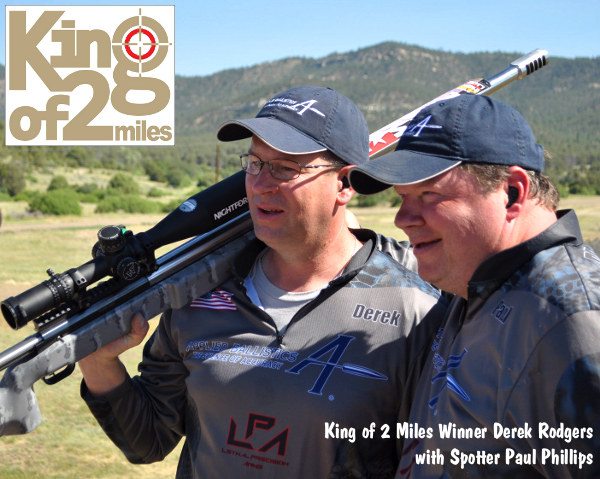
Derek Rodgers, the reigning F-TR World Champion and the only person to have won BOTH F-Open and F-TR U.S. National Championships plus the King of 2 Miles Match, runs this kind of “opposite” bolt set-up. Yep, Derek shoots right-handed with a left bolt. Though Derek is a right-hander, he shoots with a Left Bolt/Left Port (LBLP) action. He pulls the trigger with his right index finger, while working the left-side bolt with his left (weakside) hand. This allows him to stay in position, and maintain his cheekweld. He places his right hand on the grip, while manipulating the bolt (and feeding rounds) with his non-trigger-pulling hand.
Recent F-TR World Champion and King of 2 Miles Derek Rodgers
This is the rifle with which Derek won the 2013 F-TR National Championship.
*For true standing, off-hand shooting (whether in competition or on a hunt), a conventional strongside bolt placement makes sense, since the non-dominant arm must support the front of the rifle all the time. When shooting from bipod or rest, it’s a different story.
Hunting season has started in many parts of the country… or will very soon. Before you head out to the hunting fields, you may want to practice your shooting on specialty paper targets designed expressly for hunters. Here is a selection of game targets which can help you achieve success this hunting season.
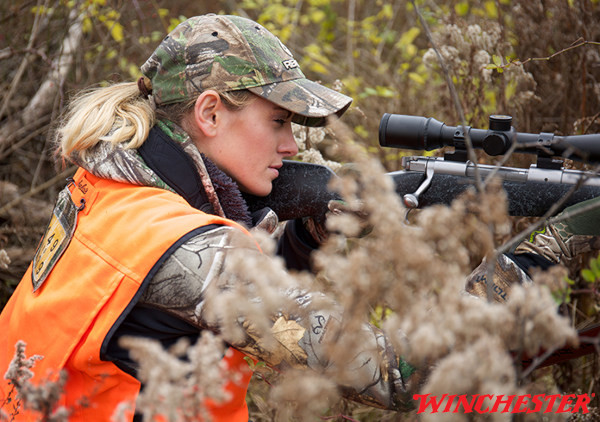
Fall Winchester Hunting photo with Nikki Boxler from Winchester Blog.
FREE Printable Game Targets from the NRA
To help you prepare for your fall hunts, NRABlog.com has created a set of color practice hunting targets. You can hone your skills on a trio of bucks, three wild hogs, or three turkeys. Each target features three red bullseyes, centered on the animals. You can print the targets in black and white, but they look best in color. Click on each image below to download a FREE printable PDF file.
Right-Click Each Image to Download Printable PDF File:


 Good Powder Choices for the .45 ACP
 This Editor owns a full-size, all-stainless S&W 1911. After trying numerous powders, I found VV N320 delivered the best combination of accuracy, easy metering, consistency, clean burning qualities, and low muzzle flash. My gun has proven exceptionally accurate using N320 with bullets from 180 grains to 230 grains — it will shoot as accurately as some expensive customs I’ve tried. At right is 5-round group I shot offhand at 10 yards with my 5″ S&W 1911.


 The new primer factory could eventually produce a projected 400 million primers annually. The factory will employ up to 50 new personnel. Nammo states the new primer factory “will help ensure the security of supply needs for Nordic defense forces and will bolster the resilience of Nammo’s supply chain”. The decision to establish the factory was made to ensure primer supplies for the Nordic Defense Forces and respond to the current high demand for commercial ammunition components.