Rimfire benchrest rifle of Forum member Peebles24.
With the variety of rimfire disciplines, from cowboy action to Olympic three-position smallbore, there are countless different rimfire designs on the market — bolt guns, lever guns, single-shots, toggle-links and more. These may shoot the same ammo, but they certainly vary in looks and ergonomics. This is testimony to human creativity.
In our Shooters’ Forum, you’ll find a long-running thread showcasing rimfire rifles for plinking, hunting, 3P Target Shooting, Silhouette, Benchrest, Rimfire F-Class, NRL22 and more. Here are some of the notable rifles in that Forum thread, with brief build/component details.
Rimfire F-Class Competition Rifle in Eliseo Stock
Here is a cool rimfire rifle featuring an Anschutz Model 1813 action in an Eliseo (Competition Machine) F-Class Chassis resting on a SEB Mini front joystick rest. This rig belongs to Forum member 10XShooter who won a Silver Medal at the Firecracker match at the NRA Whittington Range in Raton, NM. This rifle has a Maven 5-30X scope, Shilen Ratchet barrel smithed by Mark Penrod, plus a Harrell’s tuner. Gary Eliseo makes excellent metal stocks for centerfire and rimfire rifles with models for a variety of disciplines — Palma, F-Class, PRS/NRL and more. Check out all the Eliseo models at GotXRing.com.
IR 50/50 Sporter with 2500 XS Action and Muller 7R Barrel
Here is member doclu60’s Holeshot Arms (Stiller) 2500XS IR 50/50 Sporter. It features a polished action, barrel, rings/bases, trigger guard, and bolt knob. There are premium components: Bix ‘N Andy trigger, Peightal stock, and Muller 7R barrel. The optic is a Leupold Custom Shop VX3i 6.5-20x40mm wearing Rick Averill custom leather scope caps.
Anschutz BR-50 Benchrest Rifle with Upgrades
This is member BHarvey’s rare Anschutz 2013 BR50, with upgrades. This is actually a factory BR-50 stock, but the owner fitted a custom Benchmark barrel, along with a Fudd barrel tuner. That massive butt-plate is three POUNDS of custom-crafted copper, which helps with balance. This rifle was also featured in our popular Guns of the Week collection.
Rimfire F-Class Rig with Curly Maple Stock
This handsome, ultra-accurate Smallbore F-Class rig belongs to member RMist of Team Pro-Shot Products. It has a Holeshot (Stiller) 2500X, stunning Cerus Curly Maple wood stock, Nightforce scope. Up front is the joystick co-axial SEB Joy-Pod.
How does this impressive rimfire F-Classer shoot? Amazingly well. That target at right shows TEN (10) rounds fired at 100 yards. Most centerfire rifles would have trouble beating that level of accuracy.
Rimfire Tactical Rig with CZ Action and McRees Precision Chassis
Here’s a modern chassis rig built with a CZ 455 action. Forum member A-Rob upgraded the CZ 455 with a SCAR 2-stage trigger. This rifle features a Keystone Accuracy-fitted glue-in barrel, Athlon 10-40x scope and McRees Precision chassis. As you can see from the target, it shoots great. Note: CZ has replaced its 455s with the new CZ 457 series with available metal chassis precision model. CLICK HERE to see full target sheet with six 5-shot groups at 50 yards, averaging 0.270″.
Rampro .22 LR Pistol by Gre-Tan
This is a very rare .22 LR bolt-action silhouette pistol. It is a RamPro 22 LR single-shot crafted by Greg Tannel of Gre-Tan Rifles. Member Tonedaddy says this is the only .22 LR Rampro bolt-action pistol built by Gre-Tan in existence. Not the beautifully-figured wood stock.
Benchrest Rimfire with Turbo V3 Action and Owner-Crafted Stock
Member J.J. Coe reports: “Here is a little side project I recently finished. It features a
Turbo V3 action, Benchmark 3-groove barrel chambered by Mark Penrod, Jewell trigger, and Leupold 40X barrel in Harrell’s offset rings.” Notably, J.J. made the 5-piece laminate stock himself. Nice work! Yes this gun is very accurate as you can see from the match target. Below that is another one of J.J.’s rimfires, an Anschutz 54 in another handsome stock he made himself. This guy has talent!
SAKO P94S Rimfire Trio
This trio of SAKO P94S rimfire rifles belongs to Forum member “Thomasconnor”. He tells us: “The one in the middle is probably the most accurate .22 LR rifle I’ve owned. It was about 6 pounds (without the scope or rings) before I made a heavy buttplate for it. In its current configuration it’s under 8 pounds with a giant scope and steel rings. It now has a Jewell trigger, Benchmark barrel, oversized action screws, and Alex Sitman stock”.
Springfield Model 1922s
Member SnapDraw posted: “Here are my Springfield Model 1922s. One is an M1 I got from a shooting club back East. It has an NRA stock with upgraded M2 bolt and Lyman super target spot 15X scope. And the other (below) is an unmolested (except front sight) M2 with military stock. Both are amazing shooters!”
Benchrest Modified Anschutz 2013
Member Esk308 Picked up this pre-owned rifle in the summer of 2020. Along with the Anschutz 2013 action it features a 27″ Lilja barrel, laminated Shehane stock, and Nightforce 15-55x52mm scope in Kelbly rings. On the end of the barrel is a Harrels tuner with Don Blue tube. Esk308 now uses a John Loh front rest with SEB Bigfoot rear bag.
Anschutz 2013 in M. Werks Stock
Here is another Anschutz model 2013, but in a completely different configuration. This is a rimfire prone match rifle upgraded with a Bartlein gain-twist barrel and an M. Werks tuner stock. Note how the barreled action is secured. This handsome rig belongs to Forum member Jeffrey.
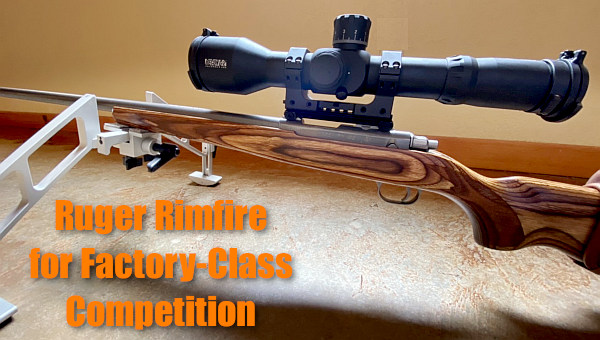
Factory-Class Ruger with Big Bipod
Forum member DavidJoe from Texas put together this rig for a local factory-class rimfire series. He reports: “There’s a discipline where a factory rifle under $1000.00 gets to shoot at a bigger-ringed target. I’m going to try out this new Ruger combination in those limited matches, weighed down with an enormous Valdada scope on a Sinclair bipod.”
Wood-Stocked Trio — Two Remingtons and a Kimber
Here are three .22 LR rigs belonging to member Alamo308. Note the competition iron sights on the middle rifle, a Remington M37 which features a Custom Birdseye Maple stock. The Kimber 82G was sold directly by the CMP as a training rifle. These CMP Kimbers were often extremely accurate.
Marlin 980S Custom with Owner-Crafted Stock
The rifle is based off a Marlin 980S action with a Green Mountain 20″ fluted barrel. The action was bedded with a one-piece aluminum bedding block and Devcon 10110. Owner Kakotoch tells us: “Trigger is a Rifle Basix I took down to just over 16 oz. by using a different pull weight screw. The scope is a Japanese-made Tasco 36x that I picked up NIB for $100 and is surprisingly clear. The stock was my winter project — it’s laminated carbon fiber and walnut, finished with Tru-Oil. I cut, shaped, and polished the buttplate by hand.”
Readers often ask us: “Is there an inexpensive way I can get started in position shooting?” The answer is “yes” — across the country CMP-affiliated clubs host Rimfire Sporter matches. You can use a wide variety of .22 LR rimfire rifles — manual actions (such as a Winchester model 52) or semi-automatics (such as a Ruger 10/22). There are prone, sitting/kneeling, and standing stages. CMP rules provide separate classifications for scoped rifles, open-sighted rifles, and aperature-sighted rifles. The matches are fun, the ammo is inexpensive, and everyone has a good time while improving their marksmanship.
The rapid-fire sitting or kneeling stage of a CMP-sanctioned .22 Sporter Match consists of two, 5-shot strings. A manually-operated or semi-automatic rifle may be used for this match.
This video shows the sitting/kneeling rapid-fire stage of a Rimfire Sporter match.
Our friend Dennis Santiago helps run CMP Rimfire Sporter Matches in Southern California. Dennis observes: “You want something challenging? Well that X-Ring 50 yards away is the diameter of a 50 cent piece, and there are people out there that can womp that thing with iron sights.”
Dennis notes: “There are six (6) stages of fire on a tough little target. Notice the rifles that can be used run the gamut from pump and bolt actions to variations on the semi-auto theme. All still require a good eye and a steady hold to earn one’s bragging rights for the day. A match takes about an hour and a half per relay. The slowest part of the match is initial sighting in. It’ll take longer than the allocated 5 minutes for the typical first timer coming to a club match.”
At Dennis’s Burbank Rifle & Revolver Club (BRRC), procedures are modified a little bit: “What we typically do at BRRC is run two relays. Experienced competitors shoot per the full rulebook. New shooters are afforded a bit more relaxed environment to make the experience more fun and inviting. We do the same thing in our M-1 Garand Clinic/Match series.”
Rimfire Sporter Match Basics
The CMP Rimfire Sporter Rifle Match is an inexpensive, fun-oriented competition using .22 caliber sporter rifles (plinking and small game rifles) commonly owned by most gun enthusiasts. To compete, all you need is a basic rifle, safety gear, and ammunition. No fancy, high-dollar rifles are required.
The event is shot with standard sporter-type, rimfire rifles weighing no more than 7 ½ lbs, with sights and sling. Rifles may be manually-operated or semi-automatic. Shooters with manually-operated actions are given extra time in the rapid-fire stage to compensate for the difference. (See Video).
There are three classes of competition — the standard “O Class” for open-sighted rifles, “T-Class” for telescope-sighted and rear aperture-sighted rifles and “Tactical Rimfire” class, which is a .22 caliber A4 or AR15 style rifle. Firing for all classes is done at 50 and 25 yards on a target with a 1.78″ ten-ring and an 18″ outer one-ring. Even new shooters can get hits on this target, but it’s still tough enough that no one yet has fired a perfect 600×600 score.
The Civilian Marksmanship Program (CMP) has a CMP Guide to Rimfire Sporter Shooting. This FREE, 50-page digital publication covers equipment, positions, course of fire, rules, scoring and much more. You’ll find helpful “how-to” sections on aiming, sight picture, hold control, and trigger control. Reading these instructional sections can benefit any prone or three-position competitive shooter.
What a tale this rusty Colt could tell — this M1911 pistol is more than a vintage military side-arm. It is a symbol of courage, determination, and triumph over adversity. This pistol was carried on a 2,060-mile open-boat ocean crossing from the Philippines to Australia. In May of 1942, the skipper and 17 crewmen of the Minesweeper U.S.S. Quail courageously decided to sail from Manilla to Darwin, Australia rather than surrender to the Japanese. Lt. J.H. Morrill and his crew made that long ocean journey in a 36-foot launch, braving enemy air and sea forces and dangerous ocean conditions.
This pistol is part of the NRA Museum Collection in Fairfax, Virginia. This historic Colt M1911 was a featured “Gun of the Day” on the NRA Museum Facebook Page where you’ll find hundreds of other interesting firearms. We believe the remarkable story of this pistol deserved to be told here…
Colt M1911 Pistol — Escape from Corregidor
The minesweeper U.S.S. Quail was the last operational American naval vessel in the Philippines when Japan began its occupation of the country in May 1942. After his vessel was disabled at the strategically-important island of Corregidor near the entrance to Manilla Bay, Lt. Commander J. H. Morrill scuttled the ship and gave his crew a choice: either surrender to the Japanese or attempt to escape, by sea, to Allied territory thousands of miles away. Rather than surrender, 17 crew members elected to join Morrill on a dangerous passage in a 36-foot open launch/lifeboat. Gear was scavenged including this M1911 recovered from a dead serviceman. With few charts or navigational aids, Morrill and his men successfully completed an epic 58-day 2,060-mile journey to Australia and safety.
The 2025 SHOT Show (Shooting, Hunting, and Outdoor Trade show) is just 17 days away. Thousands of new products will be on display at the SHOT Show, hosted at the Venetian Expo/Convention Center and Caesars Forum in Las Vegas. Gunmakers from around the world will be introducing hundreds of new (and updated) rifles, pistols, and shotguns. Along with the new guns, SHOT Show will feature many noteworthy new optics, electronics, reloading equipment, and accessories.
Here are six interesting videos that preview new (and updated) firearms expected to be on display at SHOT Show in Las Vegas later this month. There are hunting rifles, tactical rifles, rimfire rifles, plus a wide range of new pistols and some interesting shotguns.
This Survival Gear Video feature six interesting guns, starting with the Bear Creek Arsenal BC-15, a bolt-action AR-style rifle (note: this is incorrectly called the BCA-14 in a graphic). There is also an upper-only version that can be used with your existing AR Lower. Next the video reviews the Shadow System CR920X pistol, Wilson Combat Project 1 pistol, Ruger LC 10mm Carbine, CZ Bren 3 (3rd generation), and Atlas Gunworks Apollo V12 pistol. Other new guns are featured in a second Survival Gear Video with four rifles (Beretta 1301 Tactical, Cascade LRH, CMMG BR47, IWI Galil Ace Gen 2), one shotgun (Browning A520) and two pistols (Kimber KDS9C, Ruger RX XM).
This Gun Addicts video features a dozen new guns, many of which will be on display at SHOT Show for the first time. The host states: “The SHOT Show 2025 is here, and it’s packed with groundbreaking firearm announcements.” Featured new guns include: Bushmaster V-Radicator AR Rifle; Charter Arms Double Dog Revolver; EAA Girsan Witness Match Pistol; Fightlight Industries Lever-Action Bandito Pistol (AR style); Heritage Mfg. Coachwhip shotgun; Highpoint Firearms Large-Format Pistols; Jacob Grey TWC Black 2011 Pistol; Patriot Ordnance Factory P-15 Rifle; Shadow Systems CR920X/CR920XP Pistols; Taurus 608 Competition .357 Mag Revolver; and TriStar Arms APOC and Protege-X Pistols.
It’s that time of the year again with SHOT Show right around the corner. The PewPew Zone YouTube Channel offers a first look at some interesting new firearms. The PewPew editors were impressed, stating: “Gun makers are starting to roll out their latest and greatest for the upcoming year, pushing the boundaries of innovation and performance.” Over a dozen new rifles and pistols are featured in this 17-minute video.
This Line45 video features a large collection of new or updated guns. Featured firearms include: Shadow System CR920X pistol; Bushmaster V-Radicator AR-15; Hi-Point large format pistols; Patriot Ordnance P-15 Base Rifle; and Jacob Grey TWC Black 2011 Pistol.
Savage New Revel Rimfire Lever-Action Rifles
At SHOT Show 2025, Savage Arms will showcase its new Revel Classic and Revel DLX rimfire lever-action rifles in .22 LR, .22 WMR, and .17 HMR chamberings. These are take-down rifles with simple disassembly for cleaning and maintenance. The Revels feature a nice, satin-finish walnut wood stock plus a large lever loop for rapid cycling. These new rimfire lever guns start at $439.00 MSRP for the Revel Classic and $539.00 for the Revel DLX. The .22 LR Revel Classic is available now while the .22 WMR and .17 WMR versions will be available in early spring 2025, as will all Revel DLX models.
Here’s another Line45 channel video with five new guns on display at SHOT Show 2025. This 9-minute video is compiled mostly from marketing footage from the manufacturers. The featured new firearms include: EAA Gerson Witness 231 Pistol; Charter Arms Double Dog Revolver; Heritage Manufacturing Coach Whip Shotgun; Taurus 608 Revolver; Patriot Ordnance Factory (POF) P-15 Base Rifle (shown above).
BONUS: SHOT Show Floor Tour — Locations of Gun Companies
Will you be heading to SHOT Show this year? CLICK HERE for the handy official Interactive Floor Map. For each building and floor level this shows the location of exhibitors. This can help you efficiently organize visits to your favorite gun and optics manufacturers.
Nikon offers eyepieces with reticles for its flagship Monarch Fieldscopes. Eyepiece reticles help spotters call shot corrections with precise click values (MOA or Mils).
Using a spotting scope seems simple. Just point it at the target and focus, right? Well, actually, it’s not that simple. Sometimes you want to watch mirage or trace, and that involves different focus and viewing priorities. Along with resolving bullet holes (or seeing other features on the target itself), you can use your spotting scope to monitor mirage. When watching mirage, you actually want to focus the spotting scope not on the target, but, typically, about two-thirds of the distance downrange. When spotting for another shooter, you can also use the spotting scope to watch the bullet trace, i.e. the vapor trail of the bullet. This will help you determine where the bullet is actually landing, even if it does not impact on the target backer.
In this video, SFC L.D. Lewis explains how to use a spotting scope to monitor mirage, and to watch trace. SFC Lewis is a former Army Marksmanship Unit member, U.S. Army Sniper School instructor, and current U.S. Army Reserve Service Rifle Shooting Team member. In discussing how precision shooters can employ spotting scopes, Lewis compares the use of a spotting scope for competition shooters vs. military snipers. NOTE: You may wish to turn up the audio volume, during the actual interview segment of this video.
Why You CANNOT Rely on the MV Printed on the Ammo Box!
When figuring out your come-ups with a ballistics solver or drop chart it’s “mission critical” to have an accurate muzzle velocity (MV). When shooting factory ammo, it’s tempting to use the manufacturer-provided MV which may be printed on the package. That’s not such a great idea says Bryan Litz of Applied Ballistics. Don’t rely on the MV on the box, Bryan advises — you should take out your chrono and run your own velocity tests. There are a number of reasons why the MV values on ammo packaging may be inaccurate. Below is a discussion of factory ammo MV from the Applied Ballistics Facebook Page.
Five Reasons You Cannot Trust the Velocity on a Box of Ammo:
1. You have no idea about the rifle used for the MV test.
2. You have no idea what atmospheric conditions were during testing, and yes it matters a lot.
3. You have no idea of the SD for the factory ammo, and how the manufacturer derived the MV from that SD. (Marketing plays a role here).
4. You have no idea of the precision and quality of chronograph(s) used for velocity testing.
5. You have no idea if the manufacturer used the raw velocity, or back-calculated the MV. The BC used to back track that data is also unknown.
1. The factory test rifle and your rifle are not the same. Aside from having a different chamber, and possibly barrel length some other things are important too like the barrel twist rate, and how much wear was in the barrel. Was it just recently cleaned, has it ever been cleaned? You simply don’t know anything about the rifle used in testing.
2. Temperature and Humidity conditions may be quite different (than during testing). Temperature has a physical effect on powder, which changes how it burns. Couple this with the fact that different powders can vary in temp-stability quite a bit. You just don’t know what the conditions at the time of testing were. Also a lot of factory ammunition is loaded with powder that is meter friendly. Meter friendly can often times be ball powder, which is less temperature stable than stick powder often times.
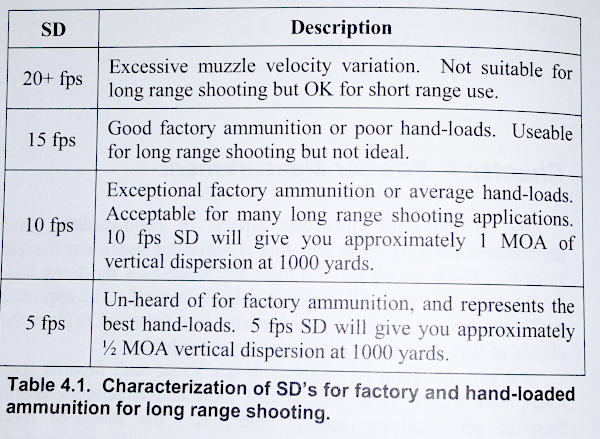
3. The ammo’s Standard Deviation (SD) is unknown. You will often notice that while MV is often listed on ammo packages, Standard Deviation (normally) is not. It is not uncommon for factory ammunition to have an SD of 18 or higher. Sometimes as high as 40+. As such is the nature of metering powder. With marketing in mind, did they pick the high, low, or average end of the SD? We really don’t know. You won’t either until you test it for yourself. For hand-loaded ammo, to be considered around 10 fps or less. Having a high SD is often the nature of metered powder and factory loads. The image below is from Modern Advancements in Long Range Shooting: Volume II.
4. You don’t know how MV was measured. What chronograph system did the manufacturer use, and how did they back track to a muzzle velocity? A chronograph does not measure true velocity at the muzzle; it simply measures velocity at the location it is sitting. So you need to back-calculate the distance from the chrono to the end of the barrel. This calculation requires a semi-accurate BC. So whose BC was used to back track to the muzzle or did the manufacturer even do that? Did they simply print the numbers displayed by the chronograph? What kind of chronograph setup did they use? We know from our Lab Testing that not all chronographs are created equal. Without knowing what chronograph was used, you have no idea the quality of the measurement.
5. The MV data may not be current. Does the manufacturer update that data for every lot? Or is it the same data from years ago? Some manufacturers rarely if ever re-test and update information. Some update it every lot (ABM Ammo is actually tested every single lot for 1% consistency). Without knowing this information, you could be using data for years ago.
CONCLUSION: Never use the printed MV off a box of ammo as anything more than a starting point, there are too many factors to account for. You must always either test for the MV with a chronograph, or use carefully obtained, live fire data. When you are using a Ballistic Solver such as the AB Apps or Devices integrated with AB, you need to know the MV to an accuracy down to 5 fps. The more reliable the MV number, the better your ballistics solutions.
Today we share some smart tips from a past F-Class and Sling Champion who is both a great shooter AND a ballistics wizard. Founder of Applied Ballistics LLC, Bryan Litz is the author of multiple books and creator of advanced Ballistics Software.
Bryan is also a highly skilled competitor. In 2015, Bryan Litz won the F-TR Mid-Range AND Long-Range National Championships hosted at Ben Avery. And at the 2014 Berger SW Nationals (SWN), Bryan took top honors among all sling shooters. If you only know Bryan Litz from his Applied Ballistics Books and DVDs, you may not realize that this guy is a also great marksman along with being an actual rocket scientist!
Given his impressive track record in both F-Class and Palma (Fullbore) out to 1000 yards, we asked Bryan if he had any advice for other long-range competitors.
First Bryan provided three tips concerning Ballistics, his special area of expertise. Next Bryan offered three more general tips about long-range competition — how to analyze your shooting, how to choose your ‘wind strategy’, and how to avoid the most costly mistakes, i.e. how to avoid the “train-wrecks”.
Bryan Litz won the 2015 F-TR Mid-Range and Long-Range Championships with this sleek rig:
Litz Ballistics Tips
Ballistics TIP ONE. If you’re having trouble getting your ballistic software to match actual drops, you need to look at a number of possible reasons. Here are some common issues that can cause problems.
Click Values Are Not Exact. Scopes and iron sights don’t always produce accurate adjustments. In other words, if your ballistics program predicts 30 MOA of drop, and you dial 30 MOA but hit low, it might be that your sight actually only moved 28 MOA (for example). To see if your sight is adjusting accurately, shoot a tall target at 100 yards and measure group separation when dialing your sight.
Barometric vs. Station Pressure. This is a commonly misunderstood input to ballistics programs. You can avoid this pitfall by remembering the following: station pressure is the actual measured pressure at your location, and you don’t need to tell the program your altitude when using station pressure. Barometric pressure is corrected for sea level. If you’re using barometric pressure, you also have to input your altitude.
Muzzle Velocity. Chronographs are not always as accurate as shooters think they are — your true MV may be off by 10-20 fps (or more). If your drop is different than predicted at long range, it might be because your muzzle velocity input is wrong.
Mixing Up BC (G1 vs. G7). Knowledgeable long range shooters know that the G7 standard is a more representative standard for modern LR bullets. However, using G7 BCs isn’t just a matter of clicking the ‘G7′ option in the program. The numeric value of the BC is different for G1 and G7. For example, the G1 BC of the Berger 155.5 grain Fullbore bullet is .464 but the G7 BC is .237. If you were to enter .464 but click on G7, the results would be way off.
Ballistics TIP TWO. A properly installed level is absolutely essential for long range shooting. Without a good level reference, your long range wind zero will be off due to minor canting of the rifle from side to side. You can verify that your level is installed correctly on a 100-yard ‘tall target’. Draw a plumb line straight up the target and verify that your groups track straight up this line as you go up in elevation.
Ballistics TIP THREE. If your long range ballistic predictions aren’t tracking, always come back and verify your 100-yard zero. Sometimes a simple zero shift can be misconstrued as errors in long range ballistics predictions.
Litz Competition Shooting Tips
Competition TIP ONE. Improving your scores in long range competition is a constant process of self-assessment. After each match, carefully analyze how you lost points and make a plan to improve. Beginning shooters will lose a lot of points to fundamental things like sight alignment and trigger control. Veteran shooters will lose far fewer points to a smaller list of mistakes. At every step along the way, always ask yourself why you’re losing points and address the issues. Sometimes the weak links that you need to work on aren’t your favorite thing to do, and success will take work in these areas as well.
Competition TIP TWO. Select your wind shooting strategy carefully. For beginners and veterans, most points are typically lost to wind. Successful shooters put a lot of thought into their approach to wind shooting. Sometimes it’s best to shoot fast and minimize the changes you’ll have to navigate. Other times it’s best to wait out a condition which may take several minutes. Develop a comfortable rest position so you have an easier time waiting when you should be waiting.
Competition TIP THREE. Actively avoid major train wrecks. Sounds obvious but it happens a lot. Select equipment that is reliable, get comfortable with it and have back-ups for important things. Don’t load on the verge of max pressure, don’t go to an important match with a barrel that’s near shot out, physically check tightness of all important screws prior to shooting each string. Observe what train wrecks you and others experience, and put measures in place to avoid them.
Looking down-range with F-TR rifle at Ben Avery Shooting Facility in Phoenix, Arizona.
Bullet Stability and Twist Rates
In this video, Bryan Litz talks about bullet in-flight stability and how to calculate barrel twist-rate requirements for long-range bullets. Bryan explains that bullet stability (for conventional projectiles) is basically provided by the spinning of the bullet. But this spin rate is a function of BOTH the nominal twist rate of the barrel AND the velocity of the projectile. Thus, when shooting the same bullet, a very high-speed cartridge may work with a slower barrel twist rate than is required for a lower-speed (less powerful) cartridge. For match bullets, shot at ranges to 1000 yards and beyond, Bryan recommends a twist rate that offers good stability.
You’ll find more expert information on long-range shooting and ballistics on the Applied Ballistics website and the Bryan Litz Ballistics Facebook page. Bryan’s most recent Facebook post talks about the Coriolis effect — the apparent drift of a rifle trajectory due to the rotation of the earth.
To learn more, we recommend you subscribe to the Applied Ballistics Science of Accuracy — with in-depth articles, brilliant podcasts, exclusive videos and more.
Most of us have access to a printer at home or at work. That means you can print your own targets. You’ll find hundreds of free target designs online, including dozens of downloadable targets on our AccurateShooter.com Target Page. If you’re feeling creative, you can design your own target with a computer drawing program such as MS Paint.
Paper Stock Is Important
If you want your self-printed targets to show shots cleanly (and not rip when it gets windy), you should use quality paper stock. We recommend card stock — the kind of thick paper used for business cards. Card stock is available in both 65-lb and 110-lb weights in a variety of colors. We generally print black on white. But you might experiment with bright orange or yellow sheets. Forum Member ShootDots report: “They sell cardstock at Fed-Ex Kinko! I use either Orange or Yellow. That makes it easy to see the bullet holes clearly.” On some printers, with the heavier 110-lb card stock, you will need to have the paper exit through the rear for a straighter run.
Here are some Target-Printing Tips from our Forum members:
“Staples sells a 67-lb heavy stock that I have settled on. I use the light grey or light blue, either of these are easy on the eyes on bright days. I have used the 110-lb card stock as well and it works fine. It’s just a little easier to print the lighter stuff.” (JBarnwell)
“Cardstock, as mentioned, works great for showing bullet holes as it doesn’t tear or rip like the thin, lightweight 20-lb paper. I’ve never had a problem with cardstock feeding in the printer, just don’t stick too many sheets in there. If I need three targets, I load only three card stock sheets”. (MEMilanuk)
“I’ve used Staples Sticker paper. This works well and no staples are required (joke intended). It helps if you put slight tension on the lighter weight paper when mounting it on the target frame.” (Mac 86951).
Here are some tips for using lighter weight paper (if you want to save money or your printer won’t work with heavier stock):
“20-lb bond works pretty well for me if I use a spray adhesive and stick the entire back of the paper’s surface to the backer board.” (Lapua40X)
“I use the regular 20-lb paper but the only time it tears is when there is no backer to support it. This can be an issue when going to a public range and the backer are all shot out. I use a large construction paper backer that I clip onto the stands.” (CPorter)
Here Are Three of Our Favorite Targets. Click to Download PDFs.
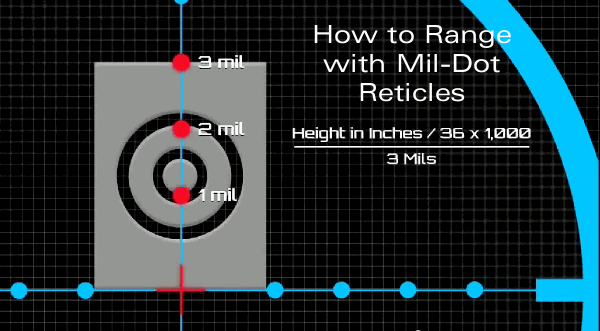
MIL-system scopes are popular with tactical shooters. One advantage of MIL scopes is that the mil-dot divisions in the reticle can be used to estimate range to a target. If you know the actual size of a target, you can calculate the distance to the target relatively easily with a mil-based ranging reticle. Watch this helpful NRA video to see how this is done:
Milliradian Definition and Yardage Ranging Formula
“MIL” or “Milrad” is short-hand for Milliradian, a unit of angular measurement. The subtension of 1 mil equals 3.6 inches at 100 yards or 36 inches at 1,000 yards. (In metric units, 1 mil equals 10 centimeters at 100 meters or 1 meter at 1,000 meters.) Knowing this subtension and knowing the size of the target (or a reference object near the target) allows the distance to the target to be estimated with considerable accuracy. The formula used to calculate range (in yards) based on MIL measurement is:
Height of Target in inches (divided by 36) x 1000, divided by the number of mils.
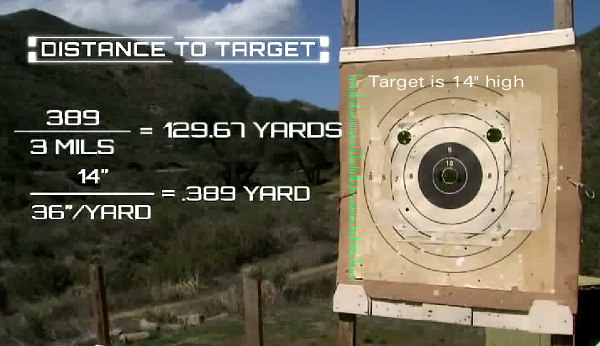
For example, if a 14″ tall target spans 3 mils from top to bottom, the distance is 129.67 yards calculated as follows: 14/36 x 1000 = 389, then divided by 3 = 129.67. You can also use a different conversion to find distance in meters.
Can You Estimate Range with an MOA-Marked Reticle? Yes You Can…
Reader Josh offers this handy advice: “It worth noting that the ability to measure range is not unique to mil-based systems. A MIL is just another unit for measuring angles, and any angular measurement will work. Considering that just about everybody knows that 1 MOA is about an inch per hundred yards, similar formulae can be developed for ranging with MOA marks. The advantage with mils is the precise relationship between units — the MOA-inch measurement is imprecise (being off by 0.047″) — so in principle MILs are a better unit”.
Smart gun owners know they need a good, solid gun safe. But when choosing a gun safe, what kind of lock should you select — electronic or mechanical? Both types have their advantages and disadvantages. This article will help you make the right choice for your needs and also get the most reliable performance from either type.
Gunsafes can be fitted with either an electronic keypad-style lock, or a conventional dial lock. In our Gunsafe Buyer’s Guide, we explain the important features of both dial and electronic lock systems. Many safe-makers will tell you that consumers prefer electronic locks for convenience. On the other hand, most of the locksmiths we’ve polled believe that the “old-fashioned” dial locks, such as the Sargent & Greenleaf model 6730, will be more reliable in the long run. CLICK HERE to learn more about the Pros and Cons of Mechanical (dial) Lock vs. Electronic (keypad) safe locking systems.
One safe supplier, The Safe Keeper, notes that mechanical (dial) locks tend to be more reliable over long periods: “When it comes to reliability, a mechanical lock is the way to go. Anything electronic is designed to fail sooner or later. For every 20 broken electronic locks we will get one mechanical. Bottom line is, it’s not that complicated to input a combination on a mechanical lock. Those extra 7 seconds just might save you from being locked out and having your safe drilled opened.”
This Liberty Safe video compares Mechanical (dial or key) vs. Electronic (keypad) safe locking systems.
Here is the opinion of RFB from Michigan. He is a professional locksmith with over two decades of experience servicing locks and safes of all brands and types:
What a Professional Locksmith Says:
For the convenience of quick opening, the electronic locks can’t be beat. However, for endurance and years of trouble-free use, the electronics can’t compare with the dial lock.
I’ve earned my living, the past 22 years, servicing locks of all types. This includes opening safes that can’t otherwise be opened. I do warranty work for several safe manufacturers (including Liberty). What I’ve learned in all those years is that manual dial locks have very few problems. The most common is a loose dial ring which can shift either left or right, which will result in the index point being in the wrong place for proper tumbler alignment. This is simple to fix.
Electronic locks, however, can have all kinds of issues, and none (except bad key-pad) are easy to fix, and when one goes bad, it must be drilled into to open it. IMO, it’s not a matter of ‘if’ an electronic lock will ultimately fail, but a matter of ‘when’ it will fail. Over the past 10 years or so, since electronics have become more and more prevalent, I’ve had to drill open bad electronic locks vs. bad manual dial locks on a ratio of about 20-1.
My professional opinion is to get the manual dial lock, unless you’ve got a good friend who is a locksmith/safecracker.
How Secure is Your Lock?
RFB tells us that both dial and electronic locks offer good security, provided it’s a good quality lock made by LaGard, Sargent & Greenleaf, Amsec, or Kaba/Ilco. However, RFB warns that “Some of the ‘cheaper’ locks (both manual and electronic) however, are very simple to bypass.
An electronic lock that’s glued or ‘stuck’ to the door with double-sided tape, and has its ‘brain’ on the outside of the lock in the same housing as the keypad, and merely sends power to an inner solenoid via a pair of wires through the door, is a thief’s best friend. The good ones have the brain inside the safe, inaccessible from the outside.
No amateur can ‘manipulate’ either a good manual or electronic lock. Both give you a theoretical one million possible combinations. I say ‘theoretical’ because there are many combinations that cannot, or should not, be used. You wouldn’t set your combo on a dial lock to 01-01-01 etc., nor would you set an electronic to 1-1-1-1-1-1, or 1-2-3-4-5-6.”
Tips for Dial Locks
RFB notes that “The speed, and ease of use, of a manual dial lock can be improved upon, simply by having your combo reset using certain guidelines. Avoid high numbers above 50. Having a 1st number in the 40s, 2nd number anywhere from 0-25, and 3rd number between 25 and 35 will cut dialing time in half, without compromising security. (For mechanical reasons I won’t get into here, the 3rd number of a good manual dial lock cannot — or should not — be set to any number between 95 & 20).”
Tips for Electronic Locks
Electronic locks can have the combination changed by the user much more easily than dial locks. That should be a good thing. However, RFB explains: “That can be a double-edged sword. More than a few times I’ve had to drill open a safe with an electronic lock that has had the combo changed incorrectly by the user, resulting in an unknown number that nobody can determine. Also, don’t forget that electronic locks have a ‘wrong-number lock-out’. I would NOT rely on the normal quickness of an electronic 6-number combo in an emergency situation. If for any reason (panic etc.) you punch in the wrong number several times, the lock will shut down for a 5-minute ‘penalty’.
Replace Electronic Lock Batteries Every Year
To get the most life out of any electronic (keypad Lock), you should change the battery at least once a year, whether it needs it or not. Low voltage won’t necessarily shut down the lock, but using it in a low voltage situation is bad for the electronics, and eventually will cause lock failure. So, If you do nothing else to maintain your digital-lock safe, replace the battery every year.
And get a fresh battery (with a release date) from the store — don’t just pull a battery out of a storage bin, even if it’s never been used. Old batteries can lost “juice” and physically degrade, even when in storage.
This article is Copyright 2023 AccurateShooter.com. No reproduction on any other website is authorized without payment of licensing fees or liquidated damages.


 This handsome, ultra-accurate Smallbore F-Class rig belongs to member RMist of Team Pro-Shot Products. It has a Holeshot (Stiller) 2500X, stunning Cerus Curly Maple wood stock, Nightforce scope. Up front is the joystick co-axial SEB Joy-Pod.




 Using a spotting scope seems simple. Just point it at the target and focus, right? Well, actually, it’s not that simple. Sometimes you want to watch mirage or trace, and that involves different focus and viewing priorities. Along with resolving bullet holes (or seeing other features on the target itself), you can use your spotting scope to monitor mirage. When watching mirage, you actually want to focus the spotting scope not on the target, but, typically, about two-thirds of the distance downrange. When spotting for another shooter, you can also use the spotting scope to watch the bullet trace, i.e. the vapor trail of the bullet. This will help you determine where the bullet is actually landing, even if it does not impact on the target backer.


 Most of us have access to a printer at home or at work. That means you can print your own targets. You’ll find hundreds of free target designs online, including dozens of downloadable targets on our



 Gunsafes can be fitted with either an electronic keypad-style lock, or a conventional dial lock. In our
  Tips for Dial Locks
 Replace Electronic Lock Batteries Every Year


