If you will be flying with firearms this summer, here are six videos you should watch before you travel. You need to familiarize yourself with current Federal Regulations on gun transport before you get anywhere near an airport. Thankfully, the Transportation Security Administration (TSA) has an official INFO page that states the important requirements for airline passengers traveling with firearms and/or ammunition.
You’ll want to visit the TSA Firearms and Ammunition webpage, and read it start to finish. In addition, before your trip, you should check the regulations of the airline(s) with which you will fly. Some airlines have special requirements, such as weight restrictions.
We have two other key tips: 1) WEIGH Your Guns and ammo (as packed) BEFORE you get to the airport — so you comply with all airline flight limits without being surcharged; 2) Carry a printed copy of TSA and airline baggage regulations pertaining to firearms — this can help when dealing with airline personnel.
TSA offers this general advice: “You may transport unloaded firearms in a locked, hard-sided container as checked baggage only. Declare the firearm and/or ammunition to the airline when checking your bag at the ticket counter. The container must completely secure the firearm from being accessed. Locked cases that can be easily opened are not permitted. Be aware that the container the firearm was in when purchased may not adequately secure the firearm when it is transported in checked baggage.”
Traveling by Air with Firearms — Advice from Legal Expert
This is a good video by a very knowledgeable attorney. Washington Gun Law President William Kirk goes over everything you need to know in order to fly safely, and legally, with a firearm if you travel domestically. Kirk states: “While many believe this is a complicated formula of various state laws, in actuality TSA regulations govern all travel domestically with a firearm. There are very specific rules which must be followed in order to do this correctly.”
Colion Noir — Air Travel with Packed Firearms
Popular YouTube host and lawyer Colion Noir has created a good video that shares important points about traveling with firearms. Colion says: “Don’t risk making costly mistakes — get informed and ensure your firearm journey is hassle-free and lawful.” In this video, Colion covers these key points:
1. Bag Check: Learn the crucial pre-flight checklist to avoid any unwanted surprises at the TSA checkpoint.
2. Airline Check: Discover the differences in airline policies and ensure a smooth journey by reviewing your chosen carrier’s firearm guidelines.
3. Law Check: Stay on the right side of the law by understanding the gun regulations in every state you’ll visit during your trip.
4. The Gun Case: Explore the essential details about the TSA-required hard-sided lockable case and find out which one is my top choice.
5. Ammo Transport: Learn the correct way to transport ammunition separately from your firearm, all while staying within the weight limit.
Step-By-Step Guide to Gun Transport — Good Tips
This 18-minute Spiritus Systems video provides some very valuable practical tips for gun owners traveling by air. The host explains what to look for in a rifle case and locking system. He also explains how to pack the rifle and gear efficiently and how to label and track your gun/ammo cases. If you’re new to airline travel with guns, this video is worth watching start to finish. Here are highlights are listed by video times:
00:01 Introduction and Regulations
00:51 Storage Container Options
2:50 Type of Lock You Should Use
6:25 Tape Tip
7:16 Contact Information, and Labeling Your Bag
8:07 Firearm Considerations / Configuration
10:03 Documents
12:30 Tracking Your Bag
13:20 Packing Your Ammo
16:00 Prepping Your Magazines
How to Efficiently Pack Your Rifles and Gear
Our friend F-Class John often travels by air to major F-Class matches (most recently to the V2 Finale in Texas). John has learned how to transport valuable match rifles and optics most efficiently and economically. In these two videos F-Class John shows how to pack your rifles and equipment, and how to employ carry-on bags to secure optics and other non-regulated equipment.
TSA Video about Airline Travel with Guns and/or Ammo
This is the latest official TSA video covering gun/ammo transport via airlines. When packing for a flight be sure to start with an empty bag (make sure there are no forgotten gun parts or ammo inside before you pack). If you’re planning to travel with a firearm, follow the tips in this video and remember that you may NEVER bring a firearm in your carry-on bag. Also make sure you are not “packing” when entering the airport even if you have a CCW permit. TSA.gov Firearms/Ammo Transport INFO Page.
Official TSA Guidelines for Airline Travel with Firearms and Ammo
When traveling, comply with the laws concerning possession of firearms as they vary by local, state, and international governments.* Declare each firearm each time you present it for transport as checked baggage. Ask your airline about limitations or fees that may apply.
Firearms must be unloaded and locked in a hard-sided container and transported as checked baggage only. As defined by 49 CFR 1540.5 a loaded firearm has a live round of ammunition, or any component thereof, in the chamber or cylinder or in a magazine inserted in the firearm. For civil enforcement purposes, TSA also considers a firearm to be loaded when both the firearm and ammunition are accessible to the passenger.
Only the passenger should retain the key or combination to the lock unless TSA personnel request the key to open the firearm container to ensure compliance with TSA regulations. You may use any brand or type of lock to secure your firearm case, including TSA-recognized locks.
Bringing an unloaded firearm with accessible ammunition to the security checkpoint carries the same civil penalty/fine as bringing a loaded firearm to the checkpoint. You may find information on civil penalties at the Civil Enforcement page.
Firearm parts, including magazines, clips, bolts and firing pins, are prohibited in carry-on baggage, but may be transported in checked baggage. Replica firearms, including firearm replicas that are toys, may be transported in checked baggage only.
Rifle scopes are permitted in carry-on and checked baggage.
TSA Guidelines for Transporting Ammunition on Flights
Ammunition is prohibited in carry-on baggage, but may be transported in checked baggage. NOTE: Check with your airline for quantity limits for ammunition.
Firearm magazines and ammunition clips, whether loaded or empty, must be securely boxed or included within a hard-sided case containing an unloaded firearm. Read the requirements governing the transport of ammunition in checked baggage as defined by 49 CFR 175.10 (a)(8).
Small arms ammunition (up to .75 caliber and shotgun shells of any gauge) must be packaged in a fiber (such as cardboard), wood, plastic, or metal box specifically designed to carry ammunition and declared to your airline.
Ammunition may be transported in the same hard-sided, locked case as a firearm if it has been packed as described above. You cannot use firearm magazines or clips for packing ammunition unless they completely enclose the ammunition. Firearm magazines and ammunition clips, whether loaded or empty, must be boxed or included within a hard-sided, locked case.
*INTERNATIONAL: If you are traveling internationally with a firearm in checked baggage, please check the U.S. Customs and Border Protection website for information and requirements prior to travel.
Hornady recently added TWO new A-Tip® Match bullets to its High-BC A-Tip lineup for competitive shooters. First is a very impressive 6mm (.243 Cal) 120-grainer, and second is a slick, new .30-Caliber 177-grainer. Both these new A-Tips offer very good consistency and high-BC ratings for their size/weight. The 120gr 6mm A-Tip can work in many disciplines, while the 177gr .30 Cal A-Tip was optimized for the PRS Tactical Division. Videos showing both new bullet types are included below, and you can click on these links for more information:
The new 6mm 120gr A-Tip Match bullet delivers an exceptional ballistic coefficient of 0.675 G1 BC and a 0.340 G7 BC, making it the highest-BC big brand 6mm bullet currently on the market. For comparison, the 6mm Berger 120gr Long Range Hybrid Target Bullet has a 0.328 G7 ballistic coefficient (BC). Designed for shooters seeking max aerodynamic efficiency and outstanding long-range performance, Hornady’s mew 120gr A-Tip brings impressive capability to the 6mm category. Optimal barrel twist rate is 1:7″ inches.
.30 Cal 177gr A-Tip Match, 0.565 G1 BC, 0.285 G7 BC
The other new A-Tip is Hornady’s .30 Cal. 177gr A-Tip Match. This boasts good ballistic coefficients for its size — a 0.565 G1 BC, and a 0.285 G7 BC. Purpose-built with the competitive shooter in mind, the new 177gr A-Tip is optimized for PRS Tactical Division, combining the consistency and precision of A-Tip technology with a weight/ballistic profile well suited to PRS Tactical competition.
Design Features of Hornady A-Tip Bullets
Precision-Machined Aluminum Tips: Longer than standard polymer tips, the aluminum design shifts the center of gravity forward. This provides enhanced in-flight stability, resulting in higher BC and claimed reduced drag variability. Drag Variability Reduction Technology (DVRT): These A-Tip bullets have a refined flat meplat on the tip to increase drag uniformity and shrink long-range group sizes. Sequential Packaging: Bullets come straight off the press consecutively into individual slots and are not bulk-tumbled, ensuring ultimate lot-to-lot consistency (each box includes a polishing bag)
This can be very important — even life-saving. For example, with a hang fire, i.e. a round that does not fire immediately, it is vital to keep the gun pointed DOWN-RANGE. And with a squib load, which may have left a round inside the barrel, it is vital to UNLOAD and NOT take another shot! If you did, the gun could blow up in your hand when the second, full-charge bullet hits the trapped bullet.
The Five Topics Covered Are:
Misfeed (aka Tip-Up)
Double Feed
Stovepipe (Failure to Extract)
Misfire / Hangfire
Squib Load
1. Misfeed or Tip-Up: With any misfeed you should stop firing. With the muzzle pointed safely down-range, remove the magazine, then pull the slide back and remove the round that did not feed. Check the slide for dirt, debris, and check the round that did not feed. After re-inserting the magazine, make sure the mag is seated properly.
2. Double-Feed: This is a fairly common issue with some gun types with worn springs or cheap magazines. Again you want to remove the magazine. CTD states: “Remove the magazine and cycle the action until your double-fed rounds fall out — always keeping the muzzle pointed in a safe direction[.]”
3. Stove-Pipe: This occurs when the case of a fired round does not eject fully. There can be many causes — damaged extractor, low-pressure powder charge, dirty chamber, or greasy cartridge brass. In addition the issue is common with old, worn-out recoil springs. To avoid Stove-Pipes, replace the recoil spring every 4000 rounds, and make sure your chamber is clean and the extractor is not chipped or damaged.
4. Misfires and Hang-Fires: There are multiple causes for misfires (“click no bang”) and hang-fires (slow ignition). There can be a defective primer, the firing pin could be damaged, the powder many have been bad, or the case not filled properly. With a misfire, keep the gun pointed down-range at least one minute. If the case does not fire, eject it but leave it on the ground. With a hang-fire (delayed ignition after firing pin strike), keep the gun pointed down-range, then drop the magazine and eject the (new) unfired cartridge in the chamber and inspect the gun when completely empty.
5. Squib Load: A squib load is when the gun fires, but the actual case ignition is very light with little noise, smoke, or recoil. This can be because the case had a primer but no powder. Or it can be because the powder did not ignite. Squib loads can be very dangerous in rapid-fire situations. If you EVER get a squib load STOP immediately! Do NOT fire another round! This is because the squib may have left a bullet inside the barrel.
In discussions of ballistics, you’ll see references to “tangent”, “secant”, and “hybrid” bullet shapes. We know that, for many readers, these terms can be confusing. To add to the confusion, bullet makers don’t always identify their projectiles as secant or tangent designs. This article provides a basic explanation of tangent, secant, and hybrid ogive bullet designs, to help you understand the characteristics of these three basic bullet shapes.
Tangent vs. Secant vs. Hybrid
Most match bullets produced today use a tangent ogive profile, but the modern VLD-style bullets employ a secant profile. To further complicate matters, the latest generation of “Hybrid” projectiles from Berger Bullets feature a blended secant + tangent profile to combine the best qualities of both nose shapes. The secant section provides reduced drag, while the tangent section makes the bullet easier to tune, i.e. less sensitive to bullet seating depth position.
Berger Bullets ballistician Bryan Litz explains tangent and secant bullet ogive designs in a glossary section of his Applied Ballistics website, which we reprint below. Bryan then explains how tangent and secant profiles can be combined in a “hybrid” design.
How Bullet Ogive Curves are Defined
While the term “ogive” is often used to describe the particular point on the bullet where the curve reaches full bullet diameter, in fact the “ogive” properly refers to the entire curve of the bullet from the tip to the full-diameter straight section — the shank.
Understanding then, that the ogive is a curve, how is that curve described?
LITZ: The ogive of a bullet is usually characterized by the length of its radius. This radius is often given in calibers instead of inches. For example, an 8 ogive 6mm bullet has an ogive that is a segment of a circular arc with a radius of 8*.243 = 1.952”. A .30-caliber bullet with an 8 ogive will be proportionally the same as the 8 ogive 6mm bullet, but the actual radius will be 2.464” for the .30 caliber bullet.
For a given nose length, if an ogive is perfectly tangent, it will have a very specific radius. Any radius longer than that will cause the ogive to be secant. Secant ogives can range from very mild (short radius) to very aggressive (long radius). The drag of a secant ogive is minimized when its radius is twice as long as a tangent ogive radius. In other words, if a tangent ogive has an 8 caliber radius, then the longest practical secant ogive radius is 16 calibers long for a given nose length.”
Bryan Litz Explains Hybrid Design and Optimal Hybrid Seating Depths
Ogive Metrics and Rt/R Ratio
LITZ: There is a number that’s used to quantify how secant an ogive is. The metric is known as the Rt/R ratio and it’s the ratio of the tangent ogive radius to the actual ogive radius for a given bullet. In the above example, the 16 caliber ogive would have an Rt/R ratio of 0.5. The number 0.5 is therefore the lowest practical value for the Rt/R ratio, and represents the minimum drag ogive for a given length. An ogive that’s perfectly tangent will have an Rt/R ratio of 1.0. Most ogives are in between an Rt/R of 1.0 and 0.5. The dimensioned drawings at the end of my Applied Ballistics book provide the bullets ogive radius in calibers, as well as the Rt/R ratio. In short, the Rt/R ratio is simply a measure of how secant an ogive is. 1.0 is not secant at all, 0.5 is as secant as it gets.
Hybrid Bullet Design — Best of Both Worlds?
Bryan Litz has developed a number of modern “Hybrid” design bullets for Berger. The objective of Bryan’s design work has been to achieve a very low drag design that is also “not finicky”. Normal (non-hybrid) secant designs, such as the Berger 105gr VLD, deliver very impressive BC values, but the bullets can be sensitive to seating depth. Montana’s Tom Mousel has set world records with the Berger 105gr VLD in his 6mm Dasher, but he tells us “seating depth is critical to the best accuracy”. Tom says a mere .003″ seating depth change “makes a difference”. In an effort to produce more forgiving high-BC bullets, Bryan Litz developed the hybrid tangent/secant bullet shape.
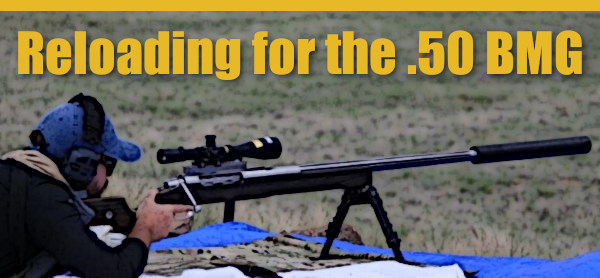
For today’s Sunday GunDay story we offer a short history of the legendary .50 BMG cartridge, tips on loading, and some fun photos from FCSA matches in the Western USA.
Fans of Heavy Artillery should visit Fifty Caliber Shooters Association (FCSA) website. There you’ll find range maps, photo collections and animated slide-shows On the FCSA photo gallery page, you’ll find a map. Click on any gray range link to see images from that venue. There are also a series of articles covering FCSA competition along with the “care and feeding” of the big 50-caliber rifles.
About the .50 BMG Cartridge
The .50 Browning Machine Gun (.50 BMG, aka 12.7×99mm NATO or 50 Browning) is a cartridge developed for the Browning .50 caliber machine gun in the late 1910s, entering official service in 1921. Under STANAG 4383, it is a standard cartridge for NATO forces as well as many non-NATO countries.
John Browning had the idea for this round during World War I in response to a need for an anti-aircraft weapon, based on a scaled-up .30-06 Springfield design, used in a machine gun based on a scaled-up M1919/M1917 design that Browning had initially developed around 1900. According to the American Rifleman: “The Browning .50 originated in the Great War. American interest in an armor-piercing cartridge was influenced by the marginal French 11 mm design, prompting U.S. Army Ordnance officers to consult Browning. They wanted a heavy projectile at 2700 FPS, but the ammunition did not exist. Browning pondered the situation and, according to his son John, replied, ‘Well, the cartridge sounds pretty good to start. You make up some cartridges and we’ll do some shooting’.”
Are you a died-in-the-wool .50 BMG fan? Got a hankerin’ for heavy artillery? Then visit the FCSA Photo Gallery page. There you’ll find hundreds of photos from Fifty Caliber Shooting Association (FCSA) matches and 50 Cal fun shoots in eleven states plus Australia, Switzerland, and the United Kingdom. To access the photos from the Gallery Page, start by selecting a shooting club and state with the brown buttons. After selecting the location, then click on the colored buttons for the event date.
Photo sets go all the way back to 2002, so you can see the evolution of the hardware over the years. Sample multiple archives to see the differences in terrain from one range to another — from Raton’s alpine setting to the hot, dry Nevada desert. This Gallery is really a treasure-trove of .50-Cal history. Here are a few sample images.
Reloading Powder and Special Tools for .50 BMG
Alliant’s Powder for 50-Caliber Applications
In 2009 Alliant unveiled Reloder 50, a slow-burn-rate powder designed primarily for long-range, .50-caliber rifle shooters. According to Alliant, the burn rate is “a little slower than Winchester 860″ and the powder is showing excellent lot-to-lot consistency. Load density is optimized for the 50 BMG and similar cases. Like Reloder 17, Reloder 50 employs a process which penetrates the kernels with the burn-rate-controlling chemical. This should allow a longer, flatter pressure curve, yielding more velocity than conventional powders can deliver. Alliant says that Reloder 50 offers “superior velocity and the ability to burn cleaner (with less residue)”. Reloder 50 comes in both 1-lb (#150527) and 8-lb (#150528) containers.
Forster and Lyman .50 BMG Trimmers
Big Fifty enthusiasts asked for a dedicated .50 BMG case trimmer, so Forster and Lyman created .50 Cal trimmers specifically for that cartridge. The cutter tip on the Forster .50 BMG Case Trimmer is much sharper than the cutter on the Lyman 50 Cal AccuTrimmer. However, the Forster tool is currently out of production, so it is harder to find than the Lyman .50 BMG trimmer, which is $92.93 on Amazon. Our advice is go ahead and get the Forster if you can find one — the cutter head is much sharper, and we prefer the Forster’s collet-style case-holder. The Forster gets the job done more quickly, with less effort. If you want the ultimate .50 BMG trimmer, check out the L.E. Wilson .50 BMG trimmer. But it is a hefty $268.40 at Midsouth.
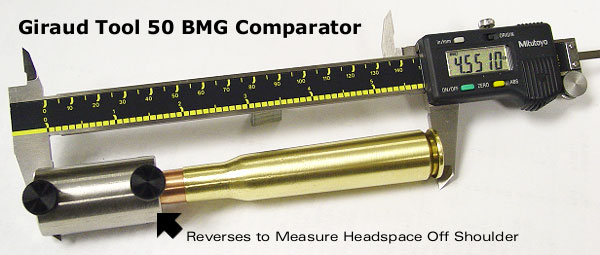
Giraud .50 BMG Case/Bullet Comparator Giraud Tool makes a comparator for 50-Cal cartridges. The double-ended comparator is quite versatile. In one orientation you can measure base-to-ogive bullet length and also measure cartridge OAL from rim to bullet ogive. When reversed, you can use the comparator to measure cartridge headspace. The $35.00 Giraud .50 BMG Comparator gauge is constructed of 303 stainless and fits most any vernier, dial, or digital caliper. CLICK HERE for more info.
This custom war wagon hauls varmint hunters around the Longmeadow Game Resort in Colorado. Bottom image by Forum member Randful, Big Horn Mountains, Wyoming.
Will you be heading to the varmint fields this summer? Proper planning is key to a safe, satisfying, and productive varmint holiday. Bring a variety of rifles if possible — you’ll need to switch off as one barrel gets hot, and the chambering that works best for your close shots may not be ideal for those longer shots out past 400 yards. Here’s one tip that can help you shoot more effectively on your varmint hunt — at your shooting station, put a strip of surveyor’s tape on a tall stake to show the wind direction. Then align to the wind direction, so that it is a direct headwind or tailwind. This will minimize the effect of cross-winds.
For fans of varmint hunting, we’ve assembled eight videos for this Saturday at the Movies Feature. You’ll see a variety of rifles being used in classic American varmint country — Montana, Oregon, and the Dakotas. We’ve also included an interesting video from South Africa.
Extreme Outer Limits — Oregon Adventure with .22 Creedmoor
This varmint safari video features the Extreme Outer Limits squad in Central Oregon. The host is shooting the .22 Creedmoor cartridge from a 22″ Benchmark barrel. The shooters benefit from a great operation, with elevated mobile shooting stations and benches. Watching this video made this Editor want to travel up to Oregon this summer, and try out a .22 Dasher that’s been sitting in the safe.
This video has plenty of action, with hits on small varmints (mostly ground squirrels) out to considerable distances. You can see the effectiveness of the .22 Creedmoor cartridge — it basically vaporizes some of the critters.
.22-250 Nails Ground Squirrels and Rock Hyraxes in South Africa
Here’s an interesting video from South Africa. The video maker starts with shots on ground squirrels. His .22-250 blasts them into little pieces. They he switches to more distant targets, a furry ground-hog size animal called the Rock Hyrax, Cape Hyrax, or Dassie. Mature Rock Hyraxes weigh 4-5 kilograms and have short ears and tail. These Rock Hyraxes are found at higher elevations in habitats with rock crevices, allowing them to escape from predators (but not skilled varmint hunters).
1125-Yard Rockchuck Hit with Extreme Outer Limits
Here a team from Extreme Outer Limits tests their skills at Extreme Long Range Varminting. The group set up benches and aim their rifles at a distant hillside over 1100 yards away. You can see a successful first-shot rockchuck hit at the 5:15 time-mark. On this episode of Extreme Outer Limits, Bob Beck, Tim Titus, and some MOA Rifles clients to put the .22 Creedmoor and other MOA-brand rifles to the test. At these long distances, Rockchucks are relatively small targets providing plenty of challenge.
Long Range Rockchuck Adventure with Gunwerks Crew
This Gunwerks video showcases varmint hunting in the Western USA. In this video Aaron Davidson and the Gunwerks crew try out some new rifles on some rockchucks. Most of the the rifles were suppressed but the host said the rockchucks took cover after the first shot, so this required good coordination among shooters and spotters. A 6XC varminter is featured at 2:44 and there’s some nice drone footage starting at 2:00.
Varminter.com — Great Resource for Varmint Hunters
Varminter.com is a great resource for serious varmint hunters. This site regularly reviews rifles, optics, and varmint ammunition. In addition, the site’s founder, Eric Mayer, often ventures out in the backcountry to film his varmint adventures.
Varminting with .17 HMR Savage A17 and Custom .17 WSM AR
On varmint excursions, we like to have a .17 rimfire for the closer shots, inside 150 yards. This video shows a successful Prairie Dog hunt with a .17 HMR. Watch and you’ll see hits out to 160 yards (00:50), proving the effective range of the .17 HMR cartridge. The host is shooting a Savage A17 semi-auto 17 HMR rifle in a Boyds laminated stock.
Varminters now enjoy three .17-caliber rimfire options. The .17 Mach 2, .17 HMR, and .17 WSM are all good choices, with the 17 Mach 2 being the cheapest and the .17 WSM the most powerful. With a rimfire you save on ammo costs and you don’t waste precious centerfire barrel life. Also the noise is reduced so you don’t spook the critters so much. We have shot ground squirrels with both the 17 HM2 and .17 HMR. And with a 3000 fps MV, the .17 WSM has some really impressive ballistics. As you can see, the .17 WSM has a much flatter trajectory than both the .17 HMR and .22 WMR:
Last but certainly not least, this video from Eric Mayer, founder of Varminter.com and AR15Hunter.com. This video features an innovative AR-platform rifle chambered for the potent .17 Winchester Super Magnum (aka .17 WSM) cartridge. Eric was able to have instant kills out to 200 yards. This rifle features a Franklin Armory F-17 V4 upper with a Franklin Armory 10-rd magazine. Eric was very impressed with the .17 WSM and he believes the 20gr bullet with 3000 fps MV will be very effective for most of his small varmint hunting out to considerable distances.
KILL Shots — BONUS Age-Restricted Videos
Linked below are a couple very good varminting videos that show explosive hits. However, YouTube has decided these can’t be posted on third-party websites so you’ll have to click the links below to see the Prairie Dogs going airborne. In the first video, the lady shooter nails THREE P-Dogs with one shot!
1. Eastman’s Hunting Journals. Great Video from Eastern Montana. This has nice Aerial Footage and an amazing shot with three P-dogs (in line) dropped with a single shot (at time-mark 9:28). One shot — THREE prairie dogs down! This prairie dog hunt features slow-motion kill shots, digiscope close-ups, and a rare prairie dog triple kill. A group of hunters works to remove prairie dog pests from private grazing lands in this episode of Beyond the Grid by Eastmans’ creators of Eastmans’ Hunting TV. You’ll have to CLICK HERE to watch this video. See Also Eastman’s Prairie Dog Armageddon video.
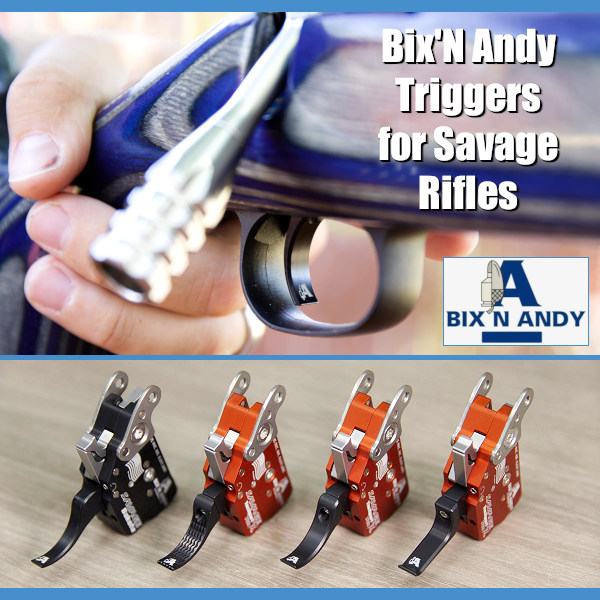
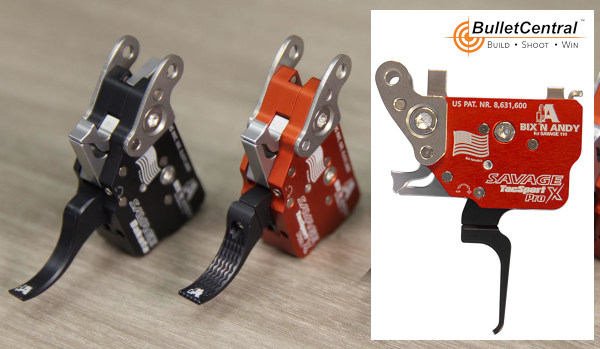
Bix’n Andy Savage TacSport Pro X and Savage Dakota Triggers
Article based on review by Les Voth
In 2012 benchrest shooter Chris Harris, owner of BulletCentral.com, brought Austrian gunsmith and engineer Andy Atzl’s Bix’n Andy triggers to America. Since then, their collaborative innovation has not slowed or stopped. Well known to the benchrest world, the Bix’N Andy Remington 700 Competition trigger with its frictionless ball trigger design, has broken records and surpassed previous trigger designs what came before The mechanism that replaced friction designs has gained favor among their shooters who have Bix’N Andy triggers on their rifles
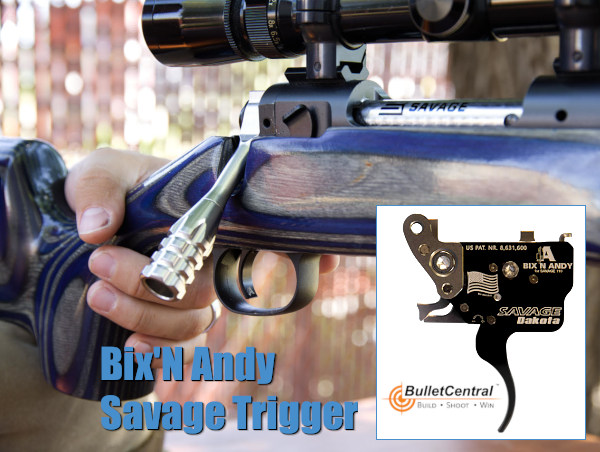
Seeking to go beyond providing triggers for Remington 700s, Rem 700 clones, Tikkas, Sakos, and Barnards, BulletCentral.com now offers atop-quality, drop-in Bix’n Andy replacement triggers for the Savage 110 line of rifles. As these popular Savage rifles are offered in many configurations, including competition rifles, hunting rigs, and varmint rifles, it made sense to offer a top-quality Bix’N Andy trigger for Savage rifles.
Bix’N Andy Savage Trigger Review — UltimateReloader.com
In my association with Bullet Central, as their trigger repair and warranty guy, I’ve already seen these new Bix’N Andy Savage triggers installed on competition single shots, prairie dog rifles, truck guns, deer/hog hunting rifles, and varmint rifles. The appreciation shown by their new owners, for having access to the same technology as the most expensive ELR, PRS, F-Class rifles is great to witness.
Installation in Savage Action is Fast and Easy
Changing the trigger on a Savage 110 is as simple as removing the stock, pulling one pin to remove the stock trigger, and putting the new trigger in its place with the return of the pin.
Savage Tacsport Pro X (3.5 oz to 2.2 lbs) | Savage Dakota (1 lb. to 4.4 lbs.)
The Savage TacSport Pro X trigger has a pull force weight range from 3.5 ounces to 2.2 pounds, and the Dakota model starts at one pound and goes up to 4.4 pounds. With the TacSport Pro X model you can change the shoe, from curved, to straight, to the Gator grip shoe, without disassembling the trigger.
When using a Bix’n Andy Savage trigger for the first time, you’ll instantly sense how it precise and smooth it feels. Because you are not trying to “overcome” something with the trigger force it is set at. You’ll note that the movement feels smoother than a friction-based trigger (with the same pull weight).
When you set a trigger to your desired pull force, whether it is under 10 ounces, or over two pounds, the Bix’n Andy trigger will feel lighter than the others because of its inner mechanism. You are not trying to “overcome” you are “setting off” the trigger, if that’s how to describe it.
Also, when some triggers release the cocking piece, they stop at a wall. Bix’n Andy triggers do not. They follow through with slight over-travel, so the rifle is not upset during that time the bullet has not yet exited the barrel. This is a feature that the Bix’n Andy Savage TacSport triggers and also the Dakota share with the original Benchrest triggers from the same company.
Benefits of Trigger Replacement in Savage Rifles
Why would you replace the stock trigger on a Savage 110? Well, it’s like Chuck said on Friday when he came to pick up a truckload of prairie dog pills – “If yer gonna git serious about shooting prairie dogs, yer gonna change triggers!” Who’s Chuck? He’s a retired Vietnam vet/volunteer NRA Range Officer. When asked how many prairie dogs he shot on his last trip, he said “…about 400.”
That many trigger pulls demand a trigger that works, one that doesn’t distract you from the job at hand, and one that allows you to shoot little targets a long ways away.
F-Class ace Erik Cortina has interviewed noted author and Olympic Gold Medal-winning shooter Lanny Bassham. For his popular video channel, Cortina asked Lanny about his book With Winning in Mind. The two talented shooters also broadly discussed the “mental game” in the shooting sports and Lanny’s program for visualization of a winning performance. Lanny explains that after you have mastered your rifle skills, and learned to read the wind, it is important to adopt a winning mentality and to visualize success. Lanny should know. He won a shooting Gold Medal in the Olympics along with 22 world individual and team titles.
Watch Full Video Interview
Here is the wide-ranging and fascinating hour-long Lanny Bassham interview hosted by Erik Cortina. If you are looking to enhance your motivation, discipline, and “mental focus” when competing, this video is worth watching:
Visualization is a process of mental preparation that is done before you get to the range. Many of the greatest shooting champions have used this technique to get ready for big matches, and to optimize their performance during record fire. If you want to enhance your “mental game” through pre-match visualization, we strongly recommend Lanny Bassham’s book, With Winning in Mind.
As a competitive smallbore 3P shooter, Bassham developed a mental management system. Using this system, Lanny Bassham won 22 world individual and team titles, set four world records, and captured an Olympic Gold Medal in Montreal in 1976. His techniques have been embraced by professional and Olympic athletes in many sports. With Winning in Mind covers a complete system of “mental management” techniques used by Olympians and elite champions.
Putting principles into practice — Anette Wachter
Our friend Anette Wachter, aka “30CalGal”, did a series of videos for the NRAWomen.com site. In one episode, Anette talks about the “mental game” in competition. Specifically she explains how to “visualize success”:
I have found that a lot of my success in competition has come through what I call a ‘mental rehearsal’. I actually visualize every stage of the match and I visualize the success of the match and winning the match.
I actually visualize that round going downrange into the target, and the target coming up with a dead-center ‘X’. I visualize this over and over. If you visualize success you will achieve success.
Guest Article By Michelle Gallagher, Berger Bullets
Let’s face it. In the world of firearms, there is something for everyone. Do you like to compete? Are you a hunter? Are you more of a shotgun shooter or rifle shooter? Do you enjoy running around between stages of a timed course, or does the thought of shooting one-hole groups appeal to you more? Even though many of us shoot several different firearms and disciplines, chances are very good that we all have a favorite. Are we spreading ourselves too thin by shooting different disciplines, or is it actually beneficial? I have found that participating in multiple disciplines can actually improve your performance. Every style of shooting is different; therefore, they each develop different skills that benefit each other.
How can cross-training in other disciplines help you? For example, I am most familiar with long-range prone shooting, so let’s start there. To be a successful long-range shooter, you must have a stable position, accurate ammunition, and good wind-reading skills. You can improve all of these areas through time and effort, but there are other ways to improve more efficiently. Spend some time practicing smallbore. Smallbore rifles and targets are much less forgiving when it comes to position and shot execution. Long-range targets are very large, so you can get away with accepting less than perfect shots. Shooting smallbore will make you focus more on shooting perfectly center shots every time. Another way to do this with your High Power rifle is to shoot on reduced targets at long ranges. This will also force you to accept nothing less than perfect. Shoot at an F-Class target with your iron sights. At 1000 yards, the X-Ring on a long range target is 10 inches; it is 5 inches on an F-Class target. Because of this, you will have to focus harder on sight alignment to hit a center shot. When you go back to the conventional target, you will be amazed at how large the ten ring looks.
Also, most prone rifles can be fitted with a bipod. Put a bipod and scope on your rifle, and shoot F-TR. Shooting with a scope and bipod eliminates position and eyesight factors, and will allow you to concentrate on learning how to more accurately read the wind. The smaller target will force you to be more aggressive on your wind calls. It will also help encourage you to use better loading techniques. Nothing is more frustrating than making a correct wind call on that tiny target, only to lose the point out the top or bottom due to inferior ammunition. If you put in the effort to shoot good scores on the F-Class target, you will be amazed how much easier the long-range target looks when you return to your sling and iron sights. By the same token, F-Class shooters sometimes prefer to shoot fast and chase the spotter. Shooting prone can help teach patience in choosing a wind condition to shoot in, and waiting for that condition to return if it changes.
Benchrest shooters are arguably among the most knowledgeable about reloading. If you want to learn better techniques about loading ammunition, you might want to spend some time at benchrest matches. You might not be in contention to win, but you will certainly learn a lot about reloading and gun handling. Shooting F-Open can also teach you these skills, as it is closely related to benchrest. Benchrest shooters may learn new wind-reading techniques by shooting mid- or long-range F-Class matches.
Position shooters can also improve their skills by shooting different disciplines. High Power Across-the-Course shooters benefit from shooting smallbore and air rifle. Again, these targets are very small, which will encourage competitors to be more critical of their shot placement. Hunters may benefit from shooting silhouette matches, which will give them practice when shooting standing with a scoped rifle. Tactical matches may also be good, as tactical matches involve improvising shots from various positions and distances. [Editor: Many tactical matches also involve hiking or moving from position to position — this can motivate a shooter to maintain a good level of general fitness.]
These are just a few ways that you can benefit from branching out into other shooting disciplines. Talk to the other shooters. There is a wealth of knowledge in every discipline, and the other shooters will be more than happy to share what they have learned. Try something new. You may be surprised what you get out of it. You will certainly learn new skills and improve the ones you already have. You might develop a deeper appreciation for the discipline you started off with, or you may just discover a new passion.
This article originally appeared in the Berger Blog. The Berger Blog contains the latest info on Berger products, along with informative articles on target shooting and hunting.
Hodgdon Powder Company (Hodgdon) offers a series of informative, “how-to” instructional videos through its online Reloading Data Center. These 3.5-minute videos present rifle, pistol, and shotshell reloading basics in an easy-to-understand, step-by-step format. These mobile-friendly, informative videos can also be viewed on a smart phone or tablet.
To watch the reloading videos go to the Reloading Data Center at hodgdon.com. Click to the right/left of the displayed video to switch between pistol, rifle, and shotgun videos. Or, for your convenience, we have embedded the Rifle and Pistol videos here. Just click to watch!
Click to Watch Hodgdon Rifle Reloading Video:
Click to Watch Hodgdon Pistol Reloading Video:
In addition to these videos, Hodgdon’s Reloading Data Center (RDC) provides a wealth of information on Hodgdon, IMR, Accurate, Winchester, and Ramshot propellants. Along with reliable load data, you’ll find explanations of reloading basics, safety procedures, plus answers to frequently asked questions (FAQ).


 When traveling, comply with the laws concerning possession of firearms as they vary by local, state, and international governments.* Declare each firearm each time you present it for transport as checked baggage. Ask your airline about limitations or fees that may apply.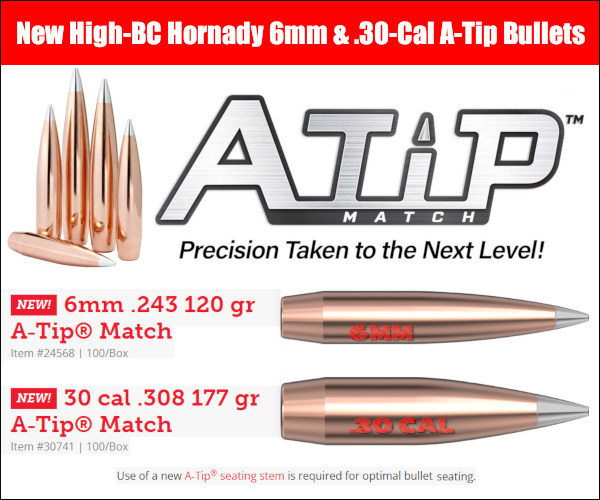


 Hybrid Bullet Design — Best of Both Worlds?
 For today’s Sunday GunDay story we offer a short history of the legendary .50 BMG cartridge, tips on loading, and some fun photos from FCSA matches in the Western USA.



 Alliant’s Powder for 50-Caliber Applications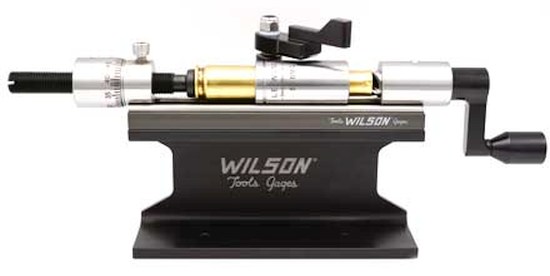

 This varmint safari video features the Extreme Outer Limits squad in Central Oregon. The host is shooting the .22 Creedmoor cartridge from a 22″ Benchmark barrel. The shooters benefit from a great operation, with elevated mobile shooting stations and benches. Watching this video made this Editor want to travel up to Oregon this summer, and try out a .22 Dasher that’s been sitting in the safe.



 F-Class ace Erik Cortina has interviewed noted author and Olympic Gold Medal-winning shooter Lanny Bassham. For his popular video channel, Cortina asked Lanny about his book
  Our friend

 Position shooters can also improve their skills by shooting different disciplines. High Power Across-the-Course shooters benefit from shooting smallbore and air rifle. Again, these targets are very small, which will encourage competitors to be more critical of their shot placement. Hunters may benefit from shooting silhouette matches, which will give them practice when shooting standing with a scoped rifle. Tactical matches may also be good, as tactical matches involve improvising shots from various positions and distances. [Editor: Many tactical matches also involve hiking or moving from position to position — this can motivate a shooter to maintain a good level of general fitness.]


