|
|
March 7th, 2010
It looks like the NRA is considering creating a new type of multi-distance rifle match, or at least expanding High Power competition as we know it today. The NRA has seen the growing popularity of “tactical” matches with scoped bolt-action rifles, and apparently is looking for ways to bring the tactical game under the NRA umbrella.
 The NRA recently hired Trey Tuggle for the newly-created position of “Tactical Rifle Coordinator”. This position is part of the NRA Competition Division’s efforts to bring more people into the shooting sports. The focus of the Tactical Rifle Coordinator will be to promote the use of optics at existing High Power Matches as well as to move the NRA forward with a sanctioning process for Multi-Gun Action Shooting Events. The NRA recently hired Trey Tuggle for the newly-created position of “Tactical Rifle Coordinator”. This position is part of the NRA Competition Division’s efforts to bring more people into the shooting sports. The focus of the Tactical Rifle Coordinator will be to promote the use of optics at existing High Power Matches as well as to move the NRA forward with a sanctioning process for Multi-Gun Action Shooting Events.
As a former U.S. Navy SEAL sniper, Trey Tuggle knows his tactical rifles. Tuggle is also an entrepreneur, having created a counterterrorism assault vehicle company called Patriot 3.
Those interested in tactical or multi-gun competition can email Tuggle via ttuggle [at] nrahq.org.
March 6th, 2010
It’s already March 6th, and that means the 2010 U.S. F-Class Championships is less than three weeks away. That’s right, this year the F-Class championships will be held in March instead of October. The venue is the Sacramento Valley Shooting Center range in Sloughhouse, California, just east of Sacramento. 2010 Match dates are: March 25, 26, 27, and 28.

We know you east-coasters may still be shoveling snow, but it’s time to pack up those F-Class rifles, start loading ammo and get prepared for one of the biggest long-range shooting events of the year. There will be shooters from across the U.S., Great Britain, Canada, and likely from Australia and South Africa. Match organizers expect upwards of 150 competitors.

 This year the course of fire is at two distances: 600 and 1000 yards. There will be three days of individual competition and a one-day team match. Lunch will be served at the range each day, and a huge barbecue is included for Saturday. The awards for placing high in the standings will be great, but the prizes drawn randomly from all of the competitors participating will be even better. This year the course of fire is at two distances: 600 and 1000 yards. There will be three days of individual competition and a one-day team match. Lunch will be served at the range each day, and a huge barbecue is included for Saturday. The awards for placing high in the standings will be great, but the prizes drawn randomly from all of the competitors participating will be even better.
If you’re curious about the location and how the Nationals are run, check out this report on the 2006 F-Class Nationals previously held in Sacramento.
UNITED STATES F–CLASS NATIONAL CHAMPIONSHIP 2010
DATES: March 25, 26, 27, 28, 2010
LOCATION:
Sacramento Valley Shooting Center
P.O. Box 1407
15501 Meiss Road
Sloughhouse, California
Ph. 916-354-9668
Web site: www.sacvalley.org
March 3rd, 2010
Forum member Ken Littlefield recently had a older CMP Remington 40X restored/upgraded with a handsome walnut prone stock and top-of-the-components. Ken also added a CG Trigger and a RightSight front sight made by Stallings Machine. There’s also an adjustable cheekpiece, adjustable buttplate, and what looks like an aftermarket trigger guard and handstop. Ken posted his upgraded 40X on our Shooters Forum, noting: “Jim Cloward recently finished restocking my CMP 40X in English walnut. The rifle also has a CG uni-trigger and Rightsight. Jim also fitted a 0 degree rail to the receiver (I have a Leupold 6.5-20 EFR scope for ‘any sight’ training and matches). Jim can be reached at (425) 334-3006. The rifle will be used primarily as a winter training rifle for Palma, but hopefully we will sneak in a smallbore prone match now and then.”

Hopefully Ken can tell us more about the build and all the hardware upgrades. Ken certainly has created of the nicest 40X rimfires we’ve seen. Ken’s beautiful 40X has inspired envy among fellow Forum members. Flatlander posted: “Ken, I applaud your (incredibly successful) efforts to bring one of these old CMP rifles to the level of aethetic beauty and functionality it’s entitled to. I’d love to see more of these rifles ‘all dressed-up’ instead of stored in someone’s closet.”

March 1st, 2010
IBS 600-yard National Champion and recent 600-yard Shooter of the Year Sam Hall has been hard to beat when he’s got his 6BR or his Dasher dialed in. Sam recently told us that he’s been experimenting with the 6.5×47 Lapua cartridge, thinking that a larger, higher-BC bullet might perform better in the wind.


Sam’s competitors are probably hoping we’ll report that Sam is struggling with the new cartridge, and can’t get his new 6.5×47 to shoot. Well, guys… no such luck. Sam recently took his 6.5×47 Heavy Gun out in some fairly windy conditions, but still returned a spectacular four-shot group at 600 yards. Sam measured the group at 0.357 inches. We measured it at 0.371″ with OnTarget software, but that was going off a photograph, which can be less precise. Either way, 4 shots in well under 0.4 inches at 600 yards is spectacular.
As Sam told us, however, “I just wish I’d shot that in competition… with a fifth shot of course.” Even though Sam’s group was shot in practice, it’s still an amazingly small group — one that suggests that the 6.5×47 Lapua may have great potential as a Benchrest cartridge. The group size, in MOA, is 0.059!

Sam’s load was 37.0 grains of Reloder 15 with 130gr Berger VLDs and CCI BR4 primers. The gun is a Bat-actioned, 47-lb “true heavy” built by Leonard Baity using a McMillan 50BMG stock. The barrel is a 29.5″ Brux, 1.25″ straight contour, with a 1:8.5″ twist. Sam reports:
The gun has a BAT MB 1.55″ round action. The reamer was a Kiff (PTG) .290 neck with .160 freebore. The loaded round is .288 at the neck. I made a mistake labeling the target. The primers were CCI BR4s, not 450s. The 130gr Bergers VLDs are lot 0225 (the early ones). They are in the rifling as far as I can get them (jam). I use a .287 Redding bushing in my Redding “type S” FL dies. I seat with a Wilson seater. The stock is a McMillian Light 50 BMG stock full of lead from McMillian. With the 40x Leupold it weighs 47 pounds. The fore-end is 3.5 inches wide. Leonard Baity did the complete rifle. I had him to put a rail (3 inches wide) on the back so I could use my adjustable rest Leonard made me a few years ago for my Shehane Maxi-Tracker stock. Even though this rifle is only 14 pounds lighter than the 61-pound aluminum stock Maxi-Tracker 6mm Dasher I shot last year, it feels like it is 25 pounds lighter. It is much, and I mean MUCH more manageable carrying this rifle around than the Maxi-Tracker. I can actually use my Farley, joy-stick rest with the rifle. I just replace the 3 inch bag with a 3.5 inch wide bag. I can make adjustments much faster with the Farley than I can twisting knobs.
The reason I built the 6.5×47 Lapua is to try to beat the wind we have here in NC in the spring. Plus, the fact I love to shoot and experiment. The 6.5 bullets are not affected as much by the wind as the 6mms. I started shooting 600-yard competiton with a 6.5-284. I could predict where the bullet was going to hit much better with it than the 6mms I shoot now. In windy conditions, the 6mms seem to “dance around” when sighting in. The heavy 6.5 seems to say on track and Point of Impact is more predictable. In 600-yard competition, score is half the game. I figured if I could get a 6.5 shooting somewhere close to a 6BR or 6BR Improved, I would be ahead of the game in the wind. So far this rifle is agging at 600 yards pretty close to my Dasher and BRX, but not better. After I found this load that shot the 0.357 inch 4-shot group, I went out and shot four more, 4-shot groups in some wind of 10-20 mph and the rifle agged 2.08 inches.
I am still haunted by a “flier” in each group. I am still trying to work that out. The 0.357 group I will say was a fluke because it is the only group I have shot that did not have a flier. The rifle sure won’t group like that every time, but that one time sure was pretty! You may ask why I shoot 4-shot groups during load development and practice. Three is not enough, but four will tell you what the rifle will do, plus I can shoot more groups before the barrel gets too warm.
Our first match is next month at Piedmont. I am going to give this rifle a try. Time will tell if I will stick with this round for serious 600-yard competition or back to the 6mms. — Samuel Hall
March 1st, 2010
Creedmoor Sports notified us that they have Geissele Triggers (for AR platform rifles), and Lapua Brass in stock. These triggers are often back-ordered for months, so if you need one, you should give Creedmoor a call at 800-273-3366. Chose the Geissele GT-SR trigger for $279.00, or the new SSA model for $170.00.

If you have been looking for Lapua Brass, Creedmoor has ample quantities for most of the popular cartridges: .223 Rem, .220 Russian, 6mmBR, .243 Win, 6.5×47 Lapua, 6.5-284 Norma, .308 Win, 30-06, .338 Lapua Magnum.
CLICK HERE for Lapua Brass at Creedmoor Sports
You may want to stock up now while supplies are available. To give you an idea on price, Creedmoor sells a 100-ct box of .308 Win Brass for $75.95.
March 1st, 2010
Eleven members of the 2010 World Championship team were selected following the Spring Airgun Championships, which served as Part II of the World Championship Team selection for the men’s and women’s open air rifle and pistol events. Six air rifle and five air pistol shooters qualified to represent the U.S.A. this August at the 50th ISSF World Championships in Munich, Germany.
 The 2010 World Championship team for airgun was determined by the match scores from the first two days of the 2009 Winter Airgun Championships (held last December), added to the match scores from both days of the Spring Airgun Championships and the best two finals from both matches. For complete results from the 2010 Spring Airgun Championships, please visit www.usashooting.org. The 2010 World Championship team for airgun was determined by the match scores from the first two days of the 2009 Winter Airgun Championships (held last December), added to the match scores from both days of the Spring Airgun Championships and the best two finals from both matches. For complete results from the 2010 Spring Airgun Championships, please visit www.usashooting.org.
Olympic gold and silver medalist Matt Emmons qualified for the World Championship team in Men’s 10m Air Rifle with an overall score of 2600.7 points. U.S. Army Marksmanship Unit (USAMU) member Matt Rawlings grabbed the second spot in Men’s Air Rifle with a total score of 2584.2 and Jonathan Hall earned the third spot with 2577.1 total points.
Leading the Men’s Air Pistol team will be 2008 Olympian Brian Beaman, who finished with an overall score of 2507.4 points. Two-time Olympian and 2008 bronze medalist Jason Turner will finished right behind Beaman with 2506.2 points. Three-time Olympian and USAMU member Daryl Szarenski grabbed the third spot after firing a total score of 2502.1 points.
Two-time Olympian Emily Caruso lead the way in Women’s Air Rifle with 1800.4 total points. Jamie Beyerle, a 2008 Olympian, took the second spot with an overall score of 1798.8 points and TCU’s Sarah Scherer qualified in third place with 1796.4 points. Teresa Meyer finished first in Women’s Air Pistol after firing 1691.8 total points, while Brenda Shinn, a 2008 Olympian, took the second spot with 1679.0 points.
CLICK HERE for Info on 50th ISSF World Shooting Championship (PDF)

February 26th, 2010
Jeff Stover, President of the IBS (International Benchrest Shooters) just sent us the final rules and safety guidelines for AR benchrest competition under the IBS. Jeff noted: “Shooters should understand that the ranges and clubs will determine whether to allow AR rifles in their particular IBS benchrest matches.” This program is not mandatory, and each club will decide, based on its own priorities, whether ARs will be allowed to compete. When they ARE “invited”, AR-platform rifles will run in their own separate class.

Click the links below to download two .PDF files:
DOWNLOAD: IBS AR Benchrest Final Rules
DOWNLOAD: IBS AR Benchrest Safety Checklist
February 24th, 2010
After we reported that Tyler Rico of Arizona won the Nevada Regional High Power Championship (at the ripe old age of 15), some of our readers asked about Tyler’s match rifle. Tyler, who earned his Distinguished badge at age 13 (the youngest ever to do do), primarily shoots AR-platform rifles. The AR with which Tyler won the 2010 Nevada Regional featured a custom 6mmAR upper built by Robert Whitley’s AR-X Enterprises. The 6mmAR chambering, basically a 6.5 Grendel necked down to 6mm, was popularized by Robert, who is himself an avid High Power shooter.
Tyler Rico’s 6mmAR upper has an interesting history. Whitley explained: “Originally we built it up for some testing by the Marine Shooting Team and we took it down to Quantico. They liked it a lot but did not have authority or funding to buy them. When Tyler’s father called me looking for an upper for Tyler, I offered a special deal on it because we wanted to help support a junior shooter.” Built on a heavy-walled DPMS Low Pro receiver, Tyler’s upper features a 26″ Krieger 1:8″ twist barrel, and a side-positioned charging handle.

According to Whitley, “My test rifle with Tyler’s upper shot great. Above is a photo of one of the initial 10-shot, 100-yard test targets I shot with the upper at 100 yards. This gun really hammered. Remember The ‘X’ ring is the size of a dime”.
Five Shots at 300m that Could Fit under a Quarter
Robert Whitley took the photo below at the Marine’s Quantico, VA, Precision Weapons Section facility. The photo shows a target shot with Tyler’s upper at 300 meters. That’s a five-shot group the size of a quarter. Robert reports: “The Marines wouldn’t let me take the target home, because they planned to use the target to support their lobbying effort for funds to purchase new 6mmAR uppers.”

February 18th, 2010
A reliable 22LR conversion kit for an AR-platform rifle lets you train with inexpensive ammo. That’s a big advantage for 3-gun competitors who must engage multiple targets rapidly, often at relatively short distances. Multi-gun competition is a speed game, requiring plenty of practice to “run with the big dogs”. It’s not unusual for elite 3-gun shooters to put hundreds of rifle rounds down range every week. Service Rifle shooters can also benefit from cross-training with an AR equipped to shoot .22LR rimfire rounds. With a good .22LR conversion kit, Service Rifle shooters can practice their positions and gun-handling at minimal expense. In the winter, if you have a .22LR conversion for your AR, you can train at the many indoor ranges that allow rimfire rifles, but not centerfire rifles.
Complete Conversion Kit for $189.99 from CDNN
CDNN Investments in Texas is offering a good deal on the CMMG .22lr Stainless Conversion Kit for AR15-type rifles. This includes a stainless bolt and bolt carrier assembly and two (2) 25-round magazines or two (2) 10-round mags. The CMMG Kit uses your existing fire control (trigger) group and requires no internal gunsmithing. Just drop it in and shoot. While supplies last, the CMMG Conversion Kit with magazine(s) is priced at $189.99. NOTE: CDNN is offering 2 mags with this package as a “limited time offer”. (MidwayUSA also has this Kit, with one mag, for $199.99.)

CMMG .22LR Kit Is Reliable and Affordable
The CMMG conversion is widely used and has proved quite reliable, both with the 10-round and 25-round magazines. It is recommended by Brownells, though some Brownells customers have said the kits required some minor fitting or polishing. (This may be more of an issue with “off-brand” uppers — Colt AR owners reported no issues.) In the video below you see an AR15 being fired with the CMMG .22LR conversion in place. Then the CMMG bolt is exchanged for the original .223 Rem bolt assembly and the gun is shot in centerfire mode.

In the second video below you’ll see the CMMG conversion shot with two full (or nearly full) 25-round magazines, in rapid fire. There are no malfunctions.

February 14th, 2010
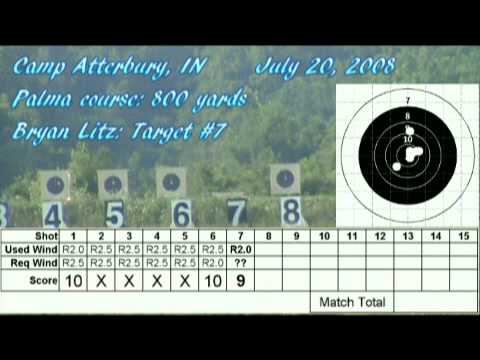
 Bryan Litz, Ballistician for Berger Bullets, is the author of the book Applied Ballistics for Long-Range Shooting. Before joining Berger, Bryan was a missile design engineer working with the U.S. Air Force. An NRA High Master, Bryan also happens to be one of the country’s top long-range shooters. Bryan (aka “bsl135″ in our Forum) has written many ballistics programs and technical papers dealing with long-range flight dynamics of projectiles. Bryan has recorded some very impressive match performances recently. At the 2008 NRA National Championships at Camp Perry, Bryan beat 258 other competitors to win the Palma Individual Trophy Match. Bryan shot a remarkable 450/26x, not dropping a single point. Bryan Litz, Ballistician for Berger Bullets, is the author of the book Applied Ballistics for Long-Range Shooting. Before joining Berger, Bryan was a missile design engineer working with the U.S. Air Force. An NRA High Master, Bryan also happens to be one of the country’s top long-range shooters. Bryan (aka “bsl135″ in our Forum) has written many ballistics programs and technical papers dealing with long-range flight dynamics of projectiles. Bryan has recorded some very impressive match performances recently. At the 2008 NRA National Championships at Camp Perry, Bryan beat 258 other competitors to win the Palma Individual Trophy Match. Bryan shot a remarkable 450/26x, not dropping a single point.
Palma Match — Caught on Video
Bryan has crafted a cool video that puts the viewer “in the driver’s seat” as Bryan shoots an 800-yard match with his .308 Winchester, iron-sights Palma rifle. Watch as each shot is marked and scored. Bryan explains: “The inset target at upper right displays each shot location in sequence. The score card shows the windage used for each shot, as well as the windage that was ‘Required’ for that shot to be centered. Wind wasn’t very challenging in this string, only requiring between 2 and 3 MOA right. This particular match is the 800-yard phase of a Palma course fired in the summer of 2008 at Camp Atterbury, IN. NOTE: I’ve had to cut out some ‘pauses’, and speed up the film in order to meet YouTube’s size requirements, so that’s why we sound like chipmunks.”
CLICK SCREEN to WATCH VIDEO. Click Menu Button for High Quality (HQ) Option
Bryan also has his own website with a number of authoritative articles. Topics include: Bullet Design, Meplat Trimming, Gyroscopic and Coreolis Drift, Palma Bullet Analysis, How Ballistics Programs Work, and Ballistic Coefficient Testing. CLICK HERE to visit BRYAN LITZ Website.
|


