|
|
February 12th, 2010
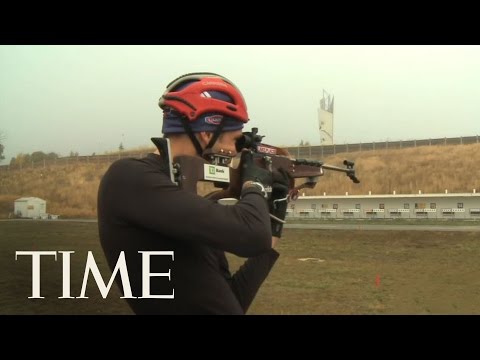
The 2010 Winter Olympics kick off tonight in Vancouver, BC, Canada. Shooting sports fans should follow the USA Biathlon team, which is considered the strongest group of American biathletes ever. Tim Burke, a top finisher in recent Biathlon World Cup events in Europe, is one of the favorites to collect a medal in Vancouver. That would be quite an accomplishment. Thus far, no American has ever won an Olympic Biathlon medal. Burke hope to change that. In the video below, Tim explains his training methods and his love for the sport. Definitely watch this video (produced by Time.com). Tim shows off his shooting skills and the reporter even tries out Tim’s Anschütz rifle. In an entire day of training, Tim only missed one target.
WATCH This Video — It Does a Great Job Explaining the Sport
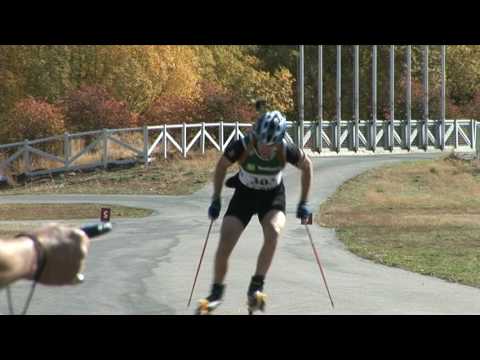
While the American team is strong, it will face tough competition from the Europeans. Biathlon is far more popular in Europe than it is in the USA. In fact Biathlon is the #1 televised winter sport in Europe. Nonetheless, the American team has been training hard in hopes of a strong performance. The video below shows members of the USA Biathlon team doing off-season “dry land” training. In the summer months, Biathletes train with special short skis equipped with wheels. They shoot with the same rimfire rifles used in winter events.
Over 90% of Olympic-level Biathletes use Anschütz rifles, most commonly fitted with a straight-pull Fortner action. These rifles are capable of 1/4 MOA accuracy at 50 meters. Of course, it’s not so easy to hold the guns steady after skiing many kilometers with no time to rest before engaging the targets. That’s what makes Biathlon so challenging. For more information on Biathlon competition, visit the TeamUSA.org website.

February 11th, 2010

The First Shot, the CMP’s online magazine, features a well-written article on Prone Shooting Technique by SPC Matthew Sigrist of the U.S. Army Marksmanship Unit (USAMU). The article covers all the major points of gun hold and body position: hand position, elbow position, stock weld, buttstock placement, and sling position/tension.

SPC Matt Sigrist of the USAMU breaks down the prone position into “fundamentals” and explains how you put each element together to create a stable body position: “The fundamentals are the building blocks of a position. Much like the framework of a house, a correct application of the fundamentals ensures a solid and stable structure. Since each person’s position will depend on their particular body build and shape, there is no ‘perfect position’ that applies to everyone. Experience, practice and knowledge of the correct fundamentals will dictate the best position for you.”
SPC Sigrist also demonstrates the two basic variations of the leg position when shooting prone: open/spread legged, and bent-legged.
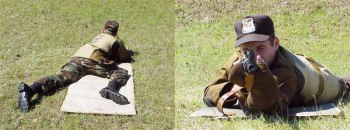

For any service rifle, highpower, cross-course, or prone shooter, this helpful article can improve your performance in the prone position.
February 7th, 2010
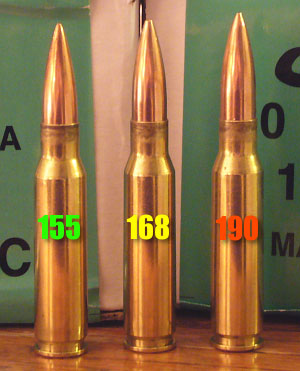 In December, we published the rules controlling choice of caliber and bullet weight for Palma competition. (CLICK HERE to Read.) In the USA, some events are still limited to 156gr or lighter bullets for .308-caliber shooters. But where such restrictions don’t exist, many shooters are using heavy 175-190gr bullets in their .308s. Is the heavier bullet always better? What considerations favor the lighter 155gr-class bullets in Palma competition? Top Palma shooter Kelly Bachand addresses these questions in today’s commentary. In December, we published the rules controlling choice of caliber and bullet weight for Palma competition. (CLICK HERE to Read.) In the USA, some events are still limited to 156gr or lighter bullets for .308-caliber shooters. But where such restrictions don’t exist, many shooters are using heavy 175-190gr bullets in their .308s. Is the heavier bullet always better? What considerations favor the lighter 155gr-class bullets in Palma competition? Top Palma shooter Kelly Bachand addresses these questions in today’s commentary.
Factors That Favor the 155s
by Kelly Bachand
It is clear that 155gr bullets are adequate. In the Palma game, more matches have been won and more 450 scores have been shot with 155gr bullets than with any other weight projectile. With the NRA allowing heavier bullets in Palma matches, many shooters prefer to shoot the longer, heavier bullets when possible. With their higher BCs, the longer bullets would seem to offer a ballistic advantage. There may be an edge, but in my opinion, it comes at a high cost.
Shooting a heavier bullet adds complications. You’ll probably need a different powder and new load development will have to be done. New zeroes must be calculated and confirmed on the range. An expensive new barrel with a faster twist rate may be needed to stabilize the heavier bullets. And unless you’re lucky, there’s a chance that the new barrel is less accurate than your existing barrel. (If you’ve got a “hummer” barrel for the 155s, what are the odds of getting another one as good for the 190s?) For a shooter who only competes domestically and who has plenty of time and money, this does not pose much of a problem, as he can work up multiple loads and acquire multiple barrels, or even build up a second complete rifle. But shooting BOTH the 155s and the heavy bullets (which may require a new barrel) certainly adds to the cost of competing, and the time required to work up loads. One who also competes internationally has much more to worry about, since you’ll likely be switching between the heavy bullets for most domestic matches and the 155s for most international matches.

Consider the challenges you’ll encounter switching between a heavy-bullet domestic load and a 155gr international load. Will changing between two different loads (with very different recoil levels) alter your gun-handling and follow-through? Will having two loads (with different ballistics) create confusion when making wind calls? And if you DO shoot both 155s and 190s, should you have two different barrels, or should you stick to one barrel which is adequate for both bullet weights, but perhaps not optimal for either? The heavier bullets typically have a better BC which means they should be less bothered by the wind. At the same time the heavier bullets travel at a much slower velocity. Does this negate the ballistic advantage? You need to check the ballistic tables carefully, looking at BOTH BC and velocity.
As a person who prefers to keep things simple and stick with what works, it’s no surprise I continue to shoot 155gr bullets exclusively in Palma competitions. But I understand this is just one viewpoint. A Palma shooter reading this should survey competitors who are consistently putting themselves in the winner’s circle. Talk to top shooters and then make your own rational, informed decision about which bullets to use. Good luck and keep them in the center.
February 6th, 2010
The new IMR 8208 XBR powder is quickly acquiring a reputation for accuracy and pressure stability over a very wide range of temperatures. In addition, it looks like 8208 XBR has a huge load window for accuracy, at least in the 6 PPC cartridge. Here are five successive targets shot by journalist James Mock. With loads range from 30.5 grains to 31.5 grains, Mock nailed five “zero” groups in a row. (These were all three-shot groups.) Mock nailed “zeroes” over a full grain load-weight spread. That’s very impressive, and it bodes well for those who want to spend less time “tuning” their loads.

James observes: “[Here are] 5 consecutive ‘zeroes’ with charges from 30.5 to 31.5. I used a Krieger barrel (583 rounds) and a BAT Model B action. The bullets are from Del Bishop. I used both Wolf SR and Fed 205 primers.The combination that I used that day was really working. The Bishop 65 grain FB bullets were seated to just touch the lands in a barrel with 583 rounds.”
February 5th, 2010
The U.S. Practical Shooting Association (USPSA) has announced the dates of its 2010 National Championships. Divided into four events, the Nationals are expected to draw more than 1,000 top shooters competing in a variety of divisions. Featured in the video below are “Women of USPSA” (including Team Glock’s Jessie Abbate) shooting at the 2009 USPSA Nationals. Be sure to watch this great video. Some very talented ladies demonstrate amazing shooting skills.
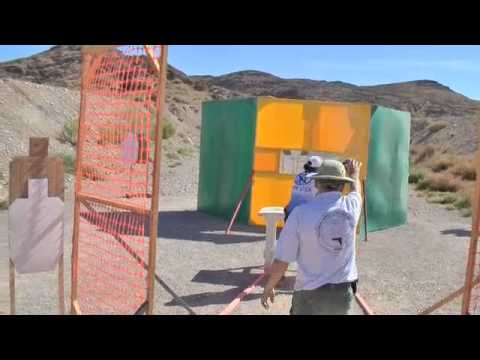
 The first event on the calendar, the USPSA Single Stack Nationals, will take place April 28 through May 1 at the PASA Park ranges in Barry, Ill. In 2009 this event drew 270-plus devotees of the venerable 1911 pistol. Next on the schedule is USPSA’s MultiGun Nationals which will take place in Las Vegas, Nev. at the Desert Sportsman’s Rifle & Pistol Club ranges September 9 through 12. The MultiGun championship draws close to 150 shooters using pistol, rifle and shotgun in the Open, Tactical, Limited and Heavy Metal divisions. The first event on the calendar, the USPSA Single Stack Nationals, will take place April 28 through May 1 at the PASA Park ranges in Barry, Ill. In 2009 this event drew 270-plus devotees of the venerable 1911 pistol. Next on the schedule is USPSA’s MultiGun Nationals which will take place in Las Vegas, Nev. at the Desert Sportsman’s Rifle & Pistol Club ranges September 9 through 12. The MultiGun championship draws close to 150 shooters using pistol, rifle and shotgun in the Open, Tactical, Limited and Heavy Metal divisions.
The USPSA championship season will wrap up with back-to-back handgun championships also held in Las Vegas from October 8 through 16, 2010. With over 600 shooters participating, the USPSA back-to-back handgun championships represent the largest gathering of Practical Shooting competitors in the USA. In addition to America’s top guns, the match will also draw some of the best shooters from South America, Europe and the Pacific Rim.
USPSA National Championship dates
April 28 – May 1: Single Stack Nationals (PASA Park, Barry, IL)
Sept. 9 – 12: Multi-Gun Nat’ls (Desert Sportsman’s Range, Las Vegas, NV)
Oct. 8 – 12: Open & Limited-10 Nat’ls (Desert Sportsman’s Range, Las Vegas, NV)
Oct. 13 – 16 Limited, Production & Revolver Nat’ls (Desert Sportsman’s Range, Las Vegas, NV)
To learn more about the USPSA National Championships and other major matches on the 2010 schedule, visit www.uspsa.org or call (360) 855-2245.
February 4th, 2010
 Sgt. 1st Class James Henderson, a service pistol shooter with the U.S. Army Marksmanship Unit (USAMU), was selected as the Military Marksmanship Association (MMA) Soldier of the Year for 2009. Henderson became the first Soldier in 24 years to win the National Pistol Championship at Camp Perry, Ohio. He won the National Trophy Pistol championship, the President’s Pistol match, and the Interservice Service Pistol championship. He was also a member of the first-place National Trophy Pistol Team and the first-place Interservice Service Pistol team. During the course of 2009, SFC Henderson broke numerous national pistol shooting records and claimed countless other individual and team accolades. He was featured in Sports Illustrated’s “Faces in the Crowd” section and was promoted to SFC in 2009. Sgt. 1st Class James Henderson, a service pistol shooter with the U.S. Army Marksmanship Unit (USAMU), was selected as the Military Marksmanship Association (MMA) Soldier of the Year for 2009. Henderson became the first Soldier in 24 years to win the National Pistol Championship at Camp Perry, Ohio. He won the National Trophy Pistol championship, the President’s Pistol match, and the Interservice Service Pistol championship. He was also a member of the first-place National Trophy Pistol Team and the first-place Interservice Service Pistol team. During the course of 2009, SFC Henderson broke numerous national pistol shooting records and claimed countless other individual and team accolades. He was featured in Sports Illustrated’s “Faces in the Crowd” section and was promoted to SFC in 2009.
 Henderson stated: “This is a great honor. I have to thank the guys in the (custom firearms) shop. They help make this all possible. I couldn’t have done it without the support of my team. They push me every day and if I mess up I know one of them will win the match. Being on this team and in this unit is the best job in the Army.” Henderson stated: “This is a great honor. I have to thank the guys in the (custom firearms) shop. They help make this all possible. I couldn’t have done it without the support of my team. They push me every day and if I mess up I know one of them will win the match. Being on this team and in this unit is the best job in the Army.”
Henderson first served with the USAMU from 1991-1994 after tours at Fort Benning, Fort Sill and Korea. After a long stint in the Army Reserves, Henderson resumed active duty service and was assigned to the USAMU. Henderson is the only shooter to ever win the “Triple Crown” (President’s Hundred, National Trophy Individual Pistol Championship, and High Team Shooter) in the same year, and he did it twice (2002 and 2009).
January 31st, 2010
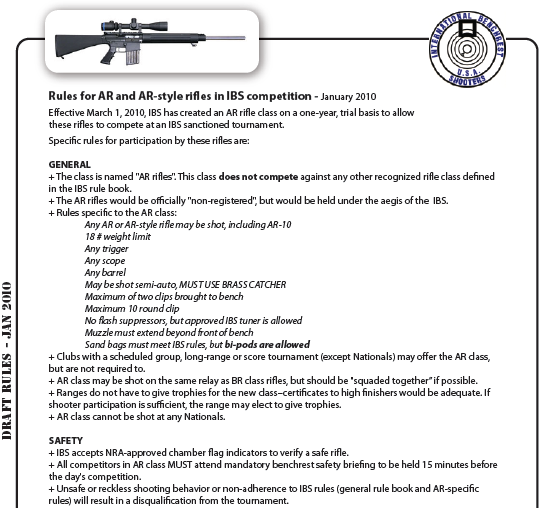
The IBS recently announced that it would allow AR-platform rifles to compete in local IBS benchrest matches in their own class. If you plan to campaign your AR in this new class, you should definitely add a 3″-wide front sled and some kind of rear bag-rider to your gun. Without a flat fore-arm “sled” and rear bag-rider, ARs tend to be very wobbly, and the standard rear stock (with sling loop in place) is terrible in a rear sandbag.

 
Robert Whitley’s AR-X Enterprises has just what you need to improve your AR’s bench behavior. AR-X sells precisely-fitted Delrin bag-riders, crafted expressly for ARs by Evolution Gun Works (EGW). The 3″-wide front bag rider (aka “sled”) features a “twin rail” design and attaches to a tubular fore-arm via a swivel stud. The rear bag-rider mates to the bottom of a standard AR stock and attaches via the rear sling swivel anchor. This provides a smooth, straight surface to ride the bags.
These Delrin EGW bag-rider units were originally designed and prototyped for AccurateShooter.com’s 20 Practical AR project rifle. We tried many different designs, and the final production versions really work — as you can see in the video above. The AR bag-riders cost $40 front and $40 rear, or $75.00 for the set of two. To order, visit 6mmAR.com, or email Robert Whitley: rcw3 [at] erols.com .
January 29th, 2010
 Defying its reputation as a stodgy, conservative organization, the IBS will allow AR-style rifles to compete in their own class at IBS benchrest matches next year. Both AR15-platform and AR10-platform rifles can compete in this new, provisional class. Defying its reputation as a stodgy, conservative organization, the IBS will allow AR-style rifles to compete in their own class at IBS benchrest matches next year. Both AR15-platform and AR10-platform rifles can compete in this new, provisional class.
This will NOT displace any of the current classes (e.g. Sporter, LV, HV, Unlimited), nor change any rules for current classes. The “AR Experiment” will last for one year and then the IBS will determine whether to make the class permanent. IBS President Jeff Stover stressed three points:
1. This is an experiment for a one-year trial.
2. Clubs MAY have an AR class, but they are not required to do so.
3. The IBS Nationals are NOT affected — there will be no ARs at any Nationals
The IBS has distributed proposed draft rules, and the IBS plans to adopt final rules on March 1, 2010. Here are some of the key proposed rules:
January 28th, 2010
The 2010 Winter Olympics are coming up soon, so we asked Uwe Anschütz to show us the Fortner-Action rimfire biathlon rifle that will be used by the vast majority of top competitors. This high-tech 22LR rifle features a straight-pull action that can be cycled nearly as quickly as a semiautomatic. The rifle is designed to be carried on the back while skiing, then quickly deployed at the shooting stages, where competitors engage banks of targets either prone or standing. Note the slots on the forearm for storing up to four extra 5-round magazines.
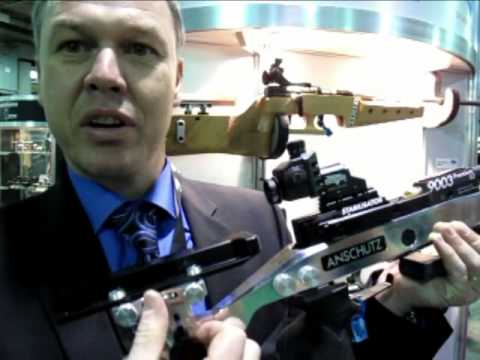

Olympic Medal-Winning Air Rifles on Display
In addition to the Biathlon Rifle, Uwe Anschütz showed us the model 9003 S2 Premium Air Rifle, which features a 9003 S2 action in the Precise aluminum stock. This state-of-the-art airgun earned medals at the 2008 Olympics in China, and it is a favorite of top compeitors worldwide. The model 9002 S2 features a very sophisticated buttstock assembly which with great adjustability. With this metal stock, you can adjust every point at which the rifle contacts the shooter’s body, from shoulder to cheek to hand. Even the angle and fore/aft position of the trigger shoe can be adjusted.

January 27th, 2010
 Chip Lohman, Managing Editor of Shooting Sports USA Magazine, has authored an excellent article on barrel maintenance and cleaning. Chip’s article, Let the BARREL Tell You — Match Barrel Care, Part I, appears in the January 2010 edition of Shooting Sports USA, which is FREE online, in a digital e-zine format. Chip Lohman, Managing Editor of Shooting Sports USA Magazine, has authored an excellent article on barrel maintenance and cleaning. Chip’s article, Let the BARREL Tell You — Match Barrel Care, Part I, appears in the January 2010 edition of Shooting Sports USA, which is FREE online, in a digital e-zine format.
Chip Lohman is a talented writer, an NRA-Certified Instructor, and an active shooter. Like most writers, he maintains a healthy sense of curiosity. The debate about the proper care of a match barrel is a hot one, spiked with folklore and old wives’ tales, Lohman said. He and his staff set out to set the record straight: “We tried to interject some science into the discussion of cleaning a match barrel,” he explained. In his article, Lohman writes:
Why worry about a little barrel fouling when the throat is subjected to a brutal 5,600° F volcano at 55,000 PSI? To investigate these and other questions about taking care of a match barrel, we spoke with a dozen experts and share their knowledge in this first of a series of articles.
After listening to folks who shoot, build barrels or manufacture cleaning solvents for a living, we concluded that even the experts each have their own unique recommendations on how to care for a match barrel. But they all agree on one thing— the gun will tell you what it likes best. Because the life expectancy of a match barrel is about 1,500 to 2,500 rounds, the objectives of cleaning one should include: preserve accuracy, slow the erosion and remove fouling—all without damaging the gun. This article doesn’t claim that one cleaning method is better than the next. Rather, we set out to interject a little science into the discussion and to share some lessons learned from experts in the field.

CLICK HERE to read complete Barrel Care Article in Shooting Sports USA
CLICK HERE to read latest February 2010 Edition of Shooting Sports USA
|


